
Best Pump for Irrigation Farms: How to Choose the Right Pump for Flow, Head, Water Source, and Crop Reliability
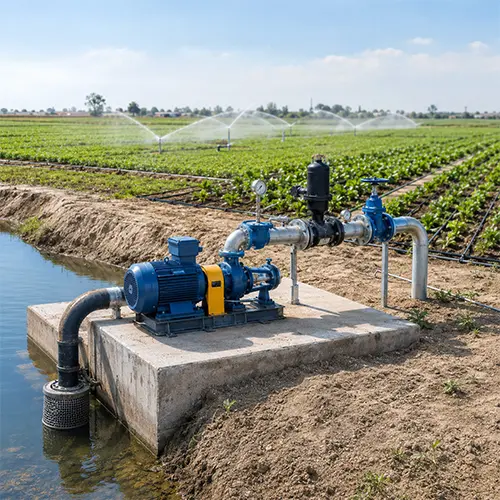
The best pump for irrigation farms is the pump that can deliver the required water volume to the crop at the correct pressure, from the real water source, through the actual pipe network, with acceptable energy cost, water quality protection, seasonal reliability, and maintainable service support. It is not automatically the biggest pump, the cheapest pump, or the pump with the highest horsepower.
For many farms, an end suction centrifugal pump is practical for surface water from ponds, canals, rivers, or reservoirs. A submersible deep well pump is usually required for boreholes or deep wells. A split case pump or mixed flow pump may be better for large-flow, low-to-medium-head irrigation. A multistage pump may be needed for hillside fields, long pipelines, high-pressure sprinklers, or greenhouse irrigation. A diesel engine pump is useful when grid power is unavailable or mobility is required. A solar irrigation pump can work well for off-grid farms when sunlight, daily irrigation schedule, and storage planning match the water demand.
For farmers, irrigation contractors, agricultural project buyers, dealers, and farm managers, the real question is not: “What is the best irrigation pump?” The better question is: “Which pump can deliver the required water volume to my crop at the correct pressure, from my actual water source, through my real pipe network, within my power, water quality, maintenance, and seasonal operating conditions?”
This distinction matters because irrigation pump selection is highly site-specific. A pump that works well beside a pond may fail in a deep well. A pump that delivers enough water for flood irrigation may not provide stable pressure for drip irrigation. A diesel pump may be practical for remote seasonal irrigation but expensive for daily fixed operation. A solar pump may reduce fuel cost but may not support high-head, high-flow, night-time irrigation unless a storage tank or battery system is designed properly.
Select the irrigation pump by water source first, irrigation method second, total dynamic head third, and lifecycle reliability before choosing the supplier.
Direct Answer: What Is the Best Pump for Irrigation Farms?
For most irrigation farms using surface water from ponds, canals, rivers, or reservoirs, an end suction centrifugal pump is often a practical first choice because it is simple, efficient, available, and easy to maintain. For large-flow surface irrigation, a split case pump or mixed flow pump may be more suitable. For farms using wells or boreholes, a submersible deep well pump is usually required because surface pumps cannot overcome deep suction conditions. For drip irrigation and sprinkler systems, the pump must provide stable pressure, so filtration and pressure control are just as important as pump capacity. For remote farms without reliable electricity, diesel engine pumps or solar irrigation pumps may be better options depending on operating hours, fuel cost, sunlight, mobility, and water demand.
The best pump for irrigation farms depends on:
- water source;
- required flow rate;
- total dynamic head;
- irrigation method;
- field size;
- crop water demand;
- pipe length and diameter;
- elevation difference;
- suction lift;
- water quality;
- filtration requirement;
- power availability;
- operating hours;
- maintenance capacity;
- spare parts availability;
- lifecycle cost.
A good farm irrigation pump should deliver the right amount of water to the crop at the right pressure without cavitation, clogging, excessive energy use, pressure instability, or frequent downtime during peak irrigation season.
Surface water farms often use end suction centrifugal pumps. Large-flow canal-fed farms may use split case or mixed flow pumps. Deep well farms usually need submersible deep well pumps. Hilly farms, long pipelines, or high-pressure sprinklers may need multistage pumps. Remote farms may use diesel engine pumps, while off-grid daytime irrigation may use solar pumps with storage planning.
Quick Selection Table for Irrigation Farm Pumps
This table helps farmers and procurement teams quickly identify the first pump direction to evaluate. Final pump selection still requires flow calculation, total dynamic head calculation, pump curve review, water quality assessment, and site installation checks.
| Farm Irrigation Condition | Recommended Pump Type | Why |
|---|---|---|
| Surface water from pond, canal, or river | End suction centrifugal pump | Simple, efficient, easy to maintain |
| Large-flow surface irrigation | Split case pump or mixed flow pump | Handles high flow with lower to medium head |
| Deep well or borehole water | Submersible deep well pump | Works below water level, avoids surface suction limitation |
| High-head irrigation to hillsides | Multistage pump | Provides higher pressure and head |
| Drip irrigation | Centrifugal pump + filtration + pressure control | Stable pressure protects emitters |
| Sprinkler irrigation | Centrifugal or multistage pump | Requires stable pressure and flow |
| Center pivot irrigation | High-flow pump with stable pressure | Supports long-distance distribution |
| Remote farm without grid power | Diesel engine pump | Independent power and flexible use |
| Off-grid low-to-medium demand | Solar irrigation pump | Lower fuel cost, suitable for daylight operation |
| Sandy or dirty water | Pump with proper filtration / abrasion-resistant design | Reduces clogging and wear |
| Seasonal emergency irrigation | Trailer diesel pump | Portable and fast deployment |
| Greenhouse irrigation | Booster pump or multistage pump | Stable pressure for controlled irrigation |
The table shows the core principle: irrigation pump selection starts with the real farm condition, not the pump catalog.
Key Takeaway for Farmers and Buyers
The best pump for an irrigation farm should be selected by water source first, irrigation method second, and hydraulic requirement third. A river intake pump, a borehole pump, a drip irrigation booster pump, and a diesel emergency irrigation pump solve different problems. They should not be selected with the same logic.
Farmers should not buy an irrigation pump only by horsepower, pipe size, or price. Horsepower tells how much power the motor or engine can provide, but it does not prove whether the pump can deliver the required flow at the required head. Two pumps with the same horsepower can produce very different flow and pressure depending on pump design, impeller size, speed, efficiency, suction condition, and operating point.
A correct irrigation pump selection process should confirm:
- Water source: pond, canal, river, reservoir, storage tank, shallow well, deep well, or borehole.
- Irrigation method: drip, sprinkler, center pivot, flood, greenhouse, or mixed system.
- Required crop water volume.
- Available irrigation time per day.
- Required flow rate.
- Total dynamic head.
- Suction lift and water level variation.
- Pipe length, pipe diameter, valves, and fittings.
- Filter loss and emitter or sprinkler pressure requirement.
- Water quality: sand, silt, algae, debris, salinity, fertilizer, or chemicals.
- Power source: electric, diesel, solar, or PTO.
- Operating hours and seasonal reliability.
- Maintenance access and local spare parts.
- Supplier proof: pump curve, duty point, material, seal type, motor or engine data, warranty, and installation guidance.
30-Second Irrigation Pump Decision Table
This decision table helps farmers, irrigation contractors, and dealers quickly diagnose which pump direction to check first. It is especially useful when the existing pump has low flow, weak sprinklers, unstable pressure, priming problems, cavitation noise, or high fuel cost.
| If Your Farm Has... | Check First | Likely Pump Direction |
|---|---|---|
| Pond, canal, or river water | Suction lift and flow demand | End suction centrifugal pump |
| Deep well water | Well depth and bore diameter | Submersible deep well pump |
| Large acreage irrigation | Required flow rate | Split case or large centrifugal pump |
| Hillside fields | Elevation difference | Multistage high-head pump |
| Drip irrigation | Required pressure and filtration | Pump + filter + pressure regulator |
| Sprinkler irrigation | Operating pressure | Centrifugal or multistage pump |
| No reliable electricity | Fuel access and mobility | Diesel engine pump |
| High fuel cost | Sunlight and daily irrigation schedule | Solar pump review |
| Sand in water | Filtration and pump material | Filter system + wear-resistant pump |
| Pressure fluctuation | Control valve and pump curve | Correct sizing / VFD / pressure tank |
| Frequent clogging | Intake screen and filtration | Better filtration and water source review |
| Pump loses prime | Suction line and foot valve | Self-priming or improved suction design |
A farmer should not replace a pump blindly. Weak sprinkler pressure may come from low pump head, but it may also come from clogged filters, undersized pipes, long pipe runs, worn nozzles, high elevation difference, or a pump operating far from its duty point.
Scope of This Guide: Applicable Irrigation Farms and Pump Types
This guide applies to common irrigation farm pump selection where buyers need to move water from a real source to crops through a practical irrigation system. It is written for farmers, farm owners, irrigation contractors, distributors, dealers, agricultural project buyers, and procurement teams.
This guide applies to these farm types:
- vegetable farms;
- fruit orchards;
- grain farms;
- greenhouses;
- tea, coffee, and plantation irrigation;
- smallholder farms;
- large commercial farms;
- pasture irrigation;
- nursery irrigation;
- drip irrigation farms;
- sprinkler irrigation farms;
- center pivot irrigation systems;
- remote off-grid farms.
This guide applies to these water sources:
- pond;
- river;
- canal;
- reservoir;
- lake;
- irrigation ditch;
- storage tank;
- shallow well;
- deep well;
- borehole.
This guide applies to these pump types:
- end suction centrifugal pump;
- split case pump;
- mixed flow pump;
- submersible pump;
- deep well pump;
- multistage pump;
- diesel engine pump;
- solar irrigation pump;
- self-priming pump;
- booster pump;
- PTO pump.
This guide needs separate engineering verification for:
- large municipal irrigation districts;
- high-sediment river pumping stations;
- flood control pumping;
- fertigation systems with aggressive chemicals;
- high-pressure greenhouse fertigation;
- saline water irrigation;
- seawater or brackish water agricultural use;
- mining or agricultural slurry water;
- regulated water abstraction systems;
- projects requiring local water rights, permits, or electrical code compliance.
This article is for irrigation pump selection guidance. Final selection for large pumping stations, high-sediment water, saline irrigation, chemical fertigation, regulated water abstraction, or critical agricultural projects should be verified by qualified engineers using actual water source data, lowest seasonal water level, field layout, crop water demand, irrigation equipment pressure, pump curves, and local regulations.
Irrigation Pump System Architecture: Where the Pump Fits in the Farm Water Network
A farm irrigation pump should be selected as part of the whole agricultural water delivery system, not as an isolated product. The pump must work with the intake, mainline, filters, valves, pressure regulators, field zones, and irrigation devices.
A typical irrigation system flow path may look like this:
Water Source → Intake Screen / Foot Valve → Pump → Mainline → Filter → Control Valve → Fertigation Unit → Pressure Regulator → Field Zones → Drip Emitters / Sprinklers / Pivot System
| System Stage | Component | Why It Matters |
|---|---|---|
| Water source | Pond, river, canal, well, reservoir, tank | Determines surface pump vs submersible pump |
| Intake | Screen, foot valve, floating intake, suction pipe | Prevents debris, air entry, and suction failure |
| Pump | Centrifugal, deep well, diesel, solar, multistage | Provides required flow and head |
| Mainline | Pipe network | Creates friction loss that affects pump head |
| Filtration | Screen, disc, sand filter | Protects drip emitters, sprinklers, and valves |
| Control | Valve, VFD, pressure regulator, pressure tank | Stabilizes pressure and protects irrigation devices |
| Fertigation | Fertilizer injection system | Requires chemical compatibility and stable pressure |
| Field delivery | Drip, sprinkler, pivot, flood channel | Determines final flow and pressure requirement |
This system view is important because many pump problems are not caused by the pump alone. A correct pump can still fail if the intake is blocked, the suction line leaks air, the mainline is too small, the filter is clogged, or the irrigation zones are not matched to the pump curve.
Irrigation Pump Type Definitions
Irrigation pump selection becomes easier when buyers clearly define each pump type by function. This table helps farmers, dealers, and procurement teams communicate with suppliers more accurately.
| Pump Type | Practical Definition | Best Used For | Main Risk If Misused |
|---|---|---|---|
| End suction centrifugal pump | Surface pump for clean to moderately clean water | Pond, canal, river, reservoir irrigation | Loses performance if suction condition is poor |
| Split case pump | Large-flow centrifugal pump with serviceable casing design | Large farms, pivot systems, fixed pump stations | Too large and costly for small farms |
| Mixed flow pump | High-flow, low-to-medium-head pump | Flood irrigation, canal pumping, rice fields | Not suitable for high-pressure sprinklers |
| Submersible deep well pump | Pump installed below water level in a well or borehole | Deep wells, groundwater irrigation | Can fail if well yield, sand, or dry-run protection is ignored |
| Multistage pump | Pump with multiple impellers for higher pressure | Hillside, long-distance, sprinkler, greenhouse irrigation | Not suitable for dirty water without filtration |
| Diesel engine pump | Pump driven by diesel engine | Remote, mobile, emergency, seasonal irrigation | Fuel cost, noise, emissions, engine maintenance |
| Solar irrigation pump | Pump powered by solar array and controller | Off-grid daylight irrigation, tank filling | Weather dependency and flow limitation |
| Self-priming pump | Surface pump designed to re-prime after air enters the suction line under certain conditions | Mobile surface water intake, temporary pumping | Does not mean unlimited suction lift |
| Booster pump | Pump used to increase pressure in a pipeline or zone | Greenhouses, drip/sprinkler zones, storage tank systems | May not provide enough flow for whole-farm irrigation |
| PTO pump | Pump driven by tractor power take-off | Seasonal, mobile, emergency pumping | Requires tractor availability and operator control |
This definition table prevents vague procurement requests such as “quote one farm pump” when the buyer actually needs a pump matched to water source, field pressure, irrigation method, and power availability.
Main Pump Types Used for Irrigation Farms
Irrigation farms use different pump types because water sources, field layouts, irrigation methods, and power conditions vary widely. Understanding each pump type helps buyers avoid forcing one pump into the wrong duty.
End Suction Centrifugal Pump
An end suction centrifugal pump is one of the most common choices for surface water irrigation because it is simple, widely available, efficient for clean to moderately clean water, and easy to maintain. It is often installed near ponds, canals, rivers, reservoirs, or storage tanks.
End suction centrifugal pumps are suitable for:
- pond irrigation;
- canal irrigation;
- river intake;
- reservoir water transfer;
- moderate flow and head;
- flood irrigation;
- sprinkler systems with moderate pressure;
- fixed pump stations;
- general farm water transfer.
They are not suitable for:
- deep wells;
- very high head if single-stage design is insufficient;
- heavy sand without filtration;
- long suction lift beyond pump limit;
- dirty water with large debris;
- applications where priming cannot be maintained.
For many farms, an end suction pump is a cost-effective first option. However, suction conditions must be checked carefully. If the water level drops during the dry season, the suction lift may increase and the pump may lose performance or cavitate.
Split Case Pump
A split case pump is often used for large-flow irrigation systems where efficiency, continuous operation, and serviceability matter. It is common in larger pumping stations, center pivot supply, canal-fed systems, and large commercial farms.
Split case pumps are suitable for:
- large farms;
- high-flow irrigation stations;
- center pivot supply;
- low-to-medium head large water volume;
- long operating hours;
- fixed pumping stations;
- large pipe networks.
They are not suitable for:
- small farms with low flow demand;
- deep wells;
- dirty water without intake protection;
- tight pump rooms;
- highly mobile seasonal use.
The main advantage of a split case pump is efficient large-flow operation. The main limitation is installation space, foundation, alignment, and initial system cost.
Mixed Flow Pump
A mixed flow pump can move large volumes of water at low to medium head, making it useful for canals, flood irrigation, rice fields, and drainage-irrigation transfer. It sits between centrifugal and axial flow pump behavior, providing higher flow than many standard centrifugal pumps while still generating useful head.
Mixed flow pumps are suitable for:
- large-flow low-head irrigation;
- canal pumping;
- flood irrigation;
- rice fields;
- drainage and irrigation transfer;
- low-lift water movement;
- large seasonal water transfer.
They are not suitable for:
- high-pressure sprinklers;
- deep wells;
- high-head hillside irrigation;
- small drip systems requiring precise pressure;
- systems with heavy debris unless protected.
A mixed flow pump is practical when the farm needs volume more than pressure. For example, flood irrigation often needs high water volume but not high pressure at emitters or nozzles.
Submersible Deep Well Pump
A submersible deep well pump is installed below water level and is used when irrigation water comes from deep wells or boreholes. It avoids the suction limitation of surface pumps because it pushes water upward from inside the well.
Submersible deep well pumps are suitable for:
- deep wells;
- boreholes;
- groundwater irrigation;
- limited surface space;
- farms where water level is below surface pump suction capability;
- stable below-water installation;
- remote water supply from wells.
They are not suitable for:
- surface pond pumping where a surface pump is easier to maintain;
- dirty water with heavy sand unless designed for sand tolerance;
- wells with insufficient yield;
- installations where cable protection and dry-run protection are ignored.
Deep well pump selection must consider static water level, dynamic water level, bore diameter, pump setting depth, well yield, sand content, cable length, control box, and dry-run protection. A pump that delivers more water than the well can supply may cause dry running and early failure.
Multistage Pump
A multistage pump uses multiple impellers to generate higher pressure, making it useful for high-head irrigation, hillside farms, long-distance pipeline irrigation, and pressure-demanding sprinkler or greenhouse systems. It is not the best choice for dirty water or low-head large-flow flood irrigation.
Multistage pumps are suitable for:
- hillside irrigation;
- long-distance pipeline irrigation;
- high-pressure sprinkler systems;
- greenhouse irrigation;
- booster stations;
- drip systems requiring controlled pressure;
- irrigation zones with high elevation difference.
They are not suitable for:
- dirty water;
- high solids;
- low-head high-flow flood irrigation;
- unfiltered surface water with debris;
- heavy sand conditions without proper protection.
The main advantage is pressure. The main risk is using it in dirty water or oversizing pressure. For drip irrigation, excessive pressure can damage emitters, connectors, and pipe networks if pressure regulation is not included.
Diesel Engine Pump
A diesel engine pump is useful where electricity is unavailable, unreliable, or where the pump must be moved between fields or water sources. It is common for remote farms, seasonal irrigation, emergency pumping, and mobile river or pond intake.
Diesel engine pumps are suitable for:
- remote farms;
- emergency irrigation;
- seasonal pumping;
- mobile irrigation;
- river or pond intake;
- areas with unstable grid power;
- high-flow temporary pumping;
- farms needing portable water transfer.
They are not suitable for:
- indoor poor-ventilation areas;
- sites with strict noise or emissions restrictions;
- farms where fuel logistics are difficult;
- fully automated low-maintenance irrigation;
- users who cannot maintain engines.
Diesel pumps offer independence, but they bring fuel cost, engine maintenance, noise, emissions, oil changes, filters, and starting reliability issues. The buyer should compare not only pump price, but also seasonal fuel cost and maintenance capability.
Solar Irrigation Pump
A solar irrigation pump can reduce fuel cost and support off-grid irrigation when sunlight, daily water demand, and storage planning match the farm’s needs. It is especially useful for small to medium farms that can irrigate during daylight or fill a storage tank for later use.
Solar irrigation pumps are suitable for:
- off-grid farms;
- low-to-medium flow irrigation;
- daytime irrigation;
- remote small farms;
- storage tank filling;
- farms with high fuel cost;
- areas with good solar resources.
They are not suitable for:
- large continuous night irrigation unless storage or battery is planned;
- high-head large-flow systems without a large solar array;
- areas with unstable sunlight unless backup is included;
- farms requiring guaranteed flow at all times without storage.
Solar pump selection must include the pump, controller, solar panel array, cable, protection, storage tank, and daily irrigation schedule. A solar pump should not be selected only by pump capacity without checking solar energy availability.
Self-Priming Pump
A self-priming pump is useful when the pump is installed above the water source and the suction line may contain air. It is commonly used for surface water intake, mobile irrigation, temporary pumping, and applications where priming is difficult.
Self-priming pumps are suitable for:
- surface water intake;
- mobile irrigation;
- temporary pumping;
- suction lift applications;
- farms where pump must start after suction line disturbance;
- seasonal water transfer.
They are not suitable for:
- deep wells;
- very high suction lift beyond pump limit;
- heavy solids unless designed as a trash pump;
- systems where suction pipe design is poor.
Self-priming does not mean unlimited suction. Suction pipe diameter, foot valve, air leaks, water level, and pump placement still matter.
Best Pump by Irrigation Water Source
The water source is usually the first decision point in irrigation pump selection. A pump for a pond, river, canal, deep well, or storage tank may require a different design, installation method, and protection strategy.
Best Pump for Pond Irrigation
For pond irrigation, an end suction centrifugal pump is often a practical choice when the pump can be installed close to the water and suction conditions are stable. If the pump is above water level and priming is difficult, a self-priming pump may be considered. For remote ponds without electricity, a diesel pump may be more practical.
Pond irrigation pump selection should consider:
- suction lift;
- water level change during dry season;
- foot valve condition;
- intake screen;
- algae;
- leaves and debris;
- sediment at the bottom;
- priming requirement;
- pipe length to the field;
- required irrigation pressure.
A common mistake is placing the intake too close to the pond bottom. This can pull mud, silt, algae, and organic matter into the pump, causing clogging, impeller wear, filter blockage, or drip emitter problems. A floating intake or raised intake screen can reduce this risk.
Best Pump for River or Canal Irrigation
For river or canal irrigation, an end suction centrifugal pump is often suitable for moderate flow, while mixed flow or split case pumps may be better for large-flow irrigation. River and canal water may have fluctuating levels, sand, debris, leaves, seasonal turbidity, and flood-related water quality changes.
River and canal pump selection should consider:
- water level variation;
- suction line length;
- floating intake design;
- debris screen;
- sand content;
- seasonal silt load;
- suction lift;
- pump foundation;
- flood season protection;
- access for maintenance.
For mobile river irrigation, a trailer diesel pump may be useful. For fixed canal-fed farms with high water volume, a split case or mixed flow pump may reduce lifecycle energy cost. Where sand is common, intake protection and filtration should be treated as part of the pump system, not an optional accessory.
Best Pump for Deep Well Irrigation
For deep well irrigation, a submersible deep well pump is usually required because surface pumps have suction lift limits. A surface pump cannot pull water from a deep borehole simply by increasing horsepower. The pump must be placed below water level and push water upward.
Deep well pump selection should consider:
- static water level;
- dynamic water level;
- bore diameter;
- pump setting depth;
- well yield;
- required flow;
- required head;
- sand content;
- cable length;
- voltage stability;
- dry-run protection;
- control box quality.
Static water level is the water level when the pump is not running. Dynamic water level is the water level during pumping. The pump must be selected based on dynamic water level, not only static level. If the well cannot supply enough water, an oversized pump may run dry and fail.
Best Pump for Reservoir or Storage Tank Irrigation
For reservoirs or storage tanks, pump selection is usually more stable because the intake condition can be controlled better than a river or deep well. However, liquid level, pipe losses, and irrigation pressure still need to be calculated.
Recommended pump directions include:
- end suction pump for general transfer;
- booster pump for pressure increase;
- multistage pump if high pressure is needed;
- solar pump if filling or irrigation happens during daylight;
- electric pump for fixed automated systems.
The key advantage is stable water availability. The key risk is underestimating pipe friction, field elevation, filter loss, and irrigation device pressure.
Best Pump for Wastewater or Reuse Water Irrigation
For reuse water irrigation, the pump must be selected by water quality, filtration level, corrosion risk, clogging risk, and sanitation requirements. Reuse water may contain suspended solids, organic matter, chemicals, fertilizer residue, or corrosive components.
Selection should consider:
- filtration before drip or sprinkler systems;
- corrosion-resistant materials if needed;
- clog-resistant design if water contains solids;
- chemical compatibility;
- local agricultural water regulations;
- odor and hygiene control;
- maintenance access.
A standard clean-water irrigation pump may fail quickly if reuse water contains solids or aggressive chemicals. For drip irrigation, filtration becomes essential because emitters can clog easily.
Best Pump by Water Source: Fast Reference Table
This table helps buyers quickly match the farm water source to a first pump direction. Final selection still requires flow, total dynamic head, suction condition, water quality, power source, and pump curve verification.
| Water Source | Best Pump Direction | Main Selection Risk |
|---|---|---|
| Pond | End suction pump / self-priming pump | Sediment, algae, suction lift, seasonal water level |
| River | End suction / mixed flow / diesel trailer pump | Sand, debris, water level fluctuation |
| Canal | End suction / split case / mixed flow pump | Large flow, debris, intake protection |
| Reservoir | End suction / booster / multistage pump | Pipe friction and field pressure may be underestimated |
| Storage tank | Booster / end suction / multistage pump | Low tank level and pressure fluctuation |
| Shallow well | Surface pump or shallow well pump if suction condition allows | Suction lift limitation |
| Deep well / borehole | Submersible deep well pump | Dynamic water level, well yield, sand, dry running |
| Reuse water | Pump selected by filtration and corrosion risk | Clogging, corrosion, hygiene, emitter blockage |
This table prevents a common buyer mistake: selecting by pump price before confirming whether the pump can physically access the water source.
Best Pump by Irrigation Method
Different irrigation methods require different combinations of flow, pressure, filtration, and control. The pump should be matched to how water is delivered to the crop, not only where the water comes from.
Best Pump for Drip Irrigation
For drip irrigation, the best pump is usually a centrifugal or multistage pump combined with proper filtration and pressure regulation. Drip systems need stable low-to-moderate pressure and clean water because emitters can clog easily.
Drip irrigation pump selection should consider:
- emitter operating pressure;
- zone flow rate;
- filtration requirement;
- pressure regulator;
- fertigation compatibility;
- pipe friction loss;
- elevation difference;
- pressure uniformity;
- overpressure protection;
- flushing requirement.
A pump alone does not make a good drip irrigation system. Filters, pressure regulators, control valves, and flushing design are critical. If pressure is too low, some emitters may not deliver enough water. If pressure is too high, emitters, connectors, and drip lines may be damaged.
Best Pump for Sprinkler Irrigation
For sprinkler irrigation, the pump usually needs higher pressure than drip irrigation because sprinkler nozzles require enough pressure to create a proper spray pattern. End suction centrifugal pumps are common for moderate-pressure systems, while multistage pumps may be needed for higher pressure or long-distance distribution.
Sprinkler pump selection should consider:
- sprinkler operating pressure;
- nozzle flow;
- number of sprinklers running at one time;
- pipe friction loss;
- elevation difference;
- filter loss;
- wind impact;
- distribution uniformity;
- pressure at the last sprinkler.
Weak sprinklers often indicate insufficient pressure at the nozzle, but the cause may be pump selection, clogged filters, pipe size, long mainlines, elevation, or too many sprinklers operating at once.
Best Pump for Center Pivot Irrigation
For center pivot irrigation, the pump must provide stable flow and pressure over long operating hours. These systems often cover large areas and require reliable water delivery to maintain uniform crop irrigation.
Recommended pump directions include:
- high-flow centrifugal pump;
- split case pump for large systems;
- diesel or electric drive depending on site;
- VFD or pressure control if operating conditions vary.
Center pivot pump selection should consider:
- total pivot flow demand;
- pressure required at pivot point;
- mainline length;
- elevation change;
- water source reliability;
- filtration;
- operating hours;
- energy cost;
- pump efficiency at duty point.
Because center pivot systems may operate for long periods, pump efficiency has a major impact on seasonal cost.
Best Pump for Flood Irrigation
For flood irrigation, the pump usually needs high flow but relatively lower pressure compared with sprinkler or high-pressure drip systems. The goal is to move large volumes of water into canals, basins, or field channels.
Recommended pump directions include:
- mixed flow pump;
- end suction centrifugal pump;
- diesel pump for seasonal water transfer;
- split case pump for larger fixed stations.
Flood irrigation pump selection should consider:
- required water volume;
- available irrigation time;
- low-to-medium head;
- canal or field distribution;
- sediment;
- fuel or electricity cost;
- ease of maintenance.
A high-pressure multistage pump is usually not the best option for flood irrigation because the system needs volume more than pressure.
Best Pump for Greenhouse Irrigation
For greenhouse irrigation, the pump must provide stable pressure, clean water, automation compatibility, and chemical compatibility when fertigation is used. Greenhouse systems are often more sensitive to pressure fluctuation because they may use drip lines, misters, foggers, or precise fertigation systems.
Recommended pump directions include:
- booster pump;
- multistage pump;
- small centrifugal pump with pressure control;
- VFD-controlled pump when multiple zones operate differently.
Greenhouse pump selection should consider:
- pressure stability;
- fertigation;
- filtration;
- automation;
- low noise;
- chemical compatibility;
- zone control;
- emitter uniformity;
- maintenance access.
A greenhouse pump should not only deliver water. It must support crop consistency and controlled irrigation.
Irrigation Method Pressure and Flow Direction Table
Different irrigation methods place different demands on the pump. This table gives buyers a practical direction before detailed flow and head calculation.
| Irrigation Method | Flow Direction | Pressure Direction | Main Pump Risk |
|---|---|---|---|
| Drip irrigation | Low to medium | Low to moderate, stable | Clogging, overpressure, poor zone balance |
| Sprinkler irrigation | Medium | Moderate to high | Weak spray pattern if pressure is too low |
| Center pivot | High | Stable medium pressure | High energy cost and long pipe loss |
| Flood irrigation | High | Low | Overspending on high-pressure pump |
| Greenhouse fertigation | Low to medium | Stable controlled pressure | Chemical compatibility and pressure fluctuation |
| Orchard irrigation | Medium, often zoned | Stable low-to-medium pressure | Uneven watering if zones are poorly balanced |
| Hilly farm irrigation | Depends on zones | Higher head due to elevation | Underestimating elevation difference |
| Nursery irrigation | Low to medium | Stable pressure | Nozzle clogging and uneven distribution |
This table helps explain why no single “best pump” exists. The best pump for flood irrigation may be a poor choice for greenhouse fertigation, and the best pump for deep well orchard irrigation may be unnecessary for a flat canal-fed farm.
Irrigation Zones and Pipe Network: Why Pump Size Changes
Irrigation pump size changes when the farm is divided into zones, when pipe length increases, when pipe diameter is too small, or when field elevation changes. Many farms do not need to irrigate the entire area at the same time, but zone design must be matched to the pump curve.
How Irrigation Zones Affect Flow Requirement
Zone irrigation can reduce the required pump flow because only part of the farm operates at one time. For example, a farm may need 120 m³ of water per day, but it may irrigate in six zones instead of one large zone. This can lower the required flow per operating period, but it increases total irrigation time.
The buyer should decide:
- how many zones will operate at the same time;
- required flow per zone;
- irrigation time per zone;
- total daily irrigation window;
- pressure required at the farthest zone;
- whether valves are manual or automatic.
If a supplier sizes the pump for the whole farm while the farm operates by zones, the pump may be oversized. If the supplier sizes the pump for one zone but the farmer later runs several zones together, the system may suffer low pressure and weak irrigation.
How Pipe Diameter Affects Pump Selection
Pipe diameter has a direct effect on friction loss. If the pipe is too small, water velocity rises and friction loss increases. The pump may appear large enough, but much of its pressure is wasted overcoming pipe resistance.
A common field problem is: The pump is not too small, but the pipe network is too restrictive.
This can happen when:
- mainline diameter is too small;
- pipe runs are very long;
- too many elbows and valves are installed;
- old pipes are rough or partially blocked;
- flow velocity is too high;
- filters are dirty.
In some farms, increasing pipe diameter or improving pipe layout may solve the problem better than buying a larger pump.
How Seasonal Water Level Changes Affect Pump Performance
Seasonal water level change can make a pump that works in wet season fail during dry season. When pond, river, canal, or well water level drops, suction lift or pumping lift increases. This changes the actual duty point.
Buyers should check the lowest expected water level, not only the normal water level. For wells, dynamic water level during pumping is more important than static water level. For surface pumps, falling water level can cause priming problems, cavitation, and reduced flow. For deep well pumps, falling dynamic water level can cause dry running if protection is not included.
How to Calculate Irrigation Pump Requirements
Irrigation pump requirements should be calculated from crop water volume, irrigation time, total dynamic head, suction conditions, pipe losses, water quality, and equipment pressure requirements. Buying by horsepower alone often leads to underperformance, high energy cost, or poor irrigation uniformity.
Step 1: Calculate Required Flow Rate
Required flow rate depends on total water volume and available irrigation time. If the farm needs to finish irrigation within a shorter time window, the pump must deliver higher flow.
A simple formula is:
Required Flow = Total Water Volume Needed ÷ Available Irrigation Time
For example, if a farm needs 120 m³ of water per day and wants to finish irrigation in 6 hours:
120 ÷ 6 = 20 m³/h
This means the pump must be evaluated around 20 m³/h before head, pipe loss, and pressure requirements are checked.
Several factors affect required flow:
- farm area;
- crop type;
- growth stage;
- climate;
- soil type;
- irrigation method;
- daily irrigation window;
- number of irrigation zones.
Zone irrigation can reduce pump size. For example, instead of irrigating the whole farm at once, the farmer may divide the field into zones and run one zone at a time. This lowers the required flow but increases total irrigation time.
Step 2: Calculate Total Dynamic Head
Total Dynamic Head, or TDH, is the total pressure the pump must overcome to move water from the source to the crop. It is one of the most important factors in irrigation pump selection.
A practical formula is:
TDH = Static Lift + Elevation Difference + Pipe Friction Loss + Filter Loss + Valve/Fitting Loss + Required Operating Pressure
Each part matters:
- Static lift is the vertical distance from the water surface to the pump centerline or discharge reference point.
- Elevation difference is the height difference between the pump and the field or highest irrigation point.
- Pipe friction loss depends on pipe length, diameter, flow velocity, and pipe condition.
- Filter loss increases when filters become dirty.
- Valve and fitting loss comes from elbows, valves, reducers, tees, and connectors.
- Required operating pressure is the pressure needed by drip emitters, sprinklers, pivot systems, or greenhouse irrigation devices.
A pump selected only by vertical height may be too small because pipe friction, filter loss, and sprinkler pressure may be ignored. A pump selected with too much safety margin may waste energy and damage drip systems through overpressure.
If the farm problem is unclear, this high head pump vs high flow pump guide can help buyers distinguish whether the irrigation system needs more pressure, more flow, or better pipe design.
Step 3: Check Suction Conditions
Suction conditions determine whether a surface pump can pull water reliably from the source. Many irrigation pump failures come from suction problems, not discharge problems.
Buyers should check:
- suction lift;
- water level during dry season;
- suction pipe diameter;
- suction pipe length;
- foot valve;
- air leaks;
- priming condition;
- intake screen;
- NPSH;
- cavitation risk.
NPSH means Net Positive Suction Head. In practical terms, it relates to whether the pump has enough inlet pressure to avoid cavitation. If suction lift is too high, pipe is too small, foot valve is blocked, or air leaks exist, the pump may lose prime, make noise, vibrate, or deliver low flow.
Surface pumps cannot solve deep well conditions by using more horsepower. If the water level is too deep, a submersible deep well pump is usually required.
Step 4: Match Pump Curve and Duty Point
The selected pump should operate near the required flow and head, not at the far edge of the pump curve. The duty point is where the required flow and required head meet on the pump curve.
Farmers and buyers should ask suppliers to show:
- pump curve;
- duty point;
- efficiency at duty point;
- motor or engine power;
- suction requirements;
- operating range;
- impeller size;
- fuel or electricity consumption;
- recommended pipe size.
A pump may have a high maximum flow, but that does not mean it can deliver that flow at the required head. A pump may also have a high maximum head, but that does not mean it can deliver enough flow at that head. The duty point is more important than catalog maximum numbers.
Step 5: Confirm Water Quality and Filtration
Water quality affects pump wear, clogging, irrigation uniformity, and maintenance frequency. Irrigation water may contain sand, silt, algae, leaves, organic matter, fertilizer, salts, or chemicals.
Buyers should check:
- sand content;
- silt;
- algae;
- leaves and debris;
- organic matter;
- salinity;
- fertilizer exposure;
- chemical exposure;
- intake screen requirement;
- sand filter;
- disc filter;
- screen filter;
- drip emitter clogging risk;
- pump material and impeller wear.
For drip irrigation, filtration is not optional. Even if the pump works, poor filtration can clog emitters and cause uneven crop irrigation.
Power Options for Irrigation Pumps
Power availability is a major pump selection factor for farms because irrigation often happens in remote or seasonal conditions. Electric, diesel, solar, and PTO pumps each have different cost, maintenance, and reliability implications.
Electric Irrigation Pump
An electric irrigation pump is usually best for fixed farms with stable grid power because it can support automation, lower operating cost, and easier daily operation. It is common in permanent pump stations, greenhouse irrigation, fixed drip systems, and farm storage tank systems.
Electric pumps are suitable for:
- stable grid power;
- fixed pump station;
- automated irrigation;
- lower operating cost;
- long-term daily irrigation;
- pressure-controlled systems.
Risks include:
- grid failure during irrigation season;
- voltage instability;
- electrical installation cost;
- cable sizing problems;
- limited mobility.
If power supply is unstable, motor protection, voltage monitoring, and backup planning should be considered.
Diesel Engine Irrigation Pump
A diesel engine irrigation pump is better for remote or mobile irrigation where electricity is unavailable or unreliable. It is also useful for emergency irrigation and seasonal water transfer.
Diesel pumps are suitable for:
- remote farms;
- emergency pumping;
- mobile irrigation;
- high-flow seasonal irrigation;
- river or pond intake;
- farms with no grid power.
Risks include:
- fuel cost;
- noise;
- emissions;
- engine maintenance;
- starting problems;
- oil and filter replacement;
- fuel storage and transport.
Diesel pumps should be selected with both hydraulic performance and engine performance in mind. A low-cost diesel pump may become expensive if fuel consumption is high or spare parts are difficult to obtain.
Solar Irrigation Pump
A solar irrigation pump can be a good choice for off-grid farms when irrigation can happen during daylight or when a storage tank is included. It reduces fuel dependency and may lower long-term operating cost.
Solar pumps are suitable for:
- off-grid farms;
- daytime pumping;
- storage tank filling;
- low-to-medium flow;
- remote small farms;
- farms with strong sunlight;
- areas with high fuel cost.
Risks include:
- weather dependency;
- higher initial cost;
- lower flow during cloudy conditions;
- need for storage tank or battery if night irrigation is required;
- limited high-head large-flow capacity unless the solar system is large.
A solar pump should be selected as a system: pump, controller, panels, cables, protection, tank, and operating schedule.
PTO Pump
A PTO pump is driven by a tractor power take-off and can be useful for seasonal or mobile irrigation where the farm already has suitable tractors. It is often used for temporary pumping, water transfer, or emergency irrigation.
PTO pumps are suitable for:
- farms with tractors;
- seasonal irrigation;
- emergency pumping;
- mobile water transfer;
- temporary pumping.
Risks include:
- tractor availability;
- fuel use;
- safety;
- lower automation;
- operator dependence;
- wear on tractor hours.
PTO pumps can be practical, but they are not always the best choice for daily automated irrigation.
Irrigation Pump Materials and Water Quality
Water quality affects pump life, impeller wear, clogging, corrosion, filtration, and irrigation uniformity. A pump that works well in clean pond water may fail quickly in sandy river water or chemically aggressive fertigation water.
Clean Water
For relatively clean water from a pond, tank, reservoir, or treated source, standard cast iron or stainless steel pump materials may be acceptable depending on corrosion risk and system requirements. Clean water still requires intake protection because leaves, algae, or small debris can enter the pump.
Buyers should confirm:
- water clarity;
- pH;
- salinity;
- fertilizer exposure;
- expected service life;
- pump casing material;
- impeller material;
- seal material.
Sandy Water
Sandy water can wear impellers, casing surfaces, wear rings, and seals. This is common in some wells, rivers, canals, and shallow sources with sediment.
Sandy water requires attention to:
- intake position;
- sediment settling;
- sand separator;
- filtration;
- wear-resistant material;
- pump speed;
- maintenance interval;
- deep well sand content.
For deep wells, sand content can damage submersible pump stages and reduce efficiency. If sand is present, buyers should discuss sand tolerance with the supplier before purchase.
Muddy or Debris Water
Muddy water or debris-filled water can clog ordinary clean-water pumps and damage irrigation equipment. Large debris should be stopped before it enters the pump.
Buyers should consider:
- intake screen;
- trash rack;
- floating intake;
- settling basin;
- pre-filter;
- pump type suitable for dirty water if needed;
- filter maintenance access.
A standard clean-water centrifugal pump should not be expected to handle large debris without protection.
Fertigation and Chemical Water
Fertigation water contains fertilizer or chemicals that may affect pump materials and seals. Fertigation means applying fertilizer through the irrigation system. It is common in drip irrigation, orchards, greenhouses, and high-value crops.
Fertigation pump selection should check:
- fertilizer concentration;
- acid injection;
- chemical dosing location;
- pump material;
- seal material;
- corrosion risk;
- flushing process;
- compatibility with filters and emitters.
If irrigation water contains chemicals, fertilizer, chloride, or aggressive water, this pump corrosion troubleshooting guide can help buyers check whether pump material matches real water chemistry.
Energy Efficiency and Lifecycle Cost
Irrigation pumps often run for many hours during the irrigation season, so energy or fuel cost can become larger than the pump purchase price. A technically correct pump should deliver the required water with reasonable efficiency and manageable maintenance.
Why Oversizing Wastes Energy
An oversized irrigation pump may look safer at purchase, but it can waste energy, increase pressure, damage irrigation equipment, and raise lifecycle cost. Bigger is not always better.
Oversizing can cause:
- excessive electricity or fuel use;
- throttling loss through valves;
- high pressure in drip lines;
- sprinkler misting or poor distribution;
- pipe stress;
- emitter damage;
- frequent cycling;
- engine or motor inefficiency;
- higher initial cost.
For drip irrigation, overpressure is especially risky because it can damage emitters, connectors, and thin-wall drip lines.
Electric vs Diesel vs Solar Cost
The best power choice depends on grid availability, irrigation schedule, fuel logistics, mobility, and total seasonal cost. The table below helps buyers compare the main trade-offs.
| Power Type | Main Cost | Best For | Main Risk |
|---|---|---|---|
| Electric | Electricity + installation | Fixed farms with grid | Grid reliability |
| Diesel | Fuel + maintenance | Remote/mobile farms | Fuel cost and engine service |
| Solar | Initial system cost | Off-grid daylight pumping | Weather and flow limitation |
| PTO | Tractor fuel/time | Seasonal/mobile use | Tractor availability |
A farm with reliable grid power may save operating cost with an electric pump. A remote farm may need diesel or solar. A farm with high daytime water demand and strong sunlight may benefit from solar plus storage. A seasonal farm with tractors may consider PTO, but automation will be limited.
VFD for Irrigation Pumps
A VFD can help irrigation pumps when flow or pressure demand changes between zones, but it is not required for every farm. VFD means Variable Frequency Drive, a device that changes motor speed to control pump output.
VFD may help when:
- irrigation zones have different flow demand;
- drip and sprinkler zones operate separately;
- pressure needs to remain stable;
- pump is used for multiple fields;
- energy saving under partial load is possible;
- soft start is needed.
Fixed-speed operation may be enough when:
- one stable duty point is used;
- irrigation flow is constant;
- pump is correctly sized;
- the system does not need pressure variation;
- VFD cost is not justified.
For farms comparing speed control and fixed-speed pumping, this VFD pump vs fixed speed pump guide explains when VFD control can reduce energy and when fixed-speed operation may be enough.
If an irrigation pump uses more electricity or fuel than before while delivering less water, this pump efficiency loss guide can help buyers check whether the issue comes from wear, blockage, operating point change, pipe resistance, or system efficiency decline.
Common Irrigation Pump Selection Mistakes
Many irrigation pump problems begin with selection mistakes made before installation. These mistakes can cause weak irrigation, high fuel cost, clogging, cavitation, motor overload, pipe damage, and crop stress during the irrigation season.
Mistake 1: Choosing by Horsepower Only
The same horsepower does not mean the same flow and head. A 10 hp pump can perform very differently depending on pump design, impeller size, speed, and efficiency.
Farmers should compare pump curves, duty point, flow, head, and efficiency instead of horsepower alone.
Mistake 2: Ignoring Total Dynamic Head
Some buyers calculate only vertical lift and forget pipe friction, filter loss, valve loss, field elevation, and sprinkler or drip pressure. This can lead to a pump that appears large enough but delivers weak flow at the field.
TDH should be calculated before pump selection.
Mistake 3: Using a Surface Pump for a Deep Well
Surface pumps have suction lift limits and cannot solve deep wells by adding horsepower. If the water level is too deep, the correct solution is usually a submersible deep well pump.
Using the wrong pump can cause no water delivery, loss of prime, cavitation, or pump failure.
Mistake 4: Ignoring Water Quality
Sand, silt, algae, leaves, and organic matter can cause pump wear, filter blockage, and emitter clogging. Water quality should be checked before selecting pump material, intake design, and filtration.
For drip irrigation, poor filtration can create uneven irrigation and crop stress.
Mistake 5: Oversizing for Safety
Oversizing the pump for safety can create high energy cost, excess pressure, and irrigation system damage. A reasonable margin is useful, but excessive pressure can damage drip lines and reduce sprinkler performance.
The pump should be selected near the real duty point.
Mistake 6: Ignoring Seasonal Water Level Change
Water levels may drop during dry season, increasing suction lift or reducing well yield. A pump selected during wet season may fail during peak irrigation demand if seasonal water levels are ignored.
Buyers should check the lowest expected water level, not only the normal water level.
Mistake 7: No Filtration Before Drip Irrigation
Drip irrigation without proper filtration is a high-risk design. Even if the pump works, emitters can clog and create uneven crop watering.
Filters should be selected based on water quality, emitter requirement, flow rate, and maintenance schedule.
When NOT to Choose Each Irrigation Pump Type
A pump type can be correct for one irrigation duty and wrong for another. Buyers should use this reverse decision table to avoid expensive misapplication.
| Pump Type | Do NOT Choose When... | Better Direction |
|---|---|---|
| End suction centrifugal pump | Water source is a deep well below suction capability | Submersible deep well pump |
| Split case pump | Farm is small with low flow demand | End suction or smaller centrifugal pump |
| Mixed flow pump | System needs high pressure for sprinklers or hillsides | Multistage or high-head centrifugal pump |
| Submersible deep well pump | Water source is a surface pond and easy surface maintenance is preferred | End suction or self-priming pump |
| Multistage pump | System is low-head, high-flow flood irrigation | Mixed flow or split case pump |
| Diesel engine pump | Farm has reliable grid power and daily fixed irrigation | Electric pump may reduce operating cost |
| Solar irrigation pump | Irrigation must run at night without tank or battery support | Diesel/electric pump or solar + storage system |
| Self-priming pump | Water source is a deep well | Submersible deep well pump |
| Standard clean-water pump | Water contains heavy sand, debris, or slurry | Intake protection, filtration, or suitable dirty-water design |
| Fixed-speed pump | Zones have very different pressure and flow demand | VFD or pressure control review |
This table protects buyers from choosing a pump only because it is available, cheap, or familiar. The “best pump” is only best when the water source, flow, head, and irrigation method match.
Troubleshooting Matrix: Irrigation Pump Problems and Causes
This troubleshooting matrix helps farmers diagnose common irrigation pump problems before replacing the pump. Many issues come from suction design, filters, pipe losses, water level changes, worn components, or wrong pump selection.
| Problem | Likely Cause | What to Check |
|---|---|---|
| Low flow at field | Pump undersized or pipe loss too high | Pump curve, pipe size, TDH |
| Sprinklers weak | Pressure too low | Pump head, filter loss, nozzle pressure |
| Drip emitters clog | Poor filtration | Filter type, water quality |
| Pump loses prime | Suction air leak or foot valve failure | Suction line, foot valve |
| Pump cavitation noise | Suction lift too high | Water level, NPSH, suction pipe |
| High fuel/electric cost | Oversized pump or throttling | Duty point, valve position |
| Pump wears quickly | Sand or abrasive water | Intake, filtration, material |
| Pressure fluctuates | Wrong control or unstable suction | VFD, valves, water level |
| Motor overloads | Pump operating off curve | Current, curve, discharge pressure |
| Diesel pump hard to start | Engine/fuel issue | Fuel, filter, battery, maintenance |
| Solar pump flow unstable | Sunlight variation | Solar array, controller, storage tank |
| Drip zone has uneven watering | Pressure loss or clogged emitters | Filters, pressure regulator, pipe layout |
| Pump works in wet season but fails in dry season | Seasonal water level drop | Lowest water level, suction lift, well yield |
| Upper field receives weak water | Elevation head ignored | TDH, zone pressure, multistage pump need |
This matrix prevents one common mistake: replacing a pump when the real problem is a clogged filter, suction air leak, falling water level, undersized pipe, or poor pressure regulation.
Real Irrigation Pump Selection Cases
Real irrigation pump cases show why pump selection must solve the actual field problem, not just replace a pump with the same horsepower. These examples help buyers connect pump decisions to crop reliability, pressure stability, fuel cost, and seasonal maintenance.
| Case | Original Problem | Better Pump Decision | Result |
|---|---|---|---|
| Vegetable farm drip system had uneven watering | Pump selected by horsepower only, no pressure regulation | Centrifugal pump + filter + pressure regulator | More uniform irrigation |
| Orchard deep well pump failed | Surface pump used for deep water level | Submersible deep well pump selected by dynamic water level | Stable groundwater supply |
| Canal-fed large farm had high fuel cost | Small diesel pumps running long hours | Larger centrifugal or split case pump selected at duty point | Lower seasonal energy cost |
| Sandy river water wore pump quickly | No intake screen or filtration | Intake screen + sediment control + better material | Reduced wear |
| Hilly farm had weak upper-field sprinklers | Elevation head ignored | Multistage high-head pump selected | Better pressure at high elevation |
| Solar irrigation failed on cloudy days | Pump selected without storage planning | Solar pump + storage tank + irrigation schedule review | More reliable water availability |
| Drip emitters clogged repeatedly | Pond algae and debris entered system | Floating intake + filtration + flushing plan | Reduced emitter blockage |
| Diesel pump hard to operate daily | Fixed farm had reliable grid power | Electric pump selected for fixed station | Lower daily operation burden |
These cases show that irrigation pump selection is not isolated from water source, filtration, pipe design, energy source, field elevation, and irrigation method.
Irrigation Pump Quotation Review Matrix
A professional irrigation pump quotation should prove that the pump fits the real farm duty. A quotation that only lists horsepower, inlet/outlet size, and price is not enough for serious irrigation procurement.
| Quotation Item | What Buyer Should Check | Risk If Missing |
|---|---|---|
| Pump curve | Flow/head match | Cannot verify real performance |
| Duty point | Actual operating point | Wrong pump may be approved |
| TDH basis | Static lift + elevation + friction + filters + pressure | Under-sizing risk |
| Suction condition | Lift, pipe, NPSH, water level | Cavitation or priming failure |
| Water source data | Pond, canal, river, well, tank | Wrong pump type may be selected |
| Irrigation method | Drip, sprinkler, pivot, flood, greenhouse | Pressure requirement may be wrong |
| Material | Casing, impeller, shaft, seal | Wear or corrosion risk |
| Engine / motor data | Power, efficiency, voltage, fuel use | Lifecycle cost unclear |
| Filtration recommendation | Intake screen, filter type, sediment control | Clogging and emitter blockage |
| Installation drawing | Pipe, foundation, intake, discharge layout | Field installation risk |
| Spare parts | Seal, bearing, impeller, engine parts | Seasonal downtime |
| Warranty terms | Coverage and exclusions | Disputes after failure |
This matrix helps buyers compare technical risk, not only purchase price. A low-price pump without curve, suction data, material proof, and installation guidance may become expensive when the farm faces low flow, cavitation, clogging, high fuel use, or downtime during irrigation season.
Supplier Verification: What Buyers Should Ask Before Buying an Irrigation Pump
A professional irrigation pump quotation should include technical data that proves the pump fits the real farm duty. A quotation that only lists horsepower, pipe size, and price is not enough for reliable irrigation selection.
| Verification Item | Why It Matters |
|---|---|
| Pump curve | Confirms flow and head |
| Duty point | Shows real operation |
| Flow rate | Must match irrigation demand |
| Total dynamic head | Prevents under-sizing |
| Suction condition | Prevents cavitation |
| Water quality compatibility | Prevents wear/corrosion |
| Motor or engine data | Affects power and cost |
| Fuel consumption / efficiency | Affects lifecycle cost |
| Material specification | Matches water condition |
| Seal type | Affects leakage and maintenance |
| Filtration recommendation | Protects drip/sprinklers |
| Spare parts availability | Reduces downtime |
| Warranty terms | Clarifies responsibility |
| Installation drawing | Helps field installation |
A supplier who does not ask about water source, field size, irrigation method, flow, head, suction lift, power supply, or water quality may be quoting a pump rather than designing a reliable irrigation solution.
Step-by-Step Buyer Checklist Before Final Irrigation Pump Selection
This checklist helps farmers and procurement teams choose an irrigation pump by field requirement instead of guessing from horsepower or price. It can be used before sending an RFQ or approving a supplier quotation.
| Step | Buyer Question | Why It Matters |
|---|---|---|
| 1 | What is the water source? | Determines surface vs submersible pump |
| 2 | What is the required irrigation flow? | Determines pump capacity |
| 3 | What is the irrigation method? | Determines pressure requirement |
| 4 | What is the total dynamic head? | Determines pump head |
| 5 | What is the suction lift? | Prevents surface pump failure |
| 6 | Is water clean, sandy, or muddy? | Determines filtration/material |
| 7 | Is electricity available? | Determines electric/diesel/solar |
| 8 | How many hours per day will it run? | Determines efficiency importance |
| 9 | Is pressure control needed? | Determines VFD/regulator need |
| 10 | Is the farm irrigated in zones? | Affects flow and pressure |
| 11 | Are filters required? | Protects drip/sprinkler system |
| 12 | Has supplier provided pump curve? | Confirms selection |
| 13 | Are spare parts locally available? | Reduces seasonal downtime |
| 14 | Is installation practical in the field? | Prevents commissioning problems |
| 15 | Has the lowest seasonal water level been checked? | Prevents dry-season failure |
| 16 | Has the pipe network been reviewed? | Prevents friction loss and pressure shortage |
A good irrigation pump decision should reduce crop risk, not only reduce purchase price.
RFQ Checklist for Irrigation Pump Procurement
A clear RFQ helps suppliers quote the correct irrigation pump instead of guessing from incomplete information. RFQ means Request for Quotation. For farm irrigation, the RFQ should describe the farm, water source, irrigation method, hydraulic duty, power source, and water quality.
| RFQ Item | Information to Provide or Request |
|---|---|
| Farm size | hectares / acres |
| Crop type | vegetables, orchard, grain, greenhouse |
| Water source | pond, river, canal, well, tank |
| Water level | static and seasonal low level |
| Required flow | m³/h, L/s, GPM |
| Required pressure/head | m, bar, psi |
| Irrigation method | drip, sprinkler, pivot, flood |
| Pipe length and diameter | mainline and branch lines |
| Elevation difference | pump to field height |
| Water quality | sand, silt, algae, fertilizer, salinity |
| Power source | electric, diesel, solar, PTO |
| Operating hours | hours/day and season length |
| Mobility requirement | fixed or portable |
| Required documents | curve, datasheet, engine data |
| Spare parts | impeller, seal, bearing, engine parts |
| Warranty | coverage and exclusions |
A weak RFQ says: “Quote a 10 hp irrigation pump.”
A strong RFQ says: “Quote an irrigation pump for 20 m³/h flow, calculated TDH, pond water source, 4 m suction lift, drip irrigation, 600 m mainline, filtration requirement, electric power, sandy water risk, and 8 hours per day operation.”
That difference determines whether the supplier can select a pump that works in the field.
Best Pump by Farm Scenario
This scenario table helps buyers quickly identify the first pump direction to evaluate. Final approval still requires pump curve, TDH calculation, water quality review, and site installation checks.
| Farm Scenario | Best Pump Direction |
|---|---|
| Small vegetable farm with drip irrigation | Centrifugal pump + filter + pressure regulator |
| Orchard using well water | Submersible deep well pump |
| Large canal-fed farm | Split case or mixed flow pump |
| Remote farm without electricity | Diesel engine pump |
| Off-grid daytime irrigation | Solar pump + storage tank |
| Hilly farm | Multistage high-head pump |
| Greenhouse fertigation | Booster / multistage pump with chemical compatibility |
| Seasonal emergency pumping | Trailer diesel pump |
| Sandy river water | Intake screen + filtration + wear-resistant pump |
| Center pivot irrigation | High-flow pump with stable pressure |
| Flat flood-irrigated field | Mixed flow or large centrifugal pump |
| Multi-zone drip system | Pump + filtration + pressure regulation + zone control |
| Deep borehole with falling water level | Submersible pump with dry-run protection |
| Farm with high fuel cost | Electric or solar feasibility review |
The table reinforces the main point: the best irrigation pump changes by farm scenario. A farm with a deep well, an orchard drip system, and a hilly field may need a completely different pump than a flat canal-fed rice farm.
FAQ About Best Pump for Irrigation Farms
These FAQ answers address common farmer and buyer questions about irrigation pump type, drip irrigation, sprinkler irrigation, deep wells, diesel pumps, solar pumps, sandy water, pump sizing, and supplier verification. They are written to help buyers make better technical decisions before purchase.
What is the best pump for irrigation farms?
The best pump for irrigation farms depends on the water source, required flow, total dynamic head, irrigation method, power supply, water quality, and maintenance capability. Surface water farms often use end suction centrifugal pumps. Deep well farms usually need submersible deep well pumps. Large-flow canal-fed farms may use split case or mixed flow pumps. Remote farms may use diesel or solar pumps depending on power conditions.
There is no single pump that is best for every farm.
What pump is best for drip irrigation?
Drip irrigation usually needs a pump that provides stable low-to-moderate pressure, combined with filtration and pressure regulation. A centrifugal pump may be suitable for many drip systems, while a multistage pump may be needed if the farm has higher head, long pipelines, or elevation differences.
Filtration is critical because drip emitters clog easily.
What pump is best for sprinkler irrigation?
Sprinkler irrigation usually needs higher pressure than drip irrigation, so end suction centrifugal pumps or multistage pumps may be used depending on flow, head, and field layout. The pump must maintain enough pressure at the sprinkler nozzles, not only at the pump outlet.
Pipe friction, filter loss, elevation, and number of sprinklers operating at one time should be calculated.
Can I use a surface pump for a deep well?
Usually no. Surface pumps have suction lift limits and cannot pull water from deep wells simply by using more horsepower. Deep wells and boreholes usually require submersible deep well pumps installed below the water level.
The pump should be selected using static water level, dynamic water level, well yield, bore diameter, and required flow.
Is a diesel pump better than an electric pump for farms?
A diesel pump is better for remote or mobile irrigation where electricity is unavailable or unreliable. An electric pump is usually better for fixed farms with stable grid power because it can be easier to automate and may have lower operating cost.
The best choice depends on fuel cost, grid reliability, mobility needs, maintenance capacity, and seasonal operating hours.
Is a solar pump good for irrigation?
A solar pump can be good for off-grid farms with daytime irrigation or storage tanks. It can reduce fuel cost and support remote water supply, but it may not suit high-flow, high-head, continuous night irrigation unless the solar array, battery, or storage tank is properly designed.
Solar pumping should be selected as a complete system, not only as a pump.
How do I size an irrigation pump?
Start by calculating required flow from crop water volume and irrigation time, then calculate total dynamic head including static lift, elevation difference, pipe friction loss, filter loss, valve loss, and required operating pressure. Then check the pump curve to confirm the duty point.
Pump sizing should be based on real field conditions, not horsepower alone.
Why is my irrigation pump not delivering enough water?
Possible causes include undersized pump, clogged filter, suction air leak, low water level, high pipe friction, wrong pump curve, worn impeller, blocked intake screen, or too many zones operating at once. Check suction conditions, filters, pipe size, pump curve, water level, and discharge pressure before replacing the pump.
Low flow is often a system problem, not only a pump problem.
What pump should I use for sandy water?
For sandy water, the pump system should include intake protection, filtration, sediment management, and pump materials suitable for abrasive conditions. A standard clean-water pump may wear quickly if sand enters the impeller and seal area.
If sand comes from a well, check well condition and pump sand tolerance. If sand comes from river or canal water, use intake screens, settling, and filters.
What should I ask suppliers before buying an irrigation pump?
Ask for the pump curve, duty point, flow and head data, suction requirements, material specification, seal type, motor or engine data, fuel or electricity consumption, filtration recommendation, spare parts availability, warranty terms, and installation guidance. Also provide the supplier with water source, field size, irrigation method, pipe layout, elevation, operating hours, and water quality.
A supplier who quotes only by horsepower and price may not be selecting the pump correctly.
Why does pipe diameter affect irrigation pump performance?
Pipe diameter affects irrigation pump performance because small pipes create higher friction loss, especially at high flow. If the pipe is too small, the pump may lose much of its pressure before water reaches the field.
In some cases, improving pipe diameter or reducing pipe restrictions can solve low-flow problems better than buying a larger pump.
Should I irrigate the whole farm at once or divide it into zones?
Dividing the farm into zones can reduce the required pump flow, but it increases total irrigation time. Zone design should match crop water demand, available irrigation time, valve control, pressure requirement, and pump curve.
If the pump is selected for one zone but several zones are opened at once, pressure and flow may drop.
Conclusion: How Buyers Should Choose the Best Pump for Irrigation Farms
The best pump for an irrigation farm is not the largest pump, the cheapest pump, or the pump with the most horsepower. It is the pump that can deliver the required water volume to the crop at the correct pressure, from the real water source, through the actual pipe network, with acceptable energy cost, water quality protection, seasonal reliability, and maintainable service support.
For surface water from ponds, canals, rivers, and reservoirs, end suction centrifugal pumps are often practical. For large-flow low-head irrigation, split case or mixed flow pumps may be better. For deep wells and boreholes, submersible deep well pumps are usually required. For hillside farms, long-distance pipelines, high-pressure sprinklers, or some greenhouse systems, multistage pumps may be needed. For remote farms without reliable electricity, diesel engine pumps offer independence. For off-grid farms with suitable sunlight and storage planning, solar irrigation pumps can reduce fuel dependency.
Before final purchase, buyers should verify:
- water source;
- water level and seasonal variation;
- irrigation method;
- crop water demand;
- required flow rate;
- total dynamic head;
- suction lift;
- pipe length and diameter;
- filter loss;
- required operating pressure;
- water quality;
- sand, silt, algae, debris, salinity, or chemical exposure;
- power source;
- operating hours;
- pump curve and duty point;
- motor or engine data;
- fuel or electricity consumption;
- material and seal type;
- filtration recommendation;
- spare parts availability;
- warranty terms;
- installation practicality.
Choose the irrigation pump by the real water source first, calculate flow and total dynamic head second, verify the pump curve and water quality third, and compare lifecycle reliability before choosing the supplier.
Get A Quote

Get A Quote
0 Comments