
Why Does a Pump Corrode Quickly? Causes, Material Checks, and Prevention
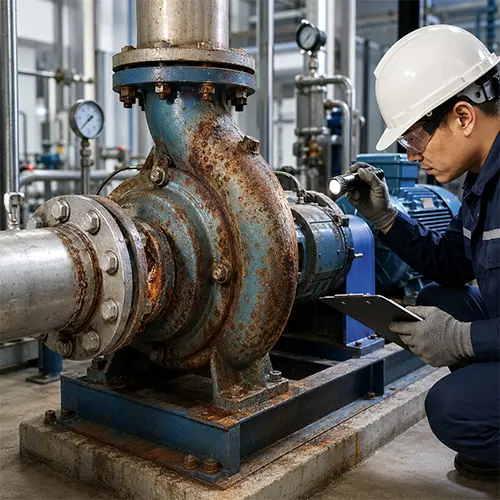
Pump corrosion happens quickly when the pump material, liquid chemistry, operating condition, and site environment do not match. For engineers, maintenance teams, contractors, and pump buyers, this problem usually appears as rust on the pump casing, pitting on the impeller, shaft surface damage, fastener corrosion, seal chamber corrosion, coating failure, leakage, reduced flow, vibration, or repeated pump replacement after a short operating period.
Fast pump corrosion is rarely caused by “bad metal” alone. In real industrial water systems, corrosion is usually the result of several factors working together: low or high pH, chloride content, salinity, dissolved oxygen, temperature, chemical additives, suspended solids, cavitation, galvanic reaction, coating damage, stagnant liquid, poor grounding, or material selection based only on flow and head. A cast iron pump may corrode quickly in acidic, saline, oxygen-rich, or untreated water. A stainless steel pump may also corrode if the chloride level, temperature, crevice condition, or chemical exposure exceeds the resistance of the selected stainless grade.
Pump corrosion should be diagnosed before replacing the pump with the same material. The correct decision is to identify the corrosion pattern, test the liquid, confirm the exact pump material, check operating conditions, and then decide whether to repair, recoat, upgrade material, improve water quality, reduce cavitation, isolate mixed metals, or reselect the pump. Without that process, the next pump may fail in the same way.
Scope of This Guide: Which Pump Types and Corrosion Cases Does This Apply To?
This guide applies to pump systems where wetted parts corrode, rust, pit, crack, discolor, or lose material faster than expected. It mainly applies to centrifugal water pumps and industrial fluid transfer pumps, but the diagnosis must be adjusted for slurry pumps, chemical pumps, seawater pumps, wastewater pumps, submersible pumps, and stainless steel pump systems.
This guide is written for practical field decisions. It helps users separate material mismatch, water chemistry, cavitation, erosion, galvanic corrosion, coating failure, and maintenance mistakes before making another replacement decision.
| Pump Type / Application | Can Use This Guide? | What Must Be Adjusted |
| Cast iron clean-water pump | Yes | Focus on water quality, oxygen, coating, and external rust |
| Stainless steel pump | Yes | Check chloride, pitting, crevice corrosion, and grade selection |
| Seawater pump | With adjustment | Add chloride level, galvanic corrosion, material grade, and sacrificial protection |
| Chemical pump | With adjustment | Use chemical compatibility data and temperature correction |
| Slurry pump | With adjustment | Separate corrosion from erosion and abrasive wear |
| Wastewater pump | With adjustment | Add sulfide, gas, biological corrosion, and sediment checks |
| Submersible pump | With adjustment | Add cable gland, motor shell, grounding, and immersion condition |
| Fire pump | Limited | Follow fire pump code, inspection standard, and approved materials |
| Food / pharma pump | Limited | Add hygienic material and cleaning chemical compatibility |
This guide is not suitable for direct use in highly hazardous chemical transfer, explosive or flammable liquid systems, high-temperature corrosive media, food-grade sanitary systems, nuclear service, marine classification projects, or API process pump applications without project-specific engineering review. Those cases require formal material compatibility verification, safety procedures, and qualified engineering judgment.
What Is Pump Corrosion?
Pump corrosion is the loss, weakening, pitting, rusting, or chemical degradation of pump materials caused by reaction with liquid, oxygen, salts, chemicals, electrical currents, or the surrounding environment. Fast pump corrosion means the material is being attacked faster than its expected service life under the actual operating condition.
Pump corrosion may affect the casing, impeller, shaft sleeve, fasteners, seal chamber, wear rings, flanges, coating, or external pump surface. The most important decision is not simply whether the pump has rust, but why the damage happened and whether the current material is suitable for the real service condition.
Corrosion should be separated from erosion, cavitation, and normal wear. These failure modes can look similar, but they require different solutions. A pump damaged by cavitation needs suction and operating-point correction. A pump damaged by chloride pitting needs material review. A pump damaged by abrasive solids needs wear-resistant design. A pump damaged by external humidity needs coating and site protection.
Why a Pump Corrodes Quickly
A pump corrodes quickly when the liquid chemistry, material grade, temperature, oxygen level, chloride content, solids, electrical environment, or operating condition attacks the pump’s wetted parts faster than the material can resist. Common causes include wrong material selection, low or high pH, chloride pitting, seawater exposure, chemical incompatibility, cavitation, erosion-corrosion, galvanic corrosion, coating failure, poor grounding, and stagnant liquid.
Pump corrosion is a material compatibility and operating condition problem. A cast iron pump may corrode quickly in oxygen-rich, acidic, saline, or untreated water. A stainless steel pump may corrode if chloride concentration, temperature, crevice condition, or chemical exposure exceeds the material’s resistance. Correct diagnosis should compare liquid analysis, pump material, temperature, flow velocity, solids content, grounding condition, coating condition, and corrosion pattern.
Direct Answer for Fast Diagnosis
A pump usually corrodes quickly because the selected material does not match the actual liquid and site conditions. The first checks should be pH, chloride level, salinity, temperature, dissolved oxygen, chemical additives, solids, flow velocity, grounding, coating condition, and the exact material grade of the pump’s wetted parts.
If a pump corrodes faster than expected, do not replace it with the same material before checking the liquid and damage pattern. Pitting usually points to chloride, crevice, or stainless steel grade issues. Uniform rust may point to cast iron exposure, coating failure, or oxygen-rich water. Local damage near high-velocity areas may indicate erosion-corrosion or cavitation.
What Causes a Pump to Corrode Quickly?
Pump corrosion usually accelerates when the liquid is more aggressive than expected, the material grade is unsuitable, the protective coating fails, or the pump operates under conditions that create pitting, erosion, cavitation, or electrochemical reaction.
The fastest way to diagnose pump corrosion is to compare the corrosion pattern with the liquid condition. Uniform rust, deep pits, crevice attack, impeller surface loss, coating blistering, and flange corrosion do not point to the same root cause. Each pattern requires a different correction.
| Corrosion Symptom | Likely Cause | What to Check First | Best Action |
| Uniform rust on cast iron casing | Oxygen-rich water / coating failure | Water quality, coating, exposure | Recoat, improve material, control water quality |
| Small deep pits on stainless steel | Chloride pitting | Chloride level, SS grade, temperature | Upgrade stainless grade or use duplex/bronze |
| Corrosion near flange or gasket | Crevice corrosion | Gasket area, stagnant liquid, chloride | Improve sealing design/material |
| Impeller surface eaten away | Erosion-corrosion | Solids, velocity, cavitation | Change material, reduce velocity, select slurry design |
| Rapid corrosion after chemical dosing | Chemical incompatibility | Chemical type, concentration, pH | Reselect material based on compatibility |
| Rust outside pump body | External environment | Humidity, coating, condensation | Improve coating and site protection |
| Mixed metal corrosion | Galvanic corrosion | Metal pairing, grounding, electrolyte | Isolate metals or select compatible materials |
| Corrosion after long shutdown | Stagnant liquid / oxygen concentration | Drainage, storage, water chemistry | Flush, drain, preserve pump |
Corrosion Location: What the Damaged Area Tells You First
Pump corrosion location is often the fastest clue for field troubleshooting. The same corrosion mark has different meaning depending on whether it appears on the external casing, impeller inlet, shaft sleeve, flange, fasteners, seal chamber, or coating surface.
A maintenance team should take both close-up photos and full-location photos before cleaning the surface. A close-up photo shows the corrosion pattern; a wider photo shows whether the damage is related to flow direction, gasket position, suction side, discharge side, coating defect, or mixed-metal connection.
| Corrosion Location | Likely Cause | What It Usually Means | First Check |
| Outside pump casing | Humidity, condensation, salt spray, coating damage | External protection issue | Coating, ventilation, site environment |
| Inside pump casing | Liquid chemistry or stagnant liquid | Wetted material may not match liquid | pH, chloride, temperature, oxygen |
| Impeller inlet | Cavitation or suction problem | Hydraulic condition may be damaging surface | NPSH, suction pressure, air entry |
| Impeller outlet edge | Erosion-corrosion or high velocity | Solids or excessive flow may be present | Solids, flow velocity, operating point |
| Shaft sleeve | Seal leakage, chemical attack, crevice condition | Seal chamber and material need review | Seal flush, liquid compatibility, sleeve grade |
| Seal chamber | Stagnant liquid, chemical concentration, poor flushing | Local chemistry may be aggressive | Flush plan, temperature, deposits |
| Flange / gasket area | Crevice corrosion | Liquid trapped in narrow gaps | Gasket material, chloride, crevice design |
| Bolts / fasteners | External corrosion or galvanic corrosion | Fastener material may be incompatible | Fastener grade, metal pairing, humidity |
| Weld area | Heat-affected zone, surface contamination | Fabrication or passivation issue | Weld quality, surface finish, material certificate |
| Coating defect | Mechanical damage or poor surface preparation | Local corrosion may spread under coating | Coating thickness, adhesion, handling damage |
This location-based review helps the customer avoid one of the most common mistakes: treating all visible damage as the same corrosion problem.
First Decision: Is It Corrosion, Erosion, Cavitation, or Normal Wear?
A pump should not be judged as simply “corroded” until the damage pattern is identified. Corrosion, erosion, cavitation, and normal wear can look similar in photos, but they have different root causes and require different fixes.
Misdiagnosis is expensive. If cavitation damage is treated as a material problem, a more expensive material may still fail. If chemical corrosion is treated as normal wear, the pump may leak again after replacement. The correct starting point is the visible damage pattern.
What Pump Corrosion Means
Pump corrosion means material loss caused by chemical or electrochemical reaction between the pump material and its environment. This environment may include water, oxygen, acids, alkalis, salts, chlorides, chemicals, gases, deposits, or electrically connected dissimilar metals.
Corrosion may appear as uniform rust, pitting, discoloration, cracking, scale, thinning, or localized attack around gaskets, welds, fasteners, or stagnant areas.
What Erosion Means
Erosion means material is removed by mechanical action such as sand, solids, high velocity, turbulence, or abrasive particles. Erosion often appears directional, smooth, or concentrated where flow velocity is high.
Erosion can combine with corrosion. When particles remove the protective film from the metal surface, fresh metal is exposed and corrosion accelerates. This is called erosion-corrosion.
What Cavitation Damage Looks Like
Cavitation (the formation and collapse of vapor bubbles in a liquid) can create small honeycomb-like pits, often near the impeller inlet or low-pressure areas. It may look like corrosion, but the root cause is hydraulic stress caused by poor suction condition, insufficient NPSH (Net Positive Suction Head), or operation away from the correct duty point.
If the damage pattern looks like honeycomb pitting near the impeller inlet, this air inside pump troubleshooting guide can help engineers check suction leaks, air pockets, and cavitation-related damage.
| Damage Type | Visual Pattern | Main Cause | Correct Fix |
| Chemical corrosion | Rust, thinning, discoloration | Liquid chemistry | Change material or control fluid |
| Pitting corrosion | Small deep holes | Chloride / crevice / stainless grade | Upgrade material and reduce chloride risk |
| Erosion | Directional wear, smooth loss | Solids / high velocity | Reduce velocity or use wear-resistant design |
| Cavitation | Honeycomb pits near impeller inlet | Low NPSH / suction problem | Fix suction and operating point |
| Normal wear | Gradual material loss | Long operation | Maintenance or scheduled replacement |
Liquid Chemistry: The First Thing to Check Before Blaming the Pump
Pump corrosion often begins with liquid chemistry. Without pH, chloride, salinity, temperature, oxygen, chemical additives, conductivity, and solids data, material selection becomes guesswork.
Many pump failures happen because the pump was selected using only flow, head, and motor power. Those values are necessary for hydraulic selection, but they do not prove material compatibility. A corrosion-resistant pump selection must include both hydraulic data and liquid chemistry.
pH: Acidic or Alkaline Water Can Accelerate Corrosion
pH (a measure of acidity or alkalinity) affects how aggressively liquid attacks metal. Acidic water can accelerate corrosion of cast iron, carbon steel, and some coatings. Highly alkaline liquids can also attack certain metals, elastomers, seals, and coating systems.
A pump that works well in neutral clean water may fail quickly when the water becomes acidic due to process discharge, chemical cleaning, mine drainage, wastewater conditions, or dosing errors.
Chloride: Why Stainless Steel Can Still Corrode
Chloride is one of the most common reasons stainless steel pumps corrode unexpectedly. Stainless steel depends on a passive protective film, but chloride can break that film and cause pitting corrosion. This is especially important in warm water, seawater, brine, cooling water, coastal installations, and chemical systems.
A 304 stainless steel pump may pit quickly in chloride-rich water. A 316 stainless steel pump has better chloride resistance than 304, but it is not automatically safe for all seawater or high-temperature chloride service.
Salinity and Seawater Exposure
Salinity increases corrosion risk because saltwater is conductive and chemically aggressive. In seawater systems, corrosion is not only about the pump casing material. Fasteners, shaft sleeves, seals, couplings, piping, and mixed-metal contact can also fail if the material system is not designed properly.
Seawater pumps often require marine-grade alloys, bronze, duplex stainless steel, coatings, or sacrificial protection depending on duty, temperature, velocity, and service life requirement.
Dissolved Oxygen and Oxidizing Conditions
Dissolved oxygen can accelerate rust and oxidation, especially in open water systems, cooling towers, open tanks, and recirculating water systems. Oxygen-rich water can attack cast iron and carbon steel more aggressively than closed, treated water.
Oxygen concentration differences can also create localized corrosion. Areas under deposits, gaskets, stagnant liquid, or air pockets may corrode faster than surrounding surfaces.
Chemical Additives and Cleaning Agents
Chemical additives can change corrosion risk even if the original water looked safe. Biocides, chlorine, acid cleaners, descaling agents, disinfectants, anti-scaling chemicals, and wastewater treatment chemicals may all affect material compatibility.
Corrosion that begins after chemical dosing or cleaning should be treated as a compatibility problem until proven otherwise. The supplier should receive the chemical name, concentration, temperature, exposure time, and cleaning frequency.
| Data Needed | Why It Matters |
| pH | Determines acidic/alkaline corrosion risk |
| Chloride concentration | Critical for stainless steel pitting |
| Temperature | Higher temperature accelerates corrosion |
| Specific gravity | Helps identify liquid concentration |
| Viscosity | Affects velocity and hydraulic behavior |
| Solids content | Separates corrosion from abrasion |
| Chemical additives | Checks material compatibility |
| Dissolved oxygen | Explains oxidation risk |
| Conductivity | Indicates electrochemical corrosion risk |
Pump Material Selection: When Cast Iron, Stainless Steel, Bronze, or Duplex Steel Makes Sense
Fast pump corrosion often means the material was selected for price or availability instead of real liquid compatibility. The correct pump material depends on liquid chemistry, temperature, chloride level, solids, corrosion allowance, lifecycle cost, and failure consequence.
Material choice should be a decision based on risk, not only a price comparison. The cheapest pump material can become the most expensive option if it causes repeated shutdown, emergency replacement, leakage, production loss, or safety risk.
Cast Iron Pumps
Cast iron pumps are commonly used for clean water, general industrial water, HVAC circulation, irrigation, and non-aggressive liquid transfer. Cast iron can be cost-effective and durable when the liquid is compatible and the external environment is controlled.
Cast iron is not a good default choice for acidic water, high-salt water, seawater, aggressive wastewater, strong oxidizing chemicals, or systems where the coating will be damaged and the base metal exposed. If the pump corrodes quickly in cast iron service, water quality and coating condition should be checked before replacing the same pump again.
304 Stainless Steel Pumps
304 stainless steel pumps are suitable for many clean, mildly corrosive, or sanitary-like applications, but 304 is not a universal corrosion solution. Its resistance to chloride is limited compared with higher grades.
If the liquid contains chloride, salt, disinfectant, or warm water, 304 stainless steel may develop pitting. Customers should not accept “stainless steel” as a complete material description. The exact grade must be confirmed.
316 Stainless Steel Pumps
316 stainless steel pumps provide better chloride resistance than 304 because of their alloy composition. In many mildly corrosive water systems, 316 is a better choice than 304. However, 316 is still not automatically suitable for all seawater, brine, high-temperature chloride, or stagnant chloride environments.
If a 316 pump pits quickly, check chloride concentration, temperature, stagnant zones, crevice areas, surface finish, and cleaning chemicals.
Duplex Stainless Steel and Super Duplex
Duplex stainless steel and super duplex stainless steel are used when corrosion risk is more severe, especially in chloride-containing environments where ordinary stainless steel may pit. These materials offer better strength and chloride resistance, but they cost more and may require longer procurement lead time.
Duplex material makes sense when corrosion failure has high cost, seawater exposure is significant, chloride levels are high, or the pump must meet a longer service life requirement.
Bronze and Marine Materials
Bronze, nickel aluminum bronze, and other marine materials are commonly considered for seawater and marine pumping applications. These materials can perform well in suitable seawater service, but galvanic compatibility must be reviewed when connected to stainless steel, carbon steel, or other metals.
Marine material selection should consider not only the pump casing, but also impeller, shaft, fasteners, wear rings, piping, and cathodic protection strategy.
Coated Cast Iron or Lined Pumps
Coated cast iron or lined pumps can reduce cost while improving corrosion resistance. However, coating systems only work if surface preparation, coating selection, application thickness, curing, and installation handling are correct.
A small coating scratch can become a local corrosion point. If coating failure is seen as blistering, peeling, cracking, or rust spreading from damaged areas, the coating system and site handling should be reviewed.
| Liquid / Condition | Lower-Risk Material Direction | Caution |
| Clean freshwater | Cast iron / stainless steel | Confirm oxygen and pH |
| Mildly corrosive water | 304 / 316 stainless steel | Check chloride |
| High-chloride water | 316 / duplex / bronze | 304 may pit quickly |
| Seawater | Duplex / bronze / marine-grade alloy | Check galvanic corrosion |
| Wastewater | Stainless / coated / application-specific | Check sulfide and gas |
| Slurry with corrosion | High-chrome / rubber-lined / duplex options | Separate corrosion from abrasion |
| Acidic chemical liquid | Chemical-resistant alloy or non-metallic pump | Must use compatibility data |
If the corrosion decision is mainly between stainless steel and cast iron, this stainless steel vs cast iron pump guide can help buyers compare material cost, corrosion resistance, and application limits before choosing a replacement pump.
Best Material by Liquid Scenario
Pump material selection should start from the actual liquid scenario, not from a general idea that one material is always better than another. A buyer should compare liquid chemistry, temperature, solids, failure consequence, and service life target before choosing a corrosion-resistant pump.
This table is a practical starting point, not a final material guarantee. Final selection should always be verified against actual liquid analysis, concentration, temperature, exposure time, and supplier compatibility data.
| Liquid Scenario | Corrosion Risk | Better Material Direction | Why |
| Clean freshwater, neutral pH | Low | Cast iron / 304 / 316 depending on budget | Cost-effective options may work |
| Oxygen-rich open water | Medium | Coated cast iron / stainless steel | Oxidation risk is higher |
| Mild chloride water | Medium | 316 stainless steel preferred over 304 | Better chloride resistance |
| Warm chloride water | High | Duplex stainless steel or higher review | Pitting risk increases with temperature |
| Seawater | High | Duplex / bronze / marine alloy | Needs marine corrosion strategy |
| Brine or high-salinity water | High | Duplex / super duplex / special alloy | High chloride and conductivity |
| Acidic wastewater | High | Chemical-compatible alloy, lining, or non-metallic option | pH may attack standard metals |
| Corrosive slurry | Very high | Wear-resistant plus corrosion-resistant design | Must handle both abrasion and chemistry |
| Chemical dosing system | Variable | Material based on chemical compatibility | Chemical concentration controls risk |
| Long shutdown with liquid retained | Medium to high | Corrosion-resistant material plus drain/flush plan | Stagnant liquid increases local attack |
The key decision is to avoid choosing material only by pump category. A “water pump” may handle clean water, seawater, wastewater, hot chloride water, or chemically treated process water. These are not the same corrosion environment.
Why Stainless Steel Pumps Still Corrode
Stainless steel pumps can corrode quickly when the passive film is damaged or when the liquid contains chloride, stagnant zones, high temperature, aggressive chemicals, or crevice conditions. Stainless steel is corrosion-resistant, not corrosion-proof.
This misunderstanding causes many replacement mistakes. A buyer may upgrade from cast iron to “stainless steel” but still experience corrosion because the grade is not suitable for the liquid. The question should not be “Is it stainless?” but “Which stainless grade, under what chloride level, temperature, oxygen condition, and flow condition?”
Pitting Corrosion
Pitting corrosion appears as small, deep holes. It is dangerous because the surface may look mostly intact while the pit penetrates deeply. In stainless steel pumps, pitting is often associated with chloride, warm water, deposits, poor surface condition, or stagnant areas.
Pitting on the impeller, casing, shaft sleeve, or seal chamber should trigger a chloride and temperature review.
Crevice Corrosion
Crevice corrosion happens in narrow gaps where liquid becomes stagnant and oxygen concentration changes. Common locations include gasket areas, flange faces, threads, seal chambers, deposits, under washers, and areas behind trapped solids.
Crevice corrosion is common in chloride-containing liquid because the small gap becomes more aggressive than the bulk liquid.
Welding and Surface Finish Problems
Welding, grinding, surface contamination, and poor passivation can reduce stainless steel corrosion resistance. Iron contamination from tools, poor surface finish, or heat-affected zones may become corrosion initiation points.
If corrosion appears around welds, polished areas, or fabricated parts, manufacturing and surface treatment should be reviewed.
| Material | Typical Advantage | Corrosion Risk | When to Upgrade |
| 304 SS | Lower cost, general corrosion resistance | Chloride pitting | Chloride or warm water present |
| 316 SS | Better chloride resistance than 304 | Still not seawater-proof | High chloride, high temperature, pitting history |
| Duplex SS | Stronger chloride resistance | Higher cost, availability | Seawater / harsh corrosive service |
| Super duplex | Severe chloride and marine service | High cost | Critical corrosion failure risk |
External Corrosion: Why the Outside of the Pump Rusts Fast
External pump corrosion is often caused by humidity, condensation, poor coating, chemical vapor, outdoor exposure, salt spray, or poor drainage around the foundation. It may not mean the wetted material is wrong, but it still affects safety, appearance, and service life.
External corrosion is easy to ignore because the pump may still run normally at first. Over time, external rust can weaken fasteners, damage baseplates, affect alignment, hide leakage, and reduce confidence during inspection.
Humidity and Condensation
Humidity and condensation can make the outside of a pump rust quickly, especially in pump rooms with poor ventilation, coastal air, high temperature difference, or water dripping from nearby equipment.
Cold pump surfaces in humid air can collect condensation. If the coating is weak or scratched, rust can start quickly.
Chemical Vapor or Coastal Air
Chemical plants, wastewater stations, coastal installations, and industrial cleaning areas may expose pumps to corrosive vapor or salt-laden air. In those cases, external corrosion may happen even if the pumped liquid itself is not very aggressive.
Fasteners, nameplates, coupling guards, motor frames, and baseplates should be inspected along with the pump casing.
Coating Damage During Transport or Installation
Coating damage during transport, lifting, pipe installation, or maintenance can become the starting point for external rust. Once corrosion begins under coating edges, it can spread below the coating film.
Installation teams should repair coating damage before commissioning, especially in outdoor or corrosive environments.
How to Protect External Pump Surfaces
External corrosion prevention requires surface preparation, suitable coating, drainage, ventilation, and inspection. Epoxy coating, stainless fasteners, proper touch-up repair, improved pump room ventilation, and foundation drainage can significantly reduce external corrosion.
The practical rule is simple: do not treat external coating as cosmetic only. In corrosive environments, coating is part of the pump’s protection system.
Galvanic Corrosion: When Mixed Metals Attack Each Other
Galvanic corrosion occurs when different metals are electrically connected in a conductive liquid. It can make one metal corrode much faster than expected, especially in saltwater, seawater, brine, or high-conductivity industrial water.
This problem often appears after a replacement project because the new pump may introduce a different metal into an existing piping system. A stainless pump connected to carbon steel pipe, a bronze impeller in a steel system, or mixed fasteners in seawater can create corrosion risk if not reviewed.
Common Mixed-Metal Risk Areas
Common galvanic corrosion risk areas include stainless steel shafts with cast iron casings, bronze impellers with steel components, carbon steel pipe connected to stainless pumps, dissimilar bolts and flanges, mixed metals in seawater systems, and field modifications using whatever fasteners are available.
The risk becomes higher when the liquid is conductive and the metals are directly connected.
How to Confirm Galvanic Corrosion
Galvanic corrosion is suspected when corrosion is concentrated on one metal near another dissimilar metal, especially at joints, flanges, fasteners, or contact points. The liquid conductivity, grounding, bonding, coating condition, and metal pairing should be checked.
Corrosion that appears after changing one component but not others may also suggest galvanic interaction.
Prevention Methods
Galvanic corrosion prevention may include avoiding incompatible metal combinations, using dielectric isolation, selecting compatible fasteners, applying proper coating strategy, using sacrificial anodes where appropriate, and improving grounding and bonding.
However, isolation and coating must be designed carefully. A poorly coated mixed-metal system can sometimes concentrate corrosion at defects.
Cavitation and Erosion-Corrosion: When Operation Makes Corrosion Look Worse
Pump corrosion can accelerate when hydraulic conditions damage protective surfaces. Cavitation, high flow velocity, sand, solids, and turbulence can remove protective films and expose fresh metal to corrosion.
This is why material upgrade alone may not solve the problem. If the pump is cavitating, operating too far from BEP (Best Efficiency Point), or handling abrasive solids at excessive velocity, even better material may suffer damage.
Cavitation-Corrosion
Cavitation-corrosion happens when vapor bubbles collapse and damage the metal surface, removing protective layers and creating local attack sites. Once the surface is damaged, corrosion accelerates because fresh metal is repeatedly exposed.
Cavitation damage often appears near the impeller inlet, suction side, or low-pressure areas. It is usually linked to poor suction condition, air entry, low inlet pressure, high temperature, or operation outside the recommended range.
Erosion-Corrosion
Erosion-corrosion happens when flowing liquid, solids, or turbulence removes protective films and corrosion products from the metal surface. This exposes fresh material and creates continuous metal loss.
Common locations include impeller edges, volute tongue, elbows, wear ring areas, seal chambers, and high-velocity passages.
Where to Look for This Damage
Erosion-corrosion and cavitation-related damage should be checked at the impeller inlet, impeller outlet edge, volute tongue, wear ring area, elbows, high-velocity zones, and seal chamber. If the damage is directional or concentrated in high-flow areas, pure chemical corrosion is unlikely to be the only cause.
If corrosion has already reduced pump efficiency or increased energy use, this pump efficiency loss guide can help maintenance teams understand how internal damage changes hydraulic performance.
How to Reduce Erosion-Corrosion
Erosion-corrosion can be reduced by lowering excessive velocity, improving suction condition, avoiding operation far from BEP, using wear-resistant material, selecting a slurry pump design if solids exist, and improving filtration or settling.
The best correction is often a combination of material upgrade and operating condition correction.
Installation and Maintenance Mistakes That Accelerate Pump Corrosion
Pump corrosion may accelerate because of site conditions after installation, even when the original material selection was reasonable. Poor storage, stagnant liquid, air pockets, wrong flushing, damaged coating, and incompatible cleaning chemicals can shorten pump life.
This is important for warranty discussions. A pump can be correctly supplied but damaged by storage, cleaning, installation, or operation. A fair diagnosis should review both supplier selection and site handling.
Leaving Liquid Inside the Pump During Long Shutdown
Liquid left inside the pump during long shutdown can create local corrosion, especially when it contains chloride, solids, chemicals, oxygen, or biological activity. Deposits can create crevice-like conditions and oxygen concentration differences.
If the pump is used seasonally, preservation and drainage procedures should be defined before shutdown.
Poor Flushing After Chemical Cleaning
Poor flushing after chemical cleaning can leave aggressive chemical residue inside the pump. Acid cleaners, disinfectants, descaling chemicals, or process cleaners may continue attacking metal and seals after the system is returned to service.
Cleaning procedures should specify chemical concentration, contact time, neutralization, flushing volume, and compatible materials.
Damaged Coating or Lining
Damaged coating or lining can create concentrated corrosion at exposed metal points. A coated pump may fail faster at coating defects because the exposed area becomes a local corrosion cell.
Transport damage, installation scratches, improper bolt tightening, and debris impact should be checked when coating failure is present.
Air Pockets and Stagnant Zones
Air pockets and stagnant zones can accelerate corrosion because local chemistry changes inside trapped areas. Dead zones, poor draining areas, high points in piping, and low-flow pockets can all create localized attack.
A pump system should be designed and operated to avoid trapped air and stagnant liquid where possible.
| Mistake | What Happens | Correct Action |
| Same material replacement without water test | Corrosion repeats | Test liquid before replacement |
| Using 304 SS in chloride water | Pitting develops | Upgrade material |
| Ignoring shutdown liquid | Local corrosion starts | Drain and preserve pump |
| Leaving coating scratches unrepaired | Rust spreads | Touch up coating |
| Mixing metals without isolation | Galvanic corrosion | Use compatible materials |
| Ignoring suction cavitation | Surface damage accelerates | Fix suction and NPSH |
Step-by-Step Troubleshooting When a Pump Corrodes Quickly
Fast pump corrosion should be diagnosed in a fixed sequence: identify the damage location, identify the damage pattern, test the liquid, confirm material grade, check operating conditions, inspect galvanic and electrical risks, review installation history, and then choose the correction plan.
This sequence prevents guesswork. It also gives buyers and suppliers a common technical language for deciding whether the issue is material mismatch, operating condition, installation, maintenance, or supplier configuration.
Step 1: Identify Where the Corrosion Appears
Pump corrosion diagnosis should begin with location. Check the casing, impeller, shaft, shaft sleeve, bolts, seal chamber, flanges, welds, gasket areas, coating defects, and pipe connections.
Damage on the outside of the casing points to environment and coating. Damage inside the casing points to liquid compatibility or hydraulics. Damage at flanges and gasket areas may point to crevice corrosion. Damage near mixed metals may point to galvanic corrosion.
Step 2: Identify the Corrosion Pattern
Pump corrosion pattern gives the first clue. Uniform rust suggests general corrosion or coating exposure. Deep pits suggest chloride or crevice corrosion. Directional material loss suggests erosion. Honeycomb pitting suggests cavitation. Local attack around mixed metals suggests galvanic corrosion.
Take clear photos before cleaning the surface. Photos should include close-up images and wider images showing location.
Step 3: Test the Liquid
Pump liquid testing should include pH, chloride concentration, salinity, temperature, conductivity, dissolved oxygen, solids content, chemical additives, and cleaning chemicals. If the liquid changes over time, test during the actual operating condition, not only from clean makeup water.
A water sample from the tank may differ from liquid inside the pump after shutdown. If shutdown corrosion is suspected, sample residue or trapped liquid as well.
Step 4: Confirm the Exact Pump Material
Pump material must be confirmed by exact grade. “Stainless steel” is not enough. Identify whether the material is 304, 316, duplex, bronze, cast iron, coated cast iron, rubber-lined material, or another alloy.
Also check the material of impeller, shaft, sleeve, fasteners, seal components, and wear rings. A pump is only as corrosion-resistant as its vulnerable wetted components.
Step 5: Check Operating Conditions
Pump operating conditions can accelerate corrosion. Check flow rate, head, velocity, suction pressure, cavitation symptoms, operation near or away from BEP, start-stop frequency, shutdown periods, and whether the pump runs dry or partially filled.
If corrosion appears in high-velocity areas, the operating point matters as much as the material.
Step 6: Check Galvanic and Electrical Risks
Pump galvanic risks should be checked when different metals are connected in conductive liquid. Review metal combinations, grounding, bonding, stray current, sacrificial anodes, dielectric isolation, and coating condition.
Submersible and seawater installations deserve special attention because the environment is highly conductive.
Step 7: Review Installation and Maintenance History
Pump maintenance history can explain sudden corrosion. Review chemical cleaning, flushing, shutdown storage, coating repair, pipe installation, gasket changes, seal replacement, and any new chemical dosing.
A pump that corroded after a process change may not be a pump quality problem. It may be a changed compatibility condition.
Step 8: Decide the Correct Fix
Pump corrosion correction should match the cause. If the material is wrong, upgrade material. If chloride causes pitting, change stainless grade or alloy. If cavitation damages surfaces, fix suction and NPSH. If erosion-corrosion is present, reduce velocity or use wear-resistant design. If galvanic corrosion is present, isolate metals or redesign material pairing.
If the current pump has failed repeatedly after replacement, this replacement pump troubleshooting guide can help buyers separate material mismatch, system curve problems, and supplier configuration issues.
Pump Corrosion Decision Framework
The correct corrosion solution depends on whether the root cause is liquid chemistry, material mismatch, external environment, galvanic reaction, erosion-corrosion, cavitation, coating failure, or poor maintenance. Replacing the pump with the same material often repeats the failure.
A decision framework helps the buyer avoid two common mistakes: under-upgrading and over-upgrading. Under-upgrading repeats corrosion. Over-upgrading wastes budget without fixing hydraulics, chemicals, or installation issues.
| Root Cause | Best Fix | What Not to Do |
| Acidic or alkaline liquid | Select compatible material | Do not use standard cast iron blindly |
| High chloride | Upgrade stainless grade or alloy | Do not assume all stainless is safe |
| Seawater | Use marine-grade materials | Do not mix metals without review |
| Solids and high velocity | Use wear-resistant design | Do not treat it as pure corrosion |
| Cavitation | Fix suction / NPSH issue | Do not only change material |
| External rust | Improve coating and environment | Do not ignore coating damage |
| Galvanic corrosion | Isolate metals / use compatible materials | Do not mix metals casually |
| Chemical dosing | Recheck compatibility | Do not rely on original water data |
Do / Don’t Checklist for Pump Corrosion Decisions
Pump corrosion decisions should be made from evidence, not from assumptions. This checklist helps buyers and maintenance teams avoid repeated failures and unnecessary material upgrades.
| Do | Don’t |
| Test pH, chloride, temperature, and conductivity before replacement | Don’t replace with the same material blindly |
| Confirm exact material grade, not just “stainless steel” | Don’t assume all stainless steel is corrosion-proof |
| Match the corrosion pattern to the likely root cause | Don’t treat cavitation, erosion, and corrosion as the same failure |
| Check coating damage, installation scratches, and shutdown liquid | Don’t ignore site handling and maintenance history |
| Review mixed metals and grounding in conductive liquids | Don’t overlook galvanic corrosion |
| Send photos and liquid data to the supplier | Don’t ask for a judgment based only on “the pump rusted” |
| Consider lifecycle cost, not only purchase price | Don’t choose the cheapest pump if corrosion failure is costly |
| Fix suction or velocity issues when damage is hydraulic | Don’t rely only on stronger material to solve operating problems |
The most important rule is simple: do not select the next pump until you know why the last one corroded.
Cost Consequences of Wrong Corrosion Decisions
Wrong corrosion decisions increase lifecycle cost because the same failure may repeat after replacement. The lowest-cost solution is not always the cheapest pump material; it is the material and operating strategy that prevents repeated downtime, leakage, safety risk, and emergency replacement.
Pump corrosion cost should include equipment cost, installation labor, downtime, lost production, emergency shipping, seal replacement, energy loss, and repeated troubleshooting. For B2B buyers, lifecycle cost is usually more important than initial purchase price.
Why Same-Material Replacement Can Be Expensive
Same-material replacement is expensive when the original material was incompatible with the liquid. The new pump may look cheaper at purchase, but it can fail again in the same service.
If a cast iron pump rusts quickly in aggressive water, another cast iron pump will likely repeat the issue unless water treatment, coating, or operation changes. If 304 stainless steel pits in chloride water, another 304 pump may fail again.
Why Over-Upgrading Material Can Also Waste Money
Over-upgrading can waste money when the real problem is cavitation, high velocity, poor flushing, coating damage, or galvanic contact. A better alloy may last longer, but it may not solve the root cause.
A material upgrade should be justified by liquid data and failure pattern, not by fear alone.
Lifecycle Cost Table
| Decision | Short-Term Cost | Long-Term Risk |
| Replace with same cast iron | Low | Corrosion may repeat |
| Upgrade to 304 SS | Medium | May fail in chloride water |
| Upgrade to 316 SS | Higher | Better but not seawater-proof |
| Use duplex / bronze | High | Better for harsh conditions |
| Add coating only | Medium | Coating damage may cause local corrosion |
| Fix liquid/operation first | Variable | Often reduces repeated failure |
When the Pump Supplier or Material Selection May Be the Real Problem
The supplier or material selection may be the real problem if the pump was recommended without liquid data, chloride level, pH, temperature, chemical concentration, solids content, or corrosion history. A proper corrosion-resistant pump selection must be based on actual service conditions, not only flow and head.
A good supplier should ask about liquid chemistry when corrosion risk exists. If the selection only considered flow rate, head, and motor power, material compatibility may not have been properly evaluated.
Supplier Selection Problems
Supplier selection problems may include considering only flow and head, ignoring liquid chemistry, describing material only as “stainless steel” without grade, treating seawater as normal water, ignoring chloride concentration, ignoring chemical additives, ignoring solids and abrasion, selecting coating without compatibility data, or failing to consider temperature correction.
A buyer should request the exact material grade in writing. The pump casing, impeller, shaft, shaft sleeve, fasteners, and seal components may not all be the same material.
What Data to Send to the Supplier
Pump suppliers can only make reliable material recommendations when the buyer provides complete liquid and operating data. “Corrosive water” is not enough. The supplier needs measurable conditions.
| Data Type | What to Provide | Why It Matters |
| Liquid name | Exact medium | Basic compatibility |
| pH | Acid/alkaline risk | Material selection |
| Chloride level | Pitting risk | Stainless grade |
| Temperature | Corrosion acceleration | Compatibility correction |
| Solids content | Erosion risk | Material/design |
| Chemical additives | Compatibility | Seal/material selection |
| Existing damage photos | Pattern analysis | Root cause |
| Operating hours | Failure speed | Severity |
| Pump material | Actual grade | Match or mismatch |
How to Judge Supplier Recommendation Quality
A strong supplier recommendation should explain why the material is suitable for the liquid, temperature, chloride level, solids, and expected service life. It should also state limits and risks, not only provide a quote.
If the supplier does not ask for pH, chloride, temperature, solids, chemical additives, or corrosion history in a corrosion-sensitive application, the buyer should request a more detailed review before purchasing.
Warranty / Supplier Responsibility vs Site Responsibility
Pump corrosion responsibility should be judged with records, not assumptions. A corrosion problem may come from wrong material selection, wrong supplied material, incomplete liquid data, changed site conditions, coating damage, installation damage, chemical cleaning, or long shutdown with liquid retained.
This table is not a legal judgment. It is a technical decision aid for communication between the buyer, supplier, installer, and maintenance team.
| Situation | More Likely Supplier / Selection Issue | More Likely Site / Operation Issue | What Evidence Helps |
| Wrong material grade delivered | Yes | No | Material certificate, order record |
| Supplier ignored full liquid data | Possible | Less likely | RFQ data, technical proposal |
| Liquid data was never provided | Less likely | Yes | Inquiry record, selection basis |
| Chloride higher than stated | Less likely | Yes | Original and actual liquid test |
| Coating damaged before delivery | Possible | No if documented at receipt | Receiving inspection photos |
| Coating damaged during installation | No | Yes | Installation photos, damage location |
| Corrosion starts after chemical cleaning | Less likely | Yes | Cleaning chemical, concentration, flushing record |
| Pump corrodes after long shutdown with liquid inside | Less likely | Yes | Shutdown and preservation record |
| Stainless pits despite correct supplied grade | Depends on liquid compatibility | Depends on actual chloride/temp | Liquid analysis, grade, temperature |
| Factory test passed but site corrosion occurs | Not enough alone | Site chemistry may differ | Factory medium vs site medium |
The buyer should document corrosion with dates, photos, liquid data, operating hours, and maintenance history. The supplier should provide material grade, coating specification, selection basis, and any stated limits. A fair decision requires both sides to compare the real site condition with the original selection condition.
Factory Test vs Site Corrosion: Why the Pump Passed Test but Corroded Quickly
A pump can pass factory testing but corrode quickly on site because factory testing usually verifies hydraulic performance under controlled conditions, while corrosion depends on actual liquid chemistry, temperature, oxygen, chloride, solids, shutdown condition, and site environment.
This is important in disputes. A factory test may prove that the pump can run, deliver flow, and meet head under test liquid conditions. It does not prove that the pump material is suitable for every site liquid unless the test liquid and site liquid are chemically equivalent.
What Factory Test Can Prove
Factory testing can prove hydraulic performance, leakage control, basic operation, vibration under test conditions, and assembly quality. It can confirm that the pump was functional before shipment.
Factory testing usually does not prove long-term corrosion resistance unless the project includes material verification, corrosion testing, or service-specific compatibility documentation.
What Site Corrosion Proves
Site corrosion proves that the actual site environment is attacking the material. It does not automatically prove supplier defect, but it does prove that material, liquid, operation, or environment must be reviewed.
Photos, liquid analysis, operating hours, and material certificates help separate material defect, wrong selection, site chemical change, and maintenance issue.
How to Compare Fairly
Factory and site conditions should be compared by liquid chemistry, temperature, exposure time, material grade, coating condition, shutdown condition, installation environment, and operating pattern.
If the supplier selected the pump based on incorrect or incomplete liquid data, the failure may be a selection communication problem. If the correct liquid data was provided and the material was still unsuitable, supplier review is justified.
Corrosion Prevention Checklist for Pump Buyers and Engineers
Pump corrosion prevention starts before purchase. Buyers should provide complete liquid data, confirm material grade, review corrosion history, check installation conditions, and define acceptable service life before selecting the pump.
A corrosion-resistant pump is not simply a pump made of more expensive metal. It is a pump selected around the real service environment.
Before Buying the Pump
Before buying the pump, provide full liquid analysis, pH, chloride level, temperature range, solids content, gas content, chemical additives, external environment, shutdown pattern, required service life, and previous corrosion history.
Confirm material grade in writing. Ask whether the casing, impeller, shaft, sleeves, fasteners, and seal chamber are made from compatible materials.
During Installation
During installation, avoid coating damage, incompatible fasteners, dissimilar metal contact, poor grounding, air pockets, stagnant zones, and pipe stress. The pump should be supported, aligned, and installed so that hydraulic and mechanical stress do not accelerate corrosion.
Coating scratches should be repaired before operation, not after corrosion begins.
During Operation
During operation, avoid cavitation, dry running, deadheading, unstable flow, poor flushing, and long shutdown with liquid trapped inside the pump. Inspect coating, fasteners, casing, seal chamber, and drain points regularly.
Record corrosion changes with dates and photos. This helps identify whether corrosion is gradual, seasonal, chemical-related, or caused by a recent process change.
FAQ About Pump Corrosion
Pump corrosion questions usually come from customers who already replaced a pump once or are trying to avoid another failure. These answers focus on practical decisions: material choice, liquid testing, corrosion pattern, repair risk, warranty communication, and supplier data.
Why does my pump corrode so quickly?
A pump corrodes quickly when the pump material is not compatible with the liquid or site environment. Common causes include acidic water, high chloride, salinity, dissolved oxygen, chemical additives, solids, cavitation, galvanic corrosion, coating damage, stagnant liquid, or poor maintenance.
The first step is to identify the corrosion pattern and test the liquid. Replacing the pump with the same material before testing can repeat the failure.
Is stainless steel always better than cast iron?
Stainless steel is not always better than cast iron in every application. Stainless steel has better corrosion resistance in many environments, but different grades perform very differently. 304 stainless steel, 316 stainless steel, duplex stainless steel, and super duplex are not interchangeable.
Cast iron may be acceptable for clean freshwater systems, while stainless steel may still fail in high-chloride or chemical service if the grade is wrong.
Why does stainless steel still pit?
Stainless steel pits when its passive protective film breaks down locally. Chloride, warm water, stagnant liquid, crevices, deposits, poor surface finish, or aggressive cleaning chemicals can cause pitting.
Pitting is dangerous because small surface holes may become deep local damage. If stainless steel pits, check chloride level, temperature, grade, and crevice conditions.
Can seawater corrode a stainless steel pump?
Seawater can corrode stainless steel pumps, especially if the grade is not suitable or if crevice conditions, stagnant zones, galvanic contact, or high temperature are present. Ordinary 304 stainless steel is usually risky in seawater. 316 may still be limited depending on conditions.
Seawater pump selection often requires duplex stainless steel, bronze, marine-grade alloys, compatible fasteners, and galvanic corrosion control.
Can cavitation make corrosion worse?
Cavitation can make corrosion worse because collapsing vapor bubbles damage the metal surface and remove protective films. Once fresh metal is exposed, chemical corrosion can accelerate.
If corrosion-like damage appears near the impeller inlet or suction side, check NPSH, suction piping, air entry, flow condition, and pump operating point.
Should I replace the pump with the same material?
You should not replace the pump with the same material until the corrosion cause is identified. If the original material was incompatible with the liquid, the new pump may fail again.
Same-material replacement is reasonable only when corrosion was caused by age, poor coating maintenance, unusual temporary contamination, or a corrected site condition.
What material should I choose for corrosive water?
The best material for corrosive water depends on pH, chloride concentration, temperature, salinity, solids, chemical additives, conductivity, and required service life. There is no universal answer based only on the phrase “corrosive water.”
For some systems, 316 stainless steel may be enough. For others, duplex, bronze, coated pumps, rubber-lined pumps, or non-metallic materials may be needed.
Is pump corrosion covered by warranty?
Pump corrosion may be covered by warranty when the supplied material does not match the order, the coating was defective before delivery, or the supplier recommended an unsuitable material despite receiving complete and accurate liquid data. However, corrosion may not be covered when the liquid chemistry changed, required liquid data was not provided, coating was damaged during installation, unsuitable chemicals were used, or the pump was stored or shut down incorrectly.
Warranty discussion should be based on material certificates, liquid analysis, corrosion photos, operating hours, installation records, and the original selection basis.
What information should I send to the pump supplier?
Send the liquid name, pH, chloride level, temperature, salinity, chemical additives, solids content, conductivity, operating hours, corrosion photos, pump material grade, flow, head, shutdown condition, and installation environment.
Good photos should show both close-up corrosion pattern and the full pump location. This helps the supplier distinguish chemical corrosion, pitting, erosion, cavitation, galvanic corrosion, and coating damage.
Conclusion
Pump corrosion happens quickly when the pump material, liquid chemistry, hydraulic condition, external environment, and maintenance practice do not match. The correct decision is to diagnose the corrosion pattern and liquid condition before replacing the pump.
Fast corrosion should not be blamed on pump quality alone without evidence. A buyer should first identify where the damage appears, whether the pattern is uniform rust, pitting, crevice corrosion, erosion, cavitation, galvanic corrosion, or coating failure. Then the liquid should be tested for pH, chloride, salinity, temperature, solids, oxygen, conductivity, and chemical additives. The exact pump material grade should also be confirmed.
The correct fix depends on the root cause. If the liquid is chemically aggressive, select a compatible material. If chloride causes stainless steel pitting, upgrade the stainless grade or use a more suitable alloy. If cavitation damages the surface, fix suction and NPSH. If erosion-corrosion is present, reduce velocity or use wear-resistant design. If galvanic corrosion is present, isolate dissimilar metals and review grounding. If external rust is the issue, improve coating, ventilation, drainage, and site protection.
For engineers, maintenance teams, and pump buyers, the key lesson is simple: do not replace a corroded pump with the same material until the liquid and corrosion pattern have been checked. A corrosion-resistant pump decision should be based on measured liquid data, real operating conditions, exact material grade, documented supplier selection basis, and lifecycle cost—not only initial purchase price.
Get A Quote

Get A Quote
0 Comments