
High Head Pump vs High Flow Pump: Which One Does Your System Really Need?
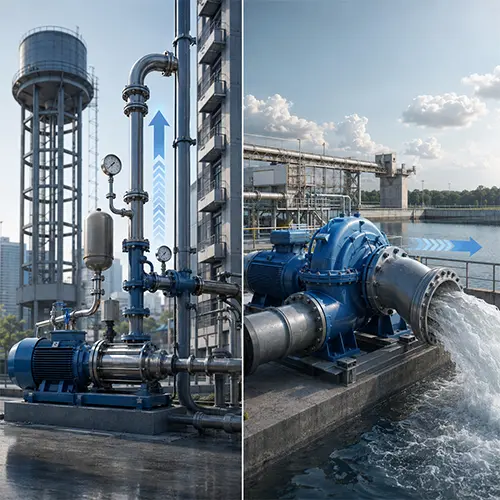
High head pump vs high flow pump selection should be based on the system’s required pressure, flow rate, pipeline resistance, elevation difference, liquid condition, and operating purpose—not on pump size, motor power, outlet diameter, or maximum catalog value alone. A high head pump is designed to overcome pressure, vertical lift, long pipelines, valves, filters, and system resistance. A high flow pump is designed to move a large volume of liquid in a given time, usually at low or moderate head.
For industrial buyers, engineers, contractors, and procurement teams, the key question is not “Which pump is stronger?” The better question is:
Does my system need more pressure, more water volume, or a properly engineered combination of both?
A high head pump is usually required when water must be pushed to a high building, elevated tank, hill, long-distance pipeline, RO system, nozzle system, booster system, or pressure-dependent process. A high flow pump is usually required when the goal is to move large water volume quickly, such as flood drainage, irrigation, cooling circulation, river intake, municipal drainage, stormwater removal, or tank filling.
The common mistake is assuming that a bigger motor, larger outlet, or higher price will automatically solve the problem. In reality, two pumps with the same motor power can perform very differently. One may deliver high pressure with lower flow, while another may deliver high flow with lower pressure. The correct pump must match the duty point—the required combination of flow rate and total head under real operating conditions.
If the pump is selected incorrectly, the system may suffer from low outlet pressure, insufficient water volume, high electricity cost, motor overload, cavitation, vibration, seal failure, bearing damage, pipe noise, unstable operation, or premature pump replacement. For B2B pump procurement, the safest method is to calculate the required flow and total head first, then match the pump curve to the system curve.
Quick Decision Summary for Buyers
A high head pump is the better choice when the system needs pressure, lift, or resistance control. A high flow pump is the better choice when the system needs volume, capacity, or fast water movement. If the project needs both high pressure and large flow, the buyer should request engineered pump selection instead of choosing by pump name.
This quick summary helps buyers make the first decision before detailed calculation. It is not a replacement for final engineering selection, but it prevents the most common procurement mistake: confusing pressure demand with volume demand.
| Buyer Condition | Better Direction | Why It Matters |
|---|---|---|
| Water must be lifted to a high building, hill, elevated tank, or long pipeline | High head pump | The pump must overcome elevation and pressure loss |
| Large volume of water must be moved quickly over a short distance | High flow pump | The system needs capacity more than pressure |
| Pipeline is long, narrow, or has many elbows and valves | High head pump | Friction loss increases required head |
| Flood drainage, open-channel transfer, or construction dewatering | High flow pump | Large volume movement is the main goal |
| Boiler feed, RO system, pressure boosting, or high-rise supply | High head pump | Stable pressure is critical |
| Cooling circulation, raw water transfer, or drainage | High flow pump | Continuous volume delivery matters |
| Both high pressure and high volume are required | Engineered pump selection | May require multistage pumps, split case pumps, series pumps, or parallel pumps |
| Existing pump has pressure but low water output | Check pump curve and system curve | The issue may be friction loss, pipe size, valve position, or wrong duty point |
| Existing pump has flow but cannot reach destination pressure | High head or multistage pump may be needed | The pump lacks pressure capacity |
The practical decision rule is simple:
Choose a high head pump when the system needs pressure. Choose a high flow pump when the system needs volume. If the system needs both, calculate the duty point and select by pump curve—not by outlet size, motor power, or supplier description.
Scope of This Guide: Applicable Pump Types and Operating Conditions
This high head pump vs high flow pump guide applies mainly to clean water, industrial utility water, building water supply, irrigation, drainage, cooling circulation, pressure boosting, and long-distance water transfer applications. It is most useful when buyers need to decide whether pressure or volume should control the pump selection.
This guide applies well to:
- End suction pumps
- Multistage pumps
- Split case pumps
- Inline pumps
- Booster pump sets
- Diesel engine pumps
- Irrigation pumps
- Drainage pumps
- Submersible pumps
- Industrial centrifugal pumps
- Pipeline pumps
- Clean water transfer pumps
This guide is especially relevant for:
- Building water supply
- High-rise pressure boosting
- Long-distance water transfer
- Agricultural irrigation
- Construction dewatering
- Cooling circulation
- Municipal water distribution
- Industrial utility water
- Tank filling
- RO pretreatment or pressure support
- General clean water pressure systems
This guide needs adjustment or separate engineering verification for:
- Slurry pump systems
- Chemical transfer
- API process pumps
- Fire pumps governed by NFPA or local codes
- Seawater or corrosive liquid
- High-temperature liquid
- Explosive or hazardous areas
- Food-grade sanitary applications
- Mine drainage with heavy solids
- Severe abrasion systems
For special applications, the buyer should not use “high head” or “high flow” as the only selection logic. Material compatibility, seal selection, motor protection, certification, local standards, safety requirements, and third-party approval may become more important than flow and head alone.
If the buyer is still comparing general pump structures before deciding whether pressure or volume is the priority, this end suction vs inline vs multistage pump guide can help clarify which pump type fits the required flow, head, and installation layout.
Practical Buyer Rule for High Head Pump vs High Flow Pump
A high head pump is the right choice when the system needs pressure, elevation lift, or resistance control. A high flow pump is the right choice when the system needs large water volume at low or moderate head. If both high pressure and large volume are required, buyers should calculate the duty point and select by pump curve instead of choosing by pump name or motor power.
This rule is important because many pump purchase mistakes happen before the supplier even quotes. The buyer says “I need a strong pump,” but the supplier does not know whether “strong” means high pressure, large flow, long distance, high lift, or heavy-duty construction.
A professional pump selection must answer four questions:
- How much water must be delivered?
- How much resistance must the pump overcome?
- What happens if the pump cannot meet the required duty point?
- Can the selected pump operate near its efficient and stable range?
If these four questions are not answered, the buyer is not selecting a pump. The buyer is guessing.
What Is a High Head Pump?
A high head pump is designed to generate higher pressure so liquid can overcome vertical lift, long-distance pipeline resistance, equipment pressure loss, valves, filters, nozzles, or process pressure requirements. Its main function is not to deliver the largest possible water volume, but to deliver liquid against resistance.
In pump selection, head means the energy a pump gives to liquid, commonly expressed in meters or feet. A high head pump can push liquid to a higher elevation or through a system with higher pressure resistance. This is why high head pumps are commonly used in high-rise buildings, pressure boosting, RO systems, boiler feed support, mine drainage, mountain irrigation, and long-distance pipeline transfer.
Definition of High Head Pump
A high head pump is a pump selected for applications where the required total head is high compared with the required flow rate. Total head means the full resistance the pump must overcome, including elevation difference, pipe friction, valves, fittings, filters, equipment pressure drop, and required outlet pressure.
Key terms buyers should understand:
- Head: The energy level a pump adds to liquid, usually expressed in meters or feet.
- Total head: The total resistance the pump must overcome in the real system.
- Static head: The vertical height difference between the liquid source and the discharge point.
- Friction loss: Pressure loss caused by liquid moving through pipes, elbows, valves, filters, meters, and fittings.
- Pressure requirement: The pressure needed at the end point, such as a nozzle, RO membrane, boiler feed inlet, or process equipment inlet.
A high head pump is often selected when the system needs pressure. If the pump cannot generate enough head, water may not reach the upper tank, the nozzle may not spray properly, the RO system may not operate, or the pressure booster system may fail to maintain service pressure.
Typical Applications of High Head Pumps
High head pumps are usually selected when pressure and resistance are more important than maximum water volume. These systems often require stable pressure at the outlet or enough energy to overcome long-distance resistance.
Typical applications include:
- High-rise building water supply
- Long-distance pipeline transfer
- Boiler feed water support
- RO system pressure support
- Deep well or mine drainage with high lift
- Mountain irrigation
- Pressure boosting stations
- Sprinkler or nozzle systems
- Filter press feed
- Industrial process pressure supply
- Elevated storage tank filling
- High-pressure washing systems
For example, a building booster pump does not only need to move water. It must maintain enough pressure at upper floors. A farm irrigation pump for a mountain area may need more head than a flat-field irrigation pump because elevation difference and pipeline resistance are much higher.
Common Pump Types Used for High Head Duty
High head duty often requires pumps that generate pressure efficiently, especially multistage pumps, booster pump sets, or properly selected centrifugal pumps. The right pump type depends on flow rate, total head, space, control method, and liquid condition.
| Pump Type | High Head Suitability | Typical Reason |
|---|---|---|
| Multistage pump | Very strong | Multiple impellers increase pressure in stages |
| End suction pump | Medium to high | Suitable for moderate high-head clean water duty |
| Inline pump | Medium | Good for compact building pressure systems |
| Booster pump set | High | Multiple pumps and controls maintain stable pressure |
| Submersible multistage pump | High | Used in wells or deep-lift systems |
| Split case pump | Usually medium | More common for high flow than very high head |
| Diesel engine pump | Depends on pump end | Useful where electric power is unavailable |
A multistage pump is often the first option when clean water requires high pressure. A booster set may be better when demand changes throughout the day, such as in high-rise buildings, hotels, factories, or municipal pressure zones.
For projects where pressure is the main requirement, the multistage pump product page can help buyers review suitable pump structures for higher head clean-water applications.
What Is a High Flow Pump?
A high flow pump is designed to move a large volume of liquid per unit time, usually at low or moderate head. Its main function is capacity, not high pressure. It is selected when the project needs to move water quickly, continuously, or in large volume.
In pump selection, flow rate means the liquid volume delivered over time, commonly expressed in m³/h, L/s, or GPM. A high flow pump may have a large outlet, large impeller passage, or hydraulic design optimized for capacity. However, high flow does not automatically mean high pressure.
Definition of High Flow Pump
A high flow pump is a pump selected for applications where the required flow rate is high compared with the required head. It is designed to move large water volume efficiently through systems with relatively lower resistance.
Key terms buyers should understand:
- Flow rate: The volume of liquid moved per unit time.
- Capacity: The pump’s delivery ability at a specific head.
- System curve: A curve showing how system resistance increases as flow increases.
- Rated flow: The recommended operating flow for stable and efficient performance.
- Maximum flow: The highest possible flow under very low resistance, which may not represent real site performance.
High flow pumps are commonly used when the system needs volume rather than pressure. If a high flow pump is selected for a system that requires high head, the pump may deliver much less water than expected because the system resistance is too high.
Typical Applications of High Flow Pumps
High flow pumps are usually selected when the project needs to move a large amount of water quickly and the pressure requirement is not extremely high. These applications often prioritize capacity, drainage speed, circulation volume, or tank filling time.
Typical applications include:
- Flood drainage
- Irrigation canal pumping
- Cooling water circulation
- River water intake
- Municipal drainage
- Large tank filling
- Construction dewatering
- Industrial circulation
- Agricultural water supply
- Low-head water transfer
- Stormwater pumping
- Reservoir transfer
For example, flood drainage usually needs large volume removal within a short time. The system may not require high pressure, but it requires enough flow capacity to reduce water level quickly. Cooling water circulation may also require high flow because heat removal depends on stable water circulation volume.
Common Pump Types Used for High Flow Duty
High flow duty often requires pumps with larger passages, lower hydraulic resistance, and stable capacity under low or moderate head. The right pump type depends on required flow, total head, liquid quality, installation layout, and maintenance access.
| Pump Type | High Flow Suitability | Typical Reason |
|---|---|---|
| Split case pump | Very strong | High capacity and stable operation |
| End suction pump | Medium to high | Common for water transfer and utility systems |
| Axial flow pump | Very strong | Very high flow, low head applications |
| Mixed flow pump | Strong | Balance between flow and moderate head |
| Submersible drainage pump | Strong | Suitable for drainage and dewatering |
| Pipeline pump | Medium | Depends on system head and pipe size |
| Diesel drainage pump | Strong | Useful for emergency drainage and remote sites |
A split case pump is often suitable for large water supply, cooling systems, and municipal transfer because it can handle high flow efficiently. Axial flow and mixed flow pumps may be better for very large water volume at low head, such as drainage, flood control, and irrigation canal systems.
High Head Pump vs High Flow Pump: Core Difference for Buyers
The core difference between a high head pump and a high flow pump is that one solves a pressure problem and the other solves a volume problem. Buyers should not compare them as if one is simply “stronger” than the other. They serve different system needs.
A high head pump is useful when the system resistance is high. A high flow pump is useful when the required volume is high. Some systems need both, but that requires careful engineering because high head and high flow together create much higher power demand.
| Comparison Point | High Head Pump | High Flow Pump | Buyer Meaning |
|---|---|---|---|
| Main purpose | Generate pressure | Move large volume | Choose based on system problem |
| Key parameter | Head / pressure | Flow rate / capacity | RFQ must include both |
| Typical system | High lift, long pipeline, pressure boosting | Drainage, irrigation, circulation | Application controls selection |
| Common pump type | Multistage, booster, high-pressure centrifugal | Split case, axial flow, mixed flow, drainage pump | Pump structure differs |
| Risk if wrong | Cannot reach required pressure | Cannot deliver enough water | Different failure mode |
| Energy concern | Overpressure and throttling loss | Oversized flow and pipe loss | System matching matters |
| Best for | Vertical lift, resistance, pressure | Large volume, short transfer, low head | Not interchangeable |
A high head pump is not automatically a high flow pump. A high flow pump is not automatically a high pressure pump. The buyer must match the pump curve to the real system curve.
Why Buyers Confuse High Head and High Flow Pumps
Buyers often confuse high head and high flow pumps because visible pump features do not always explain hydraulic performance. Motor power, outlet diameter, price, and pump size can be misleading if the buyer does not check the pump curve.
This confusion is common in procurement because the buyer may say, “I need a strong pump,” while the supplier needs exact flow and head data. “Strong” can mean high pressure, high volume, high motor power, or heavy-duty construction. These are different requirements.
Mistake 1: Thinking a Bigger Motor Means a Better Pump
A bigger motor does not automatically mean the pump provides the correct flow or head. Motor power only shows how much power is available. It does not prove that the hydraulic design matches the system.
A pump with a larger motor can still be wrong if the impeller, pump curve, speed, and system resistance do not match the duty point. Oversized motor power may increase cost without solving the real hydraulic problem.
Possible risks include:
- Higher electricity cost
- Motor overload if the operating point is wrong
- Pump operating far from BEP
- Vibration
- Seal failure
- Bearing damage
- Low operating efficiency
- Unstable pressure or flow
BEP (Best Efficiency Point) means the operating point where the pump runs with the best hydraulic efficiency and usually lower vibration. A pump operating far from BEP can fail early even if the motor is large.
Mistake 2: Thinking a Large Outlet Means High Flow Under Any Condition
A large outlet can support high flow, but it does not guarantee high flow in a high-resistance system. If the pipeline is long, narrow, elevated, or full of fittings, actual outlet flow may be much lower than expected.
The buyer may see a 6-inch outlet and assume it will deliver large volume. But the real performance depends on the pump curve and the system curve. If the total head is high, the flow may drop sharply.
Possible risks include:
- Expected flow not achieved
- Pump selected too close to shut-off head
- High energy consumption
- Excessive pipe friction
- Poor site performance
- Customer incorrectly blaming pump quality
Outlet size is a connection dimension. It is not a complete performance guarantee.
Mistake 3: Thinking High Head Means Stronger in Every Way
A high head pump may generate pressure, but it may not deliver large flow. Using a high head pump for a low-head, high-volume application can waste energy and reduce efficiency.
For example, if a drainage project needs to move a large volume of water at low head, a high head multistage pump may be the wrong choice. It may create pressure the system does not need while failing to deliver the required capacity efficiently.
Possible risks include:
- Throttling loss
- Unstable operation
- Overpressure
- Poor efficiency
- Unnecessary purchase cost
- Higher maintenance cost
High head is not a universal advantage. It is only valuable when the system actually needs pressure.
Total Head vs Flow Rate: The Calculation Buyers Must Understand
The correct choice between a high head pump and a high flow pump depends on the duty point. The duty point is the required flow rate at the required total head. Without this combined value, pump selection is incomplete.
A supplier cannot select a pump accurately if the buyer only says “I need a high pressure pump” or “I need a large flow pump.” The supplier needs actual operating data. Even a professional pump manufacturer cannot overcome missing system information.
What Is Total Head?
Total head is the total resistance the pump must overcome to move liquid from the source to the discharge point. It includes vertical lift, pipe friction, valves, fittings, equipment resistance, and required outlet pressure.
A simplified formula is:
Total head = static head + friction loss + pressure requirement + minor losses
The main components are:
- Static head: The vertical height difference between suction level and discharge point.
- Friction loss: Resistance caused by liquid moving through pipe length and pipe diameter.
- Pressure requirement: Pressure needed at the outlet or equipment inlet.
- Minor losses: Losses caused by elbows, valves, check valves, filters, meters, strainers, and nozzles.
For example, a system may have only 20 meters of vertical lift but still require 70 meters total head because the pipeline is long, the pipe diameter is small, and there are many valves or filters. This is why buyers should never estimate head only by height.
What Is Flow Rate?
Flow rate is the volume of liquid the system needs per unit time. It should come from process demand, irrigation demand, tank filling time, cooling load, drainage requirement, or water supply demand.
| Unit | Common Use |
|---|---|
| m³/h | Industrial and municipal projects |
| L/s | Engineering calculations |
| GPM | North American markets |
| m³/day | Irrigation or water supply planning |
For example, if a tank must be filled within two hours, the required flow depends on tank volume. If an irrigation system must cover a certain field area within a set time, flow rate must match the irrigation schedule. If a cooling system must remove heat continuously, flow rate must match thermal load.
Why Both Flow and Head Must Be Provided Together
A pump cannot be selected correctly if the buyer provides only flow or only head. Flow and head define the real duty point together. One value without the other can lead to wrong selection.
Poor inquiry examples include:
- “I need a 30 kW pump.”
- “I need a 4-inch pump.”
- “I need a high pressure pump.”
- “I need a big flow pump.”
- “I need a pump that can send water far.”
A better inquiry should include:
- Required flow: 80 m³/h
- Required total head: 75 m
- Liquid: clean water
- Pipe length: 300 m
- Elevation difference: 25 m
- Pipe diameter: existing or planned size
- Power supply: 380V / 50Hz
- Operating hours: 10 h/day
- Control method: fixed speed or VFD
- Required documents: pump curve, datasheet, GA drawing
VFD (Variable Frequency Drive) means a motor control device that adjusts pump speed to match changing demand. For systems with variable flow or pressure needs, VFD control can reduce energy waste and improve stability.
Example: How to Estimate Total Head Before Selecting a Pump
A total head example helps buyers understand why vertical height alone is not enough for pump selection. Many wrong pump purchases happen because buyers only calculate elevation and ignore friction loss, outlet pressure, valves, filters, and fittings.
Assume a buyer needs to pump clean water from a ground-level tank to an elevated storage tank through a long pipeline.
| Total Head Component | Example Value | What It Means |
|---|---|---|
| Static lift | 25 m | Vertical height difference from source water level to discharge point |
| Pipeline friction loss | 22 m | Resistance from pipe length, diameter, and flow velocity |
| Elbows / valves / filter loss | 8 m | Local resistance from fittings and equipment |
| Required outlet pressure | 15 m | Pressure needed at the discharge point |
| Estimated total head | 70 m | Real head requirement for selection |
In this example, the buyer should not ask for a pump based only on the 25 m vertical lift. The real estimated total head is about 70 m. A pump selected only for 25 m head may start normally but fail to deliver the required flow at the discharge point.
This is why the supplier should receive both required flow and estimated total head. If the buyer only gives height, the quotation may look cheaper, but the installed pump may not work correctly.
If the pipeline is long, the pipe diameter is small, or the system has many elbows, valves, filters, or nozzles, total head may be much higher than vertical lift alone.
Pump Curve and System Curve: Why the Real Operating Point Matters
The buyer does not purchase maximum head or maximum flow. The buyer purchases performance at the real operating point. That operating point is determined by where the pump curve and the system curve meet.
This is one of the most important concepts in pump selection. If a buyer only checks maximum head or maximum flow, the selected pump may look correct on paper but fail at the jobsite.
What Is a Pump Curve?
A pump curve shows how much flow a pump can deliver at different head levels. As head increases, available flow usually decreases. The curve helps the buyer see whether the pump can meet the required duty point.
A useful pump curve should show:
- Flow
- Head
- Efficiency
- Power
- NPSH if relevant
- Recommended operating range
NPSH (Net Positive Suction Head) means the suction pressure margin required to avoid cavitation. Cavitation is the formation and collapse of vapor bubbles inside the pump, which can damage the impeller, casing, seal, and bearings.
A buyer should not only ask for the pump model. The buyer should ask whether the required duty point is within the recommended operating range.
What Is a System Curve?
A system curve shows how the system resistance changes as flow increases. In most systems, higher flow creates higher friction loss. This is especially important in long pipelines, narrow pipes, and systems with many fittings.
System resistance is affected by:
- Pipe diameter
- Pipe length
- Elevation
- Elbows
- Valves
- Filters
- Nozzles
- Liquid viscosity
- Flow velocity
- Check valves
- Strainers
- Heat exchangers
A high flow pump may not deliver high flow if the system curve is too steep. A high head pump may operate inefficiently if the system resistance is much lower than expected.
Why Maximum Head and Maximum Flow Are Misleading
Maximum head and maximum flow are not the same as real operating performance. Maximum head usually occurs at zero or near-zero flow. Maximum flow usually occurs at very low head. Neither value alone represents the site duty point.
| Supplier Data | Buyer Misunderstanding | Correct Interpretation |
|---|---|---|
| Max head 120 m | Pump can deliver full flow at 120 m | Flow may be very low at maximum head |
| Max flow 200 m³/h | Pump can deliver 200 m³/h in any system | Only possible at low head |
| Motor 45 kW | Strong enough for any duty | Hydraulic match still matters |
| Outlet 6 inch | Must be high flow | Pipe system may limit actual flow |
| High pressure model | Must be better | Only better if pressure is the real need |
The buyer should ask for rated performance at the required duty point, not only maximum values.
When to Choose a High Head Pump
A high head pump should be selected when the system needs pressure, vertical lift, or resistance control. Buyers should confirm total head instead of simply requesting “more pressure.”
A high head pump is usually the correct direction when the system cannot reach the required pressure at the endpoint, when water must be lifted to a high elevation, or when pipeline resistance is high.
Choose High Head Pump for High Elevation
A high head pump is required when water must be lifted to a higher tank, hill, building, or elevated process point. Elevation creates static head, and the pump must generate enough energy to overcome it.
Typical high-elevation applications include:
- High-rise building water supply
- Mountain water supply
- Elevated storage tank filling
- Deep well lifting
- Mine drainage
- Long vertical pipeline
- Hilltop irrigation
- Industrial process platforms
For example, if a buyer needs to pump water from ground level to a rooftop tank, the vertical height is only one part of the total head. The buyer must also add pipe friction and outlet pressure requirement.
Choose High Head Pump for Long or Restrictive Pipelines
A high head pump may be required even when elevation is not high if the pipeline creates large friction loss. Long pipelines, small pipe diameter, high flow velocity, many elbows, filters, check valves, and control valves can greatly increase required head.
Common restrictive system features include:
- Long transfer distance
- Small pipe diameter
- Multiple elbows
- Many valves
- Filters or strainers
- Flow meters
- Heat exchangers
- Nozzles
- Check valves
- High velocity in pipe
If the buyer ignores friction loss, the pump may start normally but fail to deliver the expected flow at the outlet. In that case, the pump may not be defective. The system resistance may be higher than assumed.
Choose High Head Pump for Pressure-Dependent Systems
A high head pump should be used when the system requires stable pressure at the end point. Some systems are not satisfied by water movement alone; they require a specific pressure to operate correctly.
Pressure-dependent systems include:
- RO systems
- Booster systems
- Spray nozzles
- Boiler feed support
- Filter press feed
- High-pressure washing
- Process water pressure supply
- Pressure irrigation systems
- High-rise building zones
If a pressure-dependent system uses a high flow but low head pump, the system may have water movement but insufficient working pressure.
For systems with variable demand, this VFD pump vs fixed speed pump guide can help buyers decide whether flow and pressure should be adjusted automatically.
When to Choose a High Flow Pump
A high flow pump should be selected when the system needs to move a large volume of liquid within a required time and the pressure requirement is low or moderate. These applications usually prioritize capacity, drainage speed, or circulation volume.
High flow does not mean unlimited pressure. If the system resistance rises, the actual flow may fall. Therefore, the buyer still needs to confirm total head even when the main goal is volume.
Choose High Flow Pump for Drainage and Dewatering
A high flow pump is usually suitable for drainage and dewatering because the main goal is rapid water removal. These systems often need to reduce water level quickly rather than maintain high discharge pressure.
Typical applications include:
- Flood control
- Construction dewatering
- Stormwater drainage
- Basement drainage
- Surface mine water removal
- Emergency drainage
- Temporary site pumping
In drainage projects, the buyer should check water volume, required drainage time, solids content, head, and power availability. If the liquid contains solids, pump passage size and impeller design become important.
Choose High Flow Pump for Irrigation and Water Transfer
A high flow pump is often suitable for irrigation and raw water transfer when large volume matters more than pressure. This is common in flat-field irrigation, canal pumping, river intake, reservoir transfer, and large tank filling.
Typical applications include:
- Farm irrigation
- Canal pumping
- River water intake
- Reservoir transfer
- Large tank filling
- Raw water transfer
- Low-lift water supply
For irrigation, the correct choice depends on field layout. Flood irrigation may need high flow at low head. Sprinkler irrigation may need higher pressure. Mountain irrigation may need both head and flow.
Choose High Flow Pump for Cooling and Circulation
A high flow pump is commonly used in cooling and circulation systems where continuous volume delivery is more important than high pressure. Cooling performance often depends on stable circulation volume.
Typical applications include:
- Industrial cooling water
- HVAC circulation
- Heat exchanger circulation
- Utility water circulation
- Process cooling loop
- Cooling tower circulation
- Chilled water or condenser water circulation
If the circulation pump is undersized, equipment may overheat or process stability may decline. If it is oversized, the system may waste energy and create unnecessary pipe velocity, noise, or valve throttling.
When You Need Both High Head and High Flow
Some projects require both high head and high flow, and these projects need engineered selection instead of a simple pump label. High flow multiplied by high head creates significantly higher power demand, so the buyer must check efficiency, motor power, pipe size, and operating cost carefully.
In these applications, simply selecting a larger motor may not solve the problem. The system may require a multistage pump, split case pump, pump set, series pump arrangement, parallel pump arrangement, or even pipeline redesign.
High Head and High Flow Create Higher Power Demand
When both flow and head are high, power demand increases sharply. The simplified relationship is that hydraulic power increases with flow multiplied by head.
Hydraulic power increases as flow × head increases.
This means:
- Higher flow requires more water volume movement.
- Higher head requires more pressure energy.
- High flow plus high head requires much more power.
- Poor efficiency increases motor power and operating cost.
A buyer should not assume that a larger motor is always the answer. If the pipe is too small, friction loss may be excessive. If the pump is selected far from BEP, energy waste and mechanical stress may increase.
Parallel Pumps vs Series Pumps
Parallel pumps are usually used to increase flow, while series pumps are usually used to increase head. Understanding this difference helps buyers discuss system design with suppliers.
| Arrangement | Main Purpose | Common Use |
|---|---|---|
| Parallel pumps | Increase flow | Large water supply, irrigation, variable demand |
| Series pumps | Increase head | Long-distance transfer, high pressure boosting |
| Multistage pump | Increase head in one pump | High pressure clean water systems |
| Booster set | Maintain pressure and flow | Buildings, municipal pressure zones |
| Split case system | Handle large flow | Cooling, municipal, transfer systems |
In parallel operation, two pumps discharge into the same header to increase capacity. In series operation, one pump feeds another to increase pressure. The design must consider controls, check valves, pressure limits, and pump curve compatibility.
When to Redesign the Pipeline Instead of Oversizing the Pump
Sometimes the real problem is not the pump but the pipeline. A pipe that is too small may create excessive friction loss and force the buyer to select a larger, more expensive, and less efficient pump.
Before oversizing the pump, buyers should check:
- Pipe diameter
- Flow velocity
- Total pipe length
- Number of elbows
- Valve type and quantity
- Filter pressure drop
- Check valve loss
- Outlet pressure requirement
- Existing pipe condition
- Future flow expansion
A larger pipe may reduce friction loss and allow a smaller pump to operate more efficiently. This can reduce both purchase cost and long-term electricity cost.
If the buyer is seeing reduced output after installation, this pump efficiency loss guide can help check whether the issue comes from pump wear, wrong sizing, or system resistance.
Troubleshooting Matrix: Is It a Head Problem or a Flow Problem?
Troubleshooting after installation helps buyers identify whether poor pump performance comes from the pump selection, the pipe system, the control method, or the site condition. Many complaints about “bad pump quality” are actually caused by wrong duty point, underestimated friction loss, valve throttling, or pipe restrictions.
| Site Symptom | More Likely Problem | What to Check |
|---|---|---|
| Water reaches the outlet but volume is too low | Excessive head or friction loss | Pump curve, pipe size, valve position, filters |
| Large flow near pump but weak discharge far away | Pipeline friction loss | Pipe diameter, pipe length, elbows, fittings |
| Good flow but pressure too low | Pump lacks head | Total head, outlet pressure, pump curve |
| Pump has pressure but almost no discharge | Pump operating near shut-off head | System blockage, closed valve, excessive resistance |
| Motor overload | Wrong operating point | Flow, head, impeller size, valve opening |
| Strong vibration | Pump operating far from BEP | Duty point, cavitation, foundation, pipe support |
| Pump noisy at suction | Cavitation risk | NPSH, suction pipe, water level, inlet blockage |
| Pressure unstable | Control or demand fluctuation | VFD setting, pressure tank, valve response |
| Flow drops after filter | Filter pressure loss underestimated | Filter type, clogging, pressure drop |
| High energy cost after replacement | Pump oversized or inefficient | Pump curve, operating point, throttling condition |
This matrix helps buyers avoid replacing the pump too quickly. Before blaming the pump, the buyer should measure actual flow, discharge pressure, suction condition, motor current, valve position, and filter pressure drop.
Same Motor Power, Different Result: Why Pump Design Matters
Two pumps with the same motor power can produce completely different performance. One may be designed for high head and lower flow, while another may be designed for high flow and lower head.
This is why buying by kW or HP alone is unsafe. Motor power is only one part of pump selection. Hydraulic design determines how that power is converted into pressure and flow.
Same kW Does Not Mean Same Flow
The same motor power does not guarantee the same flow rate. Pump hydraulic design, impeller diameter, speed, efficiency, and casing design decide how much flow the pump can deliver at a given head.
For example, a 30 kW high head pump may deliver moderate flow at high pressure. A 30 kW high flow pump may deliver much larger flow at low head. Both use the same motor power, but they solve different system problems.
Same Outlet Size Does Not Mean Same Capacity
Outlet size does not define actual pump capacity. It only shows connection size. The real capacity depends on pump curve, impeller geometry, speed, flow passage design, system resistance, and operating point.
A 4-inch outlet pump may have different performance depending on whether it is designed for pressure boosting, water transfer, drainage, or circulation. Therefore, outlet size should never be used as the only selection standard.
Same Pump Type Can Have Different Duty Ranges
Even pumps in the same category can have different duty ranges. Two end suction pumps, for example, may look similar but have different impeller diameters, speeds, curves, and efficiency zones.
| Visible Similarity | Hidden Difference |
|---|---|
| Same motor power | Different impeller diameter |
| Same outlet size | Different pump curve |
| Same pump type | Different efficiency range |
| Same brand or series | Different duty point |
| Similar price | Different material or testing |
| Similar appearance | Different internal hydraulic design |
A serious supplier should provide pump curves, not just model names and motor power.
Common Mistakes When Choosing High Head or High Flow Pumps
Most high head vs high flow pump selection mistakes happen because the inquiry data is incomplete. The buyer may provide motor power, pipe size, or distance, but not enough information to calculate the real duty point.
A good pump selection starts with system data. A poor selection starts with assumptions.
Mistake 1: Selecting by Motor Power Only
Selecting by motor power alone can lead to wrong flow, wrong head, poor efficiency, and higher operating cost. A 30 kW pump may be too small, too large, or hydraulically wrong depending on the required duty point.
Possible consequences include:
- Low efficiency
- Motor overload
- Higher electricity cost
- Poor performance
- Shorter service life
- Unstable pressure
- Excess vibration
The buyer should use motor power as a result of selection, not the starting point of selection.
Mistake 2: Ignoring Pipeline Friction Loss
Ignoring friction loss can make a pump look correct on paper but fail on site. Long pipelines can create large pressure losses, especially when pipe diameter is too small or flow velocity is too high.
Possible consequences include:
- Outlet flow lower than expected
- Pump operating at wrong point
- Energy waste
- Vibration or noise
- Valve throttling
- Customer assumes pump quality problem
A buyer should provide pipe length, pipe diameter, elbows, valves, filters, and outlet pressure when requesting a pump recommendation.
Mistake 3: Confusing Maximum Flow with Rated Flow
Maximum flow is not the same as rated operating flow. Maximum flow often occurs at very low head and may not represent stable or efficient operation.
The buyer should ask for:
- Rated flow
- Rated head
- Efficiency at duty point
- Recommended operating range
- Power requirement at duty point
- NPSH requirement if suction condition is difficult
A pump selected near extreme ends of its curve may operate poorly even if the maximum value looks attractive.
Mistake 4: Oversizing the Pump to “Be Safe”
Oversizing a pump may look safe, but it can cause more problems than it solves. A pump that is too large may operate far from BEP, requiring throttling or causing unstable system performance.
Possible consequences include:
- Throttling loss
- Overpressure
- High vibration
- Valve damage
- Noise
- Seal wear
- Bearing stress
- Unnecessary energy cost
- Higher purchase cost
A properly selected pump is safer than an oversized pump.
Supplier Verification: What a Professional Pump Supplier Should Provide
A professional pump supplier should provide technical evidence, not only a model name and price. Buyers should expect the supplier to show how the recommended pump matches the required duty point.
| Required Evidence | Why It Matters |
|---|---|
| Pump curve with duty point marked | Confirms real performance at required flow and head |
| Datasheet | Confirms model, material, speed, motor, and basic specification |
| GA drawing | Confirms installation dimensions and connection layout |
| Efficiency data | Helps estimate energy cost |
| NPSH data | Helps prevent cavitation risk |
| Motor data | Confirms voltage, frequency, insulation, and protection |
| Material information | Confirms suitability for liquid condition |
| Seal information | Prevents leakage or compatibility problems |
| Test report option | Supports critical projects and acceptance |
| Spare parts list | Reduces downtime risk after installation |
If a supplier quotes only by motor power or outlet size and cannot provide a pump curve, the buyer should treat the quotation as incomplete. A fast quotation is not always a safe quotation.
Step-by-Step Buyer Checklist Before Final Pump Selection
Buyers should confirm flow, total head, liquid condition, pipeline data, operating hours, and system criticality before final pump selection. This checklist can be used internally before sending an RFQ to suppliers.
| Step | Buyer Question | Why It Matters |
|---|---|---|
| 1 | What liquid is being pumped? | Determines material and seal |
| 2 | What flow rate is required? | Determines capacity |
| 3 | What total head is required? | Determines pressure requirement |
| 4 | What is the vertical lift? | Calculates static head |
| 5 | What is the pipe length and diameter? | Calculates friction loss |
| 6 | How many elbows, valves, filters, and nozzles exist? | Adds minor losses |
| 7 | Is outlet pressure required? | Determines final head |
| 8 | How many hours per day will it run? | Affects efficiency importance |
| 9 | Is the system critical? | Affects redundancy and pump tier |
| 10 | Is VFD control needed? | Affects variable demand performance |
| 11 | Are test reports required? | Affects supplier level |
| 12 | Are spare parts available? | Affects downtime risk |
This checklist helps buyers move from rough inquiry to engineering selection. It also helps suppliers avoid guessing.
RFQ Checklist for High Head Pump vs High Flow Pump Procurement
A clear RFQ helps suppliers select the correct pump and prevents the buyer from receiving misleading quotations. RFQ means Request for Quotation, but in pump procurement, it should request both price and technical selection evidence.
| RFQ Item | Information to Provide |
|---|---|
| Application | Building supply, irrigation, drainage, cooling, transfer |
| Liquid | Clean water, hot water, corrosive water, sandy water |
| Required flow | m³/h, L/s, or GPM |
| Required total head | m or ft |
| Static lift | Vertical height difference |
| Pipeline length | Total pipe distance |
| Pipe diameter | Existing or planned pipe size |
| Fittings | Elbows, valves, filters, check valves |
| Outlet pressure | Required terminal pressure |
| Operating hours | Intermittent, daily, continuous |
| Power supply | Voltage, frequency, phase |
| Control method | Fixed speed, VFD, pressure control |
| Required documents | Pump curve, datasheet, GA drawing, test report |
| Spare parts | Seal, bearing, impeller, wear parts |
A good RFQ should ask the supplier to confirm the duty point on the pump curve. If the supplier only quotes a model without showing the curve, the buyer should ask for more technical evidence.
Best Option by Scenario: High Head Pump or High Flow Pump?
Different applications require different selection logic. Buyers should use the scenario table below as a first decision filter, then confirm the duty point with pump curve and system data.
| Scenario | Better Pump Direction | Reason |
|---|---|---|
| High-rise building water supply | High head pump / booster set | Pressure and vertical lift matter |
| Farm flood irrigation | High flow pump | Large volume matters |
| Long-distance pipeline to elevated tank | High head pump | Friction plus elevation require pressure |
| River water intake to reservoir | High flow or mixed flow pump | Volume is usually priority |
| RO water system | High head pump | Pressure requirement is critical |
| Cooling tower circulation | High flow pump | Continuous circulation volume matters |
| Mine deep drainage | High head pump | Lift height dominates |
| Flood drainage | High flow pump | Rapid water removal matters |
| Sprinkler or nozzle system | High head pump | Nozzle pressure matters |
| Municipal transfer station | Engineered selection | May require both flow and head |
| Large factory utility water circulation | High flow or split case pump | Stable capacity is usually important |
| Mountain irrigation pipeline | High head or multistage pump | Elevation and friction loss are high |
The table provides direction, not final selection. Final selection still requires flow, total head, liquid condition, pipe system data, and operating requirements.
Final Decision Matrix: High Head, High Flow, Both, or Pipeline Redesign?
The final pump direction should be selected after the buyer understands whether the system problem is pressure, volume, combined demand, or excessive pipe resistance. This matrix helps buyers avoid forcing the wrong pump into a poorly defined system.
| System Need or Problem | Recommended Direction | Buyer Reasoning |
|---|---|---|
| High elevation or required outlet pressure | High head pump | Pressure and lift dominate |
| Large water volume with low resistance | High flow pump | Capacity dominates |
| High pressure plus large volume | Engineered selection | Power, efficiency, and pump arrangement must be checked |
| Long small pipe causing high loss | Consider larger pipe before larger pump | Reducing friction may lower pump size and energy cost |
| Variable demand throughout the day | VFD pump or booster set | Speed control can improve stability and reduce energy waste |
| Critical system with no shutdown tolerance | Verified supplier + testing + spare parts | Reliability and support dominate |
| Drainage with solids | High flow drainage or sewage pump | Passage size and clogging resistance matter |
| High pressure clean water system | Multistage pump | Multiple impellers increase head efficiently |
| Large cooling circulation | Split case or high flow centrifugal pump | Stable large-volume flow is usually required |
| Existing pump underperforms after installation | Check system curve and duty point | The issue may be system resistance, not pump quality |
This matrix is useful for procurement discussion because it shows that “bigger pump” is not always the correct answer. Sometimes the right solution is a different pump type, a VFD system, a series or parallel arrangement, or a pipe redesign.
FAQ About High Head Pump vs High Flow Pump
These FAQ answers address the real questions buyers usually ask when comparing pressure, volume, pump power, outlet size, and performance. The goal is to help procurement and engineering teams avoid wrong selection before purchase.
Is a High Head Pump the Same as a High Pressure Pump?
A high head pump is often used for high pressure applications, but head and pressure are not exactly the same expression. Head is usually expressed in meters or feet of liquid, while pressure is expressed in bar, kPa, or psi.
For water, head can be converted into pressure, but the conversion depends on liquid density. For most clean water applications, buyers can use head as a practical way to compare pressure capability. For chemicals, slurry, or liquids with different density, engineering verification is needed.
Can a High Head Pump Also Provide High Flow?
A high head pump can provide flow, but it is not automatically a high flow pump. On most pump curves, as head increases, available flow decreases. If both high head and high flow are required, the buyer needs engineered selection.
The solution may be a larger centrifugal pump, multistage pump, split case pump, series arrangement, parallel arrangement, or pipeline redesign.
Can a High Flow Pump Pump Water to a High Building?
A high flow pump cannot always pump water to a high building because it may not generate enough head. High-rise water supply usually requires pressure, not only volume.
A high flow low-head pump may move large water volume at ground level but fail to deliver water to upper floors. For high-rise buildings, buyers usually need a high head pump, booster pump set, or zone-based pressure system.
Which Pump Is Better for Irrigation?
The better pump for irrigation depends on field elevation, irrigation method, pipeline length, and required water volume. Flood irrigation on flat land often needs high flow. Mountain irrigation, sprinkler irrigation, and long pipeline irrigation often need higher head.
Buyers should provide field layout, elevation difference, pipe length, sprinkler pressure if any, and required irrigation time before selecting the pump.
Which Pump Is Better for a High-Rise Building?
A high head pump or booster pump set is usually better for a high-rise building because pressure and vertical lift are critical. The system must deliver water to upper floors while maintaining usable pressure.
For buildings with changing demand, a booster set with VFD control may help maintain stable pressure and reduce energy waste.
Why Does My Pump Have High Pressure but Low Water Output?
A pump may have high pressure but low water output when it operates at a high-head, low-flow point or when system resistance is excessive. The buyer should check the pump curve, pipe size, valves, filters, and actual duty point.
This problem can also happen when the pipeline is too narrow, too long, partially blocked, or restricted by valves or filters.
Why Does My Pump Have High Flow but Not Enough Pressure?
A pump may have high flow but not enough pressure when it is designed for low-head capacity rather than high-head service. In this case, a high head pump, multistage pump, or booster system may be required.
The buyer should calculate total head instead of simply increasing motor power.
Should I Choose a Larger Motor to Get Both High Head and High Flow?
A larger motor does not fix wrong hydraulic selection. The pump curve, impeller design, speed, pipe system, and efficiency must match the required duty point.
A larger motor may increase power availability, but if the pump hydraulic design is wrong, the system may still have poor pressure, poor flow, high energy cost, or unstable operation.
How Do I Know If My Pump Problem Is Caused by Low Head or Low Flow?
Buyers can identify the problem by measuring actual discharge pressure, actual flow, motor current, valve position, suction condition, and pipe restrictions, then comparing the result with the pump curve. If pressure is high but flow is low, the pump may be working against excessive resistance. If flow is available near the pump but pressure is weak at the outlet, the system may have high friction loss or insufficient head.
The buyer should not replace the pump before checking pipe diameter, pipe length, valves, filters, elbows, and outlet pressure requirement.
What Information Should I Give a Supplier Before Asking for a Pump Quote?
Buyers should provide application, liquid, required flow, required total head, static lift, pipe length, pipe diameter, fittings, outlet pressure, operating hours, voltage, frequency, control method, and documentation requirements. These details allow the supplier to select a pump by duty point instead of guessing.
A short inquiry may produce a fast quotation, but it often increases the risk of wrong pump selection.
Conclusion: How Buyers Should Choose Between High Head Pump and High Flow Pump
The final decision between a high head pump and a high flow pump should be based on whether the system needs pressure or volume. A high head pump solves pressure, elevation, long pipeline, and resistance problems. A high flow pump solves capacity, drainage, transfer, and circulation volume problems.
Buyers should not select by motor power, outlet diameter, maximum head, maximum flow, or pump appearance alone. These values can be misleading without the real duty point. The correct selection requires both required flow and required total head. The supplier should confirm the operating point on the pump curve and consider the system curve.
The practical rule is:
Choose a high head pump when the system needs pressure. Choose a high flow pump when the system needs volume. If the system needs both, calculate the duty point and select the pump by curve—not by pump name, motor power, or outlet size.
Before final purchase, buyers should verify liquid condition, flow rate, total head, static lift, pipe friction, outlet pressure, motor power, efficiency, control method, testing documents, spare parts, and supplier support. That is the difference between buying a pump and selecting a reliable pumping system.
Get A Quote

Get A Quote
0 Comments