
VFD Pump vs Fixed Speed Pump: Which Control Method Is Better for Energy Savings, Pressure Stability, and Long-Term Cost?
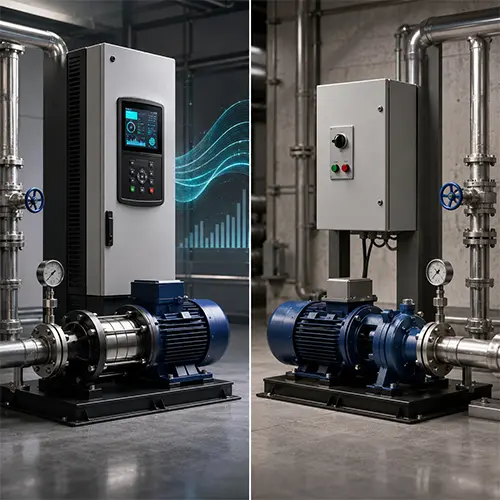
VFD pump vs fixed speed pump selection should start from the system load profile, operating hours, pressure control requirement, and lifecycle cost—not from pump price alone. A VFD pump is usually better when the system has variable flow demand, changing pressure requirements, long operating hours, frequent start-stop cycles, or high electricity cost. A fixed speed pump is usually better when the duty point is stable, the flow demand rarely changes, the system is simple, and lower control complexity matters more than energy optimization.
A VFD pump uses a Variable Frequency Drive (VFD, a motor speed control device) to adjust pump speed according to real system demand. A fixed speed pump runs at one constant motor speed and usually controls flow through valves, bypass lines, pressure tanks, or start-stop operation. This difference changes the entire pumping system: energy consumption, pressure stability, motor stress, water hammer risk, control complexity, maintenance difficulty, and lifecycle cost.
For B2B buyers, engineers, contractors, plant operators, and project decision makers, the wrong control method can create long-term hidden costs. A fixed speed pump may look cheaper during procurement but waste energy for years if the system is frequently throttled. A VFD pump may look advanced but create unnecessary control complexity if the pump runs at one stable duty point most of the time.
The practical decision is simple: choose a VFD pump when system demand changes often and energy or pressure control matters; choose a fixed speed pump when the duty is stable, the system is simple, and control complexity adds more cost than value.
Quick Answer: VFD Pump vs Fixed Speed Pump
VFD pump vs fixed speed pump comparison is mainly about whether the pump should change speed or run at one constant speed. A VFD pump can adjust speed to match changing demand. A fixed speed pump cannot adjust speed, so the system usually relies on valves, bypass, tanks, or on/off control to manage flow and pressure.
| Decision Factor | VFD Pump | Fixed Speed Pump |
| Motor speed | Adjustable | Constant |
| Best for | Variable flow, pressure control, energy saving, frequent demand changes | Stable flow, fixed duty, simple systems, low control complexity |
| Energy efficiency | Higher when demand varies | Good only when duty point is stable |
| Initial cost | Higher | Lower |
| Control complexity | Higher | Lower |
| Pressure stability | Better with sensors and control logic | Depends on valves, tanks, or start-stop control |
| Start-up impact | Softer start, lower mechanical stress | Higher start current and mechanical shock |
| Maintenance focus | Drive, sensors, control cabinet, motor cooling | Motor, starter, valves, mechanical wear |
| Failure risk | Drive fault, sensor issue, harmonics, wrong parameter setting | Energy waste, pressure fluctuation, water hammer, frequent starts |
| Best buyer priority | Long-term efficiency and control | Simplicity and lower upfront cost |
A VFD pump is usually more suitable for variable-demand systems, while a fixed speed pump is usually more suitable for stable-duty systems where the pump runs near one design point.
30-Second Decision Table for Buyers
A fast decision table helps buyers screen whether a VFD pump or fixed speed pump should be evaluated first. This table does not replace engineering calculation, but it can prevent buyers from paying for unnecessary automation or losing money through long-term energy waste.
| If Your System Condition Is... | Choose First | Why |
| Flow demand changes throughout the day | VFD pump | Speed can match real demand |
| Pressure must remain stable | VFD pump | Works with pressure sensor and PID control |
| Pump runs many hours every day | VFD pump | Energy savings may justify higher initial cost |
| System has frequent start-stop cycles | VFD pump | Soft start reduces electrical and mechanical stress |
| Electricity cost is high | VFD pump | Lower speed can reduce power consumption significantly |
| Flow demand is almost constant | Fixed speed pump | Simple and cost-effective |
| Pump runs near one duty point | Fixed speed pump | VFD may not provide enough savings |
| Small pump with low operating hours | Fixed speed pump | Payback period may be too long |
| Site maintenance team lacks control experience | Fixed speed pump or simple VFD package | Avoid unnecessary control complexity |
| Critical process needs precise flow or pressure | VFD pump with proper control design | Better controllability and monitoring |
The key point is that VFD value comes from variable demand, not from the name “variable frequency drive.” Fixed speed value comes from simplicity, not from being outdated. If the system operates at nearly full load all the time, a VFD may not save much energy. If the system often operates at partial load but uses valve throttling, a fixed speed pump may waste energy every day.
What Is a VFD Pump?
A VFD pump is a pump system controlled by a Variable Frequency Drive, which adjusts motor speed by changing electrical frequency. It is commonly selected when flow demand changes, pressure must be controlled, energy saving is important, or frequent start-stop operation causes mechanical and electrical stress.
How a VFD Pump Works
A VFD pump changes pump speed instead of forcing the pump to run at full speed all the time. By adjusting motor frequency, the VFD can reduce pump speed when demand is lower and increase speed when demand rises.
This matters because pump performance follows pump affinity laws (the relationship between pump speed, flow, head, and power). In simplified terms, flow changes roughly in proportion to speed, head changes roughly with the square of speed, and power changes roughly with the cube of speed. This is why a modest speed reduction can sometimes create meaningful energy savings in variable-demand systems.
However, VFD control is not automatic magic. A VFD pump still needs correct pump sizing, proper sensor placement, a suitable motor, safe minimum speed, stable control logic, and correct commissioning. If the pump is badly selected or the control logic is wrong, the VFD may create pressure hunting, unstable flow, motor overheating, nuisance trips, or poor efficiency.
In many field projects, a VFD pump does not fail because VFD technology is wrong. It fails because the control logic, sensor position, minimum speed limit, motor cooling, or system curve was not reviewed before commissioning.
Common Applications of VFD Pumps
VFD pumps are commonly used where flow or pressure demand changes during operation and the buyer wants better control, smoother starting, and lower energy consumption.
| Application | Why VFD Pump May Be Suitable |
| Building pressure boosting | Maintains stable pressure under changing demand |
| HVAC chilled water circulation | Adjusts flow based on cooling load |
| Industrial process water | Supports variable flow requirement |
| RO feed system | Helps stabilize pressure when demand changes |
| Municipal water supply | Reduces pressure fluctuation and energy waste |
| Cooling tower circulation | Matches flow to thermal load |
| Irrigation with variable zones | Adjusts pressure for different operating areas |
| Multi-pump systems | Supports staging and load sharing |
If the system needs stable pressure and higher head, this single stage vs multistage pump guide can help buyers decide whether the pump also needs multistage pressure-building capability.
What Is a Fixed Speed Pump?
A fixed speed pump is a pump that runs at one constant motor speed, usually controlled by a direct starter, star-delta starter, soft starter, or simple on/off control. It is commonly selected when flow demand is stable, system design is simple, and lower initial cost matters more than dynamic control.
How a Fixed Speed Pump Works
A fixed speed pump operates at a constant rotational speed. If the system needs less flow, the flow is usually controlled by valves, bypass lines, pressure tanks, or start-stop operation rather than motor speed adjustment.
This makes fixed speed pumps simple and easy to understand. The control cabinet is usually less complex, troubleshooting is more familiar to many maintenance teams, and initial cost is usually lower. For systems with a stable duty point, a fixed speed pump can be a very practical and reliable option.
The limitation appears when the system demand changes. If the pump continues running at full speed while the process needs less flow, energy may be wasted through throttling valves or bypass lines. If the system uses frequent on/off control, the motor, starter, contactor, pipework, valves, and mechanical seal may experience repeated stress.
In stable-duty systems, a fixed speed pump can be more practical than a VFD pump because fewer control components may mean fewer failure points and easier troubleshooting.
Common Applications of Fixed Speed Pumps
Fixed speed pumps are commonly used where demand is predictable and the pump runs close to its design duty point.
| Application | Why Fixed Speed Pump May Be Suitable |
| Constant-flow transfer | Demand does not change much |
| Simple tank filling | On/off control may be enough |
| Small irrigation systems | Lower control cost |
| Basic cooling circulation | Stable duty point |
| Fire pump systems | May require fixed speed or code-specific control |
| Simple industrial transfer | Easy maintenance and low complexity |
| Backup pump systems | Standby operation may not justify VFD cost |
| Low operating-hour systems | Energy savings may not justify investment |
If the buyer is mainly worried about why a pump becomes less efficient after months of operation, this pump efficiency loss guide can help separate control-related energy waste from wear, blockage, wrong duty point, and installation problems.
VFD Pump vs Fixed Speed Pump: Core Differences Buyers Must Understand
The main difference between VFD and fixed speed pumps is how the system responds to changing demand. VFD pumps adjust motor speed; fixed speed pumps keep speed constant and rely on external control methods such as valves, bypass, tanks, or start-stop logic.
Speed Control Difference
Speed control is the foundation of the comparison. A VFD pump changes speed to match demand, while a fixed speed pump continues running at the same speed even when the system needs less flow.
| Control Factor | VFD Pump | Fixed Speed Pump |
| Speed adjustment | Yes | No |
| Flow control method | Speed variation | Valve, bypass, start-stop, tank |
| Pressure control | Sensor + PID control | Pressure switch, valve, tank, or manual control |
| Low-demand operation | Can slow down | Often still runs at full speed |
| Start-up behavior | Soft start possible | Higher inrush current unless soft starter is used |
| Control tuning | Required | Minimal |
A VFD pump is more flexible because it can change motor speed. This is valuable in systems where demand rises and falls across the day. A fixed speed pump is less flexible, but it can be more stable and easier to maintain when the duty is predictable.
The buyer should not treat speed control as a luxury feature. In a variable-demand system, speed control may directly affect energy cost, pressure stability, pipe stress, and equipment life. In a stable-duty system, speed control may add cost without enough benefit.
Energy Consumption Difference
Energy consumption is often the main reason buyers consider VFD pumps. A VFD can reduce energy use when the system often operates below full demand. However, if the pump runs at full load most of the time, energy savings may be limited.
| Operating Pattern | VFD Pump Energy Result | Fixed Speed Pump Energy Result |
| Demand varies greatly | Strong saving potential | Often wastes energy through throttling |
| Demand stays constant | Limited saving potential | Can be efficient if correctly selected |
| Pump runs many hours | Savings may justify VFD cost | Energy cost may accumulate |
| Pump runs rarely | Payback may be long | Lower initial cost may be better |
| System uses valve throttling | VFD can reduce wasted energy | Energy loss often remains high |
| Oversized pump | VFD can reduce speed, but selection still needs correction | High energy waste and pressure risk |
A VFD should not be used as a permanent excuse for oversizing a pump. A VFD can reduce some consequences of oversizing, but a badly selected pump may still operate inefficiently, vibrate, overheat, or run outside the preferred operating range.
The best energy-saving result comes from correct pump selection plus suitable VFD control. If the pump is selected too far from the real duty range, VFD control may reduce symptoms but not fully solve the selection problem.
Pressure Stability Difference
Pressure stability is critical for building water supply, RO feed, process water, and systems where pressure fluctuation affects equipment or product quality. A VFD pump can adjust speed based on pressure feedback, while a fixed speed pump often relies on pressure switches, valves, or tanks.
In a VFD system, a pressure sensor sends feedback to the controller, and the VFD changes pump speed to maintain the target pressure. This is commonly done through PID control (Proportional-Integral-Derivative control, a feedback control method used to reduce the difference between actual pressure and target pressure).
A fixed speed pump can still maintain pressure in some systems, but it usually needs a pressure tank, control valve, bypass line, or on/off control. This may be enough for simple systems, but it may create more pressure fluctuation in systems with changing demand.
If the project involves RO pressure feed, this RO system pump sizing guide can help buyers check whether the required flow, pressure, and control margin are suitable before choosing VFD or fixed speed control.
Start-Up Stress and Water Hammer Difference
Start-up behavior affects pipe stress, valve life, motor current, and mechanical reliability. VFD pumps can start gradually, while fixed speed pumps may create higher inrush current and sudden hydraulic shock.
A VFD can ramp motor speed up and down, which reduces sudden acceleration. This can reduce electrical inrush current, mechanical shock, and hydraulic surge. In large systems, long pipelines, high-pressure lines, or systems with sensitive valves, this smoother start and stop can be valuable.
A fixed speed pump may start suddenly unless it uses a soft starter, star-delta starter, or other reduced-voltage starting method. Sudden starts and stops can contribute to water hammer, pipe movement, valve stress, seal stress, and higher electrical demand.
Water hammer is not caused only by the pump. It can also come from fast-closing valves, poor pipe design, sudden power loss, missing surge protection, or incorrect stop logic. But the control method affects how gently the system starts and stops.
Maintenance and Troubleshooting Difference
Maintenance does not disappear when a VFD is installed. VFD pumps shift some maintenance focus from purely mechanical components to electrical control, sensors, cooling, parameter settings, and drive protection.
| Maintenance Area | VFD Pump | Fixed Speed Pump |
| Pump mechanical parts | Required | Required |
| Motor inspection | Required | Required |
| Control cabinet | More complex | Simpler |
| Sensors | Important | May not be needed |
| Parameter settings | Critical | Minimal |
| Harmonics review | May be needed | Usually less concern |
| Troubleshooting skill | Electrical + hydraulic + control logic | Mainly electrical + hydraulic |
| Spare parts | Drive, sensors, control components | Starter, contactor, protection devices |
A VFD pump requires more control knowledge. Technicians may need to review fault logs, sensor signals, PID parameters, drive temperature, grounding, cable shielding, motor compatibility, and minimum speed settings. This does not mean VFD pumps are unreliable, but it does mean the site must be ready to maintain them.
A fixed speed pump is usually easier to troubleshoot because the control logic is simpler. However, fixed speed systems can still suffer from pressure fluctuation, water hammer, high energy use, frequent starts, and valve wear.
Load Profile: The First Data Buyers Should Check
Load profile is the most important evidence before choosing VFD or fixed speed control. Many wrong decisions happen because buyers only provide one flow and one head value, while the real system operates across several demand points.
| Load Data | Why It Matters | Selection Impact |
| Minimum flow demand | Shows how low the system operates | Strongly affects VFD value |
| Average flow demand | Shows normal operating condition | Helps estimate real energy use |
| Peak flow demand | Confirms maximum pump requirement | Determines sizing limit |
| Daily operating hours | Shows how long energy savings can accumulate | Affects payback period |
| Seasonal variation | Shows whether demand changes by season | Supports VFD selection if variation is large |
| Valve throttling percentage | Shows hidden energy waste | High throttling favors VFD review |
| Number of operating zones | Shows pressure/flow variation | Multi-zone systems often benefit from VFD |
| Start-stop frequency | Shows mechanical/electrical stress | Frequent starts favor VFD or soft start review |
The most useful buyer question is not “Does VFD save energy?” The better question is: How many hours does the pump run below full demand, and how is flow currently controlled during those hours?
If the answer is “the pump runs many hours at partial demand and the valve is often throttled,” VFD may have strong value. If the answer is “the pump runs only briefly at one fixed duty point,” fixed speed may be more practical.
How to Estimate Whether a VFD Pump Is Worth the Cost
A VFD pump is worth the cost when its energy savings, pressure-control benefits, and reduced mechanical stress are greater than the added cost of the VFD, sensors, control cabinet, commissioning, and maintenance. Buyers should not accept a vague “VFD saves energy” claim without checking the operating pattern.
The practical estimation starts with five numbers: pump operating hours, electricity price, estimated load variation, current throttling or bypass loss, and the added cost of the VFD package. Without these numbers, the payback discussion is only a guess.
| Estimation Factor | What Buyers Should Check | Why It Matters |
| Operating hours | Hours per day and days per year | More hours increase savings potential |
| Electricity price | Local electricity cost per kWh | Higher energy price improves payback |
| Low-load operation | Percentage of time below full demand | More partial-load operation favors VFD |
| Current control method | Valve throttling, bypass, start-stop, tank | Shows where energy is wasted |
| Added VFD cost | Drive, cabinet, sensor, wiring, commissioning | Determines payback period |
| Maintenance capability | Can the site maintain drive and sensors? | Poor maintenance can reduce real value |
| Process value | Pressure stability, reduced water hammer, fewer starts | Benefits may exceed energy savings alone |
A useful rule is this: VFD has stronger value when the pump runs long hours at variable demand; fixed speed has stronger value when the pump runs short hours at stable demand.
For example, a building booster system that runs 16 hours per day with large demand changes may justify VFD quickly. A small transfer pump that runs 30 minutes per day at one duty point may not.
VFD Pump Payback Period: When Does the Higher Cost Make Sense?
VFD pump payback period should be calculated from realistic energy savings, not from ideal conditions. The payback period is the time required for energy savings and operational benefits to recover the added VFD investment.
A simple payback logic is:
Payback period = Added VFD system cost ÷ Estimated annual savings
Estimated annual savings can include reduced electricity use, fewer start-stop failures, lower valve throttling loss, reduced pressure fluctuation damage, and lower downtime risk. However, energy savings should be separated from non-energy benefits so the buyer can see the real business case.
| Payback Factor | Strong VFD Case | Weak VFD Case |
| Operating hours | Many hours per day | Few hours per week |
| Demand pattern | Highly variable | Almost constant |
| Electricity cost | High | Low |
| Current control | Heavy throttling or bypass | Stable duty with little throttling |
| Pressure requirement | Tight pressure control needed | Pressure variation acceptable |
| Start-stop frequency | Frequent starts | Rare starts |
| Maintenance skill | Team can maintain VFD system | Team lacks control experience |
| Added cost | Reasonable compared with savings | High compared with operating hours |
A VFD may make strong financial sense if the payback period is acceptable for the project owner. For many industrial and building systems, buyers often expect a payback that fits their internal investment rules. Some projects may accept a longer payback if pressure stability, soft start, water hammer reduction, or process protection is critical.
A VFD should not be rejected only because payback is not immediate. It should also not be accepted only because payback is promised. The supplier should show the assumptions: operating hours, load profile, electricity cost, expected speed range, and control method.
Field Service Notes From VFD and Fixed Speed Pump Failures
Field service experience shows that VFD and fixed speed pump failures often come from different root causes. VFD problems often come from control design and commissioning. Fixed speed problems often come from using a simple control method in a variable-demand system.
VFD energy savings often fail to meet expectations when the pump runs near full load most of the time. The buyer expects large savings, but the system has little partial-load operation. In this situation, the VFD may still provide soft start or pressure control benefits, but the energy-saving case is weak.
Pressure hunting in VFD systems often comes from poor sensor placement or PID tuning, not from the pump itself. If the pressure sensor is too close to the pump, too far from the critical demand point, or installed in a turbulent section, the controller may receive unstable feedback and continuously change speed.
Fixed speed pumps often waste energy when operators use throttling valves to reduce flow for long hours. The pump still runs at full speed, but the valve forces the system to waste pressure. The buyer may see a low initial pump cost, but the electricity bill becomes the real cost.
In many retrofit projects, the first audit should check valve position, load profile, operating hours, pressure fluctuation, and start-stop frequency before recommending VFD. If the system is constantly throttled, VFD deserves serious review. If the system runs steadily at one duty point, correct fixed speed selection may be enough.
The practical lesson is clear: VFD pumps need load data and control tuning; fixed speed pumps need stable duty and proper flow-control strategy.
VFD Pump Advantages and Limitations
VFD pumps are valuable when the system has variable demand, pressure control requirements, high operating hours, or frequent start-stop conditions. However, buyers should not ignore higher initial cost, control complexity, drive cooling, harmonics, sensor reliability, and commissioning quality.
Main Advantages of VFD Pumps
VFD pump advantages mainly come from matching pump speed to real demand. When the system does not need full flow, the pump can slow down instead of wasting energy through throttling.
The main advantages include better energy savings in variable-demand systems, more stable pressure control, softer start and stop, lower mechanical and hydraulic shock, reduced valve throttling losses, better multi-pump staging, improved load sharing, automation readiness, and remote monitoring potential.
For building pressure boosting, VFD control can reduce pressure swings during peak and low-demand periods. For HVAC circulation, VFD control can match flow to cooling or heating load. For industrial water systems, VFD control can support different process demand levels without constantly changing valves.
Main Limitations of VFD Pumps
VFD pump limitations mainly come from control complexity. A VFD is not simply an energy-saving box. It must be matched with the pump, motor, control logic, sensor position, electrical environment, and operating range.
The main limitations include higher initial cost, more complex control cabinet design, parameter-setting requirements, sensor dependency, potential harmonics, cabinet cooling needs, motor cooling concerns at low speed, and a higher troubleshooting skill requirement.
A VFD pump may also be unnecessary if the demand is stable. When the pump runs near full load most of the time, the VFD may provide soft start and monitoring benefits, but energy savings may not justify the investment.
When Not to Choose a VFD Pump
A VFD pump should not be selected only because it sounds advanced. If the system runs at a stable duty point most of the time and the pump already operates efficiently, VFD savings may be limited.
A VFD pump may not be the best choice when flow demand is nearly constant, the pump runs only a few hours per week, the initial budget is very limited, the site lacks electrical/control maintenance capability, the system requires code-specific fixed-speed operation, or control failure would create higher risk than energy waste.
For these projects, a fixed speed pump with correct sizing, proper protection, and a simple control method may provide better lifecycle value.
Fixed Speed Pump Advantages and Limitations
Fixed speed pumps are valuable when the system has stable demand, simple operation, low operating hours, and the buyer wants lower upfront cost and easier troubleshooting. However, fixed speed pumps can waste energy when used in variable-demand systems or when flow is controlled mainly by throttling valves.
Main Advantages of Fixed Speed Pumps
Fixed speed pump advantages mainly come from simplicity. For systems with a clear and stable duty point, a fixed speed pump can be easier to purchase, install, operate, and maintain.
The main advantages include lower initial cost, simpler control system, easier maintenance, easier troubleshooting, fewer control components, suitability for stable duty points, suitability for low operating-hour applications, and practicality for standby or backup use.
A fixed speed pump can be a good choice for simple tank transfer, constant-flow industrial transfer, low-hour irrigation, and standby systems where dynamic pressure control is not required.
Main Limitations of Fixed Speed Pumps
Fixed speed pump limitations come from constant-speed operation. When demand falls, the pump still runs at the same speed, so the system must control flow by other methods.
The main limitations include lower efficiency in variable-demand systems, higher energy waste if throttling is common, more pressure fluctuation in some systems, higher start-up current unless a soft starter is used, more mechanical shock during start-stop, possible water hammer, less flexible automation, and possible need for larger tanks or valves.
A fixed speed pump can be reliable, but it can also become expensive if it is used in the wrong control environment. Long operating hours plus variable demand can turn a low upfront cost into a high energy bill.
When Not to Choose a Fixed Speed Pump
A fixed speed pump should not be selected only because it is cheaper. If the system has variable demand, high operating hours, pressure stability requirements, or frequent throttling, the lower upfront cost may become higher long-term cost.
A fixed speed pump may not be suitable for building pressure systems with changing demand, cooling circulation with variable load, multi-zone irrigation, RO feed systems requiring tighter pressure control, or industrial processes where flow and pressure must be adjusted frequently.
If the pump spends many hours running against a throttled valve, the buyer should evaluate VFD control before final selection.
VFD Pump vs Fixed Speed Pump by Application Scenario
Different applications require different control strategies. Buyers should choose based on load variation, operating hours, pressure control needs, energy cost, and maintenance capability.
| Application Scenario | Recommended Control Method | Reason |
| Building pressure boosting | VFD pump | Demand changes throughout the day |
| HVAC chilled water circulation | VFD pump | Flow can match cooling load |
| RO feed system | VFD pump or fixed speed with control review | Depends on pressure stability and membrane requirement |
| Constant tank transfer | Fixed speed pump | Simple duty and predictable operation |
| Small irrigation system | Fixed speed pump or VFD | Depends on zones and operating hours |
| Multi-zone irrigation | VFD pump | Different zones may need different pressure/flow |
| Industrial process water | VFD pump if demand varies | Improves process control |
| Cooling tower circulation | VFD pump | Load often changes with temperature |
| Fire pump system | Usually fixed speed or code-specific | Must follow fire protection requirements |
| Backup pump | Fixed speed pump | Low operating hours may not justify VFD |
This table is a first screening tool. The final decision still needs flow range, pressure range, operating hours, electricity cost, pump curve, system curve, control requirement, and maintenance capability.
Real Application Cases: How the Choice Changes by Site
Real application cases help buyers understand why VFD vs fixed speed pump selection must match operating demand. The same pump flow and head can lead to different control choices depending on load variation, energy cost, pressure stability, and failure consequence.
Case 1: Building Booster System With Variable Demand
A building booster system usually has changing demand during the day. Morning and evening peak water use may require higher flow, while night demand may be much lower. In this case, a VFD pump can adjust speed to maintain pressure and reduce unnecessary energy use.
The wrong choice is using a fixed speed pump without enough pressure buffering or control strategy. This may cause pressure fluctuation, frequent start-stop, higher energy use, and poor user comfort.
The correct decision is to evaluate a VFD booster system first, especially when pressure stability and long operating hours matter.
Case 2: Simple Tank Filling System
A simple tank filling system may not require VFD control if the pump only transfers water from one tank to another at a stable duty point. On/off control with a level switch may be enough.
The wrong choice is adding VFD control only because it sounds more advanced. This may increase purchase cost and troubleshooting complexity without meaningful energy savings.
The correct decision is to choose a fixed speed pump if the system has simple operation, low operating hours, and stable demand.
Case 3: Industrial Cooling Water System
An industrial cooling water system may need either VFD or fixed speed control depending on thermal load variation. If cooling demand changes with production load or ambient temperature, VFD control may save energy. If cooling load is stable, fixed speed may be enough.
The wrong choice is choosing fixed speed only because the initial quote is lower while ignoring years of throttling loss. If the system is frequently throttled, energy cost may exceed the VFD price difference over time.
The correct decision is to review operating hours, flow variation, valve throttling percentage, and electricity cost before deciding.
Case 4: RO Feed Pump System
An RO feed pump may require stable pressure and controlled flow. VFD control can be useful when feed pressure needs adjustment, membrane condition changes, or operating conditions vary.
The wrong choice is using fixed speed without proper pressure control in a system where pressure fluctuation affects membrane performance. This can create unstable operation and higher system stress.
The correct decision is to evaluate VFD when pressure control is important, but pump sizing and control margins must be calculated carefully.
Case 5: Standby or Emergency Pump
A standby pump may run only during failure or emergency. If operating hours are very low, VFD energy savings may not justify the higher cost.
The wrong choice is over-specifying VFD for a rarely used standby pump. This can increase procurement cost and add control components that still require inspection and maintenance.
The correct decision is to use fixed speed unless soft start, pressure control, or special process control is clearly required.
Common Selection Mistakes When Comparing VFD and Fixed Speed Pumps
Most selection mistakes happen because buyers compare only initial price or assume VFD always saves energy. Correct selection must consider load profile, operating hours, pump curve, system curve, pressure requirement, control capability, and maintenance skill.
Mistake 1: Assuming VFD Always Saves Energy
VFD saves energy mainly when the system demand varies and the pump often runs below full load. If the pump runs near full load most of the time, savings may be limited.
Buyers should ask for estimated savings based on real operating hours and load profile, not only general claims about variable speed control.
Mistake 2: Using VFD to Hide Pump Oversizing
A VFD can reduce speed, but it should not be used to justify poor pump sizing. An oversized pump may still operate inefficiently or outside the preferred operating range.
Correct pump selection must come first. VFD control should improve a properly selected system, not cover a wrong pump selection.
Mistake 3: Choosing Fixed Speed Because Initial Cost Is Lower
Fixed speed pumps are cheaper upfront, but they can become expensive if they run many hours under throttled conditions or cause pressure fluctuation and water hammer.
Buyers should compare lifecycle cost, not just the initial quotation.
Mistake 4: Ignoring Minimum Speed and Motor Cooling
Motor cooling can become a concern when a VFD pump runs at low speed for long periods. Buyers should confirm minimum speed, motor type, cooling method, and allowable operating range.
This is especially important when a pump is expected to operate for long hours at low speed.
Mistake 5: Ignoring Sensor Location and Control Logic
A VFD pump depends on sensor feedback. Wrong sensor location, poor PID tuning, unstable pressure signals, or bad control logic can cause pressure hunting, unstable flow, or frequent trips.
A VFD quote should include control logic, sensor type, sensor position, and commissioning support.
Mistake 6: Ignoring Harmonics and Electrical Environment
VFDs can create harmonics in some electrical systems. Large pumps, sensitive equipment, or weak power networks may require harmonic review, filters, or proper grounding design.
This does not mean VFD should be avoided. It means the electrical environment should be reviewed before installation.
Troubleshooting: What Can Go Wrong After Installation?
Post-installation symptoms often show whether the control method was selected and commissioned correctly. Buyers should diagnose both hydraulic and control-system causes instead of blaming only the pump.
| Symptom | More Common With | Possible Cause | What to Check |
| Pressure fluctuates | VFD pump | Poor PID tuning, wrong sensor position | Sensor location, control parameters |
| Pump trips at low speed | VFD pump | Motor cooling, overload, minimum speed too low | Motor data, VFD settings, load condition |
| Energy savings are lower than expected | VFD pump | Pump runs near full load, wrong sizing | Load profile, pump curve, operating hours |
| Water hammer occurs | Fixed speed pump | Sudden start/stop or valve closure | Start method, valve timing, pipe system |
| Motor starts too often | Fixed speed pump | Poor tank sizing or control logic | Pressure tank, switch settings |
| High energy bill | Fixed speed pump | Valve throttling, oversized pump | Valve position, pump curve, duty point |
| VFD fault alarms | VFD pump | Overvoltage, overheating, harmonics, poor grounding | Power quality, cabinet cooling, fault log |
| Flow is unstable | Both | Wrong duty point, air, cavitation, control conflict | System curve, suction condition, control mode |
Troubleshooting should start with the full system. A VFD fault may come from electrical conditions, cooling, grounding, or control settings. A fixed speed problem may come from suction design, valve throttling, sudden starts, or poor pressure tank sizing.
Step-by-Step Guide: How to Choose Between VFD and Fixed Speed Pump
The correct selection process should start from demand variation and operating hours, then evaluate pressure control, energy cost, pump curve, system curve, maintenance capability, and payback period.
Step 1: Confirm the Load Profile
Load profile is the first decision point. Buyers should identify whether the system demand is constant, variable by hour, variable by season, or controlled by different zones.
Buyers should confirm minimum flow demand, average flow demand, peak flow demand, daily operating hours, seasonal variation, valve throttling percentage, and the number of operating zones.
If the pump runs across a wide range of flow conditions, VFD should be evaluated. If the pump runs at one stable duty point, fixed speed may be enough.
Step 2: Review Operating Hours and Electricity Cost
Operating hours determine whether VFD energy savings can justify higher initial cost. A pump that runs many hours per day has much stronger VFD payback potential than a pump that runs occasionally.
Buyers should confirm hours per day, days per year, electricity price, existing energy bill, estimated low-load operating time, and expected project life.
A VFD may be financially attractive when the pump runs many hours under partial load. A fixed speed pump may be more practical when the pump runs rarely or only for short transfer cycles.
Step 3: Check Pressure Stability Requirements
Pressure stability determines whether VFD control is necessary for process reliability or user comfort. Building booster, RO feed, process water, and multi-zone systems often need tighter control than simple transfer applications.
Buyers should confirm required pressure range, acceptable pressure fluctuation, sensor position, control response speed, process sensitivity, and water hammer risk.
If pressure fluctuation affects product quality, membrane performance, user comfort, or downstream equipment, VFD control should be reviewed carefully.
Step 4: Review Pump Curve and System Curve
Pump curve and system curve determine whether the pump can operate efficiently across the required speed range. A VFD does not remove the need for correct pump selection.
Buyers should confirm selected duty point, preferred operating range, minimum safe flow, maximum speed, minimum speed, NPSH condition, and efficiency at different speeds.
A VFD pump should not be selected without checking whether the pump remains stable and efficient across the expected operating range.
Step 5: Compare Lifecycle Cost and Payback Period
Lifecycle cost includes pump price, VFD cost, control cabinet, sensors, energy cost, maintenance, downtime, troubleshooting, and spare parts. Buyers should calculate payback based on real operating demand, not only theoretical savings.
| Cost Factor | VFD Pump | Fixed Speed Pump |
| Initial cost | Higher | Lower |
| Energy cost | Lower in variable systems | Higher if throttling is common |
| Control cost | Higher | Lower |
| Maintenance skill | Higher | Lower |
| Pressure stability | Better with proper tuning | Lower unless supported by tanks/valves |
| Startup stress | Lower | Higher without soft starter |
| Payback potential | Strong with long hours and variable load | Better when demand is stable |
| Failure complexity | Higher | Lower |
The right control method is the one with the best lifecycle value. If VFD payback is clear and the site can maintain the control system, VFD may be the better investment. If payback is weak and the duty is stable, fixed speed may be more rational.
Information to Send Before Asking for a Pump Quotation
Complete operating information helps the supplier recommend the correct control method. If buyers only send flow and head, the supplier may quote a pump that meets hydraulic duty but fails to optimize energy, pressure, or lifecycle cost.
| Information to Send | Why It Matters |
| Required flow range | Determines whether variable speed is useful |
| Required head or pressure range | Confirms pressure control need |
| Minimum, average, and peak demand | Defines load profile |
| Daily operating hours | Affects VFD payback |
| Electricity cost | Affects energy-saving value |
| Existing control method | Shows current inefficiency or failure point |
| Valve throttling percentage | Indicates energy waste |
| Pressure fluctuation issue | Determines control requirement |
| Water hammer history | Affects start-stop strategy |
| Motor power and voltage | Confirms VFD compatibility |
| Control cabinet condition | Affects upgrade cost |
| Site maintenance capability | Determines practical complexity |
| Sensor availability | Affects VFD control feasibility |
| Process sensitivity | Determines pressure/flow stability requirement |
A buyer who provides load profile and operating hours will usually receive a better recommendation than a buyer who only asks for “a VFD pump price.” Pump control selection depends on how the system actually operates.
Supplier Quotation Red Flags Before Final Selection
A reliable supplier should explain why VFD or fixed speed control fits the system load profile, pressure requirement, operating hours, and maintenance capability. A quotation that only lists pump model, motor power, and price is not enough for serious B2B decision-making.
| Red Flag | Why It Is Risky | What Buyers Should Ask |
| VFD recommended without load profile | Savings may be unrealistic | Ask for operating-hour and demand analysis |
| Fixed speed recommended without control review | Energy waste or pressure fluctuation may be ignored | Ask how flow and pressure will be controlled |
| No pump curve | Duty point cannot be verified | Ask for selected duty point and operating range |
| No system curve discussion | Control may not match real system | Ask how pump responds to changing demand |
| No minimum speed limit | Motor cooling or pump stability risk | Ask for allowable speed range |
| No sensor/control logic | VFD performance unclear | Ask for sensor type, position, and PID control plan |
| No harmonic or electrical review | Electrical issues may appear later | Ask if filters or grounding review is needed |
| Only promises “energy saving” | Overclaiming risk | Ask for estimated payback assumptions |
A VFD quotation should not only say “energy saving.” It should explain the assumptions behind the saving. A fixed speed quotation should not only say “lower cost.” It should explain how the system will manage pressure, flow, starts, and throttling.
Documents Buyers Should Request from the Pump Supplier
Supplier documents help buyers verify whether the selected control method is technically justified. This is especially important for VFD booster systems, RO feed pumps, HVAC circulation, municipal water systems, and high operating-hour industrial applications.
| Document | Why It Matters |
| Pump datasheet | Confirms model, flow, head, power, speed |
| Pump curve | Confirms duty point and operating range |
| Efficiency curve | Helps estimate energy use |
| VFD datasheet | Confirms drive rating and functions |
| Control logic description | Explains pressure or flow control method |
| Sensor specification | Confirms feedback accuracy |
| Wiring diagram | Helps installation and troubleshooting |
| Motor specification | Confirms VFD compatibility |
| Minimum speed guidance | Protects motor and pump |
| Harmonic guidance | Helps avoid electrical issues |
| Operation manual | Supports commissioning and maintenance |
| Spare parts list | Reduces downtime |
For B2B procurement, documentation is part of risk control. A supplier that can explain the pump curve, control logic, motor compatibility, and payback assumptions is easier to trust than a supplier that only provides a low price.
Acceptance Checklist Before Final Purchase
An acceptance checklist helps buyers confirm whether the selected VFD pump or fixed speed pump can operate safely, efficiently, and reliably under real site conditions.
| Checklist Item | VFD Pump | Fixed Speed Pump |
| Load profile | Confirm minimum, average, peak demand | Confirm stable duty point |
| Pump curve | Confirm speed range and operating range | Confirm selected duty point |
| Control method | Confirm PID, sensor, and logic | Confirm starter, switch, tank, valve, or bypass |
| Energy expectation | Confirm payback assumptions | Confirm throttling or start-stop impact |
| Motor compatibility | Confirm VFD-rated motor if needed | Confirm starter and protection |
| Minimum speed | Confirm cooling and stable operation | Not usually applicable |
| Electrical review | Confirm grounding, cooling, harmonics | Confirm starting current and protection |
| Maintenance plan | Confirm VFD and sensor inspection | Confirm motor, starter, valve inspection |
| Protection logic | Confirm overload, dry-run, pressure, temperature | Confirm overload and abnormal operation protection |
| Documents | Datasheet, curve, VFD data, wiring, manual | Datasheet, curve, starter data, manual |
A pump should not be accepted only because the flow and head match the requirement. Buyers should confirm how the system will be controlled, protected, maintained, and verified after installation.
Applicable Pump Types and Scope of This Guide
This guide applies mainly to pump control method selection where buyers compare variable speed control and constant speed operation. It is most useful for clean water, pressure boosting, circulation, transfer, RO feed, irrigation, HVAC, and industrial utility water systems.
Applicable Pump Types
This guide is most applicable when the same pump hydraulic duty can be operated either through VFD control or fixed speed control.
| Pump Type | Applicability |
| End suction pump | Can use VFD or fixed speed depending on demand |
| Inline pump | Common in building and circulation systems |
| Multistage pump | Often paired with VFD for pressure boosting |
| Split case pump | VFD useful for large variable-flow systems |
| RO feed pump | VFD may improve pressure control |
| Irrigation pump | Depends on zones and operating hours |
| Cooling water pump | VFD useful if load changes |
| Booster pump | VFD common for pressure stability |
The pump type and the control method should be selected together. A good VFD cannot fix every wrong pump type, and a fixed speed pump can still work very well when the pump and system are correctly matched.
Use With Adjustment
Some pump applications require additional review because codes, safety requirements, process sensitivity, or electrical conditions may dominate the control decision.
Fire pump systems may require code-specific controls. Hazardous areas may require certified electrical design. Large motors may require electrical studies. Slurry or solids-containing systems may require hydraulic review. Strict pressure or flow tolerance systems may require control validation.
In these applications, VFD vs fixed speed is only one part of the final engineering decision.
Not Suitable For
This guide should not replace project-specific electrical engineering, control system design, or safety review for regulated or critical pumping systems.
It should not be used as the only basis for certified fire protection systems without code review, explosion-proof environments without certified VFD design, severe slurry applications without hydraulic review, large municipal systems without electrical study, processes requiring formal control validation, or systems with unknown load profile and no operating data.
In these cases, buyers should request engineering review, electrical documentation, control logic, and project-specific verification before final selection.
Practical Decision Framework: Which Control Method Should You Choose?
The simplest decision framework is to start with load variation, then check operating hours, pressure stability, electricity cost, and maintenance capability.
Choose a VFD pump if flow demand changes often, pressure stability is important, the pump runs many hours per day, electricity cost is high, valve throttling is common, frequent start-stop causes stress, multi-pump staging is needed, or automation and monitoring are required.
Choose a fixed speed pump if demand is stable, the pump runs near one duty point, operating hours are low, initial cost matters most, the site maintenance team needs simple equipment, standby operation is the main purpose, or code or process requirements favor fixed-speed operation.
Do not choose VFD only because it sounds more advanced, the supplier promises energy saving without data, the pump is oversized and VFD is used as a cover, the site cannot maintain control equipment, or the system runs almost always at full demand.
Do not choose fixed speed only because it is cheaper upfront if the system has variable demand, electricity cost is high, pressure fluctuation already exists, valve throttling is frequent, or water hammer and frequent start-stop are damaging the system.
FAQ About VFD Pump vs Fixed Speed Pump
VFD pump vs fixed speed pump questions usually come from real buyer concerns about energy savings, cost, pressure control, maintenance, payback period, motor protection, and when VFD control is unnecessary.
Is a VFD pump always better than a fixed speed pump?
A VFD pump is not always better. It is better when demand varies, pressure control matters, or energy savings can justify the higher cost.
A fixed speed pump may be better when demand is stable, operating hours are low, and simplicity is more important than energy optimization.
Does a VFD pump always save energy?
A VFD pump does not always save energy. It saves energy mainly when the pump often runs below full demand.
If the pump runs near full load most of the time, energy savings may be limited, although soft start and control benefits may still have value.
When should I choose a VFD pump?
Choose a VFD pump when flow demand changes, pressure needs to stay stable, the pump runs many hours, electricity cost is high, or frequent start-stop creates stress.
VFD is also useful for multi-pump systems, building pressure boosting, HVAC circulation, and applications requiring automation.
When should I choose a fixed speed pump?
Choose a fixed speed pump when the duty point is stable, the pump runs occasionally, the system is simple, and lower upfront cost or easier maintenance matters more than energy optimization.
Fixed speed is often practical for simple transfer, small systems, backup pumps, and low-hour applications.
Can VFD solve pump oversizing?
A VFD can reduce speed and help manage some oversizing consequences, but it should not be used as a substitute for correct pump selection.
The pump still needs to operate within a safe and efficient range. Oversizing should be corrected at the selection stage whenever possible.
What is the main risk of VFD pumps?
The main risks include poor parameter setting, wrong sensor location, drive overheating, harmonics, motor cooling issues at low speed, and control logic problems.
These risks can be managed through proper design, commissioning, documentation, and maintenance.
What is the main risk of fixed speed pumps?
The main risks include energy waste from throttling, pressure fluctuation, high start current, water hammer, frequent start-stop, and inefficient operation when demand varies.
These risks become more serious in long-hour and variable-demand systems.
Is VFD worth the higher cost?
VFD is worth the higher cost when the pump runs many hours and demand changes frequently. Buyers should compare energy savings, control benefits, maintenance cost, and payback period.
If operating hours are low or demand is stable, fixed speed may provide better value.
Does a VFD pump need special maintenance?
A VFD pump needs normal pump maintenance plus drive inspection, cabinet cooling, sensor checks, parameter review, and electrical protection checks.
Maintenance teams should know how to read drive fault logs and check sensor signals.
What information should I send to the supplier?
Buyers should provide flow range, pressure range, operating hours, electricity cost, load variation, existing control method, valve throttling condition, motor voltage, site maintenance capability, and control requirements.
This information helps the supplier recommend a control method based on real operation, not only theoretical pump duty.
Conclusion: VFD or Fixed Speed Pump — Choose by Load Profile, Control Need, and Lifecycle Cost
VFD pump vs fixed speed pump selection should be based on load profile, operating hours, pressure stability, electricity cost, control complexity, maintenance capability, and lifecycle cost. VFD pumps are usually better for variable-demand systems, while fixed speed pumps are usually better for stable-duty systems.
For buyers, the safest decision is to separate pump hydraulic duty from control strategy. Flow and head tell you what the pump must deliver. Load profile, operating hours, pressure variation, electricity cost, valve throttling, start-stop frequency, and maintenance capability tell you whether VFD control is worth the cost.
Choose a VFD pump for variable flow, high operating hours, pressure stability, energy-saving potential, frequent start-stop reduction, and multi-pump control. Choose a fixed speed pump for stable duty, simple transfer, low operating hours, lower upfront cost, standby service, and sites where simple maintenance is more important than dynamic control.
The wrong control method may still work during commissioning, but create long-term cost after installation. A fixed speed pump may waste energy through throttling, create pressure fluctuation, or suffer from frequent starts. A VFD pump may fail to deliver expected savings if the load profile is stable, the pump is oversized, the sensor is poorly located, or the control parameters are not commissioned correctly.
Before final selection, buyers should ask the supplier to explain the control logic, provide the pump curve and efficiency curve, review the load profile, estimate energy savings, confirm minimum speed, verify motor compatibility, clarify sensor position, and provide wiring and commissioning documents. A technically justified recommendation is more valuable than a quotation that only says “VFD pump” or “fixed speed pump.”
Get A Quote

Get A Quote
0 Comments