
Which Pump Type Saves More Energy? A Practical Guide for Pump Buyers
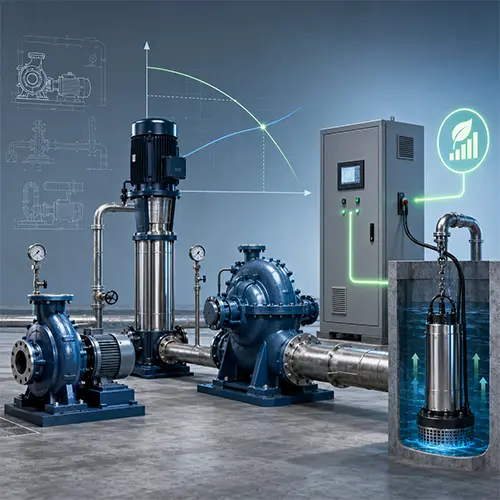
The pump type that saves the most energy is not always the pump with the highest catalog efficiency, the smallest motor power, or the lowest purchase price. For buyers, the most energy-saving pump is the one that delivers the required flow and head near its Best Efficiency Point, matches the real liquid and system curve, avoids unnecessary throttling, and uses the right control method during daily operation. End suction pumps, inline pumps, multistage pumps, split case pumps, submersible pumps, deep well pumps, sewage pumps, slurry pumps, fixed-speed pumps, and VFD-controlled pump systems can all save energy in the right application. They can also waste energy if selected incorrectly.
For procurement teams, project engineers, plant managers, farm operators, building owners, distributors, and pump buyers, the real question is not: “Which pump type is always the most energy-efficient?” The better question is: “Which pump type can move my required liquid at the required flow and head with the lowest total energy cost during real operation?”
This distinction matters because pump energy cost is rarely decided by pump type alone. A high-efficiency pump can waste electricity if it is oversized. A small pump can waste energy if it runs too long or cannot meet the required pressure. A VFD-controlled pump can save energy in variable-demand systems, but it may not create meaningful savings in a stable constant-flow duty. A sewage pump may look less efficient than a clean-water pump in catalog data, but if the liquid contains solids, the correct sewage pump may save more real operating cost by avoiding clogging, overload, and maintenance downtime.
The most energy-saving pump type is the one that matches the real flow, head, liquid, system curve, control requirement, and operating hours—not the one with the biggest motor, highest advertised efficiency, or lowest purchase price.
Direct Answer: Which Pump Type Saves the Most Energy?
No single pump type saves the most energy in every system. The most energy-efficient pump is the pump that operates near its Best Efficiency Point, matches the required flow and head, handles the real liquid correctly, avoids unnecessary throttling, and uses the right control method. End suction pumps often fit moderate clean-water duty, multistage pumps fit high-head duty, split case pumps fit large-flow duty, submersible deep well pumps fit well lifting, sewage pumps fit dirty water, slurry pumps fit abrasive liquid, and VFD-controlled systems fit variable demand.
This direct answer prevents the most common buying mistake: ranking pump types by catalog efficiency alone. A split case pump may be very efficient in a large-flow clean-water system, but unsuitable for sewage. A multistage pump may save energy in high-head duty, but waste energy if the pressure is oversized. A VFD may save energy when demand changes, but add limited value in stable constant-flow systems.
For energy-saving pump selection, buyers should always compare:
- required flow
- required head
- liquid type
- pump curve
- system curve
- Best Efficiency Point
- motor efficiency
- control method
- annual operating hours
- maintenance condition
- lifecycle cost
Quick Answer: Which Pump Type Usually Saves More Energy?
No pump type saves energy in every system. The energy-saving direction depends on the application condition, required flow, required head, liquid type, demand pattern, and operating hours. This quick table helps buyers make an initial judgment before reviewing pump curves and lifecycle cost.
| Application Condition | Usually More Energy-Efficient Direction | Why |
|---|---|---|
| Low to medium flow, moderate head, clean water | End suction pump | Simple hydraulic path and good efficiency range |
| Space-limited building water supply | Inline pump | Compact layout and lower piping modification cost |
| High head, moderate flow | Multistage pump | Better than forcing a single-stage pump into high-head duty |
| Large flow, low to medium head | Split case pump | High efficiency for large-volume clean-water transfer |
| Deep well water lifting | Submersible deep well pump | Designed for well depth, dynamic water level, and vertical lifting |
| Variable demand system | VFD-controlled pump | Reduces speed instead of wasting energy through throttling |
| Constant demand system | Fixed-speed correctly sized pump | Lower complexity when duty is stable |
| Dirty water or sewage | Correct sewage pump | Avoids clogging, overload, and efficiency loss |
| Slurry or abrasive liquid | Slurry pump | Energy saving comes from wear-resistant design, not peak clean-water efficiency |
| Oversized existing pump | Smaller pump or VFD retrofit | Reduces wasted head, throttling loss, and unnecessary motor load |
The key point is simple: the most energy-saving pump type is the one that matches the real flow, head, liquid, system curve, and control requirement. A pump that looks efficient in a catalog can still waste electricity if it operates far from the real duty point.
Key Takeaway for Buyers
A pump saves energy when it operates near its Best Efficiency Point, delivers only the required flow and head, avoids unnecessary throttling, and matches the real operating pattern. For constant-duty clean water systems, a correctly sized end suction, split case, or multistage pump may save energy. For variable-demand systems, a properly selected VFD-controlled pump often saves more energy. For dirty water, sewage, slurry, or deep well applications, the most efficient choice is the pump type designed for that liquid and installation condition.
Best Efficiency Point, or BEP, is the operating area where a pump converts energy into water movement most efficiently and most smoothly. If a pump runs far away from BEP, it may consume more energy, vibrate more, wear faster, create noise, overheat, or suffer from cavitation. Cavitation is the formation and collapse of vapor bubbles inside the pump, which can damage impellers and reduce performance.
For buyers, the biggest mistake is comparing only motor power. A 15 kW pump is not automatically cheaper to run than an 18.5 kW pump if the 15 kW pump operates inefficiently, runs longer, or cannot meet the required duty. Real energy saving should be measured by input power per delivered flow, annual operating hours, reliability, and lifecycle cost.
30-Second Energy-Saving Decision Table
This table gives buyers a fast first filter before requesting a detailed pump quotation. It does not replace hydraulic calculation, but it helps prevent common purchasing mistakes such as oversizing, choosing by motor kW, or assuming VFD always saves energy.
| If Your System Is... | Check This First | Likely Energy-Saving Direction |
|---|---|---|
| Pump runs 8–24 hours/day | Duty point and efficiency curve | High-efficiency correctly sized pump |
| Flow demand changes during the day | Control method | VFD-controlled pump |
| Pump outlet valve is always throttled | Oversizing | Smaller pump or VFD |
| Pressure is much higher than needed | Excess head | Recalculate head and select lower-head pump |
| Large volume transfer | Flow and pipe loss | Split case or optimized end suction pump |
| High building pressure boosting | Required head | Multistage pump or booster system |
| Deep well pumping | Well depth and dynamic water level | Submersible deep well pump |
| Dirty water or sewage | Solids and clogging risk | Sewage pump, not clean-water pump |
| Pump electricity cost is high | Operating hours and current | Audit pump curve, motor load, and system curve |
| Buyer only compares kW | Real hydraulic output | Compare energy per cubic meter pumped |
This table should be used as a first decision guide. Final selection still requires actual flow, actual head, liquid properties, pump curve, motor efficiency, pipe friction, control method, and annual runtime.
Scope of This Guide: Applicable Pump Types and Operating Conditions
This guide applies to common electric pump systems where buyers need to reduce energy cost, compare pump types, or improve lifecycle cost. It is especially useful for B2B procurement, factory utility water, building services, irrigation, HVAC circulation, municipal water transfer, and long-hour pumping systems.
This guide applies well to:
- End suction pumps
- Inline pumps
- Multistage pumps
- Split case pumps
- Double suction pumps
- Submersible pumps
- Deep well pumps
- Submersible sewage pumps
- Pipeline pumps
- Booster pump systems
- Circulation pumps
- Slurry pumps
- VFD-controlled pump systems
- Fixed-speed centrifugal pumps
This guide is especially useful for:
- Building water supply
- Industrial cooling water
- HVAC circulation
- Boiler feed support
- Factory utility water
- Agricultural irrigation
- Municipal water transfer
- Deep well water lifting
- Drainage and sewage pumping
- Commercial booster systems
- Long-hour clean water transfer
- Variable-demand pressure systems
This guide needs separate engineering verification for:
- Fire pump systems governed by local code
- Chemical pumping
- Food-grade sanitary pumping
- High-viscosity liquids
- Explosive environments
- Severe slurry systems
- High-temperature thermal oil
- Seawater desalination systems
- Process-critical pumps requiring redundancy
- Pump systems requiring certified energy testing
For buyers who are unsure whether the system needs pressure or flow first, this high head pump vs high flow pump guide can help clarify whether energy waste comes from excess head, excess flow, or the wrong pump type.
Key Terms Buyers Should Understand
Energy-saving pump selection becomes much easier when buyers understand a few practical terms. These terms help buyers communicate with suppliers, compare quotations, and identify whether a pump is truly efficient in the real system.
| Term | Plain-English Meaning | Why It Matters |
|---|---|---|
| Best Efficiency Point (BEP) | The operating point where the pump reaches its best efficiency and stable hydraulic performance | A pump far from BEP can waste energy and wear faster |
| Pump curve | A performance chart showing flow, head, efficiency, and power | It shows whether the pump can meet the real duty |
| System curve | A curve showing how much head the system needs at different flow rates | It determines the actual operating point |
| Duty point | The actual flow and head where the pump operates | Energy comparison should be made at this point |
| Hydraulic power | Useful power transferred to the liquid | It depends on flow, head, and liquid density |
| Input power | Electrical power drawn by the motor | This is what affects the electricity bill |
| VFD | Variable Frequency Drive, a device that controls motor speed by changing frequency | Useful when demand changes |
| Throttling loss | Energy wasted when a valve is partly closed to reduce flow | Usually indicates oversizing or poor control |
| Oversizing | Selecting a pump larger than the real duty requires | A major cause of energy waste |
| Lifecycle cost | Purchase cost plus energy, maintenance, downtime, and replacement cost | Better than comparing purchase price alone |
| Cavitation | Vapor bubble formation and collapse inside the pump | Reduces efficiency and damages components |
| Motor efficiency | How efficiently the motor converts electricity into shaft power | Affects input power and operating cost |
A supplier who cannot discuss these terms clearly may still offer a pump, but the quotation may not prove real energy savings.
Why Pump Energy Saving Is Often Misunderstood
Pump energy saving is often misunderstood because buyers may focus on motor power, catalog efficiency, purchase price, or the word “energy-saving” instead of the real operating condition. A pump system consumes energy according to the liquid moved, pressure generated, efficiency at the operating point, motor efficiency, control method, and runtime.
If one of these factors is wrong, electricity cost can stay high even after buying a “high-efficiency pump.”
Mistake 1: Thinking Smaller Motor kW Always Saves Energy
A smaller motor does not automatically mean lower energy cost. If the pump cannot deliver the required flow and head, it may run longer, operate inefficiently, overload, or fail earlier.
For example, a buyer may replace a larger pump with a smaller motor because the smaller nameplate kW looks cheaper. But if the smaller pump cannot maintain pressure, the system may run more hours per day. If it operates near overload, the motor current may rise and heat may increase. The buyer may save on purchase price but lose through longer runtime, unstable pressure, or early motor failure.
Energy saving should be judged by the electricity required to complete the pumping task, not by the motor nameplate alone.
Mistake 2: Thinking Higher Catalog Efficiency Always Saves Energy
Catalog efficiency is measured under specific test conditions. It does not guarantee field energy saving if the pump runs far from its real duty point. A pump may have high peak efficiency, but if the actual system operates at a very different flow or head, actual efficiency may be much lower.
This often happens when buyers oversize pumps “for safety.” The oversized pump produces more flow or head than the system needs. Then the operator throttles the outlet valve to reduce output. The pump still consumes energy to create pressure, but part of that energy is wasted across the valve.
A correctly sized pump with slightly lower peak catalog efficiency may use less energy than a high-efficiency pump operating far from BEP.
Mistake 3: Thinking VFD Always Saves Energy
A VFD can save energy in variable-demand systems, but it does not save energy automatically in every application. A Variable Frequency Drive, or VFD, controls motor speed by changing electrical frequency. When flow demand drops, lowering pump speed can significantly reduce power consumption.
However, if the system demand is constant and the pump is already correctly sized, VFD savings may be limited. In some low-runtime or simple systems, the added cost, control complexity, harmonic concerns, heat management, and maintenance may not justify the investment.
For buyers deciding whether speed control is worth the investment, this VFD pump vs fixed speed pump guide can help compare energy saving, control complexity, and lifecycle cost.
The Basic Formula: What Really Determines Pump Energy Cost?
Pump energy cost is determined by flow, head, liquid density, pump efficiency, motor efficiency, operating hours, and electricity price. The pump type matters, but only because different pump types are efficient in different flow and head ranges.
Pump Power Formula
Hydraulic Power (kW) = Flow (m³/s) × Head (m) × 9.81 × Liquid Density (kg/m³) ÷ 1000
Input Power (kW) = Hydraulic Power ÷ Pump Efficiency ÷ Motor Efficiency
Energy Cost = Input Power (kW) × Operating Hours × Electricity Price
These formulas explain why energy waste becomes expensive. If flow is oversized, hydraulic power increases. If head is oversized, hydraulic power also increases. If pump efficiency is low at the actual operating point, input power increases. If the pump runs many hours per year, even a small efficiency gap becomes a large operating cost.
For buyers, this means pump selection should not start with “What motor power do you have?” It should start with:
- What flow is actually required?
- What head is actually required?
- How many hours will the pump run each year?
- Does demand stay constant or change?
- What liquid is being pumped?
- Where is the duty point on the pump curve?
What Each Parameter Means for Buyers
Each parameter in the energy formula represents a real purchasing decision. If the buyer overestimates any parameter, energy cost may rise for years.
| Parameter | Plain-English Meaning | Buyer Impact |
|---|---|---|
| Flow | How much liquid must be moved | Oversized flow wastes energy |
| Head | How much pressure or lift the pump must overcome | Excess head wastes energy |
| Pump efficiency | How well the pump converts energy into water movement | Low efficiency increases input power |
| Motor efficiency | How well the motor converts electricity into shaft power | Low motor efficiency increases electricity cost |
| Operating hours | How long the pump runs | Long-hour pumps justify better efficiency |
| Electricity price | Cost per kWh | Higher electricity price shortens payback time |
| Liquid density and viscosity | How hard the liquid is to move | Heavier or thicker liquid needs more power |
| Control method | Fixed speed, VFD, pressure control, or throttling | Poor control wastes energy |
This is why a complete RFQ should include flow, head, liquid, runtime, control method, and system layout. Without those details, suppliers can only guess.
Simple Buyer Example
A pump that runs 12 hours per day deserves a much deeper energy review than a pump that runs 30 minutes per day. If a pump operates 4,000 hours per year, even a 5–10% efficiency difference can become meaningful. If electricity price is high, the payback period for a better pump or VFD may become shorter.
For example, if two pump options perform the same duty but one requires 2 kW less input power, and the pump runs 4,000 hours per year, the energy difference is:
2 kW × 4,000 hours = 8,000 kWh per year
If electricity costs $0.12 per kWh, the annual saving is:
8,000 × $0.12 = $960 per year
This simplified example shows why long-hour pumps should be selected by lifecycle cost, not only purchase price. For short-runtime backup pumps, the same efficiency difference may not justify a higher investment.
Example: How the Wrong Pump Type Increases Annual Energy Cost
A real energy-saving decision becomes clearer when buyers compare annual input power, not only pump price. The following example shows how an oversized or mismatched pump can create long-term energy waste.
Assume a factory cooling water system needs a stable flow and head. The existing pump is oversized and the outlet valve is usually throttled. The buyer compares two options:
| Item | Existing Oversized Pump | Correctly Matched Pump |
|---|---|---|
| Average input power | 18.5 kW | 14.8 kW |
| Operating hours per year | 5,000 hours | 5,000 hours |
| Electricity price | $0.12/kWh | $0.12/kWh |
| Annual energy use | 92,500 kWh | 74,000 kWh |
| Annual energy cost | $11,100 | $8,880 |
| Annual saving | — | $2,220 |
The annual saving is calculated as:
(18.5 kW − 14.8 kW) × 5,000 hours × $0.12/kWh = $2,220 per year
If the replacement or modification cost is $5,000, the simple payback period is:
$5,000 ÷ $2,220 ≈ 2.25 years
This example is simplified, but it shows the correct buyer logic. If the pump runs many hours, even a few kilowatts of wasted input power can become a meaningful annual cost. If the pump runs only occasionally, the payback may be much longer.
BEP: Why Best Efficiency Point Matters More Than Pump Type Alone
Best Efficiency Point is often more important than pump type alone because it tells buyers whether the pump is operating in its efficient and stable range. A pump type saves energy only when its curve matches the real system duty.
What Is BEP?
Best Efficiency Point, or BEP, is the operating point where a pump reaches its highest hydraulic efficiency and most stable performance. Around BEP, the flow pattern inside the pump is smoother, vibration is lower, hydraulic losses are lower, and mechanical stress is usually more controlled.
Running far away from BEP can reduce efficiency and increase reliability risks. A pump running too far left of BEP may suffer from low-flow recirculation, heat buildup, vibration, and unstable operation. A pump running too far right of BEP may face overload, cavitation risk, high motor load, and reduced service life.
Why Operating Far from BEP Wastes Energy
Operating far from BEP wastes energy because the pump is no longer converting electricity into useful water movement efficiently. The system may still receive water, but more input power is lost as heat, turbulence, vibration, pressure loss, or unnecessary flow.
| Operating Condition | Energy / Reliability Impact |
|---|---|
| Too far left of BEP | Low flow, recirculation, heat, vibration risk |
| Too far right of BEP | Overload, cavitation risk, high motor load |
| Throttled outlet valve | Energy wasted as pressure loss |
| Excess head | Pump produces pressure the system does not need |
| Oversized pump | Low efficiency and control problems |
| Undersized pump | Longer runtime and possible overload |
| Wrong impeller size | Duty point does not match real system |
| Wrong control method | Pump runs harder than required |
The buyer rule is: a pump type saves energy only when its efficiency curve fits the required duty point. A lower-efficiency pump operating near BEP may sometimes use less energy than a high-efficiency pump operating far from BEP.
System Curve: Why the Same Pump Uses Different Energy in Different Systems
The same pump can use different energy in different systems because the system curve changes the actual operating point. A pump curve describes what the pump can produce. A system curve describes what the pipe network, elevation, valves, fittings, and equipment require.
When the pump curve and system curve meet, that point becomes the real operating point. If the system has long pipes, small pipe diameter, many elbows, clogged filters, or high static lift, the pump may operate at a different point from the catalog expectation.
What Changes the System Curve?
The system curve changes when resistance or required lift changes. Buyers often focus on the pump model but ignore the pipe system that controls the real duty.
Common factors include:
- pipe length
- pipe diameter
- number of elbows and fittings
- valve type and opening position
- filter and strainer condition
- static lift
- tank pressure
- elevation difference
- heat exchanger resistance
- nozzle or terminal equipment resistance
- liquid viscosity
- scaling or internal pipe deposits
A pump that works efficiently in one site may waste energy in another site because the system resistance is different.
Why System Curve Matters for Energy Saving
Energy saving requires matching the pump curve to the system curve. If the pump is selected without system curve consideration, the buyer may get excess pressure, excess flow, throttling loss, cavitation, or low-flow operation.
| System Condition | Likely Energy Result |
|---|---|
| Pipe diameter too small | Higher friction loss and higher required head |
| Pipe length underestimated | Pump head may be insufficient or oversized incorrectly |
| Many elbows and valves | More resistance and higher energy use |
| Outlet valve throttled | Energy wasted as pressure loss |
| Filter clogged | Pump works harder for less useful output |
| Static lift overestimated | Pump may be oversized |
| Static lift underestimated | Pump may fail to meet duty |
| Liquid viscosity higher than expected | Higher power demand |
A professional energy-saving pump quotation should not only provide a pump model. It should also explain how the pump duty point matches the system requirement.
Energy-Saving Comparison by Pump Type
Different pump types save energy in different situations. The right comparison is not “which pump type is always best,” but “which pump type is naturally efficient for this flow, head, liquid, installation, and control pattern.”
End Suction Pump: Energy Saving in Clean Water Transfer
End suction pumps are often energy-efficient for clean water, low to medium flow, and moderate head applications when correctly sized. They are common in factory utility water, cooling water, irrigation support, and general transfer systems because the structure is simple, the hydraulic path is direct, and maintenance is usually straightforward.
Energy-saving advantages include:
- Simple structure
- Good efficiency in many clean-water duties
- Easy maintenance
- Wide supplier availability
- Suitable for industrial utility water
- Good option for moderate flow and head
- Easier impeller trimming in many models
Energy-wasting risks include:
- Oversized impeller
- Too much head
- Continuous throttling
- Poor suction conditions
- Wrong duty point
- Cavitation from poor installation
- Using one pump for several mismatched duties
End suction pumps are often a good first option for clean-water transfer when the duty is moderate and stable. But they are not ideal for very high head, severe solids, deep wells, or large-flow applications where another pump type fits better.
Inline Pump: Energy Saving in Building and Pipeline Systems
Inline pumps can save energy indirectly by fitting building pipeline layouts, reducing piping changes, and supporting compact circulation or boosting systems. They are often used in HVAC circulation, building services, and pipeline boosting where space matters.
Energy-saving advantages include:
- Compact installation
- Suitable for building services
- Less piping layout change
- Useful for circulation and pressure boosting
- Easier integration into pipeline systems
- Good for moderate building-duty applications
Energy-wasting risks include:
- Selected only for space, not efficiency
- High system resistance
- Poor control strategy
- Oversized safety margin
- Poor maintenance access
- Running too far from the duty point
Inline pumps are suitable when compact installation and system compatibility matter. However, buyers should not choose inline pumps only because they save space. They must still check the pump curve, operating point, motor efficiency, and control method.
Multistage Pump: Energy Saving in High-Head Applications
Multistage pumps are often more energy-efficient for high-head, moderate-flow systems because several impellers share the pressure-building work. Instead of forcing a single-stage pump into a high-pressure duty outside its efficient range, a multistage pump can generate pressure more effectively.
Energy-saving advantages include:
- Better for high head than forcing single-stage pumps
- Good for booster systems
- Efficient pressure generation
- Suitable for RO feed and high-rise building supply
- More stable pressure for high-head duties
- Useful where moderate flow and high pressure are required
Energy-wasting risks include:
- Oversized pressure
- Wrong number of stages
- Operation at low flow
- Poor control in variable demand
- Excessive pressure setpoint
- Not matching actual building demand
Best applications include:
- High-rise building pressure
- Boiler feed support
- RO system feed
- Industrial pressure supply
- Long-distance high-head transfer
- Commercial booster systems
If the application involves high pressure with moderate flow, this single-stage vs multistage pump guide can help buyers understand why multistage design may reduce energy waste in high-head systems.
Split Case / Double Suction Pump: Energy Saving in Large-Flow Systems
Split case pumps, also called double suction pumps in many large-flow designs, often provide strong efficiency in large-flow, low-to-medium-head clean water systems. They are commonly used when the system moves large volumes of clean water for long operating hours.
Energy-saving advantages include:
- High efficiency in large flow
- Balanced hydraulic design
- Good for continuous duty
- Easier maintenance in large systems
- Suitable for large pipe networks
- Stable operation when correctly sized
Energy-wasting risks include:
- Too large for actual demand
- Wrong impeller trim
- Low-flow operation
- Large pipe friction if system design is poor
- Poor foundation or alignment
- Using the pump far away from BEP
Best applications include:
- Municipal water transfer
- Large HVAC chilled water
- Irrigation stations
- Industrial cooling water
- Large clean-water systems
- District energy water circulation
A split case pump can save significant energy in large-flow continuous operation, but only when the actual demand justifies its size. If the system demand is much lower than the selected pump capacity, the energy advantage can disappear.
Submersible Deep Well Pump: Energy Saving in Well Applications
For deep wells, energy saving comes from matching the pump to dynamic water level, required flow, pipe friction, cable sizing, and motor efficiency. A submersible deep well pump is designed to operate below the water level and push water upward through the rising main.
Energy-saving advantages include:
- Designed for vertical well lifting
- Compact installation inside the well
- Suitable for deep groundwater extraction
- Avoids long suction lift problems
- Good fit for rural water and irrigation wells
- Can be matched by stages to required head
Energy-wasting risks include:
- Wrong stage count
- Overestimated well depth
- Excessive pipe friction
- Falling water level
- Poor cable sizing
- Low motor efficiency
- Pump operating below minimum flow
- Sand or solids causing wear
Best applications include:
- Deep well irrigation
- Groundwater supply
- Rural water systems
- Farm pumping
- Remote water extraction
- Borehole water supply
For deep well systems, the buyer must use dynamic water level, not only static water level. Dynamic water level is the water level while pumping. If the pump is selected only from static level, actual head may be wrong and energy consumption may increase.
Submersible Sewage Pump: Energy Saving in Dirty Water Applications
Sewage pump energy saving is not about the highest clean-water efficiency. It is about avoiding clogging, overload, and repeated maintenance in dirty water. A clean-water pump may look efficient on paper, but if it clogs or overloads in sewage, real energy and maintenance cost will be worse.
Energy-saving advantages include:
- Handles solids and dirty water
- Avoids clog-related overload
- Suitable impeller design reduces maintenance energy loss
- Can operate directly in sump
- Reduces manual cleaning and downtime
- Protects system reliability in drainage duty
Energy-wasting risks include:
- Using clean-water pump for sewage
- Frequent clogging
- Wrong impeller type
- Pump running against blocked discharge
- Float control problems
- Wrong sump design
- Excessive start-stop cycles
Best applications include:
- Sewage drainage
- Wastewater pits
- Construction drainage
- Municipal drainage
- Industrial dirty water
- Basement drainage
- Lift stations
In dirty water systems, the most energy-saving pump is often the pump that keeps running without clogging and overload—not the pump with the highest clean-water efficiency rating.
Slurry Pump: Energy Saving in Abrasive Liquid Systems
Slurry pumps may not have the highest catalog efficiency compared with clean-water pumps, but they save lifecycle energy and maintenance cost by surviving abrasive service. If a clean-water pump is used for slurry, impeller wear, casing wear, clearance increase, vibration, and performance loss can quickly destroy real efficiency.
Energy-saving advantages include:
- Designed for solids and abrasion
- Maintains performance longer under wear
- Reduces frequent replacement
- Avoids using unsuitable clean-water pumps
- Uses wear-resistant materials
- Better fit for abrasive transport
Energy-wasting risks include:
- Excessive wear increases clearance and reduces efficiency
- Wrong material
- Wrong speed
- Oversized pump
- Poor pipeline design
- Incorrect solids concentration estimate
- High friction loss from poor pipe sizing
Best applications include:
- Mining slurry
- Sand water
- Abrasive industrial liquid
- Dredging support
- Heavy solids transport
- Tailings transfer
For slurry, energy saving must be judged over the wear life. A pump with slightly lower initial efficiency but much slower wear may save more total energy and maintenance cost over time.
VFD-Controlled Pump System: Energy Saving in Variable Demand
A VFD-controlled pump system often saves energy when system demand changes during operation. VFD is not a pump type; it is a control method. The pump still must be correctly selected.
Energy-saving advantages include:
- Reduces speed during low demand
- Avoids throttling losses
- Maintains pressure automatically
- Reduces soft-start stress
- Useful for booster and HVAC systems
- Can reduce frequent start-stop
- Helps match output to real demand
Energy-wasting risks include:
- Demand is actually constant
- Minimum speed too low
- Pump operates inefficiently at low speed
- Poor sensor placement
- Control instability
- Harmonic and cooling issues
- Pump not suitable for VFD operation
- Incorrect pressure setpoint
Best applications include:
- Variable building water demand
- Booster systems
- HVAC chilled water
- Irrigation zones
- Industrial process variation
- Pressure control systems
- Systems previously controlled by throttling valves
A VFD can be one of the strongest energy-saving tools, but it should not be used to hide poor pump selection. If the pump is severely oversized, replacing the pump may save more than adding speed control alone.
Which Pump Type Saves More Energy by Application?
Buyers usually make decisions by application, not by pump theory. The table below gives practical first directions for common pump systems.
| Application | Usually Energy-Saving Pump Direction | Key Buyer Check |
|---|---|---|
| High-rise building water supply | Multistage booster pump with proper control | Required pressure and demand variation |
| Large HVAC chilled water | Split case or VFD-controlled system | Flow variation and operating hours |
| Factory cooling water | End suction or split case pump | Continuous duty point |
| Small building circulation | Inline pump or circulation pump | Pipe resistance and noise |
| Deep well irrigation | Submersible deep well pump | Dynamic water level and pipe loss |
| Sewage drainage | Submersible sewage pump | Solids and clogging risk |
| RO system feed | Multistage pump | Stable pressure and water quality |
| Agricultural irrigation | End suction, split case, or deep well pump | Water source and required flow/head |
| Variable pressure boosting | VFD booster system | Demand profile and pressure setpoint |
| Slurry transfer | Slurry pump | Solids, abrasion, and wear life |
| Municipal transfer | Split case or optimized end suction pump | Large-flow efficiency and pipeline loss |
| Long-hour utility water | High-efficiency pump near BEP | Annual runtime and energy payback |
This matrix gives a starting direction. Final selection should still be based on pump curves, duty point, system curve, liquid condition, motor efficiency, and lifecycle cost.
When NOT to Choose Each Pump Type for Energy Saving
A pump type can be energy-saving in one application and wasteful in another. Buyers should not choose a pump type only because it is popular, compact, high-pressure, or commonly promoted as efficient.
| Pump Type | Do NOT Choose When... | Why |
|---|---|---|
| End suction pump | Required head is very high or flow is extremely large | It may operate outside its efficient range |
| Inline pump | Efficiency is sacrificed only for compact layout | Space saving does not always mean energy saving |
| Multistage pump | Required head is low or pressure is oversized | Too much pressure wastes energy |
| Split case pump | Actual flow is much lower than selected capacity | Low-flow operation can reduce efficiency |
| Submersible deep well pump | The application is not a well or submerged lifting duty | Wrong installation type wastes cost and energy |
| Sewage pump | Liquid is clean and high-efficiency clean-water transfer is needed | Solids-handling design may not be the most efficient for clean water |
| Slurry pump | Liquid has no solids or abrasion | Wear-resistant design may add unnecessary cost and losses |
| VFD-controlled system | Demand is constant and the pump is already correctly sized | Savings may not justify control cost |
| Fixed-speed pump | Demand changes widely during the day | Full-speed operation may waste energy |
| Oversized pump | Selected only for “safety margin” | Excess head and throttling create long-term energy waste |
This table helps buyers avoid a misleading conclusion. The correct question is not whether one pump type is “efficient.” The correct question is whether that pump type is efficient for the buyer’s real duty.
VFD vs Fixed-Speed Pump: Which Saves More Energy?
VFD and fixed-speed systems save energy in different conditions. VFD is usually stronger in variable-demand systems, while fixed-speed pumps can be practical and efficient when demand is stable and the pump is correctly sized.
When VFD Saves Energy
A VFD saves energy when flow or pressure demand changes significantly. Instead of running the pump at full speed and wasting energy across valves, the VFD reduces speed to match demand.
VFD is often useful for:
- Building booster systems
- HVAC chilled water
- Variable irrigation zones
- Industrial process with changing demand
- Systems previously using throttling valves
- Pumps oversized for peak demand
- Pressure systems with daily demand variation
- Long-hour systems where savings justify investment
The strongest VFD savings usually appear when the pump runs many hours and demand is often below peak.
When Fixed-Speed May Be More Practical
Fixed-speed pumps may be more practical when demand is stable and the pump is correctly sized. In constant duty, a well-selected fixed-speed pump can be simple, reliable, and efficient.
Fixed-speed may be practical for:
- Constant transfer duty
- Stable irrigation flow
- Fixed process flow
- Simple drainage
- Small pumps with low runtime
- Low-cost systems where VFD payback is too long
- Applications where control complexity is unnecessary
The buyer should avoid assuming VFD is always better. If the pump already operates near BEP at stable demand, the incremental energy saving may be small.
Buyer Decision Table
The correct choice depends on demand pattern, runtime, and existing control losses.
| System Condition | Better Direction |
|---|---|
| Demand changes often | VFD-controlled pump |
| Demand is constant | Fixed-speed correctly sized pump |
| Outlet valve is throttled most of the time | VFD retrofit or smaller pump |
| Pump runs only occasionally | Fixed-speed may be enough |
| Pump runs 24/7 with variable load | VFD should be evaluated |
| Pump already matches duty point | VFD savings may be limited |
| Pressure fluctuates with demand | VFD booster system |
| Energy cost is high and runtime is long | VFD payback should be calculated |
How Oversizing Destroys Pump Energy Savings
Oversizing is one of the most common reasons pump systems waste electricity. Buyers often add safety margins to flow, head, and motor power, but if those margins are not controlled, they become permanent energy waste.
Why Buyers Oversize Pumps
Buyers oversize pumps because they want to avoid insufficient pressure or flow. This is understandable, but excessive safety margins can make the pump operate far from BEP.
Common reasons include:
- fear of insufficient pressure
- unclear pipe loss
- future expansion assumption
- supplier adds safety margin
- buyer compares only motor power
- no real duty data
- old project copied to new system
- wrong unit conversion
- confusing maximum flow with required flow
- no system curve calculation
A reasonable margin can be useful. But a pump selected with too much margin may waste energy every day.
What Oversizing Causes
An oversized pump may still deliver water, but it often does so inefficiently. The system may need valves, bypasses, or frequent start-stop control to reduce the pump’s output.
| Oversizing Problem | Result |
|---|---|
| Excess head | Throttling loss and high pressure |
| Excess flow | Higher motor load and pipe friction |
| Operation left of BEP | Vibration, heat, low efficiency |
| Frequent start-stop | Motor stress and energy spikes |
| Larger motor | Higher purchase and energy cost |
| Control instability | Pressure fluctuation |
| Higher pipe velocity | More friction loss and noise |
| Shorter component life | More maintenance cost |
Oversizing is especially expensive in long-hour systems because wasted power repeats every day.
How to Fix an Oversized Pump
Fixing an oversized pump starts with identifying the real duty point. The solution may be impeller trimming, VFD control, pressure reset, pump replacement, or system redesign.
Possible solutions include:
- recalculate actual flow and head
- check pump curve and duty point
- trim impeller if suitable
- use VFD if demand varies
- replace with smaller pump if badly oversized
- reduce pressure setpoint if possible
- check whether pipe diameter causes excessive friction
- check valve positions
- review actual operating hours
- compare current draw before and after correction
If the pump is only slightly oversized, impeller trimming or control adjustment may help. If the pump is severely oversized, replacement may provide better energy savings.
Pump System Design: Energy Saving Is Not Only the Pump
Pump energy saving is a system issue. Even the right pump type can waste energy if the pipe, valves, suction condition, control method, or maintenance condition is poor.
Pipe Diameter and Friction Loss
Pipe diameter directly affects friction loss. If the pipe is too small, liquid velocity increases and friction loss rises. The pump then needs more head to deliver the same flow, which increases energy use.
A pump selected for a poorly designed pipe system may consume more electricity than expected. Buyers should not evaluate the pump alone. They should also check pipe length, diameter, fittings, elbows, filters, strainers, and valves.
Valves and Throttling Loss
If the outlet valve is always partly closed, the pump may be oversized or poorly controlled. Throttling creates artificial pressure loss. The pump consumes energy to produce head, and the valve wastes part of that energy.
Throttling may be acceptable for occasional adjustment, but continuous throttling is often a sign of energy waste. Buyers should evaluate whether impeller trimming, pump replacement, or VFD control would reduce power consumption.
Suction Conditions and Cavitation
Poor suction conditions can reduce efficiency and damage the pump. Cavitation can occur when inlet pressure is too low, suction pipe design is poor, liquid temperature is high, or the pump operates too far from its proper range.
Cavitation can cause:
- noise
- vibration
- impeller damage
- reduced flow
- lower efficiency
- higher maintenance cost
- shorter pump life
A pump that cavitates is not an energy-saving pump, even if its catalog efficiency looks high.
Maintenance and Efficiency Loss
A pump that was once efficient can become inefficient over time. Wear, corrosion, scaling, blockage, bearing problems, seal problems, and impeller damage can all reduce efficiency.
If an existing pump once worked well but now consumes more energy or delivers less flow, this pump efficiency loss guide can help buyers diagnose wear, blockage, corrosion, and wrong operating conditions.
Energy Audit Checklist for Existing Pump Systems
Before replacing a pump, buyers should audit the existing system. Many high-energy problems are caused by wrong operating point, throttling, pipe friction, wear, poor control, or maintenance issues rather than pump type alone.
| Check Item | What to Measure | What It Means |
|---|---|---|
| Motor current | Actual ampere | Shows load condition |
| Voltage | Supply stability | Low voltage increases current |
| Flow rate | Actual delivered flow | Confirms whether output matches need |
| Discharge pressure | Actual head | Reveals excess pressure |
| Suction pressure | Inlet condition | Checks cavitation risk |
| Valve position | Fully open or throttled | Throttling may mean oversizing |
| Operating hours | Daily / yearly runtime | Determines energy saving payback |
| Pump curve | Duty point | Shows BEP distance |
| Vibration/noise | Mechanical condition | May indicate wrong operation |
| Impeller condition | Wear, clogging, corrosion | Efficiency loss source |
| Pipe system | Diameter and friction | Determines required head |
| Control setpoint | Pressure or flow target | Reveals unnecessary pressure |
This checklist helps buyers avoid replacing a pump blindly. A system audit can show whether the solution is a different pump type, smaller pump, VFD, impeller trim, pipe modification, or maintenance.
Real Energy-Saving Cases by Pump System
Real application cases show that energy saving usually comes from correcting the system match, not simply choosing a pump marketed as efficient. These examples can help buyers explain energy-saving decisions internally.
| Case | Original Problem | Correction | Result |
|---|---|---|---|
| Oversized clean-water pump | Outlet valve throttled most of the time | Impeller trim or smaller pump | Lower power draw and less throttling loss |
| Building booster system | Demand varied all day but pump ran full speed | VFD booster system | Reduced low-demand energy waste |
| High-rise pressure system | Single-stage pump forced into high-head duty | Multistage pump | Better pressure generation efficiency |
| Sewage drainage | Clean-water pump clogged often | Submersible sewage pump | Lower overload, less cleaning, better uptime |
| Large HVAC loop | Pump operated far from BEP | Split case pump near duty point | Better continuous efficiency |
| Deep well irrigation | Pump selected from static water level only | Recalculated using dynamic water level | Better head match and lower energy waste |
| Slurry transfer | Clean-water pump wore quickly | Slurry pump with suitable material | More stable efficiency over wear life |
| Constant transfer duty | VFD added without demand variation | Correct fixed-speed pump selected | Lower complexity and better payback |
These cases show the main buyer lesson: the most efficient pump is not always the most expensive option. It is the option that corrects the real source of energy waste.
What Proof Should Suppliers Provide for an Energy-Saving Pump?
An energy-saving pump quotation should include proof, not only claims. Buyers should ask suppliers to show how the pump saves energy at the real duty point.
| Supplier Proof | Why Buyers Need It |
|---|---|
| Pump curve | Confirms flow and head range |
| Efficiency at duty point | More useful than peak catalog efficiency |
| Motor efficiency | Affects real input power |
| Input power estimate | Helps calculate operating cost |
| Annual kWh estimate | Supports lifecycle cost comparison |
| Duty point marking | Shows BEP distance |
| System curve review if available | Confirms field operating point |
| VFD control logic | Shows whether speed control fits demand |
| Impeller trim option | Helps avoid oversizing |
| Test report | Supports performance accountability |
| NPSH requirement | Helps prevent cavitation |
| Warranty terms | Clarifies duty and performance exclusions |
The best quotation is not the cheapest pump. It is the quotation that proves lower energy cost at the buyer’s real duty point.
A professional supplier should be able to explain:
- why the pump type fits the application
- where the operating point sits on the curve
- whether the system is constant or variable demand
- whether VFD is useful
- how much energy the pump is expected to use
- what operating risks may affect efficiency
- what documents are available for verification
How to Compare Pump Quotations for Energy Saving
A pump quotation should not be judged by purchase price alone. For energy-saving procurement, the supplier must prove the pump will operate efficiently at the buyer’s real duty point.
| Quote Item | Why It Matters |
|---|---|
| Required flow and head | Confirms correct duty |
| Pump curve | Shows actual operating range |
| Efficiency at duty point | More useful than max efficiency |
| Motor efficiency | Affects input power |
| Power consumption estimate | Helps compare lifecycle cost |
| VFD option | Useful for variable demand |
| Impeller trim option | Helps avoid oversizing |
| Material and liquid compatibility | Prevents wear and efficiency loss |
| Control panel | Affects stable operation |
| Warranty and test report | Supports supplier accountability |
| NPSH requirement | Helps avoid cavitation risk |
| Annual energy estimate | Helps compare real operating cost |
If two suppliers quote the same motor power but only one supplier provides a curve, duty point efficiency, and annual energy estimate, the second quotation is more useful for real procurement decisions.
Step-by-Step Buyer Checklist Before Choosing an Energy-Saving Pump
This checklist helps buyers move from general energy-saving claims to a practical selection process. It can be used before requesting quotations or approving a pump replacement.
| Step | Buyer Question | Why It Matters |
|---|---|---|
| 1 | What flow is actually required? | Oversized flow wastes energy |
| 2 | What head is actually required? | Excess head wastes energy |
| 3 | Is demand constant or variable? | Determines fixed-speed vs VFD |
| 4 | What liquid is being pumped? | Determines pump type |
| 5 | How many hours per year will it run? | Determines energy payback |
| 6 | Where is the duty point on the curve? | Confirms BEP match |
| 7 | Is the pump currently throttled? | Indicates energy waste |
| 8 | What is motor efficiency? | Affects input power |
| 9 | What is the pipe friction loss? | Can create hidden energy cost |
| 10 | Is maintenance reducing efficiency? | Wear can increase power use |
| 11 | Is lifecycle cost calculated? | Prevents false economy |
| 12 | Does supplier provide curve and test data? | Reduces procurement risk |
| 13 | Is suction condition safe? | Prevents cavitation and efficiency loss |
| 14 | Is VFD useful or unnecessary? | Prevents over-investment |
Buyers should not approve an “energy-saving pump” without confirming the duty point, control method, and operating hours.
RFQ Checklist for Energy-Saving Pump Procurement
A clear RFQ prevents suppliers from quoting only by power, connection size, or lowest price. RFQ means Request for Quotation, but for energy-saving pump procurement it should request both technical performance and lifecycle cost information.
| RFQ Item | Information to Provide or Request |
|---|---|
| Application | Building, irrigation, industrial, sewage, HVAC |
| Liquid | Clean water, sewage, slurry, seawater, chemical |
| Required flow | m³/h, L/s, GPM |
| Required head | m, bar, psi |
| Operating hours | Hours/day and hours/year |
| Demand pattern | Constant or variable |
| Control method | Fixed speed, VFD, pressure control |
| Pipe length and diameter | Friction loss calculation |
| Suction condition | Tank, well, flooded suction, lift |
| Electricity price | Lifecycle cost calculation |
| Required documents | Pump curve, efficiency data, motor data |
| Energy estimate | kWh/year or input power |
| Test standard | Factory test if required |
| Warranty terms | Performance and duty exclusions |
| Existing pump data | Useful for replacement comparison |
| Site constraints | Space, noise, voltage, maintenance access |
A complete RFQ allows suppliers to recommend the right pump type instead of simply quoting a model that matches motor power or pipe size.
Troubleshooting Matrix: Why Your Pump Uses Too Much Energy
If an existing pump uses too much electricity, the cause may be pump type, oversizing, worn parts, wrong control, pipe friction, poor suction, or operation far from BEP. This troubleshooting matrix helps buyers identify likely causes before spending money on replacement.
| Symptom | Likely Cause | What to Check |
|---|---|---|
| High electricity bill | Oversized pump or low efficiency | Pump curve, current, runtime |
| Outlet valve always partly closed | Excess flow/head | Recalculate duty |
| Motor current high | Overload or wrong duty point | Current, voltage, impeller |
| Pressure too high | Excess head | Pressure setpoint and pump curve |
| Flow too low but power high | Blockage or wear | Impeller, pipe, suction |
| Pump noisy/vibrating | Far from BEP or cavitation | Suction, flow, BEP |
| Pump starts/stops frequently | Control problem | Pressure tank, VFD, setpoints |
| Energy increased over time | Wear, corrosion, scaling | Maintenance inspection |
| VFD installed but no savings | Constant demand or poor control | Demand profile, speed range |
| New pump uses more energy | Wrong selection | Compare old/new duty point |
| Pump overheats | Low flow or overload | Flow, current, valve position |
| Pipe noise increases | Excess velocity or pressure | Pipe size and flow rate |
This matrix helps buyers avoid a common mistake: replacing the pump without solving the system problem.
Best Pump Type by Scenario: Energy-Saving Decision Matrix
The final pump type should be selected by real scenario, not by generic efficiency ranking. This matrix gives buyers a practical starting point.
| Real Scenario | First Pump Direction to Evaluate | Why |
|---|---|---|
| Clean water, moderate flow/head | End suction pump | Simple and efficient when sized correctly |
| High head, moderate flow | Multistage pump | More efficient pressure generation |
| Very large flow | Split case pump | High efficiency for large volume |
| Building pipeline boosting | Inline or booster pump | Compact and system-friendly |
| Variable building demand | VFD booster system | Speed control reduces waste |
| Deep well pumping | Submersible deep well pump | Correct design for well lifting |
| Sewage drainage | Submersible sewage pump | Avoids clog-related energy loss |
| Abrasive liquid | Slurry pump | Maintains performance under wear |
| Existing oversized pump | Smaller pump or VFD | Reduces throttling and excess head |
| Long-hour industrial duty | High-efficiency pump near BEP | Energy payback matters |
| Constant transfer duty | Fixed-speed correctly sized pump | Simple and efficient |
| Large HVAC central plant | Split case or VFD-controlled system | Large flow and runtime justify optimization |
The table gives a first direction, not final approval. Buyers should still request pump curves, efficiency at duty point, motor data, control logic, and annual energy estimates.
FAQ About Which Pump Type Saves More Energy
These FAQ answers address common buyer questions about pump type, VFD, oversizing, multistage pumps, split case pumps, and energy audits. The goal is to help buyers avoid simple but costly assumptions.
Which pump type is the most energy-efficient?
There is no single most energy-efficient pump type for every system. The most energy-efficient pump is the one that matches the required flow, head, liquid, system curve, and operating pattern. End suction pumps may be efficient for moderate clean-water duty, multistage pumps for high-head duty, split case pumps for large-flow duty, and VFD-controlled systems for variable demand.
Does a smaller pump always save energy?
No. A smaller pump does not always save energy. If it cannot deliver the required flow and head, it may run longer, operate inefficiently, overload, or fail earlier. Energy saving means completing the required pumping task with the lowest practical input energy, not simply using the smallest motor.
Is a VFD pump always more energy-saving?
No. A VFD saves energy mainly in variable-demand systems. If the system has constant flow and the pump is already correctly sized, VFD savings may be limited. VFD should be evaluated based on demand profile, operating hours, pressure setpoint, control quality, and payback period.
Is a multistage pump more energy-efficient?
A multistage pump can be more energy-efficient in high-head, moderate-flow systems. It is often better than forcing a single-stage pump to operate outside its suitable pressure range. However, it must still match the required duty point. Too many stages or too much pressure can waste energy.
Are split case pumps more energy-saving?
Split case pumps are often energy-efficient for large-flow clean-water systems, especially when running continuously near BEP. They are commonly used in municipal transfer, large HVAC, irrigation stations, and industrial cooling. They are not energy-saving if oversized or operated at low flow.
Why does my pump use too much electricity?
Common causes include oversizing, excess head, throttling, operation far from BEP, worn impeller, pipe friction, poor control, low motor efficiency, or wrong pump type. Buyers should measure current, voltage, flow, discharge pressure, valve position, and duty point before replacing the pump.
How do I know if my pump is oversized?
Signs of an oversized pump include a partly closed outlet valve, pressure higher than required, frequent cycling, noisy operation, motor current mismatch, and a duty point far from BEP. If the pump is oversized, the buyer should evaluate impeller trimming, VFD control, pressure reset, or replacement with a smaller pump.
Should I replace the pump or add a VFD?
If demand varies, a VFD may help reduce energy use. If the pump is severely oversized or the wrong pump type, replacement may save more. A system audit should come first. The buyer should compare pump curve, runtime, valve position, demand profile, and energy cost before deciding.
What data should I give suppliers for an energy-saving pump?
Buyers should provide required flow, required head, liquid type, operating hours, demand pattern, pipe length, pipe diameter, suction condition, electricity price, and control requirement. Without this data, suppliers cannot accurately recommend the most energy-saving pump type.
Does pump efficiency matter more than motor efficiency?
Both matter, but pump efficiency at the actual duty point is usually the first priority. A high-efficiency motor cannot fully compensate for a pump operating far from BEP. Buyers should compare pump efficiency, motor efficiency, input power, operating hours, and lifecycle cost together.
Conclusion: How Buyers Should Choose the Most Energy-Saving Pump Type
The pump type that saves the most energy is the pump that delivers the required flow and head near its Best Efficiency Point, with the right control method, correct system design, suitable liquid handling, and verified real-duty performance. No pump type saves energy in every application.
End suction pumps can save energy in clean-water systems with moderate flow and head. Multistage pumps can save energy in high-head, moderate-flow systems. Split case pumps can save energy in large-flow, long-hour clean-water systems. Inline pumps can be efficient and practical in building pipeline systems. Submersible deep well pumps are usually the correct direction for well lifting. Sewage and slurry pumps save real energy by avoiding clogging, wear, overload, and repeated maintenance in dirty or abrasive service. VFD-controlled systems can save significant energy when demand changes, but they are not automatically the best choice for every system.
Do not buy an “energy-saving pump” label. Select a pump system that matches the real duty.
Before final purchase, buyers should verify required flow, required head, liquid type, operating hours, demand pattern, pipe friction, suction condition, pump curve, BEP position, motor efficiency, control method, supplier proof, and lifecycle cost. That is the difference between buying a pump and selecting an energy-saving pumping system.
Get A Quote

Get A Quote
0 Comments