
Regular Pump Failures: How to Diagnose the Root Cause
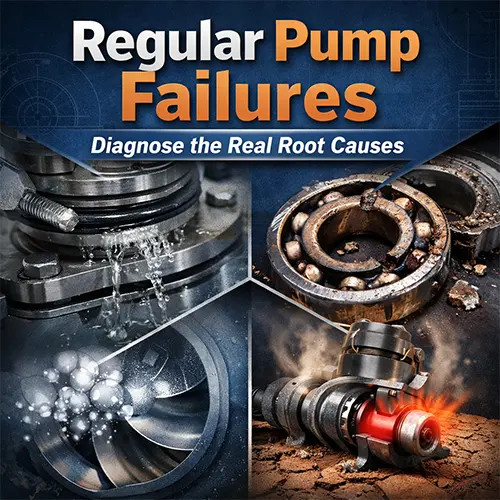
Why Replacing Parts Rarely Fixes Repeated Pump Failures
In industrial environments, pumps rarely fail without warning.
When seals, bearings, or impellers fail repeatedly, the root cause is almost never the component itself—but the operating conditions, system design, or application mismatch behind it.
For procurement managers and operations teams, repeated pump failures create three major risks:
-
escalating downtime costs
-
uncontrolled spare part consumption
-
loss of confidence in equipment suppliers
This article provides a decision-oriented diagnostic framework to help identify the real causes behind recurring pump failures—before more parts are replaced without solving the problem.
Failure Symptoms vs Root Causes (A Troubleshooting Map)
Before diving into component-level analysis, it is critical to separate what you observe from what actually causes it.
Common misconception:
“The seal failed, so the seal must be the problem.”
In reality, most failures follow this pattern:
Symptom → Hidden operating condition → Component damage
Understanding this relationship is the foundation of effective pump troubleshooting.
A Quick Diagnostic Flow (For Non-Specialists)
Before conducting engineering calculations or instrumented testing, many pump problems can be roughly classified using observable symptoms and operating behavior.
This quick diagnostic flow helps non-specialists narrow the investigation and avoid repeated part replacement without understanding the cause.
Step 1 — Identify the dominant symptom
| What you observe most often | Likely direction |
| Pump fails shortly after startup | Dry running or suction issues |
| Seal leakage repeats after replacement | Misalignment or off-design operation |
| Increasing noise or vibration | Cavitation or hydraulic instability |
| Bearings overheat or fail early | Chronic overload or contamination |
This flow does not replace engineering analysis. It defines where to look first.
Seal Failures — What They Usually Mean
Mechanical seals are often blamed because they are visible and relatively easy to replace.
However, in most industrial cases, seal failure is a symptom—not a root cause.
Typical underlying contributors include:
-
intermittent dry running
-
shaft misalignment
-
excessive vibration
-
operation far from design conditions
When seals fail repeatedly, it is essential to review system behavior and material compatibility, not just seal type.
In many cases, improper pump material selection accelerates seal degradation—especially when corrosion, abrasion, or temperature limits are exceeded.
(See related reference: pump material compatibility in How to Select the Right Pump Materials.)
Dry-Running Scenarios You Can Prevent
Dry running occurs when a pump operates without sufficient liquid film for cooling and lubrication.
Common triggers include:
-
unreliable suction priming
-
level control errors
-
air entrainment during startup
Even brief dry-running events can permanently damage seal faces.
Prevention depends more on system design and control logic than seal upgrades.
Bearing Failures — Misalignment, Contamination, or Overload?
Bearing failures provide valuable diagnostic clues because they respond directly to load and alignment conditions.
When bearings fail repeatedly within similar time intervals, investigate:
-
shaft alignment accuracy
-
foundation stiffness
-
operating point relative to design
Chronic overload is especially common when pumps are incorrectly sized and operate far from their Best Efficiency Point (BEP – Best Efficiency Point).
Incorrect sizing decisions are frequently made during procurement, often without full system validation.
This risk is addressed in detail in Pump Sizing & Selection: What Does a “Wrong Pump” Really Cost You?
Cavitation — The Silent Life Reducer
Cavitation is one of the most destructive—and misunderstood—pump failure mechanisms.
It occurs when local pressure drops below vapor pressure, causing vapor bubbles to form and collapse violently on metal surfaces.
Typical cavitation indicators:
- crackling or gravel-like noise
- fluctuating flow and pressure
- accelerated impeller and bearing wear
Cavitation is closely linked to suction conditions, sump geometry, and system layout.
Understanding how the pump interacts with the sump and suction system is critical, especially in industrial drainage or process pits.
(Reference context: how the pump interacts with the sump and suction system in What Is a Sump Pump and How Does It Work in Real Industrial Sites?)
Why “Fixing the Pump” Without Fixing the System Fails
Repeated failures often follow a predictable pattern:
- component replacement
- temporary improvement
- failure recurrence
- escalating downtime
This cycle continues because the system-level causes remain unaddressed.
Common overlooked system issues include:
-
mismatched operating range
-
unstable suction conditions
-
inappropriate control strategies
-
unsuitable materials for the medium
Building a Preventive Failure-Reduction Loop
Effective pump reliability requires a closed-loop approach:
| Step | Objective |
| Observe symptoms | Identify patterns, not isolated events |
| Apply quick diagnostic flow | Narrow investigation scope |
| Validate system conditions | Confirm suction, load, and alignment |
| Review selection assumptions | Check sizing, materials, duty point |
| Implement preventive controls | Avoid recurrence |
This approach transforms troubleshooting from reactive repair into predictable risk management.
Conclusion: From Repeated Failures to Controlled Reliability
Repeated pump failures are rarely random.
They are signals—indicating mismatches between pump design, system behavior, and operating conditions.
By shifting focus from component replacement to root cause diagnosis, industrial teams can:
-
reduce unplanned downtime
-
lower lifecycle costs
-
improve long-term equipment reliability
A pump that fails repeatedly is not “unlucky.”
It is usually telling you something important—if you know how to listen.
Get A Quote

Get A Quote
0 Comments