
Pump Sizing & Selection: What Does a “Wrong Pump” Really Cost You?

Most industrial pump failures are not caused by poor manufacturing quality.
They are caused by incorrect sizing and selection decisions made long before the pump ever reaches site.
A wrong pump rarely fails immediately. Instead, it operates inefficiently, unpredictably, and expensively—quietly draining energy budgets, increasing downtime, and accelerating component wear.
This article explains what a wrong pump really costs, how to avoid those costs, and how to build a repeatable, verifiable pump selection process suitable for industrial buyers, engineers, and procurement teams.
The Hidden Cost Categories (Energy, Downtime, Spares, Process Loss)
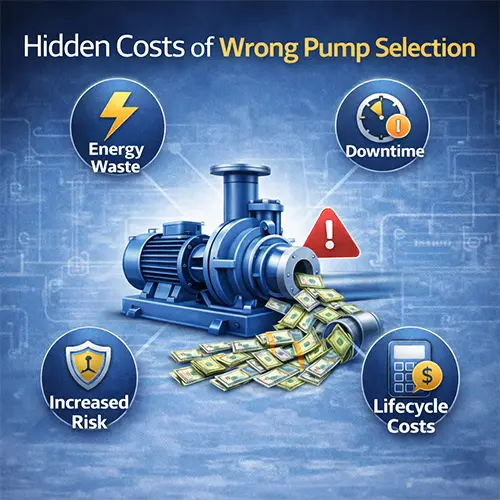
| Cost Category | Practical Impact | Why It’s Often Missed |
| Energy waste | Operation far from BEP | Energy seen as fixed overhead |
| Downtime | Seal and bearing failures | Treated as maintenance issues |
| Spare parts | Short replacement cycles | Normalized over time |
| Process loss | Flow instability, overflow | Difficult to quantify |
| Labor & safety | Emergency interventions | Rarely attributed to pump |
Buyer insight:
If losses cannot be clearly attributed, they are rarely controlled.
Sizing Inputs You Must Validate Before Ordering
Pump selection should never begin with a catalog curve.
It should begin with validated system inputs—even if those inputs come from third parties.
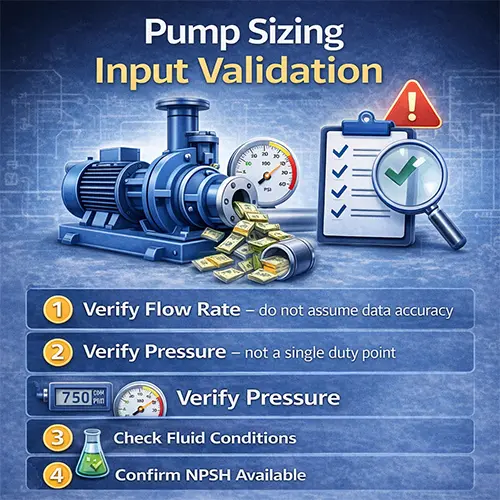
Inputs buyers must actively confirm
| Input | Why It Matters |
| Flow range (min / normal / max) | Prevents oversizing |
| Total Dynamic Head | Defines real duty point |
| System curve | Determines operating behavior |
| Fluid density & viscosity | Impacts power and efficiency |
| Temperature | Affects seal and material choice |
| Solids / abrasives | Drives wear and lifecycle cost |
System Curve Basics in Buyer Language
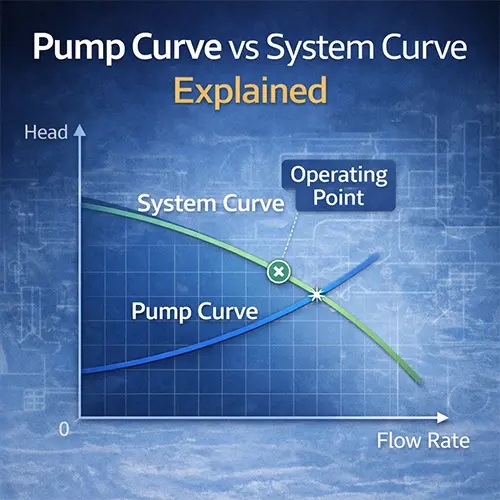
A pump does not operate at its catalog duty point.
It operates where the pump curve intersects the system curve.
For buyers, the key takeaway is simple:
any change in piping, fluid, or operating condition will shift the operating point—and potentially the cost profile.
Oversizing vs Undersizing — Which One Is More Dangerous?
Both conditions are risky.
However, oversizing typically causes greater long-term economic damage.
| Risk | Oversizing | Undersizing |
| Energy consumption | High | Moderate |
| Cavitation | Likely | Possible |
| Seal damage | Frequent | Occasional |
| Process impact | Instability | Capacity limits |
| Correction difficulty | Hard | Easier |
Buyer insight:
Oversizing hides problems longer—but costs more over time.
Acceptance Test Checklist (What to Ask for Before Shipment)
Many pump failures can be prevented before the pump leaves the factory, if buyers request the right verifications.
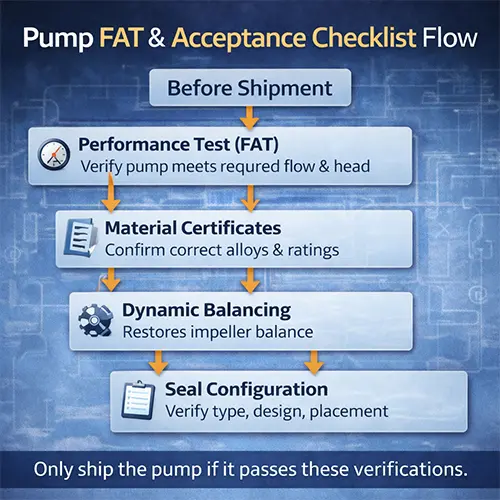
| Verification | Purpose |
| Performance test (FAT) | Confirms actual duty |
| Material certificates | Ensures compatibility |
| Dynamic balancing | Reduces vibration |
| Seal configuration review | Prevents leakage |
| Documentation | Enables future maintenance |
A pump that cannot be tested, documented, and explained is a risk—regardless of brand.
Build a Repeatable Pump Selection Workflow
High-performing organizations rely on repeatable workflows, not individual experience.
This reduces assumptions and simplifies internal decision-making.
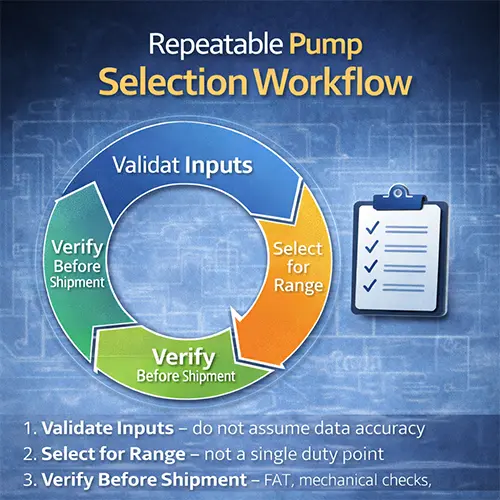
A practical 3-step framework
- Validate inputs – do not assume data accuracy
- Select for operating range – not a single duty point
- Verify before shipment – FAT, mechanical checks, documentation
Buyer insight:
A selection process that can be explained internally is more valuable than one that cannot.
Conclusion
A wrong pump rarely fails immediately.
It fails economically—through wasted energy, downtime, spare parts, and process disruption.
The most effective way to avoid these outcomes is not to “buy a better pump,” but to apply a disciplined pump sizing and selection process that is repeatable, verifiable, and auditable.
Get A Quote

Get A Quote
0 Comments