
How to Select the Right Pump Materials
Cast Iron vs Stainless Steel vs High-Chrome vs Linings for Industrial Pumps
Selecting the right pump material is one of the most underestimated decisions in industrial fluid handling. While flow rate and head are often calculated carefully, material choice is frequently reduced to habit, budget pressure, or assumptions such as “stainless steel is safer.”
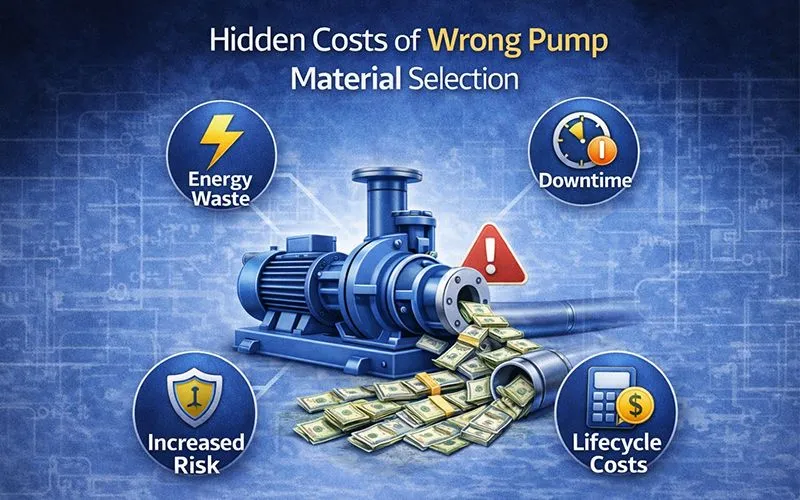
In reality, pump material selection determines how a pump degrades, how failures appear, and how much unplanned downtime an operation will eventually face. A pump with the wrong material may operate for months—or even years—before failure, but the cost is paid continuously through corrosion, wear, maintenance intervention, and operational risk.
This article is written for industrial buyers, engineers, and decision-makers who need to select pump materials that reduce long-term risk, not just initial purchase price.
Material Choice Is a Risk Decision, Not a Preference
Pump material selection is fundamentally a risk management decision, not a matter of preference, familiarity, or brand reputation. The wrong material rarely fails immediately—it increases corrosion rate, accelerates wear, and amplifies the consequences of operating deviations.
From a buyer’s perspective, the most important question is not:
“Which material is stronger?”
But rather:
“How does this material fail, and what happens to my operation when it does?”
Material choice defines whether failures are gradual and detectable—or sudden and disruptive. It also determines whether maintenance can be planned, or whether downtime becomes reactive and costly.
A defensible material decision is one that can be explained, reviewed, and justified internally—especially when failure consequences are high.
Common Materials and Where They Fail (Not Just Where They Work)
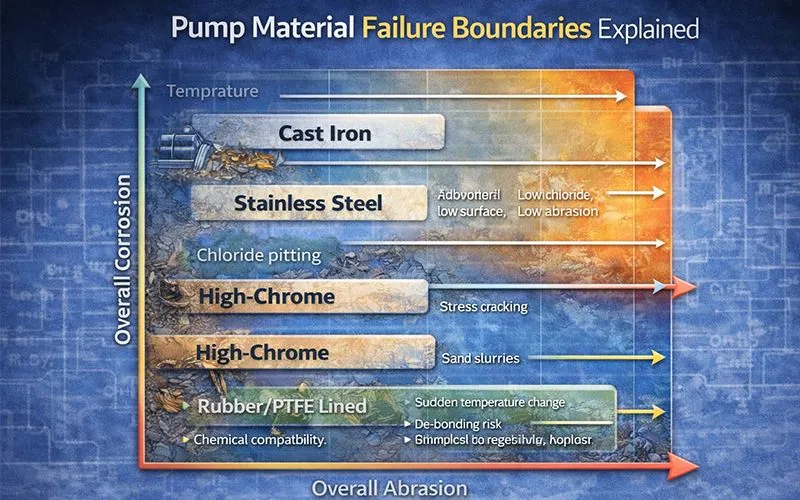
Every pump material performs well under specific conditions and fails predictably outside them. Understanding failure boundaries is far more valuable than comparing material advantages in isolation.
Buyers who focus only on “where a material works” often discover its limits only after failure has already occurred. The sections below focus deliberately on where each material stops protecting the process.
Cast Iron / Cast Steel — Good Value, Clear Limits
Cast iron and cast steel provide excellent value in low-risk environments, but their performance envelope is narrow and well defined.
These materials are widely used because they are economical, easy to manufacture, and adequate for many neutral-fluid applications. However, they offer limited resistance to corrosion and abrasion.
Typical suitable applications
-
Clean water
-
Neutral or near-neutral pH fluids
-
Moderate temperature and pressure
-
Low chloride content
Failure boundaries
-
Acidic or corrosive media
-
Elevated temperatures that accelerate corrosion
-
Abrasive solids that cause rapid wall thinning
-
Chloride-rich environments
Common failure modes
-
Internal corrosion and gradual material loss
-
Pitting that eventually leads to leakage
-
Cracking under thermal or mechanical stress
Buyer takeaway
Cast iron is not a “safe default.” It is a cost-efficient option only when operating conditions are verified and stable.
| Factor | Cast Iron / Cast Steel |
| Initial cost | Low |
| Corrosion resistance | Low |
| Abrasion resistance | Low–Moderate |
| Failure predictability | Moderate |
| Best use case | Neutral fluids, stable conditions |
Stainless Steels — Corrosion Resistance Is Not Universal
“Stainless” does not mean corrosion-proof. Incorrect stainless steel selection often results in pitting, crevice corrosion, or stress corrosion cracking, sometimes without visible warning.
Stainless steels are frequently chosen to “reduce risk,” but in reality, they shift risk from general corrosion to localized and often more dangerous failure mechanisms.
Where stainless performs well
-
Chemically compatible fluids
-
Low chloride concentration
-
Controlled temperatures
-
Low abrasion environments
Where stainless fails unexpectedly
-
Chloride-rich fluids
-
Elevated temperatures combined with chlorides
-
Stagnant zones inside the pump
-
Mixed chemical exposure
Why stainless failures are risky
-
Damage is often internal and invisible
-
Failure can be sudden rather than progressive
-
Repairs are typically expensive and disruptive
Buyer takeaway
Stainless steel reduces risk only when the grade matches the chemistry. Misapplied stainless steel often increases lifecycle cost instead of reducing it.
| Factor | Stainless Steel |
| Initial cost | Medium–High |
| Corrosion resistance | Medium–High (grade dependent) |
| Abrasion resistance | Low |
| Failure predictability | Low |
| Best use case | Chemically compatible, low-abrasion fluids |
High-Chrome and Wear Alloys — When Abrasion Dominates Failure
When abrasion—not corrosion—is the dominant failure mechanism, hardness becomes more important than chemical resistance.
High-chrome alloys are designed specifically for environments where solid particles erode pump components rapidly. These materials trade toughness and corrosion resistance for extreme wear resistance.
Typical applications
-
Slurry transport
-
Sand-laden fluids
-
Mining and mineral processing
-
Dredging and tailings systems
Strengths
-
Exceptional resistance to erosive wear
-
Predictable wear patterns
-
Extended service life in abrasive duties
Limitations
-
Brittle behavior under impact loading
-
Limited corrosion resistance
-
Higher replacement cost
Buyer takeaway
High-chrome alloys are precision solutions for abrasion-dominated services, not general-purpose materials.
| Factor | High-Chrome Alloys |
| Initial cost | High |
| Corrosion resistance | Low–Medium |
| Abrasion resistance | Very High |
| Failure predictability | High |
| Best use case | Slurries, solids-heavy fluids |
Rubber and PTFE Linings — When Linings Beat Metal
Linings can outperform metal in corrosive environments—but only when temperature limits, bonding quality, and maintenance discipline are strictly controlled.
Linings are often selected to reduce corrosion cost, but they introduce different risks that must be actively managed.
Advantages
-
Excellent chemical resistance
-
Lower cost compared to exotic alloys
-
Smooth internal surfaces that reduce turbulence
Common failure causes
-
Delamination due to temperature excursions
-
Poor bonding during manufacturing
-
Mechanical damage during maintenance
Critical buyer question
If the lining fails, how quickly can the failure be detected and corrected?
Buyer takeaway
Linings reduce chemical risk but introduce inspection and maintenance risk.
| Factor | Rubber / PTFE Linings |
| Initial cost | Medium |
| Corrosion resistance | Very High |
| Abrasion resistance | Low–Medium |
| Failure detectability | Low |
| Best use case | Highly corrosive, low-abrasion fluids |
A Buyer’s Material Decision Tree
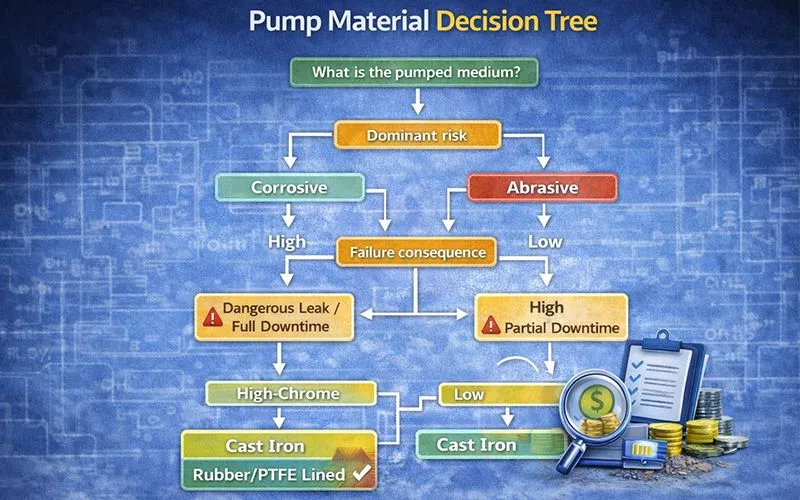
Medium → Dominant Risk → Failure Consequence → Budget
Effective pump material selection starts with the pumped medium, but the final decision should be driven by failure consequence, not purchase price.
Decision logic buyers can defend internally
| Step | Key Question |
| Medium | Is the fluid corrosive, abrasive, or both? |
| Dominant risk | Which failure mode appears first? |
| Failure consequence | What happens if the pump fails unexpectedly? |
| Budget logic | Lifecycle cost vs upfront savings |
Key insight:
A material that “works” but fails unpredictably is riskier than a material that fails gradually and visibly.
Conclusion: The Right Material Minimizes Downtime, Not Purchase Price
The right pump material does not minimize upfront cost—it minimizes unplanned downtime, maintenance intervention, and operational uncertainty.
For industrial buyers, the most defensible material decision is one that:
-
Has clearly defined failure boundaries
-
Fails predictably rather than suddenly
-
Can be explained, reviewed, and justified internally
Final buyer insight
A material choice that cannot be explained is already a risk.
Get A Quote

Get A Quote
0 Comments