
Vertical Sump Pump vs Submersible Pump: How to Choose for Industrial Applications
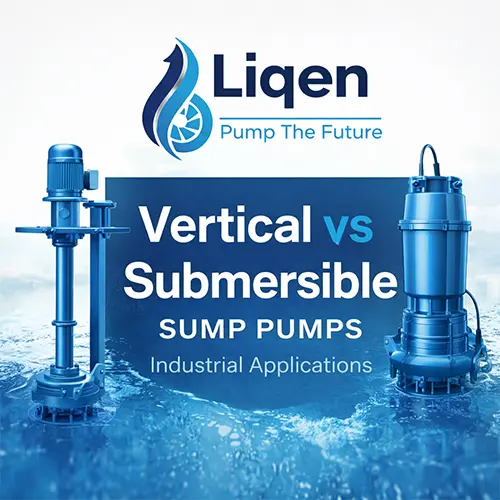
Choosing between a vertical sump pump and a submersible pump is one of the most common decision points in industrial drainage, wastewater, and process applications. While both pump types are designed to remove liquid from sumps, pits, or collection points, they behave very differently once installed and operated over time.
Many selection mistakes occur because this choice is made too early, based on footprint, price, or familiarity, rather than on operating risk, maintenance access, and lifecycle cost. This guide is written for engineers, procurement professionals, and facility managers who need a clear, application-driven framework for deciding which design is more appropriate for their site.
Understanding the Fundamental Design Difference
The key distinction between vertical sump pumps and submersible pumps lies in where the motor is located and how the pump interacts with the liquid environment. This difference has direct implications for reliability, safety, and long-term operating cost.
A vertical sump pump places the motor above the sump, with a long shaft connecting it to the submerged hydraulic section. A submersible pump, by contrast, integrates the motor and pump into a sealed unit designed to operate fully submerged.
This single design choice influences nearly every downstream consideration—from seal reliability to maintenance procedures.
Vertical Sump Pumps: Characteristics and Typical Use Cases
Vertical sump pumps are commonly selected in industrial environments where serviceability, reliability, and risk control are higher priorities than compact installation.
Key Characteristics of Vertical Sump Pumps
| Feature | Practical Implication |
| Motor above liquid | Reduced risk of moisture ingress |
| Long shaft design | Allows operation in deep sumps |
| External bearings | Easier inspection and lubrication |
| Open sump operation | Less dependence on sealed motor housings |
Because the motor remains outside the liquid, vertical sump pumps are often perceived as more forgiving in harsh or contaminated environments.
Typical Applications Where Vertical Sump Pumps Perform Well
Vertical sump pumps are frequently used in:
-
Chemical process pits
-
Plating lines and corrosive service areas
-
Industrial wastewater collection basins
-
Applications with elevated temperatures or aggressive fluids
In these scenarios, the ability to access and service the motor without entering the sump is a significant operational advantage.
Submersible Pumps: Characteristics and Typical Use Cases
Submersible pumps are designed for compact installation and fully flooded operation, making them attractive where space is limited or rapid deployment is required.
Key Characteristics of Submersible Pumps
| Feature | Practical Implication |
| Integrated motor and pump | Compact footprint |
| Sealed motor housing | Enables submerged operation |
| Internal cooling | Relies on surrounding liquid |
| Single-unit removal | Maintenance requires lifting the pump |
Submersible designs are widely used in municipal and industrial settings, but their reliability depends heavily on seal integrity and operating conditions.
Typical Applications Where Submersible Pumps Are Preferred
Submersible pumps are often selected for:
-
Confined sumps or narrow pits
-
Temporary or mobile installations
-
Flood-prone areas where dry installation is impractical
-
Applications where noise reduction is important
When properly specified and maintained, submersible pumps can deliver stable performance with minimal surface infrastructure.
Decision Matrix: Vertical Sump vs Submersible Pump
Rather than asking which pump type is “better,” buyers should evaluate which design reduces risk and cost for their specific application. The table below provides a structured comparison.
| Decision Factor | Vertical Sump Pump | Submersible Pump |
| Motor location | Above liquid | Submerged |
| Exposure to moisture | Low | High (seal-dependent) |
| Maintenance access | Easy, above grade | Requires pump removal |
| Installation space | Requires vertical clearance | Compact |
| Seal criticality | Moderate | High |
| Typical failure driver | Mechanical alignment, bearings | Seal failure, moisture ingress |
| Best suited for | Harsh fluids, long-term reliability | Tight spaces, fast installation |
This comparison highlights why a design that looks simpler at installation may introduce higher maintenance or failure risk over time.
Maintenance and Lifecycle Cost Considerations
For B2B buyers, the true cost of a pump is rarely its purchase price. Maintenance effort, downtime exposure, and repair logistics often dominate lifecycle cost.
Maintenance Access and Downtime Risk
Vertical sump pumps allow:
-
Motor inspection without sump entry
-
Faster troubleshooting
-
Reduced safety exposure for maintenance personnel
Submersible pumps typically require:
-
Lifting equipment
-
Complete pump removal
-
Downtime during inspection or seal replacement
In critical applications, these differences can outweigh any initial cost savings.
Seal Dependence and Failure Risk
Seal performance is a central risk factor for submersible pumps. Abrasive solids, thermal cycling, and frequent starts increase seal wear, raising the likelihood of moisture ingress and motor damage.
Vertical sump pumps, while not seal-free, generally rely less on complex sealing to protect electrical components.
Common Selection Mistakes to Avoid
Many vertical-versus-submersible decisions fail not because of incorrect data, but because of incorrect assumptions.
Common mistakes include:
-
Choosing submersible pumps solely to save space
-
Assuming all sump liquids are “clean enough”
-
Underestimating maintenance access constraints
-
Ignoring long-term operating hours and cycling frequency
These oversights often lead to recurring failures that are incorrectly attributed to pump quality rather than selection logic.
Practical Selection Checklist for Buyers
Before finalizing a pump type, buyers should confirm that key application inputs have been evaluated.
| Question | Why It Matters |
| What solids are present, and how abrasive are they? | Influences seal and wear risk |
| How deep is the sump, and is access restricted? | Affects installation and maintenance |
| How critical is uptime? | Determines acceptable failure risk |
| How often will the pump start and stop? | Impacts seal and motor life |
| Is long-term maintenance support available onsite? | Influences design preference |
This checklist helps align pump selection with operational realities rather than assumptions.
When One Design Clearly Outperforms the Other
In many cases, the decision is not ambiguous once operating conditions are fully understood.
Vertical sump pumps tend to outperform when:
-
Fluids are aggressive or contaminated
-
Maintenance access must remain simple
-
Downtime carries high cost or safety risk
Submersible pumps tend to outperform when:
-
Installation space is severely limited
-
Flooded operation is unavoidable
-
The application is non-critical or intermittent
Recognizing these patterns helps avoid compromise-driven decisions.
Conclusion
The choice between a vertical sump pump and a submersible pump is ultimately a decision about risk distribution. Vertical designs shift risk toward mechanical components that are accessible and serviceable, while submersible designs concentrate risk in seals and motor protection systems.
By evaluating installation constraints, maintenance strategy, solids handling, and lifecycle cost, B2B buyers can select the pump type that best aligns with their operational priorities. Making this decision deliberately—rather than by habit or convenience—reduces downtime, improves reliability, and supports more predictable long-term performance.
Get A Quote

Get A Quote
0 Comments