
How to Select the Right Industrial Pump: A Practical Engineering Guide for Buyers
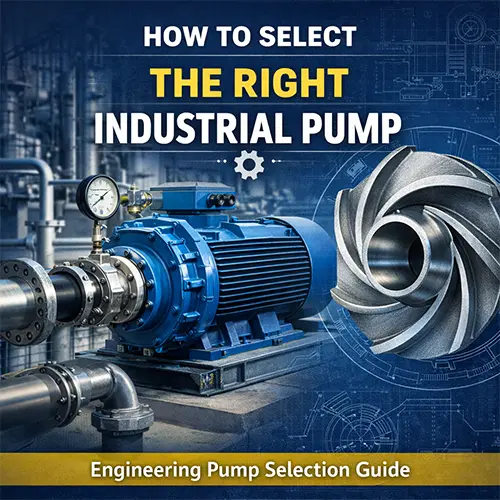
Industrial pumps are essential components in water supply systems, irrigation infrastructure, construction drainage, mining operations, and numerous industrial processes. Selecting the wrong pump can lead to serious operational issues such as insufficient pressure, unstable flow, cavitation damage, excessive energy consumption, or premature equipment failure.
For engineers, contractors, and procurement professionals, pump selection requires more than simply choosing a pump with a specific flow rate. A reliable pumping system must consider flow requirements, total dynamic head (TDH), liquid characteristics, operating environment, pump design, and lifecycle operating cost.
This guide presents a practical engineering framework for industrial pump selection, helping project engineers and procurement teams understand how pumps are evaluated, compared, and selected in real-world applications.
Quick Industrial Pump Selection Framework
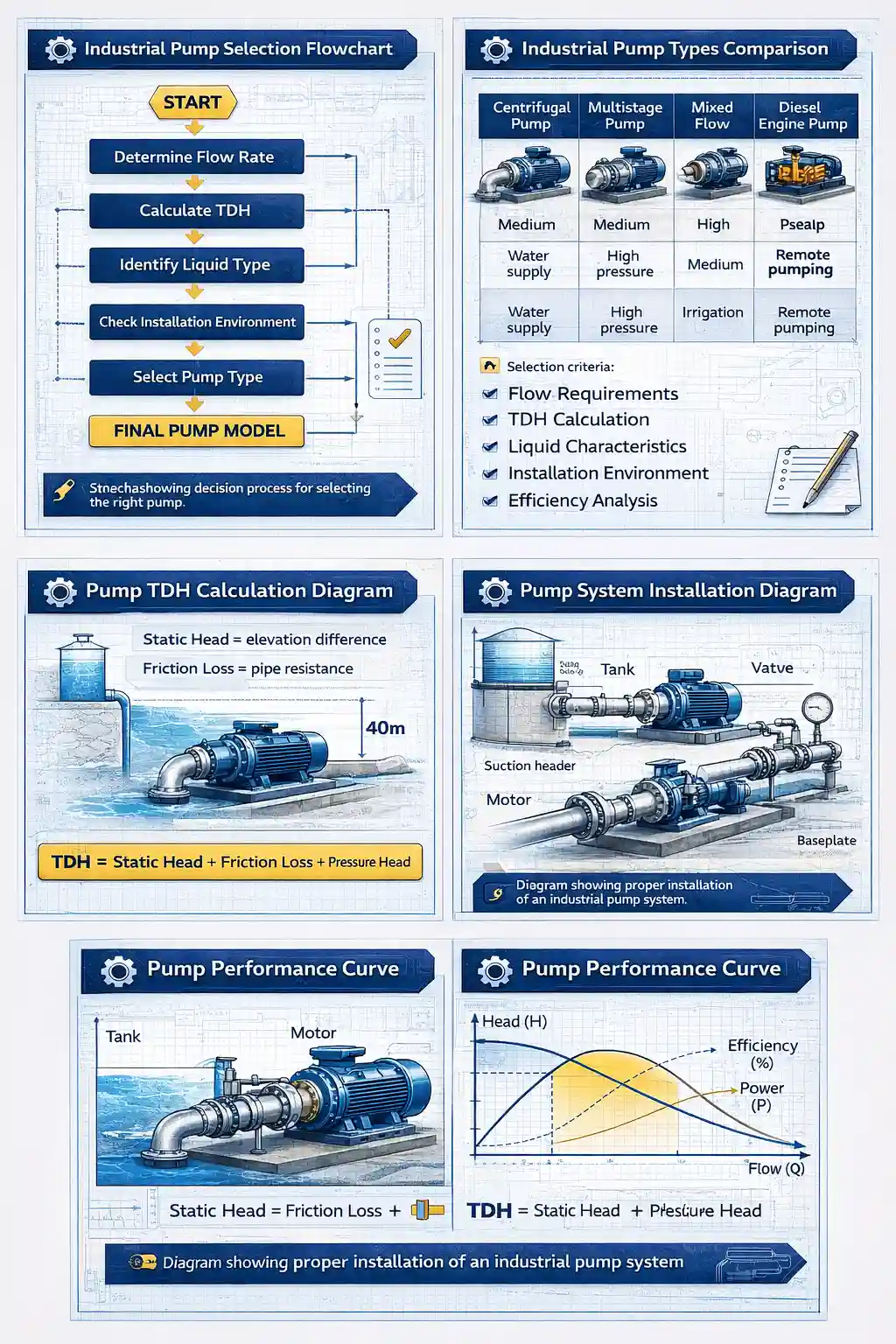
Industrial pump selection typically follows a structured engineering process. Instead of selecting equipment randomly, engineers determine system requirements step by step and narrow down the most suitable pump category.
Industrial Pump Selection Logic
Step 1 — Determine required flow rate
Step 2 — Calculate total dynamic head (TDH)
Step 3 — Identify liquid characteristics
Step 4 — Evaluate installation environment
Step 5 — Select pump type
Step 6 — Determine power source (electric or diesel)
Step 7 — Compare efficiency and lifecycle cost
This logical sequence helps engineers ensure that pump selection decisions are based on system requirements rather than guesswork.
Quick Pump Type Recommendation
| Application Scenario | Recommended Pump Type |
| High pressure water supply | Multistage centrifugal pump |
| Large-scale irrigation | Mixed flow pump |
| General industrial water transfer | End suction centrifugal pump |
| Remote locations without electricity | Diesel engine pump |
This quick decision table provides an initial reference before performing detailed hydraulic calculations.
What Is an Industrial Pump?
An industrial pump is a mechanical device used to transport liquids by converting mechanical energy into hydraulic energy. Pumps are widely used in water supply infrastructure, industrial production systems, irrigation networks, and emergency drainage projects.
Industrial pumps are typically designed for:
-
continuous operation
-
high reliability
-
heavy-duty working environments
-
stable hydraulic performance
Compared with household pumps, industrial pumps must operate under more demanding conditions such as high pressure, large flow rates, abrasive fluids, and long operating hours. Because of these requirements, industrial pump systems require careful engineering design.
Key Parameters That Determine Pump Selection
The most critical step in pump selection is determining the system parameters. Incorrect parameter estimation is one of the leading causes of pump performance problems.
The four most important parameters include:
-
Flow rate
-
Total Dynamic Head (TDH)
-
Liquid characteristics
-
Operating environment
Understanding these parameters helps engineers determine the correct pump size and configuration.
Flow Rate (Capacity)
low rate refers to the volume of liquid that must be transported by the pump within a specific time period.
Common units include:
-
cubic meters per hour (m³/h)
-
liters per second (L/s)
-
gallons per minute (GPM)
Flow requirements vary depending on the application.
| Application | Typical Flow Requirement |
| Agricultural irrigation | Large continuous flow |
| Municipal water supply | Stable medium flow |
| Industrial cooling systems | Constant circulation flow |
If the selected pump cannot provide sufficient flow, the system will fail to meet operational demand. However, selecting an oversized pump may cause inefficient energy usage and unstable operation.
Total Dynamic Head (TDH)
Total Dynamic Head represents the total pressure required to move fluid through a pumping system.
TDH is calculated using the following formula:
TDH = Static Head + Friction Loss + Pressure Head
Static head represents the vertical elevation difference between the suction source and discharge point.
Friction losses occur as fluid flows through pipes, valves, and fittings.
Pressure head represents the required outlet pressure.
Underestimating TDH is one of the most common reasons for pump system failure.
Internal reference:
👉 Total Dynamic Head (TDH) Pump Calculation Guide
Liquid Characteristics
The physical properties of the liquid being pumped have a significant impact on pump design.
Important characteristics include:
-
viscosity
-
density
-
corrosiveness
-
solid particle content
For example, pumps designed for clean water may not perform well when handling liquids containing sand, sediment, or chemicals. In such cases, special materials or impeller designs may be required.
Understanding fluid properties helps engineers determine the appropriate pump materials and sealing systems.
Operating Environment
The installation environment can significantly affect pump reliability.
Important environmental factors include:
-
outdoor weather exposure
-
ambient temperature
-
humidity and dust
-
altitude and atmospheric pressure
For example, pumps installed in remote agricultural areas must withstand dust, heat, and continuous operation, while industrial facilities may require corrosion-resistant materials.
Common Industrial Pump Types Explained
Industrial pumps are designed with different hydraulic characteristics to meet different flow and pressure requirements. Understanding these differences helps engineers select the most appropriate pump for their system.
Industrial Pump Type Comparison
| Pump Type | Flow Capacity | Head Range | Typical Applications |
| End suction centrifugal pump | Medium | Low–Medium | Water supply, industrial circulation |
| Multistage centrifugal pump | Low–Medium | High | High-pressure water systems |
| Mixed flow pump | Very high | Medium | Irrigation, flood control |
| Diesel engine pump | Variable | Variable | Remote pumping, emergency drainage |
End Suction Centrifugal Pump
End suction pumps are among the most commonly used industrial pumps.
Typical applications include:
-
water transfer systems
-
industrial cooling circulation
-
municipal water supply
These pumps are widely used because of their simple structure, low cost, and easy maintenance. However, they are generally limited in pressure capability compared with multistage pumps.
Multistage Centrifugal Pump
Multistage pumps are designed for applications that require high pressure output.
These pumps use multiple impellers arranged in series to gradually increase pressure.
Typical applications include:
-
high-rise building water supply
-
boiler feed systems
-
high-pressure industrial processes
Multistage pumps provide high pressure while maintaining relatively efficient operation.
Internal reference:
👉 Multistage Pump Selection Guide for High-Pressure Systems
Mixed Flow Pump
Mixed flow pumps combine characteristics of centrifugal pumps and axial flow pumps.
They are designed for applications that require large flow capacity with moderate pressure.
Typical applications include:
-
agricultural irrigation
-
flood control pumping stations
-
drainage systems
Mixed flow pumps are particularly effective for moving large volumes of water over relatively short elevation differences.
Diesel Engine Water Pump
Diesel engine driven pumps are commonly used where electrical power is unavailable or unreliable.
Typical applications include:
-
agricultural irrigation
-
construction site drainage
-
emergency flood control
-
remote water transfer projects
Diesel pumps provide an independent power source and are especially useful in remote areas.
Internal reference:
👉 Diesel Engine Water Pump Integrated Technology Applications
Pump Selection Based on Application Scenarios
Pump selection often begins with analyzing the application scenario. Different industries prioritize different system requirements such as pressure stability, flow capacity, efficiency, or portability.
Agricultural Irrigation
Agricultural irrigation systems require pumps capable of delivering large volumes of water continuously.
Key considerations include:
-
flow capacity
-
fuel efficiency
-
long operating hours
Diesel irrigation pumps and mixed flow pumps are commonly used for large agricultural projects.
Municipal Water Supply
Municipal water supply systems require reliable pumps capable of maintaining stable pressure across long pipelines and elevation changes.
Multistage pumps are commonly used in these systems.
Industrial Water Systems
Industrial facilities use pumps for cooling systems, production processes, and water circulation.
Reliability and continuous operation are critical factors.
Internal reference:
👉 Industrial Water Treatment and Pump Systems in Public Infrastructure
Common Pump Selection Mistakes
Many pump failures occur not because of manufacturing defects but because of incorrect system design or pump selection.
Common mistakes include:
-
underestimating system head requirements
-
ignoring friction losses in pipelines
-
selecting pumps based only on price
-
choosing oversized pumps
-
ignoring cavitation risks
Avoiding these mistakes requires careful hydraulic calculations and system analysis.
Internal reference:
👉 Why Industrial Pumps Fail Prematurely: Causes and Prevention
Cost Factors in Industrial Pump Systems
The purchase price of a pump is only a small portion of the total lifecycle cost of a pumping system.
Important cost factors include:
-
equipment purchase cost
-
installation cost
-
electricity or fuel consumption
-
maintenance cost
-
spare parts availability
Selecting a more efficient pump may significantly reduce long-term operating costs.
Internal reference:
👉 Industrial Pump Energy Efficiency Optimization Guide
Industrial Pump Quality Inspection Checklist
Before purchasing pumps from a manufacturer, buyers should evaluate several quality indicators to ensure long-term reliability.
Engineering Quality Checklist
-
casting quality of pump casing
-
impeller balance accuracy
-
shaft alignment precision
-
mechanical seal reliability
-
factory performance testing results
Reliable manufacturers should provide performance curves and test reports verifying pump performance.
Internal reference:
👉 What Defines a Reliable Multistage Pump Manufacturer
FAQ
Industrial pump selection often raises practical questions for engineers and procurement teams. These questions usually relate to pump sizing, pressure calculations, operational reliability, and maintenance considerations.
The following answers address common technical questions encountered during pump selection.
What size pump do I need?
Pump size depends on the required flow rate and total dynamic head (TDH). Accurate system calculations must be completed before selecting a pump model.
Choosing a pump with insufficient capacity can lead to system failure, while oversized pumps may waste energy and operate inefficiently.
How do engineers calculate pump head?
Pump head is calculated using the Total Dynamic Head formula.
TDH = Static Head + Friction Loss + Pressure Head
What is cavitation in pumps?
Cavitation occurs when pressure inside the pump drops below the vapor pressure of the liquid, forming vapor bubbles that collapse and damage the impeller.
Common causes include insufficient suction pressure or incorrect pump installation.
How long does an industrial pump typically last?
With proper installation and maintenance, industrial pumps can operate 10–20 years or longer depending on working conditions.
Can diesel pumps operate continuously?
Yes. Industrial diesel pumps are designed for continuous operation when properly maintained.
Regular inspection of oil systems, filters, and cooling components is required to maintain reliability.
Conclusion
Selecting the right industrial pump requires a systematic evaluation of hydraulic requirements, system conditions, and pump design characteristics.
By understanding flow rate, total dynamic head, pump types, application scenarios, and lifecycle costs, engineers and procurement teams can significantly reduce the risk of pump system failures.
A structured pump selection process not only improves system efficiency but also ensures reliable long-term operation in industrial pumping applications.
Get A Quote

Get A Quote
0 Comments