
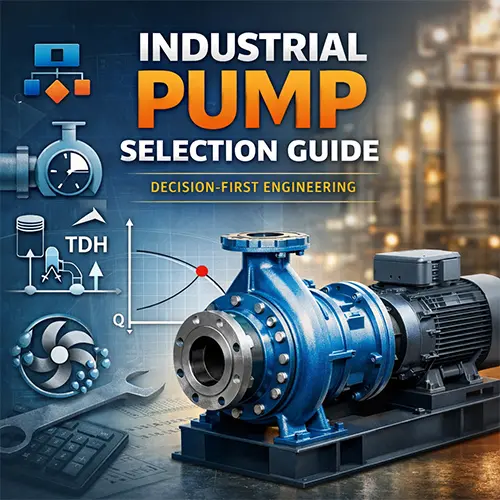
Industrial Pump Selection Guide A Decision-First Engineering Framework for Reliable Industrial Systems
Introduction
Why “Complete Specifications” Still Lead to Wrong Pump Selection
Most industrial pump selection failures do not happen because the pump itself is defective. They happen because the selection decision is made too early—before the system is fully defined.
In real projects, pump selection often begins with statements like:
-
“We need 100 m³/h—pick a model.”
-
“The head is about 60 meters—this should be fine.”
-
“This pump worked before—reuse it.”
On paper, those assumptions can look correct. In operation, the system fails quietly:
-
Design flow is never reached
-
Power consumption exceeds expectation
-
Vibration increases month by month
-
Mechanical seals leak early
-
Bearings fail far earlier than rated life
The root cause is usually the same:
The pump was selected before the system was properly defined.
This guide reverses that order. It is not a product catalog and not a failure textbook. It is a decision-first industrial pump selection guide designed to help buyers, engineers, and project managers avoid irreversible mistakes and defend selection decisions in technical reviews.
Step 1 – Define the System Before Selecting the Pump
System Conditions Are Not Optional Inputs
Decision First — When Selection Must Stop
If system operating conditions are not fully defined, pump selection must stop.
Comparing pump models at this stage is meaningless.
Before selecting any pump, define what the system demands—under normal, peak, and worst-case conditions.
System Information Completeness Check (Stop / Go)
| Key System Variable | Defined? | Acceptable Standard | Risk If Missing |
| Flow range | ⬜ | Min / Design / Max | Cannot place operating point near BEP |
| TDH (Total Dynamic Head) | ⬜ | Full calculation | Overload or low flow |
| NPSHa | ⬜ | Numeric value (worst case) | Cavitation risk hidden |
| Duty cycle | ⬜ | Hours + starts/hour | Life becomes unpredictable |
| Fluid properties | ⬜ | Temp / composition / solids | Wrong material / rapid wear |
| Installation conditions | ⬜ | Suction layout, elevation, pipe size | Chronic instability |
| Power source | ⬜ | Motor or diesel confirmed | Power mismatch, overheating |
If any item is undefined, do not proceed to model comparison.
Why “We’ll Adjust It On Site” Is a Dangerous Assumption
Many selection errors are structural and cannot be “tuned out”:
-
Insufficient NPSH margin cannot be fixed by changing discharge valves
-
Incorrect TDH often becomes a permanent overload condition
-
Wrong duty cycle assumption will destroy bearings and seals early
-
Diesel vs electric mismatch changes tolerances dramatically
Selection errors are cheap to fix on paper, expensive to fix in the field (rework, delays, disputes).
Field Check — Signs the System Was Never Properly Defined
You likely have an incomplete selection if:
-
Flow is a single number (no min/max range)
-
TDH is “estimated”
-
No one can show how NPSHa was calculated
-
Duty cycle is “normal operation” (no starts/hour)
-
Fluid is described qualitatively (“slightly corrosive”)
-
Power source is decided after the pump
Step 2 – Flow: How Much Is Too Much, and How Little Is Dangerous
Decision First
Design flow should sit close to the pump’s Best Efficiency Point (BEP).
Oversizing “for safety” is one of the most common causes of early failure.
Flow is an envelope: Qmin / Qdesign / Qmax. Your selection must keep the operating point within a stable region—not at curve extremes.
Flow Selection Comparison
| Selection Approach | Initial Result | Mid-Term Impact | Long-Term Outcome |
| Oversized + throttling | Runs | Rising vibration | Early bearing & seal failure |
| Near BEP | Stable | High efficiency | Predictable service life |
| Undersized | Pressure issues | Internal recirculation | Impeller damage / overheating |
Why This Matters (Engineering Explanation)
At BEP, internal hydraulic forces are balanced. Away from BEP:
-
Pressure field becomes asymmetric
-
Continuous radial load increases shaft deflection
-
Bearing load and seal misalignment rise
-
Vibration increases slowly but persistently
This is typically fatigue damage, not instant failure.
Risk Boundary (Practical Rule)
| Operating Region | Typical Guidance | What It Means |
| Within ±10% of BEP | Preferred | Best efficiency and lowest mechanical stress |
| ±10–20% of BEP | Acceptable with caution | Verify vibration, seal plan, and control strategy |
| Beyond ±20% of BEP | High risk | Treat as redesign or control strategy problem |
Field Check — Flow-Related Warning Signs
-
Gradually increasing vibration over weeks/months
-
Stable but higher-than-expected motor current
-
Repeated seal leakage with no alignment issue
-
Efficiency drops year over year (energy cost rises)
If you see these, confirm operating point on the pump curve before replacing parts.
Step 3 – TDH: Why Most Pumps Are Undersized Without Knowing It
Decision First
If TDH is estimated instead of calculated from the full system, the selection is not engineering-grade.
TDH is not a guess. It is energy demand: static + friction + minor losses + pressure requirement.
TDH Calculation Methods Compared
| TDH Method | Typical Source | Risk Level | Common Outcome |
| Experience-based estimate | Old projects | High | Overload or low flow |
| Static head only | Quick quotes | Very high | Underperformance |
| Full system calculation | Engineering design | Low | Stable operation |
TDH Deviation and System Impact
| TDH Error | Flow Impact | Power Impact | Actual Risk |
| −5% | Minor | Slight increase | Often manageable |
| −10% | 15–25% loss | Overload | High-risk, frequent failure |
| −15% | System failure | Severe overload | Inevitable rework |
Why This Matters (Engineering Explanation)
Power demand increases with TDH. If TDH is underestimated:
-
Motor operates above rated load (thermal aging accelerates)
-
Diesel engine runs “heavy” (high EGT, overheating, wear)
-
Energy cost increases and reliability declines
Field Check — TDH Error Symptoms
-
Motor runs hot without tripping
-
Diesel engine consistently “struggles” at normal flow
-
Flow improves noticeably when downstream restrictions are removed
-
Operators keep “opening valves” but never reach design flow
Step 4 – NPSH & Cavitation: The Hidden Deal Breaker
Decision First
For continuous-duty, diesel-driven, or high-temperature systems,
NPSH margin below 1.0 m is unacceptable.
Minimum Recommended NPSH Margin
| System Type | Minimum NPSH Margin | Compromise Allowed |
| Electric / intermittent | ≥ 0.5 m | Limited |
| Continuous duty | ≥ 0.8 m | Not recommended |
| Diesel-driven | ≥ 1.0–1.2 m | ❌ No |
| High-temperature fluid | ≥ 1.2 m | ❌ No |
Cavitation Stages and Field Symptoms
| Stage | Audible Sign | Measurable Effect | Often Misdiagnosed As |
| Early | Light gravel noise | High-frequency vibration | “Normal noise” |
| Mid | Clear noise | Flow loss | Bearing issue |
| Late | Heavy knocking | Pressure fluctuation | “Bad pump quality” |
Why This Matters (Engineering Explanation)
Cavitation is a phase-change failure. When local pressure drops below vapor pressure:
-
Vapor bubbles form
-
Collapse violently in higher-pressure zones
-
Create micro-jet impacts that erode metal
Damage is cumulative. If selection ignores NPSH margin, you are accepting an erosion mechanism by design.
Field Check — Cavitation Confirmation
If you suspect cavitation, don’t guess. Check:
-
Worst-case liquid temperature (vapor pressure changes)
-
Suction-side friction losses (pipe size, fittings, strainer)
-
Air entrainment (vortexing, leaking flanges, low tank level)
Step 5 – Duty Cycle: Why “It Runs Fine Now” Means Nothing
Decision First
Start frequency often shortens pump life faster than total running hours.
More than 6 starts/hour without mitigation is a high-risk condition.
Duty Cycle Impact Comparison
| Operating Mode | Bearing Life | Seal Life | Risk Level |
| Continuous operation | High | Stable | Low |
| Intermittent | Medium | Medium | Medium |
| High start-stop | Low | Very low | High |
Start Frequency and Required Measures
| Starts per Hour | Risk Assessment | Required Action |
| ≤2 | Safe | None |
| 3–6 | Caution | Soft starter |
| >6 | High risk | VFD required |
Why This Matters (Engineering Explanation)
Each start introduces:
-
Electrical inrush
-
Mechanical torque shock
-
Brief seal-face friction before full lubrication
-
Load transients that amplify vibration
Repeated starts create pulse fatigue and lubricant film breakdown—leading to premature bearing and seal failure.
Field Check — Duty Cycle Is the Root Cause When…
-
Failures occur shortly after start-up
-
Components look “new” but fail repeatedly
-
Vibration spikes at start, then normalizes
-
“Runs fine during operation” but dies early
Step 6 – Fluid Properties: When Material Choice Becomes a Time Bomb
Decision First
Material selection based only on “clean/corrosive/slurry” delays failure—it does not prevent it.
Fluid Condition vs Material Selection
| Fluid Condition | Recommended Material | Common Mistake |
| Clean water | Cast iron | Overusing stainless |
| Chloride exposure | 316 SS | Using 304 SS |
| Abrasive solids | High-chrome alloy | Standard cast iron |
| High temperature | Alloy steel | Ignoring thermal effects |
Why This Matters (Engineering Explanation)
Corrosion/erosion changes internal geometry:
-
Surface roughness increases
-
Hydraulic losses increase
-
Efficiency drops
-
Power rises
-
Temperature rises
-
Seal and bearing stress increase
This is a self-accelerating loop.
Field Check — Fluid-Driven Degradation Indicators
-
Efficiency declines over time (same duty, more power)
-
Impeller surfaces look sandblasted or pitted
-
Wear rings loosen faster than expected
-
Frequent clearance-related performance loss
Step 7 – Power Source Matters: Electric vs Diesel
Decision First
Diesel-driven pumps tolerate less error in TDH, NPSH, and duty cycle than electric systems.
If you can’t show curve matching, selection is incomplete.
Electric vs Diesel Selection Differences
| Factor | Electric Motor | Diesel Engine |
| Speed stability | High | Medium |
| TDH tolerance | Higher | Lower |
| NPSH sensitivity | Normal | Higher |
| Start-stop impact | Moderate | Severe |
| Best practice | Standard sizing | Curve matching + load band control |
Why This Matters (Engineering Explanation)
Diesel systems introduce dynamic behavior:
-
Torque varies with RPM
-
Load acceptance is slower than electric motors
-
Speed fluctuation reduces NPSH margin effectively
-
Incorrect matching causes overheating, fuel waste, and shortened engine life
Integrated Selection Decision Table (Go / No-Go)
| Selection Item | Pass | Risk If Failed |
| Flow near BEP | ⬜ | Vibration, early failure |
| TDH calculated | ⬜ | Overload or low flow |
| NPSH margin OK | ⬜ | Cavitation damage |
| Duty cycle defined | ⬜ | Short service life |
| Material matched | ⬜ | Corrosion / erosion |
| Power matched | ⬜ | Chronic instability |
If any item fails, do not proceed to procurement.
FAQ
This FAQ is designed for new buyers and project teams. Each answer ends with a clear “what to do next” so it can be used in procurement and engineering reviews.
What is the first step in industrial pump selection?
Answer: Define the system first: flow range, calculated TDH, NPSHa, duty cycle (hours + starts/hour), fluid properties, and power source.
What to do next: If any item is missing, stop selection and complete inputs before comparing models.
Is oversizing a pump safer than undersizing?
Answer: Usually no. Oversizing often causes off-BEP operation, increasing vibration, seal wear, and lifecycle cost.
What to do next: Size around BEP and use VFD / parallel pumps instead of throttling when possible.
What is a safe NPSH margin?
Answer: Common practical thresholds are ≥0.8 m for continuous duty and ≥1.0–1.2 m for diesel-driven systems.
What to do next: If margin is below threshold, redesign suction conditions before selecting a pump model.
Why do pumps fail even when the datasheet looks correct?
Answer: Because system assumptions (TDH, NPSH, duty cycle, fluid) were incomplete or estimated, so the pump runs off-design.
What to do next: Validate calculations and confirm operating point on the pump curve.
When is a VFD required?
Answer: When start frequency is high or flow must be adjusted frequently; it reduces start shock and improves BEP alignment.
What to do next: If starts exceed 6/hour, treat VFD as a requirement.
What is the biggest difference between electric and diesel pump selection?
Answer: Diesel systems have lower tolerance for TDH/NPSH errors and require curve matching with engine load.
What to do next: Require pump curve + engine load curve matching and confirm stable load band operation.
What documents prove a professional pump selection?
Answer: Pump curve with duty point, TDH calculation, NPSHa margin, duty cycle definition, material justification, and power sizing/matching.
What to do next: If the supplier can’t provide these, treat it as a sales quote.
What is the fastest way to reduce lifecycle cost (LCC)?
Answer: Operate near BEP, reduce throttling losses, and prevent cavitation—energy usually dominates total cost.
What to do next: Prioritize BEP alignment + correct TDH + correct suction design before negotiating price.
Decision-Oriented FAQ (Deep, Practical, For Real Selection Reviews)
Before comparing pump models, engineers and buyers must confirm whether the system information is complete enough to support a valid selection.
This section focuses on decision readiness, not pump performance.
Each question below addresses a common selection shortcut that often leads to oversizing, cavitation, unstable operation, or early failure.
The tables are designed to help you quickly judge whether you are ready to compare models, what risks exist if key inputs are missing, and what must be clarified before moving forward.
If the prerequisites in these tables cannot be confirmed, pump model comparison should be paused and system definition completed first.
Can I start comparing pump models now?
| Must-Have Input | Minimum Requirement | If Missing, What Happens |
| Flow | Min / Design / Max | Cannot validate BEP alignment |
| TDH | Full calc (static + friction + minor + pressure) | Overload or insufficient flow |
| NPSHa | Numeric value (worst case) | Cavitation risk hidden |
| Duty cycle | Hours + starts/hour | Bearing/seal life unpredictable |
| Fluid | Temperature + composition + solids | Wrong material / rapid wear |
| Power source | Motor or diesel confirmed | Drive mismatch risk |
What to do next: If any row is not confirmed, stop model comparison and complete the missing inputs first.
Oversizing vs correct sizing: what do I really trade off?
| Choice | What You Gain | What You Lose (Hidden Cost) | Best Use Case |
| Oversize + throttle | “It can run” | Vibration, seal/bearing wear, energy waste | Temporary/unknown demand only |
| Size near BEP | Stable operation | Requires correct system data | Most industrial applications |
| Undersize | Lower purchase cost | Underperformance, overheating, rework | Rarely acceptable |
What to do next: If demand varies, use VFD or parallel pumps—don’t solve variability by throttling an oversized pump.
What NPSH margin should I use for my system?
| Scenario | Recommended Minimum NPSH Margin | Decision Note |
| Electric, intermittent | ≥ 0.5 m | Limited compromise possible |
| Continuous duty | ≥ 0.8 m | Avoid compromise |
| Diesel-driven | ≥ 1.0–1.2 m | Do not compromise |
| High-temperature liquid | ≥ 1.2 m | Treat as hard constraint |
What to do next: If you can’t meet margin, fix suction conditions first (pipe diameter, fittings, elevation, temperature).
How do I confirm cavitation on site (not guess)?
| Signal | Cavitation-Likely? | Why It Matters | What You Should Check First |
| Gravel-like noise near suction | Yes | Bubble collapse signature | NPSHa vs NPSHr margin |
| Discharge pressure fluctuation | Yes | Two-phase instability | Suction losses / entrained air |
| High-frequency vibration increase | Yes | Implosion energy | Suction pipe size / fittings |
| Repeated seal issues + pitting history | Yes | Typical progression | Worst-case liquid temperature |
What to do next: Verify margin, then fix suction-side losses before replacing seals/impellers.
When do I need a soft starter vs a VFD?
| Starts per Hour | Risk Level | Recommended Solution |
| ≤2 | Low | None needed |
| 3–6 | Medium | Soft starter |
| >6 | High | VFD required |
| Frequent flow adjustment | High | VFD recommended |
What to do next: If you have frequent starts, solve control strategy first—don’t accept early failures as “normal maintenance.”
304 vs 316 stainless: how do I decide quickly?
| Environment / Fluid | 304 SS | 316 SS | Decision Guidance |
| Clean water | OK | OK | Choose based on standard/cost |
| Chloride exposure / coastal | Risk of pitting | Preferred | Default to 316 if uncertain |
| Higher temperature + chloride | High risk | Better but verify limits | Ask for chloride ppm + temperature |
What to do next: If chloride concentration is unknown, treat it as a risk and specify testing or upgrade material.
What must be checked for diesel-driven pump systems?
| Critical Item | Why It Matters | What You Ask For |
| Pump curve + operating point | Confirms BEP proximity | Curve marked with duty point |
| Engine load band | Avoids carboning & overload | Confirm normal load band |
| NPSH margin (higher) | RPM fluctuation reduces margin | Margin per worst case |
| Duty cycle definition | Start-stop and load changes | Starts/hour and hours/day |
What to do next: If the supplier cannot show curve matching, do not approve the diesel-driven selection.
What should I request from a supplier before I sign?
| Deliverable | What It Proves | Without It, You Risk |
| Pump curve with duty point | Correct operating region | Off-BEP operation |
| TDH calculation | Head not guessed | Overload/low flow |
| NPSHa calculation + margin | Cavitation control | Impeller & seal damage |
| Duty cycle assumptions | Life expectation basis | Premature failures |
| Material justification | Corrosion/erosion control | Hidden wear |
| Power sizing / matching | Motor/diesel compatibility | Chronic instability |
What to do next: Use this as a procurement checklist; if items are missing, require them before negotiation.
Executive Summary for Buyers & Project Managers
This guide is not about choosing a pump that can run. It is about choosing a pump that will not create problems throughout its lifecycle.
Use it to:
-
Stop bad selections early
-
Defend engineering decisions with clear thresholds
-
Reduce lifecycle cost by staying near BEP and avoiding cavitation
-
Match pump behavior to duty cycle and power source reality
Final Conclusion
Correct industrial pump selection is not about finding a suitable model. It is about ensuring:
-
The system is defined (not guessed)
-
The pump operates within safe boundaries
-
Failure risks are controlled before installation
-
Procurement decisions are backed by calculations and clear assumptions
If a selection cannot be justified using these rules, it should be reconsidered.
Get A Quote

Get A Quote
0 Comments