
Diesel Engine and Water Pump Integrated Technology Applications
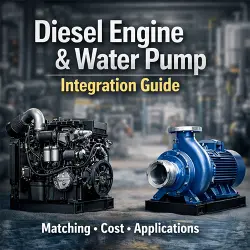
A Decision-Oriented Guide for Industrial and Off-Grid Projects
Introduction
Diesel engine driven water pump systems continue to play a critical role in industrial, agricultural, construction, and emergency applications worldwide. Despite the expansion of electric motor driven systems and renewable energy alternatives, diesel-driven pump solutions remain indispensable wherever electrical infrastructure is unavailable, unstable, or strategically insufficient.
Selecting a diesel engine and water pump integrated system, however, is not merely a matter of choosing equipment. It is an engineering decision that directly affects operational stability, fuel consumption, maintenance planning, and lifecycle cost.
Engineers and project managers frequently ask:
-
Should I use diesel or electric drive?
-
How do I correctly match the engine to the pump?
-
What are the most common integration failures?
-
What does long-term cost actually look like?
-
How can I avoid oversizing or undersizing?
This guide provides a structured, decision-oriented explanation of diesel engine and water pump integrated technology applications. Its purpose is to support technically sound and economically rational project decisions.
Definition – What Is a Diesel Engine Driven Pump System?
A diesel engine driven pump system is an integrated mechanical assembly in which a diesel engine supplies rotational power directly to a water pump through a coupling or shaft connection, enabling independent, off-grid fluid transfer under controlled torque and speed conditions.
In engineering terms, the system must ensure:
-
Torque compatibility between engine and pump
-
Stable RPM alignment
-
Adequate power margin
-
Thermal and vibration stability
-
Predictable lifecycle behavior
Reliability in such systems is determined not only by component quality, but by correct integration and load matching.
Should You Choose a Diesel Engine Driven Pump System?
Diesel engine driven systems are not universal solutions. They are application-driven technologies suited to specific operational environments.
When Diesel Is the Right Choice
Diesel-driven pump systems are typically appropriate when:
-
No reliable electrical grid exists
-
Power supply is unstable
-
Mobility is required
-
Emergency deployment is critical
-
Temporary pumping operations are needed
-
Redundant backup systems are required
In flood control, remote irrigation, mining dewatering, and construction sites, diesel systems provide operational independence that electric systems cannot guarantee.
When Diesel May Not Be Ideal
Diesel systems may not be optimal when:
-
Continuous fixed urban installation is planned
-
Noise regulations are strict
-
Emission compliance is tightly regulated
-
Electrical supply is stable and cost-effective
-
Long-term low-maintenance operation is prioritized
Understanding these boundaries ensures strategic decision-making rather than default equipment selection.
Application-Driven Requirements
Different applications impose different mechanical and operational demands. Misalignment between system design and application needs is a primary source of failure.
Agricultural Irrigation
Irrigation systems often require:
-
Long continuous operation
-
Moderate to high flow rates
-
Controlled fuel consumption
-
Portability across fields
Fuel efficiency becomes critical in long-duration irrigation cycles. Matching engine load to pump demand improves operating economy.
Construction and Dewatering
Construction pumping typically demands:
-
Self-priming capability
-
Debris tolerance
-
Frequent relocation
-
Rapid startup
Improper alignment after transportation is a common cause of vibration-related failures.
Emergency Flood Control
Emergency applications require:
-
Immediate startup capability
-
High torque response
-
Stable performance under extreme load
Diesel systems provide resilience where electrical infrastructure may be damaged.
Industrial Backup Systems
In industrial facilities, diesel pump sets:
-
Operate in parallel with electric pumps
-
Provide redundancy during power failure
-
Support fire protection systems
Integration planning must consider automatic transition and readiness.
Diesel vs Electric Pump Systems – A Practical Comparison
The choice of power source is strategic, not ideological.
| Factor | Diesel Driven | Electric Driven |
| Grid Dependency | Independent | Required |
| Mobility | High | Low |
| Installation Speed | Fast | Moderate |
| Fuel/Energy Cost | Variable | Generally Lower |
| Noise | Higher | Lower |
| Emissions | Present | Minimal |
| Maintenance Type | Mechanical | Electrical |
Diesel systems provide independence and mobility. Electric systems provide operational economy in stable grid environments.
Lifecycle Cost Considerations
Total cost of ownership includes fuel, maintenance, downtime risk, and service life.
Initial Investment
Includes:
-
Engine
-
Pump
-
Frame or skid
-
Coupling and alignment
-
Commissioning
Fuel Consumption – Practical Estimation
Fuel usage depends on load stability.
Engineering reference values:
-
Typical diesel consumption: 0.2–0.3 liters per kWh at 70–80% load
-
A 50 kW system operating 8 hours may consume 80–120 liters per day, depending on load
Oversized engines operating at low load may increase fuel usage by 10–20%.
Maintenance Planning
Typical service intervals:
-
Oil change: 250–500 hours
-
Fuel filter replacement: 500–1000 hours
-
Major inspection: 2000 hours
Service Life Expectation
Properly integrated systems may operate reliably for 5–15 years, depending on:
-
Duty cycle
-
Environmental exposure
-
Maintenance discipline
Lifecycle cost analysis must incorporate downtime risk and operational continuity.
How to Properly Match a Diesel Engine to a Water Pump
Correct load matching determines system stability.
Understanding Pump Load Curve
Pump power demand increases with flow. Load curves must be calculated for actual operating conditions.
Understanding Engine Torque Curve
Engine torque delivery must overlap the pump’s load demand at operating RPM.
Power Margin
A 10–15% power margin is typically recommended. Excess margin reduces efficiency.
RPM Compatibility
Engine rated speed must match pump design speed to avoid:
-
Reduced hydraulic efficiency
-
Increased vibration
-
Accelerated wear
Altitude Correction
Engine output decreases at higher altitudes due to air density changes. Correction factors must be applied.
Common Integration Mistakes and Their Consequences
Most system failures result from integration errors.
-
Undersized engine → Overload shutdown and overheating
-
Oversized engine → Fuel inefficiency and unstable operation
-
Improper alignment → Bearing and coupling damage
-
Insufficient ventilation → Thermal stress
-
Ignoring duty cycle → Premature mechanical fatigue
Each error increases lifecycle cost and risk.
Engineering Insight – Why Integration Quality Determines Stability
From practical integration experience, many diesel pump failures are not caused by engine defects or pump manufacturing issues. They stem from improper system matching.
Common field weaknesses include:
-
Ignoring torque curve compatibility
-
Excessive safety margin leading to inefficiency
-
Improper shaft alignment after relocation
-
Inadequate ventilation in enclosed environments
System stability is an engineering outcome resulting from correct load matching and installation discipline.
Maintenance Strategy for Diesel Driven Pump Systems
Maintenance planning ensures long-term reliability.
Key areas include:
-
Engine oil management
-
Fuel filtration
-
Cooling inspection
-
Vibration monitoring
-
Scheduled servicing
Structured maintenance reduces unplanned downtime.
Decision Framework for Diesel Pump Projects
Structured evaluation improves project stability.
- Define application scenario
- Calculate hydraulic demand
- Determine pump power requirement
- Match engine torque and RPM
- Evaluate fuel and environmental conditions
- Plan maintenance strategy
Projects that follow structured evaluation typically demonstrate improved reliability.
Key Technical Factors in Diesel Engine Pump Integration
Five core factors determine integration success:
- Clear application definition
- Accurate hydraulic calculation
- Torque and RPM compatibility
- Controlled power margin
- Predictable maintenance planning
Addressing these factors early reduces lifecycle risk.
Future Trends in Diesel Engine Pump Systems
Diesel-driven systems continue evolving.
-
Improved fuel efficiency
-
Emission compliance
-
Integrated monitoring systems
-
Hybrid backup configurations
While alternative energy solutions expand, diesel systems remain essential for off-grid and emergency applications.
FAQ – Diesel Engine and Water Pump Integration
The following frequently asked questions address practical engineering concerns related to diesel engine and water pump integration. These questions reflect common issues encountered in industrial, agricultural, and emergency pumping projects, particularly those involving off-grid or mobile systems. Understanding these points helps reduce integration risk and improve long-term operational stability.
Why not oversize the engine for safety?
Oversizing increases fuel consumption and may cause unstable low-load operation.
What happens if RPM mismatch occurs?
Efficiency decreases and vibration increases, accelerating wear.
Can diesel pump systems run continuously?
Yes, if properly matched and maintained.
What is typical service life?
5–15 years depending on maintenance and duty cycle.
How can vibration be minimized?
Through proper alignment, stable foundation, and dynamic balancing.
Conclusion – Engineering Integration Determines System Reliability
Diesel engine and water pump integration is an engineering process requiring precise load matching, torque compatibility, and maintenance planning.
Diesel-driven systems remain indispensable in off-grid, mobile, and emergency scenarios. When correctly integrated, they provide operational independence and reliability.
In diesel pump projects, long-term stability is determined not by horsepower alone, but by disciplined engineering integration.
Get A Quote

Get A Quote
0 Comments