
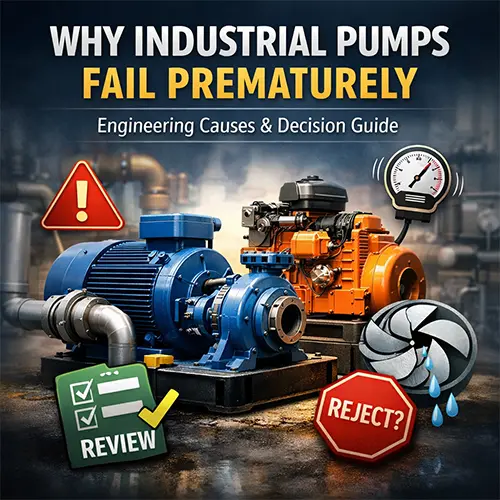
Why Industrial Pumps Fail Prematurely A Decision-First Engineering Guide to Avoid Costly Selection and System Mistakes
Reference Page Notice
This page is designed as an engineering reference for industrial pump selection and failure analysis.
It focuses on decision boundaries, risk identification, and system-level causes, rather than product promotion or troubleshooting steps.
The guidelines and decision tables on this page are intended to support engineering review, procurement decisions, and system validation in industrial pump applications.
Introduction – Why Most Pump Failures Are Decided Before Installation
Premature industrial pump failure is rarely accidental.
In most industrial projects, the failure path is already set before the pump is installed—often during pump selection, system definition, or early engineering shortcuts.
In the field, failures are commonly explained as:
-
“The pump quality is not good.”
-
“The mechanical seal failed too early.”
-
“The bearing life is much shorter than expected.”
However, post-failure analysis across industrial applications repeatedly shows a different reality:
More than 70–80% of premature industrial pump failures are driven by selection and system decisions, not manufacturing defects.
This article is not a troubleshooting manual and not a maintenance guide.
Its purpose is earlier and more fundamental:
To help engineers, buyers, and project owners decide whether a pump system is safe to continue, requires redesign, or should be rejected before failure occurs.
If you are reading this page, you are likely facing one of these situations:
-
A pump is operating, but reliability is questionable
-
A project is moving forward, but risks are not fully understood
-
A supplier claims the selection is correct, but confidence is low
-
Early warning signs (vibration, noise, leakage) are appearing
This guide replaces uncertainty with engineering-based decision rules.
Methodology & Scope
The conclusions in this reference guide are based on:
-
Industrial pump selection practice across multiple application scenarios
-
Field failure analysis involving cavitation, off-BEP operation, duty cycle abuse, and TDH mismatch
-
Engineering review of system-level assumptions, not isolated component defects
This guide does not replace detailed project-specific calculations.
Instead, it provides decision rules and risk boundaries to identify when recalculation, redesign, or system correction is required.
Applicability & Limitations
This reference page applies to:
-
Industrial centrifugal pump systems
-
Continuous and intermittent duty applications
-
Electric motor-driven and diesel-driven pump systems
This guide is not intended for:
-
Residential or domestic pump applications
-
Positive displacement pump sizing
-
Temporary construction pumps without defined operating conditions
How Industrial Pumps Fail: A Root-Cause Decision Map
Although pump failures appear diverse in the field, their root causes are highly repetitive.
Most premature failures fall into a limited number of decision-stage categories.
Understanding which category your project belongs to is the first step toward deciding whether risk is acceptable.
Failure Category Overview
| Failure Category | Typical Root Cause | Preventable at Selection Stage |
| Hydraulic | Wrong flow, off-BEP operation | Yes |
| System | Incorrect TDH, poor suction design | Yes |
| Cavitation | Insufficient NPSH margin | Yes |
| Mechanical | Fatigue, vibration overload | Indirect |
| Operational | Start-stop abuse, duty mismatch | Yes |
| Installation | Alignment, foundation | Partially |
Decision Takeaway
If the dominant root cause belongs to a selection-stage category, corrective maintenance alone will not eliminate the failure mechanism.
Wrong Flow Selection: Oversizing and Off-BEP Operation
Oversizing is the most common industrial pump selection mistake because it feels conservative and safe.
In reality, it is one of the fastest ways to shorten pump life.
Why Oversizing Happens
-
Desire for future capacity without system validation
-
Fear of insufficient flow
-
Supplier recommendations without full system data
-
Misuse of throttling valves as a control strategy
What Physically Happens Off BEP
When a centrifugal pump operates away from its Best Efficiency Point (BEP):
-
Radial hydraulic imbalance increases
-
Shaft deflection rises
-
Bearing load increases continuously
-
Seal face alignment becomes unstable
-
Vibration becomes persistent rather than transient
This damage accumulates gradually and silently.
Early vs Late Symptoms
| Stage | Typical Observation | Can You Continue? |
| Early | Slight vibration increase | Conditional |
| Mid | Seal leakage, noise | High risk |
| Late | Bearing or shaft failure | No |
Decision Takeaway
If the operating point is more than ±20% away from BEP, redesign is recommended rather than throttling or “accepting vibration.”
Incorrect TDH Calculation: When “Estimated Head” Becomes a Failure Trigger
TDH errors rarely cause immediate failure.
Instead, they create continuous overload conditions.
Common TDH Shortcuts
-
Ignoring minor losses
-
Reusing past project values
-
Assuming static head is sufficient
TDH Error vs Consequence
| TDH Error | Typical Result | Decision |
| ≤5% | Minor inefficiency | Acceptable |
| 5–10% | Overload risk | Recheck |
| >10% | Chronic failure | Stop & recalc |
Decision Takeaway
If TDH was not calculated from the full system, the pump selection should not be considered final.
Cavitation Misjudgment: NPSH Errors That Destroy Pumps Quietly
Cavitation is destructive because early damage is subtle and often misdiagnosed.
Cavitation Progression
| Stage | Physical Process | Field Sign | Can Continue? |
| Early | Micro-bubble collapse | Light noise | Temporary |
| Mid | Surface erosion | Pressure fluctuation | No |
| Late | Structural damage | Severe vibration | Stop |
Decision Takeaway
Continuous cavitation is never an acceptable operating condition, regardless of noise level.
Duty Cycle and Start-Stop Abuse: The Hidden Life Shortener
Pump life is often limited by how often it starts, not how long it runs.
Why Start Frequency Matters
Each start introduces:
-
Electrical inrush
-
Torque shock
-
Seal-face dry contact
-
Fatigue accumulation
Start Frequency Decision Table
| Starts / Hour | Risk Level | Required Action |
| ≤2 | Low | 空白 |
| 3–6 | Medium | Soft starter |
| >6 | High | VFD required |
Decision Takeaway
More than 6 starts/hour without mitigation should be considered a high-risk condition.
Material Selection Mistakes: Corrosion and Erosion Are Slow Killers
Material failure is rarely sudden—it degrades performance gradually.
Material Risk Table
| Condition | Short-Term Risk | Long-Term Outcome |
| Mild corrosion | Low | Efficiency loss |
| Abrasive erosion | Medium | Clearance failure |
| Combined | High | Rapid breakdown |
Decision Takeaway
Gradual efficiency loss is often a material problem, not an alignment issue.
Installation vs Selection Errors: Know What You Can Still Fix
Not all failures are installation mistakes—but many installation problems are locked in by poor selection.
What Selection Can Prevent
| Issue | Preventable by Selection |
| Insufficient NPSH | Yes |
| Suction piping layout | Yes |
| Poor foundation | No |
| Misalignment | No |
Decision Takeaway
If the root cause is selection-related, installation correction alone will not solve the problem.
Diesel-Driven Pump Systems: Where Margins Matter Most
Diesel-driven pumps have lower tolerance for engineering error.
Diesel Suitability Checklist
| Question | Yes / No |
| Pump & engine curves matched? | ⬜ |
| NPSH margin ≥1.0 m? | ⬜ |
| Load within engine band? | ⬜ |
Decision Takeaway
Without curve matching, diesel pump selection is incomplete.
Stop-or-Go: When to Continue, Redesign, or Reject a Pump System
This section answers one question:
Can this system safely continue, or must it be redesigned?
Risk Acceptance Matrix
| Situation | Can Continue? | Recommendation |
| Mild cavitation (short-term) | Temporary | Monitor |
| Continuous cavitation | No | Redesign |
| TDH underestimated >10% | No | Recalculate |
| Oversized + throttled | Conditional | Control or reselect |
FAQ – Industrial Pump Failure & Decision Making
Why do industrial pumps fail early?
Because selection and system assumptions introduce continuous stress.
Is cavitation always noisy?
No. Early cavitation can be quiet while damage progresses.
How long should an industrial pump last?
When selected and operated correctly, many pumps exceed their design life.
Can VFDs extend pump life?
Yes. They reduce start shock and stabilize operating points.
When is redesign unavoidable?
When core limits (TDH, NPSH, BEP alignment) are continuously violated.
Conclusion – Pump Failure Is a Decision Outcome, Not an Accident
Most pump failures are not surprises.
They are the result of risks accepted during selection, often unknowingly.
A professional system is not defined by never failing.
It is defined by knowing when continuation is unsafe and acting before failure occurs.
About This Reference
This reference page is prepared by the LIQEN Power engineering team,
focusing on industrial pump systems, diesel-driven pump applications, and system-level selection reliability.
The content is intended for engineering review, procurement validation, and technical decision support, not for consumer product comparison.
Get A Quote

Get A Quote
0 Comments