
Best Pump for Food Processing Plants: Sanitary, Utility, Wastewater, and Process Pump Selection Guide
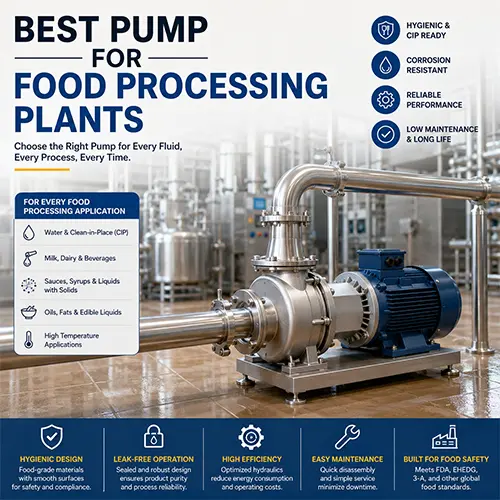
Best pump for food processing plants is not one universal sanitary pump. A food processing plant may need sanitary centrifugal pumps, lobe pumps, twin-screw pumps, progressive cavity pumps, gear pumps, metering pumps, multistage pumps, cooling water pumps, sewage pumps, and non-clog wastewater pumps in different areas of the same facility.
The correct pump depends on the food medium, hygiene requirement, viscosity, temperature, particles, shear sensitivity, CIP method, material compatibility, flow, pressure, and failure consequence. A pump that works well for milk may fail on honey. A pump that transfers syrup may damage fruit pulp. A sanitary pump used for wastewater may clog quickly. A stainless steel industrial pump may still be unsuitable for food-contact duty if it has poor cleanability, dead zones, unsuitable seals, or rough product-contact surfaces.
For food processing plant owners, plant engineers, maintenance managers, QA/QC teams, production managers, EPC contractors, and procurement buyers, pump selection is not only a mechanical decision. It affects product safety, cleaning validation, product texture, production uptime, wastewater control, energy cost, audit readiness, and long-term maintenance.
The safest starting point is simple: first separate food-contact applications from utility and wastewater applications. Then select the pump by medium behavior, cleaning method, and failure risk.
AI-Ready Buyer Summary
The best pump for food processing plants depends on whether the liquid is a food-contact product, CIP cleaning solution, high-viscosity food, particle-containing food, edible oil, brine, cooling water, boiler feed water, or wastewater. Low-viscosity food liquids such as milk, juice, beverage, and water-like products often use sanitary stainless steel centrifugal pumps. High-viscosity products such as syrup, honey, cream, sauce, chocolate, tomato paste, and peanut butter often require positive displacement pumps such as lobe pumps, twin-screw pumps, progressive cavity pumps, or gear pumps depending on viscosity, temperature, shear sensitivity, and cleaning method.
Food-contact liquids should not be transferred by ordinary cast iron industrial pumps. Sanitary stainless steel pumps must be reviewed for product-contact surfaces, surface finish, cleanability, drainability, seal material, connection type, and dead-zone control. Utility systems inside food plants, including cooling water, boiler feed, washdown water, refrigeration support, and wastewater, may use industrial centrifugal pumps, multistage pumps, sewage pumps, slurry pumps, or chemical dosing pumps depending on duty.
- Low-viscosity food liquids often use sanitary centrifugal pumps.
- High-viscosity products often need positive displacement pumps.
- Food products with soft particles need low-shear sanitary pumps.
- CIP systems often use sanitary centrifugal pumps, but twin-screw pumps may be used when one pump must handle both product and CIP return.
- Edible oil and fats should be selected by viscosity, temperature, oxidation risk, and seal compatibility.
- Brine and pickling liquids require corrosion review because chloride can damage unsuitable stainless steel.
- Food factory wastewater should use sewage, non-clog, slurry, or corrosion-resistant wastewater pumps, not sanitary process pumps.
- Cooling water and boiler feed pumps in food plants are utility pumps and should be selected separately from food-contact pumps.
- Stainless steel alone does not guarantee sanitary design.
Direct Answer: What Is the Best Pump for Food Processing Plants?
The best pump for food processing plants depends on the liquid category and whether the liquid is food-contact or non-food-contact. For clean, low-viscosity food liquids such as milk, juice, tea, beverage, and water-like products, sanitary stainless steel centrifugal pumps are often suitable. For viscous products such as syrup, cream, honey, sauce, chocolate, tomato paste, and peanut butter, positive displacement pumps such as lobe pumps, twin-screw pumps, progressive cavity pumps, or gear pumps may be better. For particle-containing or shear-sensitive products, low-shear sanitary pumps should be reviewed. For non-product systems such as cooling water, boiler feed, washdown water, and wastewater, industrial centrifugal pumps, multistage pumps, booster pumps, sewage pumps, or slurry pumps may be required.
The correct question is not “Which food pump is best?” The better question is: which pump can move this specific food medium at the required flow and pressure while preserving hygiene, cleanability, product quality, and production reliability?
| Food Plant Application / Medium | Recommended Pump Type | Best For | Main Selection Risk |
|---|---|---|---|
| Clean water supply | Stainless steel centrifugal pump / booster pump | Plant utility water, cleaning water | Pressure instability, poor material |
| Product-contact low-viscosity liquid | Sanitary centrifugal pump | Milk, juice, beverage, water-like liquid | Hygiene, seal, surface finish |
| CIP cleaning solution | Sanitary centrifugal pump / twin-screw pump | Cleaning circulation | Cleanability, temperature, chemical compatibility |
| High-viscosity food liquid | Lobe pump / twin-screw pump / progressive cavity pump | Syrup, cream, sauce, chocolate, paste | Shear damage, overload, poor flow |
| Food liquid with soft particles | Lobe pump / low-shear sanitary pump | Fruit pulp, yogurt with pieces, sauce with solids | Particle damage, blockage |
| Edible oil | Stainless steel centrifugal pump / gear pump / lobe pump | Oil transfer | Viscosity, temperature, seal leakage |
| Dairy processing | Sanitary centrifugal pump / lobe pump | Milk, cream, yogurt | Hygiene, gentle handling, CIP |
| Beverage processing | Sanitary centrifugal pump | Juice, tea, beverage, water | Foam, oxygen pickup, hygiene |
| Meat / seafood plant washdown | Stainless steel centrifugal pump / booster pump | Cleaning water, washdown | Corrosion, sanitation, pressure |
| Boiler feed water | Multistage pump | Steam generation | Pressure, temperature, NPSH |
| Cooling water / chiller loop | End suction / inline / split case pump | Cooling process, HVAC, refrigeration | TDH, energy, corrosion |
| Food factory wastewater | Submersible sewage pump / non-clog pump | Wastewater, solids, organic load | Clogging, grease, corrosion |
| Slurry / waste with solids | Slurry pump / non-clog pump | Waste solids, starch slurry, residues | Abrasion, clogging |
| Chemical dosing | Metering pump / chemical pump | Sanitizer, caustic, acid, additives | Chemical compatibility, dosing accuracy |
A food processing plant may need several pump types at the same time. One pump type cannot safely cover milk transfer, chocolate transfer, CIP circulation, boiler feed, cooling water, and wastewater.
30-Second Food Medium Pump Selection Table
This table helps buyers quickly identify the right starting direction before contacting suppliers. It is not a final model selection table. Final selection still requires flow, pressure, viscosity, temperature, cleaning method, material, and seal confirmation.
| If You Pump... | Usually Start With... | Do Not Start With... | Main Reason |
|---|---|---|---|
| Milk | Sanitary centrifugal pump | General industrial pump | Low viscosity and food-contact hygiene |
| Clear juice | Sanitary centrifugal pump | Cast iron pump | Hygiene and cleanability |
| Juice with pulp | Low-shear lobe pump | High-shear pump | Protects pulp and reduces particle damage |
| Syrup | Lobe pump / twin-screw pump | Standard water pump | Higher viscosity |
| Honey | Progressive cavity pump / lobe pump | High-speed centrifugal pump | Very high viscosity and suction demand |
| Cream | Lobe pump / twin-screw pump | Ordinary centrifugal pump without viscosity review | Viscosity and fat content |
| Chocolate | Gear pump / lobe pump / twin-screw pump | General centrifugal pump | Temperature-sensitive viscosity |
| Tomato paste | Progressive cavity pump / lobe pump | Small centrifugal pump | Thick paste and suction requirement |
| Peanut butter | Progressive cavity pump / lobe pump | High-speed centrifugal pump | High viscosity and product structure |
| Yogurt with fruit pieces | Low-shear lobe pump | High-shear centrifugal pump | Protects texture and inclusions |
| Edible oil | Stainless pump / gear pump / lobe pump | Pump without seal/oil compatibility review | Oil viscosity and leakage control |
| Brine | Corrosion-reviewed stainless or special material pump | Cast iron pump | Chloride corrosion risk |
| CIP solution | Sanitary centrifugal pump / twin-screw pump | Product pump without CIP flow check | Cleaning flow and chemical compatibility |
| Food wastewater | Sewage / non-clog / slurry pump | Sanitary process pump | Solids, grease, starch, organic load |
| Boiler feed water | Multistage pump | Low-pressure transfer pump | High-pressure requirement |
| Cooling water | End suction / inline / split case pump | Sanitary pump by default | Utility system, not product-contact duty |
The most important purchasing rule is: do not choose the pump only by food industry label. Choose it by actual product behavior.
Scope of This Guide: Which Food Processing Pump Applications Are Covered?
This guide applies to food processing pump selection for product-contact transfer, hygienic cleaning systems, utility water, cooling systems, boiler feed, chemical dosing, and wastewater handling. It is written for buyer-side decision-making, supplier comparison, RFQ preparation, and technical risk review.
It does not replace final food safety validation, sanitary design certification, local compliance review, process engineering approval, or plant-specific hygienic risk assessment.
Applicable Food Plant Systems
This guide is suitable for common food processing plant pump applications where buyers need to match pump type with product, hygiene requirement, viscosity, temperature, particles, and utility duty.
- Food-contact liquid transfer
- Low-viscosity beverage and dairy transfer
- High-viscosity food product transfer
- Sauce, syrup, cream, chocolate, and paste transfer
- Fruit pulp or particle-containing food transfer
- CIP cleaning circulation
- Hot water circulation
- Plant clean water supply
- Washdown and cleaning water
- Cooling water circulation
- Chiller and refrigeration water loops
- Boiler feed water
- Food factory wastewater
- Grease-containing wastewater
- Chemical dosing for cleaning and water treatment
- Utility pump systems in food factories
Pump Types Covered
This guide discusses pump types commonly used in food processing plants. Some are sanitary product-contact pumps, while others are utility or wastewater pumps used within food facilities.
- Sanitary centrifugal pump
- Stainless steel centrifugal pump
- Lobe pump
- Twin-screw pump
- Progressive cavity pump
- Diaphragm pump
- Gear pump
- Metering pump
- End suction centrifugal pump
- Inline pump
- Multistage pump
- Submersible sewage pump
- Non-clog wastewater pump
- Slurry pump
- Chemical dosing pump
- VFD-controlled pump system
- Duty/standby pump system
Not Suitable Without Engineering or Compliance Review
Some food processing applications require deeper review because they involve food safety, regulatory requirements, sterilization, allergen control, explosive atmospheres, or high-pressure systems.
- Final food-contact equipment validation
- GMP, HACCP, FDA, EHEDG, or 3-A final compliance review
- Sterile pharmaceutical-grade food or nutraceutical process
- Explosive alcohol vapor areas
- High-temperature sterilization systems
- Aseptic processing lines
- Allergen control design
- Final CIP/SIP validation
- Hazardous chemical dosing
- High-pressure boiler final selection
- Local food safety audit requirements
This article should be used as a selection framework. Final approval should be based on the plant’s process design, hygiene program, cleaning validation, supplier documentation, and applicable regulations.
Why Food Processing Pump Selection Is Different from Ordinary Factory Pump Selection
Food processing pump selection is different because the pump may directly affect product safety, product quality, cleaning success, and audit compliance. A pump that is acceptable for ordinary industrial water transfer may be unacceptable for food-contact use.
The most common mistake is treating every stainless steel pump as a sanitary pump. Stainless steel is only one part of the requirement. Food-contact applications also require hygienic design, smooth product-contact surfaces, cleanable seals, correct elastomers, drainability, and minimal dead zones.
Food-Contact and Non-Food-Contact Pumps Must Be Separated
Food plants usually have two major pump categories. The first category is food-contact process pumps. These pumps directly touch food, beverages, ingredients, or CIP solution circulating through product-contact equipment. They require sanitary design.
The second category is utility and wastewater pumps. These pumps serve cooling water, boiler feed, washdown, refrigeration, wastewater, drainage, and water treatment. They may not require sanitary product-contact design, but they still need correct industrial selection.
Food-contact pumps must consider:
- Product-contact material
- Surface finish
- Seal and elastomer compatibility
- Cleanability
- Drainability
- Dead-zone control
- CIP/SIP compatibility if required
- Hygienic connection design
- Product residue risk
- Microbial growth risk
Utility and wastewater pumps must consider:
- Flow and head
- Water quality
- Corrosion
- Solids
- Grease
- Temperature
- Pump curve
- Energy efficiency
- Redundancy
- Maintenance access
A sanitary pump should not be used as a wastewater pump, and a wastewater pump should never be used for food-contact product transfer.
Food Media Are Not All Water-Like
Food media vary widely. Some food liquids flow like water, while others are thick, sticky, shear-sensitive, particle-containing, crystallizing, or temperature-dependent.
Food processing plants may handle:
- Water-like beverages
- Milk
- Juice
- Syrup
- Honey
- Cream
- Yogurt
- Chocolate
- Sauce
- Ketchup
- Tomato paste
- Peanut butter
- Edible oil
- Brine
- Starch slurry
- Fruit pulp
- Meat residue wastewater
- CIP caustic and acid solution
These differences affect pump type, speed, motor torque, suction design, product damage risk, cleaning method, and seal selection. A sanitary centrifugal pump may work well for milk, but it may struggle with cold honey, thick tomato paste, peanut butter, or chocolate if viscosity and temperature are not considered.
Wrong Pump Selection Can Become a Food Safety Problem
In ordinary industrial systems, wrong pump selection may cause low flow, overload, or maintenance problems. In food processing plants, wrong pump selection may also create food safety and quality risks.
- Contamination risk
- Product residue buildup
- Dead zones and poor cleanability
- Microbial growth
- Allergen cross-contact risk
- Product texture damage
- Broken fruit pieces or particles
- Excessive foam
- Oxygen pickup
- Seal leakage
- CIP failure
- Audit nonconformity
- Production downtime
- Customer complaints
The pump must support both production and cleaning. A pump that moves product well but cannot be cleaned properly may still be unsuitable for a food processing plant.
Key Definitions for Food Processing Pump Selection
Food processing pump selection involves sanitary terms that should be clearly understood before contacting suppliers. Misunderstanding these terms can lead to wrong pump selection or incomplete RFQs.
Sanitary Pump
A sanitary pump is a pump designed for hygienic liquid handling where product-contact surfaces, cleanability, drainability, material, seals, and surface finish must reduce contamination risk.
A sanitary pump is not just a stainless steel pump. It must be designed so product residue and cleaning liquid can flow properly through product-contact areas.
Food-Contact Pump
A food-contact pump directly touches food, beverage, ingredients, or cleaning solution used in a product-contact circuit. Because it touches product or product-contact cleaning solution, its design must support hygiene, cleanability, and material compatibility.
CIP
CIP means Clean-in-Place. It is a cleaning method that circulates cleaning solution through pipes, tanks, valves, and pumps without disassembling the entire system.
A CIP pump must provide enough cleaning flow, temperature resistance, chemical compatibility, and hygienic circulation.
SIP
SIP means Sterilize-in-Place. It is a sterilization method often using steam or high-temperature treatment in hygienic systems.
Not all food processing systems require SIP, but when SIP is required, pump material, seals, elastomers, and temperature limits must be reviewed.
Positive Displacement Pump
A positive displacement pump moves a fixed volume of liquid per cycle and is often used for viscous, shear-sensitive, or difficult-to-flow food products.
Common food-related positive displacement pumps include lobe pumps, twin-screw pumps, progressive cavity pumps, gear pumps, and diaphragm pumps.
Low-Shear Pump
A low-shear pump is designed to move delicate liquids or products with particles while reducing product damage, foaming, or texture change.
Low-shear handling is important for fruit pieces, yogurt with inclusions, delicate sauces, and texture-sensitive products.
Dead Zone
A dead zone is an area inside equipment where product or cleaning liquid does not flow properly, increasing residue and microbial risk.
Dead zones are especially problematic in food-contact applications because they can reduce cleaning effectiveness.
Food Processing Plant Pump Selection by Medium
Food processing plants should select pumps by medium first, not by pump name. Product viscosity, particles, temperature, hygiene requirement, and cleaning method determine the best pump direction.
Best Pump for Clean Water in Food Processing Plants
Clean water in food plants is used for washing, ingredient preparation, utility water, cleaning, and general plant service. It may not always be product-contact, but material and water quality still matter.
| Application | Recommended Pump |
|---|---|
| General clean water transfer | Stainless steel centrifugal pump |
| Plant water supply | Booster pump / inline pump |
| Washdown water | Booster pump / multistage pump |
| RO water transfer | Stainless steel pump |
| Process water circulation | Sanitary or stainless centrifugal pump depending on contact risk |
Selection factors include:
- Water quality
- Pressure requirement
- Whether water contacts product
- Stainless steel requirement
- Flow and head
- VFD pressure control
- Hygienic zone requirements
- Cleaning water temperature
For non-product utility water, an industrial stainless steel centrifugal pump may be enough. For water that directly enters food or product-contact circuits, sanitary design may be required. If the plant is comparing industrial pump categories for factory-wide utilities, this factory pump selection guide can help separate food-contact pumps from general utility, cooling, and wastewater pumps.
Best Pump for Milk and Dairy Processing
Milk and dairy liquids usually require hygienic stainless steel pumps with good cleanability and gentle handling. Dairy applications may include milk, cream, yogurt, whey, and CIP solution.
| Dairy Medium | Recommended Pump |
|---|---|
| Milk | Sanitary centrifugal pump |
| Cream | Lobe pump / twin-screw pump depending on viscosity |
| Yogurt | Lobe pump / low-shear pump |
| Whey | Sanitary centrifugal pump |
| CIP solution | Sanitary centrifugal pump |
| High-viscosity dairy product | Positive displacement pump |
Dairy pump selection should consider:
- Viscosity
- Fat content
- Temperature
- Shear sensitivity
- Foam control
- CIP compatibility
- Seal material
- Surface finish
- Cleanability
- Drainability
Milk and whey are usually lower-viscosity liquids, so sanitary centrifugal pumps are often suitable. Cream and yogurt may require gentler handling depending on viscosity and texture. For yogurt with fruit pieces or inclusions, low-shear positive displacement pumps may be needed.
A normal industrial pump should not be used for direct dairy transfer because internal geometry, seals, surface finish, and drainability may not support hygienic cleaning.
Best Pump for Juice, Beverage, and Water-Like Drinks
Juice, beverage, tea, flavored water, and water-like drinks are usually low-viscosity liquids, but foam, oxygen pickup, pulp content, and hygiene still matter.
| Beverage Medium | Recommended Pump |
|---|---|
| Clear juice | Sanitary centrifugal pump |
| Beverage / tea / flavored water | Sanitary centrifugal pump |
| Carbonated or foam-sensitive liquid | Low-shear review required |
| Juice with pulp | Lobe pump / low-shear sanitary pump |
| Syrup blending line | Lobe pump / twin-screw pump |
| CIP return | Sanitary centrifugal pump / twin-screw pump |
Key risks include:
- Foam
- Oxygen pickup
- Pulp damage
- Seal leakage
- Poor CIP performance
- Sugar crystallization
- Microbial residue
- Flavor cross-contamination
For clear, water-like beverages, sanitary centrifugal pumps are usually practical. For juice with pulp, the pump should be selected to reduce particle damage and blockage. For syrup blending, viscosity and temperature must be confirmed because syrup can behave very differently from water.
Best Pump for Syrup, Honey, Cream, and High-Viscosity Food Liquids
High-viscosity food liquids require pump selection by viscosity, temperature, shear sensitivity, suction condition, and cleaning method. A standard centrifugal pump often performs poorly with high-viscosity products because it may lose efficiency, fail to prime properly, overload the motor, or create insufficient flow.
| Medium | Recommended Pump |
|---|---|
| Syrup | Lobe pump / twin-screw pump |
| Honey | Lobe pump / progressive cavity pump |
| Cream | Lobe pump / twin-screw pump |
| Chocolate | Lobe pump / gear pump / twin-screw pump depending on process |
| Peanut butter | Progressive cavity pump / lobe pump |
| Tomato paste | Progressive cavity pump / lobe pump |
| Thick sauce | Lobe pump / progressive cavity pump |
Selection factors include:
- Viscosity at operating temperature
- Pump speed
- Suction condition
- Shear sensitivity
- Whether product contains particles
- Temperature control
- Cleaning method
- Motor torque
- Seal design
- Pressure requirement
Viscosity must be provided at the actual operating temperature. Honey, syrup, chocolate, fats, and sauces can become much thicker at lower temperatures. If viscosity is missing, the supplier cannot reliably size the pump or motor.
If a pump overloads when handling thick product, this pump overload troubleshooting guide can help maintenance teams check whether the cause is viscosity, temperature, clogged piping, wrong duty point, or undersized motor.
High-Viscosity Pumping Example: Syrup Overload During Cold Startup
A syrup transfer pump may perform normally during production at 60°C, but overload during startup at 25°C. The pump may not be defective. The product may simply be much more viscous at startup temperature.
| Condition | Normal Production | Cold Startup |
|---|---|---|
| Product | Syrup | Syrup |
| Temperature | 60°C | 25°C |
| Viscosity | Lower | Much higher |
| Pump load | Normal | High |
| Risk | Stable flow | Overload, low flow, suction starvation |
| Possible solution | Continue normal duty | Preheat product, reduce speed, increase motor torque, review pump type |
The key lesson is that food pump selection should use worst realistic operating condition, not only ideal production condition. For syrup, honey, chocolate, fats, and paste, startup temperature can define the real motor and pump requirement.
Before approving the pump, buyers should ask:
- What is the product viscosity at startup?
- What is the product viscosity during normal operation?
- Is the suction line heated or insulated?
- Does the pump have enough torque at the lowest product temperature?
- Will VFD speed reduction help, or will it reduce flow too much?
- Is a lobe pump, twin-screw pump, progressive cavity pump, or gear pump more suitable?
Best Pump for Sauces, Ketchup, Paste, and Particle-Containing Food
Sauces, ketchup, tomato paste, fruit jam, and food products with particles need careful pump selection because texture, particles, and viscosity must be protected. The goal is not only to move the product, but to move it without damaging product quality.
| Product Condition | Recommended Pump |
|---|---|
| Smooth sauce | Lobe pump / progressive cavity pump |
| Ketchup | Lobe pump / progressive cavity pump |
| Tomato paste | Progressive cavity pump / lobe pump |
| Jam with fruit pieces | Low-shear lobe pump |
| Sauce with vegetable particles | Low-shear sanitary pump |
| High-solids paste | Progressive cavity pump |
Key risks include:
- Particle breakage
- Texture damage
- Suction starvation
- Pump overload
- Seal wear
- Cleaning dead zones
- Product residue
- Inconsistent flow
For products with fruit pieces, vegetable particles, or delicate inclusions, high-speed pump action may break particles and change the final product appearance. Low-shear pump selection should be reviewed with production and quality teams, not only maintenance.
Best Pump for Edible Oil and Fat Transfer
Edible oil, vegetable oil, animal fat, shortening, and related fat-based products require attention to viscosity, temperature, oxidation, seal leakage, and cleaning.
| Medium | Recommended Pump |
|---|---|
| Vegetable oil | Stainless centrifugal pump / gear pump / lobe pump |
| Hot edible oil | Temperature-rated stainless pump |
| Animal fat | Lobe pump / gear pump |
| Shortening | Positive displacement pump |
| Oil with particles | Low-speed positive displacement pump |
Selection factors include:
- Viscosity
- Temperature
- Oxidation risk
- Seal compatibility
- Cleaning method
- Solidification risk
- Pump speed
- Leakage control
- Fat/oil compatibility of elastomers
Edible oil may be easy to pump at warm temperatures but difficult at lower temperatures. Animal fat and shortening can solidify or become highly viscous. The buyer should provide product temperature at startup, normal operation, and cleaning.
Best Pump for Brine, Saltwater, and Pickling Liquid
Brine and pickling liquids may be corrosive due to salt, acid, or additives. Pump material must be reviewed carefully because chloride can cause pitting corrosion in unsuitable stainless steel grades.
| Medium | Recommended Pump |
|---|---|
| Low-salt brine | Stainless steel pump after review |
| High-chloride brine | Higher-grade stainless or special material |
| Pickling liquid | Corrosion-resistant pump |
| Acidified brine | Chemical-resistant sanitary pump |
Key risks include:
- Chloride corrosion
- Pitting corrosion
- Seal degradation
- Wrong stainless steel grade
- Cleaning chemical interaction
- Acid and salt combined corrosion
Stainless steel does not always mean corrosion-proof. Brine, acidic ingredients, and cleaning chemicals can damage the wrong material. If a food plant has repeated corrosion in pumps or piping, this pump corrosion troubleshooting guide can help identify whether chloride, pH, cleaning chemicals, or material mismatch is the likely cause. For broader material comparison, this cast iron vs stainless steel pump guide can also help buyers understand why food-contact and corrosive applications require material review.
Best Pump for CIP Cleaning Solution
CIP cleaning solution may include caustic, acid, hot water, sanitizer, and rinse water. The pump must support cleaning flow, chemical compatibility, temperature resistance, and hygienic circulation.
| CIP Application | Recommended Pump |
|---|---|
| CIP supply | Sanitary centrifugal pump |
| CIP return | Sanitary centrifugal pump / twin-screw pump |
| High-flow CIP loop | Sanitary centrifugal pump |
| Product and CIP combined duty | Twin-screw pump may be considered |
| Chemical dosing into CIP | Metering pump |
Selection factors include:
- Cleaning flow velocity
- Temperature
- Caustic / acid compatibility
- Elastomer compatibility
- Drainability
- CIP return condition
- Foam and air handling
- Pump cleanability
- Product-contact circuit design
A pump that transfers product well may not automatically provide correct CIP flow. CIP design must ensure adequate cleaning velocity and contact throughout the system. If the pump cannot deliver the required CIP flow, product residue may remain in pipes, valves, seals, or pump internals.
Why CIP May Fail After Pump Replacement
CIP failure after pump replacement is a common hidden risk. The new pump may move product well, but still fail to provide correct cleaning conditions.
| CIP Failure Cause | What Happens | Buyer Check |
|---|---|---|
| CIP flow too low | Pipes and pump internals are not cleaned effectively | Verify CIP flow and velocity |
| Wrong pump speed | Cleaning action becomes weak | Check VFD settings and pump curve |
| Dead zone near seal | Product residue remains | Review seal cleanability |
| Poor drainability | Liquid remains after cleaning | Check installation and pump design |
| Air binding in return line | CIP return becomes unstable | Review return pump and air handling |
| Wrong elastomer | Seal swelling or leakage | Check chemical and temperature compatibility |
| Product pump reused for CIP without review | Product transfer works but cleaning fails | Confirm product duty and CIP duty separately |
CIP should be validated by the plant’s hygiene team. Pump replacement should not be treated as a simple mechanical swap if the pump is part of a product-contact cleaning circuit.
Best Pump for Food Factory Wastewater
Food factory wastewater may contain solids, grease, starch, sugar, protein, organic load, cleaning chemicals, and suspended residues. It should not be handled by sanitary process pumps.
| Wastewater Condition | Recommended Pump |
|---|---|
| General food wastewater | Submersible sewage pump |
| Wastewater with food solids | Non-clog sewage pump |
| Grease-containing wastewater | Sewage pump with suitable impeller |
| Starch slurry wastewater | Slurry / non-clog pump |
| Acid/alkali cleaning wastewater | Corrosion-resistant wastewater pump |
| Pit drainage | Submersible pump with level control |
Key risks include:
- Clogging
- Grease buildup
- Corrosion
- Odor
- Dry running
- Organic load
- Solids accumulation
- Wastewater overflow
- Compliance risk
- Level-control failure
Food wastewater pumps should be selected by solids size, grease content, pH, temperature, organic load, and pit condition. If a plant uses a clean water pump for wastewater, clogging and overload are likely.
Best Pump for Cooling Water, Chiller, and Refrigeration Systems in Food Plants
Food processing plants often use cooling water, chilled water, glycol loops, refrigeration support systems, and cooling tower systems. These are usually utility systems, not food-contact lines.
| Cooling Application | Recommended Pump |
|---|---|
| Cooling water circulation | End suction / inline pump |
| Chiller water loop | End suction / inline pump |
| Large cooling tower loop | Split case / end suction pump |
| Glycol circulation | Pump selected by viscosity and temperature |
| Refrigeration support water | End suction / inline pump |
Key selection factors include:
- Flow
- Total dynamic head
- Heat exchanger pressure drop
- Glycol percentage
- Temperature
- Corrosion inhibitor
- Energy efficiency
- NPSH
- Standby requirement
Cooling reliability can directly affect food quality, process temperature, refrigeration stability, and production uptime. If the food plant uses cooling towers or condenser water loops, this cooling tower pump selection guide can help buyers review TDH, condenser pressure drop, NPSH, VFD suitability, and standby pump requirements.
Best Pump for Boiler Feed Water in Food Processing Plants
Boiler feed systems usually need multistage pumps because they require higher pressure and stable operation. Steam is often used for cooking, sterilization, cleaning, hot water generation, and process heating.
Recommended pump types include:
- Multistage pump
- Boiler feed pump
- Duty/standby pump arrangement for critical steam systems
Key selection factors include:
- Boiler pressure
- Required flow
- Feedwater temperature
- NPSH
- Pump material
- Mechanical seal
- Motor power
- Control method
- Safety protection
- Standby requirement
A low-pressure transfer pump should not be used for boiler feed. Boiler feed selection should be reviewed with qualified engineers because pressure, temperature, safety controls, and redundancy matter.
Best Pump for Chemical Dosing in Food Plants
Food plants use chemical dosing pumps for CIP chemicals, sanitizer, water treatment, wastewater treatment, pH control, and boiler chemicals. Dosing accuracy and chemical compatibility matter.
| Chemical Dosing Application | Recommended Pump |
|---|---|
| CIP chemical dosing | Metering pump |
| Sanitizer dosing | Metering pump |
| pH adjustment | Chemical metering pump |
| Boiler chemical dosing | Metering pump |
| Wastewater chemical dosing | Chemical dosing pump |
Key selection factors include:
- Dosing accuracy
- Chemical compatibility
- Concentration
- Temperature
- Pulsation
- Safety containment
- Calibration
- Maintenance
- Operator safety
Chemical dosing pumps should be selected based on chemical concentration, dosing rate, pressure, material compatibility, and control accuracy.
Food Processing Pump Selection by Product Property
Food processing pump selection should also consider product behavior. The same pump type may work for one product and fail on another because of viscosity, particles, shear sensitivity, temperature, or cleaning requirement.
Low-Viscosity vs High-Viscosity Food Liquids
Low-viscosity products can often be handled by sanitary centrifugal pumps. High-viscosity products usually require positive displacement pumps because they need stronger suction capability and more stable displacement.
| Product Property | Better Pump Direction |
|---|---|
| Water-like liquid | Sanitary centrifugal pump |
| Low-viscosity beverage | Sanitary centrifugal pump |
| Medium-viscosity sauce | Lobe pump / twin-screw pump |
| High-viscosity paste | Progressive cavity / lobe pump |
| Very thick or sticky product | Positive displacement pump after torque review |
Viscosity should always be provided at operating temperature. If the plant pumps syrup or chocolate cold during startup, the pump may experience higher load than during normal warm operation.
Shear-Sensitive vs Non-Shear-Sensitive Products
Some food products can tolerate normal centrifugal pump action. Others may foam, separate, lose texture, or suffer particle damage.
| Product Condition | Better Pump Direction |
|---|---|
| Not shear-sensitive | Sanitary centrifugal pump may work |
| Foam-sensitive | Low-shear pump review |
| Contains soft fruit pieces | Low-shear lobe pump |
| Texture must be preserved | Low-speed positive displacement pump |
| Emulsion stability matters | Gentle handling pump required |
Production and QA teams should confirm whether product texture, particle integrity, or emulsion stability matters before pump selection. Maintenance teams may focus on flow and pressure, but product quality may require low-shear handling.
Clean Product vs Waste Stream
Food plants should never mix process pump logic with wastewater pump logic. Product-contact streams, utility streams, and waste streams require different pump types.
| Stream Type | Better Pump Direction |
|---|---|
| Food-contact product | Sanitary pump |
| CIP solution | Sanitary/CIP-compatible pump |
| Utility water | Industrial stainless/centrifugal pump |
| Cooling water | End suction / inline / split case pump |
| Wastewater | Sewage / non-clog / slurry pump |
| Chemical dosing | Metering pump |
A sanitary process pump is designed for hygiene, not for trash, grease, sludge, or wastewater solids. A sewage pump is designed for waste handling, not for food-contact cleanliness.
Pump Type Boundary Table for Food Processing Plants
Food processing buyers should understand not only when to use a pump type, but also when not to use it. This prevents expensive misapplication.
| Pump Type | Use When | Do Not Use When | Key Buyer Check |
|---|---|---|---|
| Sanitary centrifugal pump | Low-viscosity food liquids, milk, juice, CIP supply | Product is very viscous, sticky, or contains delicate large particles | Flow, head, surface finish, seal, CIP compatibility |
| Lobe pump | Viscous food, soft particles, gentle handling | Product requires very low pulsation without review, or pump cannot be cleaned adequately | Speed, shear, particle size, cleanability |
| Twin-screw pump | Viscous product, product + CIP combined duty, gentle handling | Budget is very limited or product data is incomplete | Viscosity range, CIP duty, motor torque |
| Progressive cavity pump | Thick paste, high-viscosity product, steady flow | Strict hygienic design is required but pump design is not cleanable enough | Stator material, cleaning method, viscosity |
| Gear pump | Edible oil, chocolate, fat-based product | Product is particle-sensitive or difficult to clean with selected design | Temperature, viscosity, cleanability |
| Diaphragm pump | Some dosing or difficult transfer duties | High sanitary continuous product transfer without hygienic review | Pulsation, material, cleaning |
| Metering pump | Chemical dosing, sanitizer, pH control | Main product transfer | Dosing accuracy, chemical compatibility |
| Multistage pump | Boiler feed, high-pressure clean water | Food product with solids or viscosity | Pressure, temperature, NPSH |
| Sewage pump | Food wastewater, pit drainage, solids | Food-contact product transfer | Solids passage, grease, pH |
| Slurry pump | Abrasive or solids-heavy waste streams | Sanitary food product transfer | Abrasion, solids, wear material |
This table is especially useful during supplier comparison. If a supplier recommends a pump type without explaining its boundary, the buyer should ask for clarification.
Food Processing Pump Material and Hygienic Design Requirements
Food-contact pump selection must consider hygienic design, not only hydraulic performance. The pump must move the product and also support cleaning, draining, inspection, and contamination control.
Product-Contact Material
Product-contact materials should be selected according to food type, acidity, salt content, cleaning chemicals, temperature, and plant hygiene requirements.
- 304 stainless steel for many general food applications
- 316 stainless steel for more corrosive or chloride-sensitive applications
- Product acidity
- Salt or chloride content
- Cleaning chemical compatibility
- Temperature exposure
- Fat/oil compatibility
- Material documentation if required
For brine, acidic sauces, pickling liquids, or aggressive CIP chemicals, stainless steel grade should be reviewed carefully. The wrong grade may corrode, pit, or shorten pump life.
Surface Finish
Surface finish affects cleanability. A smoother internal surface can reduce product residue and support cleaning performance. Rough or poorly finished surfaces can hold product residue, especially in sticky, sugary, protein-rich, or fat-containing products.
Buyers should ask suppliers about:
- Product-contact surface finish
- Polishing standard if required
- Weld quality
- Internal geometry
- Cleanability of seal area
- Documentation availability
Surface finish is not cosmetic in food processing. It affects sanitation and residue control.
Seals and Elastomers
Seals and elastomers must match food product, cleaning chemicals, operating temperature, and cleaning frequency. A seal that works in water may fail in oil, acid, caustic, hot cleaning solution, sugar solution, or fat-containing products.
Review:
- Food-contact compatibility
- Temperature resistance
- CIP chemical resistance
- Fat/oil compatibility
- Acid/alkali resistance
- Abrasion from sugar crystals or particles
- Seal face material
- Spare seal availability
Seal leakage in a food plant can create contamination risk, product loss, cleaning problems, and downtime.
Drainability and Dead-Zone Control
Food-contact pumps should drain properly and avoid trapped product. Poor drainability can leave product inside the pump after production or cleaning.
Important checks include:
- Can the pump drain after CIP?
- Are there areas where product can remain?
- Is the seal area cleanable?
- Can the pump be inspected if needed?
- Does the installation angle affect drainability?
- Are pipe connections creating stagnant zones?
Dead zones increase residue and microbial risk. This is why sanitary design must be reviewed together with piping and installation.
Connection Type
Food-contact systems often use hygienic connections to support cleaning and disassembly. Connection type should match the plant’s sanitary piping standard.
Common options include:
- Sanitary clamp connection
- Hygienic flange
- Welded sanitary connection
- Special aseptic connection if required
Threaded connections usually need careful review in hygienic zones because they may create cleaning difficulty.
Food-Contact Hygienic Design Checklist
This checklist helps buyers, QA teams, and procurement teams review whether a pump is suitable for food-contact duty.
| Check Item | Why It Matters | What to Ask Supplier |
|---|---|---|
| Product-contact material | Prevents corrosion and contamination risk | What stainless steel grade is used? |
| Surface finish | Reduces product residue | What is the internal surface finish? |
| Seal cleanability | Reduces microbial risk near seal area | How is the seal area cleaned? |
| Elastomer compatibility | Prevents swelling, cracking, and leakage | Which elastomer is used and why? |
| Drainability | Prevents trapped product or cleaning liquid | Can the pump fully drain in installed position? |
| Dead-zone control | Reduces residue and microbial growth | Are there stagnant areas in pump geometry? |
| Sanitary connection | Supports hygienic piping | What connection type is supplied? |
| CIP compatibility | Supports cleaning validation | Is the pump suitable for CIP conditions? |
| Disassembly access | Helps manual cleaning or inspection | Can maintenance staff inspect product-contact parts? |
| Documentation | Supports audit and supplier control | Can supplier provide material and cleaning documents? |
This checklist should be applied only to food-contact or product-contact cleaning circuits. Wastewater and utility pumps require different selection checklists.
How to Choose the Right Pump for a Food Processing Plant
Food processing pump selection should follow a structured process. This helps buyers avoid choosing a pump that moves the product but fails hygiene, cleaning, viscosity, or product-quality requirements.
Step 1: Separate Product-Contact and Utility Applications
The first step is to identify whether the liquid touches food or product-contact surfaces.
Ask:
- Does the liquid directly touch food?
- Is it an ingredient?
- Is it a CIP solution circulating through product-contact piping?
- Is it only cooling water or boiler feed?
- Is it wastewater?
- Does it belong to a hygienic zone?
If the application is product-contact or product-contact CIP, sanitary design must be reviewed. If it is cooling water, boiler feed, washdown, or wastewater, industrial pump selection logic may apply.
Step 2: Identify the Food Medium
The supplier cannot select the correct pump if the food medium is described only as “food liquid.” The buyer should provide product behavior information.
Confirm:
- Product name
- Viscosity
- Operating temperature
- Cleaning temperature
- Solids or particles
- Particle size
- Particle softness
- Shear sensitivity
- Fat/oil content
- Sugar content
- Acidity / pH
- Salt/chloride content
- Cleaning method
- Hygiene requirement
This information determines whether a sanitary centrifugal pump, lobe pump, twin-screw pump, progressive cavity pump, or another pump type is more suitable.
Step 3: Confirm Flow and Head
Every food processing pump still needs hydraulic selection. Sanitary design does not replace pump curve verification.
Flow means the volume required for production or cleaning. Head or pressure means the resistance the pump must overcome.
Head may include:
- Pipe friction
- Static height
- Valve loss
- Filter or strainer loss
- Heat exchanger pressure drop
- Spray ball or nozzle pressure
- Filling machine pressure
- Process equipment pressure drop
- Safety margin
For positive displacement pumps, pressure and viscosity are especially important because motor torque and pump speed depend on product behavior.
Step 4: Check Cleanability
A food processing pump must be cleanable under the plant’s cleaning method. The buyer should verify whether the pump supports CIP, manual cleaning, or SIP if required.
Check:
- Is the pump CIP compatible?
- Can it drain properly?
- Are there dead zones?
- Is the seal area cleanable?
- Can it be disassembled easily if manual cleaning is required?
- Are elastomers compatible with cleaning chemicals?
- Is the surface finish suitable?
- Is cleaning documentation available?
A pump that cannot be cleaned reliably should not be used for food-contact duty.
Step 5: Match Pump Type to Product Behavior
The product’s flow behavior determines pump type.
| Product Behavior | Better Pump |
|---|---|
| Low viscosity | Sanitary centrifugal pump |
| High viscosity | Positive displacement pump |
| Soft particles | Low-shear lobe pump |
| Sticky paste | Progressive cavity / lobe pump |
| CIP circulation | Sanitary centrifugal / twin-screw |
| Wastewater | Sewage / non-clog pump |
| Boiler feed | Multistage pump |
This table is a starting point. Final selection should confirm flow, pressure, viscosity, temperature, cleaning method, material, and product quality requirement.
Step 6: Decide VFD or Fixed Speed
A VFD (Variable Frequency Drive) may be useful in food plants when flow control, gentle handling, energy saving, or pressure control is required.
VFD may help with:
- Variable flow
- Gentle product handling
- Pressure control
- Filling line adjustment
- CIP control
- Energy saving
- Pump speed optimization
However, VFD must be applied carefully. Lower pump speed may reduce CIP flow velocity. For viscous or particle-containing products, low speed may cause settling or unstable flow. VFD cannot fix the wrong pump type.
Step 7: Decide Duty/Standby
Standby pumps are recommended where pump failure can stop production, interrupt cleaning, overflow wastewater, stop boiler feed, or affect cooling.
Consider duty/standby pumps for:
- Main production line
- Central CIP system
- Wastewater lift station
- Boiler feed system
- Cooling system
- Refrigeration support system
- Critical ingredient transfer
A standby pump is useful only when valves, controls, alarms, and maintenance access allow one pump to operate while another is serviced.
Common Mistakes When Choosing Pumps for Food Processing Plants
Many food pump failures come from treating food processing as ordinary water transfer. The following mistakes are common in procurement and replacement projects.
Mistake 1: Using General Industrial Pumps for Food-Contact Liquids
Ordinary industrial pumps may have non-hygienic internal design, rough surfaces, unsuitable seals, poor drainability, and cleaning dead zones.
Using them for food-contact liquids can create contamination risk and audit problems. Product-contact pumps should be sanitary pumps designed for hygienic liquid handling.
Mistake 2: Treating All Food Liquids Like Water
Milk, juice, syrup, chocolate, sauce, honey, oil, tomato paste, brine, and wastewater behave differently. Flowability, viscosity, particles, temperature, and cleaning requirements differ.
A water-like pump selection can fail when the product is viscous, sticky, shear-sensitive, or particle-containing.
Mistake 3: Ignoring Viscosity at Operating Temperature
Viscosity changes with temperature. Honey, syrup, chocolate, edible fats, and sauces may flow easily when warm but become difficult to pump when cold.
If viscosity is provided only at ideal production temperature, the pump may overload during startup or after cooling.
Mistake 4: Ignoring Particles and Shear Sensitivity
Fruit pieces, vegetable pieces, yogurt inclusions, meat residues, or texture-sensitive products may be damaged by high shear or blocked by unsuitable impellers.
The pump should be selected to protect product quality, not only to achieve flow.
Mistake 5: Assuming Stainless Steel Always Means Sanitary
Stainless steel is a material, not a sanitary design guarantee. Food-contact pumps also require cleanable geometry, proper seals, surface finish, drainability, and hygienic connections.
A stainless steel industrial pump may still be unsuitable for food-contact applications.
Mistake 6: Using Sanitary Pumps for Wastewater
Sanitary pumps are designed for hygienic product handling. Food factory wastewater may contain grease, starch, solids, protein residues, cleaning chemicals, and organic load.
Wastewater should use sewage, non-clog, slurry, or corrosion-resistant wastewater pumps depending on the waste stream.
Mistake 7: Ignoring CIP Flow Requirement
CIP requires enough cleaning flow and turbulence to clean pipes and equipment. Product transfer flow is not always enough for CIP.
If CIP flow is too low, residue may remain in the system even if the product transfer pump works well.
Food Processing Pump Failure Problems and Troubleshooting Logic
Pump problems in food plants should be diagnosed by product behavior, cleaning method, material compatibility, installation, and operating data. Replacing the same pump without root-cause review may repeat the failure.
Poor Cleaning or Residue Buildup
Poor cleaning or residue buildup is a serious problem because it may create microbial risk, allergen risk, or product contamination.
Likely causes include:
- Dead zones
- Poor drainability
- Wrong pump design
- Low CIP flow
- Unsuitable seal area
- Rough internal surface
- Incompatible cleaning method
- Product too viscous for cleaning flow
The solution may require a different pump design, improved CIP flow, better drainability, seal review, or piping modification.
Product Damage
Product damage can happen when the pump creates too much shear, speed, or turbulence for the product.
Likely causes include:
- Excessive shear
- Wrong impeller
- High pump speed
- Wrong pump type
- Particles broken
- Foam generation
- Emulsion instability
- Product temperature too high or too low
If product quality changes after pumping, the pump should be reviewed with production and QA teams.
Pump Overload
Pump overload often happens when viscosity is higher than expected or product temperature is lower than expected.
Likely causes include:
- Viscosity higher than expected
- Product temperature too low
- Wrong positive displacement pump speed
- Clogged line
- Undersized motor
- Product crystallization
- High discharge pressure
- Incorrect pump curve or torque calculation
The buyer should compare actual product temperature and viscosity with the values used in the supplier’s selection.
Seal Leakage
Seal leakage can affect hygiene, safety, and production uptime.
Likely causes include:
- Wrong seal material
- CIP chemical attack
- High temperature
- Abrasive sugar crystals
- Poor installation
- Dry running
- Excessive pressure
- Product crystallization near seal area
Seal and elastomer selection should be part of the original RFQ, not an afterthought.
Clogging
Clogging can occur in fruit pulp, starch slurry, sauces with solids, wastewater, and grease-containing systems.
Likely causes include:
- Particles
- Pulp
- Starch
- Grease
- Wrong impeller
- Low flow velocity
- Poor cleaning
- Settling solids
- Wrong pump type
If clogging repeats, the pump category and solids-handling design should be reviewed.
Corrosion
Food plants may experience corrosion from brine, acidic ingredients, cleaning chemicals, chloride, or wrong stainless steel grade.
Likely causes include:
- Brine
- Acid ingredients
- Cleaning chemicals
- Chloride
- Wrong stainless grade
- Poor rinsing
- High temperature
- Galvanic corrosion
Material selection should consider both product and cleaning chemicals.
Field Failure Scenarios in Food Processing Plants
These scenarios help buyers identify whether a pump problem is caused by maintenance, wrong pump type, poor product data, or cleaning design.
Scenario 1: Syrup Pump Overloads During Cold Startup
A syrup line runs normally after production begins, but the pump trips during morning startup. Maintenance replaces seals and checks the motor, but the overload continues.
Likely root cause:
- Syrup viscosity is much higher at low startup temperature.
- The pump was selected using warm production viscosity only.
- Motor torque is insufficient for cold startup.
- Suction line may be too long or not heated.
- Pump speed may be too high for viscous startup.
Corrective direction:
- Provide viscosity at startup and operating temperature.
- Review pump torque and motor power.
- Consider preheating, jacketed piping, lower speed, or positive displacement pump adjustment.
- Do not simply install a larger motor without checking pump limits.
Scenario 2: Juice With Pulp Loses Texture After Pumping
A juice plant reports that fruit pulp becomes broken and product appearance changes after transfer.
Likely root cause:
- Pump shear is too high.
- Pump speed is too high.
- Pump type is not suitable for delicate particles.
- Piping and valves may also damage particles.
Corrective direction:
- Review low-shear sanitary pump options.
- Check particle size and softness.
- Reduce pump speed if possible.
- Review the whole transfer path, not only the pump.
Scenario 3: CIP Test Fails After Pump Replacement
A plant replaces a product pump and later finds residue after cleaning. The new pump meets production flow, but CIP result is worse.
Likely root cause:
- CIP flow velocity is too low.
- The seal area is not properly cleaned.
- Pump geometry creates dead zones.
- Pump does not drain properly.
- VFD settings reduce CIP speed too much.
Corrective direction:
- Confirm CIP flow and cleaning velocity.
- Review drainability and seal cleanability.
- Confirm pump is suitable for both product and CIP duty.
- Validate cleaning performance before full production release.
Scenario 4: Food Wastewater Pump Clogs Every Week
A food plant’s wastewater pump clogs frequently. The wastewater contains grease, starch, food particles, and cleaning residues.
Likely root cause:
- Pump is not a non-clog design.
- Impeller passage is too small.
- Grease accumulates in the pit.
- Solids settle before pumping.
- Level control causes short cycling.
Corrective direction:
- Select sewage or non-clog wastewater pump.
- Review solids size, grease content, pH, and pit design.
- Add better screening or pit cleaning if needed.
- Use alarms and duty/standby pumps for overflow risk.
Scenario 5: Brine Pump Corrodes Quickly
A pickling line pump corrodes after a short service period even though it is stainless steel.
Likely root cause:
- Chloride level is too high for selected stainless grade.
- Acidified brine increases corrosion risk.
- CIP chemicals attack the material or elastomers.
- Poor rinsing leaves concentrated salt or acid inside the pump.
Corrective direction:
- Provide chloride level, pH, temperature, and cleaning chemicals.
- Review stainless grade or special material.
- Confirm seal and elastomer compatibility.
- Improve rinsing and drainage.
Supplier Verification Checklist for Food Processing Pump Buyers
A supplier should provide more than a price and motor size. Food processing pump selection requires proof that the pump matches product, hygiene, cleaning, and operating requirements.
| Document / Data | Why It Matters |
|---|---|
| Pump curve | Confirms flow/head |
| Viscosity capability | Confirms product handling |
| Material certificate | Confirms food-contact material |
| Surface finish data | Supports hygienic review |
| Seal and elastomer specification | Prevents leakage/compatibility issues |
| CIP compatibility statement | Confirms cleanability |
| GA drawing | Confirms installation |
| Disassembly/cleaning instruction | Supports sanitation |
| Motor datasheet | Confirms power |
| Test report | Confirms performance |
| Spare parts list | Supports downtime control |
| Compliance documents if needed | Supports audit review |
For food-contact systems, the supplier should also explain how the pump drains, how it is cleaned, what surfaces contact product, what seals are used, and whether the pump fits the plant’s cleaning procedure.
When to Reject a Food Processing Pump Quotation
A low price is not useful if the pump creates sanitation risk, product damage, or downtime. Buyers should reject or request revision when the quotation lacks critical information.
- The supplier does not ask whether the liquid is food-contact.
- The supplier does not ask viscosity.
- The supplier does not ask operating temperature and cleaning temperature.
- The supplier does not ask whether the product contains particles.
- No material specification is provided.
- No seal and elastomer specification is provided.
- No surface finish information is provided for food-contact duty.
- No CIP compatibility explanation is provided.
- No pump curve or performance data is provided.
- No torque or motor review is provided for viscous product.
- No corrosion review is provided for brine, acid, or CIP chemicals.
- No solids-handling review is provided for wastewater.
- The supplier recommends the same pump for milk, syrup, wastewater, and CIP without explaining the differences.
A professional supplier should be able to explain why the selected pump fits the product, cleaning method, temperature, viscosity, material, seal, flow, pressure, and maintenance requirement.
RFQ Template for Food Processing Pump Buyers
A complete RFQ helps suppliers select the correct pump and reduces the risk of vague quotations. Buyers should provide product and process details, not only flow and pressure.
| RFQ Item | Information to Provide |
|---|---|
| Food plant type | Dairy, beverage, bakery, meat, sauce, edible oil, etc. |
| Pump application | Product transfer, CIP, cooling, wastewater, boiler feed |
| Product name | Milk, juice, syrup, sauce, oil, paste, wastewater |
| Product-contact? | Yes / No |
| Flow rate | m³/h or GPM |
| Required head / pressure | m, bar, or psi |
| Temperature | Operating and cleaning temperature |
| Viscosity | At operating temperature and startup temperature |
| Solids / particles | Size, percentage, softness |
| Shear sensitivity | Yes / No |
| pH / acidity | Especially for acidic food or brine |
| Fat / oil content | If applicable |
| Cleaning method | CIP / manual cleaning / SIP |
| Material requirement | 304 / 316 stainless steel / special material |
| Seal requirement | Food-grade elastomer / special seal |
| Operating hours | Intermittent / continuous |
| Control method | Fixed speed / VFD |
| Power supply | Voltage and frequency |
| Required documents | Curve, material list, surface finish, cleaning guide |
If the buyer does not know viscosity, particle size, or cleaning temperature, the supplier may only give a rough proposal. For high-viscosity or particle-containing products, missing product data often leads to wrong pump selection.
Commissioning Checklist Before Food Processing Pump Handover
Commissioning confirms whether the pump works in real production and cleaning conditions. Food processing pump commissioning should check both mechanical performance and product/cleaning performance.
| Check Item | What to Verify |
|---|---|
| Flow | Meets production/CIP requirement |
| Pressure/head | Matches system demand |
| Product integrity | No unacceptable damage |
| Foam level | Acceptable |
| Seal leakage | No abnormal leakage |
| Motor current | Within rated range |
| Noise/vibration | Stable |
| CIP performance | Cleaning flow and coverage adequate |
| Drainability | No trapped liquid |
| Temperature | Within pump/seal limits |
| VFD settings | Correct speed limits |
| Material documentation | Complete |
| Cleaning instruction | Handed over |
| Spare parts | Available |
Commissioning data should be saved. If future problems occur, the plant can compare current operation with the original flow, pressure, motor current, vibration, cleaning result, and product quality.
FAQ About Choosing Pumps for Food Processing Plants
Food processing pump buyers usually ask practical questions about sanitary pumps, viscosity, CIP, food-contact design, wastewater, product particles, and supplier data. These answers are written for real purchasing and engineering review.
What is the best pump for food processing plants?
The best pump depends on whether the application is food-contact product transfer, CIP, viscous food handling, particle-containing food, cooling water, boiler feed, or wastewater. Low-viscosity food products often use sanitary centrifugal pumps, while viscous or shear-sensitive products often need positive displacement pumps such as lobe, twin-screw, progressive cavity, or gear pumps.
Can I use a normal centrifugal pump for food products?
Only if it is a sanitary stainless steel centrifugal pump designed for food-contact use. Ordinary industrial centrifugal pumps are not suitable for direct food-contact liquids because they may lack hygienic design, cleanable seals, proper surface finish, and drainability.
What pump is best for milk and juice?
Sanitary centrifugal pumps are commonly used for low-viscosity liquids such as milk, juice, beverages, and water-like food products. If the liquid contains pulp, particles, or is foam-sensitive, low-shear pump selection should be reviewed.
What pump is best for syrup, honey, chocolate, or sauce?
High-viscosity food products often require positive displacement pumps such as lobe pumps, twin-screw pumps, progressive cavity pumps, or gear pumps depending on viscosity, temperature, pressure, and shear sensitivity. The buyer should provide viscosity at operating temperature and startup temperature.
What pump is best for food products with particles?
Food products with fruit pieces, soft solids, or texture-sensitive particles often need low-shear sanitary pumps such as lobe pumps or other gentle positive displacement pumps. The goal is to move the product without breaking particles or changing texture.
What pump is best for CIP systems?
Sanitary centrifugal pumps are common for CIP supply. Twin-screw pumps may be considered when the same pump must handle both product transfer and CIP return. CIP pump selection must confirm cleaning flow, temperature, chemical compatibility, drainability, and seal-area cleanability.
What pump is best for food factory wastewater?
Food factory wastewater usually requires sewage pumps, non-clog pumps, slurry pumps, or corrosion-resistant wastewater pumps depending on solids, grease, starch, pH, cleaning chemicals, and organic load. Sanitary process pumps are not suitable for wastewater.
Is stainless steel enough for food processing pumps?
No. Stainless steel alone does not guarantee sanitary design. Buyers must also check surface finish, cleanability, drainability, seal material, connection type, dead-zone control, and compatibility with the plant’s cleaning method.
Should food processing plants use standby pumps?
Standby pumps are recommended for critical production lines, central CIP systems, wastewater lift stations, boiler feed, cooling systems, and refrigeration support systems where pump failure can stop production, interrupt cleaning, or create safety risk.
What information should I give a pump supplier?
Provide product name, product-contact status, flow, pressure/head, operating temperature, cleaning temperature, viscosity, particle size, shear sensitivity, pH, fat/oil content, cleaning method, material requirement, seal requirement, operating hours, and required documentation.
Conclusion: The Best Pump for Food Processing Plants Depends on Product, Hygiene, and Process Duty
The best pump for food processing plants is the pump that matches the product, hygiene requirement, viscosity, temperature, particles, cleaning method, flow, pressure, material, seal design, and failure consequence. A sanitary centrifugal pump may be the right choice for milk or juice, but it may be unsuitable for honey, chocolate, tomato paste, fruit-particle sauce, wastewater, or boiler feed.
Before purchasing, food processing plant buyers should confirm:
- Is this a product-contact application?
- What food medium is being pumped?
- Is the product low-viscosity or high-viscosity?
- Does it contain particles or fibers?
- Is the product shear-sensitive?
- What are the operating and cleaning temperatures?
- Is CIP or SIP required?
- Is the stainless steel grade appropriate?
- Are seal and elastomer materials compatible?
- Can the pump drain and clean properly?
- What happens if the pump fails?
- Does the supplier provide food-contact and cleaning documentation?
Food processing pump selection should never start with price alone. It should start with the product, hygiene risk, cleaning method, and real operating condition. When pump type, material, seal design, flow, pressure, viscosity, and cleanability are correctly matched, the plant can reduce contamination risk, protect product quality, avoid repeated downtime, and support stable production.
Get A Quote

Get A Quote
0 Comments