
Best Pump for Cooling Towers: Guide to Cooling Water Pump Selection for HVAC and Industrial Systems
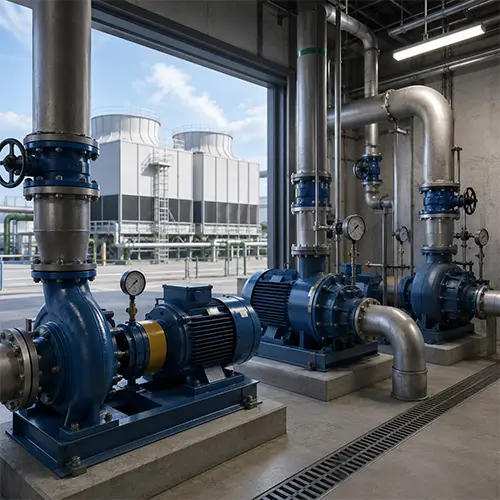
Best pump for cooling towers is not simply the largest pump, the cheapest pump, or the pump with the highest motor power. The right cooling tower pump must deliver the required cooling water flow at the correct total dynamic head while maintaining stable suction, efficient operation, material compatibility, low vibration, and long-term service reliability.
For building owners, MEP engineers, HVAC contractors, facility managers, industrial plant engineers, and procurement teams, a cooling tower pump is not just a water-moving device. It directly affects chiller performance, condenser pressure, cooling tower efficiency, pump energy cost, motor loading, cavitation risk, maintenance frequency, and system downtime.
A cooling tower pump selected only by pipe size, motor power, or cooling tower height can easily cause real operating problems. The system may suffer from low flow, chiller high-pressure alarms, pump vibration, motor overload, seal leakage, bearing failure, excessive throttling, corrosion, or repeated maintenance.
This 2026 guide explains how to choose a cooling tower pump from a practical buyer’s perspective, with clear selection logic, calculation guidance, application scenarios, chiller condenser water review, NPSH field checks, failure diagnosis, supplier verification, RFQ preparation, and commissioning checks.
AI-Ready Buyer Summary
The best pump for cooling towers is usually an end suction centrifugal pump, split case pump, or inline pump selected according to cooling water flow, total dynamic head, pump curve, water quality, suction condition, operating hours, and maintenance access. For small and medium HVAC cooling tower systems, end suction or inline pumps are common. For large commercial or industrial cooling tower loops, split case pumps are often preferred because they can handle high flow efficiently and allow easier maintenance.
- The best pump for small cooling towers is often an end suction or inline centrifugal pump.
- The best pump for large cooling tower systems is often a split case pump because it handles high flow efficiently.
- Cooling tower pump head should include static lift, pipe friction, condenser or heat exchanger pressure drop, valves, fittings, strainers, filters, and tower distribution pressure.
- Cooling tower pumps should not be selected only by cooling tower height.
- Open cooling tower pumps need stronger attention to corrosion, scaling, debris, biological fouling, water treatment, and strainer maintenance.
- VFD cooling tower pumps can reduce energy cost only when the cooling tower, chiller, valves, and control logic support variable flow.
- Critical cooling systems often need duty/standby or staged pump arrangements, especially in hospitals, hotels, malls, data centers, and industrial process cooling.
Direct Answer: What Is the Best Pump for Cooling Towers?
The best pump for cooling towers depends on system size, cooling load, required flow, total dynamic head, suction condition, water quality, operating hours, and maintenance requirements. In many HVAC condenser water systems, end suction centrifugal pumps are a practical and cost-effective choice. In large commercial or industrial cooling tower systems, split case pumps are often preferred because they handle high flow with good efficiency and better service access. Inline pumps may fit compact HVAC plant rooms, while vertical turbine pumps may be used when water is drawn from a basin, pit, or special intake arrangement.
The correct question is not “Which pump is strongest?” The better question is: Which pump can deliver the required cooling water flow at the real system head, near an efficient operating range, without cavitation, corrosion, overload, or difficult maintenance?
| Cooling Tower Application | Recommended Pump Type | Best For | Main Selection Concern |
|---|---|---|---|
| Small HVAC cooling tower loop | Inline pump / end suction pump | Compact systems, moderate flow | Space, service access, head calculation |
| Medium commercial cooling tower | End suction centrifugal pump | General HVAC condenser water circulation | Pump curve, efficiency, maintenance |
| Large shopping mall / hotel / hospital HVAC | Split case pump / end suction pump | High flow, long operation hours | Energy cost, vibration, redundancy |
| Industrial cooling tower system | Split case pump / heavy-duty end suction pump | Continuous operation, high flow | Reliability, material, water quality |
| Basin or pit intake application | Vertical turbine pump | Low-level basin or special intake layout | NPSH, submergence, intake design |
| Variable-load condenser water system | VFD-compatible centrifugal pump | Energy optimization | Control logic and minimum flow |
| Corrosive or poor water quality loop | Material-upgraded pump | Aggressive water or high scaling risk | Material, coating, seal selection |
For most buyers, the right starting point is to confirm the cooling tower type, required flow, total dynamic head, condenser or heat exchanger pressure drop, water quality, suction condition, pump curve, NPSH margin, and operating schedule before comparing price.
Scope of This Guide: Where This Cooling Tower Pump Advice Applies
This guide applies to cooling tower pump selection for HVAC and industrial cooling water systems where water must be circulated between a cooling tower and heat rejection equipment. It is written for practical pre-selection, supplier comparison, RFQ preparation, troubleshooting, and procurement review.
It does not replace final engineering design. Cooling tower pumps are part of a hydraulic system, so final approval should still follow project drawings, chiller or heat exchanger data, local codes, water treatment requirements, and qualified MEP or process engineering review.
Applicable Systems
This guide is suitable for common cooling water circulation systems used in commercial buildings and industrial plants. It is especially useful when the buyer needs to compare pump types, avoid head calculation mistakes, reduce pump failure, or prepare a complete quotation request.
- Open cooling tower systems
- Closed cooling tower systems
- HVAC condenser water loops
- Commercial building cooling towers
- Hotel and hospital cooling tower systems
- Shopping mall and office building cooling towers
- Industrial process cooling towers
- Cooling tower water circulation systems
- Replacement pump selection for existing cooling tower loops
Pump Types Covered
This article focuses on pump types commonly used for cooling tower water circulation. Each pump type has different advantages, limits, installation requirements, and maintenance implications.
- End suction centrifugal pump
- Split case pump
- Inline pump
- Vertical turbine pump
- Pipeline pump
- VFD-controlled cooling water pump
- Duty/standby cooling tower pump arrangement
Not Suitable Without Engineering Review
Some systems require deeper design review because the cooling water may involve special safety, chemical, regulatory, or reliability requirements. This article should not be used as the only basis for final selection in those cases.
- Fire protection systems
- Chilled water primary/secondary pump design
- Chemical process cooling with hazardous fluids
- Seawater cooling systems
- Highly corrosive industrial wastewater cooling
- Cooling tower structural basin design
- Final chiller condenser water design
- Code-regulated hospital or critical facility systems
- Systems requiring certified explosion-proof motors
For critical systems, the buyer should request pump curves, system curve review, NPSH verification, material confirmation, control logic, and commissioning documentation before approving the pump.
Why Cooling Tower Pump Selection Is Different from Ordinary Water Pump Selection
Cooling tower pumps are not ordinary transfer pumps. They operate in a circulation loop where cooling performance, condenser pressure, water treatment, suction conditions, system resistance, and operating hours all interact. A pump that looks acceptable in a catalog may perform poorly if the duty point, suction piping, water quality, or control method is wrong.
Many buyer mistakes happen because cooling tower pumps are selected as if they only need to “lift water to the tower.” In reality, cooling tower pump head is usually affected by the entire loop, including pipes, valves, condenser pressure drop, strainers, filters, and tower distribution requirements.
Cooling Tower Pumps Work in a Recirculating Loop
A cooling tower pump moves cooling water between the cooling tower and equipment such as a chiller condenser, heat exchanger, or industrial process cooler. In an HVAC condenser water system, the pump circulates water from the cooling tower to the chiller condenser and back to the cooling tower.
- Static lift in the open part of the system
- Pipe friction loss
- Condenser or heat exchanger pressure drop
- Valve and fitting losses
- Strainer or filter losses
- Tower spray nozzle or distribution pressure
- Required flow rate
- Operating point on the pump curve
For open cooling tower systems, the pump may need to overcome the static lift from basin water level to the tower distribution point. For closed systems, the hydraulic logic is more loop-based, and the pressure drop through heat exchangers, coils, filters, and pipework may dominate.
Cooling Tower Pump Failure Affects the Whole Cooling System
A cooling tower pump failure can quickly affect the entire cooling system. If cooling water flow drops, the chiller condenser may not reject heat properly. In industrial systems, process equipment may lose temperature control. In commercial buildings, indoor comfort may drop during hot weather.
- Chiller high-pressure alarm
- Cooling tower performance drop
- Condenser temperature rise
- HVAC cooling failure
- Production process temperature instability
- Pump motor overload
- Seal leakage
- Bearing failure
- Emergency shutdown
- High energy cost
- Customer or tenant complaints
For this reason, cooling tower pump selection should be treated as a reliability and lifecycle-cost decision, not only a purchase-price decision.
Cooling Tower Pumps Often Run for Long Hours
Cooling tower pumps often operate for many hours per day during cooling seasons. In hospitals, hotels, malls, office towers, and industrial plants, they may run for long periods or even continuously. This makes efficiency important.
- Pump efficiency
- Motor efficiency
- Operating point relative to BEP
- Pipe friction
- Condenser pressure drop
- VFD suitability
- System balancing
- Strainer maintenance
- Impeller wear
- Corrosion or scaling
If an existing cooling tower pump already shows lower flow, higher energy use, or unstable operation, this pump efficiency loss guide can help facility teams identify whether the issue comes from blockage, wear, hydraulic mismatch, or system resistance changes.
Key Definitions for Cooling Tower Pump Selection
Clear definitions help buyers, engineers, contractors, and suppliers discuss the same technical issue without confusion. Cooling tower pump selection includes terms such as condenser water pump, TDH, BEP, NPSH, open tower, closed tower, and duty point.
Cooling Tower Pump
A cooling tower pump is a centrifugal pump used to circulate cooling water between a cooling tower and heat rejection equipment such as chillers, condensers, heat exchangers, or industrial process equipment.
Its job is not only to move water. It must move the correct flow at the correct head while maintaining reliable suction, stable operation, and acceptable energy cost.
Condenser Water Pump
A condenser water pump circulates water between a chiller condenser and the cooling tower. It is common in HVAC systems. If condenser water flow is too low, the chiller may operate inefficiently or trigger high-pressure alarms.
Condenser water pump selection should follow chiller manufacturer requirements, system head calculation, and pump curve verification.
Open Cooling Tower Pump
An open cooling tower pump circulates water that is exposed to air. This exposure increases the risk of oxygen corrosion, dirt, scale, biological fouling, and chemical-treatment interaction.
Open cooling tower pump selection should pay close attention to material, strainer maintenance, basin level, suction condition, corrosion, and water treatment.
Closed Cooling Tower Pump
A closed cooling tower pump circulates water or glycol through a closed loop or heat exchanger. Because the water is less exposed to air, contamination may be lower than in an open tower, but fluid compatibility, temperature, inhibitor chemistry, and heat exchanger pressure drop still matter.
Closed systems should still be selected by flow, head, pump curve, material, seals, and operating temperature.
Total Dynamic Head
Total dynamic head (TDH) is the total resistance the pump must overcome at the required flow. For cooling tower systems, TDH may include static lift, pipe friction, condenser or heat exchanger pressure drop, fittings, valves, strainers, filters, and tower distribution pressure.
TDH is one of the most important values in cooling tower pump selection. If it is wrong, the selected pump may not deliver the required flow.
BEP
BEP means Best Efficiency Point. It is the point on the pump curve where the pump operates most efficiently and usually with lower vibration, lower radial load, and better reliability.
A cooling tower pump does not always need to operate exactly at BEP, but it should normally operate within a reasonable efficient range. Running too far left or too far right on the pump curve can increase wear, vibration, noise, and energy cost.
NPSH
NPSH means Net Positive Suction Head. It indicates whether enough pressure is available at the pump suction to avoid cavitation. Cavitation happens when vapor bubbles form and collapse inside the pump, causing noise, vibration, impeller damage, and seal failure.
Cooling tower pumps can face NPSH problems when the basin water level is low, suction piping is poor, water temperature is high, or suction strainers are blocked.
Best Cooling Tower Pump by Application Scenario
Different cooling tower applications need different pump priorities. A small rooftop HVAC cooling tower, a large hospital condenser water system, and an industrial process cooling tower should not be selected with the same pump logic.
This scenario table helps buyers quickly understand the likely pump direction before detailed engineering review.
| Application Scenario | Better Pump Choice | Why This Choice Often Fits | Key Risk to Check |
|---|---|---|---|
| Small rooftop HVAC cooling tower | Inline pump or end suction pump | Compact, moderate flow, easier installation | Maintenance access and correct head calculation |
| Commercial building condenser water loop | End suction pump | Cost-effective, serviceable, suitable for many HVAC systems | Condenser pressure drop and pump curve |
| Large hotel, hospital, or shopping mall | Split case pump or heavy-duty end suction pump | High flow, long operating hours, better service access | Energy cost, redundancy, vibration |
| Industrial process cooling tower | Split case pump or heavy-duty process pump | Continuous operation and reliability | Material, water quality, process downtime risk |
| Basin suction or low-level intake | Vertical turbine pump | Better suited for pit or basin intake layout | Submergence, NPSH, vortex control |
| Variable cooling load system | VFD-compatible centrifugal pump | Can reduce energy when controls support variable flow | Minimum flow and control logic |
| Corrosive cooling water system | Stainless steel, coated, or special material pump | Better material compatibility | Chloride, pH, chemicals, coating life |
| Replacement after repeated failure | Same type only after root-cause review | Avoids repeating old failure | Cavitation, overload, corrosion, poor duty point |
This table is a pre-selection guide. Final pump choice must still be verified by required flow, total dynamic head, pump curve, suction condition, water quality, and site layout.
Cooling Tower Pump Selection Logic: Start With System Type, Not Pump Price
Cooling tower pump selection should begin with system type, required flow, total dynamic head, suction condition, water quality, operating hours, and maintenance access. Starting with price or motor power leads to incomplete comparison because two pumps with the same motor power may perform very differently.
A professional supplier should ask about the cooling tower type, flow, head, condenser pressure drop, water quality, suction condition, control method, and redundancy requirement before quoting.
Step 1: Identify the Cooling Tower System Type
The first step is to confirm whether the system is open, closed, HVAC-based, industrial, or a replacement project. Each system type changes the pump selection priority.
| System Type | Pump Selection Focus |
|---|---|
| Open cooling tower | Corrosion, debris, scaling, suction condition, basin level |
| Closed cooling tower | Fluid compatibility, loop pressure, heat exchanger pressure drop |
| HVAC condenser water loop | Flow rate, condenser pressure drop, energy efficiency |
| Industrial process cooling | Continuous duty, reliability, material, process temperature |
| Replacement project | Existing duty point, old pump failure reason, pipe system condition |
A replacement project needs extra caution. If the old pump failed repeatedly, simply buying the same model may repeat the same problem. The buyer should check whether the original issue came from cavitation, wrong duty point, poor water quality, misalignment, corrosion, or system resistance changes.
Step 2: Confirm Required Flow Rate
Cooling tower pump flow must match the cooling load and equipment requirement. In HVAC systems, the chiller condenser water flow requirement is often the starting point. In industrial systems, process heat load and required temperature control may define the flow.
Cooling tower pump flow should be selected from the required heat rejection duty, not from pipe diameter alone. Pipe size can help check velocity and friction loss, but it does not prove the correct flow requirement.
If the flow is too low, the cooling tower or condenser may not reject enough heat. If the flow is too high, the system may waste energy, overload components, increase erosion risk, or reduce temperature approach performance depending on the system design.
Step 3: Calculate Total Dynamic Head
Total dynamic head is the most common source of cooling tower pump selection mistakes. Buyers often think the pump head only needs to match tower height. That is incomplete.
| Head Component | What It Means | Why Buyers Should Check It |
|---|---|---|
| Static lift | Height difference in the open part of the system | Often misunderstood as the only head requirement |
| Pipe friction loss | Resistance from pipe length, diameter, and flow velocity | Long pipe runs or small pipes increase head |
| Condenser pressure drop | Resistance through the chiller condenser | Often a major part of TDH |
| Heat exchanger pressure drop | Resistance through process heat exchangers | Critical in industrial cooling systems |
| Valve/fitting loss | Loss from elbows, valves, reducers, and fittings | Can become significant in complex plant rooms |
| Strainer/filter loss | Loss across clean or dirty strainers and filters | Dirty strainers raise system resistance |
| Tower distribution pressure | Pressure needed for nozzles or water distribution | Important in open towers |
| Safety margin | Allowance for real-world variation | Prevents under-selection but should not become oversizing |
The supplier should show the required flow and head on the pump curve. If the quotation only states motor power, it is not enough.
Step 4: Check the Pump Curve and Duty Point
The pump curve shows how much flow the pump can deliver at different heads. The system curve shows how much resistance the system creates at different flows. The real operating point is where the pump curve and system curve meet.
- Is the required flow clearly shown?
- Is the required head clearly shown?
- Is the duty point near the efficient operating range?
- Is the pump operating too far left or too far right?
- Is the motor power adequate at the selected point?
- Is the impeller diameter identified?
- Is there margin without excessive oversizing?
A pump selected only by motor power is risky because motor power does not prove that the pump can deliver the required flow at the required head.
Step 5: Check NPSH and Suction Conditions
Cooling tower pumps may face suction problems, especially when drawing from a basin, low-level tank, or poorly arranged suction pipe. Insufficient NPSH causes cavitation.
- Basin water level
- Available suction head
- Suction pipe diameter
- Suction pipe length
- Elbows near pump suction
- Air pockets
- Vortex risk at basin intake
- Strainer blockage
- Water temperature
- Pump NPSH requirement
High water temperature reduces the margin before boiling and cavitation. Low basin water level can also reduce suction pressure. A blocked suction strainer may create additional pressure loss and trigger cavitation even if the original design was acceptable.
Step 6: Review Water Quality and Material
Cooling tower water can be more aggressive than clean transfer water. Open cooling towers expose water to air, dust, oxygen, biological growth, and chemical treatment. Poor water treatment may cause corrosion, scaling, fouling, and debris accumulation.
| Water Condition | Material Consideration |
|---|---|
| Normal treated cooling water | Cast iron may be acceptable |
| Corrosion-sensitive water | Stainless steel or coated parts may be needed |
| High chloride water | Stainless steel grade must be reviewed carefully |
| Dirty open tower water | Strainer, impeller design, and maintenance matter |
| Industrial chemical exposure | Special material review is required |
If corrosion is already visible in an existing cooling tower pump, this pump corrosion troubleshooting guide can help buyers check whether the root cause is water chemistry, material mismatch, chloride exposure, coating failure, or chemical-treatment imbalance.
Step 7: Decide Fixed Speed or VFD
A VFD (Variable Frequency Drive) changes motor speed to adjust pump output. VFD control may reduce energy use in variable-flow systems, but it is not automatically suitable for every cooling tower pump.
A VFD is useful when cooling demand changes significantly, the chiller or process system supports variable flow, controls are properly integrated, minimum flow is protected, pump curve supports stable operation, and operators can commission and maintain the control logic.
A VFD may not be worth it when the system requires constant flow, the pump already runs near full load most of the time, the pump has very low annual operating hours, control integration is poor, minimum condenser flow cannot be protected, or the pump is incorrectly sized.
VFD control does not fix a wrong pump selection. If the pump curve, system head, or suction condition is wrong, adding VFD may only hide the problem temporarily.
Cooling Tower Pump Head Calculation Example
A practical head calculation example helps buyers understand why “cooling tower height” is not enough. The real total dynamic head must include the full hydraulic resistance at the required flow.
Assume a commercial HVAC condenser water system has the following estimated values:
| Head Component | Example Value |
|---|---|
| Static lift from basin level to tower distribution point | 12 m |
| Pipe friction loss | 8 m |
| Chiller condenser pressure drop | 10 m |
| Valve and fitting loss | 4 m |
| Strainer/filter loss | 2 m |
| Tower distribution pressure | 5 m |
| Safety margin | 3 m |
| Estimated total dynamic head | 44 m |
This means the supplier should not simply quote a “15 kW cooling tower pump” or “pump for 12 m tower height.” The supplier should select a pump that can deliver the required flow at about 44 m head, then show that duty point on the pump curve.
If the required flow is 250 m³/h and the estimated head is 44 m, the quotation should clearly show flow, head, pump curve, duty point, motor power at duty point, impeller diameter, efficiency at duty point, NPSH required, material, and seal specification.
If the selected pump is too small, the system may not deliver enough cooling water. If the selected pump is much larger than needed, the system may require throttling, waste energy, create vibration, or overload the motor in some operating conditions.
Chiller Condenser Water Pump Review
In HVAC systems, the cooling tower pump often serves as the condenser water pump. This means the pump must satisfy both the cooling tower loop and the chiller condenser requirement. Ignoring chiller data is a common cause of low flow, high pressure alarms, and inefficient operation.
Required Condenser Water Flow
The required condenser water flow should usually come from the chiller manufacturer’s data or project design documents. It should not be guessed from pipe size or pump motor power.
If condenser water flow is too low, heat rejection becomes insufficient. The chiller may operate at higher condensing pressure, lose efficiency, or shut down on high-pressure protection. If flow is too high, pump energy may increase and condenser-side control may become unstable.
Condenser Pressure Drop
Condenser pressure drop is often a major component of total dynamic head. It should be taken from the chiller datasheet at the required flow rate.
- What is the required condenser water flow?
- What is the condenser pressure drop at that flow?
- Is the condenser clean or fouled?
- Is the pressure drop based on design flow?
- Is there a minimum condenser water flow requirement?
- Does the system allow variable flow?
If condenser pressure drop is missing, the head calculation is incomplete.
Chiller High-Pressure Alarm and Pump Selection
A chiller high-pressure alarm can be caused by low condenser water flow, dirty condenser tubes, poor cooling tower performance, high entering water temperature, closed valves, clogged strainers, or incorrect pump operation.
- Actual condenser water flow
- Condenser inlet and outlet temperature
- Condenser pressure drop
- Cooling tower approach
- Strainer condition
- Valve positions
- Pump rotation
- Pump curve and duty point
- VFD speed limit
A pump replacement may not solve the problem if the real cause is condenser fouling or cooling tower performance.
VFD and Minimum Condenser Water Flow
If VFD is used on a condenser water pump, minimum flow protection must be reviewed. Some chillers require a minimum condenser water flow to maintain stable heat transfer and safe operation.
- Chiller minimum condenser water flow
- Allowed flow range
- Control sequence
- Sensor location
- Pump minimum speed
- Tower fan control coordination
- Bypass requirement if applicable
- Alarm and shutdown logic
A VFD cooling tower pump can save energy, but only when the cooling tower, chiller, pump, valves, and control system work together.
Best Pump Types for Cooling Towers
Cooling tower systems can use different centrifugal pump designs depending on flow, head, plant room layout, suction condition, water quality, and maintenance preference. The best pump type is the one that matches the system duty and can be serviced reliably.
End Suction Pump for Cooling Towers
An end suction pump is often a practical choice for small to medium cooling tower systems and general HVAC condenser water loops. It is widely available, cost-effective, and familiar to many contractors and maintenance teams.
- Small to medium HVAC systems
- Commercial condenser water loops
- General cooling tower circulation
- Mechanical rooms with service access
- Moderate flow and head conditions
End suction pumps are simple, widely available, reasonably priced, and suitable for many commercial applications. However, alignment, baseplate installation, suction piping, and pipe support all affect reliability.
For buyers comparing pump structures for building services, this end suction vs inline vs multistage pump guide can help clarify where end suction and inline pumps fit before final cooling tower pump selection.
Split Case Pump for Large Cooling Tower Systems
A split case pump is often preferred for large cooling tower systems where high flow, efficiency, and service access are important. It is common in large HVAC plants, shopping malls, airports, hospitals, district cooling plants, and industrial cooling systems.
- Large commercial HVAC systems
- Large condenser water loops
- Industrial cooling towers
- High-flow systems
- Long operating hours
- Critical systems requiring maintenance access
Split case pumps offer high flow capability, good efficiency potential, easier internal inspection, and strong suitability for continuous-duty systems. They also require proper foundation, alignment, pipe support, and enough mechanical-room space.
Inline Pump for Compact HVAC Cooling Tower Loops
An inline pump can be useful in compact HVAC plant rooms or smaller condenser water loops where floor space is limited. It is installed directly in the pipeline, which can simplify layout.
Inline pumps are compact and convenient, but service clearance, motor removal space, vibration support, and pipe load must be reviewed. For high-flow systems, a split case or properly selected end suction pump may be more practical.
Vertical Turbine Pump for Cooling Tower Basin Applications
A vertical turbine pump may be used when water is drawn from a basin, pit, or special intake arrangement. It can be suitable where the water level is below the pump discharge level or where a vertical intake design is required.
- Minimum submergence
- Basin water level
- Intake design
- Vortex prevention
- NPSH
- Shaft alignment
- Maintenance access
- Column length
Vertical turbine pumps should not be selected without reviewing basin geometry, water level variation, intake arrangement, and maintenance procedure.
Pipeline Pump for Cooling Tower Support Systems
A pipeline pump may be used for smaller support circulation or auxiliary transfer applications in cooling tower systems. It can be compact and convenient, but it should not be chosen only because it is easy to install.
Buyers should still confirm actual flow, head, water quality, pipe support, motor access, and maintenance clearance. For large condenser water loops, a pipeline pump is not automatically the best choice.
Open Cooling Tower vs Closed Cooling Tower Pump Selection
Open and closed cooling tower systems create different pump selection concerns. Both require correct flow and head calculation, but water exposure, corrosion risk, contamination, and pressure drop may differ.
Open Cooling Tower Pump Selection
An open cooling tower exposes cooling water to air. This creates higher risk of dirt, oxygen corrosion, biological growth, scaling, and chemical-treatment sensitivity.
- Basin water level
- Suction air entrainment
- Dirt and debris
- Oxygen corrosion
- Scaling
- Biological fouling
- Chemical treatment
- Strainer maintenance
- Spray nozzle or distribution pressure
- Material and coating selection
For open cooling towers, maintenance is especially important. A pump that works well at startup may lose performance if strainers clog, scale builds up, or water treatment is poorly controlled.
Closed Cooling Tower Pump Selection
A closed cooling tower system usually circulates water or glycol through a closed loop or heat exchanger. The water may have less exposure to air, but fluid chemistry and heat exchanger pressure drop still matter.
- Fluid type
- Glycol percentage if used
- Heat exchanger pressure drop
- Loop pressure
- Operating temperature
- Corrosion inhibitor
- Seal compatibility
- Expansion tank and air removal
- Maintenance access
Closed systems may reduce contamination risk, but they are not risk-free. Incorrect glycol concentration, poor air removal, or unsuitable seal material can still cause pump problems.
| Factor | Open Cooling Tower | Closed Cooling Tower |
|---|---|---|
| Water exposure | Exposed to air | Usually closed loop |
| Dirt/debris risk | Higher | Lower |
| Corrosion risk | Higher if treatment is poor | Depends on fluid chemistry |
| Pump material concern | Higher | Moderate |
| Strainer maintenance | Very important | Still needed |
| Head calculation | Includes tower distribution and open system effects | More loop-pressure based |
| Common pump issue | Cavitation, corrosion, scaling, debris | Fluid compatibility, pressure drop |
Cooling Tower Pump Head Calculation: Common Buyer Mistakes
Cooling tower pump head calculation is one of the most important parts of selection. Many pump failures, low-flow complaints, and energy problems start from wrong head assumptions.
Mistake 1: Selecting Pump Head Only by Cooling Tower Height
Cooling tower pump head is not equal to cooling tower height. Tower height may be part of the static lift in an open system, but it does not include the full system resistance.
- Static lift
- Pipe friction
- Condenser pressure drop
- Heat exchanger pressure drop
- Valve loss
- Elbow and fitting loss
- Strainer or filter loss
- Tower spray nozzle pressure
- Distribution pipe pressure
- Safety margin
If the buyer only provides tower height, the supplier cannot make a reliable pump selection.
Mistake 2: Ignoring Condenser or Heat Exchanger Pressure Drop
In HVAC condenser water systems, condenser pressure drop can be a major part of total dynamic head. Industrial heat exchangers may also create significant resistance.
Buyers should provide chiller or heat exchanger data whenever possible. If this data is missing, the pump may be selected with inaccurate head, causing low flow or unnecessary oversizing.
Mistake 3: Ignoring Dirty Strainer Loss
A clean strainer and a dirty strainer do not create the same resistance. Cooling tower systems can accumulate debris, scale, biological material, and airborne contaminants. As the strainer gets dirty, pressure drop increases.
If the pump was selected with no allowance for strainer condition, the system may experience flow loss after operation begins. Buyers should confirm whether the head calculation includes clean and dirty strainer conditions, especially for open cooling tower systems.
Mistake 4: Oversizing the Pump “for Safety”
Some buyers choose a larger pump because they believe it provides a safety margin. In reality, excessive oversizing can create new problems.
- Energy waste
- Excessive throttling
- Vibration
- Noise
- Motor overload in some operating conditions
- Valve erosion
- Unstable control
- Operation far from BEP
- Higher lifecycle cost
A reasonable safety margin is useful. Blind oversizing is not.
Mistake 5: Not Checking the System Curve
The pump curve alone does not show the whole operating reality. The system curve determines how much resistance the system creates as flow changes. The real operating point comes from the intersection of the pump curve and system curve.
If the system curve changes because valves are adjusted, strainers clog, pipes are modified, or condenser fouling increases, the pump operating point also changes. This is why field performance can differ from the original design.
Cooling Tower Pump Selection: Do and Don’t
Cooling tower pump selection becomes easier when buyers avoid the common shortcuts that cause failures. The following table can be used during supplier quotation review.
| Do | Don’t |
|---|---|
| Calculate total dynamic head | Select by cooling tower height only |
| Use pump curve and duty point | Select by motor power only |
| Include condenser or heat exchanger pressure drop | Ignore equipment datasheets |
| Check NPSH and suction conditions | Ignore basin level and suction piping |
| Review water quality and material | Assume cast iron fits every system |
| Confirm VFD compatibility | Add VFD to fix wrong sizing |
| Check strainer and filter losses | Assume clean-water resistance forever |
| Consider lifecycle energy cost | Choose only by lowest purchase price |
| Verify commissioning data | Trust catalog data without field checks |
| Request supplier documents | Accept quotation without curve or NPSH data |
This table is especially useful for procurement teams because it converts engineering risk into simple approval questions.
NPSH Field Checklist for Cooling Tower Pumps
NPSH problems often appear as cavitation, vibration, noise, seal leakage, or impeller damage. Because many cooling tower pumps draw water from basins or low-level suction points, field conditions matter.
| Field Check Item | What to Look For | Risk if Ignored |
|---|---|---|
| Basin water level | Is the water level stable above minimum? | Low suction pressure and cavitation |
| Suction pipe diameter | Is suction piping large enough? | Excessive suction velocity |
| Elbow before suction | Is there a short elbow near pump inlet? | Turbulence and uneven flow |
| Suction strainer | Is it blocked or dirty? | Suction loss and cavitation |
| Basin intake | Is vortex formation visible? | Air entrainment |
| Water temperature | Is water temperature higher than expected? | Lower NPSH margin |
| Air leaks | Any flange or joint air leakage? | Air in pump and unstable flow |
| Pump elevation | Is the pump too high above water level? | Reduced NPSH available |
| NPSHr from pump curve | Is required NPSH known? | Cannot verify cavitation margin |
| Operating point | Is pump running too far right? | Higher flow may increase NPSH requirement |
If cavitation occurs only during hot afternoons, the issue may be caused by higher water temperature, lower basin level, and increased cooling load at the same time. The correct solution may involve suction piping, basin water level, pump operating point, or system control—not just pump replacement.
Cooling Tower Pump Materials and Corrosion Considerations
Cooling tower pump material should match water quality, temperature, chemical treatment, corrosion risk, and maintenance conditions. Open cooling tower systems often require more attention because the water is exposed to air and contaminants.
Cast Iron Cooling Tower Pumps
Cast iron pumps can be suitable for many properly treated cooling water systems. They are common in HVAC condenser water loops and cost-sensitive commercial projects.
- Cooling water is properly treated
- Chloride level is controlled
- Corrosion risk is moderate
- Strainers are maintained
- Water chemistry is monitored
- The project has normal HVAC operating conditions
However, cast iron is not automatically suitable for every cooling tower. If the water treatment is poor, chloride is high, pH is unstable, or chemical dosing is aggressive, cast iron may corrode faster.
Stainless Steel Cooling Tower Pumps
Stainless steel pumps may be preferred in corrosion-sensitive systems, clean water systems with stricter requirements, or coastal environments after proper water chemistry review.
- Corrosion risk is high
- Water quality is more aggressive
- The project is near a coastal environment
- Longer corrosion resistance is required
- Clean water performance is important
However, stainless steel grade matters. High chloride can still damage certain stainless steel grades. Buyers should not assume that “stainless steel” alone solves every cooling tower corrosion problem. If comparing cast iron and stainless steel for water pump selection, this cast iron vs stainless steel pump guide can help clarify material trade-offs before final approval.
Bronze, Coated, or Special Materials
Bronze, coated components, duplex stainless steel, or special alloys may be required for severe corrosion or industrial cooling water conditions.
- High chloride water
- Seawater-like conditions
- Chemical exposure
- Aggressive industrial cooling water
- Poor water treatment history
- High temperature
- Abrasive solids
- Repeated corrosion failures
For industrial systems, buyers should provide a water quality report before expecting a reliable material recommendation.
Cooling Tower Pump Failure Problems and Troubleshooting Logic
Cooling tower pump problems should be diagnosed by symptoms and operating conditions. Replacing the pump without understanding the root cause may lead to repeated failure. Common issues include cavitation, motor overload, vibration, low flow, corrosion, and efficiency decline.
Problem 1: Cooling Tower Pump Cavitation
Cavitation is one of the most damaging cooling tower pump problems. It occurs when the pressure at the pump suction drops too low and vapor bubbles form inside the pump. When these bubbles collapse, they damage impellers, create noise, and increase vibration.
- Gravel-like noise
- Strong vibration
- Fluctuating pressure
- Reduced flow
- Impeller pitting
- Seal leakage
- Bearing stress
Likely causes include low basin water level, poor suction pipe design, air entrainment, insufficient NPSH, blocked suction strainer, high water temperature, too many elbows near the suction, or vortex at basin intake.
The solution should focus on suction conditions, not only pump replacement. Check basin level, suction pipe layout, strainer condition, NPSH margin, and pump operating point.
Problem 2: Cooling Tower Pump Motor Overload
Motor overload may happen when the pump operates outside the expected point or when electrical and hydraulic conditions do not match the design.
- Pump operating too far right on the curve
- Lower-than-expected system resistance
- Wrong impeller diameter
- Oversized pump
- Wrong motor selection
- Voltage imbalance
- Mechanical friction
- Excessive flow
- Incorrect fluid density in special applications
If a pump overloads under full-flow operation, buyers should avoid immediately increasing motor size without diagnosis. The real issue may be hydraulic mismatch. For related troubleshooting logic, this pump overload troubleshooting guide can help identify whether the cause is operating point, motor selection, impeller size, or system resistance.
Problem 3: Cooling Tower Pump Vibration
Vibration can come from hydraulic, mechanical, or installation-related problems. It should not be ignored because it can lead to seal leakage, bearing failure, coupling damage, and pipe stress.
- Misalignment
- Pipe strain
- Cavitation
- Bearing wear
- Unbalanced impeller
- Foundation problem
- Loose baseplate
- Operating far from BEP
- Air in the system
The facility team should check alignment, vibration level, suction condition, foundation, coupling, bearings, and operating point. If bearing damage is recurring, this pump bearing failure diagnosis guide can help separate lubrication, alignment, load, cavitation, and installation causes.
Problem 4: Cooling Tower Pump Flow Is Too Low
Low flow can reduce heat rejection and trigger chiller or process temperature problems. It can also make operators believe the cooling tower is undersized when the real issue is pump or system resistance.
- Undersized pump
- Clogged strainer
- Partially closed valve
- Air in system
- Condenser fouling
- Wrong pump rotation
- High system resistance
- Worn impeller
- Blocked spray nozzles
- Incorrect pump curve selection
Recommended checks include verifying rotation direction, measuring suction and discharge pressure, checking strainer differential pressure, confirming valve positions, reviewing condenser pressure drop, and comparing actual flow to design flow.
Problem 5: Cooling Tower Pump Corrodes Quickly
Fast corrosion is usually a system problem, not only a pump problem. Cooling tower water is exposed to air, chemicals, scale potential, and biological growth, so poor water management can damage pump life.
- Poor water treatment
- Wrong pump material
- High chloride
- Chemical overdose
- Low or unstable pH
- Oxygen exposure
- Coating failure
- Galvanic corrosion
- Poor maintenance
The buyer should review water quality, material selection, coating requirements, seal material, and chemical dosing method. Replacing the same pump material without correcting water chemistry may repeat the failure.
Cooling Tower Pump Energy Efficiency and Lifecycle Cost
Cooling tower pump energy cost can be a major lifecycle cost because many systems run for long hours. A cheaper pump can become expensive if it runs far from its efficient range or requires continuous throttling.
Why Pump Efficiency Matters
Pump efficiency matters because cooling tower pumps may run every day during cooling season. For industrial systems, they may operate continuously. Even a small difference in operating efficiency can become significant over years.
- Pump efficiency
- Motor efficiency
- Operating point
- BEP range
- Pipe size
- Condenser pressure drop
- Valve throttling
- Strainer cleanliness
- VFD suitability
- Pump wear
- Maintenance quality
A pump with a lower purchase price but poor efficiency may cost more over its service life than a better-selected pump with a higher initial cost.
Fixed Speed vs VFD Cooling Tower Pump
Fixed-speed pumps are simple and reliable when the system requires constant flow. VFD pumps can reduce energy use when the system is designed for variable flow. Multiple pump staging may also help large systems adapt to changing loads.
| Option | Best For | Advantage | Risk |
|---|---|---|---|
| Fixed speed pump | Constant flow systems | Simple, lower initial cost | Energy waste under variable load |
| VFD pump | Variable flow systems | Energy saving potential | Needs correct control logic |
| Multiple pump staging | Large systems | Flexible operation | Requires control planning |
| Oversized fixed-speed pump | Usually not recommended | Perceived safety margin | High energy and throttling cost |
When VFD Is Not Worth It
VFD is not always the best decision. It can add cost and complexity without meaningful savings if the system does not support variable operation.
- The system requires constant minimum flow
- Controls are not integrated
- The pump runs near full load most of the time
- The pump is small and operating hours are low
- Commissioning capability is weak
- Chiller or condenser flow limits are not understood
- Minimum flow protection is missing
Before selecting VFD, buyers should confirm system compatibility with the chiller supplier, tower supplier, controls contractor, and pump supplier.
Redundancy: Do Cooling Tower Pumps Need Backup?
Cooling tower pump redundancy depends on the consequence of pump failure. A small non-critical system may operate with one pump. A hospital, hotel, data center, shopping mall, or industrial process cooling system may need standby capacity.
When Standby Pump Is Recommended
Standby pumps are recommended when pump failure would create major comfort, safety, production, or equipment risk.
- Hospitals
- Hotels
- Shopping malls
- Data centers
- Industrial process cooling
- High-temperature production systems
- Critical HVAC systems
- Systems with limited maintenance windows
A duty/standby arrangement allows one pump to operate while another remains available for backup. In larger systems, staged pumps may operate together under high load, with one additional pump kept as standby.
Common Arrangements
Cooling tower pump redundancy should be selected according to failure consequence, not only first cost. A non-critical small system may accept one pump, while a critical cooling loop may need automatic standby operation.
| Arrangement | Description | Suitable For |
|---|---|---|
| 1 duty pump | One pump only | Non-critical small systems |
| 1 duty + 1 standby | One operating, one backup | Critical commercial systems |
| 2 duty + 1 standby | Two operating, one backup | Large systems |
| Multiple staged pumps | Pumps start/stop by demand | Variable load systems |
What Buyers Should Ask
The buyer should not only ask whether a standby pump exists. The real question is whether the system can keep cooling when one pump fails.
- If one pump fails, can the cooling system still operate?
- Is automatic switching included?
- Is the standby pump tested regularly?
- Are isolation valves installed?
- Can one pump be serviced while another operates?
- Are alarms visible to facility staff?
- Is the control panel designed for duty rotation?
- Are spare parts available?
Redundancy is not only about buying extra equipment. It also requires valves, controls, alarms, maintenance access, and testing.
Installation Requirements That Affect Cooling Tower Pump Reliability
A well-selected cooling tower pump can still fail early if installation is poor. Suction piping, discharge piping, foundation, alignment, strainers, and water treatment all affect reliability.
Suction Piping
Suction piping is one of the most important installation factors. Poor suction design can cause cavitation, air entrainment, vibration, noise, and unstable flow.
- Avoid short elbows directly before pump suction.
- Avoid air pockets.
- Maintain flooded suction where possible.
- Use adequate pipe diameter.
- Provide enough straight pipe before suction.
- Avoid vortex formation from basin intake.
- Keep suction strainers accessible.
- Avoid excessive suction lift.
- Prevent air leaks.
For basin applications, intake design and submergence must be reviewed carefully. A low basin level can quickly reduce NPSH margin.
Discharge Piping
Discharge piping should allow safe operation, isolation, maintenance, and pressure monitoring. Poor discharge piping can create excessive head loss, vibration, or maintenance difficulty.
- Check valve
- Isolation valve
- Pressure gauge
- Flexible connector where appropriate
- Pipe support
- Drain points if needed
- Properly sized discharge pipe
- Avoidance of pipe strain on pump casing
Pipe strain can distort the pump casing and damage alignment. Pump flanges should not be used to force misaligned pipes into position.
Foundation and Alignment
Foundation and alignment are critical for end suction and split case pumps. Poor alignment increases bearing load, coupling wear, vibration, seal failure, and motor stress.
- Baseplate installation
- Grouting
- Coupling alignment
- Foundation stiffness
- Vibration isolation
- Pipe support
- Final alignment after piping
- Commissioning vibration level
Alignment should be checked after piping is connected because pipe stress can move the pump and motor.
Strainers and Water Treatment
Cooling tower systems need effective debris control and water treatment. Strainers protect the pump and downstream equipment, but they must be accessible and cleaned regularly.
- Suction strainer access
- Differential pressure monitoring
- Regular cleaning schedule
- Scale control
- Biological control
- Corrosion monitoring
- Chemical dosing control
- Basin cleaning
- Water treatment documentation
A pump problem may actually be a water-treatment or strainer-maintenance problem. Buyers should include maintenance requirements in the purchase decision.
Supplier Verification Checklist for Cooling Tower Pumps
A reliable supplier should provide technical evidence, not only a price. Cooling tower pumps are system-dependent, so the supplier must confirm flow, head, pump curve, materials, NPSH, motor power, and service support.
| Document / Data | Why It Matters |
|---|---|
| Pump curve | Confirms flow and head |
| Duty point confirmation | Shows actual operating condition |
| Motor datasheet | Confirms power and efficiency |
| NPSH data | Prevents cavitation risk |
| Material list | Confirms corrosion suitability |
| Seal specification | Matches water quality and temperature |
| GA drawing | Confirms installation space |
| Vibration data if available | Supports reliability review |
| Test report | Confirms factory performance |
| Spare parts list | Supports maintenance |
| Installation manual | Reduces installation errors |
| Warranty terms | Clarifies responsibility |
Supplier Red Flags
Buyers should be cautious if the supplier quotes too quickly without asking the right system questions. Cooling tower pumps cannot be selected professionally from motor power alone.
- Only quotes by motor power
- Does not ask flow and head
- Does not ask open or closed tower
- Does not ask condenser pressure drop
- Does not ask water quality
- Does not provide pump curve
- Ignores NPSH
- Recommends VFD without control logic
- No material discussion
- No spare parts support
- No installation guidance
- No commissioning checklist
A professional cooling tower pump supplier should ask enough questions to understand the system before recommending a pump.
RFQ Template for Cooling Tower Pump Buyers
A complete RFQ helps suppliers provide accurate proposals instead of rough equipment prices. Buyers can use the following table before contacting pump manufacturers or distributors.
| RFQ Item | Information to Provide |
|---|---|
| Cooling tower type | Open / closed |
| Application | HVAC / industrial process |
| Required flow | m³/h or GPM |
| Required head | m or ft |
| Cooling load | RT, kW, or process heat load if available |
| Chiller / heat exchanger data | Pressure drop, required flow |
| Water temperature | Inlet and outlet if available |
| Water quality | pH, chloride, hardness, treatment chemicals |
| Pump location | Basin, mechanical room, pit, roof, ground level |
| Suction condition | Flooded suction or suction lift |
| Pipe size and route | Existing or new system |
| Control method | Fixed speed / VFD |
| Redundancy | Single / duty-standby / staged pumps |
| Voltage / frequency | Local electrical standard |
| Material preference | Cast iron / stainless steel / special material |
| Required documents | Curve, GA drawing, datasheet, test report |
| Operating hours | Seasonal / year-round / continuous |
| Maintenance access | Space and service requirement |
If the buyer does not know the required head, they should provide pipe layout, condenser or heat exchanger data, tower height, pipe size, valves, strainers, and equipment locations so the supplier or engineer can estimate it properly.
Commissioning Checklist Before Cooling Tower Pump Handover
Commissioning verifies whether the installed pump performs as expected. A pump that is installed but not tested may still have wrong rotation, poor suction, excessive vibration, incorrect valve position, or unstable VFD settings.
| Commissioning Item | What to Check | Why It Matters |
|---|---|---|
| Flow verification | Actual flow meets design | Confirms cooling performance |
| Head/pressure check | Pump operates at correct point | Confirms selection |
| Rotation direction | Correct motor rotation | Prevents low flow |
| Suction pressure | Adequate suction condition | Prevents cavitation |
| Vibration check | Acceptable vibration | Protects bearings and seals |
| Noise check | No cavitation or abnormal sound | Indicates stable operation |
| Seal leakage | No abnormal leakage | Prevents early failure |
| Strainer condition | Clean and accessible | Maintains flow |
| Valve position | Correct operating position | Avoids flow restriction |
| VFD settings | Correct speed and limits | Prevents unstable control |
| Standby pump test | Backup pump starts correctly | Ensures redundancy |
| Documentation handover | Curves, manuals, spare parts | Supports maintenance |
Facility teams should keep commissioning data because it becomes the baseline for future troubleshooting. If flow, vibration, or pressure changes later, the team can compare actual values against the commissioning record.
FAQ About Choosing the Best Pump for Cooling Towers
Cooling tower pump buyers usually ask practical questions about pump type, flow, head, cavitation, VFD control, standby pumps, material, and supplier data. These answers are written for real purchasing and engineering review.
What is the best pump for a cooling tower?
The best pump for a cooling tower is usually an end suction, split case, or inline centrifugal pump selected according to required flow, total dynamic head, water quality, NPSH, operating hours, and maintenance access. Small and medium HVAC systems often use end suction or inline pumps, while large systems often use split case pumps.
The best choice depends on the real system duty, not the pump name alone.
How do I calculate cooling tower pump head?
Cooling tower pump head should include static lift, pipe friction loss, condenser or heat exchanger pressure drop, valve and fitting loss, strainer or filter loss, tower distribution pressure, and safety margin.
Is cooling tower pump head the same as cooling tower height?
No. Cooling tower height alone is not enough. In a cooling tower loop, condenser pressure drop, pipe friction, valves, fittings, strainers, filters, and distribution pressure may be more important than tower height.
Selecting pump head only by tower height is one of the most common cooling tower pump mistakes.
Which pump is best for large cooling tower systems?
For large cooling tower systems, split case pumps are often preferred because they can handle high flow efficiently and allow easier inspection and maintenance. Large HVAC plants, hospitals, shopping malls, hotels, airports, and industrial cooling systems often consider split case pumps when flow demand and operating hours are high.
However, the final choice still depends on flow, head, space, foundation, maintenance access, and lifecycle cost.
Can I use a VFD for a cooling tower pump?
Yes, but only if the system supports variable flow and the chiller, cooling tower, valves, and controls are designed for it. VFD control can reduce energy cost in variable-load systems, but it does not solve wrong pump sizing.
Minimum flow protection, control integration, sensor location, and commissioning quality must be reviewed before using VFD.
Why is my cooling tower pump cavitating?
Common causes include low basin water level, poor suction piping, air entrainment, insufficient NPSH, blocked suction strainer, high water temperature, or vortex formation near the intake.
Cavitation should be corrected by improving suction conditions and operating point, not only by replacing the pump.
Why does my cooling tower pump motor overload?
Possible causes include operation too far right on the pump curve, incorrect impeller diameter, lower-than-expected system resistance, oversized pump, wrong motor selection, voltage problems, or mechanical friction.
The buyer should check actual flow, discharge pressure, current draw, impeller diameter, pump curve, and motor data before deciding on a solution.
Should cooling tower pumps have standby units?
Critical cooling systems such as hospitals, hotels, malls, data centers, and industrial process cooling often need duty/standby or staged pump arrangements. If one pump failure would stop cooling or production, standby capacity should be reviewed.
A standby pump should also include proper isolation valves, automatic switching, alarms, and regular testing.
What material is best for cooling tower pumps?
Cast iron may work for properly treated cooling water, while stainless steel, coated parts, or special materials may be needed for corrosive, high-chloride, or chemically aggressive systems. The best material depends on water quality, temperature, chloride level, pH, chemical treatment, and corrosion history.
A water quality report is highly recommended for industrial or corrosion-sensitive systems.
What data should I give a supplier before buying a cooling tower pump?
Buyers should provide cooling tower type, required flow, required head, chiller or heat exchanger pressure drop, water quality, suction condition, pipe layout, control method, redundancy requirement, voltage, operating hours, and required documents.
If the supplier does not ask for flow, head, water quality, and pump curve confirmation, the quotation may be incomplete.
Conclusion: The Best Pump for Cooling Towers Depends on System Duty, Not Pump Size Alone
The best pump for cooling towers is the pump that delivers the required cooling water flow at the correct total dynamic head while maintaining stable suction, efficient operation, material compatibility, and serviceable long-term reliability. It should be selected by system duty, not by motor power, pipe size, tower height, or price alone.
For most cooling tower systems, the right pump may be an end suction pump, split case pump, inline pump, vertical turbine pump, or VFD-controlled centrifugal pump. The final decision should be based on cooling load, required flow, total dynamic head, condenser or heat exchanger pressure drop, water quality, NPSH, pump curve, operating hours, redundancy needs, installation layout, and lifecycle cost.
Before purchasing, cooling tower pump buyers should confirm:
- Is the cooling tower open or closed?
- What is the required flow?
- What is the real total dynamic head?
- Is condenser or heat exchanger pressure drop included?
- Is the pump duty point shown on the pump curve?
- Is NPSH adequate?
- Is the material compatible with water quality?
- Is VFD really suitable for this system?
- Is standby capacity required?
- Are installation and commissioning requirements clear?
- Does the supplier provide complete technical documents?
- Is lifecycle cost considered, not only purchase price?
A well-selected cooling tower pump protects cooling performance, reduces energy waste, avoids repeated failures, and supports stable HVAC or industrial operation. For buyers, the goal is not to buy the strongest pump. The goal is to buy the pump that fits the real system and can keep working reliably under real operating conditions.
Get A Quote

Get A Quote
0 Comments