
Why Does a New Pump Perform Worse Than the Old Pump? Causes, Checks, and Fixes
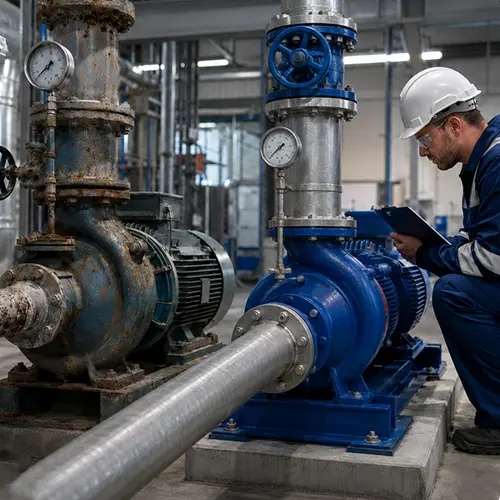
A new pump performs worse than the old pump when the replacement pump does not match the real system duty point, installation condition, control logic, pipe resistance, liquid condition, or operating requirement. For maintenance teams, engineers, contractors, distributors, and B2B pump buyers, the problem usually appears as lower flow, lower pressure, unstable discharge, higher power consumption, more noise, stronger vibration, overheating, frequent tripping, or poor reliability after replacement.
A new pump performing worse than the old pump does not automatically mean the new pump is defective. In many field cases, the real cause is wrong selection data, pump curve mismatch, different impeller diameter, different speed, changed system resistance, valve restriction, poor suction condition, air inside the pump, wrong rotation, VFD setting errors, pipe stress, liquid condition changes, or inaccurate comparison between the old and new pump. Sometimes the old pump seemed “better” only because the system had gradually adapted to its worn, oversized, throttled, or modified operating behavior.
The correct response is not to blame the pump immediately. The correct response is to compare the old pump and new pump under the same measurable conditions: flow, head, suction pressure, discharge pressure, current, voltage, speed, valve position, liquid condition, control setting, and pump curve. This guide explains why a new pump may perform worse than the old pump, what to check first, when the supplier or pump configuration may be the real problem, and how to decide whether to adjust, repair, reselect, or return the pump.
Scope of This Guide: Which Pump Types and Replacement Situations Does This Apply To?
This guide is written for pump replacement situations where the new pump does not deliver the expected flow, pressure, efficiency, stability, or reliability compared with the old pump. It mainly applies to centrifugal and industrial water pump systems, but the troubleshooting logic must be adjusted for positive displacement pumps, slurry pumps, chemical pumps, deep well pumps, fire pumps, and high-temperature process pumps.
This article is not about one specific pump model. It is about replacement pump performance as a system-matching problem. A pump works together with the pipe system, suction source, valves, controls, motor, liquid, and operating target. If any of those conditions differ from the selection assumptions, a new pump can perform worse even when the pump itself is mechanically correct.
| Pump Type / Application | Can Use This Guide? | What Must Be Adjusted |
| End suction centrifugal pump | Yes | Focus on pump curve, impeller diameter, speed, suction and discharge piping |
| Split case pump | Yes | Add checks for large flow, casing stress, foundation, and alignment |
| Horizontal multistage pump | Yes | Add checks for stage count, pressure rating, inlet pressure, and NPSH margin |
| Vertical multistage pump | Yes | Add checks for inlet pressure, pressure control, and installation stability |
| Pipeline / inline pump | Yes | Focus on pipe resistance, air venting, valve position, and system curve |
| Booster pump system | Yes | Add pressure tank, VFD, pressure sensor, and control logic checks |
| Irrigation pump | Yes | Add water source level, suction lift, filter blockage, and seasonal flow changes |
| Slurry pump | Yes, with adjustment | Add solids concentration, wear, density, and impeller clearance |
| Chemical pump | Yes, with safety adjustment | Add material compatibility, viscosity, vapor pressure, and seal system |
| Deep well pump | Partially | Add well water level, pump depth, cable voltage drop, and check valve |
| Positive displacement pump | Partially | Performance logic differs; check displacement, relief valve, viscosity, and speed |
| Fire pump | Limited | Must follow fire protection codes and certified testing procedures |
This guide is not suitable for direct use in fire pump acceptance testing under code requirements, hazardous chemical pump replacement, high-temperature process pump replacement, API process pump replacement requiring formal engineering review, positive displacement metering pump performance disputes, boiler feed pump systems with strict safety requirements, or warranty disputes without formal test data. Those cases need project specifications, acceptance procedures, or qualified engineering review.
Why a New Pump May Perform Worse Than the Old Pump
A new pump may perform worse than the old pump because the replacement was selected by nameplate power, pipe size, or old model similarity instead of the real duty point. Common causes include pump curve mismatch, wrong impeller diameter, different speed, higher system resistance, poor suction condition, installation error, valve restriction, control setting problems, liquid changes, or incorrect comparison data.
A new pump performs worse than the old pump when the new pump does not match the actual system curve, required duty point, inlet condition, control method, or liquid properties. The correct diagnosis should compare the old pump curve, new pump curve, actual flow, actual head, motor current, valve position, suction pressure, discharge pressure, pipe condition, and control settings before blaming pump quality.
Direct Answer for Fast Diagnosis
A new pump usually performs worse than the old pump when the replacement pump does not match the actual duty point, system curve, suction condition, control setting, liquid property, or installation condition. The correct first checks are pump curve comparison, actual flow, actual head, motor current, speed, valve position, suction pressure, discharge pressure, rotation direction, and VFD settings.
If the new pump has lower flow, lower pressure, higher power use, more vibration, or frequent tripping, do not judge by motor power or pipe size alone. Measure the operating point first, then decide whether the issue is selection, installation, system resistance, control parameters, electrical supply, liquid condition, or pump configuration.
Quick Answer: Why Does a New Pump Perform Worse Than the Old Pump?
A new pump performs worse than the old pump usually because the replacement pump was not selected against the actual system requirement. The problem may come from wrong pump selection, wrong impeller diameter, wrong speed, changed pipe resistance, poor suction conditions, installation error, control setting mismatch, electrical issues, liquid property changes, supplier configuration mismatch, or inaccurate field comparison.
The most important point is that a pump does not perform alone. It performs at the point where the pump curve intersects the system curve. If the system curve is higher than expected, or if the pump curve does not match the required duty point, the new pump may produce less useful flow or pressure than expected.
| Field Symptom | Likely Cause | What to Check First | Best Action |
| New pump has lower flow | Pump curve mismatch, valve restriction, clogged line | Flow, head, valve position, pump curve | Compare actual duty point with pump curve |
| New pump has lower pressure | Wrong impeller diameter, wrong speed, wrong stage count | Discharge pressure, speed, model, impeller | Verify pump configuration |
| New pump uses more power | Operating far from BEP, higher flow, wrong liquid | Current, flow, density, pump curve | Check duty point and motor load |
| New pump is noisy | Cavitation, misalignment, air, wrong operating point | Suction pressure, alignment, NPSH | Improve suction or correct installation |
| New pump vibrates more | Misalignment, foundation, pipe stress, cavitation | Alignment, base, piping, bearings | Correct installation before blaming pump |
| New pump trips often | Overload, voltage issue, blockage, wrong motor setting | Current, voltage, protection setting | Diagnose electrical and hydraulic load |
| Old pump seemed stronger | Old pump operated at different point or worn system changed | Old data, new data, system curve | Rebuild actual performance comparison |
This quick table helps customers avoid a common mistake: judging the new pump only by sound, visual discharge, or motor power. Real comparison requires measured flow, head, current, speed, and system conditions.
First Question: Are You Comparing the New Pump Correctly?
A replacement pump dispute often starts because the old pump and new pump are not being compared under the same condition. Before judging the new pump, the customer should compare actual flow, head, current, speed, valve position, liquid condition, and operating point.
A common field statement is: “The old pump worked better.” That may be true, but it must be proven with data. If the old pump was measured under a different water level, valve opening, pipe condition, frequency, pressure setting, or liquid condition, the comparison is not reliable.
Do Not Compare by Feeling Only
A new pump should not be judged only by operator feeling. “The water looks weaker,” “the pressure seems lower,” or “the sound is different” may indicate a real issue, but those observations are not enough to identify the cause.
Field impressions can be affected by valve position, pipe blockage, air in the system, pressure gauge location, VFD frequency, liquid level, old pump wear, and even the noise profile of a different hydraulic design. The first decision should be to measure, not guess.
Compare Actual Flow and Head, Not Only Motor Power
A replacement pump should be compared by actual flow and head, not only motor power. Two pumps with the same motor power can have very different curves. One 15 kW pump may be designed for high flow and low head, while another 15 kW pump may be designed for lower flow and higher head.
Motor power tells you how much power the motor can supply. It does not tell you the flow and head that the pump will deliver in your system. Pump performance must be checked against the pump curve and actual duty point.
Compare the Same Operating Conditions
A fair comparison requires the same water source level, same valve opening, same pipe route, same liquid, same electrical supply, same control mode, same pressure setpoint, and same measurement method.
If the old pump was tested with a full tank and the new pump is tested with a lower suction level, the new pump may appear worse. If the old pump ran at 50 Hz and the new pump is limited by a VFD at 42 Hz, the new pump will naturally produce less output.
What Data Should Be Collected Before Blaming the Pump?
A new pump should not be blamed until the field data is complete. The table below shows the minimum data needed for a practical diagnosis.
| Data Type | What to Record | Why It Matters |
| Flow | Actual discharge flow | Confirms capacity |
| Head / pressure | Suction and discharge pressure | Confirms duty point |
| Current | Motor current per phase | Shows load condition |
| Voltage | Operating voltage | Reveals electrical issue |
| Speed | RPM or VFD frequency | Directly affects pump curve |
| Valve position | Suction/discharge valve opening | Shows system resistance |
| Liquid | Temperature, density, solids, viscosity | Affects performance |
| Control setting | VFD, pressure switch, sensor value | Affects operating behavior |
Without these values, any discussion about whether the new pump is “worse” remains incomplete.
Pump Curve Mismatch: The Most Common Reason New Pumps Underperform
A new pump often performs worse because its pump curve does not match the actual system curve. Even if the new pump has the same motor power or similar outlet size, it may deliver less flow or pressure if its curve is different from the old pump.
The pump curve shows what the pump can do. The system curve shows what the piping system requires. The operating point is where these two curves meet. If that point is not near the required flow and head, the new pump will not perform as expected.
What a Pump Curve Means in Simple Terms
A pump curve is a performance graph that shows how much head, flow, efficiency, and power a pump can deliver at different operating points. For centrifugal pumps, flow and head are linked. As flow increases, head usually decreases. As system resistance increases, the operating point moves.
A pump should be selected so the required operating point is within a stable and efficient region of the curve. The ideal target is usually close to the BEP (Best Efficiency Point), which is the area where the pump operates most efficiently and smoothly.
Why Same Motor Power Does Not Mean Same Performance
Same motor power does not mean same pump performance. A motor is only the driver. The hydraulic performance depends on impeller diameter, impeller design, pump speed, number of stages, casing design, and efficiency.
For example, two pumps may both use 22 kW motors. One may deliver high flow at low head. Another may deliver lower flow at high head. If the replacement pump was selected only by kW, the result may be a major mismatch.
Why Same Pipe Size Does Not Mean Same Duty Point
Same inlet and outlet size does not mean same performance. Pipe size is a connection dimension, not a pump performance guarantee. Many pumps with the same flange size can have very different curves.
A pump with the same outlet diameter may still have a different impeller trim, speed, hydraulic design, and efficiency. For replacement, the pump curve matters more than the flange size.
How to Check Pump Curve Mismatch
A pump curve mismatch should be checked by comparing the old pump curve, new pump curve, required flow, required head, actual measured duty point, BEP, NPSHr (Net Positive Suction Head Required), and the system curve.
If the new pump shows lower flow after installation, this <a href=”https://liqenpower.com/pump-flow-drop-troubleshooting/”>pump flow drop troubleshooting guide</a> can help maintenance teams check whether the issue comes from pump selection, suction restriction, discharge blockage, or system resistance.
Replacement Pump Decision Framework
A replacement pump decision should separate selection problems, installation problems, system problems, control problems, and supplier configuration problems. Without this separation, customers may return a good pump, keep a wrong pump, or replace another pump without solving the system issue.
The framework below helps engineering and purchasing teams decide what the performance problem most likely means.
| Situation | Likely Meaning | Best Decision |
| Pump curve matches duty point, but field data is low | System or installation issue | Check suction, discharge, rotation, alignment, and control settings |
| Pump curve does not match required duty point | Selection problem | Reselect pump based on actual flow/head |
| Same model ordered, but performance is different | Configuration issue possible | Confirm impeller diameter, speed, stage count, and motor data |
| Pump is capable, but VFD limits frequency | Control issue | Adjust VFD and pressure settings |
| Flow is low and suction pressure is poor | Suction-side problem | Check water level, suction pipe, strainer, NPSH, and air |
| Flow is low and discharge pressure is high | Discharge restriction | Check valves, check valve, filter, scaling, and pipe blockage |
| Motor current is high | Hydraulic, electrical, or liquid load issue | Check duty point, density, voltage, phase, and blockage |
| Noise and vibration appear after installation | Installation or suction issue | Check rotation, alignment, pipe stress, cavitation, and air |
| Supplier cannot confirm configuration | Documentation issue | Request curve, impeller trim, test data, and configuration record |
| Field data is missing | Cannot assign responsibility | Measure flow, head, current, speed, and control settings first |
This framework prevents premature blame. It also helps both customer and supplier discuss the same technical evidence instead of arguing from impressions.
The Old Pump May Have Been Worn — But Still Matched the System Better
An old pump may appear to perform better because the system gradually adapted to its real operating behavior. When a new pump is installed, the difference in curve, impeller geometry, speed, and efficiency can expose hidden system problems.
This is a common replacement trap. The old pump may have been worn, oversized, modified, throttled, or operating far from its original curve. If the new pump is selected from the old nameplate only, the replacement may not match the actual system behavior.
Old Pump Performance May Not Match Its Nameplate
Old pump performance may no longer match its nameplate after years of wear. Impeller wear, internal clearance increase, corrosion, scaling, bearing condition, and previous repairs can all change the actual performance.
If the old pump curve is used without checking actual field data, the replacement selection may be based on a false assumption. A real replacement decision should use measured old performance when possible.
A Worn Impeller Can Shift the Operating Point
A worn impeller can reduce flow and head, but the system may have adapted to that reduced condition. Operators may have changed valve openings, pressure settings, or usage patterns around the old pump’s actual performance.
When a new pump is installed, it may operate differently and expose issues in the pipe system, controls, or suction source. This does not automatically mean the new pump is defective.
The Old Pump May Have Been Oversized
The old pump may have been oversized. It may have delivered more flow than the system truly needed, while wasting energy and increasing wear. A correctly selected new pump may appear weaker because it is closer to the real design requirement.
This is why customers should not define “better” only as “more flow” or “higher pressure.” Better performance means meeting the required duty point reliably, efficiently, and safely.
Why Historical Data Matters
Historical data helps prevent replacement mistakes. Useful records include old pump model, old pump curve, measured flow, measured suction and discharge pressure, current, operating frequency, valve position, failure history, and maintenance changes.
If historical data is missing, the replacement selection should be based on current system measurement rather than old pump appearance or nameplate alone.
Installation Problems That Make a New Pump Perform Worse Than the Old Pump
A correctly selected pump can still perform poorly if it is installed incorrectly. Installation problems can create suction restriction, discharge resistance, misalignment, air entry, vibration, bearing stress, seal damage, and reduced hydraulic performance.
Installation should be checked before blaming the pump. A new pump is more sensitive to installation errors because it has not yet been accepted by the system. Small errors in rotation, alignment, venting, piping, and controls can make a good pump look bad.
Wrong Rotation Direction
Wrong rotation direction is a common installation issue for three-phase motors. A centrifugal pump may still move water in reverse rotation, but flow and pressure can be much lower than expected.
Rotation direction should be checked before long operation. If the motor rotates in the wrong direction, correct the wiring and then recheck performance.
Pump and Motor Misalignment
Pump and motor misalignment can make a new pump vibrate more than the old pump. Misalignment increases bearing load, coupling wear, seal stress, and energy loss. It can also make customers believe the pump has poor quality when the real problem is installation.
If the new pump vibrates more than the old unit after installation, this pump shaft misalignment guide can help engineers check whether soft foot, pipe stress, coupling setup, or base movement is affecting performance.
Pipe Stress After Installation
Pipe stress occurs when suction or discharge piping is forced into position and pulls on the pump casing. This can distort the casing, affect alignment, create seal leakage, and increase vibration.
A pump should not be used as a pipe support. If the flange does not align naturally, the pipe support or layout should be corrected before final alignment and operation.
Air Not Removed After Installation
Air not removed after installation can cause low flow, unstable pressure, noise, vibration, and cavitation-like symptoms. New pump installations often require proper priming, venting, and air release, especially in suction lift systems, booster systems, and long pipe systems.
If the new pump has air bubbles, unstable pressure, or repeated priming problems, this air inside pump troubleshooting guide can help operators identify suction leaks, air lock, priming problems, and cavitation risk.
Suction Condition Problems: Why the New Pump Cannot Get Enough Water
A new pump may perform worse if the suction side cannot supply enough liquid. Suction problems often appear as low flow, noise, vibration, cavitation, overheating, unstable pressure, or performance that worsens at higher demand.
The suction side is often ignored because the pump is new. However, a new pump cannot create rated performance if it receives unstable, insufficient, air-filled, or restricted inlet flow.
Low Suction Pressure
Low suction pressure can prevent the pump from reaching its curve performance. If the inlet pressure is too low, the pump may cavitate, lose flow, become noisy, vibrate, or damage the impeller over time.
Suction pressure should be measured, not guessed. A pump installed in a poor suction condition may seem weak even when the pump is correctly built.
Suction Pipe Too Small or Too Long
A suction pipe that is too small, too long, or full of elbows can create excessive friction loss. This reduces available suction energy and increases the risk of cavitation.
If the new pump operates at a higher flow than the old worn pump, the existing suction pipe may become inadequate. The old system may have worked only because the old pump was already underperforming.
Clogged Strainer or Foot Valve
A clogged strainer, foot valve, or suction screen can restrict the liquid entering the pump. When a new pump is installed, old debris, scale, leaves, sand, or solids may remain in the suction system.
Cleaning the pump alone will not solve a restricted suction line. The whole suction path should be inspected.
NPSH Problem
NPSH (Net Positive Suction Head) is the suction energy available to prevent cavitation. If NPSHa (Net Positive Suction Head Available) is lower than NPSHr (Net Positive Suction Head Required), the pump may cavitate and fail to perform.
NPSH problems are more likely in hot water systems, suction lift systems, long suction pipelines, high-speed pumps, and systems with clogged inlet filters.
Discharge-Side Restrictions and System Resistance
A new pump may underperform because the discharge side has more resistance than expected. Valves, check valves, filters, pipe scaling, undersized pipes, and changed system routes can all shift the operating point.
A pump curve cannot overcome unlimited system resistance. If the discharge side is restricted, the pump may move to a lower-flow operating point even if the pump is correctly selected.
Discharge Valve Not Fully Open
A discharge valve not fully open can make a new pump look weak. This is a simple but common field issue after installation or maintenance.
Valve position should be checked physically, not assumed from handle position only. Some valves may be partially stuck or internally damaged.
Check Valve Installed Wrong or Stuck
A check valve installed in the wrong direction, stuck partially closed, or selected with excessive spring resistance can reduce flow and increase discharge loss.
If the new pump has lower flow but discharge pressure is unusually high, check valve and downstream restriction should be inspected.
Pipe Scaling or Hidden Blockage
Old pipes may have internal scaling, corrosion, sediment, or partial blockage. A new pump cannot deliver expected flow through a restricted pipe system.
If the old pump had low performance for years, the system may have accumulated deposits that were never noticed. Replacement is a good time to check pipe condition.
System Curve Is Higher Than Expected
A system curve higher than expected means the piping system requires more head to deliver the same flow. This may be caused by long pipe runs, small pipe diameter, elevation changes, fittings, filters, valves, and process equipment.
If the actual system curve is higher than the design assumption, the new pump will operate at lower flow than expected.
Control Settings: Why VFD or Pressure Control Can Make a New Pump Look Weak
A new pump may perform worse if the control system is not adjusted for the replacement pump. Variable Frequency Drive settings, pressure sensors, pressure tanks, control logic, and protection parameters can limit pump speed, pressure, flow, or startup behavior.
This is common in booster systems, HVAC systems, process circulation systems, and variable-speed pumping systems. The pump may be capable of the required performance, but the controller may be preventing it from reaching that point.
VFD Frequency Is Lower Than Expected
A VFD (Variable Frequency Drive) controls pump speed. Pump performance changes strongly with speed. If the pump is expected to run at 50 Hz but the VFD limits it to 40 Hz, the pump will deliver much lower flow and head.
Frequency should be checked directly on the VFD display or control panel. Do not assume the pump is running at full speed.
Pressure Setpoint Is Different
A different pressure setpoint can make the new pump appear weak. If the controller is set to a lower pressure, the pump may slow down or stop before reaching the old system pressure.
Pressure setpoints should be compared with old operating settings and real user demand.
Sensor Calibration Error
A pressure sensor calibration error can cause the controller to reduce speed too early or stop the pump incorrectly. A sensor reading should be compared with a reliable mechanical gauge.
If the controller thinks pressure is high when actual pressure is low, the pump may not increase speed properly.
Sleep / Wake Settings Are Wrong
Sleep and wake settings in booster systems can cause unstable operation if not adjusted for the new pump. The pump may stop too early, restart too late, or fail to respond to demand changes.
Control logic should be reviewed after pump replacement, especially when pump curve, speed range, or tank behavior changes.
Liquid Condition Changes Can Make the New Pump Perform Worse
A new pump may fail to reach expected performance if the liquid condition differs from what was used for pump selection. Temperature, viscosity, density, solids content, air content, and chemical compatibility can all affect pump behavior.
Many pumps are selected based on clean water. If the actual liquid contains solids, sand, chemicals, high viscosity, or air, the pump may not perform according to the clean-water curve.
Higher Viscosity Reduces Flow
Higher viscosity increases internal losses and reduces centrifugal pump performance. A pump selected for water may show lower flow and efficiency when handling thicker liquids.
If the process liquid changed after replacement, the selection should be recalculated.
Higher Density Increases Motor Load
Higher density increases pump power demand. A pump may deliver flow but draw more current when the liquid is heavier than expected.
If motor current is high, check liquid density before assuming the motor or pump is defective.
Solids or Sand Cause Wear and Blockage
Solids, sand, fibers, or sludge can quickly reduce pump performance by causing blockage, erosion, impeller wear, or internal clearance changes.
If the new pump handles a dirty liquid but was selected as a clean-water pump, it may underperform or fail early.
Temperature Changes Affect Cavitation Risk
Higher liquid temperature increases cavitation risk because vapor pressure rises. A pump that works well with cold water may cavitate with hot water if suction conditions are not improved.
Temperature should be included in replacement pump selection, especially for heating, boiler-related, and process systems.
Electrical and Motor Issues That Make a Replacement Pump Underperform
A new pump may perform worse because the motor, voltage, phase condition, protection setting, or wiring does not match the pump requirement. Electrical problems can cause low speed, low torque, tripping, overheating, or unstable operation.
Electrical checks are essential when the pump trips, overheats, draws abnormal current, or seems unable to reach expected speed.
Low Voltage or Phase Imbalance
Low voltage or phase imbalance can reduce motor performance and increase heating. The pump may fail to reach normal speed or may trip under load.
Voltage should be measured under operating conditions. A no-load voltage reading may not reveal a voltage drop during pump operation.
Wrong Motor Speed
Wrong motor speed can create a major performance difference. A 1450 RPM pump and a 2900 RPM pump are not interchangeable just because motor power or pipe size looks similar.
Speed should be confirmed by nameplate, VFD setting, frequency, and where necessary a tachometer.
Overload Setting Too Low
An overload setting that is too low can make the pump trip even if the pump is operating normally. This can happen when motor protection is not adjusted after replacement.
Protection settings should match the motor rated current and application safety requirements.
Motor Power Does Not Match Pump Load
Motor power must match the actual pump load at the operating point. If the new pump operates at a higher flow or handles denser liquid, motor load may increase.
A motor selected only by old pump power may be wrong if the new pump curve changes the operating point.
Factory Test vs Site Test: Why Results May Differ
Factory test and site test can produce different results because they measure different conditions. A factory test confirms the pump’s hydraulic performance under controlled test conditions, while a site test reflects the combined effect of the pump, piping, valves, suction source, electrical supply, control logic, and liquid condition.
This distinction is important in replacement disputes. A pump may pass factory performance testing but still perform poorly on site if the system curve, suction condition, or control setting is different from the selection assumptions. On the other hand, if site conditions are correct but measured performance still does not match the curve, supplier configuration or manufacturing issues should be investigated.
What a Factory Test Can Prove
A factory test can prove that the pump can achieve certain flow, head, efficiency, power, and vibration values under controlled conditions. The test environment usually has stable suction supply, calibrated instruments, known liquid properties, and controlled speed.
Factory test data is valuable because it confirms whether the pump build matches the expected curve. However, it does not prove that the customer’s site system has the same suction pressure, pipe resistance, valve condition, liquid temperature, or control setting.
What a Site Test Can Prove
A site test proves how the pump and the actual system work together. It shows the real operating point, real current, real pressure, real flow, real vibration, and real control behavior.
If site performance is poor, the site test should identify whether the pump is operating on the wrong part of the curve, whether system resistance is too high, whether suction is inadequate, or whether the control system is limiting the pump.
How to Compare Factory and Site Results Fairly
Factory and site results should be compared by flow, head, speed, impeller diameter, liquid properties, suction pressure, discharge pressure, and measurement accuracy. If speed or impeller diameter is different, the comparison is not valid.
If the factory curve is correct but the site duty point is far from the required point, the issue is likely system matching, installation, or control. If both factory and site data show the pump cannot meet the stated curve under correct conditions, supplier inspection is justified.
When the New Pump or Supplier Configuration May Be the Real Problem
A new pump or supplier configuration may be the real problem if measured field data, pump curve comparison, and system checks show that the site conditions are correct but the pump still cannot meet expected performance. A fair troubleshooting guide should not assume every problem is caused by the customer’s system.
The key is evidence. Supplier responsibility becomes more likely when pump configuration, curve, impeller, stage count, speed, material, or factory test data does not match the order or selection basis.
Configuration Problems That Can Make a New Pump Underperform
Configuration problems may include wrong impeller diameter, wrong impeller trim, wrong stage count, wrong speed, incorrect motor pairing, wrong rotation arrow or wiring guidance, wrong seal configuration for the liquid, or supplied pump curve not matching the actual build.
If the ordered pump required a specific impeller diameter or duty point, the supplied configuration should be checked against the order confirmation and technical datasheet.
When Supplier Selection Data May Have Been Incomplete
A supplier may select the wrong pump if the customer provides incomplete or inaccurate data. Missing flow, head, suction condition, liquid temperature, viscosity, solids content, pipe length, elevation, valve information, or control method can lead to wrong selection.
In this case, the problem may not be manufacturing quality but selection data quality. The solution is to recalculate based on complete field data.
When Supplier Inspection or Return Is Reasonable
Supplier inspection or return is reasonable when the pump cannot meet the published curve under correct speed, correct impeller, correct liquid, correct suction condition, and verified measurement. It is also reasonable when the supplied configuration differs from the order, the factory test data is missing or inconsistent, or the pump has a verified manufacturing defect.
However, if the pump underperforms because of blocked suction, wrong VFD setting, pipe restriction, wrong rotation, or poor installation, returning the pump will not solve the problem.
Old Pump vs New Pump: What Should Be Compared?
A fair comparison between the old pump and new pump should use measured hydraulic and electrical data, not only model name, motor power, pipe size, or operator impression. The goal is to compare actual duty point, not appearance.
This table can be used as an internal report format when engineering, purchasing, installation, and supplier teams need to discuss performance.
| Comparison Item | Old Pump | New Pump | Why It Matters |
| Model / pump type | Record | Record | Confirms whether category is comparable |
| Flow | Measure | Measure | Shows real capacity |
| Head / pressure | Measure | Measure | Shows duty point |
| Motor power | Record | Record | Not enough alone |
| Speed | Record | Record | Directly affects performance |
| Impeller diameter | Record | Record | Affects flow and head |
| Pump curve | Collect | Collect | Required for real comparison |
| Current | Measure | Measure | Shows load |
| Efficiency | Estimate/compare | Estimate/compare | Shows energy impact |
| Valve position | Record | Record | Affects system resistance |
| Control setting | Record | Record | Affects performance |
If the old pump data is missing, the new pump should be evaluated against the actual system requirement rather than memory.
Site Acceptance Data Checklist
A site acceptance checklist helps the customer, installer, and supplier agree on facts before deciding whether the pump is defective, wrongly selected, wrongly installed, or limited by the system. This checklist is especially useful for B2B projects where several parties are involved.
| Acceptance Item | Required Value | Measured Value | Pass / Fail | Notes |
| Flow rate | Project requirement | Field measurement | Use flow meter if possible | |
| Discharge pressure | Required pressure/head | Gauge reading | Record gauge location | |
| Suction pressure | Required inlet condition | Gauge reading | Check NPSH risk | |
| Motor current | Nameplate / expected load | Clamp meter reading | Record each phase | |
| Voltage | Rated voltage | Field voltage | Measure under load | |
| Speed / VFD frequency | Required RPM / Hz | Actual RPM / Hz | Confirm no control limit | |
| Valve position | Fully or specified open | Actual position | Check suction and discharge | |
| Vibration | Acceptable project value | Field reading | Compare with baseline | |
| Bearing temperature | Acceptable operating range | Field reading | Track after warm-up | |
| Liquid condition | Selection assumption | Actual liquid | Temperature, density, solids |
This checklist prevents emotional disputes. If the new pump fails acceptance, the data will show whether the cause is hydraulic, electrical, control-related, installation-related, selection-related, or supplier-related.
Cause → Symptom → Test → Decision Table
A professional diagnosis should connect each possible root cause to a symptom, a field test, and a decision. This prevents customers from blaming the pump too early or replacing another pump without fixing the real problem.
| Cause | Symptom | Test | Decision |
| Pump curve mismatch | Lower flow or pressure | Compare actual duty point with curve | Reselect or adjust pump |
| Wrong impeller diameter | Lower pressure | Check impeller trim/configuration | Replace or correct impeller |
| Wrong rotation | Low flow, noise | Check motor rotation | Correct wiring |
| Suction restriction | Noise, cavitation, low flow | Check suction pressure and strainer | Clean or redesign suction |
| Discharge blockage | Low flow, high pressure | Check valves and pipe loss | Clear blockage |
| VFD limit | Weak performance | Check frequency and settings | Adjust control parameters |
| Pipe stress | Vibration, seal leakage | Check flange movement | Correct piping |
| Liquid mismatch | Overload or low flow | Check density/viscosity/temperature | Recalculate selection |
| Old data inaccurate | Comparison confusion | Measure old/new conditions | Build real benchmark |
| Wrong pump category | Repeated underperformance | Review application and liquid | Reselect pump category |
This table is useful because it separates pump-side causes from system-side causes. That distinction is the key to avoiding unnecessary returns or repeated replacements.
Step-by-Step Troubleshooting When a New Pump Performs Worse
A replacement pump performance problem should be diagnosed in a fixed sequence: verify measurements, compare pump curves, check installation, inspect suction and discharge conditions, review control settings, check electrical data, and then decide whether the pump selection is wrong.
The goal is to find the root cause before making a commercial decision. A return request, warranty claim, re-selection, or system redesign should be based on measured evidence.
Step 1: Confirm the Exact Performance Problem
The first step is to identify the exact problem. Is the new pump producing lower flow, lower pressure, higher power consumption, more noise, more vibration, frequent tripping, unstable operation, shorter running time, or more seal and bearing problems?
Different symptoms point to different causes. Low flow may involve pump curve mismatch or blockage. High power may involve operating point or liquid density. Vibration may involve misalignment, cavitation, or pipe stress.
Step 2: Measure Actual Flow, Pressure, Current, and Speed
The second step is to measure actual flow, suction pressure, discharge pressure, motor current, voltage, and speed. Without these values, it is impossible to prove whether the pump is truly underperforming.
A pump should be evaluated by its duty point. The duty point is the combination of flow and head where the pump actually operates.
Step 3: Compare Old Pump Curve and New Pump Curve
The third step is to compare the old pump curve and new pump curve. Check whether the new curve can meet the required flow and head in the actual system.
Do not compare only motor power, pipe size, or pump appearance. Curve comparison is the core of replacement pump validation.
Step 4: Check Rotation Direction and Motor Speed
The fourth step is to check rotation direction and speed. Wrong rotation can severely reduce performance. Wrong speed can completely change flow and head.
For VFD systems, confirm actual frequency. For fixed-speed systems, confirm motor speed and power supply frequency.
Step 5: Check Suction Side
The fifth step is to check suction conditions. Inspect liquid level, suction pipe size, suction pipe length, strainer, foot valve, air entry, suction pressure, and NPSH margin.
Poor suction can make a correct pump appear weak, noisy, unstable, or inefficient.
Step 6: Check Discharge Side
The sixth step is to check discharge conditions. Inspect discharge valve, check valve, filters, pipe blockage, pipe scaling, elevation change, and system resistance.
A discharge restriction can move the pump to a lower-flow point.
Step 7: Review Control Settings
The seventh step is to review VFD settings, pressure setpoint, sensor calibration, protection parameters, sleep/wake settings, and control logic.
Control settings can limit a pump that is mechanically capable of meeting the requirement.
Step 8: Decide Whether to Adjust, Repair, Reselect, Return, or Request Supplier Inspection
The final step is to decide based on evidence. Adjust controls if the pump is limited by parameters. Repair installation issues if rotation, alignment, or pipe stress is wrong. Clean suction or discharge restrictions if the system is blocked. Reselect the pump if the curve does not match the duty point. Request supplier inspection or return only after system checks confirm the pump configuration or manufacturing issue.
Troubleshooting Tools Checklist
A new pump performance problem should be checked with measurable tools. Without flow, pressure, current, speed, and curve data, the diagnosis becomes guesswork.
| Tool | What It Checks | Why It Matters |
| Pressure gauge | Suction/discharge pressure | Confirms head condition |
| Flow meter | Actual flow | Confirms real performance |
| Clamp meter | Motor current | Shows load or overload |
| Tachometer | Pump speed | Confirms RPM |
| Multimeter | Voltage and phase | Checks electrical supply |
| Vibration meter | Vibration severity | Finds installation or mechanical issues |
| Infrared thermometer | Bearing and motor temperature | Detects overload or friction |
| Pump curve | Expected performance | Compares duty point |
| System layout drawing | Pipe resistance | Checks system curve |
| VFD parameter list | Control limits | Finds control restrictions |
A customer does not need every tool for every case, but at minimum, flow, pressure, current, speed, and curve comparison should be available before judging the pump.
Cost Consequences of Wrong Replacement Pump Decisions
Wrong replacement pump decisions can create costs beyond the pump price. A poor diagnosis can lead to repeated shipping, downtime, emergency labor, energy waste, pipe modification, seal and bearing failure, and conflict between customer, installer, and supplier.
This section matters because a cheaper or faster decision can become more expensive if it does not solve the root cause.
| Wrong Decision | Likely Result | Cost Consequence |
| Selecting by motor power only | Wrong curve or duty point | Second replacement or performance loss |
| Selecting by pipe size only | Pump does not match real head/flow | Wrong procurement decision |
| Returning the pump without site data | Same problem repeats with next pump | Shipping, delay, and unresolved root cause |
| Ignoring VFD settings | Good pump runs below required speed | Lost capacity and unnecessary dispute |
| Ignoring suction restriction | Pump cavitates or loses flow | Impeller damage, downtime, low output |
| Ignoring discharge blockage | New pump cannot deliver flow | Repeated troubleshooting and poor operation |
| Ignoring liquid properties | Motor overload or low flow | Energy waste and possible failure |
| Ignoring installation quality | Vibration, seal leakage, bearing wear | Maintenance cost and reliability loss |
The lowest-cost decision is not always the fastest return or the cheapest replacement. The lowest-cost decision is the one that identifies the real cause and prevents the same performance problem from returning.
Decision Table: Adjust, Repair, Reselect, Return, or Request Supplier Inspection?
The right decision depends on whether the problem comes from the pump itself, the system, installation, control settings, liquid condition, wrong selection, or supplier configuration. Returning the pump is not always the correct first step.
A structured decision prevents unnecessary conflict between customer, installer, and supplier.
| Root Cause | Best Decision | Why |
| Wrong VFD setting | Adjust control | Pump may be correct |
| Valve restriction | Adjust or repair valve | System is limiting flow |
| Suction blockage | Clean or redesign suction | Pump cannot receive enough liquid |
| Wrong rotation | Correct wiring | Simple installation issue |
| Misalignment | Re-align and correct base/pipe stress | Prevents vibration damage |
| Pump curve mismatch | Reselect pump | Pump does not match duty point |
| Wrong impeller trim | Correct impeller | Configuration issue |
| Liquid property mismatch | Recalculate selection | Pump was selected under wrong assumptions |
| Supplier configuration mismatch | Request inspection / correction | Supplied pump may not match order |
| Manufacturing defect | Supplier inspection / return | Only after system checks confirm defect |
| Old pump data inaccurate | Rebuild comparison | Prevents false judgment |
If the new pump uses more energy but delivers less useful output, this pump efficiency loss guide can help engineers check whether the pump is operating away from its best efficiency point or losing performance due to system conditions.
When You Should Not Blame the New Pump Yet
A new pump should not be blamed until measurement, installation, system resistance, suction condition, control settings, and electrical data have been checked. Many “bad pump” cases are actually system matching or installation problems.
This is important for both technical and commercial reasons. If a pump is returned before evidence is collected, the same problem may happen again with the next replacement.
Do Not Blame the Pump Before Checking Rotation
Wrong rotation can make a new pump look much weaker than the old pump. This is especially common in three-phase motor installations.
Rotation should be checked immediately after installation and before long operation.
Do Not Blame the Pump Before Comparing Pump Curves
If the old and new pump curves are different, the pumps will behave differently. The same motor power does not guarantee the same flow and head.
Curve comparison should be done before commercial judgment.
Do Not Blame the Pump Before Checking System Resistance
Valve restriction, pipe blockage, check valve problems, filter blockage, and scaling can limit any pump. A new pump cannot overcome a system problem that was not included in selection.
System resistance should be measured through flow and pressure data.
Do Not Blame the Pump Before Checking Control Settings
VFD and pressure control settings directly affect performance. A new pump may look weak if the frequency, pressure setpoint, sensor calibration, or protection limit is wrong.
Control settings should be reviewed after every pump replacement.
When You Should Contact the Pump Supplier
A pump supplier should be contacted when the measured duty point does not match the pump curve, when configuration is unclear, when the pump repeatedly overloads or underperforms after system checks, or when selection data may have been incomplete.
The supplier can only diagnose accurately if the customer provides complete data. A photo of the pump and the phrase “performance is worse” are not enough.
Contact a Supplier When
Contact a supplier when the new pump cannot reach required flow or head, the actual duty point does not match the curve, impeller diameter is unclear, motor current is abnormal, pump vibrates after installation checks, liquid condition differs from selection data, old and new pump curves are not comparable, or the replacement pump category may be wrong.
The supplier should help compare curve, duty point, configuration, and application conditions before recommending return or replacement.
Supplier Data Checklist
The table below shows what to prepare before asking the supplier for a technical judgment.
| Data Type | What to Provide | Why It Matters |
| Old pump data | Model, curve, power, speed, impeller | Establishes baseline |
| New pump data | Model, curve, power, speed, impeller | Confirms supplied configuration |
| Actual flow | Measured value | Confirms performance |
| Suction/discharge pressure | Gauge readings | Determines actual head |
| Current/voltage | Electrical data | Shows load |
| Liquid data | Water, slurry, chemical, temperature | Affects selection |
| Pipe layout | Length, diameter, valves, elevation | Determines system resistance |
| Control setting | VFD, pressure setpoint, sensors | Confirms operation mode |
| Photos/videos | Pump, piping, gauges, panel | Helps remote diagnosis |
| Failure symptom | Low flow, low pressure, vibration, overload | Determines next step |
A supplier can make a more reliable judgment when the customer provides flow, head, current, speed, curve, and system data together.
Common Mistakes Customers Make After Replacing a Pump
Many replacement pump problems become expensive because customers compare by appearance, motor power, or outlet size instead of actual duty point. The correct comparison should be based on flow, head, curve, current, speed, and system condition.
Avoiding these mistakes can reduce unnecessary returns, downtime, and repeated replacement failures.
Selecting by Motor Power Only
Selecting by motor power only is one of the most common mistakes. A pump is not defined only by kW or horsepower. Hydraulic design determines flow and head.
The correct selection must use required flow, required head, liquid condition, speed, efficiency, and system curve.
Selecting by Inlet and Outlet Size Only
Selecting by inlet and outlet size only is also risky. Flange size tells you how the pump connects, not how the pump performs.
Two pumps with the same inlet and outlet size may have very different curves.
Ignoring System Curve
Ignoring system curve leads to poor replacement decisions. The pump and system operate together. If system resistance is high, the pump may run at a lower flow point than expected.
A replacement pump should be selected against the system curve whenever possible.
Not Checking Old Pump Actual Performance
Not checking the old pump’s actual performance can lead to false expectations. The old pump may have been worn, oversized, modified, throttled, or running at an unknown point.
The old pump nameplate is useful, but measured old performance is better.
Replacing the Pump Without Cleaning the System
Replacing the pump without cleaning the system can make the new pump perform badly. Old strainers, filters, foot valves, pipes, and check valves may already be restricted.
A new pump installation should include system inspection, not only pump installation.
FAQ About Why a New Pump Performs Worse Than the Old Pump
A replacement pump performance problem can involve selection, installation, system resistance, suction conditions, control settings, electrical supply, supplier configuration, and liquid properties. These FAQ answers address the questions customers usually ask when a new pump does not meet expectations.
Why does my new pump have lower flow than the old pump?
A new pump may have lower flow because of pump curve mismatch, different speed, smaller impeller diameter, suction restriction, discharge restriction, valve problems, air inside the pump, or VFD control limits.
The first checks should be actual flow, suction pressure, discharge pressure, motor current, speed, valve position, and pump curve comparison.
Why does my new pump have lower pressure?
A new pump may have lower pressure because the selected head is too low, impeller trim is smaller, speed is lower, stage count is different, pressure measurement point changed, or system demand is higher than expected.
Check the pump curve, impeller diameter, speed, discharge pressure, and actual system requirement before blaming pump quality.
Can the same motor power produce different pump performance?
Yes. The same motor power can produce different pump performance because flow and head depend on pump hydraulic design, impeller diameter, speed, number of stages, and efficiency.
Motor power alone is not a replacement selection standard.
Should I return the new pump if it performs worse?
You should not return the new pump immediately without data. First measure flow, pressure, current, voltage, and speed. Then check rotation, pump curve, suction condition, discharge restriction, control settings, and liquid condition.
A return or warranty request should be supported by measured evidence.
Can installation make a correct pump perform badly?
Yes. A correct pump can perform badly if rotation direction is wrong, the pump is misaligned, pipe stress exists, air remains inside the pump, suction is restricted, discharge valves are not fully open, or control settings limit speed.
Installation checks should be completed before judging the pump.
Why does the new pump use more electricity?
A new pump may use more electricity if it operates at a different duty point, moves more flow than the old pump, handles denser liquid, runs away from BEP, has misalignment, or experiences mechanical friction.
Current should be compared with flow and head. Higher current alone does not explain whether the pump is efficient or overloaded.
Can the supplier or pump configuration be the real problem?
Yes. The supplier or pump configuration may be the real problem if the supplied impeller diameter, speed, stage count, motor pairing, material, seal configuration, or pump curve does not match the confirmed order or duty requirement.
However, supplier responsibility should be judged with measured field data and configuration records, not only by operator impression.
Why can factory test results differ from site performance?
Factory test results can differ from site performance because factory tests use controlled conditions, while site performance depends on piping resistance, suction pressure, valve position, liquid condition, electrical supply, control logic, and installation quality.
If factory data is correct but site performance is poor, the system should be checked. If both factory and site data show the pump cannot meet the curve under correct conditions, supplier inspection is justified.
Does a new pump always perform better than an old pump?
A new pump does not always perform better than an old pump. If the new pump does not match the system curve, suction condition, control setting, liquid property, or installation condition, it can perform worse.
A new pump performs better only when it is correctly selected, installed, controlled, and operated within its intended duty range.
What data should I send to the pump supplier?
You should send old pump and new pump model, pump curves, motor power, speed, impeller diameter, measured flow, suction pressure, discharge pressure, current, voltage, valve position, liquid condition, pipe layout, control settings, and photos or videos of the installation.
This data helps the supplier judge whether the problem is pump selection, configuration, installation, control, system resistance, or pump quality.
Conclusion
A new pump performs worse than the old pump when the replacement pump, installation, system resistance, suction condition, control setting, electrical supply, supplier configuration, or liquid condition does not match the real operating requirement. The right response is to diagnose the system before blaming the pump.
Customers should not select a replacement pump only by motor power, inlet and outlet size, or old pump appearance. The correct comparison must use pump curve, actual flow, actual head, motor current, speed, impeller configuration, valve position, suction condition, discharge resistance, control settings, and liquid properties. If the new pump cannot meet the required duty point after these checks, then re-selection, configuration correction, supplier inspection, or return may be necessary.
For engineers and buyers, the main lesson is clear: pump replacement is not only a product swap. It is a system-matching decision. A reliable replacement pump must match the system curve, liquid condition, control logic, installation reality, and long-term operating requirement. When the data is complete, the decision becomes clear: adjust the controls, repair the installation, clean the system, correct the electrical issue, reselect the pump, or contact the supplier with evidence.
Get A Quote

Get A Quote
0 Comments