
Water-Cooled vs Air-Cooled Pump Motor: Which Cooling Method Is Better for Industrial Pump Applications?
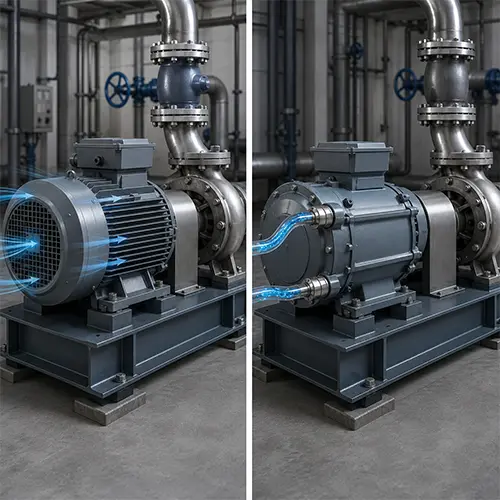
Water-cooled vs air-cooled pump motor selection should be based on motor heat load, pump duty cycle, ambient temperature, ventilation, cooling water reliability, maintenance capability, and downtime cost. For most standard industrial pump rooms with clean air and acceptable ventilation, an air-cooled pump motor is usually the simpler and more economical choice. For high-power pumps, enclosed pump rooms, hot environments, continuous-duty systems, or noise-sensitive facilities, a water-cooled pump motor may provide better thermal stability and lower operational risk.
For buyers, engineers, contractors, and project managers, the real question is not whether water cooling is “better” than air cooling. The better question is: which cooling method can keep the motor within a safe operating temperature under your real site conditions, with the lowest practical lifecycle risk?
A pump motor can fail even when the rated power looks correct on paper. Poor ventilation, high ambient temperature, blocked cooling fins, unstable cooling water, scaling, incorrect pump duty point, excessive current, or poor maintenance can all cause overheating. This guide explains how to compare water-cooled and air-cooled pump motors from a practical B2B decision-making perspective, so buyers can avoid choosing a motor based only on price, habit, or supplier preference.
Key Takeaway for Buyers
A water-cooled pump motor is recommended when pump room airflow is unreliable, the motor heat load is high, the pump runs continuously, or downtime cost is severe. An air-cooled pump motor is recommended when the pump room is clean, ventilated, easy to access, and the buyer wants lower installation complexity and simpler maintenance.
This single rule can help buyers make a first-level decision, but it should not replace engineering confirmation. Motor cooling must be reviewed together with pump type, duty point, motor power, operating hours, site layout, ambient temperature, maintenance resources, and protection devices.
| Buyer Condition | Recommended Direction | Main Reason |
|---|---|---|
| Standard clean pump room | Air-cooled motor | Simpler, lower cost, easier to maintain |
| Hot or enclosed pump room | Water-cooled motor | Less dependent on surrounding airflow |
| Large motor running continuously | Usually water-cooled, subject to engineering review | Better thermal stability under severe duty |
| Remote site with limited service team | Usually air-cooled | Fewer auxiliary cooling components |
| Unstable cooling water supply | Air-cooled | Water cooling becomes risky without reliable flow |
| Dusty site with poor air quality | Case-dependent | Air cooling may clog; water cooling needs clean water |
| Noise-sensitive indoor project | Often water-cooled | Can reduce fan-related noise |
| Low downtime tolerance | Case-dependent, often water-cooled for severe duty | Better heat control can reduce failure risk |
The safest decision is not always the most expensive option. A water-cooled motor can be the wrong choice if the site cannot maintain the cooling water system. An air-cooled motor can be the wrong choice if the pump room cannot provide enough cool airflow. The correct choice is the one that matches the real operating environment.
Scope of This Guide: Applicable Pump Types and Operating Conditions
This guide applies mainly to industrial surface pump systems where the motor is installed outside the pumped liquid and must remove heat through air or a separate cooling water path. It is most relevant for end suction pumps, inline pumps, multistage pumps, split case pumps, boiler feed pumps, circulation pumps, cooling water pumps, pressure boosting systems, HVAC pumps, and general industrial process water pumps.
This article is useful for:
- Industrial water transfer systems
- Boiler feed and high-pressure pump systems
- Cooling tower and chilled water circulation systems
- Municipal pump stations
- Factory utility water systems
- Enclosed pump rooms
- Containerized pump stations
- Hot mechanical rooms
- Continuous-duty pump packages
- Noise-sensitive indoor pumping applications
This guide is not directly suitable for all submersible pump motors because many submersible motors are cooled by surrounding liquid or by a dedicated internal cooling design. It also does not fully apply to canned motor pumps, magnetic drive pumps, special explosion-proof motors, or highly customized OEM motor systems without additional manufacturer confirmation.
If buyers are still comparing whether the application should use a surface pump or a submersible pump, this submersible vs surface pump guide can help clarify whether this motor cooling comparison applies to the selected pump configuration.
The guide also does not replace final motor sizing, insulation class verification, protection design, local electrical code review, or supplier engineering calculation. It is designed to help buyers ask better questions and reduce procurement risk before confirming the final motor cooling method.
What Is an Air-Cooled Pump Motor?
An air-cooled pump motor is a motor that removes heat through surrounding air, cooling fins, and usually a motor fan. It is the most common cooling method for standard industrial pumps because it is simple, widely available, and relatively easy to maintain.
In many pump systems, the motor fan moves air across the external motor frame. Cooling fins increase the surface area of the frame, allowing heat to transfer from the motor body to the surrounding air. When the pump room is clean, spacious, and well ventilated, this method works reliably for many industrial applications.
How Air-Cooled Pump Motors Remove Heat
Air-cooled pump motors depend on the temperature and movement of surrounding air to carry heat away from the motor. If the surrounding air is too hot, too dusty, or trapped around the motor, cooling performance can decline quickly.
During operation, the motor generates heat from electrical losses in the winding and magnetic core, as well as mechanical losses from bearings and friction. This heat moves toward the motor frame. The fan then pushes air over the frame and cooling fins, allowing heat to dissipate into the room.
The buyer should understand one important point: an air-cooled motor is only as reliable as the airflow around it. A motor rated for a certain power may still overheat if the pump room does not match the assumptions behind the motor design. Common site problems include blocked fan covers, dust-covered cooling fins, hot air recirculation, poor room ventilation, and insufficient clearance between the motor and nearby walls or equipment.
Where Air-Cooled Pump Motors Are Commonly Used
Air-cooled pump motors are commonly used in standard clean water and utility pump systems where the environment is not thermally severe. They are often the best choice when the buyer needs a practical balance of price, simplicity, and serviceability.
Typical applications include:
- Clean water transfer pumps
- Building pressure boosting systems
- HVAC circulation pumps
- Fire pump standby systems
- Factory utility water pumps
- General end suction pump systems
- Standard inline pump packages
- Moderate-power multistage pumps in ventilated rooms
For buyers comparing different pump structures before selecting the motor, this end suction vs inline vs multistage pump selection guide can help clarify which pump type matches the piping layout, head requirement, and installation space.
Air-cooled motors are not automatically low-end. In many normal industrial systems, air cooling is the correct engineering choice because it avoids unnecessary cooling water piping, flow monitoring, and water quality management.
What Is a Water-Cooled Pump Motor?
A water-cooled pump motor is a motor that removes heat through circulating water, a water jacket, or internal cooling passages instead of relying mainly on surrounding air. Because water can carry heat more effectively than air, water cooling is often used when the motor heat load is high or when air cooling is unreliable.
Water-cooled motors are often selected for large pump packages, enclosed pump rooms, high ambient temperature sites, continuous-duty operation, and noise-sensitive installations. The main advantage is better thermal stability under difficult operating conditions.
How Water-Cooled Pump Motors Remove Heat
Water-cooled pump motors transfer heat from the motor body into a flowing water circuit, allowing heat to be removed more effectively than by air alone. This can help keep the motor temperature more stable when the surrounding environment is hot or when airflow is limited.
The cooling water may pass through a water jacket or cooling channels around the motor frame. Heat moves from the winding and stator structure to the motor frame and then into the cooling water. The water then carries heat away from the motor.
This method can be very effective, but it creates additional system requirements. Buyers must confirm cooling water flow, water pressure, water quality, filtration, corrosion control, leakage prevention, temperature monitoring, and emergency shutdown logic. A water-cooled motor without reliable cooling water protection can become a high-risk component.
Where Water-Cooled Pump Motors Are Commonly Used
Water-cooled pump motors are commonly used where motor overheating would create high downtime cost, production loss, safety risk, or noise problems. They are not selected only because they are “more advanced”; they are selected when the site requires more controlled heat removal.
Typical applications include:
- Large boiler feed pump systems
- High-pressure multistage pumps
- Industrial process circulation pumps
- Mine drainage pump systems
- Enclosed or underground pump stations
- Containerized pump packages
- Hot mechanical rooms
- Long-duration continuous-duty systems
- Noise-sensitive commercial or municipal facilities
Water-cooled motors may also be suitable where ventilation improvement is difficult or expensive. For example, in an underground pump room, adding enough ventilation may require civil modification, ductwork, fans, and control systems. In that case, water cooling may be more practical than trying to force an air-cooled motor to work in a poor airflow environment.
Important Engineering Terms Buyers Should Understand Before Comparing Cooling Methods
Buyers do not need to become motor designers, but they should understand several key motor terms before approving a cooling method. These terms help prevent misunderstandings between procurement teams, engineers, and suppliers.
| Term | Plain-English Meaning | Why It Matters for Motor Cooling |
|---|---|---|
| Duty cycle | How long and how often the motor runs | Continuous operation creates more thermal stress |
| S1 duty | Continuous running duty | Important for pumps that run 24/7 |
| Insulation class | Heat resistance level of motor insulation | Higher temperature resistance can improve safety margin |
| Temperature rise | How much hotter the motor becomes during operation | Directly related to overheating risk |
| Ambient temperature | Temperature of the surrounding air | Air-cooled motors depend heavily on this |
| Service factor | Temporary overload margin under defined conditions | Should not be abused as permanent overload capacity |
| IP rating | Protection level against dust and water ingress | Important for dusty, wet, or outdoor sites |
| Cooling method | How heat is removed from the motor | Determines site support requirements |
| Motor current | Electrical current drawn during operation | Rising current may indicate overload or system problems |
| Best efficiency point | Pump operating point where efficiency is highest | Operating far from this point may increase motor load |
Why S1 Continuous Duty Matters
S1 duty means the motor is designed for continuous operation under rated conditions until thermal equilibrium is reached. For pumps that run 24 hours per day, this is an important motor selection concept.
A motor that runs continuously has less opportunity to cool down between operating cycles. If the pump room is hot or airflow is poor, heat can accumulate. For continuous-duty pump systems, buyers should pay close attention to motor temperature rise, insulation class, ventilation, cooling water reliability, and protection devices.
Why Ambient Temperature Matters
Ambient temperature is critical because the motor releases heat into its surrounding environment. If the surrounding air is already hot, an air-cooled motor has less cooling margin.
Many standard motor ratings assume a certain ambient temperature range. If the real site temperature is higher, the motor may need derating, improved ventilation, a larger frame, special insulation, or a different cooling method. Buyers should provide maximum expected pump room temperature to the supplier, not only average temperature.
Why Pump Duty Point Affects Motor Heating
Pump duty point affects motor heating because flow, head, speed, and system resistance determine how much power the pump demands from the motor. A cooling method cannot fix a pump that is operating under the wrong hydraulic condition.
If the pump operates far away from its intended range, the motor may draw higher current, generate more heat, or experience unstable loading. If the project includes speed control, this VFD pump vs fixed speed pump guide can help buyers understand how variable speed operation may affect motor load, energy use, and system stability.
Water-Cooled vs Air-Cooled Pump Motor: Core Comparison for Buyers
The difference between water-cooled and air-cooled pump motors is not only the cooling medium; it is the full lifecycle risk profile. Water cooling reduces dependence on surrounding air but adds cooling water management. Air cooling simplifies installation but requires clean airflow and proper ventilation.
| Comparison Point | Water-Cooled Pump Motor | Air-Cooled Pump Motor | Buyer Decision Meaning |
|---|---|---|---|
| Cooling medium | Water | Air | Determines site support requirements |
| Heat removal capacity | Higher | Moderate | Water cooling is stronger under high heat load |
| Dependence on room airflow | Lower | Higher | Air cooling needs good ventilation |
| Installation complexity | Higher | Lower | Water cooling needs piping and monitoring |
| Maintenance focus | Water quality, leakage, flow, scaling | Fan, fins, dust, airflow | Different failure modes must be managed |
| Initial cost | Higher | Lower | Air cooling usually wins on upfront cost |
| Lifecycle cost | Better in severe duty if maintained | Better in standard duty if ventilation is good | Depends on downtime cost and maintenance ability |
| Noise | Often lower fan-related noise | Fan noise may be higher | Important in indoor facilities |
| Main failure risk | Water interruption, blockage, leakage | Poor airflow, blocked fins, fan failure | Risk changes, not disappears |
| Best-fit condition | High heat load, enclosed, hot, continuous duty | Clean, ventilated, standard duty | Match method to site reality |
A simple procurement rule is useful here: air cooling is simpler, but it depends on the room; water cooling is stronger, but it depends on the water system.
Which Pump Applications Are Suitable for Water-Cooled Motors?
Water-cooled pump motors are suitable when the project needs stable heat removal under severe site conditions. Buyers should consider water cooling when the motor heat load is high, airflow is limited, or shutdown cost is too high to accept repeated overheating risk.
High-Power Pump Systems
High-power pump systems generate more heat and often require stronger thermal control. As motor power increases, even normal electrical losses become a significant amount of heat that must be removed continuously.
Large multistage pumps, boiler feed pumps, industrial circulation pumps, and high-pressure water systems may justify water-cooled motors if they run near full load or operate in hot pump rooms. In these applications, motor overheating may damage insulation, shorten bearing life, trip protection devices, or stop production.
Buyers should ask suppliers to review the motor’s expected temperature rise under actual operating conditions. The review should include motor power, actual pump load, duty cycle, ambient temperature, and cooling method.
Hot Ambient or Poorly Ventilated Pump Rooms
Water-cooled motors are often preferred when the pump room is hot, enclosed, or poorly ventilated. Air-cooled motors lose effectiveness when the air around the motor cannot carry heat away efficiently.
This condition is common in underground pump stations, boiler rooms, containerized pump rooms, compact mechanical rooms, and facilities where several pumps are installed close together. When hot air circulates around the motor, the fan may simply move hot air instead of cooling the motor.
Before selecting water cooling, buyers should compare two options: improving ventilation or selecting a water-cooled motor. If ventilation improvement is simple and low-cost, air cooling may still be acceptable. If ventilation improvement is difficult, water cooling may provide a more reliable solution.
Continuous-Duty Industrial Pump Systems
Continuous-duty pump systems need stronger attention to thermal stability because the motor may run for long periods without rest. A pump that runs continuously has less time to cool down between cycles.
Water-cooled motors may be suitable for 24/7 industrial processes, municipal pumping systems, boiler feed systems, and process cooling loops. In these applications, the cost of motor failure may include production stoppage, emergency maintenance, quality loss, water supply interruption, or contractual delay.
The key decision is not only whether the pump runs continuously, but whether the motor operates close to its thermal limit during that continuous operation. A moderate-power pump in a cool, ventilated room may run continuously with air cooling. A larger motor in a hot enclosed room may need water cooling.
Noise-Sensitive Facilities
Water-cooled motors may be preferred in facilities where fan noise must be reduced. This can matter in hospitals, hotels, commercial buildings, laboratories, municipal buildings, and indoor mechanical rooms near occupied areas.
However, buyers should not assume motor cooling alone solves pump noise. Noise can also come from cavitation, vibration, pipe strain, poor alignment, bearing wear, coupling issues, or pump operation away from the best efficiency point. The buyer should request total pump package noise information, not only motor noise.
Which Pump Applications Are Better for Air-Cooled Motors?
Air-cooled pump motors are better for standard applications where the site provides enough clean air and the buyer wants a simpler, lower-cost, easier-to-service solution. In many industrial pump systems, air cooling is the correct choice.
Standard Clean Water Pump Systems
Air-cooled motors are usually sufficient for standard clean water systems when the pump room is ventilated and the motor is correctly sized. These applications do not usually create extreme heat conditions.
Examples include general water transfer, pressure boosting, HVAC circulation, standard fire pump service, factory utility water, and many end suction or inline pump systems. In these cases, air-cooled motors reduce unnecessary complexity and make maintenance easier.
The buyer should still confirm motor clearance, ventilation, rated current, and operating duty point. A standard application can become severe if the pump is installed in a hot or compact room.
Projects With Limited Maintenance Resources
Air-cooled motors are often safer where maintenance teams are small, remote, or not trained to manage cooling water systems. A simpler motor cooling design can reduce operational mistakes.
Water-cooled motors need cooling water checks, leakage inspection, scale prevention, and flow monitoring. If these tasks are not realistic for the site, air cooling may be more reliable in practice.
This is especially relevant for distributors, contractors, export projects, agricultural pumping systems, temporary installations, and remote industrial sites where local support is limited.
Budget-Sensitive Standard Projects
Air-cooled motors usually have lower purchase and installation cost than water-cooled motors. They do not require cooling water piping, filters, valves, flow switches, water treatment, or additional commissioning work.
For standard-duty projects, this cost advantage is meaningful. However, buyers should avoid choosing air cooling only because it is cheaper. If the pump room is hot, dusty, or poorly ventilated, the lower initial cost may lead to higher failure cost later.
When NOT to Choose a Water-Cooled Pump Motor
Buyers should not choose a water-cooled pump motor when the site cannot reliably support the cooling water system. Water cooling is powerful, but it is not automatically safer.
Do Not Choose Water Cooling If Cooling Water Is Unstable
A water-cooled motor becomes risky when cooling water flow cannot be guaranteed. If the water supply stops, pressure drops, or flow becomes restricted, the motor may overheat quickly.
This risk is higher in sites where cooling water is shared with other equipment, controlled manually, affected by seasonal supply, or not monitored by flow sensors. If the cooling water source is unreliable, an air-cooled motor or improved ventilation may be safer.
Do Not Choose Water Cooling If Water Quality Is Poor and Untreated
Poor cooling water quality can cause scaling, corrosion, and blockage inside the cooling path. These problems reduce heat transfer and may be difficult to detect until the motor temperature rises.
Hard water, dirty water, high mineral content, rust particles, sand, biological growth, or corrosive liquid can all damage the cooling system. If water treatment or filtration is not available, the buyer should be cautious about water cooling.
Do Not Choose Water Cooling If Maintenance Cannot Support It
A water-cooled motor requires a maintenance routine that many standard pump rooms may not have. The site team must inspect cooling water flow, leakage, temperature, pressure, and water quality.
If the site only has basic electrical maintenance support and no routine water system inspection, water cooling may create hidden failure points. In this case, a robust air-cooled motor with good ventilation may be more practical.
When NOT to Choose an Air-Cooled Pump Motor
Buyers should not choose an air-cooled pump motor when the surrounding air cannot remove heat effectively. Air cooling is simple, but it depends heavily on site airflow.
Do Not Choose Air Cooling If the Pump Room Is Hot and Enclosed
An air-cooled motor can overheat in a hot enclosed pump room even if the motor rating appears correct. The motor fan cannot cool effectively if it only recirculates hot air.
This is common in basement pump rooms, containerized pump packages, boiler rooms, and compact mechanical spaces. If ventilation cannot be improved, water cooling may be a better option.
Do Not Choose Air Cooling If Dust or Fibers Block the Motor Surface
Dust, fibers, oil mist, and debris can reduce air-cooled motor performance by blocking cooling fins and fan covers. When this happens, the motor surface cannot release heat efficiently.
Air-cooled motors can still be used in dusty sites if cleaning is frequent and the motor has appropriate protection. But if cleaning is unlikely or the dust load is heavy, the buyer should review alternative cooling or protection solutions.
Do Not Choose Air Cooling If Noise Limits Are Strict
Fan-cooled motors may create noise that is unacceptable in certain indoor or commercial environments. If the project has strict acoustic requirements, water cooling may help reduce fan-related noise.
The buyer should still check the full pump package, because pump hydraulics, pipe vibration, and baseplate resonance may dominate the actual noise level.
Field Diagnosis: How to Check Whether Motor Cooling Is Failing
Motor cooling problems should be diagnosed by checking temperature, current, airflow, cooling water condition, and pump operating point together. Buyers should not assume that every motor overheating problem is caused by the motor itself.
Step 1: Check Motor Surface Temperature and Temperature Trend
A rising motor temperature trend is more important than a single temperature reading. If the motor becomes hotter over time under the same operating condition, cooling performance may be declining.
The site team should record operating temperature during normal load, peak load, and high ambient temperature periods. If temperature rises after cleaning, ventilation changes, or cooling water adjustment, the cause may become clearer.
Step 2: Check Motor Current Against Rated Current
High motor current often indicates overload, wrong duty point, mechanical friction, or system resistance problems. Cooling may not be the root cause if the motor is drawing too much current.
Buyers should compare operating current with motor nameplate current. If current is consistently high, the pump may be operating outside its intended range. In this situation, improving cooling may reduce symptoms but not solve the underlying hydraulic or mechanical issue.
If the pump also shows unstable flow, lower efficiency, or rising energy use, this pump efficiency loss guide can help identify whether the issue comes from pump wear, system change, blockage, or incorrect operating condition.
Step 3: Inspect Airflow for Air-Cooled Motors
For air-cooled motors, airflow inspection should include fan condition, fan cover, cooling fins, motor clearance, and room ventilation. Even a strong motor can overheat if airflow is blocked.
The site team should check whether the fan is rotating properly, whether the fan cover is blocked, whether dust covers the motor fins, and whether hot air is trapped around the motor. The motor should have enough space around it so cooling air can enter and exit freely.
Step 4: Inspect Cooling Water for Water-Cooled Motors
For water-cooled motors, cooling water inspection should include flow, pressure, temperature, leakage, scaling, and blockage. A water-cooled motor can overheat quickly if the water path loses effectiveness.
The site team should verify that cooling water is flowing at the required rate, the inlet water temperature is acceptable, and the outlet temperature is not abnormal. Filters, valves, and flow switches should be checked. If scaling is suspected, the cooling path may need cleaning or flushing according to manufacturer instructions.
Step 5: Check Pump Operating Point
The pump operating point must be checked because motor heating can be caused by hydraulic mismatch. A pump running too far from its intended flow and head range may overload the motor.
The buyer should review actual flow, discharge pressure, suction pressure, valve position, system resistance, and pump curve. If the pump is not operating near its expected duty point, motor cooling changes may not solve the real problem.
Cost Comparison: Initial Price vs Lifecycle Cost
Air-cooled motors usually win on initial cost, while water-cooled motors may win on lifecycle risk in severe-duty applications. Buyers should compare the total cost of ownership instead of comparing motor price alone.
Initial Purchase and Installation Cost
Air-cooled motors usually have lower initial cost because they do not require external cooling water piping or monitoring systems. Installation is also simpler because the motor cooling system is mostly self-contained.
Water-cooled motors may require:
- Cooling water inlet and outlet piping
- Valves and strainers
- Flow indicators or flow switches
- Temperature monitoring
- Water treatment or filtration
- Leakage control
- Extra commissioning checks
For standard pump systems, these extra costs may not be justified. For severe-duty systems, they may be necessary to prevent more expensive failures.
Maintenance Cost
Air-cooled motors usually have lower maintenance cost in clean standard environments. Maintenance focuses on cleaning, fan inspection, bearing condition, and airflow clearance.
Water-cooled motors require more technical maintenance. The site team must check cooling water quality, scaling, leakage, flow, and temperature. If water quality is poor, ongoing treatment cost must be included.
Downtime Cost
Downtime cost can make water cooling financially reasonable even when the initial cost is higher. If motor overheating stops production, interrupts water supply, damages connected equipment, or causes emergency repair, the real cost may exceed the price difference between the two motor types.
For production-critical pumps, the buyer should estimate:
- Lost production per hour
- Emergency repair cost
- Replacement motor lead time
- Labor and crane cost
- Impact on downstream equipment
- Contract or delivery penalty
- Safety or environmental consequence
If the downtime cost is high, better thermal control and monitoring may be worth the investment.
Case Matrix: Practical Industrial Selection Scenarios
Real pump motor cooling decisions are usually made by matching site risks to maintenance capability. The following scenarios show how buyers can think beyond catalog specifications.
| Scenario | Site Condition | Better Direction | Reason |
|---|---|---|---|
| Standard factory water transfer | Clean pump room, moderate motor power, good ventilation | Air-cooled | Simple, cost-effective, easy to maintain |
| Underground pump station | Enclosed space, poor natural airflow, long operating hours | Water-cooled | Air cooling may recirculate hot air |
| Remote irrigation booster | Limited maintenance team, no stable cooling water | Air-cooled | Simpler system reduces service risk |
| Boiler feed system | High temperature area, continuous operation, high downtime cost | Water-cooled | Better thermal stability under severe duty |
| Dusty industrial workshop | Dust and fibers near motor, cleaning not frequent | Case-dependent | Air cooling may clog; water cooling needs clean water |
| Commercial building mechanical room | Indoor space, noise concern, limited ventilation | Water-cooled may be considered | Lower fan-related cooling dependence |
| Small HVAC circulation pump | Standard duty, accessible equipment room | Air-cooled | Water cooling adds unnecessary complexity |
These examples show why the same motor cooling method cannot fit every project. A strong supplier should ask about site conditions before recommending a cooling method.
RFQ Checklist for Pump Motor Cooling Method
Buyers should include motor cooling requirements in the RFQ instead of leaving the cooling method vague. A clear RFQ reduces misunderstanding and forces suppliers to confirm assumptions.
Buyers can send the following information to suppliers:
| RFQ Item | Information to Provide |
|---|---|
| Pump type | End suction, inline, multistage, split case, boiler feed, etc. |
| Flow rate | Required operating flow |
| Head | Required total dynamic head |
| Liquid | Clean water, process water, cooling water, treated water, etc. |
| Motor power | Estimated or required motor rating |
| Operation schedule | Intermittent, daily operation, or 24/7 continuous duty |
| Ambient temperature | Average and maximum pump room temperature |
| Installation space | Open, enclosed, underground, containerized, indoor, outdoor |
| Ventilation condition | Natural ventilation, forced ventilation, poor ventilation |
| Dust level | Clean, dusty, oily, fibrous, humid |
| Cooling water availability | Stable, unstable, treated, untreated, unknown |
| Noise limit | Required noise level if applicable |
| Maintenance ability | Local technician skill level and inspection frequency |
| Protection requirements | Temperature sensor, flow switch, overload protection, alarm, shutdown |
| Downtime tolerance | Low, medium, high |
| Supplier confirmation | Required cooling method justification |
A buyer should not accept a supplier quotation that only lists motor power without explaining cooling assumptions. The supplier should confirm why the selected cooling method is suitable for the actual pump system and site environment.
Supplier Verification Questions Before Final Purchase
A reliable pump supplier should be able to explain the cooling method recommendation in relation to the real operating condition. Buyers should use these questions to test whether the supplier has reviewed the project properly.
| Question to Ask Supplier | Why It Matters |
|---|---|
| What ambient temperature did you assume for motor selection? | Confirms whether the design matches the site |
| Is the motor suitable for continuous duty? | Important for 24/7 systems |
| What motor insulation class is selected? | Shows thermal resistance margin |
| What temperature protection is included? | Reduces damage during abnormal operation |
| What clearance is required around the motor? | Prevents poor airflow |
| For air-cooled motors, what ventilation condition is required? | Confirms room design needs |
| For water-cooled motors, what cooling water flow is required? | Confirms utility capacity |
| What water quality limits should be followed? | Prevents scaling and corrosion |
| What happens if cooling water flow stops? | Clarifies alarm and shutdown logic |
| Has the pump duty point been checked? | Prevents motor overload from hydraulic mismatch |
| What maintenance routine is required? | Helps buyer estimate lifecycle cost |
| What spare parts should be stocked? | Reduces downtime risk |
These questions help buyers move from price comparison to risk comparison. In industrial pump procurement, risk comparison is often more important than the first quotation.
Best Option by Scenario
The best motor cooling method depends on application severity, not only pump type. Buyers should use the following scenario-based recommendations as a practical starting point.
Best Option for Standard Clean Water Pump Rooms
Air-cooled pump motors are usually the best option for clean, ventilated, standard pump rooms. They are simple, economical, and easy for most maintenance teams to service.
Choose air cooling when:
- Ambient temperature is reasonable
- Ventilation is adequate
- Motor power is moderate
- Pump operation is standard
- Dust level is low
- Maintenance simplicity matters
- Cooling water is not readily available
Best Option for Hot or Enclosed Pump Rooms
Water-cooled pump motors are often the better option when the pump room is hot, compact, underground, or poorly ventilated. In these environments, air-cooled motors may not remove heat reliably.
Choose water cooling when:
- Pump room airflow is limited
- Ambient temperature is high
- Several pumps operate in the same room
- Ventilation improvement is difficult
- Motor heat load is high
- Downtime cost is significant
Best Option for Continuous-Duty Industrial Pump Systems
Water-cooled motors should be strongly considered for high-power continuous-duty systems with high downtime cost, but air-cooled motors can still work in moderate-duty ventilated applications. The final decision should be based on actual heat load and site conditions.
Choose based on:
- Motor power
- Operating current
- Pump duty point
- Ambient temperature
- Operating hours
- Ventilation
- Cooling water reliability
- Failure consequence
Best Option for Remote or Low-Maintenance Sites
Air-cooled pump motors are usually better for remote sites where cooling water management is difficult. A simpler cooling method can reduce human error and service dependency.
Choose air cooling when:
- Maintenance staff are limited
- Cooling water supply is uncertain
- Spare parts access is difficult
- The site cannot monitor water flow
- The pump room can still provide reasonable airflow
FAQ About Water-Cooled vs Air-Cooled Pump Motors
These questions reflect the real concerns buyers usually raise before approving a pump motor cooling method. The answers focus on practical decision-making, risk control, cost, and application boundaries.
Is a Water-Cooled Pump Motor Always Better Than an Air-Cooled Pump Motor?
A water-cooled pump motor is not always better than an air-cooled pump motor. It is better only when the operating condition justifies stronger heat removal and the site can support cooling water management.
For standard pump rooms, an air-cooled motor is often more practical. It is simpler, cheaper, easier to maintain, and more familiar to local service teams. Water cooling becomes better when airflow is unreliable, motor heat load is high, noise is sensitive, or downtime cost is severe.
Is an Air-Cooled Pump Motor Enough for Continuous Operation?
An air-cooled pump motor can be enough for continuous operation if the motor is correctly sized, the room is well ventilated, and the pump operates within its intended duty range. Continuous operation alone does not automatically require water cooling.
However, if the pump runs continuously in a hot, enclosed, dusty, or high-load environment, air cooling may not provide enough thermal margin. In that case, water cooling or improved ventilation should be reviewed.
What Is the Biggest Risk of Using a Water-Cooled Pump Motor?
The biggest risk of using a water-cooled pump motor is cooling water failure. This may include low flow, blocked cooling passages, poor water quality, scaling, corrosion, leakage, or cooling water interruption.
These risks can be reduced by using filtration, water treatment, flow monitoring, temperature sensors, leakage inspection, and automatic shutdown logic. Without these protections, water cooling can become a hidden failure point.
What Is the Biggest Risk of Using an Air-Cooled Pump Motor?
The biggest risk of using an air-cooled pump motor is insufficient airflow. This can be caused by poor ventilation, blocked cooling fins, damaged fan covers, dust accumulation, hot air recirculation, or insufficient clearance.
Air-cooled motors are reliable only when the motor can release heat into the surrounding air. If the air cannot move or is already too hot, the motor temperature may rise beyond the safe range.
Which Motor Cooling Method Has Lower Maintenance Cost?
Air-cooled motors usually have lower maintenance cost in standard environments. They do not require cooling water piping, flow switches, water treatment, or leakage inspection.
Water-cooled motors may have higher routine maintenance cost, but they can reduce total lifecycle cost in severe-duty systems if they prevent overheating, unplanned shutdown, and motor replacement. The lower-cost option depends on operating severity and downtime cost.
Should Buyers Choose Water-Cooled Motors for All High-Power Pumps?
Buyers should not automatically choose water-cooled motors for all high-power pumps. High motor power increases heat load, but the final decision must also consider ambient temperature, ventilation, operating hours, cooling water availability, and maintenance ability.
A high-power motor in a clean, ventilated room may operate safely with air cooling. A smaller motor in a hot enclosed room may still face overheating risk. Site condition is as important as motor power.
Can Water Cooling Extend Pump Motor Life?
Water cooling can extend motor life when it keeps operating temperature stable under severe conditions. Lower and more stable temperature can slow insulation aging and reduce overheating-related stress.
However, water cooling will not extend motor life if the cooling water system is poorly maintained. Scaling, blockage, corrosion, and flow interruption can cause serious damage. Motor life depends on both cooling design and maintenance quality.
What Information Should Buyers Provide to the Supplier?
Buyers should provide pump type, flow, head, liquid, motor power, operating hours, pump room temperature, ventilation condition, cooling water availability, dust level, noise limits, and maintenance capability. These details allow the supplier to recommend a cooling method based on real operating risk.
If buyers only provide flow and head, the supplier may not fully evaluate thermal conditions. Motor cooling selection requires both pump data and site environment data.
Conclusion: How Buyers Should Make the Final Decision
The final decision between a water-cooled and air-cooled pump motor should be based on thermal risk, site support, maintenance ability, and lifecycle cost. Air-cooled pump motors are usually the best choice for standard clean pump rooms with good ventilation. Water-cooled pump motors are usually better for high-power, hot, enclosed, continuous-duty, or noise-sensitive applications where stable cooling is more important than simple installation.
For buyers, the most practical rule is this: choose air cooling when the site can provide enough clean airflow; choose water cooling when airflow is unreliable and the project can support cooling water management.
Before approving the final pump motor specification, buyers should confirm motor power, pump duty point, operating hours, maximum ambient temperature, pump room ventilation, cooling water quality, maintenance ability, protection devices, noise limits, and downtime cost. The right cooling method should reduce total operating risk—not just reduce the first purchase price.
Get A Quote

Get A Quote
0 Comments