
Split Case Pump Guide: When to Choose Double-Suction for High-Flow Systems

If you're moving high volumes of water—chilled water loops, cooling tower circuits, municipal distribution, flood control—and you need a pump that runs 24/7 and where maintenance access won't shut you down for days, a split case pump is usually the right call. The real question isn't whether it works; it's whether the higher upfront cost buys you enough lifecycle value compared to a simpler end suction pump. This guide walks you through that exact decision, step by step, so you can spec with confidence and build a stronger RFQ.
The cost of getting this wrong shows up slowly and painfully: oversized pumps that waste electricity for 20 years, cavitation-damaged impellers that nobody can reach without dismantling piping, bearings that fail early because nobody checked axial thrust balance, and maintenance windows that stretch from hours to days because the pump room has no overhead clearance for the casing lift. These aren't hypotheticals. I've seen each one happen on projects where the pump type was chosen on purchase price alone.
By the time you finish this article, you'll know when a split case pump justifies itself, what technical parameters actually matter during selection, how to verify a supplier's performance claims, and what to put in your RFQ so you're comparing apples to apples. Let's start with the basics so we're all using the same vocabulary.
What Is a Split Case Pump and How Does It Work?
A split case pump gets its name from the casing design: the housing splits horizontally along the shaft centerline into an upper and lower half. When you unbolt the top half and lift it off, the entire rotating assembly—shaft, impeller, bearings, wear rings—sits exposed in the bottom half. The suction and discharge flanges stay on the bottom casing half, so you can pull the internals without breaking any pipe connections. That's the maintenance access advantage in a nutshell.
The hydraulic side of this design is equally important. Most split case pumps use a double-suction impeller, which pulls liquid in from both sides of the impeller eye simultaneously. This balances the axial thrust that typically pushes a single-suction impeller shaft toward the suction side, reducing bearing load and improving mechanical seal life. The two opposing flows merge inside the impeller and exit together through the volute, essentially giving you two single-suction impellers working back-to-back in one compact rotating element. That's why these pumps handle high flow rates at moderate heads with excellent hydraulic stability.
Split Case vs Double Suction: Why the Terms Are Often Confused
Here's a distinction that causes confusion on RFQ documents and spec sheets. A split case refers to the casing construction—the horizontal split. A double suction refers to the impeller design—liquid entering from both sides. Most horizontal split case pumps do use double-suction impellers, but the terms describe different things. You can technically have a split case pump with a single-suction impeller, though it's rare. You can also have a double-suction pump in a vertically split casing or an end suction configuration, though those are less common.
Why does this matter to you as a buyer? Because if your spec just says "split case pump," you're describing the casing. If you also need the axial thrust balancing and flow stability that come from a double-suction impeller, you need to specify it. For most high-flow HVAC and municipal applications, you want both. But don't assume every supplier reads those two terms the same way. Clarify in your RFQ: horizontal split casing, double-suction impeller. I've seen projects where the contractor delivered a vertically split double-suction pump that couldn't be maintained the same way, leading to complaints about maintenance access. The problem wasn't the pump; it was the specification language. For a deeper dive on double-suction hydraulics specifically, you might want to review our Double Suction Pump Guide: How to Choose, Operate, and Troubleshoot It in Real Industrial Systems.
When a Split Case Pump Makes More Sense Than an End Suction Pump
End suction pumps work fine. For flows under roughly 200–300 m³/h (about 880–1320 US GPM), they're often the more economical choice—simpler, smaller footprint, lower purchase cost. But once you cross into higher flow territory, particularly above 500 m³/h, the tradeoffs start tipping toward split case designs. The table below gives you a practical comparison framework.
| Decision Factor | Split Case Pump | End Suction Pump |
|---|---|---|
| Typical flow range sweet spot | Commonly 300–10,000+ m³/h | 10–500 m³/h |
| Maintenance access | Top casing lift; internals exposed without breaking piping | Must disassemble suction piping or pull the entire pump |
| Axial thrust | Largely balanced (double-suction impeller) | Unbalanced; requires thrust bearing |
| Floor footprint | Wider; longer baseplate | Compact; shorter baseplate |
| Efficiency at BEP | Depends on pump size, hydraulic design, and operating point; must be verified against supplier‑tested performance curves under ISO 9906 | Depends on pump size, impeller trim, and motor match; verify against manufacturer‑tested curves |
| Upfront cost | Higher casing, machining, and material cost | Lower; less complex casting |
| Best applications | Chilled water, cooling tower, municipal distribution, flood control | Booster service, process transfer, smaller HVAC loops |
This isn't a "split case is always better" argument. It's about matching the pump to the system's real operating profile. Let's walk through the scenarios that most often justify the switch.
HVAC and Cooling Water Systems
Chilled water and condenser water loops in large commercial buildings, district cooling plants, and industrial process cooling all share one trait: they run nearly continuously at high flow volumes with variable load. A typical large chiller plant moving 1000–3000 m³/h through a distribution loop needs pumps that operate reliably year-round with minimal vibration and near-BEP efficiency. Split case pumps often fit this profile well.
Why? Three reasons. First, the efficiency plateau near BEP tends to be flatter for a well-designed double-suction impeller, meaning you lose less efficiency when flow deviates slightly from design point—which it will, especially if you're using VFD control for part-load operation. Second, the balanced axial thrust can lead to longer bearing life, and in a 24/7 chilled water plant, every bearing replacement is a planned or unplanned shutdown. Third, maintenance access without breaking large-bore chilled water piping is genuine cost avoidance; those flanges on 12-inch or 16-inch piping are heavy and time-consuming to reseal.
If you're specifying pumps for a cooling tower circuit, I'd suggest you also look at our Best Pump for Cooling Towers: Guide to Cooling Water Pump Selection for HVAC and Industrial Systems—it covers pump sizing, NPSH margin, and VFD logic for cooling water specifically, which overlaps with what we're discussing here.
Municipal Water Distribution and Flood Control
Municipal pumping stations for clean water distribution push thousands of cubic meters per hour through networks that can't afford to go down. The duty cycle is brutal: start, stop, respond to demand surges, and keep pressure stable across a distribution zone. Split case pumps with double-suction impellers are often preferred for this duty because the hydraulic forces stay balanced across the operating range, reducing the fatigue loads on bearings and shafts that accumulate over years of cycling service.
Flood control and stormwater pumping add another layer: the pumps sit idle for months, then need to start instantly and run at full capacity for hours or days. A horizontally split casing makes inspection and readiness checks practical—you can open the pump, verify the impeller and wear rings, and close it back up far faster than with a pump that requires piping disassembly. For broader municipal pump selection context, see our Best Pump for Municipal Projects: Water Supply, Wastewater, Drainage, and Flood Control Pump Selection Guide.
Situations Where End Suction Pumps Are Still the Better Choice
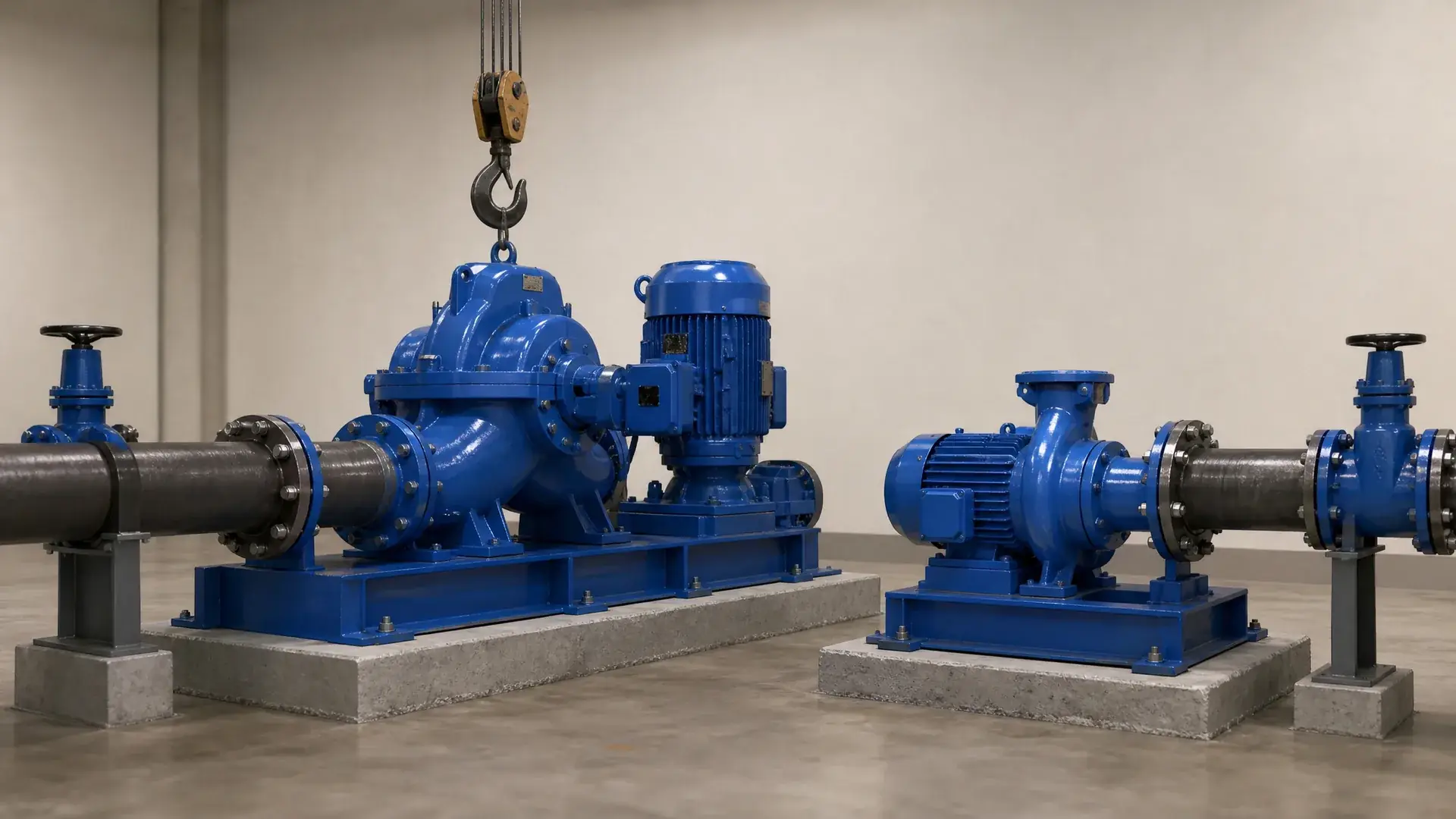
Don't spec a split case pump just because it sounds more advanced. If your flow is under 200 m³/h and your head is modest, an end suction pump may serve you better for less money. If floor space is extremely tight—say, an equipment mezzanine with limited length—a compact end suction pump might be the only layout that fits. If the system operates intermittently and the pump can be pulled easily for repairs, the maintenance advantage of a split case diminishes in value.
Also, if you're pumping anything with solids, fibrous material, or severe abrasives, a split case pump with tight wear ring clearances isn't your best option. These pumps are designed for clean or lightly contaminated water. For solids-handling applications, you'd be better served by a completely different pump type. The decision framework for that is covered more fully in our End Suction Pump Guide: How to Choose, Use, and Troubleshoot It in Real Industrial Systems, which includes scenarios where end suction designs outperform split case alternatives.
Key Selection Criteria for High-Flow Split Case Pumps
Once you've decided a split case pump makes technical sense, you still need to get the specific model right. The difference between a pump that runs quietly near BEP for 15 years and one that vibrates and cavitates from day one often comes down to how thoroughly you evaluate these four or five parameters.
| Parameter | Why It Matters | Risk If Ignored | Verification Method |
|---|---|---|---|
| Flow rate / head / BEP | Determines efficiency, vibration, and impeller life | Chronic cavitation, high energy cost, bearing failures | Request pump curve with BEP marked; confirm operating point within 70–120% of BEP flow |
| NPSH margin (NPSHa vs NPSHr) | Prevents cavitation damage to impeller and wear rings | Impeller pitting, noise, performance degradation | Calculate NPSHa from system design; require NPSHr curve from supplier; a margin of 1–1.5 m is commonly recommended, but confirm with the pump manufacturer for your specific application |
| Suction piping geometry | Affects flow distribution into double-suction impeller | Uneven loading, vibration, premature bearing wear | Review suction piping layout against ANSI/HI 9.8 recommendations for straight pipe lengths |
| Motor sizing and VFD compatibility | Matches pump to actual operating profile | Oversized motor wastes energy; undersized trips on overload | Specify duty point kW; confirm motor service factor; verify VFD-rated insulation if speed control is needed |
| Redundancy configuration | Ensures system availability during maintenance or failure | Single pump failure shuts down critical service | Define duty/standby or duty/duty/standby arrangement in spec |
Flow Range, Head, and Best Efficiency Point
A split case pump doesn't have a single "best flow"—it has a Best Efficiency Point (BEP) where hydraulic losses are minimized and mechanical loads are most balanced. Operating too far left of BEP (low flow) can cause recirculation, increased radial thrust, and vibration. Operating too far right (runout) may risk cavitation and motor overload. For continuous-duty applications, it's generally recommended to keep normal operation within roughly 80–110% of BEP flow. For intermittent duty, you may stretch to 70–120%, but expect reduced bearing life and higher vibration at the extremes.
When you get a pump curve from a supplier, don't just glance at the efficiency number at your design point. Look at the shape of the curve. A steep head-capacity curve means flow changes significantly with small pressure variations—fine for pressure-controlled systems but harder to balance in parallel pump arrangements. A flat curve gives you more stable flow across varying system resistance but can make parallel pump load sharing trickier. Neither is universally better; you just need to match the curve shape to your control strategy.
NPSH and Suction Piping Design Risks
Of all the parameters that kill split case pump reliability, suction-side problems are probably the most common and the most avoidable. A double-suction impeller is designed to receive liquid symmetrically from both sides. If the suction piping creates an uneven velocity profile approaching the pump—say, an elbow mounted too close to the suction flange—one side of the impeller gets more flow than the other. That imbalance can create a net radial load on the shaft, and now you've lost most of the benefit that the double-suction design was supposed to deliver.
The rule of thumb from ANSI/HI 9.8 recommends at least 5 to 10 pipe diameters of straight pipe upstream of the pump suction flange. However, straight-pipe distance alone doesn't guarantee a uniform intake velocity profile; the actual requirement also depends on upstream piping geometry, reducer location, elbows in multiple planes, and the approach flow velocity. A tight silhouette can still create distortions even with a nominally long straight run. Therefore, you should review the full suction layout with the pump manufacturer and, if necessary, use a suction diffuser or flow straightener to correct remaining asymmetry. If you can't fit adequate pipe lengths in your equipment room layout, discuss the velocity profile expectations directly with the pump manufacturer. Don't assume a suction diffuser fixes everything—it helps, but it's not a substitute for decent piping layout. The NPSH margin also matters here: a small margin might look fine on paper, but if your suction piping causes localized pressure drops at one impeller eye, you can still get cavitation damage even with an "acceptable" calculated margin.
Redundancy and Duty/Standby Configuration
Most HVAC and municipal specs require at least one standby pump, and for good reason. In a chilled water plant serving a hospital, data center, or 24/7 industrial process, you don't have the luxury of shutting down a pump for bearing inspection without another pump already online. The standard arrangement is N+1: for every N pumps needed to meet peak demand, you install one additional pump as standby.
Split case pumps lend themselves to parallel operation because their flow-sharing behavior tends to be stable when the curve shape is well-matched. But here's a detail that gets missed: parallel pumps need to be identical—same model, same impeller trim, same speed. Don't mix a trimmed impeller with a full-diameter unit on the same manifold and expect them to share flow evenly. One will tend to dominate, the other will surge near shutoff, and both will suffer. Your spec should explicitly state that all parallel pumps are to be hydraulically identical.
Maintenance Access and Downtime Planning
The split case's flagship feature is top-access maintenance, but only if the equipment room actually has the overhead clearance to lift the top casing. The top half of a mid-sized split case pump can weigh several hundred kilograms. If your pump room ceiling is low and there's no monorail or lifting beam, you're not going to get the maintenance benefit you paid for. The casing lift height plus the lifting gear height must be less than the available clear height above the pump centerline. Confirm this dimension during the equipment layout and coordinate with the structural engineer if you need a lifting point.
Also, think about the full maintenance workflow: where do the top casing halves go when they're lifted off? Is there floor space nearby to lay them down safely? Where does maintenance personnel stand to access the bearings and mechanical seal? A pump that's technically maintainable but practically trapped in a corner isn't much better than one that requires pipe disassembly.
Lifecycle Cost vs Purchase Price
Here's where a lot of procurement decisions go sideways. The purchase price of a split case pump is often higher than an equivalent-flow end suction pump—more cast iron, more machining, more assembly time. But the purchase price is relevant for about one day. The electricity bill runs for 20 years—or longer.
Even a small difference in pump efficiency, sustained over thousands of operating hours, can add up to a significant energy cost gap that more than offsets the initial price premium. For example, a pump operating at a slightly lower efficiency than a comparable model will draw more kilowatts continuously; multiply that by the annual operating hours and the local electricity rate, and the lifetime savings can far exceed the initial price difference. That's the kind of trade-off your energy consultant or commissioning agent should be quantifying during the design phase—there's no one-size-fits-all number, but the direction is clear: for large, continuous-duty pumps, efficiency matters more than purchase price.
The maintenance cost side is harder to quantify precisely because it depends on your labor rates, your mechanical team's skill level, and your tolerance for unplanned downtime. But the direction is clear: a pump you can inspect and repair without rigging heavy piping is likely to cost less to maintain over its life than one that requires piping disassembly for every internal inspection. Whether that saving justifies the higher upfront depends on your specific situation—and it's worth modeling the scenario rather than assuming.
Supplier Verification and RFQ Checklist for Split Case Pumps
Verifying a split case pump supplier isn't about checking a box. It's about confirming that the pump you're buying will perform as promised and that the factory has test evidence to back it up. Here's what I recommend you request, in order of importance.
Hydraulic performance test to ISO 9906 Grade 1 or 2. This verifies that the actual pump meets the published flow, head, efficiency, and power curves at the specified duty point. Grade 1 is tighter tolerance; Grade 2 is more common and generally acceptable for most commercial HVAC and municipal applications. Ask for the full test curve, not just a single data point. The shape of the curve matters as much as the BEP value.
Material certifications. For cast iron casings, ductile iron impellers, and stainless steel shaft materials, request mill test reports or material certificates showing chemical composition and mechanical properties. If your application involves slightly corrosive water or outdoor installation in a coastal environment, confirm that the materials specified are appropriate—standard cast iron may need an upgrade to ductile iron or a coating system.
NPSH test data. Not every factory routinely tests NPSH, but if your application has a tight NPSH margin, you should ask. The NPSH required curve is often calculated rather than measured. A witnessed NPSH test, while more expensive, gives you real cavitation inception data instead of a theoretical estimate.
Witness testing option. Even if you don't plan to attend in person, having a witness test option available tells you something about the factory's confidence in their equipment. If they refuse witnessed testing outright, that's a data point worth noting.
Motor documentation. Separate from the pump, get the motor data sheet: efficiency class (IE3 or IE4 in most markets), insulation class, service factor, starting method, and bearing type. Confirm the motor is sized to handle the maximum power point on the pump curve, not just the design duty point.
Export packaging. For international procurement, confirm how the pump set will be crated, whether the shaft will be locked to prevent movement during transit, and whether the mechanical seal faces are protected from vibration damage during shipping.
RFQ Data Sheet for Split Case Pumps
When you're ready to request quotes, include at minimum the following information. Leaving any of these blank invites assumptions that won't be in your favor.
| RFQ Field | Your Input or Options |
|---|---|
| Liquid | Clean water / treated water / chilled water / cooling water / other (specify) |
| Flow rate | Design flow (m³/h or US GPM) plus min/max operating range |
| Total dynamic head | Design head (m or ft) at design flow |
| NPSH available | Calculated NPSHa at pump suction flange (m or ft) |
| Operating temperature | Normal and maximum (°C or °F) |
| Power supply | Voltage, phase, frequency (e.g., 400V/3Ph/50Hz) |
| Motor enclosure and protection | IP rating, insulation class (e.g., IP55, Class F) |
| VFD required? | Yes / No; if yes, confirm VFD-rated motor insulation |
| Redundancy | Duty only / duty-standby / duty-duty-standby / other |
| Pump material preferences | Casing, impeller, shaft, wear ring materials |
| Mechanical seal preference | Single / double / tandem; flush plan if known |
| Performance test standard | ISO 9906 Grade 1 or 2; witnessed or non-witnessed |
| Documentation required | Pump curve, motor data sheet, material certs, test report, dimensional drawing |
| Special paint or coating | Indoor / outdoor / coastal / none |
| Export packaging needed? | Standard / seaworthy crate with shaft locking |
| Quantity | Number of pump sets required |
| Target delivery | Required on-site date or lead time preference |
Common Split Case Pump Selection Mistakes
I've seen the same errors repeat across projects, and they're all avoidable if you know what to watch for.
Selecting a pump too far from BEP. The most common spec mistake. Someone adds a 20% "safety factor" to the flow and another 10% to the head, the pump ends up permanently throttled or bypassed, and it runs at 60% of BEP for its entire service life. Vibration increases, efficiency drops, and the impeller starts recirculating. Size the pump for the actual system curve, not for a worst-case scenario that never actually occurs.
Ignoring suction piping symmetry. As I mentioned earlier, an elbow too close to the suction flange sends uneven flow into a double-suction impeller. This doesn't just reduce performance—it can create a cyclic radial load that may fatigue the shaft. You'll see the effects as repeated bearing replacements or a mechanical seal that never quite lasts its rated life.
No redundancy for critical services. A single split case pump is still a single point of failure. If your plant can't tolerate a 24-hour outage for a bearing swap, you need a standby pump installed, piped, and wired. Retrofitting one later is far more expensive than including it in the original design.
Insufficient maintenance clearance. This one is easy to overlook during the design phase because the 3D model shows the pump with nothing above it. Then the electrical contractor runs a cable tray directly over the pump, or the HVAC ductwork takes the only overhead space, and suddenly the top casing can't be lifted without removing other systems first. Walk the actual equipment room arrangement with the mechanical, electrical, and structural teams before locking in the layout.
Specifying by pump type without application context. "We want a split case pump" is the start of a conversation, not the end of a spec. A split case pump selected for a duty it doesn't fit will disappoint. Apply the selection logic in this guide first, confirm the application fit, then specify the pump type.
FAQ — Split Case Pump Selection Questions Buyers Ask Most
These are the questions I hear repeatedly from engineers, contractors, and procurement managers who are comparing pump types or preparing to issue an RFQ for high-flow water systems.
Are all split case pumps double suction?
No, not all of them. The term "split case" describes the casing construction—a horizontally split housing. Most split case pumps do use double-suction impellers because the design naturally complements the high-flow, axially balanced intent of the pump. But you can encounter split case pumps with single-suction impellers in some niche designs. If you need the axial thrust balancing benefit of double-suction hydraulics, specify it explicitly rather than assuming the casing type guarantees it.
What flow range is typical for a horizontal split case pump?
Horizontal split case pumps commonly cover a wide range starting from around 100–150 m³/h (roughly 440–660 US GPM) at the low end and extending to 10,000 m³/h or more for very large municipal or flood control installations. The real sweet spot where the cost and performance advantages become clear is typically above 300–500 m³/h. Below that range, end suction pumps are often more economical unless maintenance access is the overriding priority.
Are split case pumps good for HVAC systems?
Yes, they are widely used in large HVAC systems, particularly for chilled water primary and secondary loops and condenser water circulation to cooling towers. The continuous duty cycle, high flow volumes, moderate heads, and the value of maintenance access without breaking large-diameter piping connections all make split case pumps well-suited to HVAC applications. For smaller HVAC systems with lower flow requirements, an end suction or inline pump may be more practical and cost-effective.
What is the main advantage over end suction pumps?
The biggest practical advantage for large systems is maintenance access without disturbing piping connections. The rotating assembly is accessible by lifting the top casing half, leaving the suction and discharge pipes connected to the bottom half. This reduces downtime for inspections and repairs. The secondary advantage is the double-suction impeller, which balances axial thrust and can improve bearing and seal life compared to a single-suction end suction design.
How much maintenance space is needed?
The critical clearance is above the pump centerline. You need enough vertical space to lift the top casing half plus the lifting device—typically a monorail hoist or mobile crane—so the casing clears the shaft and impeller. For mid-sized pumps, this often means 1.5 to 2 meters of clear overhead space above the pump, but it varies by model. Horizontal clearance around the pump should allow personnel to access bearing housings, mechanical seals, and coupling areas without obstruction. Ask the manufacturer for a maintenance envelope drawing during the selection phase.
Can split case pumps run with VFD control?
Yes, and they frequently do. Variable speed operation is common in HVAC chilled water systems where load varies throughout the day. When spec'ing VFD operation, confirm that the motor has VFD-rated insulation to handle the voltage spikes from the drive, and that the pump's operating range under variable speed stays within the manufacturer's recommended flow limits. Operating at very low speeds can reduce lubrication to certain bearing designs, so check the minimum continuous speed with the supplier.
Official Sources and Compliance References
While this article is based on practical sourcing experience, the following standards are the primary technical references for pump selection, testing, and installation. Use them to verify supplier claims and to strengthen your specification language.
- ISO 9906: Rotodynamic pumps — Hydraulic performance acceptance tests — Defines test methods and tolerance grades for verifying pump performance. Grade 1 is the tighter standard; Grade 2 is acceptable for most commercial applications.
- ISO 5199: Technical specifications for centrifugal pumps, Class II — Covers design, materials, and construction requirements for general-purpose centrifugal pumps, including many split case models used in HVAC and water applications.
- ANSI/HI 9.8: Pump Intake Design — Provides guidance on suction piping geometry, sump design, and approach flow conditions that directly affect split case pump reliability.
- ANSI/HI 9.6.3: Allowable Operating Region for Centrifugal Pumps — Defines the acceptable flow range relative to BEP to avoid excessive vibration, cavitation, and bearing damage.
- NFPA 20: Standard for the Installation of Stationary Pumps for Fire Protection — Applicable if the split case pump is to be used in a fire water service application; not applicable for general HVAC or municipal water distribution.
Conclusion: Make the Decision Based on Your System, Not the Spec Sheet
A split case pump is the right choice when high flow, continuous duty, and maintenance access are non-negotiable. That covers a lot of HVAC plants, municipal pumping stations, and industrial cooling systems. But the pump type alone doesn't guarantee good performance. The specific model selection—BEP matching, NPSH margin, suction piping layout, motor sizing, and redundancy planning—is where the engineering value lives.
Before you issue a purchase order, verify that the supplier can back up their performance claims with an ISO 9906 test report, that the material specs match your water chemistry and environment, and that the pump room layout actually allows the top casing to be lifted. These checks don't add much time to procurement, but they eliminate the risks that turn a well-intentioned pump selection into an expensive reliability problem.
If you're still comparing options, the linked guides throughout this article cover end suction pump evaluation, cooling tower pump sizing, municipal project pump selection, and double-suction hydraulics in more detail. Start from your system's actual flow, head, and operating profile. The right pump type follows from good system analysis, not the other way around.
Get A Quote

Get A Quote
0 Comments