
Double Suction Pump Guide: How to Choose, Operate, and Troubleshoot It in Real Industrial Systems
Introduction
A double suction pump is one of the most practical solutions for high-flow industrial systems, yet it is also one of the most misunderstood pump types in real purchasing decisions. Many buyers recognize that it is used for larger flow capacity than an end suction pump, but that recognition often stops at the surface level. In practice, a double suction pump is not simply a bigger or more expensive centrifugal pump. It is a design created to solve a specific hydraulic problem: how to move large volumes of liquid while reducing axial thrust, maintaining rotor balance more effectively, and improving operating stability in continuous-duty systems.
That sounds straightforward, but real project decisions are rarely that clean. A buyer may see a high-flow requirement and assume a double suction pump is automatically the correct solution. Another may replace an end suction pump with a double suction pump because the old unit failed too often, without first checking whether the real problem was system resistance, suction conditions, or poor operating range. A third may choose the lowest-priced double suction centrifugal pump on the market, assuming that the design itself will protect the system even if the quality level and installation discipline are average. These are exactly the situations where costly misunderstandings begin.
In actual industrial systems, the performance of a double suction pump depends as much on piping symmetry, duty point, NPSH conditions, material compatibility, and supplier consistency as it does on the pump’s internal design. When the design matches the system, the result can be excellent: smooth operation, lower bearing load, better hydraulic stability at high flow, and predictable long-term service. When the design does not match the system, the same pump can become expensive, oversized, difficult to maintain, and surprisingly vulnerable to vibration, imbalance, and efficiency loss.
This guide is written from the customer’s point of view rather than from the point of view of a sales brochure. The purpose is not only to explain what a double suction pump is, but to help you judge when it should be used, when it should not be used, what operating conditions matter most, what field failures buyers often misread, and how to troubleshoot real problems step by step. If you are comparing this design with other industrial pump categories, it is also worth reviewing related resources on liqen power blog and category pages such as End Suction Pump and Multistage Pump, because pump selection becomes much clearer when the decision is made in system context instead of model context.
What Is a Double Suction Pump in Practical Terms?
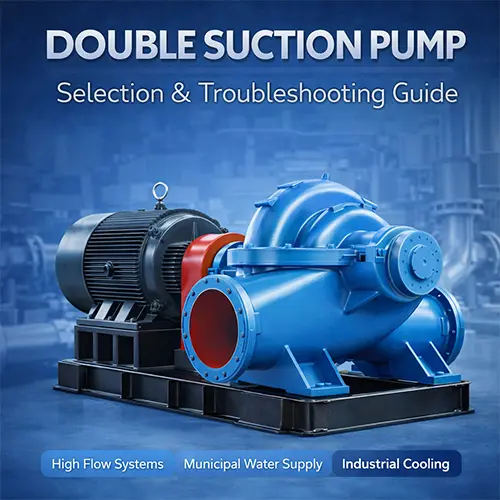
A double suction pump is a centrifugal pump with an impeller that receives liquid from both sides, and that structural arrangement is important because it reduces axial thrust and supports stable high-flow operation. Its practical value is not that it is “more advanced” in a general sense, but that it solves specific hydraulic and mechanical problems better than simpler designs in the right systems.
In practical terms, a double suction pump is most often selected where flow demand is high and operation is expected to be stable and continuous. The pump casing and impeller arrangement allow liquid to enter symmetrically from two sides, which helps balance the hydraulic load acting on the rotor. That balanced loading is one of the key reasons these pumps are used in municipal water supply, industrial cooling circulation, irrigation infrastructure, large HVAC systems, and other services where large volumes of liquid must move continuously without excessive shaft stress.
The mistake many buyers make is treating “double suction” as a universal upgrade label. It is not. A double suction pump is not automatically better than an end suction pump, and it is not automatically the right solution just because flow is relatively high. The value of the design only becomes real when the system benefits from its strengths. If the duty is not actually high-flow, if the system cannot maintain reasonably balanced inlet conditions, or if installation and maintenance constraints are severe, then the additional size and complexity of a double suction centrifugal pump may not create any practical benefit at all.
The better way to understand it is this: a double suction pump is a system-fit machine, not a prestige machine. It is most useful where high flow, reduced axial load, and stable long-duration operation matter enough to justify the design. When those conditions are absent, the pump can still operate, but the customer may end up paying for features the system never truly uses.
How Does a Double Suction Pump Work in Real Systems?
The double suction pump working principle is based on the same centrifugal process as other centrifugal pumps, but its field behavior is strongly influenced by how evenly liquid reaches both sides of the impeller. The design advantage is hydraulic balance, and that advantage can only exist when the system supports it.
The basic principle is simple. Liquid enters the casing from both sides of the impeller, the rotating impeller imparts energy to the liquid, and the casing converts part of that velocity energy into pressure before discharge. In a theoretical sense, the two-sided suction arrangement creates a more hydraulically balanced rotor condition than a single-entry design. This reduces axial thrust and can reduce mechanical stress on bearings and seals when the pump is selected and installed correctly.
That is the theory. In a real system, the pump does not receive “perfectly balanced liquid” just because the impeller has two suction sides. Flow symmetry has to be created by the piping and preserved by the operating conditions. If one side of the suction path has more resistance because of an uneven layout, additional elbows, poor inlet geometry, partial obstruction, or unstable upstream conditions, then the flow entering the impeller becomes uneven. Once that happens, the pump loses part of the very hydraulic balance it was chosen for.
This is why some customers are confused when a new double suction pump still develops vibration or uneven wear. They expected the balanced design to correct the system automatically. It cannot. The pump reduces axial force under balanced hydraulic conditions. It does not eliminate the consequences of poor suction arrangement. In field operation, this distinction is critical because the symptoms of imbalance are often gradual rather than dramatic. Instead of immediate catastrophic failure, the customer sees rising vibration, increasing energy consumption, unexplained seal stress, and an overall sense that the pump is “not running as smoothly as it should.”
The practical lesson is that the double suction pump working principle must always be interpreted together with the system layout. A catalog diagram explains the internal concept. It does not prove that your installation will allow the concept to work properly.
Where Are Double Suction Pumps Used in Real Industrial Applications?
Double suction pump applications are concentrated in high-flow systems where hydraulic stability and continuous operation matter. The design is especially useful when large volumes of relatively clean liquid must be moved efficiently over long operating cycles.
In municipal water supply systems, double suction pumps are often used for raw water intake, treated water transfer, and distribution support because these systems value large flow capacity and stable operation more than compact size. In this environment, the pump’s reduced axial load and smoother rotor behavior are not theoretical advantages. They affect real service life, maintenance intervals, and operational stability. The caution point is that municipal systems sometimes include long suction arrangements, seasonal water level changes, or sediment exposure. When those factors are ignored, the expected benefits of the pump can be reduced by cavitation risk, suction instability, or wear.
In industrial cooling systems, such as those found in power plants, chemical plants, and heavy manufacturing facilities, a double suction centrifugal pump is often selected because the process requires sustained circulation of large water volumes. These systems reward stable long-run behavior, and the pump can perform very well when the process demand remains predictable. The hidden problem is that many industrial cooling systems do not remain truly constant. Load variation, changing valve positions, fouling, and expansion of system resistance over time can shift the pump away from its intended duty point. When that happens, a pump that was correct at commissioning can become less efficient and more mechanically stressed later in service.
In irrigation and flood-control applications, the double suction pump is valued for its ability to move large water volumes in relatively low-to-medium pressure duties. This makes sense hydraulically, but these applications can also include unstable operating schedules, sediment exposure, and seasonal duty variation. A customer who sees only the “high flow” requirement and ignores the variability of the operating pattern may end up with a pump that is hydraulically capable but operationally stressed.
In large HVAC and district cooling systems, double suction pumps are often used where chilled water or condenser water must be circulated reliably at high flow. These systems can benefit from lower vibration and improved stability compared with a smaller single-entry alternative, but only when balancing and piping discipline are good. Where installation space is tight or retrofits force awkward piping geometry, the theoretical advantages may be diluted by the practical limitations of the site.
The key point across all these double suction pump applications is that the design works best where the system itself is organized, stable, and hydraulic in behavior rather than erratic. The pump rewards disciplined systems. It does not rescue undisciplined ones.
What Operating Conditions Are Suitable — and Where Problems Start
A double suction pump performs best under high-flow, medium-head, relatively stable conditions with good suction arrangement and reasonably clean fluid. Problems start when the pump is forced into unstable flow, asymmetric inlet conditions, severe contamination, or operating regions far from its intended efficiency zone.
The ideal operating condition for a double suction pump is a system with high and fairly steady flow demand, moderate head, continuous operation, and a fluid condition that does not create aggressive erosion or severe corrosion beyond the selected materials. Under those conditions, the design’s balanced impeller entry becomes a real mechanical and hydraulic advantage. The pump can run smoothly, bearing load can remain controlled, and the relationship between efficiency and service life can be quite favorable.
The problems begin when customers assume that because the design is mechanically balanced, it is also operationally tolerant. It is not infinitely tolerant. If the pump is run at too low a flow for long periods, internal recirculation and hydraulic instability can develop. If the pump is oversized and operated with heavy throttling or low actual demand, the system can pull the unit away from its best efficiency point. If the suction piping is not arranged in a way that preserves balanced entry conditions, the impeller no longer sees the balanced hydraulic environment it was designed for. If the liquid contains solids or abrasives beyond what the materials and clearances can handle, wear begins to reshape the hydraulic profile of the pump itself.
The table below shows a practical operating-condition view.
| Condition | Generally Suitable | Why It Matters |
| High flow requirement | Yes | This is where the design shows its main hydraulic advantage |
| Medium head requirement | Yes | The pump is comfortable in this region when matched correctly |
| Continuous operation | Yes | Stable operation supports long-term value |
| Clean or lightly contaminated fluid | Usually yes | Wear stays manageable with correct material choice |
| Symmetrical suction layout | Strongly preferred | Preserves the hydraulic balance the design depends on |
| Highly variable flow demand | Higher risk | Pump may spend too much time away from ideal operating zone |
| Frequent start-stop cycles | Higher risk | Mechanical and hydraulic stability decline under repeated disturbance |
| Abrasive slurry-like liquid | Usually no | Wear rate rises sharply unless a different pump design is selected |
| High head duty beyond design range | Usually no | A multistage solution is often more rational |
One practical sentence summarizes the situation well: a double suction pump is stable only when the system is stable enough to let the pump behave like a double suction pump. Once the operating condition becomes erratic, the design advantage becomes easier to lose than many customers expect.
How to Select the Right Double Suction Pump for Your System
A correct double suction pump selection starts with the system, not with the catalog. The buyer should confirm that the application truly needs high-flow hydraulic stability, then verify the duty point, suction behavior, material fit, installation reality, and supplier evidence before making the final decision.
The first question in double suction pump selection is not “Which model should I buy?” It is “Does my system actually benefit from this pump type?” That question sounds obvious, but many expensive purchasing mistakes happen because it is skipped. A double suction pump is usually justified where large flow capacity is a core requirement and where long-run stability matters enough that reduced axial loading and better hydraulic balance provide real ownership value. If the system is moderate in flow or highly constrained in layout, the customer should compare alternatives before assuming this design is optimal.
The second step is duty-point confirmation. A buyer should know the real flow, real head, expected operating range, fluid temperature, and any future system changes that may shift resistance. The objective is not simply to find a pump that can hit the required numbers. The objective is to find a pump that will spend most of its life near a stable and efficient operating region. A pump that looks strong on maximum capacity but lives off its efficiency zone in daily operation is not a good selection.
The third step is suction-side evaluation. This is especially important in double suction pump selection because the design depends on balanced fluid entry. The customer should review suction piping symmetry, upstream conditions, available NPSH, possible air ingress, tank or source level behavior, and any installation features that could bias one side of the inlet condition. A supplier who does not ask about suction conditions is not reducing your risk. They are simply shortening the sales conversation.
The fourth step is material and sealing review. A large water-transfer project may still include chloride exposure, suspended solids, chemical treatment, or temperature changes that alter corrosion and wear behavior. The customer should ask not only what material is standard, but why that material is suitable for this application and what alternatives exist if the fluid description becomes more precise. Good engineering selection is never embarrassed by a material discussion. Weak selection often avoids it.
The fifth step is checking installation and maintenance realism. Double suction pumps are generally larger and more installation-sensitive than smaller end suction units. Foundation rigidity, alignment quality, piping load control, and service access all affect long-term performance. If the project site cannot support disciplined installation, the buyer must take that limitation seriously. A technically strong pump in a weak installation environment often turns into a disappointing asset.
The sixth step is documentation review. A serious supplier should be able to provide performance curves, dimensional information, testing scope, material details, and practical discussion of comparable applications. If the site also contains useful related product information, such as End Suction Pump for moderate-flow applications or Double Suction Pump category details for high-flow systems, the buyer can compare alternatives in a more structured way instead of relying only on model numbers.
Why Do Double Suction Pumps Fail Despite Their Balanced Design?
Double suction pumps do not usually fail because the design is weak. They fail because customers overestimate what the design can forgive. The most common causes are off-BEP operation, suction imbalance, poor installation, material mismatch, and incorrect replacement logic in existing systems.
One major cause of failure is operation away from the best efficiency point. This is not unique to double suction pumps, but customers often assume the balanced design makes the pump more tolerant of poor operating range than it really is. The reality is that hydraulic imbalance still develops when the duty point shifts too far from the intended region. That imbalance may not look identical to what happens in a smaller end suction pump, but the consequences still include vibration, seal stress, bearing load increase, and efficiency loss.
A second cause is suction-side asymmetry. Because the design depends on two-sided entry, uneven upstream resistance matters more than many users realize. One side of the suction environment may effectively feed the impeller differently than the other, which disrupts the hydraulic balance that the pump was purchased for. This issue can be particularly frustrating because the customer may have chosen the pump specifically to reduce mechanical stress, only to recreate stress through poor system geometry.
A third cause is installation error. Larger pumps demand more discipline, not less. Weak foundation support, pipe strain, poor alignment, and careless commissioning can produce symptoms that buyers misread as manufacturing defects. In some cases, the pump is blamed because it is the visible machine in the system. In truth, the surrounding installation created the damage pathway.
A fourth cause is material mismatch. High-flow service does not automatically mean clean-water service. If corrosion, erosion, or solids loading are underestimated, wear can change the internal hydraulic condition of the pump, reducing performance and increasing imbalance over time. Customers often notice this first as “unexpected efficiency drop” rather than visible catastrophic damage.
A fifth cause is using the pump as a direct replacement without redesign. A common mistake is replacing a troubled end suction unit with a double suction pump while leaving the system logic largely unchanged. If the original problem was poor suction conditions, unstable duty, or incorrect hydraulic assumptions, the new pump inherits those same problems. A more expensive design does not erase an incorrect system.
How to Troubleshoot Double Suction Pump Problems Step by Step
Double suction pump troubleshooting should begin with symptoms, but it should not end there. The correct approach is to connect each symptom to hydraulic balance, operating point, suction behavior, installation condition, and material reality before replacing parts.
When the pump shows persistent vibration, the first question should be whether the vibration is continuous or condition-dependent. Continuous vibration often suggests structural or hydraulic imbalance that is present throughout operation. Condition-dependent vibration often points toward a duty-point shift, suction instability, or changing system resistance. This distinction matters because it guides the investigation. If the vibration changes with flow or valve position, the pump may be telling you more about the system than about itself.
The second check is suction-side balance. Because a double suction pump depends on balanced entry, the customer should inspect whether piping geometry, upstream obstruction, or source conditions may be favoring one side of the impeller. This is not always visible at a glance. A system can look physically symmetrical and still behave asymmetrically if one path has more hidden resistance or unstable inlet behavior.
The third check is the operating point. A pump that is too far from its best efficiency region often shows rising vibration, temperature increase, unstable power draw, and declining performance. Customers frequently replace bearings or seals before checking the duty point, which treats the damage but not the cause. In many cases, the pump curve and actual system curve need to be reviewed together to understand what changed.
The fourth check is cavitation risk. Double suction pumps can experience cavitation too, and the warning signs may be more subtle than users expect. Instead of dramatic noise alone, the customer may notice reduced capacity, rising vibration, localized damage, or unexplained performance instability. This is why NPSH conditions must be reviewed instead of assumed.
The fifth check is wear and material condition. If performance has gradually declined over time, especially in water that is not perfectly clean, internal wear may be affecting the hydraulic shape of the pump. That changes the system behavior and can produce a chain reaction of efficiency loss and mechanical stress.
The troubleshooting table below is designed so a buyer or engineer can follow it practically.
| Observed Problem | What to Check First | What the Result Usually Means | What to Do Next |
| Continuous vibration | Foundation, alignment, suction symmetry | Mechanical or hydraulic imbalance is persistent | Inspect installation rigidity, piping load, and inlet balance |
| Vibration changes with flow | Duty point and system resistance | Pump may be operating away from BEP | Compare pump curve with actual operating conditions |
| Capacity lower than expected | Valve positions, suction stability, internal wear | Flow path or hydraulic condition has changed | Verify system resistance and inspect impeller/casing condition |
| Rising power consumption | Operating point, wear, imbalance | Pump is working harder than intended | Reassess duty point and inspect hydraulic condition |
| Seal life is short | Shaft movement, vibration, alignment | Seal failure is likely a symptom, not the root cause | Correct vibration and operating issues before replacing seal again |
| Uneven wear pattern | Inlet imbalance or solids exposure | Hydraulic entry is not balanced or liquid is more aggressive than assumed | Review piping symmetry and material suitability |
| Noise with unstable performance | Cavitation or air ingress | Suction-side condition is unsafe | Review NPSH, suction piping, and upstream source behavior |
A useful rule in double suction pump troubleshooting is this: if the same component fails repeatedly, stop asking what part to replace and start asking what operating condition is destroying that part.
Common Failure Scenarios Buyers Often Misjudge
Many customers misread system problems as pump quality problems. That misunderstanding leads to poor decisions, unnecessary replacement, and repeated failure. The value of experience in pump selection is often the ability to tell the difference between a bad pump and a bad application.
One common misjudgment is assuming that vibration always means poor manufacturing quality. Sometimes quality is the issue, but very often vibration in a double suction pump points toward hydraulic imbalance, alignment problems, pipe strain, or off-BEP operation. If the customer responds only by switching brands, the next pump may fail in the same way because the system remains unchanged.
Another misjudgment is thinking that a larger pump is automatically safer. In reality, oversizing often pushes the pump into poor operating behavior when actual demand is lower than anticipated. The result can be reduced efficiency, unstable hydraulic loading, and more throttle-related losses. A pump that is too large for the real duty is not safer. It is often less rational.
A third misjudgment is assuming that a double suction pump is always superior to an end suction pump. It is superior only when the application truly benefits from high-flow hydraulic balance. In smaller or more layout-constrained systems, a well-selected end suction pump may be easier to install, easier to maintain, and more economical over the long term. This is why pump type should always be chosen by application fit, not by prestige logic.
A fourth misjudgment is replacing an existing pump without rechecking the system. Buyers sometimes inherit a problem pump and conclude that the answer is a more robust design. That can work if the previous pump was clearly under-matched, but it fails when the root cause was unstable suction, incorrect flow assumptions, or poor installation practice. In those situations, the system simply teaches the new pump the same bad lesson.
When Is a Double Suction Pump Not the Best Choice?
A double suction pump is not the best choice when the system does not actually require high-flow balance, when head demand is better served by another design, when the fluid is too abrasive, or when installation conditions are too constrained to preserve the pump’s core advantage.
If the required flow is moderate rather than high, a double suction pump may add cost and installation complexity without adding meaningful performance value. The customer may pay more for a design feature the system never fully uses.
If the application requires high head rather than high flow, a Multistage Pump is often the more rational hydraulic choice. This is not a matter of which design is “better” overall. It is a matter of which design is better for the pressure profile of the system.
If the liquid contains enough abrasive solids to reshape wear patterns quickly, then a pump selected mainly for balanced high-flow water service may not be appropriate. In that case, the customer should compare other pump categories rather than trying to force the double suction design into a fluid condition it was not intended to survive economically.
If the installation environment is tight, irregular, or likely to produce pipe strain and inlet asymmetry, then the design advantage can be undermined before the pump even starts operation. A simpler and smaller design may produce better real-world reliability if the site cannot support the larger pump properly.
This is why experienced buyers evaluate not only what the pump can do, but what the project can support. The best pump on paper is not the best pump if the site conditions make correct operation unlikely.
FAQ About Double Suction Pumps
Before choosing a double suction pump, most buyers do not have just one technical question. They usually have a cluster of concerns involving flow demand, installation risk, operating stability, replacement logic, and long-term cost. That is normal, because a double suction pump is usually considered in larger systems where mistakes are expensive and where the cost of being “almost correct” can still be very high. The questions below are designed to answer the practical concerns that usually determine whether a buyer feels confident enough to move forward.
What is the difference between a double suction pump and an end suction pump?
A double suction pump takes liquid into the impeller from both sides, while an end suction pump feeds the impeller from one side only. The practical effect is that a double suction pump can reduce axial thrust and handle high-flow service more effectively when the system supports balanced inlet conditions. An end suction pump is often simpler, smaller, and more practical for moderate-flow duties. The choice between them should not be based on which one sounds stronger. It should be based on whether the system really benefits from high-flow hydraulic balance.
When should I choose a double suction pump instead of an end suction pump?
A double suction pump should be considered when the flow demand is high, the operation is expected to be continuous and stable, and the system layout can support good suction behavior. It becomes especially attractive when axial load reduction and long-run smoothness create real value. If the application is moderate in flow, highly variable, or space-constrained, an end suction pump may remain the more rational option.
Is a double suction pump always more efficient?
Not always. It can be highly efficient in the duty range it was selected for, especially in high-flow systems, but efficiency still depends on where the pump operates on its curve and how well the system matches the selection assumptions. A badly selected double suction pump can be less economical than a well-selected simpler pump.
Can a double suction pump eliminate cavitation?
No. The design does not cancel cavitation risk. If suction conditions are poor, NPSH is inadequate, or air ingress exists, cavitation can still occur. In fact, some customers overlook cavitation risk because they assume the balanced design will be more forgiving than it actually is. Good suction design is still essential.
What is the biggest installation mistake with a double suction pump?
One of the biggest mistakes is failing to preserve good suction-side conditions, especially inlet symmetry and pipe-strain control. Another is assuming that because the pump is mechanically robust, installation discipline can be relaxed. Larger pumps usually punish weak installation more severely, not less severely.
Can I directly replace an end suction pump with a double suction pump?
Sometimes, but not safely by assumption alone. The system needs to be re-evaluated. If the original problem was poor suction conditions, unstable duty, or wrong hydraulic assumptions, replacing the pump alone may not solve anything. A more expensive design does not automatically correct a bad system.
What documents should I request from a supplier?
You should request performance curves, dimensional drawings, material details, testing information, and any practical evidence that the supplier understands comparable applications. If the supplier can explain why this double suction pump is correct for your duty instead of simply offering a model, that is a positive sign.
What kind of fluid is suitable for a double suction pump?
The design is usually most comfortable in clean or lightly contaminated water-like service, depending on materials and clearances. Once solids, corrosion risk, or severe erosion become more important, the suitability must be reviewed carefully. A vague fluid description is one of the most common reasons for poor pump selection.
Why is my double suction pump vibrating even though it is new?
A new pump can vibrate because of poor alignment, pipe strain, foundation weakness, inlet asymmetry, unstable duty point, or cavitation exposure. Newness does not protect the pump from system mistakes. In many cases, early vibration is actually a strong warning that the installation or operating condition needs attention immediately.
How do I know whether the pump is oversized?
If the pump spends most of its time throttled back, runs far from the expected duty point, shows unstable low-flow behavior, or consumes more energy than expected for the actual process demand, oversizing should be investigated. Oversizing is not harmless. It often shifts the pump into a less stable region of operation.
Conclusion
A double suction pump is a highly practical industrial solution when the application truly requires high-flow stability and when the system is disciplined enough to support the design properly. Its balanced impeller entry, reduced axial thrust, and suitability for continuous operation can create real long-term value, but only when the pump is selected, installed, and operated as part of a hydraulic system rather than as an isolated machine.
Most disappointment with double suction pumps does not come from the basic design. It comes from poor fit. The pump is oversized, used in the wrong service, installed into an imbalanced suction environment, expected to solve a system problem by itself, or purchased with too little attention to testing, materials, and operating range. Once those mistakes are removed, the design becomes much easier to appreciate for what it actually is: not a prestige upgrade, but a strong technical solution for the right flow regime.
For buyers, the safest path is to evaluate the application honestly. Confirm whether the system really needs this pump type, verify the real duty point, check suction behavior, review materials against the fluid, and ask whether the installation environment can preserve the pump’s intended hydraulic balance. When those answers align, a double suction pump can be one of the most reliable and economical choices for large-flow industrial service.
Get A Quote

Get A Quote
0 Comments