
Solar Pump vs Diesel Pump: Which Is Better for Irrigation, Remote Water Supply, and Industrial Pumping?
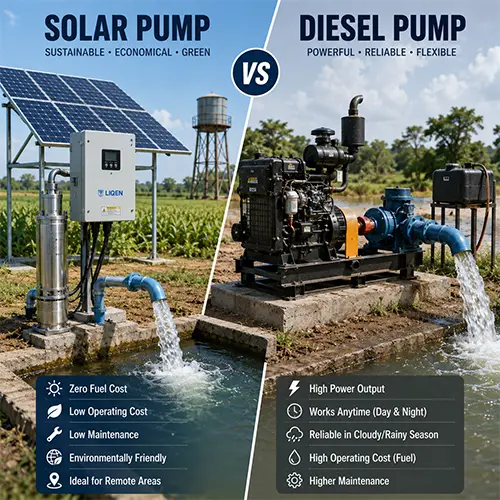
Solar pump vs diesel pump selection should be based on daily water demand, total dynamic head, sunlight availability, fuel logistics, maintenance capacity, backup requirements, and lifecycle cost. A solar pump is usually better for long-term daytime pumping in remote areas where sunlight is stable and diesel delivery is expensive. A diesel pump is usually better for emergency pumping, mobile sites, night operation, cloudy-season reliability, high-flow projects, or short-term work where immediate power output matters more than long-term fuel savings.
For buyers, farmers, contractors, distributors, and project engineers, the decision should not start with “Which pump is cheaper?” It should start with a more practical question: Which system can deliver the required water volume reliably under real site conditions at the lowest practical lifecycle cost?
A solar pump may reduce fuel cost, noise, and engine maintenance, but it can fail to meet demand if sunlight hours, seasonal weather, pump head, or water storage are miscalculated. A diesel pump may offer strong and immediate output, but it can become expensive if fuel delivery, engine maintenance, oil changes, filter replacement, and downtime are ignored.
This guide explains how to compare a solar pump and a diesel pump from a practical buyer’s perspective. It is written for irrigation, remote water supply, livestock watering, construction dewatering, industrial utility water, fish pond water exchange, and off-grid pumping projects.
Quick Decision Summary for Buyers
A solar pump is better for long-term, daytime, predictable water supply where sunlight is available and fuel logistics are expensive. A diesel pump is better for emergency, mobile, high-power, night, or cloudy-season pumping where guaranteed output is more important than low daily operating cost.
This is the fastest first-level decision rule. If your project can pump water during the day and store water in a tank, solar pumping can be a strong long-term solution. If your project must pump at night, move frequently, respond to emergencies, or deliver high flow immediately, a diesel pump is usually safer.
| Project Condition | Better Choice | Why It Matters |
|---|---|---|
| Remote site with expensive fuel delivery | Solar pump | Reduces fuel logistics and long-term operating cost |
| Daytime irrigation | Solar pump | Sunlight production often matches irrigation schedule |
| Long-term predictable water demand | Solar pump | Higher upfront cost may be recovered through fuel savings |
| Low noise or low-emission requirement | Solar pump | No diesel engine noise or exhaust during operation |
| Night pumping required | Diesel pump or solar with backup/storage | Solar alone cannot pump without sunlight |
| Emergency dewatering | Diesel pump | Can start quickly and run on demand |
| Mobile construction site | Diesel pump | Easier to move and redeploy |
| High flow or high head | Diesel pump or engineered solar system | Diesel is often simpler for large power demand |
| Cloudy or rainy season reliability | Diesel pump or hybrid system | Solar output drops when radiation is low |
| Short-term project | Diesel pump | Lower upfront cost may be more practical |
The safest decision is not always the most modern system. Solar is not automatically better because it uses renewable energy, and diesel is not automatically better because it has strong output. The correct choice depends on whether the pump can meet the required water volume when the customer actually needs water.
Scope of This Guide: Applicable Pump Types and Operating Conditions
This guide applies mainly to clean water pumping, irrigation, remote water supply, livestock water supply, temporary dewatering, and general water transfer systems. It focuses on the energy source and pumping configuration rather than every special pump application.
This comparison is especially useful for:
- Agricultural irrigation
- Drip irrigation and sprinkler irrigation
- Livestock and ranch water supply
- Remote village water supply
- Groundwater pumping
- River or reservoir water transfer
- Fish pond water replacement
- Construction site water transfer
- Temporary dewatering
- Off-grid water pumping
- Industrial utility water supply
This guide is most relevant when the liquid is clean water or slightly sandy water that can be handled by the selected pump type. It does not directly apply to all sewage, slurry, chemical, corrosive, high-temperature, fire protection, or oil and gas pumping systems. Those applications require different material selection, safety standards, sealing designs, and control logic.
If the buyer is still comparing pump structures and hydraulic ranges, this end suction vs inline vs multistage pump guide can help clarify which pump type fits the required flow, head, and installation layout before deciding between solar and diesel power.
For fire pump systems, local fire codes and approved fire pump standards should control the final decision. For sewage or slurry applications, solids handling, impeller type, abrasion resistance, and clogging risk must be checked before discussing energy source.
What Is a Solar Pump?
A solar pump is a water pumping system powered by electricity generated from solar panels. It usually includes PV panels, a solar pump controller, an electric motor, a pump, cables, protection devices, and sometimes a water tank or battery.
PV panels (Photovoltaic panels, solar panels that convert sunlight into electricity) generate DC power when sunlight reaches the panel surface. The controller manages the power and sends it to the pump motor. The motor then drives the pump to move water from a well, river, reservoir, tank, or other water source.
A solar pump is not only a pump. It is a complete energy-and-water system. If the solar panel capacity is too small, if the controller is poor, if cable voltage drop is too high, or if the pump head is underestimated, the system may produce less water than expected.
How a Solar Pump Works
A solar pump works by converting sunlight into electrical power and using that power to drive an electric pump. The stronger the sunlight, the more power the solar array can produce, and the more stable the pump output can be.
A typical solar pumping system includes:
- PV panels (Photovoltaic panels)
- Solar pump controller
- Pump motor
- Pump end
- Cables
- Mounting structure
- Water level sensor
- Tank level sensor
- Optional battery or backup power
- Optional water storage tank
MPPT (Maximum Power Point Tracking, a controller function that helps solar panels operate closer to their best power output) is important because sunlight changes throughout the day. Morning, noon, afternoon, clouds, dust, and panel temperature all affect panel output. A good MPPT controller helps improve energy use under changing sunlight.
Solar pumps usually perform best when the project can pump during daylight and store water for later use. For many water supply projects, storing water in a tank is more practical than storing electricity in batteries. A water tank is often cheaper, simpler, and more durable than a large battery bank.
Main Components of a Solar Pumping System
Solar pump reliability depends on the full system, not only on the pump model. Buyers should compare solar panels, controller quality, cable sizing, protection functions, pump material, and storage strategy before approving a quotation.
| Component | Function | Buyer Checkpoint |
|---|---|---|
| Solar panels | Generate electricity from sunlight | Wattage, panel quality, warranty, mounting angle |
| Solar pump controller | Controls power input and pump operation | MPPT, dry-run protection, overload protection |
| Pump | Moves water from source to discharge point | Flow, head, pump type, material |
| Motor | Converts electrical power into mechanical rotation | DC/AC design, efficiency, protection |
| Cables | Connect panels, controller, and pump | Cable size, voltage drop, UV resistance |
| Mounting structure | Supports solar panels | Wind resistance, corrosion resistance, angle |
| Water tank | Stores pumped water | Often better than battery storage for water supply |
| Sensors | Protect pump and control water level | Dry-run, tank overflow, low-water protection |
| Battery | Stores electricity if required | Expensive and must be sized carefully |
A solar pump quotation that only lists pump power is incomplete. The buyer should ask how much water the system can deliver per day under local sunlight conditions, especially during the worst month of the year.
What Is a Diesel Pump?
A diesel pump is a water pump driven by a diesel engine. It is widely used where strong power output, mobility, fast deployment, emergency operation, or pumping independent of sunlight is required.
A diesel pump can be fixed, skid-mounted, trailer-mounted, or portable. It uses a diesel engine to provide mechanical power to the pump shaft. As long as fuel, engine oil, cooling, and maintenance are available, a diesel pump can run during the day, at night, in cloudy weather, or in emergencies.
How a Diesel Pump Works
A diesel pump works by burning diesel fuel in an engine and converting that energy into mechanical power for the pump. The engine drives the pump through the flywheel side coupling. In a correct diesel pump package, the water pump should be mounted behind the diesel engine flywheel, with the coupling aligned between the engine flywheel end and the pump shaft.
A typical diesel pump system includes:
- Diesel engine
- Pump end mounted at the flywheel side
- Coupling and coupling guard
- Base frame or trailer
- Fuel tank
- Radiator or cooling system
- Exhaust system
- Battery for starting
- Control panel
- Filters
- Safety guards
A diesel pump is easier to deploy for temporary or urgent work because it does not require solar panels, panel mounting, long cabling, or solar radiation calculation. However, diesel reliability depends on fuel supply, fuel quality, engine servicing, cooling, lubrication, and operator skill.
Main Components of a Diesel Pump System
Diesel pump reliability depends on both the pump and the engine package. A good pump end cannot compensate for a weak engine, poor cooling, bad fuel, poor coupling alignment, or poor maintenance.
| Component | Function | Buyer Checkpoint |
|---|---|---|
| Diesel engine | Provides mechanical power | Brand, fuel consumption, spare parts |
| Pump end | Moves water | Mounted behind the engine flywheel, correct flow/head/material |
| Coupling | Transfers engine power to pump | Alignment, guard, durability |
| Fuel tank | Stores diesel | Capacity, runtime, safety |
| Cooling system | Prevents overheating | Radiator, fan, coolant condition |
| Control panel | Starts, stops, and protects engine | Alarms, gauges, auto-start option |
| Base frame/skid | Supports the pump set | Strength, vibration control |
| Exhaust system | Discharges exhaust gas | Noise, safety, ventilation |
| Filters | Protect engine | Air, fuel, oil filter availability |
A diesel pump quotation should state fuel consumption, engine brand, pump curve, maintenance schedule, fuel tank capacity, noise control, coupling arrangement, and spare parts availability. Without these details, the buyer cannot accurately compare lifecycle cost.
Solar Pump vs Diesel Pump: Core Differences Buyers Should Compare
The real difference between a solar pump and a diesel pump is not only the energy source. Buyers should compare power availability, water demand timing, operating cost, maintenance, mobility, reliability, emissions, noise, and project duration.
| Comparison Point | Solar Pump | Diesel Pump | Buyer Decision Meaning |
|---|---|---|---|
| Energy source | Sunlight | Diesel fuel | Determines operating cost and logistics |
| Initial cost | Often higher | Often lower | Diesel may be cheaper upfront |
| Operating cost | Very low after installation | Continuous fuel and service cost | Solar is better for long-term use |
| Output stability | Depends on sunlight and sizing | Stable if fuel and engine are maintained | Diesel is better for guaranteed output |
| Night operation | Needs battery, grid, diesel backup, or water storage | Easy | Diesel is better for night pumping |
| Maintenance | Lower mechanical maintenance | Higher engine maintenance | Diesel needs oil, filters, fuel system care |
| Mobility | Lower unless designed as mobile | High | Diesel is better for temporary sites |
| Noise | Low | High | Solar is better near people or livestock |
| Emissions | No on-site exhaust during operation | Exhaust emissions | Solar is better for low-emission projects |
| Best-fit scenario | Long-term remote daytime water supply | Emergency, mobile, high-power pumping | Selection depends on duty and reliability need |
The buyer should not ask only, “Which pump has higher flow?” The better question is: Can this system deliver the required daily water volume when the project actually needs it? That question includes sunlight, fuel, pump head, storage, maintenance, and backup.
Demand Profile: Daily Water Volume, Flow Rate, and Operating Hours
Solar pump vs diesel pump selection should start with water demand, not pump power. A pump that looks powerful on paper may still fail if it cannot deliver the required water volume within the available operating hours.
The buyer should separate three basic values:
| Requirement | Meaning | Why It Matters |
|---|---|---|
| Daily water volume | Total water needed per day | Determines whether solar daylight pumping can meet demand |
| Flow rate | Water delivered per hour or second | Determines pump model and pipe size |
| Operating hours | Number of hours the pump must run | Affects solar sizing and diesel fuel cost |
| Required pressure | Pressure needed at outlet or irrigation system | Adds to total dynamic head |
| Seasonal demand | Demand difference across seasons | Prevents rainy-season or dry-season failure |
For example, an irrigation project may need 300 m³/day. If the site has enough usable sunlight for 6 pumping hours, the pump must deliver about 50 m³/h during those hours, before considering losses and safety margin. If the same 300 m³/day can be pumped over 12 diesel operating hours, the required hourly flow may be lower. This difference changes pump size, pipe size, energy demand, and cost.
Why Solar Pump Projects Must Check Daily Water Volume
Solar pump projects must check daily water volume because sunlight limits the practical pumping window. A solar pump may not need fuel, but it cannot create power when sunlight is unavailable.
If the pump must deliver all water during daylight, the system must be sized for the available sun hours. If the buyer underestimates water demand or overestimates sunlight, the project may run short of water even when all equipment works correctly.
The most practical approach is:
- Confirm daily water demand.
- Confirm usable sunlight hours.
- Confirm total dynamic head.
- Select the pump flow needed during sunlight hours.
- Size solar panels for the pump and controller.
- Add water storage or backup if demand continues after sunset.
Why Diesel Pump Projects Must Check Operating Hours
Diesel pump projects must check operating hours because fuel cost increases every hour the engine runs. A diesel pump may be cheaper upfront, but daily fuel consumption can become the dominant cost over time.
A simple diesel cost estimate should include:
- Fuel consumption per hour
- Running hours per day
- Fuel price
- Fuel transport cost
- Engine oil
- Filters
- Maintenance labor
- Spare parts
- Downtime risk
A diesel pump used a few hours per month for emergency drainage may be economical. The same diesel pump running every day for irrigation or village water supply may become expensive because fuel and maintenance costs accumulate continuously.
Total Dynamic Head: The Calculation Buyers Cannot Ignore
Total Dynamic Head (TDH, total pressure requirement the pump must overcome) is one of the most important values for both solar pumps and diesel pumps. A pump may fail to deliver enough water if TDH is underestimated.
TDH usually includes:
- Static lift
- Friction loss
- Outlet pressure requirement
- Pipe fittings and valve losses
- Water level variation
- Safety margin
Static lift means the vertical height difference between the water source and the discharge point. Friction loss means pressure loss caused by water moving through pipes, valves, elbows, filters, and fittings. Outlet pressure requirement means the pressure needed at the final discharge point, sprinkler, drip irrigation system, tank inlet, or process equipment.
Why TDH Matters More for Solar Pumps
TDH matters strongly for solar pumps because higher head increases power demand and reduces flow if the solar array is undersized. A solar pump selected for 30 meters of head may not perform correctly if the real TDH is 55 meters after pipe loss and water level drop.
Buyers should pay special attention to:
- Deep well dynamic water level
- Long pipe distance
- Small pipe diameter
- Elevation difference
- Filters in irrigation systems
- Required pressure for sprinklers or drip irrigation
- Seasonal water source variation
If the head is wrong, adding more solar panels may not fully solve the issue if the pump itself is not suitable for that duty point.
Why TDH Matters for Diesel Pumps
TDH matters for diesel pumps because underestimating head can cause low flow, overload, high fuel use, or poor engine performance. Diesel engines can provide strong power, but the pump still must match the real hydraulic condition.
If the pump is forced to operate far from its proper duty range, the system may experience:
- Lower flow than expected
- Higher fuel consumption
- Engine overload
- Pump vibration
- Seal wear
- Bearing stress
- Cavitation risk
Cavitation (vapor bubble formation and collapse inside the pump due to insufficient suction pressure) can damage the impeller and reduce pump performance. It is not solved by simply using a stronger engine; suction conditions and pump selection must be corrected.
Which Applications Are Better for Solar Pumps?
Solar pumps are better when the project has enough sunlight, predictable water demand, long-term operation, and high fuel delivery cost. They are especially useful when water can be stored during the day for later use.
Daytime Irrigation Systems
Solar pumps are often suitable for daytime irrigation because irrigation demand can often be scheduled during sunlight hours. This makes solar energy and water demand naturally compatible in many agricultural projects.
Solar pumps are commonly used for:
- Drip irrigation
- Orchard irrigation
- Greenhouse water supply
- Field irrigation
- Livestock water points
- Smallholder farms
- Remote agricultural land
- Water tank filling for irrigation
Solar pumping becomes stronger when the farm can use a storage tank, reservoir, or elevated tank. Instead of storing electricity in batteries, the system pumps water when sunlight is available and stores water for evening or early morning use.
When pressure control is part of the irrigation or supply project, this VFD pump vs fixed speed pump guide can help buyers evaluate whether variable speed control is useful for energy saving and pressure stability.
Remote Water Supply Projects
Solar pumps are often better for remote water supply when diesel delivery is expensive, unreliable, or risky. In remote areas, fuel logistics can become more difficult than pump installation.
Typical remote applications include:
- Village water supply
- Ranch water supply
- Livestock watering
- Mountain water transfer
- Off-grid water points
- Remote groundwater pumping
- Rural drinking water projects
Solar pumps reduce dependence on regular fuel delivery. This is valuable when roads are poor, fuel theft is a concern, fuel cost is unstable, or operators cannot visit the site frequently.
However, remote does not automatically mean solar is enough. The buyer still needs to check sunlight, daily demand, water source depth, storage volume, and backup plan.
Long-Term Low-Maintenance Water Supply
Solar pumps are often better for long-term fixed installations where low mechanical maintenance is important. Solar systems do not have diesel engines, fuel injectors, oil filters, exhaust systems, radiators, or engine belts.
This can reduce maintenance related to:
- Engine oil
- Fuel filters
- Air filters
- Injectors
- Cooling systems
- Starting batteries
- Exhaust systems
- Fuel contamination
Solar systems still need maintenance. Panels must be cleaned, cables inspected, controllers protected from heat and water, grounding checked, and pump dry-run protection tested. But compared with diesel engines, the mechanical service burden is often lower.
Which Applications Are Better for Diesel Pumps?
Diesel pumps are better when the project needs immediate output, high power, mobility, emergency operation, night pumping, or reliable pumping during cloudy weather. They are practical when flexibility and guaranteed power are more important than low daily energy cost.
Emergency Dewatering and Flood Control
Diesel pumps are usually better for emergency dewatering because they can be transported, started quickly, and operated whenever fuel is available. Solar pumps are usually not the first choice for urgent drainage because panel setup and sunlight dependence limit response speed.
Diesel pumps are often used for:
- Flood control
- Construction site drainage
- Mine temporary dewatering
- Emergency water removal
- Stormwater pumping
- Temporary bypass pumping
- Nighttime drainage
Emergency pumping requires immediate capacity. If water must be removed now, waiting for sunlight or installing a solar array is usually not practical.
High-Flow or High-Head Pumping
Diesel pumps are often easier to apply for high-flow or high-head pumping because the engine can provide strong power in a compact, mobile package. Solar can also be engineered for large projects, but the solar array, wiring, controller, mounting structure, and land area become much larger.
Diesel pumps are commonly used for:
- Large-volume water transfer
- High-head pumping
- Long-distance water transfer
- Large-diameter pumps
- Temporary irrigation
- Mine water handling
- Heavy-duty construction pumping
If the required power is high and the project duration is short, diesel often makes more economic sense. For long-term high-power applications, solar or hybrid may still be worth evaluating, but the engineering must be done carefully.
Mobile and Temporary Pumping Sites
Diesel pumps are better for mobile and temporary sites because they are easier to move and redeploy. A diesel pump can be mounted on a skid or trailer and moved from one site to another.
This matters for:
- Construction contractors
- Rental pump fleets
- Temporary irrigation
- Emergency response teams
- Road and infrastructure projects
- Mining support work
- Seasonal water transfer
Solar systems can be made mobile, but panels, mounting frames, cables, and site setup make relocation more complex. For frequent movement, diesel is usually more convenient.
When NOT to Choose a Solar Pump
A solar pump is not always the better option. If the site has poor sunlight, urgent pumping needs, high night demand, or very high power demand without backup, solar alone may create reliability problems.
Do Not Choose a Solar Pump If Night Operation Is Required Without Backup
A solar pump should not be selected as a standalone solution when night pumping is required. Solar panels do not generate power after sunset.
For night operation, the buyer needs one of these solutions:
- Water storage tank
- Battery storage
- Grid backup
- Diesel backup
- Hybrid solar-diesel system
For many water projects, a storage tank is more economical than batteries. Pumping water during the day and using stored water at night can reduce battery cost and system complexity. Batteries may still be useful in some applications, but they must be sized carefully and replaced over time.
Do Not Choose a Solar Pump If Daily Water Demand Exceeds Solar Production
A solar pump should not be selected if the required daily water volume cannot be delivered during usable sunlight hours. This problem often appears when buyers size the system based on sunny-season assumptions only.
The buyer should check:
- Worst-month solar radiation
- Rainy season duration
- Cloudy days
- Dust on panels
- Water source depth
- Total dynamic head
- Required daily water volume
- Storage capacity
- Backup requirement
If the system cannot meet demand during the worst season, the buyer should increase panel capacity, improve storage, reduce demand, select a different pump, or add backup.
Do Not Choose a Solar Pump If the Project Is Very Short-Term
A solar pump may not be economical for very short-term projects because the upfront investment may not be recovered through fuel savings. Solar systems often need panels, mounting structures, controllers, cables, installation work, and site planning.
Diesel may be more practical for:
- A few weeks of construction drainage
- Temporary bypass pumping
- Emergency water removal
- Short-term irrigation rental
- Uncertain project locations
- One-time pumping tasks
Solar becomes more attractive when the project runs long enough for fuel savings to offset the initial investment.
When NOT to Choose a Diesel Pump
A diesel pump is not always the better option. If the project is long-term, fuel logistics are difficult, noise is sensitive, or operating cost matters more than initial cost, diesel can become expensive and difficult to manage.
Do Not Choose a Diesel Pump If Fuel Delivery Is Expensive or Unreliable
A diesel pump should not be the first choice when fuel delivery is the main operating bottleneck. In remote sites, the cost of transporting fuel can be higher than expected.
Fuel-related risks include:
- High transport cost
- Fuel shortage
- Fuel theft
- Fuel contamination
- Price volatility
- Road access problems
- Operator dependency
- Storage safety issues
For long-term remote water supply, solar pumping may reduce these risks significantly.
Do Not Choose a Diesel Pump If Noise or Emissions Are Sensitive
A diesel pump may not be suitable where noise, exhaust, or fuel handling creates complaints or compliance issues. Diesel engines generate noise and emissions during operation.
This can be a problem near:
- Villages
- Schools
- Hospitals
- Resorts
- Livestock areas
- Residential zones
- Indoor facilities
- Environmentally sensitive projects
Diesel pumps may require silencers, acoustic enclosures, exhaust routing, ventilation, fuel containment, and spill prevention. These extra measures increase cost and complexity.
Do Not Choose a Diesel Pump If Maintenance Support Is Weak
A diesel pump should not be selected if the site cannot maintain the engine properly. Diesel engines need regular maintenance to remain reliable.
Maintenance includes:
- Engine oil changes
- Fuel filter replacement
- Air filter cleaning
- Oil filter replacement
- Coolant checks
- Radiator cleaning
- Battery checks
- Belt inspection
- Fuel system care
- Periodic test runs
A poorly maintained diesel pump may fail when it is needed most. This is especially dangerous for emergency, flood control, and critical water supply projects.
Solar Pump vs Diesel Pump Cost Comparison
Solar pumps usually have higher initial cost but lower operating cost, while diesel pumps usually have lower initial cost but higher fuel and maintenance cost. Buyers should compare lifecycle cost, not only purchase price.
Initial Cost
Initial cost often favors diesel pumps, especially for small or temporary systems. Solar systems require extra energy equipment that diesel pumps do not need.
| Cost Item | Solar Pump | Diesel Pump |
|---|---|---|
| Pump unit | Medium to high | Medium |
| Energy equipment | Solar panels, controller, cables | Diesel engine and fuel tank |
| Installation | Panel mounting and electrical setup | Mechanical setup and fuel safety |
| Civil works | Panel structure, water tank if needed | Base, fuel storage, ventilation if needed |
| Initial cost | Often higher | Often lower |
| Setup complexity | Higher electrical and solar design | Higher engine and fuel safety care |
However, initial cost can be misleading. A solar pump may cost more to install but less to operate. A diesel pump may be cheaper to buy but expensive to run every day.
Operating Cost
Operating cost often favors solar pumps in long-term projects because sunlight does not require daily fuel purchase. After installation, the energy cost of solar pumping is very low.
Diesel operating cost includes:
- Diesel fuel
- Fuel transport
- Engine oil
- Filters
- Coolant
- Battery replacement
- Engine maintenance
- Operator labor
- Noise and emission control
- Spare parts
A simple diesel operating cost model is:
Daily fuel cost = fuel consumption per hour × operating hours per day × delivered fuel price
Then the buyer should add maintenance and transport costs. In remote areas, delivered fuel price can be much higher than the market fuel price because of logistics.
Payback Period
Solar pump payback depends on daily operating hours, diesel price, fuel transport cost, solar radiation, pump size, and project duration. Solar becomes more attractive when the pump operates frequently and the project lasts for years.
Solar payback is usually better when:
- The pump runs daily
- Fuel delivery is expensive
- Sunlight is strong
- Water demand is predictable
- Maintenance staff are limited
- The system can use water storage
- The project is long-term
Diesel remains practical when:
- The project is short-term
- Pumping is occasional
- Emergency response is required
- Power demand is very high
- Mobility is important
- Fuel is easy to access
The buyer should not ask only, “Which pump is cheaper?” The better question is: Which option has the lower cost per cubic meter of water delivered over the project life?
Reliability Comparison: Sunlight Risk vs Fuel Risk
Reliability is not simply “solar is unreliable” or “diesel is reliable.” Solar reliability depends on sunlight, system sizing, controller quality, and water storage. Diesel reliability depends on fuel, engine condition, maintenance, and operator availability.
Solar Pump Reliability Risks
Solar pump reliability depends on correct sizing and realistic sunlight assumptions. If the system is designed only for ideal sunny conditions, it may fail during cloudy or rainy periods.
Solar risks include:
- Cloudy-day output reduction
- Rainy-season undersupply
- Dust on panels
- Shading from trees or buildings
- Controller failure
- Cable voltage drop
- Lightning or grounding problems
- Pump dry running
- Water source level drop
- No storage for night demand
Dry running (pump operation without enough water) can damage the pump. Solar pumping systems should include water level protection when pumping from wells, tanks, rivers, or reservoirs with variable water levels.
Diesel Pump Reliability Risks
Diesel pump reliability depends on fuel quality, engine service, cooling, lubrication, and operator discipline. A diesel pump can run anytime in theory, but only if it is maintained and fueled.
Diesel risks include:
- Fuel shortage
- Poor fuel quality
- Clogged fuel filters
- Engine overheating
- Low engine oil
- Dirty air filter
- Battery failure
- Radiator blockage
- Exhaust restriction
- Long low-load operation
- Operator error
Long low-load operation can cause carbon buildup and poor combustion in diesel engines. A diesel pump should be selected and operated within a suitable load range.
Hybrid Option: Solar Pump with Diesel Backup
A hybrid system can be the best solution when normal demand is predictable but supply cannot stop during bad weather or night demand. In this configuration, solar handles normal daytime pumping, while diesel provides backup during cloudy days, peak demand, or emergency conditions.
Hybrid is worth considering when:
- The site is remote
- Fuel is expensive but still available
- Water supply cannot stop
- Rainy-season solar output is uncertain
- Night pumping may be required
- Daily demand changes seasonally
- Backup is required for risk control
Hybrid does not mean the system must be complex. In many projects, the practical design is simple: solar pumps water during the day into a storage tank, and a diesel pump is kept for backup or emergency use.
Water Storage vs Battery Storage: Which Is More Practical?
For many solar pump projects, water storage is more practical than battery storage. This is a key decision point that can reduce cost and improve reliability.
A battery stores electricity. A water tank stores the useful result of pumping: water. Since the final goal is water availability, storing water is often simpler and more economical.
When Water Storage Is Better
Water storage is better when the project can pump during the day and use water later. This is common in irrigation, livestock watering, and village supply.
Water storage advantages include:
- Lower cost than large battery banks
- Longer service life
- Easier maintenance
- Less electrical complexity
- Better for night water use
- Better for cloudy-hour buffering
For example, a solar pump can fill a tank during daylight. Users can then draw water in the evening or early morning without needing the pump to operate at night.
When Battery Storage May Be Needed
Battery storage may be needed when the pump itself must operate without sunlight and water storage is not practical. This can happen when pressure must be maintained directly, when water cannot be stored safely, or when the system requires electrical control at night.
Battery systems must be sized carefully. Buyers should consider:
- Battery capacity
- Battery life
- Replacement cost
- Charge controller quality
- Heat protection
- Safety
- Maintenance
- Theft risk
- Disposal requirements
For most agricultural and remote water supply projects, buyers should evaluate water storage first before choosing batteries.
Environmental, Noise, and Compliance Factors
Environmental and noise requirements can strongly affect the decision between solar and diesel pumps. Solar pumps are quieter and cleaner during operation, while diesel pumps require noise, exhaust, and fuel safety management.
Noise Comparison
Solar pumps usually produce much less noise because there is no combustion engine. The pump and motor may still make some sound, but there is no diesel engine noise or exhaust noise.
Low noise matters near:
- Residential communities
- Schools
- Hospitals
- Livestock
- Resorts
- Farms with workers nearby
- Night operation areas
Diesel pumps can be fitted with silencers or acoustic enclosures, but these increase cost, size, and maintenance.
Emissions and Fuel Handling
Diesel pumps create exhaust emissions and require safe fuel storage. This can be a major concern for indoor sites, farms, villages, or environmentally sensitive locations.
Diesel projects should consider:
- Fuel storage safety
- Spill containment
- Exhaust direction
- Ventilation
- Fire safety
- Noise control
- Local emission requirements
- Operator safety
Solar pumps have no on-site fuel combustion during operation, but they still need electrical safety. Buyers should check grounding, cable protection, lightning protection, controller enclosure rating, and safe installation.
Common Mistakes When Choosing a Solar Pump or Diesel Pump
Most solar pump vs diesel pump failures happen because buyers compare only purchase price and ignore water demand, energy availability, maintenance, and seasonal reliability. The following mistakes are common and expensive.
Mistake 1: Choosing a Solar Pump Without Checking Worst-Season Sunlight
A solar pump that works well in the dry sunny season may fail in cloudy or rainy months. This is one of the most common solar pumping mistakes.
The buyer should not size the system only by the best solar season. The system should be checked against the worst month when water is still required.
Possible consequences include:
- Rainy-season water shortage
- Irrigation interruption
- Emergency diesel pump purchase
- User complaints
- Misjudging the pump as poor quality
- Crop or livestock risk
Mistake 2: Choosing a Diesel Pump Only Because It Is Cheaper Upfront
A diesel pump can become expensive over time if fuel, transport, oil, filters, and maintenance are not calculated. The purchase price is only one part of the total cost.
Possible consequences include:
- Higher long-term operating cost
- Fuel budget uncertainty
- Downtime from fuel shortage
- Engine failure from poor maintenance
- Noise complaints
- Emission or fuel storage issues
Diesel can still be the right choice, but the decision should include operating cost, not only equipment price.
Mistake 3: Ignoring Water Storage in Solar Pump Projects
Solar pump projects often fail when buyers expect night supply without storage or backup. Since solar production happens during daylight, water availability after sunset must be planned.
Water storage can solve many problems:
- Night water use
- Short cloudy periods
- Peak demand buffering
- Reduced battery cost
- More stable supply
Ignoring storage can force the buyer into expensive batteries or emergency diesel backup later.
Mistake 4: Undersizing Total Dynamic Head
Undersizing TDH can make both solar and diesel pumps deliver less water than expected. This mistake often comes from ignoring pipe friction, water level changes, filters, valves, or outlet pressure.
Possible consequences include:
- Low flow
- High energy use
- Pump overload
- Engine overload
- Poor irrigation performance
- Wrong supplier blame
- Premature wear
Buyers should provide pipe length, pipe diameter, elevation difference, water source level, and outlet pressure requirement before asking for a quotation.
Step-by-Step Buyer Checklist Before Final Selection
Buyers should choose between solar and diesel only after confirming hydraulic demand, energy condition, site environment, and backup requirements. The following checklist can be used before sending an RFQ.
| Step | Buyer Question | Why It Matters |
|---|---|---|
| 1 | What is the required daily water volume? | Determines whether solar daylight pumping can meet demand |
| 2 | What is the required flow rate? | Determines pump model and pipe size |
| 3 | What is the total dynamic head? | Determines power demand |
| 4 | Is water needed at night? | Solar needs storage or backup |
| 5 | How many usable sunlight hours are available? | Determines solar panel sizing |
| 6 | What is the worst-season sunlight condition? | Prevents rainy-season failure |
| 7 | Is fuel delivery reliable and affordable? | Determines diesel operating risk |
| 8 | How long will the project run? | Affects payback calculation |
| 9 | Is the pump fixed or mobile? | Diesel is often better for mobility |
| 10 | What maintenance skill is available? | Diesel and solar need different skills |
| 11 | Is noise or emission restricted? | Affects diesel pump suitability |
| 12 | Is backup required? | May require hybrid design |
| 13 | Is water storage possible? | Reduces battery need in solar projects |
| 14 | Is the water clean or sandy? | Affects pump type and material |
This checklist helps buyers avoid vague requests such as “I need a solar pump” or “I need a diesel pump.” A good supplier needs project data, not only a pump name.
RFQ Checklist for Solar Pump vs Diesel Pump Procurement
A clear RFQ helps suppliers quote the correct system and prevents under-designed pumping solutions. Buyers should provide hydraulic demand, energy condition, site environment, and operation schedule.
| RFQ Item | Information to Provide |
|---|---|
| Application | Irrigation, water supply, dewatering, industrial use |
| Water source | Well, river, reservoir, tank, pond |
| Liquid | Clean water, sandy water, dirty water, etc. |
| Required daily volume | m³/day |
| Required flow | m³/h or L/s |
| Total dynamic head | m |
| Pipe length and diameter | For friction loss calculation |
| Operating hours | Daytime only, night, emergency, 24/7 |
| Location | For solar radiation check |
| Worst-season condition | Rainy season, cloudy months, dust, shading |
| Power preference | Solar, diesel, hybrid |
| Mobility requirement | Fixed or mobile |
| Fuel availability | Reliable, expensive, difficult |
| Storage option | Water tank, battery, no storage |
| Backup requirement | None, diesel backup, grid backup |
| Maintenance ability | Electrical, engine, basic operator |
| Noise/emission limits | Required if near people or livestock |
A supplier who receives complete information can design a more reliable system. A supplier who receives only “flow and pump power” may quote a system that looks acceptable but fails under real site conditions.
Supplier Verification Questions Before Purchase
A reliable supplier should explain why solar, diesel, or hybrid pumping is recommended for the specific project. Buyers should not accept a quotation that only lists pump power and price.
| Supplier Question | Why Buyers Should Ask |
|---|---|
| Why do you recommend solar, diesel, or hybrid? | Tests whether the supplier understands the project |
| What flow and TDH did you use for sizing? | Prevents wrong pump selection |
| What daily water output can the solar pump provide in the worst month? | Prevents seasonal undersupply |
| How many panels are included? | Confirms solar power capacity |
| Is MPPT included in the controller? | Affects solar performance |
| Is dry-run protection included? | Protects pump from water source drop |
| For diesel pump, what is fuel consumption per hour? | Helps calculate operating cost |
| What maintenance schedule is required? | Helps estimate lifecycle cost |
| Can the system run at night? | Clarifies storage or backup requirement |
| What spare parts should be stocked? | Reduces downtime risk |
| Is the pump suitable for the water source? | Prevents sand, debris, or dry-run issues |
| What happens during cloudy days? | Confirms reliability strategy |
| Is water storage or battery storage recommended? | Clarifies total system design |
| What is the expected cost per cubic meter over time? | Helps compare lifecycle economics |
These questions move the discussion away from simple price comparison and toward real system reliability.
Recommended Decision Logic by Scenario
The best solar pump vs diesel pump decision depends on project duration, water demand timing, power requirement, and acceptable downtime risk. Buyers can use the following logic before approving a purchase.
Choose a solar pump when:
- The project is long-term
- Pumping can happen during daylight
- Sunlight is stable enough
- Fuel delivery is expensive or unreliable
- Noise and emissions matter
- Water storage is possible
- Maintenance staff are limited
- Daily water demand is predictable
Choose a diesel pump when:
- Pumping is urgent or temporary
- The site changes frequently
- Night operation is required
- Output must be guaranteed regardless of sunlight
- High flow or high head is needed immediately
- Fuel is available and affordable
- Engine maintenance support exists
- Emergency dewatering is required
Choose a hybrid solar-diesel system when:
- The project is long-term but supply cannot stop
- Rainy-season sunlight is uncertain
- Fuel is expensive but still available
- Daytime solar can cover normal demand
- Diesel backup is needed for cloudy days or emergencies
- Water storage alone cannot cover the reliability requirement
For continuous-duty or high-load pumping, this water-cooled vs air-cooled pump motor guide can help buyers understand how motor cooling affects long-term reliability.
FAQ About Solar Pump vs Diesel Pump
These questions reflect real buyer concerns before selecting a pumping system. The answers focus on cost, reliability, night operation, rainy-season performance, maintenance, sizing, and backup.
Is a Solar Pump Better Than a Diesel Pump?
A solar pump is better when the project has long-term daytime water demand, good sunlight, high fuel delivery cost, and the ability to store water. It is especially useful for remote irrigation, livestock watering, and off-grid village supply.
A diesel pump is better when the project needs emergency pumping, night operation, mobile use, high power, or guaranteed output during cloudy weather. The better option depends on operating conditions, not only on the energy source.
Is a Diesel Pump Cheaper Than a Solar Pump?
A diesel pump is often cheaper upfront, but it has ongoing fuel, oil, filter, and maintenance costs. A solar pump may cost more initially because it needs panels, a controller, cables, and installation, but it can reduce operating cost over long-term use.
For short-term or occasional use, diesel may be more economical. For long-term daily pumping, solar may have lower lifecycle cost.
Can a Solar Pump Work at Night?
A solar pump cannot work at night without batteries, grid power, diesel backup, or stored water. Solar panels do not generate power after sunset.
For many projects, storing water in a tank is more economical than storing electricity in batteries. If night pumping is required directly, the buyer should consider batteries, grid backup, or a diesel backup pump.
What Happens to Solar Pumps During Cloudy Days?
Solar pump output decreases during cloudy days because panel power drops. The pump may still run, but flow may be lower depending on sunlight intensity, panel capacity, controller quality, and pump head.
Buyers should size the system based on worst-season conditions, not only sunny days. If water supply cannot stop, water storage or diesel backup should be included.
Which Pump Is Better for Irrigation?
Solar pumps are often better for daytime irrigation with predictable water demand and good sunlight. They can reduce fuel cost and engine maintenance, especially in remote farmland.
Diesel pumps are better for large farms needing high flow, flexible timing, night pumping, emergency irrigation, or reliable output during cloudy periods. For critical farms, a hybrid system may be the safest option.
Which Pump Is Better for Remote Areas?
Solar pumps are often better in remote areas where fuel delivery is expensive, unreliable, or difficult. They reduce dependence on fuel transport and engine servicing.
Diesel pumps may still be needed as backup if water demand is critical, sunlight is inconsistent, or night pumping is required.
Which Pump Has Lower Maintenance?
Solar pumps usually have lower mechanical maintenance because they do not have combustion engines. There are no engine oil changes, fuel filters, injectors, exhaust systems, or radiators.
Diesel pumps require regular engine maintenance, including oil, filters, cooling system checks, battery checks, and fuel system care. However, solar systems still need panel cleaning, cable inspection, controller protection, and pump protection.
What Information Should I Provide Before Asking for a Quotation?
Buyers should provide required daily water volume, flow rate, TDH, water source, pipe length, operating hours, location, sunlight condition, fuel availability, storage requirement, and backup requirement. These details allow the supplier to size the system correctly.
Without this information, the quotation may be based on assumptions and may not meet real site demand.
Should I Use Batteries for a Solar Pump?
Batteries are not always the best solution for solar pumping. For many irrigation and remote water supply projects, pumping water into a storage tank during the day is simpler and more economical.
Batteries may be useful when the pump must operate at night or when water storage is not practical. The buyer should compare battery cost, lifespan, maintenance, and replacement before choosing this option.
Is a Hybrid Solar-Diesel Pumping System Worth It?
A hybrid solar-diesel system is worth considering when the project is long-term but water supply cannot stop. Solar can handle normal daytime pumping, while diesel provides backup during cloudy days, night operation, or emergencies.
Hybrid systems are especially useful in remote sites where fuel is expensive but reliability is critical.
Conclusion: How Buyers Should Make the Final Decision
The final decision between a solar pump and a diesel pump should be based on water demand, total dynamic head, sunlight, fuel logistics, maintenance capability, backup needs, and lifecycle cost. Solar pumps are usually better for long-term, remote, daytime pumping where water can be stored and fuel cost is high. Diesel pumps are usually better for emergency, mobile, high-power, night, or short-term pumping where immediate and guaranteed output is required.
For buyers, the most practical rule is this: choose a solar pump when sunlight and water storage can meet daily demand; choose a diesel pump when output must be available anytime regardless of sunlight; choose a hybrid system when long-term fuel savings and backup reliability are both important.
Before final purchase, buyers should confirm daily water volume, required flow, total dynamic head, pipe length, water source condition, sunlight hours, worst-season weather, fuel availability, maintenance ability, storage options, and backup requirements. The right system should not only move water on the first day. It should deliver the required water reliably throughout the project life at the lowest practical lifecycle cost.
Get A Quote

Get A Quote
0 Comments