
Slurry Pump Wear Parts Guide: Materials, Wear Signs & Rebuild vs Replace
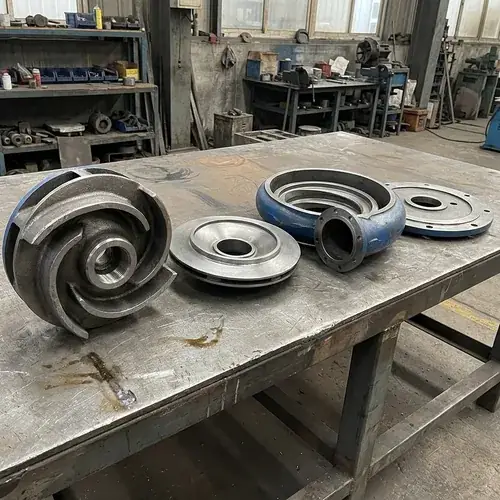
Slurry pump wear parts are the wetted components that directly contact abrasive slurry — impeller, throatbush/suction liner, volute liner, frame plate liner, shaft sleeve, and expeller ring. They are designed to be sacrificial, not wear-proof. The material grade you specify, and how early you catch wear, largely determine whether a pump runs predictably for months or fails early.
The commercial risk is not the cost of one impeller. It is the unplanned downtime, the extra power a worn wet-end consumes, and the hidden risk of buying aftermarket parts that look right but use a lower-alloy substitute. A high-chrome impeller that is not actually high-chrome often fails early.
This guide helps you identify which parts wear, choose between high-chrome and rubber, decide when to rebuild versus replace, verify supplier quality, and build a stocking list that keeps a critical slurry circuit running without overstocking your warehouse.
Quick Answer / 30-Second Buyer Decision
If you're here to make a decision, start with this:
- Coarse, sharp solids and pH 5-12: start with a high-chrome white iron A05 impeller targeting at least 58 HRC.
- Fine, rebounding particles or acidic conditions approaching pH 4: check A49 high-chrome or natural rubber R55, depending on particle shape and slurry temperature.
- Stock a matched wet-end set — impeller, throatbush, and liners — not just the impeller.
- Rebuild when a clearance adjustment restores head and flow. Replace when it does not, or when vane and liner thickness is mostly gone.
- Buy on cost per operating hour, not price per part.
The hardness, chromium, and pH ranges in this guide are typical planning references. Verify them against the current supplier material data sheet before quoting or ordering.
That's the stripped-down version. The rest of this article explains what to verify and where sourcing goes wrong.
Scope of This Guide
This guide covers wet-end wear components on horizontal centrifugal slurry pumps used in mine tailings, sand dredging, coal washing, and mineral processing. It is written for maintenance managers, procurement officers, distributors, and OEM buyers who manage slurry pump lifecycles.
It does not cover clean-water pump sizing, motor electrical troubleshooting, or full hydraulic system design. If a pump has already failed because the wet-end was run past its wear limit, this guide still applies — but you may need to replace more than one component.
What Are the Critical Slurry Pump Wear Parts?
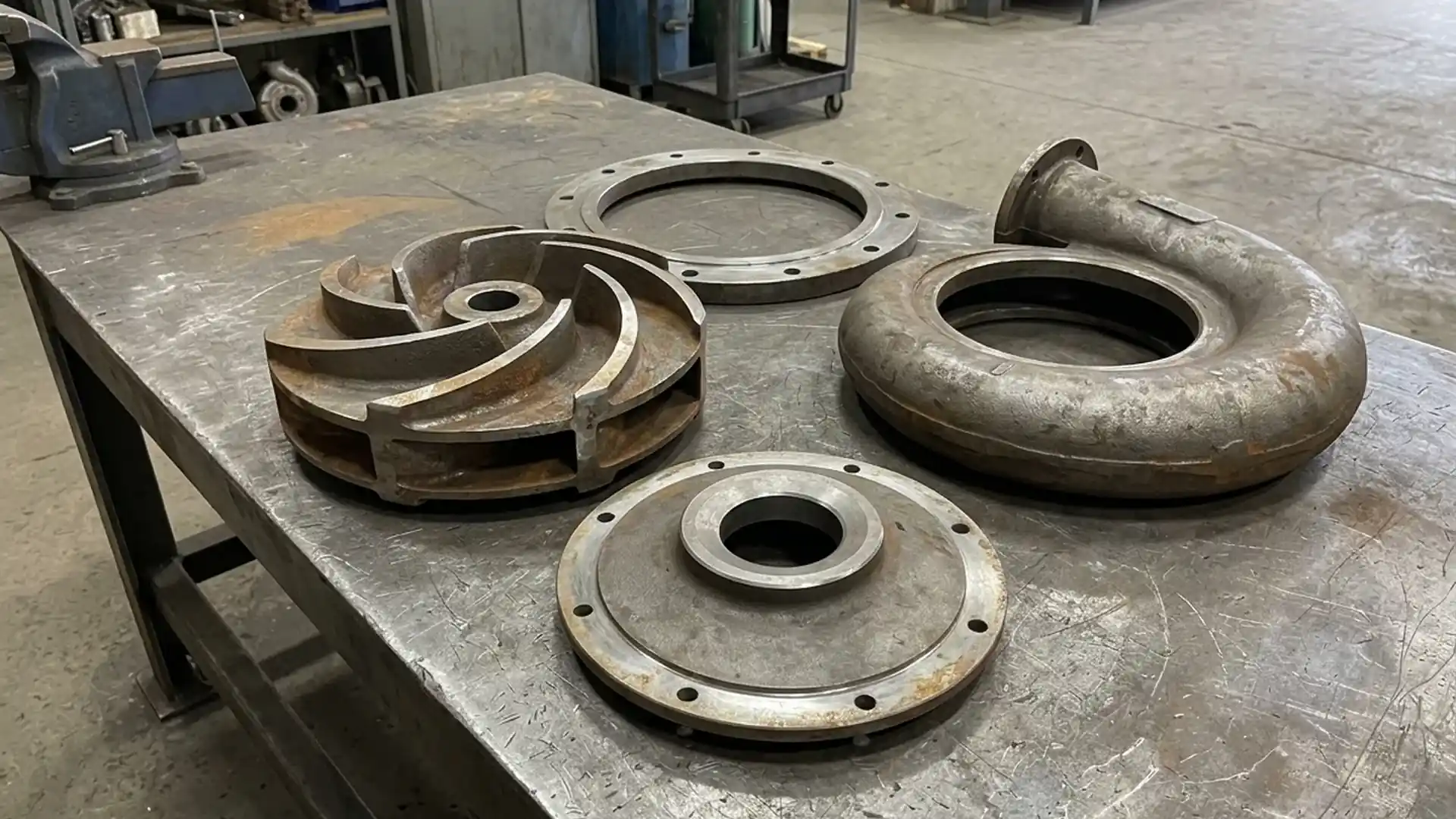
A heavy-duty slurry pump casing is usually a pressure boundary, not the main wear surface. The real wear happens on the replaceable parts inside that casing.
Impeller
The impeller is the rotating part that adds energy to the slurry. Impeller type is model-specific. Some slurry pumps use open or semi-open impellers with large passages; other heavy-duty horizontal designs use closed or front-shrouded impellers where the duty and solids profile suit them. Confirm the impeller type, vane profile, and eye geometry from the original part drawing before ordering a replacement.
The impeller wears on the vane tips, the front shroud, and the eye. Once the vane tips become scalloped or thin, the pump loses both head and efficiency.
Throatbush / Suction Liner
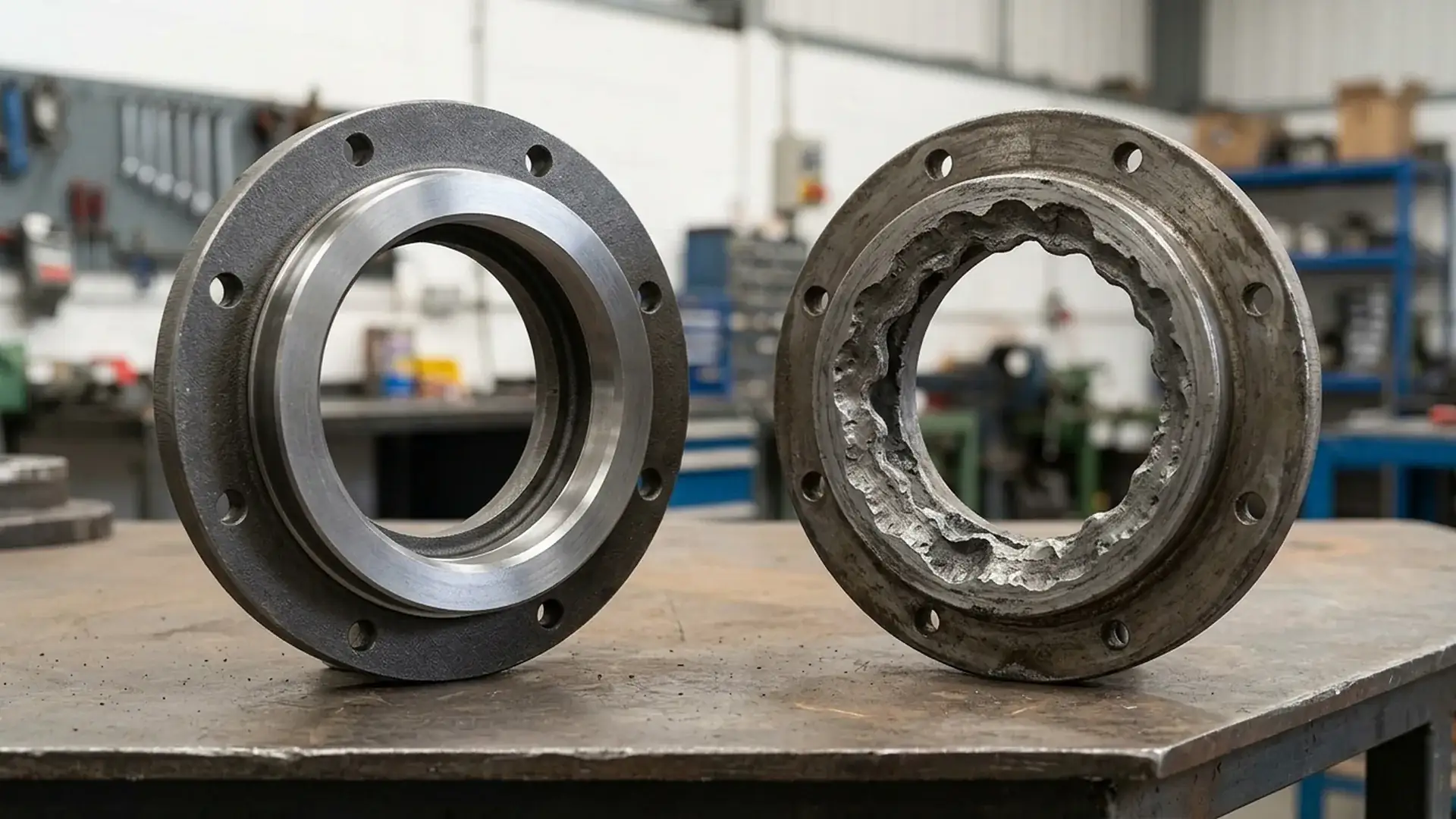
A throatbush is the suction-side wear ring that sits at the entrance of the impeller eye. It guides slurry into the impeller and controls internal recirculation back toward the suction. Because slurry enters at high velocity at this point, the throatbush is often the first component to show measurable wear.
Volute Liner
The volute liner is the sacrificial surface inside the casing that collects the slurry thrown outward by the impeller and converts velocity into pressure. It's not the same as the outer casing. A worn volute liner creates uneven flow around the impeller, which often shows up as rising vibration before it appears as a hard failure.
Frame Plate Liner
The frame plate liner sits on the suction-side casing face and works with the throatbush and impeller eye. Buyers sometimes confuse the throatbush and frame plate liner because both are near the suction side. The frame plate liner is the larger face; the throatbush is the more concentrated ring around the impeller eye.
Shaft Sleeve
The shaft sleeve is a removable cylindrical cover that protects the actual pump shaft from abrasive slurry, gland packing, or seal leakage. It's cheaper and faster to replace than a scored shaft. A shaft sleeve that has been grooved under the packing should be replaced as part of a wet-end rebuild, not reused.
Expeller Ring and Gland Seal
The expeller uses centrifugal force to push slurry away from the stuffing box before it reaches the gland packing. The expeller ring and its vanes wear just like the impeller, only on a smaller scale. When expeller wear increases, gland leakage becomes harder to control even with seal water.
Early Signs of Wear: How to Know When Parts Are Failing
A slurry pump rarely fails without warning. The first signs are usually a drop in total head and flow, rising vibration, gland leakage, and higher amps for the same duty point.
The most useful early check is to compare current discharge pressure and flow against the original duty point. If that point is not in the maintenance file, it can often be reconstructed from the original slurry pump sizing calculations. A worn impeller and throatbush create more internal recirculation, which means the pump moves less useful slurry for the same speed and power.
| Operational Symptom | Likely Worn Component | Recommended Action |
|---|---|---|
| Discharge pressure and flow drop at same speed | Impeller, throatbush, or both | Inspect impeller vanes and throatbush together; measure clearance against drawing. Replace both if vanes are scalloped or thinned; adjust clearance only if the pump design allows it. |
| Vibration increases over weeks | Volute liner, uneven impeller wear, or imbalance | Inspect liner and impeller condition; check balance and alignment before assuming a single root cause |
| Gland leakage despite increased seal water | Expeller ring, shaft sleeve, or gland packing | Inspect expeller clearance and shaft sleeve surface before changing packing |
| Motor amps higher for same duty | Worn impeller or liner reducing efficiency | Calculate energy penalty; compare rebuild cost to replacement cost |
| Sand or fines visible in gland water | Expeller failure or worn shaft sleeve | Do not run long; abrasive slurry in stuffing box can score the shaft |
| Noisy suction or unstable flow | Throatbush or suction liner wear | Remove suction cover; measure throatbush inner diameter against drawing |
For a broader check that includes bearings, coupling, alignment, and lubrication, use a full pump maintenance checklist alongside the wetted-part inspection.
Material Selection: High Chrome Impeller vs. Rubber Lined Slurry Pump Parts

The single biggest factor in slurry pump wear life is material choice. There is no universal wear material. The right choice depends on particle size, particle shape, velocity, pH, and slurry temperature.
High-Chrome White Iron
High-chrome white iron works because the chromium forms hard carbides in the iron matrix. In broad terms, the higher the chromium and hardness, the better the part resists low-angle sliding abrasion.
A05 is the common high-chrome grade used for coarse, sharp solids. A supplier-specific A05 target is often about 27% chromium with tested hardness at or above 58 HRC, usually suitable for pH 5-12. A49 is the lower-hardness high-chrome option, often specified at 43 HRC or higher, and is used when pH drops toward 4 because the alloy trades some hardness for better acidic-slurry corrosion resistance.
The caution with high-chrome is impact. It is hard but not indestructible. Large tramp metal, oversize rocks, or severe high-energy impact can crack a hard cast iron part. If the circuit sees impact rather than pure abrasion, that needs to be stated in the RFQ.
Natural Rubber and Other Elastomers
A rubber lined slurry pump excels on fine, rounded, rebounding particles. The rubber surface flexes and lets small particles bounce off instead of cutting into the surface. That's why rubber often lasts longer than metal on fine sand and frothy or low-impact slurries.
Rubber fails by tearing, not gradual metal loss. Sharp angular rocks, high tip speeds, and large coarse solids can rip rubber liners and impellers quickly. Natural rubber R55 is a standard slurry elastomer for fine abrasives, but its exact temperature and chemical limits should be confirmed against the supplier's data sheet.
Polyurethane sits between the two. It can handle fine particles and low-impact service, but its density, abrasion resistance, and temperature limits are formulation-specific and must be confirmed with the supplier. It is not a substitute for high-chrome in sharp coarse-solids duty.
Materials Comparison Table
| Material Type | Typical Hardness/Property | Ideal Solids Type | pH Range | Best Application |
|---|---|---|---|---|
| A05 high-chrome white iron | About 27% Cr, ≥58 HRC | Coarse, sharp, angular solids | pH 5-12 | Mine tailings, sand, aggregate, coal washing |
| A49 high-chrome white iron | ≥43 HRC, higher corrosion resistance | Coarse solids plus mild acid/corrosion | pH down to about 4 | Acid mine drainage, corrosive mineral slurry |
| Natural rubber R55 | Elastomer, rebounds fines | Fine, rounded, rebounding particles | Confirm with supplier | Fine sand, flotation feed, light slurry |
| Polyurethane | Elastomer, lower temperature limit | Very fine solids, low impact | Confirm with supplier | Fine slurries, non-sharp suspended solids |
The table is a starting point, not a purchase spec. All hardness, chromium, and pH values are typical planning references and must be confirmed against the current supplier's controlled material data sheet before quoting. A label that only says "high-chrome" without chemistry is not enough.
If the existing pump is too worn to rebuild economically, compare the wet-end cost against a new heavy-duty slurry pump before buying every internal part.
Rebuild vs. Replace: When to Swap Slurry Pump Spare Parts
The practical rule is simple: rebuild when you can restore duty with clearance adjustment and one or two sacrificial parts. Replace the wet-end when repeated adjustments no longer recover head, vibration stays high, or the energy penalty exceeds the cost of the parts.
Clearance Adjustment Versus Replacement
As the impeller and throatbush wear, the gap between them widens. That gap allows slurry to recirculate from the high-pressure side back into the suction eye. The pump consumes power, but less useful slurry leaves the discharge.
On pumps designed for field axial adjustment, you may be able to reposition the impeller toward the throatbush to close the clearance, or fit a new throatbush and leave the impeller in place. This is not universal; some models require shims, positioning procedures, or a fixed-clearance setup from the original manual. Confirm the adjustment method from the pump model documentation before attempting it. Where adjustment is possible, it often recovers most of the original head and flow, but only while the impeller vane tips still have adequate thickness and shape.
Don't keep adjusting indefinitely. Once the vane tips are scalloped, thinned, or broken, replacing only the throatbush shifts the wear point but does not fix the hydraulic problem.
Total Cost of Ownership Calculation
When a worn impeller drops efficiency, the real cost is usually electrical energy, not the part itself.
A rough comparison uses this formula:
Power absorbed = (Flow m³/h × Head m × Slurry SG) / (367 × Efficiency)
For example, a pump moving 200 m³/h at 30 m head with slurry SG 1.2 and 55% original efficiency absorbs about 35.7 kW. If wear drops efficiency to 45%, the same duty absorbs about 43.6 kW. That is an extra 7.9 kW. Over 6,000 operating hours, that is about 47,580 kWh of extra energy. At US$0.10/kWh — a placeholder, so substitute your actual tariff — the extra cost is around US$4,750 per year.
That number often exceeds the cost of a new impeller and throatbush. If the math shows that, replace now rather than running the part to destruction.
When to Replace Without Debate
- The impeller vane tips are visibly thinned, scalloped, or cracked.
- The volute liner or frame plate liner has worn through to the casing.
- The shaft sleeve is deeply grooved under the packing.
- Vibration cannot be brought back to normal after clearance adjustment.
- The pump no longer makes required head even after a new throatbush.
OEM vs. Aftermarket Parts: Supplier Verification and Interchangeability
Aftermarket slurry pump spare parts can be perfectly serviceable, but only when dimensional accuracy, material chemistry, hardness, and dynamic balance are verified against the original drawing. The risk is not "aftermarket" — it's buying parts that fit the bolt pattern but not the hydraulic shape.
A cheap impeller often fails early because the alloy content is lower than claimed, or because the vane profile and eye clearance are not accurate. The part may bolt in and run briefly before destroying the mating liner or the shaft.
Required verification documents:
- Spectrometer report / chemical analysis: proves the actual chromium, molybdenum, and nickel content of the heat used for your part.
- Hardness test report: confirms the finished casting meets the expected HRC range.
- Dimensional inspection report: proves the impeller eye, throatbush bore, liner fit, and bolt pattern match the drawing.
- Dynamic balance test certificate: essential for impellers; an unbalanced high-chrome impeller creates vibration that shortens bearing and seal life.
- Packing arrangement: heavy high-chrome castings should be individually blocked and braced inside ISPM 15 compliant or heat-treated wooden crates so liners and impellers do not chip each other in transit.
When you request a quote, ask for the standard the supplier tests to and the pass/fail criteria. A supplier that cannot produce a chemistry report tied to the actual heat number is not in the same category as one that can.
Interchangeability is not visual similarity. A part that looks similar but has a different vane height or eye clearance changes recirculation and wear rate. Use the original part code, drawing number, or pump model with dimensional confirmation.
Spare Parts Stocking Strategy for Industrial Buyers
Stock a matched wet-end set before overstocking bearings and shafts. The wetted parts largely determine short-interval uptime in abrasive service.
A practical tiered stocking approach:
- Tier 1 — keep on the shelf: impeller, throatbush, volute liner, frame plate liner, expeller ring, gland packing or seal rings.
- Tier 2 — condition-based spares: shaft sleeve, bearing assembly, seal water components, coupling element.
- Tier 3 — long-lead or rarely replaced: bare shaft, casing halves, baseplate, motor.
For a critical single pump, one full wet-end set is usually the right starting point. For an installed fleet, one or two full sets shared across several pumps may be enough, depending on failure history and supplier lead time. This is where a structured pump spare parts planning process helps — it keeps inventory aligned with downtime cost instead of guesswork.
Common Mistakes When Buying Slurry Pump Wear Parts
Even experienced buyers repeat the same costly errors.
- Buying by unit price instead of cost per operating hour.
- Replacing only the impeller while running it against a worn volute liner and throatbush.
- Accepting a "high-chrome" label without a spectrometer report.
- Selecting rubber for sharp coarse rocks, or high-chrome for a low-pH acidic slurry without checking grade.
- Running a worn pump past the energy-cost crossover point because the part still "looks okay".
- Skipping dynamic balance because the part is new.
- Storing rubber parts in direct sunlight, ozone, or extreme temperature conditions.
- Sending an RFQ with only "need impeller for 6/4 slurry pump" and no duty, material, or part-code detail.
Each of these is avoidable with a stricter purchase spec and a measured wear-limit procedure.
RFQ Checklist for Sourcing Slurry Pump Wear Parts
Use this table when requesting a quote. It forces the supplier to ask the right questions and gives you comparable responses.
| Field | Your Input / Options |
|---|---|
| Original pump model / size | Example: 6/4 D-AH, 4/3 C-AH, or equivalent — confirm against original drawing |
| OEM part code / drawing number | Provide if known; otherwise send part description and photo |
| Part type | Impeller / throatbush / volute liner / frame plate liner / shaft sleeve / expeller ring |
| Required material grade | A05 high-chrome / A49 high-chrome / R55 natural rubber / polyurethane / confirm |
| Slurry composition | Solids type, slurry SG, solids concentration by weight |
| Max particle size and shape | Example: 20 mm angular crushed rock |
| pH range | Example: pH 5.5-8.0 |
| Slurry temperature | Example: 20-40 °C |
| Quantity required | Exact per-part quantity |
| Required QC documents | Chemical analysis / hardness / dimensional report / dynamic balance |
| Packaging requirement | ISPM 15 compliant/heat-treated wooden crate, individual blocking and bracing |
| Delivery target | Quote-specific; confirm current production and transit schedule |
The more fields you fill, the fewer surprises you get on arrival.
FAQs about Slurry Pump Wear Parts
These are the questions buyers most often ask before committing to a wet-end rebuild or spare parts order.
How long do slurry pump wear parts last?
There is no fixed lifespan. Wear life depends on particle size, particle shape, slurry SG, pump speed, material grade, and how consistently the pump runs near its best efficiency point. Two pumps handling nominally similar sand can have very different life if one handles sharp crushed rock at high velocity. The most reliable way to predict life is to track clearance, head, flow, and power over time on your actual duty point.
Can I mix rubber and metal parts in the same pump?
Yes. Mixed material wet-ends are common and can be deliberate engineering. You might run a high-chrome impeller against rubber liners, or use a rubber throatbush with a metal impeller, depending on which part sees the worst wear mode. Before mixing, verify that the rubber and metal parts are dimensionally compatible with the same pump model and part drawing; parts from different suppliers may not share the same fit. The key is to make the material mix intentional based on wear pattern, not an accidental mismatch from two different suppliers.
How often should impeller clearance be adjusted?
Check the clearance on a scheduled interval, not only when the pump loses performance. A practical approach is to check on an hours-based or tonnage-based interval, then follow the manufacturer's recommended adjustment procedure and wear limit rather than a generic interval. If head and flow have already dropped noticeably, the clearance has likely been open too long.
Are aftermarket slurry pump wear parts safe to use?
Aftermarket parts are safe when the supplier provides chemistry, hardness, dimensional, and balance records for your actual parts. They become risky when the buyer chooses on price alone and cannot verify alloy content or vane shape. Aftermarket parts are not automatically inferior; unverified parts are.
What is the difference between a throatbush and a volute liner?
A throatbush is the suction-side wear ring around the impeller eye. It controls recirculation back toward the suction. A volute liner is the larger sacrificial surface inside the casing that collects the slurry thrown outward by the impeller. They wear in different ways and are often replaced together because excessive clearance in either one hurts efficiency.
How do I know if I need a high chrome impeller or a rubber lined slurry pump?
Choose high-chrome for coarse, sharp, angular solids and higher-velocity duties with pH roughly 5-12. Choose rubber for fine, rounded, rebounding particles and generally lower-impact slurries where tearing is not the main risk. If pH is close to 4, consider A49 high-chrome or confirm a compatible rubber compound. When in doubt, send the full slurry description to the supplier before selecting.
Official Sources and Compliance References
- ASTM A532: widely used classification for abrasion-resistant cast irons, including high-chrome white irons. Use it as a reference when specifying material, but still require the actual chemistry report for the heat.
- Supplier material data sheets for A05 / A49 / R55: these are the controlled source for exact chromium content, HRC range, pH limits, and temperature limits. The values in this guide are typical published values and must be confirmed against the latest supplier data sheet.
- ISO 9906: hydraulic acceptance test standard used when you want to verify restored pump performance after a rebuild. It does not test wear life, but it confirms whether the rebuilt wet-end recovers head, flow, and efficiency.
If a manufacturer tests to a different balance grade or material standard, ask them to state it explicitly in the quotation.
Bottom Line
Slurry pump wear parts are a management problem, not a spare parts shopping problem. The buyers who get the most uptime are not the ones who buy the cheapest impeller. They are the ones who match material to particle size and pH, catch wear before it becomes hydraulic collapse, verify alloy chemistry, and keep a matched wet-end set on the shelf.
When you can no longer restore duty with a clearance adjustment and a new throatbush, do the energy-cost calculation. In abrasive slurry service, the most expensive choice is usually running the worn parts too long.
Get A Quote

Get A Quote
0 Comments