
Pump Spare Parts Planning Guide: How Buyers Can Reduce Downtime Without Overstocking
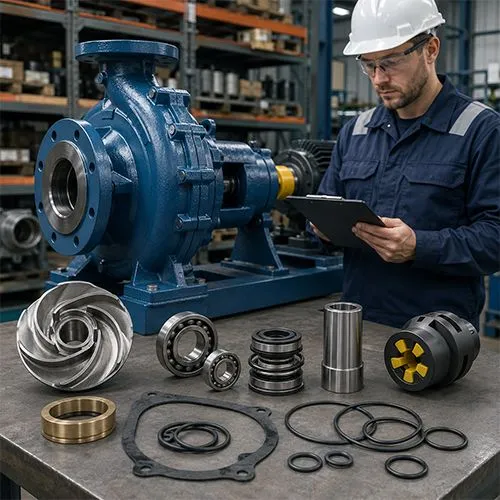
Pump spare parts planning is not about buying the largest spare parts package a supplier recommends. For industrial buyers, maintenance teams, distributors, and project owners, the real goal is to keep the right parts available before failure happens while avoiding unnecessary inventory cost.
A good pump spare parts plan should answer four practical questions: which parts fail most often, which parts stop production immediately, which parts take the longest to buy, and which parts are expensive but rarely needed. Without this logic, buyers often make two opposite mistakes. Some buyers buy too few spare parts and suffer long downtime when a mechanical seal, bearing, impeller, gasket, or O-ring is needed urgently. Others overstock expensive parts that sit unused for years and lock up maintenance budget.
Pump spare parts planning is the process of classifying pump components by failure risk, replacement frequency, delivery lead time, and downtime impact so buyers can keep the right parts available without locking excessive capital in unnecessary inventory.
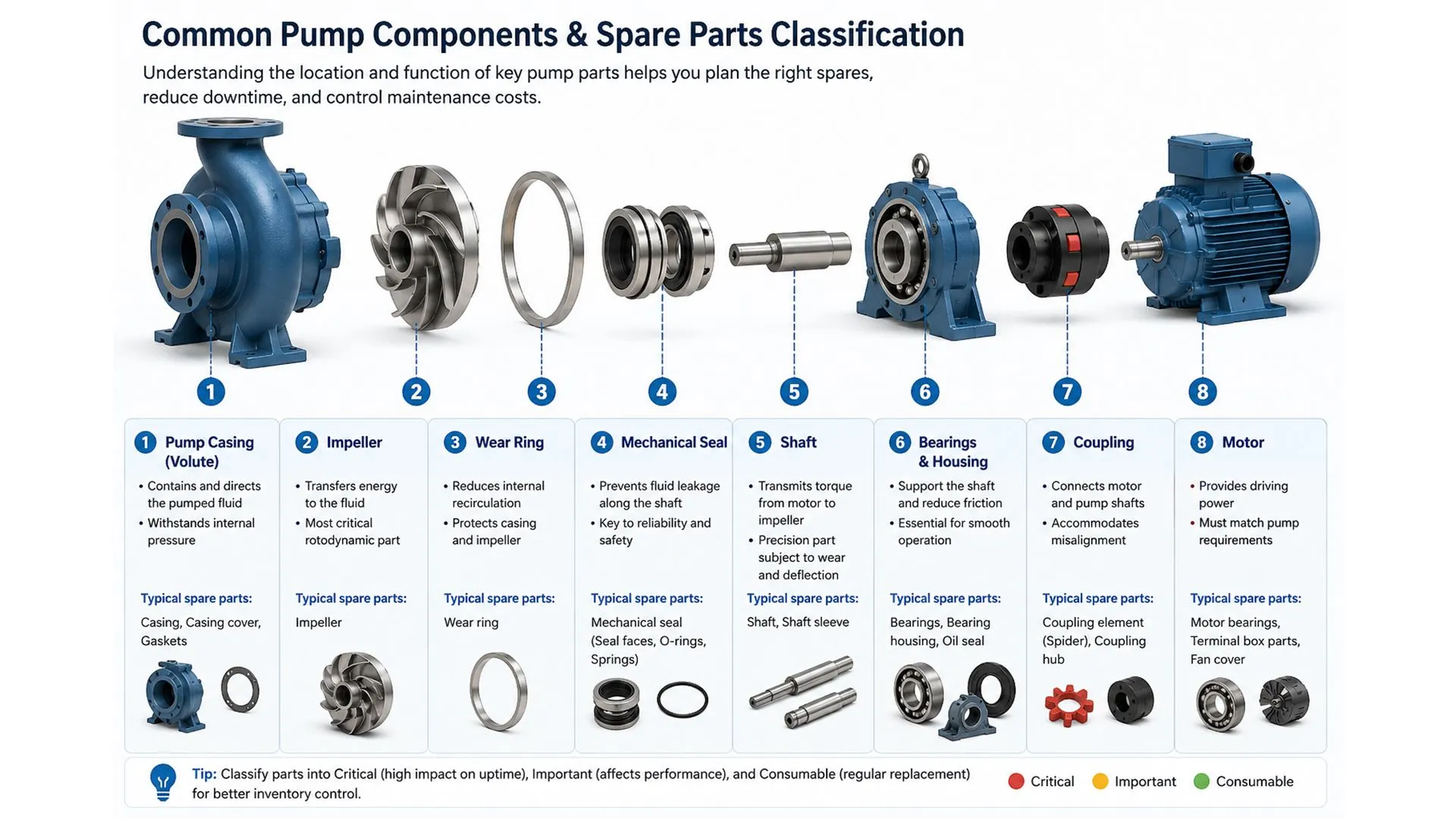
The most important pump spare parts to plan first are mechanical seals, bearings, gasket kits, O-ring kits, coupling elements, and application-specific wear parts. Buyers should then review long-lead-time parts such as impellers, shafts, casings, and rotating assemblies based on pump criticality, supplier delivery time, and the cost of downtime.
A practical pump spare parts inventory should be built from the pump BOM (Bill of Materials), operating risk, replacement frequency, supplier lead time, and downtime cost—not from a generic spare parts package. This guide explains how B2B pump buyers can build a practical spare parts plan based on pump type, application risk, maintenance history, material compatibility, local sourcing options, and supplier support.
Quick Answer: What Pump Spare Parts Should Buyers Plan First?
Pump spare parts should be prioritized by how quickly they fail, how strongly they affect operation, how long they take to replace, and how much downtime they can cause. Buyers should not treat all spare parts equally because a low-cost gasket can stop repair if it is missing, while an expensive casing may not need to be stocked for every project.
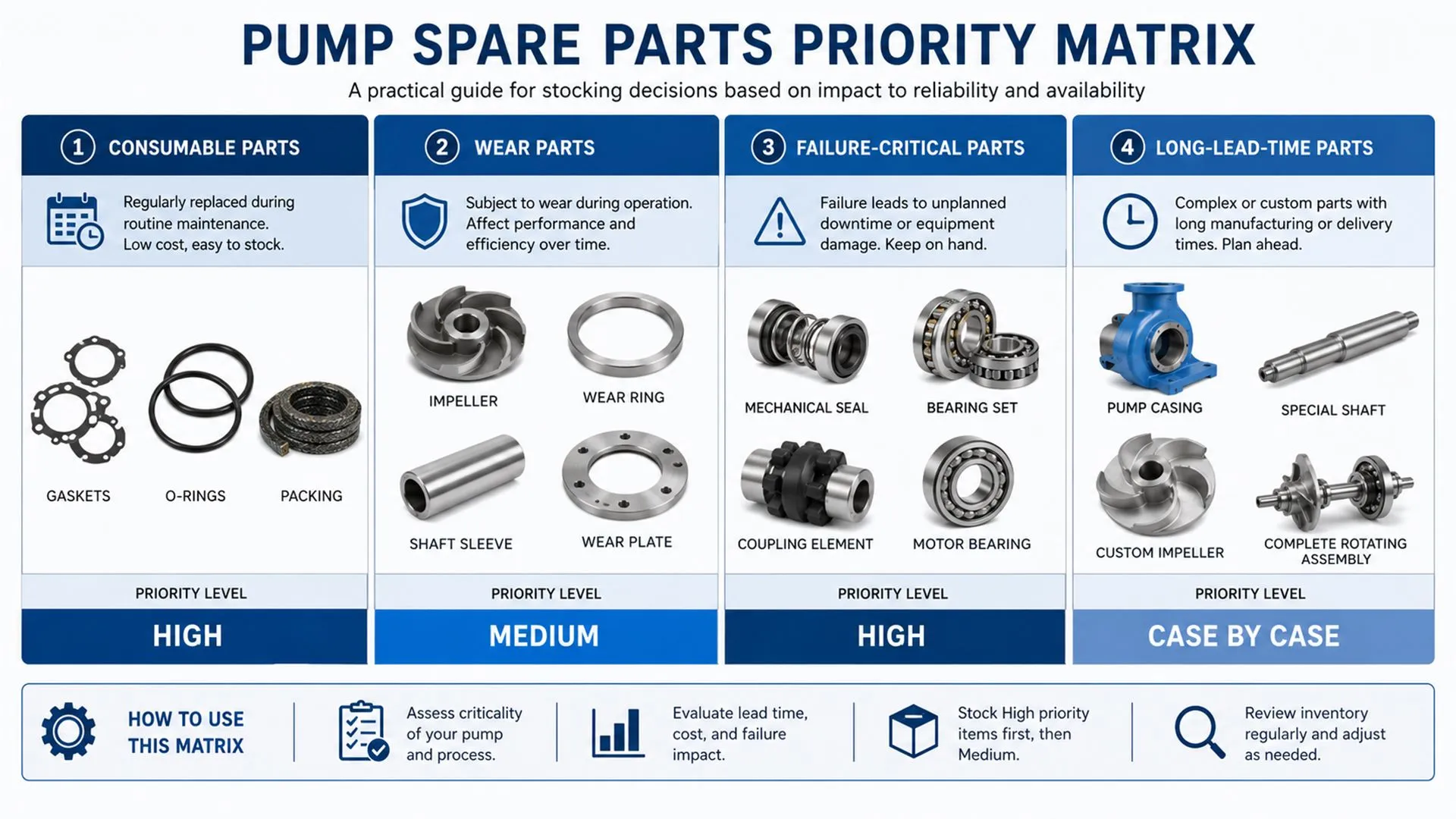
The fastest way to build a usable spare parts plan is to divide pump components into four categories: consumable parts, wear parts, failure-critical parts, and long-lead-time parts. This helps buyers decide what to keep on site, what to order annually, and what can remain supplier-supported.
| Spare Part Category | Examples | Buyer Priority | Why It Matters |
|---|---|---|---|
| Consumable parts | Gaskets, O-rings, packing | High | Low cost, frequent replacement, and often required during every repair |
| Wear parts | Impeller, wear rings, shaft sleeve, wear plate | High for abrasive, corrosive, or continuous-duty service | Directly affects efficiency, leakage, vibration, and hydraulic performance |
| Failure-critical parts | Mechanical seal, bearing, coupling element, motor bearing | Very high | Failure can stop the pump immediately |
| Electrical parts | Cable, terminal box, level sensor, thermal protector | Medium to high | Critical for submersible pumps and packaged systems |
| Long-lead-time parts | Casing, special shaft, custom impeller, complete rotating assembly | Case by case | Failure may be rare, but replacement can take weeks or months |
| Non-critical accessories | Bolts, guards, common fittings, grease nipples | Low to medium | Often available locally, but still need specification control |
A practical buyer should usually stock seal kits, bearing sets, gasket kits, O-ring kits, coupling elements, and application-specific wear parts first. Expensive major components should be evaluated based on pump criticality, supplier lead time, and downtime cost rather than purchased automatically.
Scope of This Guide: Which Pump Types and Applications Does This Spare Parts Plan Apply To?
This spare parts planning guide mainly applies to industrial pumps used in water transfer, pressure boosting, circulation, drainage, wastewater, mining, process water, and general industrial services. Buyers should adjust the spare parts list according to pump design, liquid condition, operating hours, site accessibility, and downtime consequence.
Applicable Pump Types
This spare parts planning method is suitable for common industrial pump types where scheduled maintenance, wear monitoring, and emergency repair planning are necessary. It works best when the buyer can obtain a pump BOM, exploded drawing, serial number, and supplier spare parts recommendation.
Applicable pump types include:
- End suction centrifugal pumps
- Horizontal split case pumps
- Multistage pumps
- Inline booster pumps
- Submersible sewage pumps
- Vertical turbine pumps
- Slurry pumps
- Mining dewatering pumps
- Cooling water pumps
- HVAC circulation pumps
- Industrial water transfer pumps
For these pumps, a buyer can usually create a practical spare parts plan by reviewing seals, bearings, gaskets, O-rings, impellers, wear rings, shaft sleeves, coupling elements, and project-specific electrical or wet-end components.
Use With Adjustment
Some pump applications require extra spare parts planning because standard clean-water maintenance logic may not cover the actual failure risks. In these cases, buyers should still use the framework, but the spare parts list must be adjusted according to the operating environment.
- Slurry pumps, where impellers, liners, throat bushes, wear plates, and seal parts may wear faster due to abrasion.
- Sewage pumps, where mechanical seals, cables, O-rings, impellers, level sensors, and blockage-related components may be more critical.
- Chemical pumps, where O-ring material, mechanical seal elastomer, wetted-part material, and gasket compatibility are essential.
- High-temperature pumps, where gasket material, bearing lubrication, seal cooling, and thermal expansion should be considered.
- Remote project sites, where supplier delivery time, customs clearance, local storage, and transport difficulty may increase risk.
- 24/7 continuous-duty systems, where downtime cost may justify keeping more emergency parts or one complete rotating assembly.
If the pump has already shown signs of corrosion, material failure, or seal damage, buyers should not build the spare parts list only from a standard catalog. If the spare part failure is caused by liquid corrosion, this pump corrosion troubleshooting guide can help buyers confirm whether the selected material matches the actual liquid condition.
Not Suitable as the Only Planning Method
This guide should not replace formal reliability studies, OEM maintenance contracts, legal warranty investigations, or project-specific spare parts specifications in high-risk systems. In regulated or safety-critical projects, the spare parts list should be reviewed by the owner, engineer, OEM, or third-party maintenance consultant.
Do not use this guide as the only planning method for:
- Fire pump systems requiring local code compliance
- API refinery pump packages
- Nuclear, offshore, or hazardous-area pump systems
- Legal warranty claim cases
- Large EPC projects with owner-approved spare parts lists
- Projects requiring OEM maintenance contracts
- Pumps included in formal reliability-centered maintenance programs
In these cases, spare parts planning should be integrated with the project maintenance strategy, inspection and test plan, quality records, commissioning documents, and long-term service agreement.
Why Pump Spare Parts Planning Matters Before the Pump Fails
Pump spare parts planning matters because most downtime problems are not caused only by the pump failure itself. They are caused by missing parts, wrong parts, unclear part numbers, long supplier lead time, and poor maintenance preparation after the failure occurs.
Many buyers are willing to pay for spare parts, but they do not know which parts actually protect operation. As a result, they may keep non-critical accessories in stock while missing mechanical seals, bearings, gasket kits, or application-specific wear parts. When the pump stops, the maintenance team discovers that the most important component is not available.
| Buyer Problem | What Usually Happens | Business Impact |
|---|---|---|
| No spare mechanical seal available | Pump leaks and cannot restart safely | Emergency shutdown and urgent procurement |
| Wrong impeller ordered | Replacement cannot be installed or performance changes | Extended downtime and possible rework |
| No bearing specification recorded | Local sourcing becomes risky | Wrong bearing clearance or premature failure |
| Overstocking non-critical parts | Inventory budget is locked in unused items | Poor cash efficiency |
| No supplier lead time confirmed | Critical part takes weeks to arrive | Production or project delay |
| No serial number tracking | Spare parts may not match the pump version | Warranty dispute and maintenance confusion |
| No gasket or O-ring kit | Repair cannot be completed after disassembly | Low-cost part causes high-cost downtime |
| No record after repair | Same spare parts shortage repeats | Repeated emergency purchasing |
For B2B users, spare parts planning affects more than the maintenance department. Procurement needs accurate part numbers and pricing. Finance needs inventory control. Operations need uptime. Engineers need correct materials and dimensions. Distributors need fast after-sales response. Project owners need confidence that the system can be maintained after installation.
A spare parts plan should therefore be created before failure, reviewed after commissioning, and updated after each major repair.
How to Compare Downtime Cost With Spare Parts Cost
Spare parts cost should be judged against downtime cost, not only against the pump purchase price. A spare part may look expensive in a purchase order, but it may be cheap compared with the production loss caused by waiting for that part after failure.
Why Downtime Cost Changes the Spare Parts Decision
Downtime cost changes the spare parts decision because the real cost of a missing part is not only the part price. It may include lost production, emergency freight, overtime labor, delayed project handover, customer penalties, and repeated maintenance visits.
For example:
| Item | Example Value |
|---|---|
| Mechanical seal kit cost | USD 450 |
| Supplier lead time | 7 days |
| Estimated downtime cost | USD 2,000 per hour |
| One day downtime cost | USD 48,000 |
| Cost of keeping one seal kit | USD 450 |
In this case, keeping one correct seal kit in stock is financially reasonable if the pump is important. The cost of one day of downtime is far higher than the cost of the spare seal. For a non-critical pump with a standby unit, the same decision may be different.
Simple Buyer Rule
A spare part should receive higher stocking priority when the cost of waiting for the part is greater than the cost of keeping it in inventory.
| Question | If Yes | Buyer Action |
|---|---|---|
| Will the pump stop if this part fails? | Yes | Consider local stock |
| Is there no standby pump? | Yes | Increase spare priority |
| Is supplier lead time longer than acceptable downtime? | Yes | Keep minimum stock |
| Is the part low cost and frequently replaced? | Yes | Keep routine stock |
| Is the part expensive and rarely fails? | Yes | Review case by case |
| Can the part be sourced locally with confirmed specification? | Yes | Lower stock may be acceptable |
This approach helps buyers explain spare parts decisions to finance teams and management. It also prevents both understocking and emotional overstocking.
How to Classify Pump Spare Parts by Criticality
Pump spare parts should be classified by criticality before buyers decide stock quantity. Criticality means how strongly the part affects pump operation, safety, repair time, and business continuity.
Criticality Level 1: Parts That Stop the Pump Immediately
Level 1 spare parts are components that can stop the pump quickly when they fail. These parts should receive the highest planning priority because their absence can turn a manageable repair into an extended shutdown.
Common Level 1 parts include:
- Mechanical seal
- Bearing set
- Coupling element
- Motor bearing
- Submersible pump cable
- Control sensor for packaged pump systems
- Seal flush components for special applications
A mechanical seal failure may cause leakage that prevents safe operation. A bearing failure may damage the shaft, coupling, or motor if the pump continues running. A broken coupling element may immediately stop torque transmission. For submersible pumps, cable and sealing components can be as critical as hydraulic parts because water ingress can damage the motor.
If bearing damage has already appeared on site, this pump bearing failure diagnosis guide can help maintenance teams separate lubrication, alignment, load, and installation causes before they simply replace the bearing again.
Criticality Level 2: Parts That Reduce Performance Gradually
Level 2 spare parts do not always stop the pump immediately, but they can reduce efficiency, increase leakage, lower flow, reduce head, or increase vibration over time. These parts are especially important for abrasive, corrosive, or continuous-duty service.
Common Level 2 parts include:
- Impeller
- Wear ring
- Shaft sleeve
- Casing wear plate
- Volute liner
- Diffuser for multistage pumps
- Packing gland components
A worn impeller may reduce flow and head. A worn wear ring may increase internal leakage and reduce efficiency. A damaged shaft sleeve may create seal leakage. These problems may not stop the pump on the first day, but they can increase energy consumption, reduce capacity, and create secondary failures.
For continuous operation, buyers should not wait until these parts are completely destroyed. Inspection intervals and replacement triggers should be defined based on vibration trend, leakage rate, efficiency loss, and maintenance records.
Criticality Level 3: Parts That Are Cheap but Easy to Delay Maintenance
Level 3 spare parts are low-cost items that are easy to ignore but often required during repair. Missing these parts can delay a repair even when the major part is available.
Common Level 3 parts include:
- Gaskets
- O-rings
- Packing
- Bolts and nuts
- Drain plugs
- Grease nipples
- Minor fasteners
These parts are usually inexpensive, but they should be organized carefully. A pump may be opened for seal replacement, but if the casing gasket or O-ring is missing, the maintenance team may not be able to reassemble the pump properly.
Low-value parts should not become the reason for high-value downtime.
Criticality Level 4: Expensive Parts That Should Not Always Be Stocked
Level 4 spare parts are expensive components that may have low failure frequency. Buyers should not automatically stock them for every pump. The decision should depend on downtime cost, supplier lead time, pump quantity, site location, and whether a standby pump is available.
Common Level 4 parts include:
- Pump casing
- Complete rotating assembly
- Special shaft
- Large custom impeller
- Motor
- Baseplate
- Large bearing housing
The key decision formula is simple:
Stocking priority = failure probability × downtime cost × supplier lead time
If a casing failure is extremely unlikely and the supplier can deliver quickly, stocking one casing may not be economical. But if a custom impeller takes three months to produce and the pump is critical to a mining or municipal project, keeping one spare may be justified.
How to Build a Pump Spare Parts List From the Bill of Materials
A spare parts list should be built from the pump BOM, not from memory, photos, or generic model names. The BOM connects each component to its item number, material, quantity, drawing, and pump serial number.
What Is a Pump BOM?
A BOM (Bill of Materials) is a structured list of the components used in a pump assembly. For buyers, the BOM is not only a production document. It is also the foundation for spare parts purchasing, maintenance planning, warranty discussion, and long-term service.
A useful pump spare parts BOM should include:
- Item number
- Part name
- Material
- Quantity per pump
- Drawing number
- Pump serial number
- Part number or order code
- Interchangeability note
- Recommended spare quantity
Buyers should request an exploded view drawing or spare parts drawing from the supplier. This is especially important for multistage pumps, split case pumps, submersible sewage pumps, slurry pumps, and customized pump packages.
| BOM Field | Why Buyer Needs It |
|---|---|
| Item number | Avoids ordering the wrong component |
| Part name | Helps maintenance teams identify the part correctly |
| Material | Prevents wrong material substitution |
| Quantity per pump | Helps calculate stock quantity |
| Drawing number | Supports future reordering |
| Serial number | Links the spare part to the exact pump |
| Interchangeability note | Confirms whether the same part fits multiple pumps |
| Recommended spare quantity | Helps build 1-year or 2-year inventory plan |
Why Pump Model Alone Is Not Enough
A pump model is not always enough for spare parts ordering because the same pump model may have different impeller diameters, mechanical seal types, shaft materials, motor powers, elastomers, or design revisions.
For example, two pumps may share the same model but have different impeller trimming. If the buyer orders an impeller only by model number, the replacement may not match the required duty point. Similarly, a mechanical seal that fits one shaft size or liquid may not fit another configuration.
Buyers should always order spare parts using the pump model, serial number, part number, and material confirmation together.
Supplier Documents Buyers Should Request
Supplier spare parts documents should be requested before the buyer approves the spare parts package. A long list of part names is not enough if the buyer cannot identify, reorder, or verify the parts later.
| Document | Required For | Priority |
|---|---|---|
| BOM | All industrial pump orders | High |
| Exploded drawing | Pumps that require field maintenance | High |
| 1-year spare parts list | New pump orders and standard projects | High |
| 2-year spare parts list | Critical, remote, or continuous-duty projects | Medium to high |
| Interchangeability statement | Plants with multiple similar pumps | High |
| Material list for wetted parts | Corrosive, abrasive, chemical, or seawater service | High |
| Storage instructions | Mechanical seals, elastomers, bearings, and cables | Medium |
| Lead time list | Imported, customized, or long-lead parts | High |
| Recommended emergency kit | Critical pumps without standby equipment | High |
The supplier should also confirm whether the recommended parts are OEM parts, supplier-approved equivalent parts, or standard commercially available parts.
How to Choose the Right Pump Spare Parts Package
The right pump spare parts package depends on pump risk, service condition, supplier lead time, and maintenance strategy. Buyers should not choose a package only because it is the cheapest or most complete.
Best Spare Parts Package by Scenario
A spare parts package should match the real operating scenario. A clean-water transfer pump, a slurry pump, a remote mining pump, and a distributor stock program need different packages.
| Situation | Best Spare Parts Package | Why This Package Fits |
|---|---|---|
| Small clean water pump | Basic maintenance kit | Covers routine service without overstocking major parts |
| End suction pump in normal service | Seal + bearing + gasket + coupling kit | Covers common failure and maintenance items |
| Continuous-duty pump | Seal + bearing + wear parts package | Reduces risk of unplanned downtime |
| Remote project pump | Critical spare kit + long-lead items | Protects against delivery delay |
| Slurry pump | Wet-end wear parts package | Focuses on abrasion-prone parts |
| Submersible sewage pump | Seal + cable + O-ring + sensor kit | Covers water ingress and electrical risks |
| Multistage pump | BOM-based internal parts package | Prevents wrong stage or balance component ordering |
| Distributor stock | Fast-moving parts by model family | Supports quick after-sales response |
| Custom pump | Serial-number-based spare parts package | Avoids mismatch with special configuration |
When NOT to Buy the Full Spare Parts Package
A full spare parts package is not always the best choice. It may include expensive parts that rarely fail, parts that can be sourced locally, or parts that do not fit the buyer’s actual maintenance strategy.
Buyers should avoid buying a full package blindly when:
- The pump is low-risk and easy to replace.
- A reliable standby pump is installed.
- The supplier can deliver parts quickly.
- Major parts are expensive but unlikely to fail.
- Local sourcing is confirmed for standard items.
- The package includes parts not used in the supplied pump configuration.
- The buyer does not have suitable storage conditions.
A better approach is to ask which parts are needed for startup, which are needed for routine maintenance, which are needed for emergency repair, and which are only needed for rare major overhaul.
How Many Spare Parts Should Buyers Keep in Stock?
Spare parts quantity should be based on replacement frequency, supplier lead time, pump criticality, and downtime cost. Buyers should not use a fixed percentage of pump price as the only spare parts rule.
The Basic Formula for Spare Parts Quantity
A practical spare parts quantity formula can be expressed as:
Recommended spare quantity = expected replacement frequency × supplier lead time risk × pump criticality level
This is not a strict mathematical formula. It is a decision logic that helps buyers compare different parts and decide what deserves stock.
If a part is cheap, frequently replaced, and has long lead time, the buyer should keep more stock. If a part is expensive, rarely fails, and is locally available, the buyer can keep less stock. If the pump is critical and downtime is costly, even expensive parts may deserve inventory.
The following factors should be considered:
- Number of installed pumps
- Duty and standby arrangement
- Operating hours per day
- Liquid abrasiveness or corrosiveness
- Supplier delivery time
- Local sourcing options
- Maintenance skill level
- Distance from supplier or warehouse
- Production loss per hour of downtime
- Whether the same parts fit multiple pumps
Practical Stocking Guideline by Pump Criticality
Pump criticality gives buyers a practical starting point for stock quantity. The numbers below are not universal rules, but they help buyers build a first draft before adjusting for site conditions.
| Spare Part Type | Low-Risk Pump | Important Pump | Critical Pump |
|---|---|---|---|
| Mechanical seal | 1 set if seal failure causes leakage | 1–2 sets | 2+ sets or supplier emergency stock |
| Bearing set | 1 set | 1 set | 2 sets if lead time is long |
| Gasket/O-ring kit | 1–2 kits | 2 kits | 3+ kits |
| Coupling element | 1 pc | 1–2 pcs | 2+ pcs |
| Packing | 1 package if applicable | 1–2 packages | 2+ packages |
| Wear ring | Order as needed | 1 set if wear history exists | 1–2 sets for continuous-duty service |
| Impeller | Usually order as needed | 1 pc if abrasive/corrosive or long lead time | 1 pc or rotating assembly if justified |
| Shaft sleeve | Order as needed | 1 pc if seal area wears frequently | 1–2 pcs if repeated seal wear occurs |
| Complete rotating assembly | Usually no stock | Case by case | Consider if downtime cost is high |
| Casing | Usually no stock | Usually no stock | Case by case for remote/custom systems |
A complete rotating assembly is usually justified only when downtime cost is high, workshop repair takes too long, the pump is customized, or the site is remote. A pump casing is rarely stocked unless the part is custom, long-lead, or mission-critical.
Practical Stocking Guideline by Pump Quantity
Pump quantity also affects spare parts planning. A single pump installation has different risk from a plant with six similar pumps.
| Installed Pump Quantity | Suggested Spare Parts Strategy |
|---|---|
| 1 pump only | Keep seal kit, bearing set, gasket kit, and coupling element |
| 1 duty + 1 standby | Keep normal wear parts; reduce expensive major parts if standby pump is reliable |
| 3–5 similar pumps | Standardize shared parts and keep grouped inventory |
| 6+ pumps | Build annual spare parts package and track consumption |
| Remote project site | Increase stock for seals, bearings, gaskets, and wear parts |
| Critical continuous operation | Keep emergency kit and consider complete rotating assembly |
If several pumps share the same seal, bearing, gasket, or coupling element, buyers can reduce inventory by using a shared spare parts pool. But this only works when interchangeability is confirmed by the supplier, not assumed.
Do Not Use One Spare Parts Ratio for Every Pump
Some buyers use a rough rule such as “buy spare parts equal to 5% or 10% of the pump price.” This may help with budgeting, but it is not a professional spare parts plan.
A low-cost pump in a remote mining site may need a relatively high spare parts package because the cost of downtime and logistics is high. A high-cost pump with a nearby service center and reliable standby pump may need fewer stocked components.
The spare parts budget should follow risk, not a fixed percentage.
Spare Parts Planning by Pump Type
Pump spare parts planning should change by pump type because each pump design has different failure points, maintenance steps, and replacement risks. A standard list is useful as a starting point, but it should not be copied blindly.
Recommended Spare Parts List for End Suction Centrifugal Pumps
End suction centrifugal pumps usually require practical spare parts planning around seals, bearings, gaskets, impellers, wear rings, shaft sleeves, and coupling elements. These pumps are common, but wrong seal or impeller specification can still delay repair.
Recommended spare parts include:
- Mechanical seal
- Bearing set
- Gasket set
- O-ring kit
- Impeller if the liquid is abrasive, corrosive, or supplier lead time is long
- Wear ring
- Shaft sleeve
- Coupling element
For clean water service, a seal kit, bearing set, gasket kit, and coupling element may be enough for basic maintenance. For corrosive or abrasive service, buyers should also consider impeller material, wear ring material, and shaft sleeve wear.
Recommended Spare Parts List for Multistage Pumps
Multistage pumps need more careful spare parts planning because internal components are arranged in stages. A wrong diffuser, impeller, balance component, or interstage O-ring can prevent proper assembly.
Recommended spare parts include:
- Mechanical seal
- Bearing set
- Stage impellers
- Diffusers
- Balance disc or balance drum parts
- Shaft sleeve
- O-rings and gaskets
- Tie rod nuts if applicable
- Interstage parts
For multistage pumps, buyers should request a clear exploded drawing and stage-by-stage spare parts list. If the pump is used for high pressure or continuous operation, the spare parts plan should also include balance system components and special internal wear parts.
Buyers who are preparing spare parts for high-pressure staged systems can review the multistage pump product page to better understand staged construction before confirming internal spare parts.
Recommended Spare Parts List for Submersible Sewage Pumps
Submersible sewage pumps need spare parts planning around sealing protection, cable integrity, motor protection, and clogging-related damage. Electrical and sealing parts are often more critical than ordinary external components.
Recommended spare parts include:
- Mechanical seal
- Cable
- O-ring kit
- Impeller
- Wear plate
- Float switch or level sensor
- Thermal protector if applicable
- Bearing set
For wastewater systems, buyers should not only plan hydraulic wear parts. Cable damage, seal failure, water ingress, and sensor failure can stop operation quickly. Storage and handling are also important because rubber components and cables may degrade if stored poorly.
Recommended Spare Parts List for Slurry Pumps
Slurry pump spare parts planning should focus on abrasion. The highest-risk parts are usually wet-end components exposed to solids.
Recommended spare parts include:
- Impeller
- Volute liner
- Throat bush
- Frame plate liner
- Expeller ring
- Shaft sleeve
- Seal parts
- Gland packing
- Wear plate
For slurry service, wear rate depends on particle size, concentration, hardness, velocity, and material selection. A generic spare parts list is not enough. Buyers should track actual wear history and adjust inventory based on operating conditions.
Recommended Spare Parts List for Split Case Pumps
Split case pumps often serve large-flow systems, so downtime impact may be high even when the pump itself is mechanically robust. Buyers should plan for seals, bearings, wear rings, shaft sleeves, and coupling parts.
Recommended spare parts include:
- Mechanical seal or packing set
- Bearing set
- Wear rings
- Shaft sleeve
- Gasket set
- Coupling element
- Impeller if lead time is long
For large split case pumps, wear rings and shaft sleeves are especially important because they affect efficiency and leakage control. If the pump is part of a municipal or industrial water system, the buyer should also confirm whether the spare parts list is required by the project owner.
Spare Parts Planning by Application Risk
Pump spare parts planning should also depend on application risk. The same pump model may need different spare parts packages in a low-risk water transfer system and a remote continuous-duty mining system.
Low-Risk Water Transfer Applications
Low-risk water transfer applications usually need a basic maintenance kit rather than a large spare parts inventory. The buyer’s goal is to support normal repair without locking budget in major parts.
Recommended parts include:
- Gasket kit
- Mechanical seal
- Bearing set
- Coupling element
- Packing if applicable
- O-ring kit
This strategy is suitable when the pumped liquid is clean, the pump is easy to access, local suppliers are available, and downtime does not create major production loss.
Continuous Production or Process Water Systems
Continuous production systems require stronger spare parts planning because the cost of downtime is usually higher than the cost of critical spare parts.
Recommended parts include:
- Seal kit
- Bearing set
- Wear rings
- Shaft sleeve
- Coupling element
- Gasket kit
- One rotating assembly for critical systems if justified
For these systems, buyers should track failure history and operating hours. If seals or bearings are replaced regularly, the stock level should reflect real consumption rather than a generic list.
Mining and Dewatering Projects
Mining and dewatering applications often operate in abrasive, wet, and remote environments. Spare parts planning should consider long delivery time, difficult transport, and high wear rate.
Recommended parts include:
- Impeller
- Wear plate
- Seal parts
- Bearings
- Gaskets
- Cable for submersible pumps
- Strainer or screen parts
- Shaft sleeve
For remote mining sites, waiting for one seal, cable, or impeller can stop drainage and create serious site risk. Buyers should increase stock for parts that are hard to source locally or difficult to transport quickly.
Municipal Water and Wastewater Projects
Municipal water and wastewater projects need stable operation and documented maintenance. Spare parts lists should be traceable by pump serial number and project record.
Recommended parts include:
- Seal kit
- Bearing set
- Impeller
- Wear ring
- Cable or sensor for submersible systems
- Gasket kit
- Motor protection accessories
For municipal projects, documentation matters. Spare parts should be labeled, stored, and recorded so that future maintenance teams can identify the correct part even after staff changes.
Pump Spare Parts Planning Template Buyers Can Use
A pump spare parts planning template turns technical advice into an actionable purchasing and inventory control tool. Buyers should use one table to connect pump identity, spare part specification, stock level, supplier lead time, and reorder trigger.
Spare Parts Planning Template
A useful spare parts planning template should be simple enough for procurement teams to maintain but detailed enough for engineers to prevent wrong orders.
| Field | Example | Why It Matters |
|---|---|---|
| Pump tag number | P-101A | Links spare parts to installed equipment |
| Pump model | ES100-65-200 | Identifies pump family |
| Pump serial number | SN-2026-001 | Avoids wrong configuration |
| Application | Cooling water circulation | Connects spare parts to service risk |
| Criticality | Critical / Important / Normal | Decides stock level |
| Spare part name | Mechanical seal | Identifies maintenance item |
| Part number | MS-45-SS-FKM | Avoids ordering error |
| Material | SiC / FKM / SS316 | Confirms compatibility |
| Quantity per pump | 1 set | Helps calculate total demand |
| Current stock | 2 sets | Shows available inventory |
| Minimum stock | 1 set | Triggers reorder |
| Supplier lead time | 4 weeks | Decides safety stock |
| Local sourcing possible? | Yes / No | Reduces emergency risk |
| Storage location | Warehouse A-03 | Helps maintenance team find parts |
| Last used date | 2026-05-10 | Supports consumption tracking |
How Buyers Should Use the Template
The template should be reviewed whenever a pump is installed, repaired, replaced, or moved to a new duty. Procurement should update supplier lead time and price. Maintenance should update consumption history. Engineering should verify materials, part numbers, and interchangeability.
A spare parts template is especially useful when:
- The plant has many pump models.
- Several pumps share similar parts.
- Maintenance staff changes frequently.
- Spare parts are imported.
- The site is remote.
- The buyer manages multiple projects or customers.
Without a template, spare parts planning often depends on personal memory. That creates risk when people leave, suppliers change, or the same pump model is modified.
How to Avoid Ordering the Wrong Pump Spare Parts
Wrong spare parts are a common cause of maintenance delay in pump systems. A part may look similar but fail to fit, leak early, change pump performance, or void warranty if it is not confirmed correctly.
Match Spare Parts by Serial Number, Not Only Pump Model
The same pump model may have different impeller diameter, seal material, shaft size, voltage, motor brand, or design revision. Buyers should always use pump serial number when ordering spare parts.
When ordering, confirm:
- Pump model
- Serial number
- Production date
- Impeller diameter
- Seal type
- Material code
- Motor power
- Drawing number
- Previous maintenance record
- Photo of old part if available
A serial number allows the supplier to trace the exact configuration. Without it, the buyer may receive a part that belongs to the same model family but not the same pump configuration.
Confirm Material Before Ordering
Wrong material is one of the most common spare parts mistakes. An O-ring made for clean water may fail quickly in chemical water. A cast iron impeller may not be suitable for corrosive liquid. A standard gasket may not tolerate high temperature.
| Part | Material Must Be Confirmed Because |
|---|---|
| O-ring | Elastomer must match liquid and temperature |
| Mechanical seal | Seal faces and elastomer affect leakage life |
| Impeller | Material affects corrosion and abrasion resistance |
| Shaft sleeve | Wrong material may cause seal-area wear |
| Gasket | Temperature and chemical compatibility matter |
| Cable | Submersible and wastewater environments need suitable cable |
Common elastomer options such as NBR, EPDM, FKM, or PTFE should be selected according to liquid, temperature, and chemical compatibility. Buyers should not replace elastomers only by appearance or color.
Material confirmation is especially important for chemical pumps, seawater pumps, high-temperature pumps, slurry pumps, and wastewater pumps. If the material is wrong, replacing the part may only create another early failure.
Do Not Replace Precision Parts With Similar-Looking Parts
Many pump parts look similar but are not interchangeable. A slightly different mechanical seal, bearing clearance, impeller diameter, wear ring dimension, or shaft sleeve tolerance can cause vibration, leakage, overheating, or performance loss.
Buyers should not guess:
- Mechanical seal size
- Seal face material
- O-ring elastomer
- Bearing clearance
- Impeller diameter
- Shaft sleeve dimension
- Wear ring clearance
- Cable specification
- Motor protection component
Bearing brand substitution should be approved only when bearing type, clearance, load rating, lubrication condition, and operating speed are confirmed.
For critical parts, the buyer should use the supplier drawing, BOM, part number, or written technical confirmation.
When Buyers Should Choose OEM Spare Parts and When Local Sourcing Is Acceptable
OEM spare parts are not always required for every component, but buyers should know which parts affect performance, warranty, safety, and fit. A balanced strategy can reduce cost without increasing failure risk.
When OEM or Supplier-Approved Equivalent Parts Are Recommended
OEM or supplier-approved equivalent parts are recommended when dimensional accuracy, material compatibility, warranty responsibility, or hydraulic performance is critical. These parts are usually linked to pump performance, leakage control, internal clearances, or special design.
OEM or supplier-approved equivalent parts are recommended for:
- Impeller
- Mechanical seal for special service
- Wear rings
- Shaft sleeve
- Diffuser
- Multistage internal parts
- Submersible pump cable and seal parts
- Custom shaft
- Balance disc or balance drum parts
- Wet-end slurry pump components
If the wrong impeller or wear ring is installed, pump performance may change. If the wrong seal material is used, leakage may return quickly. If the wrong multistage internal part is installed, the pump may not assemble or balance correctly.
When Local Sourcing May Be Acceptable
Local sourcing may be acceptable for standardized parts if the specification is confirmed and the local supplier has reliable quality. This can reduce lead time and inventory cost.
Parts that may be locally sourced include:
- Standard bearings
- Standard bolts and nuts
- Some gaskets
- Grease fittings
- Standard coupling elements
- Common packing material
However, local sourcing should still be controlled. For example, a bearing should match not only the bearing number but also clearance, quality grade, lubrication requirement, and operating condition. A gasket should match fluid, pressure, and temperature.
What Buyers Should Never Guess
Buyers should never guess parts that affect sealing, hydraulic performance, rotating clearances, or safety. Guessing may save a small amount of purchase time but create a much larger failure risk.
Do not guess:
- Seal material
- Bearing clearance
- O-ring elastomer
- Impeller diameter
- Shaft sleeve dimension
- Wear ring clearance
- Cable material
- Motor protection accessories
The correct approach is to request a drawing, BOM, nameplate photo, serial number confirmation, or supplier-written recommendation.
How to Build a 12-Month Pump Spare Parts Plan
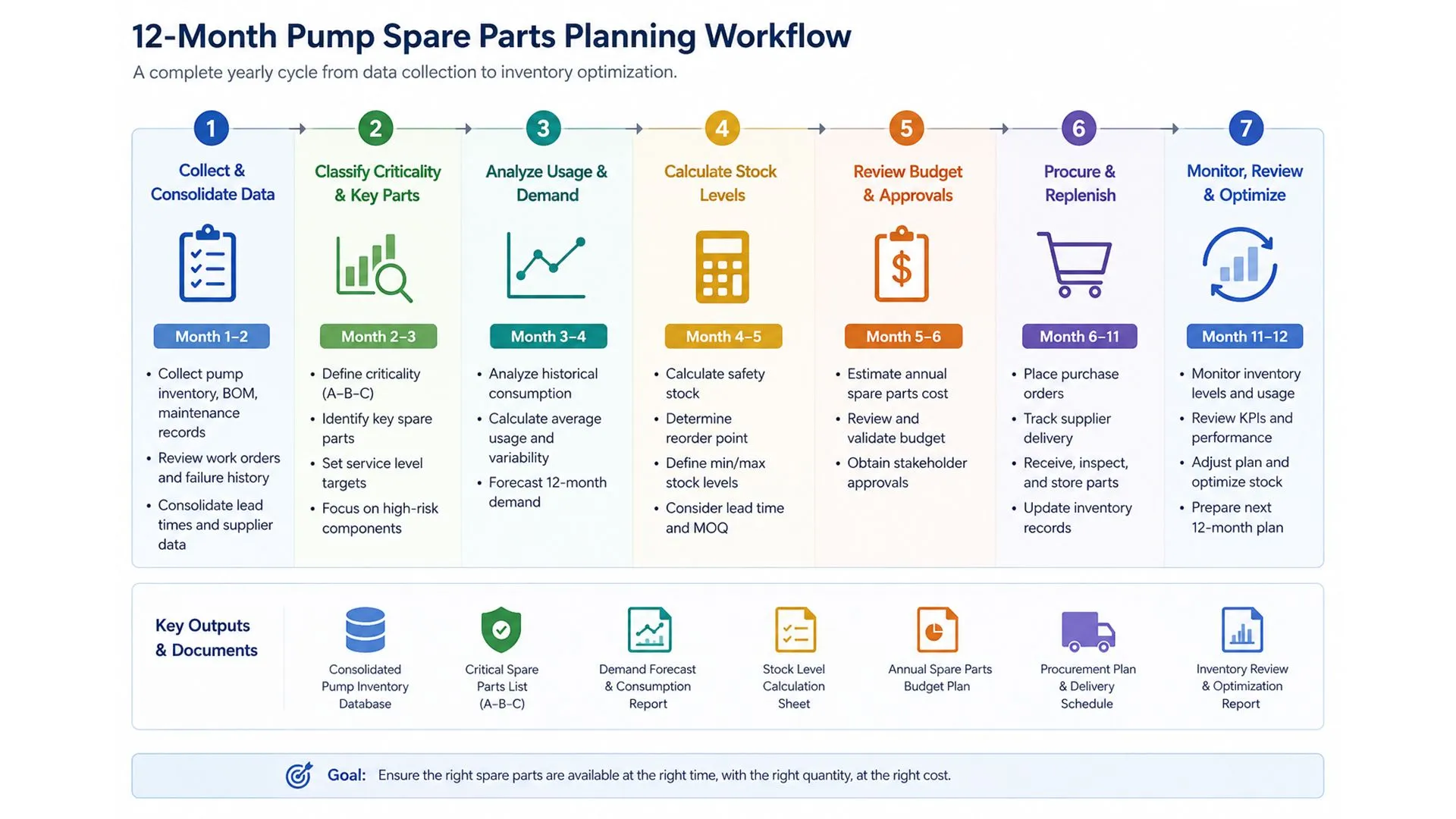
A 12-month spare parts plan helps buyers move from emergency purchasing to controlled maintenance. The plan should combine installed pump data, criticality, historical consumption, supplier lead time, and annual maintenance budget.
Step 1: List All Installed Pumps
The first step is to build an installed pump register. Buyers cannot plan spare parts accurately if they do not know how many pumps are installed, where they are used, and which pumps share common components.
The pump register should include:
- Pump tag number
- Pump model
- Serial number
- Application
- Duty/standby status
- Operating hours
- Liquid
- Criticality level
- Supplier
- Installation date
- Motor power
- Main spare parts already available
This register becomes the foundation for spare parts planning. It also helps procurement teams avoid ordering duplicate parts for pumps that already share common components.
Step 2: Classify Pumps by Criticality
Critical pumps should receive stronger spare parts coverage than non-critical pumps. The classification should reflect downtime impact, safety risk, process importance, and replacement difficulty.
| Pump Criticality | Example | Spare Parts Strategy |
|---|---|---|
| Critical | Main process pump, boiler feed pump, mining dewatering pump | Keep emergency kit and long-lead critical parts |
| Important | Cooling water pump, booster pump, wastewater transfer pump | Keep wear parts and seal/bearing kits |
| Normal | Intermittent transfer pump | Keep basic consumables |
| Low | Non-essential auxiliary pump | Order parts when needed |
This classification prevents overstocking low-risk pumps and understocking critical systems.
Step 3: Check Historical Failure and Consumption Data
If the pump has been running for more than one year, historical maintenance data is more useful than a generic supplier list. Real site data shows which parts fail in the actual application.
Check:
- Seal replacement frequency
- Bearing failure history
- Impeller wear rate
- Gasket consumption
- Leakage records
- Vibration trend
- Previous emergency purchases
- Parts that took longest to arrive
- Parts repeatedly ordered in small quantities
- Parts that remained unused for years
Historical consumption helps buyers adjust the spare parts list. If mechanical seals are replaced every six months, one seal set may not be enough. If a large casing has never failed and can be supplied quickly, keeping one in stock may not be necessary.
Step 4: Confirm Supplier Lead Time
Lead time is one of the most important factors in spare parts planning. A low-failure part may still need inventory if it takes months to manufacture or import.
| Lead Time | Suggested Planning Action |
|---|---|
| Local same-day supply | No need for high stock unless the part is critical |
| 1–2 weeks | Keep minimum stock for critical pumps |
| 3–6 weeks | Plan quarterly inventory review |
| 2–3 months | Consider advance purchase for critical parts |
| Custom manufacturing | Keep one set if downtime cost is high |
Buyers should confirm normal lead time and emergency lead time separately. Some suppliers may quote a short lead time during sales but require much longer delivery for special materials, old models, or custom parts.
Step 5: Build the Annual Spare Parts Budget
The spare parts budget should be based on risk, not a random percentage of pump price. A good budget should separate routine consumables, annual wear parts, and emergency critical spares.
The budget should consider:
- Number of pumps
- Operating hours
- Failure history
- Liquid abrasiveness
- Corrosiveness
- Downtime cost
- Delivery lead time
- Supplier reliability
- Standby pump availability
- Local sourcing options
- Storage condition
The final budget should be reviewed by maintenance, procurement, and operations together. Maintenance understands failure risk. Procurement understands supplier lead time. Operations understands downtime cost. Finance controls inventory budget. A spare parts plan only works when all four perspectives are included.
How to Plan Spare Parts for New Pump Orders
Spare parts planning should begin before the pump order is placed. If buyers wait until the pump arrives on site, they may lose the chance to review part numbers, negotiate spare part prices, and include critical parts in the initial shipment.
Ask for a Recommended Spare Parts List Before Purchase
Buyers should request a recommended spare parts list during the quotation or technical clarification stage. This allows the spare parts package to be reviewed together with the pump selection.
Ask the supplier to provide:
- 1-year spare parts list
- 2-year spare parts list
- Startup and commissioning spare kit
- Critical spare parts list
- Long-lead-time spare parts list
- Exploded drawing
- BOM with materials
- Recommended quantity
- Unit price
- Delivery time
- Interchangeability information
A supplier’s recommended list is a starting point, not the final answer. The buyer should adjust it based on the actual application.
Compare Supplier Spare Parts List With Real Site Conditions
Supplier spare parts lists are often standardized. They may not fully reflect the buyer’s site conditions, operating hours, liquid, or maintenance capacity.
Buyers should adjust the list based on:
- Liquid condition
- Operating hours
- Site remoteness
- Standby pump availability
- Maintenance skill level
- Local sourcing possibility
- Cost of downtime
- Criticality of the system
- Previous failure experience with similar pumps
For example, a standard clean-water spare parts list may not be enough for seawater, slurry, wastewater, or chemical water. A remote site may need higher stock than a plant located near a service center.
Include Spare Parts in the Initial Contract
Spare parts should be included in the initial contract when the pump is critical, customized, or installed in a remote location. If spare parts are purchased later, the buyer may face higher prices, longer lead time, model changes, or weaker supplier response.
The contract should define:
- Spare part name
- Part number
- Material
- Quantity
- Unit price
- Delivery time
- Warranty relationship
- Interchangeability
- Packing method
- Serial number reference
- Documentation requirement
This is especially important for project pumps, export orders, and distributors who need long-term after-sales support.
Spare Parts Planning for Pump Distributors
Pump distributors need a different spare parts strategy from end users because they support multiple customers, multiple pump models, and urgent after-sales requests. Their goal is not to stock every part, but to stock fast-moving parts that protect customer trust.
What Distributors Should Keep in Local Stock
Distributors should identify the most common pump models sold in their market and build a fast-moving spare parts list by model family. This avoids tying too much cash in rare parts while still allowing quick service for common failures.
Distributor stock should usually include:
- Common mechanical seal sizes
- Common bearing sets
- Gasket and O-ring kits
- Coupling elements
- Packing material
- Common impellers for best-selling models if lead time is long
- Submersible pump cables and sensors for common models
- Basic wet-end parts for high-wear applications
What Distributors Should Not Overstock
Distributors should avoid stocking expensive, slow-moving, or highly customized components unless there is clear demand history or supplier agreement.
Avoid overstocking:
- Custom pump casings
- Rare impeller sizes
- Special shafts for low-volume models
- Obsolete model parts
- Parts without clear serial number match
- Large motors unless local demand is predictable
How Distributors Should Work With the Factory
Distributors should work with the pump manufacturer to maintain a clear spare parts support system. The distributor does not need to own every part, but it should know which parts can be supplied quickly and which parts require advance planning.
A strong distributor spare parts system should include:
- Serial number tracking for sold pumps
- Fast-moving spare parts list
- Emergency factory lead time agreement
- Shared exploded drawings
- Clear part numbering system
- Warranty spare parts process
- Annual spare parts consumption review
This approach helps distributors protect after-sales reputation without turning the warehouse into dead inventory.
How to Plan Spare Parts for Existing Pump Systems
Existing pump systems often have incomplete records, mixed inventory, old spare parts, and unclear part numbers. The first task is not buying more parts. The first task is auditing what is already installed and what is already in stock.
Audit Current Pump Inventory
A spare parts inventory audit helps buyers identify usable parts, wrong parts, obsolete parts, and missing critical items. This prevents repeated emergency purchases and reduces dead stock.
Check:
- Which parts are currently in stock?
- Which pump does each part fit?
- Is the material still readable?
- Is the part damaged or corroded?
- Is storage condition acceptable?
- Is the part obsolete?
- Does it match the current pump version?
- Is the shelf life still acceptable?
- Is the part labeled by serial number or only by model?
Old inventory should not be trusted automatically. Rubber parts may harden. Bearings may be contaminated. Seal faces may be scratched. Parts for retired pumps may remain on shelves for years.
Create a Spare Parts Cross-Reference Table
A cross-reference table helps buyers reduce inventory by identifying interchangeable parts across multiple pumps. This is useful when a plant uses several similar pump models.
| Part | Fits Pump Models | Interchangeable? | Stock Quantity | Notes |
|---|---|---|---|---|
| Mechanical seal | Pump A / Pump B | Yes | 2 sets | Same shaft size and material |
| Bearing 6312 | Pump C / Pump D | Yes | 4 pcs | Confirm clearance |
| Impeller | Pump A only | No | 1 pc | Trimmed diameter |
| Gasket kit | Pump A / B / C | Partial | 3 sets | Check casing size |
| Coupling element | Pump D / Pump E | Yes | 2 pcs | Confirm coupling brand |
Interchangeability must be confirmed by drawing, part number, or supplier documentation. Buyers should not assume interchangeability only because two pumps look similar.
Identify Obsolete or Dead Inventory
Dead inventory creates false confidence. A warehouse may look full, but many parts may not fit any current pump or may be too old to use.
Common dead inventory issues include:
- Rubber parts hardened
- Seal faces damaged
- Bearings contaminated
- Wrong model parts kept for years
- Parts for pumps no longer in service
- No label or traceability
- Unknown material
- Old design parts that no longer match current pump version
After identifying dead inventory, buyers should decide whether to relabel, inspect, return, discard, or keep only for emergency reference.
Storage and Handling Rules for Pump Spare Parts
Spare parts can fail before installation if they are stored incorrectly. Buyers should treat mechanical seals, bearings, rubber parts, and precision components as controlled maintenance assets, not ordinary warehouse items.
Store Mechanical Seals Carefully
Mechanical seals are precision parts. Poor storage may damage seal faces, elastomers, springs, or secondary seals before installation.
Recommended storage rules include:
- Keep in original packaging
- Avoid dust and moisture
- Do not touch seal faces
- Avoid high temperature
- Track shelf life for elastomers
- Store by pump serial number or part number
- Keep seal parts away from vibration and impact
If the pump is already leaking at the seal area, this pump seal leak troubleshooting guide can help buyers decide whether to replace the seal, check alignment, or review operating conditions.
If the pump uses gland packing or a special sealing arrangement, the spare parts list should follow that specific design instead of assuming a standard mechanical seal.
Protect Bearings From Moisture and Contamination
Bearings can fail early if stored improperly. Even unused bearings may become unreliable if moisture, dust, or vibration damages them during storage.
Recommended bearing storage rules include:
- Store in sealed package
- Avoid moisture
- Avoid dust and chemical exposure
- Avoid vibration during storage
- Keep away from high temperature
- Rotate stock if shelf time is long
- Confirm bearing type and clearance before installation
A bearing should not be opened until installation preparation. Once packaging is damaged, contamination risk increases.
Label Every Spare Part Clearly
The most common warehouse problem is not always lack of parts. It is unclear identification. If the maintenance team cannot identify which pump a part belongs to, the part may be useless during an emergency.
A spare part label should include:
- Pump model
- Serial number
- Part name
- Part number
- Material
- Quantity
- Date received
- Supplier
- Storage location
- Applicable pump tag
Clear labeling reduces maintenance delay and prevents accidental installation of wrong parts.
Common Spare Parts Planning Mistakes Buyers Should Avoid
Many spare parts problems come from planning mistakes rather than technical complexity. Buyers can prevent most of these problems by using serial number traceability, material confirmation, criticality ranking, and regular inventory review.
Mistake 1: Buying Only the Cheapest Spare Parts Package
The cheapest spare parts package may include low-value consumables but miss critical components that actually stop the pump. Buyers should review what is included instead of comparing only package price.
A cheap package without seals, bearings, wear rings, or application-specific parts may look economical at purchase time but fail to protect the plant during operation.
Mistake 2: Stocking Major Parts but Forgetting Small Consumables
Some buyers purchase expensive parts such as impellers but forget gaskets, O-rings, or packing. During repair, the maintenance team cannot reassemble the pump correctly because small sealing parts are missing.
A complete maintenance kit should include the small parts required to complete the repair, not only the visible major component.
Mistake 3: Ordering by Pump Model Only
Ordering by pump model only is risky because the same model may have different configurations. Buyers should use model, serial number, part number, material, and drawing confirmation together.
This is especially important for impellers, mechanical seals, shaft sleeves, wear rings, cables, and multistage internal parts.
Mistake 4: Ignoring Lead Time
A part with low failure frequency can still be critical if delivery takes a long time. Buyers should not judge spare parts only by how often they fail.
For remote sites and imported pumps, customs clearance and transport time may be as important as production lead time.
Mistake 5: Not Updating the Spare Parts List After Repair
Every repair changes the spare parts situation. If the team replaces a seal but does not update inventory, the next failure may occur with no seal in stock.
After every repair, update:
- Parts consumed
- Parts reordered
- Failure reason
- Installation date
- Supplier response
- Actual lead time
- Whether the spare part worked correctly
- Whether the spare parts plan should be adjusted
FAQ About Pump Spare Parts Planning
Pump spare parts planning usually raises practical questions about what to buy, how many to stock, whether to use OEM parts, and how to avoid wrong parts. These answers focus on the decisions buyers need to make before maintenance becomes urgent.
What pump spare parts should I buy with a new pump?
For most industrial pumps, buyers should consider at least a mechanical seal, bearing set, gasket kit, O-ring kit, coupling element, and application-specific wear parts. The final list should depend on pump type, operating hours, liquid condition, supplier lead time, and downtime cost.
For clean water pumps, a basic maintenance kit may be enough. For slurry, sewage, chemical, mining, or continuous-duty pumps, buyers should add wear parts, electrical parts, seal protection parts, or long-lead critical parts according to the application.
Should I buy one full set of all spare parts?
A full spare parts set is not always necessary. It may waste budget if many parts are unlikely to fail, locally available, or not critical to operation. Buyers should prioritize failure-critical, frequently replaced, and long-lead-time parts.
A better method is to classify parts by criticality. Keep low-cost consumables and critical failure parts in stock, review wear parts based on operating conditions, and decide expensive major components based on downtime cost and lead time.
What is the difference between consumable spare parts and critical spare parts?
Consumable spare parts are replaced frequently during normal maintenance, such as gaskets, O-rings, packing, and some seal kits. Critical spare parts are parts whose failure can stop the pump, cause major leakage, create safety risk, or delay production.
Some parts can be both consumable and critical. A mechanical seal, for example, may be replaced periodically, but its failure can also stop the pump immediately if leakage becomes unsafe.
Should spare parts be ordered together with the pump?
Spare parts should usually be ordered together with the pump when the pump is critical, customized, imported, installed in a remote site, or required for project commissioning. Ordering together helps confirm correct part numbers, lock the initial price, and reduce future lead time.
For common low-risk pumps, buyers may order only a basic maintenance kit first and expand the spare parts inventory after reviewing actual operating history.
How do I know whether a pump spare part is critical?
A pump spare part is critical if its failure can stop the pump, create safety risk, cause major leakage, reduce system capacity, or require long delivery time. Mechanical seals, bearings, coupling elements, submersible cables, and certain wet-end parts are commonly critical.
The buyer should also consider whether the site has a standby pump. If there is no standby pump, more parts become critical because any failure can stop the system.
Can I use local spare parts instead of OEM parts?
Local sourcing may be acceptable for standard bearings, fasteners, packing, grease fittings, standard coupling elements, or simple gaskets if specifications are confirmed. OEM or supplier-approved equivalent parts are recommended for impellers, wear rings, shaft sleeves, special seals, multistage internal parts, and parts affecting hydraulic performance or warranty.
The decision should not be based only on price. Buyers should ask whether the part affects fit, sealing, hydraulic performance, warranty responsibility, and service life.
How often should pump spare parts inventory be reviewed?
Critical pump spare parts should be reviewed at least every 3–6 months. Normal pump systems may be reviewed annually. Inventory should also be updated after major repair, emergency failure, pump replacement, supplier design change, or repeated part consumption.
A review should check stock quantity, part condition, shelf life, labeling, supplier lead time, and whether the spare parts list still matches the installed pumps.
What information should I provide when ordering pump spare parts?
Buyers should provide pump model, serial number, part name, part number, material, impeller diameter if relevant, photos of the old part, and application condition. Ordering only by pump model increases the risk of receiving the wrong part.
For customized pumps, buyers should also provide the original PO number, project name, drawing number, and any previous maintenance record.
Are mechanical seals always necessary spare parts?
For most industrial pumps, mechanical seals are among the most important spare parts because seal leakage is a common reason for shutdown. However, the correct seal type, face material, elastomer, spring material, and size must match the liquid and operating condition.
If the pump uses gland packing, cartridge seals, magnetic drive design, or another special sealing arrangement, the spare parts list should follow the actual pump design rather than assuming a standard mechanical seal.
How can I reduce spare parts inventory cost without increasing downtime risk?
Buyers can reduce inventory cost by standardizing pump models, identifying interchangeable parts, keeping only critical parts locally, using supplier stocking agreements, reviewing actual consumption, and avoiding unnecessary major parts inventory for low-risk pumps.
The goal is not to minimize stock blindly. The goal is to keep the parts that prevent downtime while avoiding parts that are expensive, rarely used, and easy to obtain when needed.
Conclusion: A Good Pump Spare Parts Plan Balances Downtime Risk, Lead Time, and Inventory Cost
A good pump spare parts plan is not the largest list of components a buyer can purchase. It is a controlled maintenance strategy that balances failure risk, replacement frequency, supplier lead time, downtime cost, and inventory budget.
Buyers should start by classifying parts into consumables, wear parts, failure-critical parts, and long-lead-time parts. Then they should build the list from the BOM, confirm serial numbers and materials, choose the right spare parts package by scenario, adjust the plan by pump type and application risk, and review stock regularly based on actual failure history.
Critical pumps need stronger emergency kits and clearer supplier support. Low-risk pumps may only need basic consumables and normal maintenance parts. Remote sites need more lead-time protection. Continuous-duty systems need more uptime-focused planning. Distributors need fast-moving parts by model family rather than excessive stock for every model.
The final goal is simple: keep production running without wasting budget on unused inventory. A spare parts plan should help the buyer repair faster, order accurately, reduce emergency purchasing, and avoid preventable downtime before the pump fails.
Get A Quote

Get A Quote
0 Comments