
Pump Motor Gets Too Hot: A Practical Field Guide to Diagnose the Real Cause Before Damage Happens
Introduction
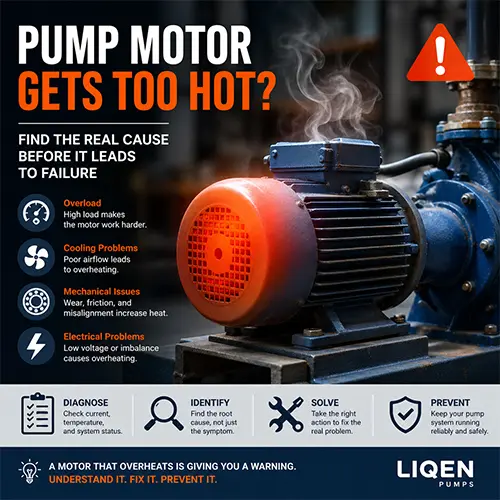
When a pump motor gets too hot, most users react too late or in the wrong way. The common response is to assume the motor is faulty, shut the system down, and consider replacing it. However, in real applications, the motor is rarely the root cause.
In most cases, the motor is simply responding to abnormal conditions in the system. It overheats because it is being forced to work harder than expected, or because it cannot release the heat it naturally generates. If the underlying issue is not identified, replacing the motor will only delay the problem.
Understanding this changes your approach completely. Instead of focusing on the motor, you start reading the system. The temperature rise is a signal, and if you interpret it correctly, you can usually locate the cause quickly and prevent further damage.
What “Too Hot” Actually Means in Practice
Before diagnosing anything, you need a realistic reference. Not every hot motor is a problem. Electric motors are designed to operate warm, and the key is whether the temperature is stable or continuously increasing.
In field conditions, operators often use touch as a quick check. If the motor is warm but you can keep your hand on it, it is generally within a safe range. If it becomes too hot to touch for more than a second or two, the temperature has likely entered a warning zone. If you smell insulation or notice rapid temperature rise, the situation is already critical.
The important factor is not just temperature, but behavior over time. A motor that stabilizes at a higher temperature may still be acceptable. A motor that keeps heating up is heading toward failure.
Start by Observing How the Motor Runs
Before using instruments, stand next to the pump and observe.
If the motor sounds heavier than before, or if the pump seems to struggle, the overheating is almost always related to increased load. The motor is working harder, drawing more current, and producing more heat.
If the motor runs smoothly, without strain, but still gets hot, the problem is different. In that case, the heat is not coming from effort, but from poor heat dissipation or internal inefficiency.
This simple observation already tells you where to focus. It prevents unnecessary disassembly and saves time.
Confirm the Direction by Checking Current
To move from observation to certainty, measure the motor current under normal operating conditions.
This is the most reliable diagnostic step because motor heating is directly linked to electrical load. If the current is above the rated value, the motor is overloaded. If the current is within normal range, the cause lies elsewhere.
| Current Reading vs Nameplate | Interpretation | What It Means |
| Above ~110% | Overload | System is forcing the motor |
| Within 90–110% | Normal load | Check cooling or motor condition |
| Unstable or fluctuating | Power issue | Check electrical supply |
This step separates system problems from motor problems.
When Overheating Is Caused by System Load
If the current is high and the motor sounds strained, the system is overloading the motor.
This usually does not come from a failure, but from a change. Something in the system has increased resistance. In many cases, it is as simple as a valve being partially closed, or pressure in the system increasing.
You can confirm this by slightly adjusting the discharge side. If the motor becomes lighter and current drops, the cause is clear.
What is important here is understanding the implication. The motor is functioning correctly, but it is operating outside its intended range. If you replace the motor without correcting the system, the new motor will overheat in the same way.
If the system has always operated like this, the issue may go back to pump selection. In that case, reviewing a structured approach such as the pump selection checklist helps determine whether the pump matches the system requirements.
When the Motor Runs Smoothly but Still Overheats
If the current is normal and the motor runs without strain, then overheating is not caused by load. Instead, it is usually caused by poor heat dissipation.
Motors rely on airflow to remove heat. If airflow is blocked or insufficient, heat accumulates even under normal operating conditions.
In real environments, this often happens gradually. Dust builds up on the motor surface, cooling fins become clogged, or the motor is installed in a confined space where hot air cannot escape.
You can verify this by checking airflow near the motor fan. A healthy motor should produce noticeable airflow. If airflow is weak or blocked, heat removal is compromised.
| Cooling Condition | What Happens | Result |
| Blocked vents or dust | Reduced heat transfer | Temperature increases |
| Poor airflow | Heat accumulation | Continuous overheating |
| Confined installation | No heat escape | Rising temperature over time |
| Symptom | Likely Cause | What It Indicates |
| Grinding or rough sound | Bearing wear | Increased friction |
| Noticeable vibration | Misalignment | Uneven load |
| Heat near shaft ends | Bearing friction | Mechanical resistance |
In this case, replacing the motor will not solve the issue. The mechanical problem must be addressed first.
If vibration is present, it is important to check system alignment and stability. You can refer to pump vibration troubleshooting to identify whether the issue comes from alignment, imbalance, or structural factors.
When Overheating Follows Electrical Changes
If the motor starts overheating after rewiring or electrical maintenance, the cause is often electrical.
One of the most common issues is low voltage. When voltage drops, the motor draws more current to maintain performance. This increased current leads directly to overheating.
Another possibility is phase imbalance, where one phase carries more load than the others. This condition does not always stop the motor, but it reduces efficiency and increases heat.
| Electrical Issue | Effect on Motor | Result |
| Low voltage | Increased current | Overheating |
| Phase imbalance | Uneven load | Heat + vibration |
| Loose connections | Resistance | Local heating |
If the problem appeared immediately after electrical work, always verify the power supply before checking mechanical components.
When the Shaft Does Not Rotate Freely
If the shaft is difficult to turn, the motor is being forced to overcome internal resistance.
This is a critical condition because it leads to rapid overheating.
Common causes include seized bearings, debris inside the pump, impeller contact, or misalignment.
In this situation, continued operation is risky. The motor will overheat quickly, and damage can become permanent.
The correct action is to stop the system and inspect the mechanical components.
Deciding Whether to Continue Running
Not every hot motor requires immediate shutdown, but the decision depends on how the temperature behaves.
| Temperature Behavior | Recommendation |
| Stable at moderate level | Continue monitoring |
| High but stable | Short-term operation |
| Continuously rising | Stop |
| Smell or vibration present | Stop immediately |
The key is whether the temperature stabilizes or continues to increase. Rising temperature always indicates a progressing problem.
Repair or Replace: Making the Right Decision
When a pump motor gets too hot, replacing the motor is not always the best solution.
If the cause is system load, adjusting the system is enough. If the cause is cooling, cleaning and improving airflow solves the issue. If the cause is mechanical resistance, repairing bearings or alignment is necessary.
Motor replacement should only be considered when internal damage has already occurred, such as insulation degradation from repeated overheating.
| Situation | Best Approach |
| System overload | Adjust system |
| Cooling issue | Clean and ventilate |
| Mechanical resistance | Repair components |
| Repeated overheating | Replace motor |
Understanding this prevents repeated failures and unnecessary cost.
FAQ About Pump Motor Gets Too Hot
When a pump motor gets too hot, users are usually not looking for theory—they need to decide what to do next: stop or keep running, repair or replace, check which part first. The following questions are based on real on-site concerns and help you make correct decisions quickly.
Should I stop the pump immediately if the motor gets too hot?
You should stop the pump immediately if the temperature is still rising, if overload protection trips, or if you notice burning smell, vibration, or abnormal noise. These are signs that the motor is under stress and damage may already be happening.
If the motor is hot but stable, with no smell, no vibration, and no change in sound, short-term operation may be acceptable while you investigate the cause. However, a motor that keeps getting hotter over time should never be ignored, because overheating always leads to failure if not corrected.
My pump motor gets too hot but still runs normally — is it safe?
This situation is more dangerous than it looks.
A motor can run “normally” while internal insulation is slowly degrading due to overheating. If your pump motor gets too hot but shows no obvious load symptoms, the most likely issue is poor cooling or heat buildup.
In this case, you should not rely on how the motor sounds. Instead, check airflow, cooling condition, and environment. Running the pump without solving the overheating problem can shorten motor life significantly.
How do I know if the overheating is caused by the pump or the motor?
The fastest and most reliable way is to check the motor current.
If current is higher than the rated value, the pump system is causing overload, and the motor is reacting to it. If current is normal but the motor gets too hot, the issue is usually cooling or internal motor condition.
This distinction is critical because it determines whether you need to fix the system or the motor itself.
Should I replace the motor if it keeps overheating?
You should not replace the motor until you are sure the root cause is inside the motor.
In many real cases, motors are replaced because they get too hot, but the actual cause is system overload, poor ventilation, or mechanical resistance. In those cases, a new motor will overheat in the same way.
Motor replacement is only recommended when there is clear evidence of internal damage, such as burning smell, insulation failure, or repeated overheating even after system issues have been corrected.
Can small system changes really cause pump motor overheating?
Yes, and this is one of the most common causes.
A small change—such as slightly closing a valve, increasing system pressure, or changing the fluid condition—can increase resistance enough to push the pump away from its optimal operating point. This increases load and causes the motor to overheat.
If your pump motor gets too hot after any system adjustment, always check whether the operating condition has changed.
My pump motor gets too hot after installation or rewiring — what should I check first?
You should check the power supply before anything else.
Overheating after installation is often caused by low voltage, phase imbalance, incorrect wiring, or wrong rotation direction. These issues increase current and lead to overheating even if the pump itself is in good condition.
Before opening the pump or replacing mechanical parts, verify voltage stability and wiring correctness.
Is it better to repair or replace when a pump motor overheats?
In most cases, repairing the cause is more effective and much cheaper.
If overheating is caused by system load, cooling, or mechanical resistance, correcting those issues will solve the problem without replacing the motor. If you replace the motor without fixing the cause, the problem will return.
Replacement is only the right decision when the motor itself is already damaged and cannot operate safely.
What is the biggest mistake when a pump motor gets too hot?
The biggest mistake is replacing the motor without diagnosing the cause.
This leads to repeated overheating, higher costs, and more downtime. The correct approach is always to identify whether the problem is load, cooling, electrical, or mechanical before taking action.
Conclusion
When a pump motor gets too hot, the motor itself is almost never the starting point of the problem. It is the final indicator that something in the system is no longer working as intended.
What separates effective troubleshooting from repeated failure is not experience, but approach.
If you start by replacing parts, you are guessing.
If you start by reading the system, you are diagnosing.
In practical terms, the solution always follows the same logic:
- If the motor is struggling, reduce system load
- If the motor runs smoothly but heats up, improve cooling
- If vibration or noise appears, fix mechanical resistance
- If the issue follows electrical work, verify power supply
Only after the real cause is identified should you decide whether repair or replacement is necessary.
A motor that overheats is not the problem—it is the warning.
If you respond to that warning correctly, you prevent damage.
If you ignore it or misinterpret it, the cost will multiply—often quickly.
The goal is not to keep the motor running.
The goal is to keep the system running correctly.
Get A Quote

Get A Quote
0 Comments