
Before You Buy a Pump: Full Checklist to Avoid Expensive Mistakes
Introduction
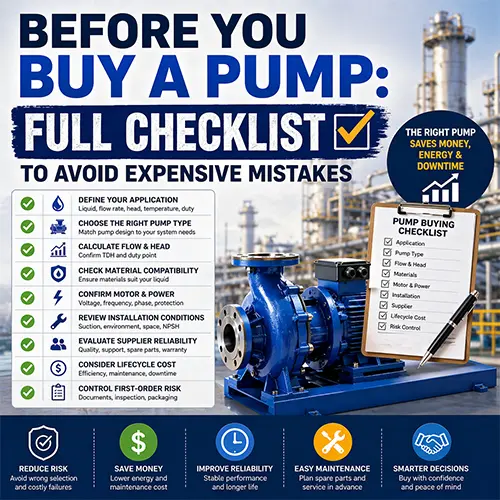
Buying a pump seems easy at first. Many buyers start by asking for a price, comparing motor power, checking inlet and outlet size, and then choosing the option that looks affordable. But in real projects, this is exactly where many expensive mistakes begin.
A pump is not just a standalone machine. It works inside a complete system that includes liquid conditions, pipe layout, valves, vertical lift, discharge pressure, power supply, installation environment, working hours, and future maintenance. If one key condition is ignored before purchase, the pump may still be delivered correctly, but it may not work correctly on site.
For example, a buyer may purchase a pump with the right pipe connection size but insufficient head. After installation, water comes out, but the pressure is too weak. Another buyer may choose a cast iron pump for slightly corrosive water because the price is lower, only to find rust and leakage after a short period. In some cases, the buyer blames the pump quality, but the real issue is that the buying checklist was incomplete.
This guide is written for industrial buyers, contractors, distributors, irrigation users, facility managers, and first-time importers who want to make a safer pump purchasing decision. It explains what you should check before buying, why each item matters, what can go wrong if it is ignored, and how to communicate with suppliers more clearly.
The goal is simple: help you buy the right pump for the real working condition, not just the cheapest pump on the quotation sheet.
Why Most Pump Buying Mistakes Happen Before Installation
Most pump problems do not start when the pump is installed. They start much earlier, during inquiry, selection, quotation, or supplier comparison. Once the wrong pump has been ordered, the buyer may not notice the mistake until the equipment arrives on site and fails to meet the system requirement.
A common mistake is buying by horsepower. Many buyers assume that a larger motor means better performance. In reality, horsepower only tells you how much power the motor can provide. It does not tell you whether the pump can deliver the required flow at the required head. A 5.5 kW pump and another 5.5 kW pump may perform very differently depending on hydraulic design, impeller size, speed, efficiency, and pump type.
Another common mistake is buying by pipe size. A buyer may say, “I need a 3-inch pump,” but pipe size alone is not enough. A 3-inch pump can have different flow ranges, pressure capabilities, motor powers, and application limits. If the supplier quotes based only on connection size, the risk of mismatch is high.
Price-only purchasing is also risky. The cheapest pump may reduce the initial budget, but it may use lower-grade materials, weaker bearings, less efficient hydraulic design, or poor sealing components. If the pump runs only occasionally, this may not be obvious immediately. But for continuous operation, poor efficiency and frequent maintenance can quickly exceed the money saved at purchase.
| Buying Mistake | What Often Happens Later |
| Buying only by price | Higher repair cost, short service life, unstable performance |
| Buying only by horsepower | Flow or pressure may not match real demand |
| Buying only by pipe size | Pump may be physically connected but hydraulically wrong |
| Ignoring liquid condition | Corrosion, clogging, seal failure, impeller wear |
| Ignoring supplier capability | Poor documentation, delayed delivery, weak after-sales support |
A good pump purchase starts with a complete understanding of the application. The buyer does not need to become a pump engineer, but they must provide enough real system information so the supplier can select the correct model.
Step 1: Define What the Pump Must Actually Do
Before comparing pump brands or prices, the buyer should first define the job of the pump. This sounds simple, but many purchasing problems happen because the buyer only describes the product they want, not the problem the pump must solve.
The first question is: what liquid are you pumping? Clean water, wastewater, slurry, seawater, chemical liquid, hot water, oil, and food-grade liquid all require different pump structures and materials. A pump that works well for clean water may fail quickly in slurry because abrasive particles damage the impeller and casing. A pump suitable for freshwater may corrode in seawater if the material is wrong.
The second question is: how much liquid must be moved? This is the required flow rate. Flow is normally expressed in cubic meters per hour, liters per minute, or gallons per minute. If the flow is too low, the system cannot meet production or water supply demand. If the pump is oversized, it may waste energy, create control problems, or operate far from its best efficiency point.
The third question is: how much resistance must the pump overcome? This is usually described as head or pressure. Head includes vertical lift, pipe friction, valve losses, and required discharge pressure. Many buyers underestimate this part. They may only calculate vertical height and forget pipe losses, elbows, filters, valves, or long horizontal pipelines.
The fourth question is: how long will the pump run each day? A pump used for two hours per day in irrigation does not have the same duty requirement as a pump running 24 hours per day in an industrial plant. Continuous operation requires stronger attention to efficiency, bearing life, cooling, and maintenance access.
A simple but useful inquiry summary should include:
| Information Needed | Why It Matters |
| Liquid type | Determines pump type, material, seal choice |
| Required flow | Determines hydraulic capacity |
| Required head | Determines pressure capability |
| Working hours | Affects durability and efficiency priority |
| Installation site | Affects motor protection and maintenance access |
| Power supply | Determines motor compatibility |
If you cannot provide all information, at least tell the supplier what you know and what you are unsure about. A professional supplier should ask follow-up questions instead of blindly quoting.
Step 2: Choose the Correct Pump Type for the Application
Different pump types exist because different systems require different hydraulic behavior. Choosing the wrong pump category is one of the most expensive mistakes a buyer can make.
For general clean water transfer, an end suction centrifugal pump is often a practical choice. It is widely used, relatively simple, and suitable for many industrial and agricultural applications. However, if the project requires high pressure, a single-stage end suction pump may not be enough. In that case, a multistage pump may be more suitable because it uses multiple impellers to build higher pressure.
For drainage, wells, sewage pits, or locations where the pump must operate underwater, a submersible pump may be required. But not all submersible pumps are the same. A clean water submersible pump should not be used for sewage with solids unless it is designed for solids handling.
For slurry, mining, dredging, or abrasive liquids, a slurry pump is usually required. Slurry is difficult because it contains solid particles that wear normal pump components quickly. Using a clean water pump for slurry may save money at first but often leads to rapid failure.
For HVAC circulation or building systems where space is limited, inline pumps can be useful. For high-flow municipal or industrial water transfer, split case pumps may be more appropriate because they are designed for large flow and easier maintenance.
| Pump Type | Better For | Buyer Should Avoid |
| End suction pump | General clean water transfer | Abrasive slurry or very high pressure without checking |
| Multistage pump | High pressure boosting | Dirty liquid with solids unless designed for it |
| Submersible pump | Wells, drainage, sewage pits | Dry installation unless specified |
| Slurry pump | Abrasive solids | Clean water projects where efficiency is priority |
| Inline pump | HVAC and circulation | Heavy solids or difficult suction conditions |
| Split case pump | High flow water systems | Small low-budget applications |
A buyer should not ask, “Which pump is best?” The better question is, “Which pump type is best for this liquid, this flow, this head, this installation, and this operating schedule?”
That question leads to a safer purchasing decision.
Step 3: Confirm Flow and Total Dynamic Head Before Requesting Final Price
Flow and head are the two most important technical parameters in pump selection. If these two are wrong, the final pump selection is usually wrong.
Flow means how much liquid the pump must move within a specific time. Head means the total resistance the pump must overcome to move that liquid from the source to the discharge point. Buyers often understand flow more easily than head. They may know they need 50 m³/h, but they may not know how much pressure is required to deliver that flow through the real pipeline.
Total Dynamic Head, often called TDH, is not only vertical height. It includes the elevation difference, pipe friction loss, valve loss, filter loss, elbow loss, and required outlet pressure. If the system includes a long pipe, many bends, a filter, or a pressurized tank, the required head can be much higher than the visible height.
For example, if water must be lifted 20 meters vertically, a buyer may think a 20-meter head pump is enough. But if pipe friction adds 8 meters and the outlet pressure requirement equals another 12 meters, the actual required head is about 40 meters. A 20-meter pump may run, but it will not deliver the required flow.
This is why buyers should always ask the supplier for a pump performance curve. The curve shows how much flow the pump can deliver at different head values. A professional supplier should mark the duty point on the curve. The duty point is the buyer’s required flow and required head combined.
| Term | Plain Explanation | Why Buyer Should Care |
| Flow | How much liquid is moved | Determines capacity |
| Head | Resistance the pump must overcome | Determines pressure performance |
| TDH | Total system resistance | Prevents under-sizing |
| Duty point | Required flow + required head | Shows whether pump is suitable |
| Pump curve | Performance map of pump | Confirms selection evidence |
Step 4: Check Liquid Compatibility and Material Selection
Material selection directly affects pump life. Many buyers focus on price and ignore what the liquid will do to the pump over time. This is especially risky when the liquid is corrosive, abrasive, hot, chemically treated, or contaminated.
Cast iron is commonly used for clean water because it is strong and cost-effective. For ordinary water transfer, it can be a practical choice. But cast iron is not suitable for every liquid. If the water contains corrosive chemicals, high chloride content, or seawater, cast iron may rust or degrade faster than expected.
Stainless steel is often selected for corrosion resistance, but buyers should not assume all stainless steel is the same. SS304 may be enough for mild corrosion, while SS316 offers better resistance in more demanding conditions. For seawater or highly corrosive environments, duplex stainless steel or other special materials may be required.
For slurry and abrasive liquids, corrosion is not the only concern. Wear is often more important. Abrasive solids can damage impellers, casings, and wear plates. In that case, high chrome alloy, rubber lining, or other wear-resistant solutions may be needed.
| Liquid Condition | Common Material Direction | Risk If Wrong |
| Clean water | Cast iron | Usually acceptable if water chemistry is normal |
| Mild corrosion | SS304 | Cast iron may rust too quickly |
| Stronger corrosion | SS316 | SS304 may not last long enough |
| Seawater | Duplex or special alloy | Severe corrosion risk |
| Abrasive slurry | High chrome / rubber lined | Rapid wear and performance loss |
| Hot water | Material and seal must match temperature | Seal failure or deformation |
The buyer should provide liquid information before purchase. If possible, share pH value, temperature, solid content, chloride content, and chemical composition. This is especially important for industrial wastewater, seawater, chemical transfer, and process liquid applications.
A pump that is cheap but made from the wrong material is not a saving. It is usually a delayed failure.
Step 5: Confirm Mechanical Seal and Wearing Parts
The mechanical seal is one of the most important components in many centrifugal pumps. Its job is to prevent liquid from leaking where the shaft passes through the pump casing. If the seal is unsuitable for the liquid or operating condition, leakage can appear early.
Many buyers do not ask about seal type. They only check pump model and motor power. This is risky because seal material must match the liquid temperature, corrosion level, abrasiveness, and operating pressure.
For clean water, a standard mechanical seal may be acceptable. For hot water, chemical liquids, or abrasive media, the seal faces and elastomers must be selected more carefully. Elastomers are rubber-like sealing parts such as NBR, EPDM, or Viton. Different elastomers resist different liquids and temperatures.
Wearing parts are also important. In some pump types, parts like wear rings, impellers, liners, and bushings may need replacement after long operation. Buyers should ask which parts are consumable, how often they usually need replacement, and whether the supplier can provide them later.
This is especially important for distributors and industrial plants. If a pump is sold or installed in a remote market, spare parts availability affects customer satisfaction. A low-cost pump with no spare parts support can create long-term complaints.
| Component | Why It Matters |
| Mechanical seal | Controls leakage |
| Bearing | Affects vibration and service life |
| Impeller | Determines hydraulic performance |
| Wear ring / liner | Affects efficiency and wear resistance |
| Elastomer | Must match liquid and temperature |
| Shaft | Affects alignment and durability |
Before buying, ask the supplier for a recommended spare parts list. A professional supplier should be able to tell you which parts are commonly replaced and what should be stocked for critical applications.
Step 6: Confirm Motor and Electrical Requirements
A pump may be hydraulically correct but still unusable if the motor does not match the site power supply. This is a common issue in international purchasing because voltage and frequency differ by country and region.
The buyer should confirm voltage, frequency, and phase before ordering. For example, a pump designed for 380V 50Hz may not perform the same when used on 460V 60Hz unless the motor and pump selection are adjusted. Frequency changes affect pump speed, flow, head, and power consumption.
Single-phase and three-phase power must also be confirmed. Small pumps may use single-phase power, but many industrial pumps require three-phase power. If the buyer orders the wrong motor type, the pump may not start or may require additional electrical equipment.
Motor protection is another important issue. The IP rating describes protection against dust and water. Outdoor, wet, dusty, or harsh environments may require higher protection. If the site is hazardous, such as oil, gas, chemical vapor, or explosive dust environments, an explosion-proof motor may be required.
| Electrical Item | What to Confirm |
| Voltage | Must match site supply |
| Frequency | 50Hz or 60Hz affects performance |
| Phase | Single-phase or three-phase |
| IP rating | Protection against dust and water |
| Insulation class | Motor heat resistance |
| Explosion-proof requirement | Needed for hazardous areas |
Buyers should never assume that “standard motor” means suitable for their market. Always write the electrical requirements clearly in the purchase order.
Step 7: Review Installation Conditions Before Final Selection
Installation conditions can change pump performance dramatically. A pump selected correctly on paper may perform poorly if the site condition is not considered.
One key issue is suction condition. If the liquid level is above the pump inlet, the pump has flooded suction, which is usually easier for operation. If the liquid level is below the pump, the pump must lift liquid from below, which creates suction lift conditions. Suction lift requires more careful design because poor suction can cause priming problems, cavitation, noise, and unstable flow.
Cavitation is a damaging condition where vapor bubbles form and collapse inside the pump. It can create noise, vibration, impeller damage, and performance loss. Many cavitation problems are related to poor suction design, high liquid temperature, long suction pipelines, small suction pipes, or insufficient Net Positive Suction Head. NPSH means the available pressure at the pump suction compared with what the pump needs to avoid cavitation.
The buyer should also consider indoor or outdoor installation. Outdoor pumps may need weather protection, anti-corrosion coating, rain covers, or special motor protection. Dusty environments may require stronger motor sealing. High-altitude locations may affect motor cooling. Noise-sensitive locations such as hotels, hospitals, office buildings, and residential projects may need quieter solutions.
Maintenance access is another practical issue. If the pump is installed in a narrow room, underground station, remote farm, or offshore location, future maintenance becomes more expensive. In such cases, buyers should prioritize reliability, spare parts planning, and easy disassembly.
A good supplier should ask about installation conditions before recommending the final model. If the supplier never asks, the buyer should provide the information anyway.
Step 8: Compare Supplier Capability, Not Just Pump Price
The supplier is part of the product. A technically suitable pump can still become a bad purchase if the supplier cannot support selection, delivery, documentation, or after-sales service.
A reliable supplier should ask technical questions before quoting. This is not a delay; it is a positive sign. If a supplier immediately gives a price without asking about flow, head, liquid, voltage, and application, the quote may be fast but unreliable.
For industrial pumps, buyers should ask whether the supplier can provide performance curves, drawings, material lists, motor data, test reports, and installation guidance. These documents help the buyer confirm the selection and support internal approval.
Quality control also matters. Ask whether the supplier has pump testing capability. Performance testing helps verify flow, head, efficiency, vibration, and leakage conditions. For export projects, packaging quality is also important. A pump can be manufactured correctly but damaged during shipping if packaging is weak.
| Supplier Capability | Why It Matters to Buyer |
| Technical selection support | Reduces wrong model risk |
| Performance curve | Confirms duty point |
| Test capability | Verifies quality before shipment |
| Export experience | Reduces shipping and documentation mistakes |
| Spare parts supply | Protects future maintenance |
| Clear warranty policy | Reduces dispute risk |
| Fast response | Helps solve problems quickly |
A supplier who only competes on price may not be the best partner for long-term business. For distributors, contractors, and industrial users, supplier reliability often matters as much as product specification.
Step 9: Review Lifecycle Cost Instead of Only Purchase Price
The purchase price is only one part of the real cost. For pumps that run regularly, energy cost, maintenance cost, downtime cost, and replacement cost may be much higher than the initial price.
Energy cost is especially important for continuous-duty pumps. A pump with lower efficiency may save money on purchase day but consume more electricity every month. Over several years, the extra electricity can exceed the original price difference.
Maintenance cost is also important. A pump that needs frequent seal replacement, bearing repair, or impeller maintenance creates labor cost and downtime. If the pump is used in a critical production process, downtime may be more expensive than the repair itself.
Spare parts availability affects lifecycle cost too. If replacement seals or impellers are not available quickly, the buyer may need to stop the system or replace the whole pump. This is why spare parts planning should happen before purchase, not after failure.
| Cost Type | Short-Term Buyer View | Better Buyer View |
| Purchase price | How much today? | Is it justified by performance and lifespan? |
| Energy cost | Often ignored | Can exceed purchase price over time |
| Maintenance | Considered later | Should be planned before purchase |
| Downtime | Not shown on quotation | Can be the biggest hidden cost |
| Spare parts | Asked after failure | Should be confirmed before order |
A good pump purchase should minimize total ownership cost, not only initial purchase cost. This is especially true for industrial plants, building systems, irrigation projects, and distributors serving professional customers.
Step 10: Control First-Order Risk Before Paying Deposit
First orders with a new supplier should be handled carefully. Even if the quotation looks good and communication is positive, the buyer should still confirm all technical and commercial details in writing before paying the deposit.
The final model code should be written clearly. The pump curve should match the duty point. The material specification should be listed. The motor voltage, frequency, phase, power, protection rating, and brand should be confirmed. Packaging should be suitable for the shipping method. Warranty terms should be clear. Spare parts should be available.
For importers and distributors, labeling and nameplate information may also matter. If the pump must meet local market requirements, the buyer should confirm language, logo, model number, serial number, and documentation format.
Pre-shipment inspection can reduce risk. The buyer can request photos, videos, test reports, packaging photos, and nameplate confirmation before shipment. For large orders, third-party inspection may be worthwhile.
| First-Order Check | Why It Prevents Problems |
| Final model code | Avoids wrong shipment |
| Pump curve | Confirms performance selection |
| Material list | Prevents wrong material disputes |
| Motor specification | Ensures site compatibility |
| Packaging photos | Reduces transport damage risk |
| Spare parts list | Supports future service |
| Warranty terms | Clarifies responsibility |
| Inspection evidence | Finds issues before shipment |
A professional buyer should not treat the first order as only a purchase. It is also a supplier test. The first order shows whether the supplier can communicate clearly, follow details, deliver on time, and maintain quality discipline.
Step 11: Ask the Right Final Questions Before Approval
Before final approval, buyers should ask questions that reveal whether the supplier understands the application or is only trying to close the order.
Ask what usually fails first on this model. An experienced supplier should answer honestly. If they say “nothing ever fails,” that is not realistic. Every pump has wearing parts and maintenance points.
Ask which spare parts should be stocked. This helps you prepare for future service. For critical applications, keeping seals, bearings, gaskets, and impellers may reduce downtime.
Ask whether the supplier has supplied similar projects before. This does not need to be a famous reference, but it helps confirm practical experience.
Ask what happens if the duty point changes. In real systems, operating conditions may not match the original estimate perfectly. A supplier with engineering experience can explain the acceptable operating range.
Ask how fast warranty parts can be shipped. A long warranty is less useful if replacement parts take months to arrive.
These questions protect buyers because they move the conversation from selling to problem solving.
Buyer Checklist by Application Type
Different applications require different priorities. A pump for irrigation is not evaluated the same way as a pump for wastewater, building pressure boosting, or industrial process water.
For irrigation, buyers usually care about flow, energy cost, field durability, and easy maintenance. The pump may operate for long hours, so efficiency and motor reliability matter. If the installation is remote, spare parts and simple maintenance become more important.
For building booster systems, pressure stability, noise, footprint, and control compatibility are important. A pump that creates too much noise may cause complaints even if the hydraulic performance is acceptable.
For industrial plants, reliability and downtime risk are usually the top priorities. Material compatibility, spare parts planning, and supplier response speed matter because pump failure can interrupt production.
For wastewater and sewage, solids handling and anti-clog design are critical. A clean water pump should not be used for sewage just because the price is lower. Clogging, seal damage, and motor overload may happen quickly.
| Application | Main Buying Priority |
| Irrigation | Flow, efficiency, easy service |
| Building booster | Stable pressure, low noise, compact design |
| Industrial plant | Reliability, material match, downtime control |
| Wastewater | Solids handling, anti-clog design |
| Chemical transfer | Corrosion resistance, seal compatibility |
| Mining/slurry | Wear resistance, heavy-duty construction |
Get A Quote

Get A Quote
0 Comments