
Why Pump Vibrates and Damages Bearings: Full Troubleshooting Guide
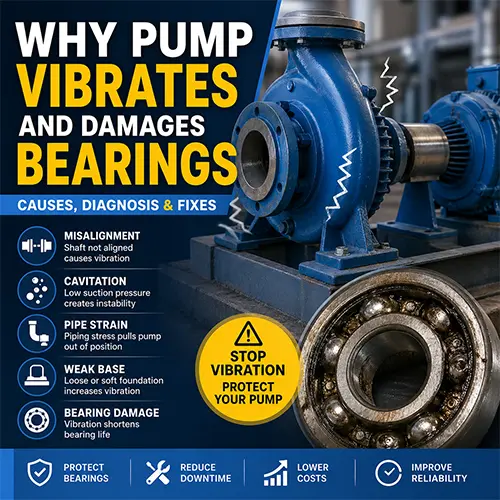
Introduction
When a pump starts vibrating, many users focus only on the visible shaking or noise. In reality, vibration is often the beginning of a more expensive problem: bearing failure. Bearings are designed to support smooth rotating load, but repeated vibration adds extra force, heat, shaft movement, and lubrication stress. That is why many pumps begin with “small vibration” and later suffer repeated bearing damage, seal leakage, coupling wear, or emergency shutdown.
Most users searching this issue are trying to solve real operational problems:
- Why is the pump vibrating now?
- Are the bearings already damaged?
- Can I keep running it today?
- Should I replace bearings only?
- Why did new bearings fail again?
- Should I repair the pump or replace it?
These are the right questions. Replacing bearings without removing the real cause often wastes money and repeats the failure cycle.
This guide is written for plant maintenance teams, contractors, irrigation users, building engineers, distributors, and industrial buyers who need practical answers. It explains why pumps vibrate, how vibration damages bearings, how to inspect the system step by step, and how to decide whether repair or replacement makes the best long-term sense.
If you regularly manage rotating equipment, it is also worth reviewing the LIQEN Pump Insights Blog for additional troubleshooting and selection guides that help reduce repeat failures.
The goal is simple:
Find the vibration source early, protect bearings, and stop expensive repeat breakdowns.
Why Pump Vibration Damages Bearings
Pump vibration means repeated uncontrolled movement in the rotating assembly, piping, or base structure. Bearings are made to carry designed loads, not constant shock and side movement.
When vibration continues, bearings often fail faster because of:
- Extra radial load on rolling elements
- Shaft movement causing uneven contact
- Grease film breakdown
- Heat buildup
- Misalignment stress
- Metal fatigue over time
This is why many users replace bearings successfully, only to see the new set fail months later. The old bearing was often not the root cause. It was the symptom.
A useful rule is:
If vibration remains, bearing life usually falls.
First Decision: Should You Stop the Pump Immediately?
Before deeper diagnosis, first decide whether continued operation is safe.
Some mild vibration can be inspected under controlled conditions. Severe vibration should not continue.
Stop the Pump Immediately If You Notice:
- Strong vibration shaking the base
- Rapid bearing temperature rise
- Loud grinding or knocking
- Sudden seal leakage
- Coupling movement visible
- Pressure loss with vibration
- Motor overload trips
- Pipe supports moving excessively
These signs often indicate dangerous mechanical or hydraulic instability.
Usually Safe for Short Controlled Inspection:
- Mild vibration only
- Stable flow and pressure
- No overheating
- No leakage
- No abnormal noise
| Condition | Recommended Action |
| Vibration + heat | Stop now |
| Vibration + grinding | Stop now |
| Mild vibration only | Inspect soon |
| Vibration + leakage | Urgent diagnosis |
| Small vibration, stable system | Controlled check |
Step-by-Step 10 Minute Vibration Check
Many users replace bearings too early. A structured inspection often finds the real cause faster.
Check Where Vibration Is Strongest
Compare vibration at:
- Pump casing
- Motor frame
- Coupling area
- Baseplate
- Suction pipe
- Discharge pipe
If vibration is strongest on the piping instead of the casing, structural or hydraulic issues may be more important than the bearing itself.
Check Bearing Temperature
Compare both bearing housings.
If one side is clearly hotter, overload, misalignment, or bearing damage becomes more likely.
Check Recent Changes
Ask what changed recently:
- Bearings replaced
- Alignment work done
- New piping installed
- Valve settings changed
- Speed changed through VFD
- Different liquid pumped
In many plants, vibration begins immediately after maintenance or process changes.
Check Flow and Pressure
If pressure fluctuates or flow becomes unstable, hydraulic causes should be investigated first.
Listen for Bearing Sound
Growling, rumbling, or rough rolling sounds often indicate the bearings are already under stress.
Cause 1: Misalignment Between Pump and Motor
Misalignment is one of the most common reasons pumps vibrate and bearings fail repeatedly.
Even small centerline error can create constant side-load on bearings and couplings.
Common Signs
- Coupling wear marks
- Hot bearings
- Vibration strongest near coupling
- Repeated bearing replacement
- Seal leakage after maintenance
What to Do Next
Realign the pump and motor using proper measurement tools.
Many users replace bearings but skip alignment correction, then face the same failure again.
If repeated failures started after installation or commissioning, review the Before You Buy a Pump Checklist to identify common setup and selection mistakes that shorten equipment life.
Cause 2: Pipe Strain Pulling the Pump Out of Position
Pipe strain happens when connected piping forces the pump casing out of natural alignment.
This is common after rushed installation or poorly supported pipework.
Common Signs
- Vibration started after piping changes
- Flanges difficult to bolt together
- Alignment correct before startup, worse after startup
- Bearing life shortened after new pipe installation
What to Do Next
Support piping independently and remove stress from pump nozzles.
Users often miss this problem because the pump appears fine when uncoupled.
Cause 3: Cavitation Causing Hydraulic Vibration
Cavitation happens when inlet pressure becomes too low and vapor bubbles collapse inside the pump.
Many users think cavitation only causes noise. In reality, it often creates vibration that damages bearings over time.
Common Signs
- Gravel or crackling sound
- Flow instability
- Pressure fluctuation
- Unexpected bearing wear
- Reduced efficiency
What to Do Next
Check suction valve position, liquid level, blocked strainers, and suction piping conditions.
If vibration is combined with abnormal sound, review the Pump Makes Noise Troubleshooting Guide to identify hydraulic warning signs before impeller and bearing damage become expensive.
Cause 4: Unbalanced Impeller or Internal Wear
If the impeller becomes worn, corroded, clogged unevenly, or physically damaged, rotating balance changes.
That imbalance becomes stronger as speed increases.
Common Signs
- Vibration increases with RPM
- Current changes
- Lower performance
- Seal and bearing wear together
What to Do Next
Inspect impeller condition during shutdown.
Replacing bearings without checking impeller condition may only solve part of the problem.
Cause 5: Soft Foot or Weak Baseplate
Soft foot means one machine foot does not sit flat on the base. A weak or twisted baseplate creates a similar effect.
This allows frame distortion after tightening bolts.
Common Signs
- Pump moves slightly during startup
- Base bolts loosen repeatedly
- Vibration strongest on frame
- Alignment changes after tightening bolts
What to Do Next
Correct base flatness, shim properly, and tighten evenly.
Foundation issues are often cheaper to correct than repeated bearing failures.
Cause 6: Wrong Bearing Installation or Lubrication
Sometimes vibration begins after bearing replacement because the installation itself created the next failure.
Common Causes
- Hammer damage during installation
- Wrong fit tolerance
- Dirty grease
- Over-greasing
- Under-greasing
- Wrong bearing type
Common Signs
- New bearings fail quickly
- Heat rises soon after service
- Noise starts shortly after maintenance
What to Do Next
Review installation method, lubrication practice, and bearing specification.
Can You Keep Running a Vibrating Pump?
This is usually the most important operating decision.
| Situation | Continue Briefly? | Risk Level |
| Mild vibration only | Sometimes | Medium |
| Vibration + heat | No | High |
| Vibration + grinding | No | Severe |
| Vibration + leakage | No | High |
| Slight vibration, stable output | Short-term possible | Low |
Get A Quote

Get A Quote
0 Comments