
Inline Pump vs End Suction Pump: How to Choose for HVAC and Booster Systems
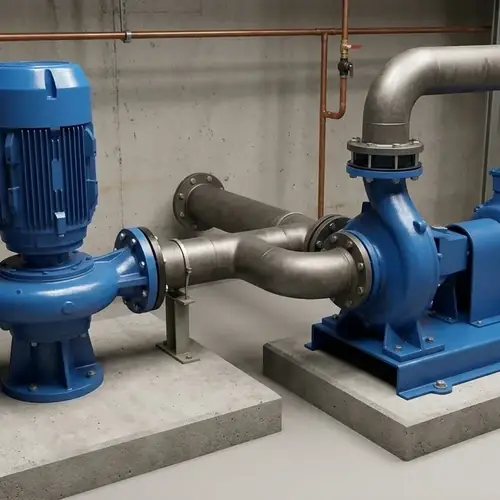
If you’re standing in a mechanical room trying to decide between an inline pump and an end suction pump, the answer usually comes down to two things: how much space you actually have, and how often your maintenance team will need to get their hands on the pump. Inline pumps — with suction and discharge flanges on the same centerline — eliminate pipe offsets and save serious floor space, which makes them a frequent default for tight HVAC circulation loops and booster skids. End suction pumps pull water in axially and discharge it radially, and they’re generally easier to service, handle higher flows more gracefully, and give you more flexibility when suction conditions get complicated. Neither layout is universally better; the real cost of choosing wrong often surfaces when the maintenance crew suddenly finds they can’t pull the motor without cutting into the pipework.
This guide walks through the comparison from a procurement and installation perspective — not just the textbook trade-offs, but the things you’ll actually argue about during a project meeting: pipe stress, vibration isolation, seal access, alignment requirements, and what happens to your installed cost when the contractor discovers there’s no room to swing a wrench. By the end, you’ll know exactly which layout fits your application, what to verify with the supplier before signing off, and what questions to put in your RFQ to avoid buying a pump that the installation team will curse you for.
If you’re already balancing multiple pump types, you may want to look at the broader End Suction vs Inline vs Multistage Pump comparison to see where multistage options fit into your system design. But if your shortlist is already down to inline versus end suction, let’s get into the details that actually matter on site.
Quick Answer: When Should You Choose an Inline Pump vs an End Suction Pump?
Before we dig into the engineering, here’s the fast decision framework most experienced project engineers use. This isn’t theoretical — it’s what typically survives value engineering rounds and contractor feedback.
| Decision Factor | Choose Inline Pump When | Choose End Suction Pump When |
|---|---|---|
| Floor space | Mechanical room is tight, every square metre counts | You have dedicated pump pad space and service access isn’t constrained |
| Pipe routing | Pipes can run straight through the pump centerline | You can accommodate pipe elbows and offsets without spatial penalty |
| Flow duty | Moderate flow, typically single-stage HVAC or booster | Higher flow ranges where end suction hydraulics cover more selection options |
| Maintenance access | Overhead clearance exists for motor removal, and the team is prepared for vertical lifting | You need walk-up access to the impeller and seal without removing piping |
| Installation | Pipe-supported installation is acceptable and pipe loads are verified | You want a rigid baseplate-mounted pump with independent support |
| Retrofitting existing system | Existing piping is already aligned for inline replacement | Pipe layout is already arranged for end suction configuration, or you’re designing from scratch with maintenance as a priority |
| NPSH margin | Suction conditions are straightforward, flooded suction or low lift | Suction is marginal and you may need a larger impeller eye or first-stage design flexibility |
| Installed cost sensitivity | Reducing pipework, concrete bases, and alignment labour is critical | Maintenance labour and downtime cost outweigh initial installation savings |
A quick rule of thumb: if you’re walking through a commercial building’s chilled water loop or a packaged booster skid, you’ll probably see inline pumps. If you’re in an industrial plant’s water transfer station with dedicated crane access and maintenance bays, end suction is likely the call. But the exceptions matter, so let’s look at what creates those exceptions.
What Is the Structural Difference Between Inline and End Suction Pumps?
Understanding the physical configuration is what makes the rest of the comparison click — especially when you’re staring at dimensional drawings from two different suppliers.
An inline pump positions the suction and discharge flanges on the same centerline, directly opposite each other. The pump casing sits in the pipe run like a straight section of pipe. In vertical inline configurations — the most common for HVAC and booster work — the motor sits on top, the pump casing below, and the entire assembly is supported by the connected piping. Close-coupled designs mount the impeller directly on an extended motor shaft, eliminating a separate pump bearing housing and coupling alignment step. Long-coupled vertical inline pumps do exist; they use a separate bearing frame and flexible coupling, which gives you more hydraulic flexibility at the cost of more height and more alignment points to check.
An end suction pump draws water axially into the impeller eye and discharges it radially — fluid comes in the front, turns 90 degrees through the impeller, and exits out the top or side of the casing. The pump shaft sits horizontally, the motor is mounted on the same baseplate (or a common frame), and the entire assembly rests on a concrete pad or structural steel base. The casing is typically split only at the cover, not along the shaft, which means impeller access requires removing the suction-side casing cover rather than lifting the entire rotating assembly vertically.
Both configurations are centrifugal pumps, and both can be built to ISO 2858 dimensional standards (commonly applied to end suction pumps) or to manufacturer-specific inline dimensions. ANSI/HI 1.1-1.5 covers hydraulic performance testing for both types. ISO 2858 governs key dimensional interchange points for many process-duty centrifugal pumps, while ANSI/HI standards define accepted hydraulic test methods and performance verification practices. Buyers should request certified performance curves, dimensional drawings, hydrostatic or performance test records, and any declared compliance documentation directly tied to the published standard edition rather than assuming interchangeability from layout alone.
Footprint and Piping Layout Comparison
Why Inline Pumps Save Mechanical Room Space
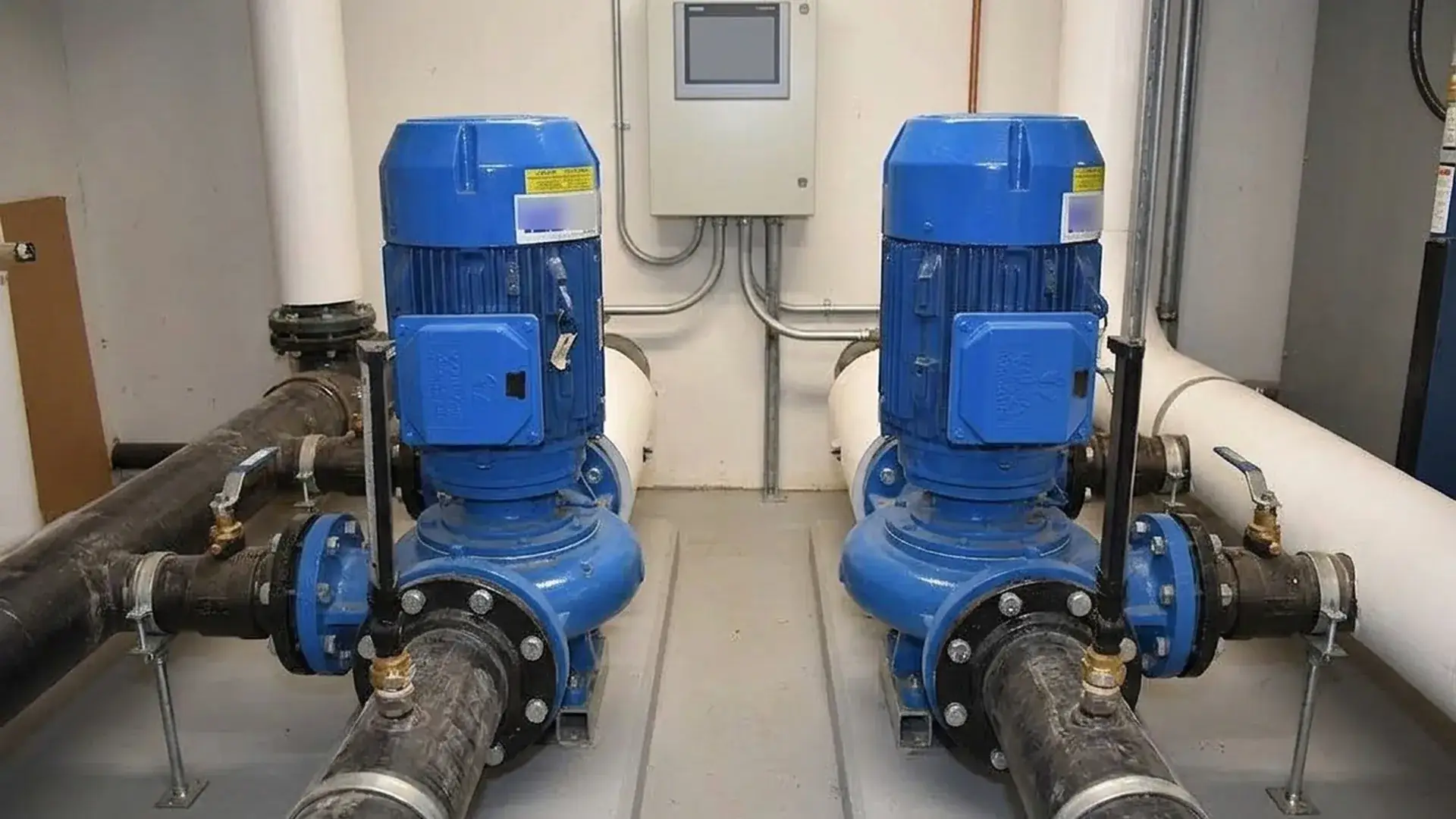
The space savings from an inline pump aren’t just about the pump itself — they’re about what you eliminate. A vertical inline pump removes the need for a concrete inertia base, removes suction and discharge elbows, and often removes the flexible coupling and its guard assembly. In a congested mechanical room with multiple pumps, that adds up quickly.
Here’s what changes physically: instead of bringing pipe to a pump, changing direction, and routing it away, you’re running pipe straight through the pump. The floor area consumed is essentially the footprint of the pump casing plus whatever clearance the motor needs overhead. Compare that to an end suction pump, where you need floor space for the baseplate, plus clearance on the suction side for the pipe elbow, plus clearance on the discharge side — and suddenly two pumps side by side need enough aisle space that you’re adding square metres to the mechanical room.
But the trade-off is pipe support. When the pump hangs on the pipes, the pipes must be designed to carry that load. This is where things go wrong in practice: the structural engineer designs the pipe supports for piping weight plus water weight, but nobody confirms whether the pump supplier’s allowable nozzle loads are compatible. If the pipe supports aren’t stiff enough, the pump settles, the shaft deflects, and the mechanical seal fails early. We’ll come back to this in the vibration section — it’s probably the single most common inline pump reliability problem I see.
When End Suction Layouts Simplify Service Access
An end suction pump sits on a baseplate with its motor beside it, not above it. That means a technician can remove the casing cover, pull the rotating assembly, inspect the impeller, and replace the mechanical seal — all without disturbing the main piping connections (assuming the casing stays in place). For a facility manager budgeting maintenance labour hours, this configuration can cut hours off most major service events compared to an inline pump where the motor often needs to be lifted vertically and pipe connections may need to be broken.
There’s also a clearance story: an end suction pump needs horizontal clearance around the pump for cover removal and shaft pull-out, but it doesn’t require overhead crane access. An inline pump needs vertical clearance above the motor — enough to lift the motor and rotating assembly straight up. In a basement mechanical room with a low ceiling or ductwork overhead, that vertical clearance constraint can rule out vertical inline pumps entirely, or force you into a split-case service procedure that nobody planned for.
For a broader perspective on how installation orientation affects your system, the Horizontal vs Vertical Pump comparison explains when shaft orientation alone — independent of the inline vs end suction question — changes your NPSH, vibration, and cost calculations.
| Footprint Factor | Vertical Inline Pump | End Suction Pump |
|---|---|---|
| Floor space required | Minimal — pump footprint only | Larger — baseplate, pipe elbows, service clearance |
| Concrete base needed | Usually not required | Typically required for larger sizes |
| Pipe routing complexity | Straight through, fewer elbows | Requires suction elbow and discharge offset |
| Overhead clearance needed | Yes — motor lifting space above pump | No — horizontal access |
| Horizontal service clearance | Minimal — side access to seal | Needed — space for cover removal and shaft pull |
| Pipe support requirement | Critical — pipes carry pump weight | Pipes carry only fluid weight, pump is independently supported |
| Retrofit into existing piping | Easier if straight pipe section available | May require pipe modification and new base |
Hydraulic Performance and System Suitability
HVAC Circulation Systems
For closed-loop HVAC circulation — chilled water, hot water, condenser water — vertical inline pumps are widely used for good reason. The head requirements are typically moderate (closing the loop means you’re only fighting pipe friction and fitting losses, not lifting water), flow ranges for most commercial buildings fall well within what single-stage inline pumps can deliver, and mechanical rooms in commercial buildings are notoriously short on space.
The hydraulic fit works because most HVAC circulation duties sit comfortably in the 20–80 m head range at flows under roughly 500 m³/h per pump. Single-stage inline pumps cover this range efficiently. The VFD compatibility is straightforward, and modern close-coupled inline pumps with IE3/IE4 motors can achieve system efficiency numbers that compare favourably with end suction alternatives — provided they’re selected to operate near best efficiency point (BEP) and not oversized. Oversizing a pump wrecks energy efficiency regardless of layout; that’s a system problem, not a pump-type problem.
But there’s a ceiling. If you’re circulating for a large district cooling plant pushing thousands of cubic metres per hour, single-stage inline pump selections thin out. End suction pumps, with more impeller diameter options and higher flow casings, widen your hydraulic selection range. At that scale, the space argument for inline pumps also weakens — the inline pump itself becomes large enough that the pipe-support and vibration risks grow, and the maintenance access concern becomes more acute.
Booster and Pressure Systems
Inline pumps show up frequently in packaged booster systems — and for good reason. Booster skids need to fit through doorways, ship as pre-assembled units, and minimize on-site pipework. A vertical inline pump’s straight-through piping lends itself naturally to compact manifold arrangements. Common configurations include multiple parallel inline pumps on a common skid, each on its own discharge check valve and isolation valve, with a VFD controlling speed based on pressure transducer feedback.
The practical limits to watch: at higher boost pressures, the pump casing pressure rating and flange class become the constraint, not the flow. Most cast iron inline pumps for clean-water booster service typically handle PN16 or PN25 ratings well, but if you’re boosting into a high-rise building’s upper zones, confirm the casing rating matches the shutoff head plus static head — not just the operating point. An end suction pump might offer a higher pressure-rating option in the same hydraulic selection range, or allow a heavier casing material without major reconfiguration. If you’re considering a complete booster package rather than individual pump selection, the Booster Set vs Single Pump comparison covers system-level trade-offs including redundancy, control strategy, and commissioning.
Industrial Water Transfer Applications
This is where end suction pumps start pulling ahead in more cases. Industrial water transfer — moving clean or lightly contaminated water from a tank to a process, from a river intake to a plant, or circulating cooling water across a facility — often involves higher flow rates, longer pipe runs, and suction conditions that aren’t always ideal.
End suction pumps provide a separate bearing housing, independent shaft support, and more design flexibility in impeller inlet geometry. That matters when NPSH available is marginal and you need a larger impeller eye or a first-stage inducer to keep the pump out of cavitation. Inline pumps, especially close-coupled designs, have limited impeller eye sizing options because the impeller must hang on the motor shaft.
Larger end suction pumps also allow pulling the rotating assembly without disturbing the casing or main pipe connections — a real advantage when downtime costs are high and the maintenance team needs maximum access speed. Most industrial plants I’ve worked with prefer end suction for any pump over about 30 kW specifically because the maintenance workflow is more predictable.
| Application | Typical Inline Pump Fit | Typical End Suction Pump Fit | Notes |
|---|---|---|---|
| HVAC chilled/hot water loop | Excellent fit, dominant choice | Used for larger plants, high flow | Confirm overhead clearance for motor removal |
| Commercial booster skid | Very common in packaged units | Used when higher flow or pressure rating needed | Check casing pressure rating at shutoff |
| Industrial cooling water circulation | Suitable for moderate flows | Preferred for high flow, marginal NPSH | Consider maintenance access needs |
| Clean water transfer (tank to process) | Works for smaller duties | Better for flows above ~300 m³/h | End suction offers more hydraulic selection |
| Retrofit into existing pipe layout | Best if pipe run is straight | Best if existing pump was end suction | Match existing pipe configuration to minimize modification cost |
| High-flow duty (>500 m³/h) | Single-stage options limited | Wider selection and proven designs | End suction generally dominates |
Maintenance, Alignment, and Downtime Risk
The Inline Pump Maintenance Reality
Let’s be direct: inline pumps are harder to service than end suction pumps. That doesn’t mean they’re unreliable — they’re not. But when something does need attention, the geometry works against you.
To access the mechanical seal or impeller on a close-coupled vertical inline pump, you usually need to remove the motor from the casing. That means lifting the motor vertically — which requires overhead clearance, a hoist or chain block, and someone who knows how to handle a motor without damaging the shaft or seal faces during reassembly. In a tight basement mechanical room with a 2.4-metre ceiling and ductwork running above the pumps, this “simple” seal replacement turns into a half-day job that might involve removing sections of ductwork first.
Long-coupled inline pumps improve this situation somewhat — the coupling separates the motor from the pump, so you might be able to drop the rotating assembly without removing the motor. But the vertical orientation still means working against gravity on every component you handle.
The other maintenance reality: pipe-supported installation means you have to think about what happens when the pump is disconnected. If the pipes aren’t independently supported, breaking the pump flanges to service the unit means the pipes sag or shift, and getting everything realigned during reassembly takes extra time. Smart installers add temporary pipe supports or design permanent independent supports near the pump — but plenty of installations skip this step, and the maintenance team pays for it later.
Why End Suction Pumps Simplify Maintenance Access
An end suction pump sits on its own baseplate. The motor is horizontal beside the pump. To inspect the impeller, you remove the casing cover bolts, slide the cover and rotating assembly forward, and look straight at the impeller without removing any piping from the casing itself. The motor stays put. The pipes stay connected. The alignment is checked between the pump shaft and motor shaft at the coupling — and if anything shifts during service, realignment is a horizontal adjustment, not a vertical lift.
For a facility maintenance manager planning service intervals, this layout means faster turnaround, lower labour cost, less specialized lifting equipment, and lower risk of damaging components during reassembly. That’s not a theoretical advantage — it shows up in maintenance budgets. Does it matter enough to outweigh the space savings of an inline pump? That depends on your labour rates, your downtime cost, and how often you actually need to open the pump.
| Maintenance Factor | Vertical Inline Pump | End Suction Pump |
|---|---|---|
| Impeller inspection access | Motor removal required (close-coupled); vertical disassembly | Casing cover removal, horizontal access |
| Mechanical seal replacement | Motor must be lifted; vertical workspace needed | Seal accessible after cover removal, horizontal access |
| Motor removal | Vertical lift, overhead clearance critical | Horizontal removal, no vertical crane typically needed |
| Pipe disconnection needed | Often required to disassemble casing | Casing stays connected to pipes; cover-only access |
| Shaft alignment | Self-aligned on close-coupled; coupling alignment on long-coupled | Flexible coupling alignment, horizontal adjustment |
| Downtime per major service | Longer — lifting, pipe handling, reassembly | Shorter — walk-up access, faster turnaround |
| Spare parts holding recommendation | Keep spare seal, gaskets, possibly a cartridge seal assembly | Standard seal, gaskets, wear rings, impeller as needed |
Vibration, Pipe Stress, and Reliability Considerations
This is the section I wish more project specifications addressed explicitly. The single most common reliability problem with vertical inline pumps — especially close-coupled ones — is pipe-induced stress and vibration.
Here’s the physics: when an inline pump hangs on the connected piping, the pipe supports carry the weight of the pump, the water inside it, and any dynamic forces from operation. If the pipe supports are spaced too far apart, or if thermal expansion puts axial load on the pump flanges, that load transfers directly to the pump casing and through the motor shaft. The shaft deflects slightly. The mechanical seal faces, which need to run precisely parallel to each other, start operating with uneven contact. Seal life shortens — sometimes dramatically. And because the failure looks like “the seal wore out,” nobody traces it back to the pipe supports that were never checked against the pump’s allowable nozzle loads.
End suction pumps avoid most of this problem simply because the pump sits on its own baseplate. Pipe loads don’t carry pump weight. The flexible coupling between pump and motor absorbs small misalignments. And the pump foundation — if designed and installed correctly — provides a stable, rigid reference point that keeps shaft alignment stable over time.
But end suction pumps aren’t immune to vibration either. A poorly grouted baseplate, soft foot conditions, or piping that’s forced into alignment at the flanges will all transmit vibration into the pump. The difference is that end suction pumps typically give you more ways to diagnose and correct these problems — adjustable baseplate leveling, coupling alignment checks, and foundation monitoring — without having to question whether the entire pipe support system needs redesign.
What to do about it, practically: - For inline pumps, demand the supplier provide allowable nozzle load data. Share it with your pipe stress engineer. Don’t skip this. - For end suction pumps, specify baseplate grouting and flatness requirements. Soft foot is avoidable if the spec is clear and the installation is checked. - For both types, require vibration test records from the factory, and specify field vibration limits after installation.
Installed Cost vs Lifecycle Cost
Initial Installation Cost
Inline pumps usually have the edge on installation cost. Eliminating the concrete inertia base alone saves on civil work, curing time, and baseplate grouting. Reducing pipe elbows saves on fittings, welding or flanging, and pressure drop. Close-coupled designs eliminate coupling alignment labour. Packaged inline booster skids arrive pre-piped and pre-wired, sometimes requiring only suction and discharge tie-ins and electrical connection.
But there’s nuance. The savings only materialise if the pipe supports are already adequate. If you need to add independent pipe supports to meet allowable nozzle load requirements — or if you’re retrofitting an inline pump where existing pipes can’t carry the pump weight — the “saved” costs reappear as structural modifications.
End suction pumps cost more to install initially: concrete pad, baseplate levelling, suction and discharge elbows, coupling alignment. But that cost is predictable and well-understood by contractors. No surprises.
Operating Energy Cost
Energy efficiency depends on system matching, not pump orientation. An inline pump operating at BEP with a properly sized motor and VFD control can achieve efficiency numbers comparable to an equivalent end suction pump at the same hydraulic duty. The pump’s hydraulic design — impeller geometry, volute shape, surface finish — determines efficiency. The layout doesn’t. If efficiency matters for your project, read the End Suction Pump Energy Efficiency comparison to understand where the real energy differences come from.
Where layout indirectly affects energy cost: an inline pump with fewer pipe elbows reduces system friction losses slightly, which means the pump operates against slightly lower total dynamic head. That’s a small but real energy advantage. But it’s usually in the single-digit percentage range, and it only matters if you’re selecting pumps near efficiency thresholds or calculating lifecycle energy costs for large continuous-duty applications.
Long-Term Maintenance Cost
This is where the calculation swings. If you’re buying for a facility where the maintenance team is understaffed or service access is tight, the faster turnarounds on end suction pump service can translate into lower total maintenance labour cost over 10–15 years. This doesn’t mean you should avoid inline pumps — but you should account for the labour difference in your TCO model, not just compare purchase prices.
A practical approach: if your operating schedule allows scheduled shutdowns and you have trained maintenance staff with appropriate lifting equipment, inline pump maintenance cost differences may be modest. If your facility runs 24/7, unplanned downtime is expensive, and you’re paying contractor rates for emergency repairs, the end suction pump’s serviceability advantage starts to look much more significant.
| Cost Component | Inline Pump: Typical Direction | End Suction Pump: Typical Direction |
|---|---|---|
| Civil/structural work | Lower — often no concrete base needed | Higher — pad, baseplate, grouting, possibly inertia base |
| Pipe fitting and welding | Lower — straight through, fewer elbows | Higher — elbows, offset routing |
| Pump purchase price | Comparable for same hydraulic duty | Comparable for same hydraulic duty |
| Alignment labour | Lower — close-coupled is factory-assembled | Higher — field coupling alignment |
| Energy cost (20,000+ hrs at BEP) | Slightly lower due to reduced pipe losses, otherwise comparable | Slightly higher pipe friction loss, otherwise comparable |
| Maintenance labour over 15 years | Higher — vertical disassembly, more service hours per event | Lower — horizontal access, faster turnaround |
| Spare parts cost | Similar — seals, gaskets, wear rings | Similar — seals, gaskets, wear rings |
| Downtime cost per event | Higher — longer service duration | Lower — faster service completion |
RFQ Checklist: What to Send Suppliers Before Selecting Inline or End Suction
A good RFQ prevents most of the mistakes this article warns about. Send this technical data block to any pump supplier — for either layout — and you’ll get back a quote that reflects your actual system, not a generic selection.
| RFQ Field | What to Specify |
|---|---|
| Fluid | Water, glycol solution (concentration %), or other — be specific about temperature range |
| Flow rate | Design flow in m³/h or l/s, plus minimum and maximum expected |
| Total dynamic head | Design head in metres at design flow |
| NPSH available | Calculated NPSHa at pump centerline, with worst-case temperature and suction level |
| Pipe size and schedule | Suction and discharge pipe diameter, material, and schedule |
| Power supply | Voltage, phase, frequency (e.g., 400V/3Ph/50Hz), available fault current if relevant |
| VFD requirement | Fixed speed or VFD; if VFD, specify speed range and control signal type |
| Space constraints | Maximum allowable pump height, width, and length; overhead clearance limit |
| Maintenance clearance | Required service access direction and minimum clearance dimension |
| Pipe support arrangement | For inline pumps — confirm pipe supports will be designed to carry pump weight within allowable nozzle loads; request nozzle load data |
| Installation environment | Indoor/outdoor, ambient temperature range, altitude, humidity or corrosive concerns |
| Noise limit | dB(A) limit at 1 metre if noise-sensitive installation |
| Redundancy / standby | Number of duty and standby pumps, parallel configuration if applicable |
| Standards | Any required compliance (ISO 2858, ANSI/HI 1.1-1.5, ASME B73.2, EN, local codes); request supplier documentation identifying which published standard edition applies and which dimensional or testing criteria were verified |
| Documentation to supply with quote | Performance curve, dimension drawing, motor data sheet, allowable nozzle loads, material certificates if specified, test standard reference |
| Factory tests required | Hydraulic performance test, vibration test, hydrostatic pressure test; specify witnessed or standard |
A couple of items on this list are often missed. The first is allowable nozzle loads for inline pumps — most suppliers can provide this data if you ask, but many people forget. The second is the maximum allowable height for the pump assembly, which matters when you’re putting an inline pump into an existing mechanical room and nobody checked the overhead clearance. Asking for these two data points in the RFQ stage saves expensive rework later.
FAQ: Inline Pump vs End Suction Pump
Is an inline pump more energy efficient than an end suction pump?
Not inherently. Hydraulic efficiency depends on impeller design, volute geometry, surface finish, and operating proximity to BEP — not on whether the suction and discharge are on the same centerline or at 90 degrees. An inline pump may reduce system friction losses slightly by eliminating piping elbows, which lowers total dynamic head slightly and reduces absorbed power. But the difference is typically small — often in the single-digit percentage range — and shouldn’t be the primary selection driver. The real energy question is whether the pump is selected to run near BEP across its operating hours, and whether VFD control is applied effectively.
Which pump layout is better for HVAC systems in commercial buildings?
Vertical inline pumps are very common in commercial HVAC circulation for good reason: mechanical rooms are tight, head requirements are moderate, and the straight-through piping simplifies manifold arrangements when multiple pumps run in parallel. In typical commercial buildings, inline pumps are widely used for chilled water, hot water, and condenser water loops. The exception is larger central plants or campus systems where flow rates push beyond what single-stage inline pumps efficiently cover — end suction pumps or double-suction pumps then become more common. Maintenance access becomes more critical at larger sizes too.
Are inline pumps harder to maintain than end suction pumps?
Yes, in most cases. Accessing the mechanical seal or impeller on a close-coupled vertical inline pump requires lifting the motor vertically, which needs overhead clearance and rigging equipment. An end suction pump allows horizontal disassembly — you pull the cover and rotating assembly forward without disturbing the casing or main piping connections. That said, cartridge mechanical seal designs on some modern inline pumps can reduce seal replacement time, so specific pump model features matter. But as a general rule, end suction gives your maintenance team easier physical access.
Can end suction pumps be installed in compact spaces?
Yes, but you need to plan the clearances carefully. The pump body itself might not be much larger than an equivalent inline pump, but you need additional space for the pipe elbows on suction and discharge, plus service clearance for cover removal and shaft pull-out. If your space is tight, look at the dimensional drawing and add at least the manufacturer’s recommended service clearance on the suction side. Also factor in that the baseplate needs floor area — sometimes extending further than the pump casing itself. An end suction pump won’t save space like an inline pump, but with careful layout it can fit into relatively tight plant rooms.
When should buyers avoid vertical inline pumps?
Avoid vertical inline pumps — or at minimum, proceed with extreme caution — in these situations: (1) Overhead clearance is severely limited and you cannot lift the motor for service without removing ductwork or structural elements above the pump. (2) The piping system cannot be designed to carry the pump weight within the manufacturer’s allowable nozzle loads, and adding independent pump supports isn’t feasible. (3) NPSH available is marginal and the inline pump’s impeller eye sizing doesn’t give you enough cavitation margin — end suction pumps often offer more design flexibility here. (4) Flow rates exceed what single-stage inline pumps comfortably cover, and you’d be forcing a selection at the edge of the pump’s hydraulic range. (5) The facility operates 24/7 with high downtime cost, and the maintenance team strongly prefers end suction access for faster service.
For a broader look at how shaft orientation influences installation constraints and maintenance planning, review manufacturer dimensional drawings and service-clearance requirements alongside the pump layout selection.
Conclusion
The inline pump vs end suction pump decision ultimately comes down to your mechanical room geometry and your maintenance philosophy. Inline pumps reward you with simpler piping, smaller footprints, and lower initial installation cost — but they demand proper pipe support design and overhead clearance, and they add labour hours to most major service events. End suction pumps cost more to install and occupy more floor space, but they give your maintenance team walk-up access to the impeller and seal, which matters more the larger the pump gets and the more expensive your downtime is.
For HVAC circulation and commercial booster service where compact installation, straight-through piping, and moderate flow ranges are priorities, inline pumps are typically the preferred starting point unless overhead clearance, pipe load capacity, or maintenance-access requirements favour an end suction layout. For industrial water transfer, high-flow duties, or installations with marginal NPSH conditions, end suction pumps are generally the safer baseline selection unless space constraints clearly justify inline installation and the pipe support design and service access plan are fully verified.
Whichever direction you go, put the RFQ checklist from this article in front of your supplier. Ask for allowable nozzle loads on every inline pump quote. Confirm motor removal clearance on dimensional drawings. And make sure your pipe stress calculations know there’s a pump hanging on the pipes — because that’s the detail that turns a “compact, cost-saving” selection into a reliability headache if it’s overlooked.
Get A Quote

Get A Quote
0 Comments