
Horizontal vs Vertical Pump: Which Layout Is Better for Installation, Maintenance, and Cost?
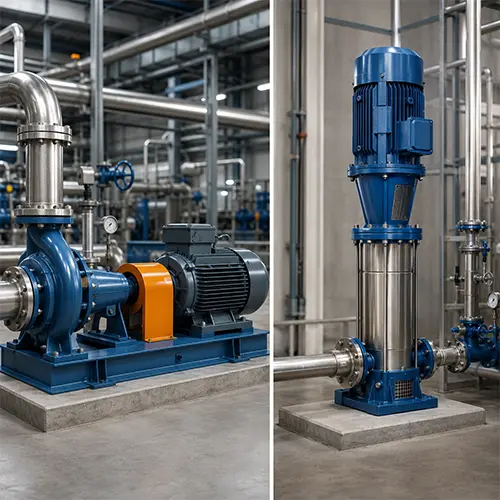
Horizontal vs vertical pump selection is not a question of which pump is more advanced. It is a question of which pump layout fits your pump room, suction condition, maintenance access, hydraulic duty point, and lifecycle cost. In most industrial and building water systems, a horizontal pump is usually better when the buyer needs easier maintenance, stable base-mounted installation, and better side access. A vertical pump is usually better when floor space is limited, the system requires a compact inline layout, or the application naturally fits a sump, tank, deep well, or vertical pressure boosting arrangement.
A horizontal pump has a horizontally arranged shaft and is usually easier to inspect, align, and maintain. A vertical pump has a vertically arranged shaft and is often selected when space-saving, vertical suction layout, or compact pressure boosting matters more than side access. The correct choice depends on floor area, ceiling height, suction design, NPSH (Net Positive Suction Head, the pressure margin needed to avoid cavitation), pump curve, installation structure, maintenance clearance, and long-term downtime risk.
For B2B buyers, engineers, contractors, and distributors, the wrong layout can create hidden costs after installation. A pump that looks compact on paper may be difficult to remove for maintenance. A pump that is easy to maintain may require more floor space than the site allows. A pump installed on a weak foundation may vibrate even if the hydraulic selection is correct. A pump selected without checking suction conditions may suffer cavitation, noise, unstable flow, and premature seal or bearing failure.
This guide explains horizontal vs vertical pump selection from the user’s perspective. It helps buyers compare installation space, maintenance access, suction condition, vibration risk, lifecycle cost, application scenarios, supplier quotation details, and final decision checkpoints before confirming a pump order.
Quick Answer: Horizontal vs Vertical Pump
Horizontal vs vertical pump selection should start from the site layout and maintenance requirement, not only from pump price or hydraulic data. A horizontal pump is usually preferred when the pump room has enough floor space and the buyer wants easier access to the motor, coupling, bearing housing, mechanical seal, and pump casing. A vertical pump is usually preferred when floor space is limited, the pipeline layout is compact, or the pump must be installed vertically above a tank, sump, well, or pressure boosting skid.
The pump layout does not replace hydraulic selection. Buyers still need to confirm flow rate, total dynamic head, pump curve, NPSH, material, seal type, power supply, and operating hours. A horizontal pump and a vertical pump may both meet the same hydraulic duty point, but their installation cost, maintenance difficulty, vibration behavior, and downtime risk can be very different.
| Decision Factor | Horizontal Pump | Vertical Pump |
| Shaft orientation | Horizontal shaft | Vertical shaft |
| Best for | Easy maintenance and stable base-mounted installation | Limited floor space and compact layout |
| Floor footprint | Usually larger | Usually smaller |
| Height requirement | Usually lower | Usually higher |
| Maintenance access | Easier from the sides | May require top clearance and lifting access |
| Alignment requirement | Coupling and baseplate alignment are important | Vertical alignment and structural support are important |
| Suction condition | Depends on suction piping and installation level | Useful for sump, tank, deep well, or inline layouts |
| Foundation requirement | Stable baseplate and foundation | Stable vertical support and correct anchoring |
| Common pump types | End suction, split case, horizontal multistage, slurry pumps | Vertical inline, vertical multistage, vertical turbine, sump pumps |
| Main selection risk | Takes more floor space and needs proper alignment | Saves floor space but may increase maintenance difficulty |
A practical first judgment is simple: choose a horizontal pump when service access and stable foundation installation are the priority; choose a vertical pump when compact layout, vertical suction, or floor-space saving is the priority. The final choice must still be verified against real site dimensions, suction condition, pump curve, and maintenance plan.
Final 30-Second Decision Table
A fast decision table helps buyers screen the layout before requesting a full technical quotation. This table is not a replacement for engineering selection, but it can prevent obvious mistakes at the early communication stage.
If your main concern is easy maintenance, side access, and stable foundation work, evaluate a horizontal pump first. If your main concern is limited floor space, vertical suction, compact pressure boosting, or a tank/sump/deep well application, evaluate a vertical pump first.
| If Your Priority Is... | Choose First | Why |
| Easy side maintenance | Horizontal pump | Easier access to motor, coupling, bearing, seal, and casing |
| Limited floor space | Vertical pump | Smaller footprint and compact arrangement |
| Large-flow municipal or cooling system | Horizontal split case pump | Large flow capacity and easier casing access |
| High-rise pressure boosting | Vertical multistage pump | Compact layout and high-pressure capability |
| Deep well or raw water intake | Vertical turbine pump | Designed for vertical water lifting |
| Sump or tank drainage | Vertical sump pump | Suitable for liquid below floor level |
| Limited ceiling height | Horizontal pump | Avoids top-removal difficulty |
| Difficult lifting access | Horizontal pump | Reduces dependence on overhead lifting |
| Retrofit with narrow floor area | Vertical pump | Easier to fit into compact layouts |
| Heavy-duty slurry service | Horizontal slurry pump | Easier wear-part access and robust structure |
A compact layout is not successful if future maintenance is impossible. Before choosing a vertical pump, confirm top clearance and lifting access. Before choosing a horizontal pump, confirm floor area and side maintenance clearance.
What Is a Horizontal Pump?
A horizontal pump is a pump installed with the shaft and motor arranged horizontally. It is commonly selected when the site has enough floor space and the buyer wants easier access for inspection, alignment, seal replacement, bearing maintenance, and motor service.
Horizontal pump is an installation layout, not only one pump category. Many pump types can be designed horizontally, including end suction pumps, split case pumps, multistage pumps, slurry pumps, and chemical pumps. The key feature is that the rotating shaft is arranged in a horizontal direction, usually supported by a baseplate, foundation, and properly aligned motor-pump connection.
How a Horizontal Pump Is Installed
A horizontal pump is usually installed on a baseplate or foundation, with the pump and motor arranged side by side. Depending on the design, the pump may be long-coupled with a separate coupling, close-coupled with the motor directly connected, or mounted as part of a skid system.
This layout gives technicians better access to key components. The coupling can be aligned and inspected. The bearing housing can be checked. The mechanical seal can often be serviced more easily. The motor can usually be removed without lifting it vertically over a tall pump body. For maintenance teams, this practical access can reduce downtime and make troubleshooting easier.
However, horizontal installation also depends heavily on foundation quality and alignment. A weak base, poor grouting, pipe stress, or coupling misalignment can cause vibration, bearing wear, mechanical seal leakage, and shortened service life. A horizontal pump is easier to maintain only when it is installed with enough clearance and proper support.
In many field service cases, early seal leakage on horizontal pumps is not caused by the seal brand alone. It is often related to pipe stress, coupling misalignment, poor baseplate installation, or vibration from weak foundation work. Buyers should treat installation quality as part of pump reliability, not as a separate civil-work issue.
For buyers comparing common centrifugal structures, this end suction vs centrifugal pump selection guide can help explain how pump structure affects installation, flow, pressure, and maintenance planning.
Common Types of Horizontal Pumps
Horizontal pumps include several different hydraulic designs. Buyers should not choose a horizontal pump only because the layout looks familiar. The pump type must still match the flow, head, liquid condition, and duty cycle.
| Horizontal Pump Type | Typical Use | Buyer’s Main Concern |
| Horizontal end suction pump | General water transfer, irrigation, HVAC, industrial supply | Simple structure, easy service, moderate flow and head |
| Horizontal split case pump | Large-flow water supply, cooling water, municipal systems | Large flow, stable foundation, easier casing access |
| Horizontal multistage pump | High-head clean water transfer, boiler feed, pressure boosting | Higher head with horizontal service access |
| Horizontal slurry pump | Abrasive slurry transfer | Wear resistance and easy replacement of wear parts |
| Horizontal chemical pump | Corrosive liquid transfer | Material compatibility and seal selection |
A horizontal pump is often practical when the site has enough footprint and the buyer wants a maintenance-friendly layout. It is especially valuable in continuous-duty systems where downtime is expensive and technicians need direct access to rotating parts.
What Is a Vertical Pump?
A vertical pump is a pump installed with the shaft arranged vertically. It is commonly selected when floor space is limited, the pump must be installed above or inside a tank, the liquid source is below floor level, or the system requires a compact inline or pressure boosting layout.
Vertical pump is also a layout category, not one single pump type. A vertical inline pump, vertical multistage pump, vertical turbine pump, vertical sump pump, and vertical sewage pump can all be called vertical pumps, but their applications, maintenance methods, and installation requirements are very different.
How a Vertical Pump Is Installed
A vertical pump uses a vertical shaft arrangement, which reduces floor footprint because the motor and pump are stacked vertically instead of spread horizontally. This can be useful in compact pump rooms, building services, RO systems, booster skids, sump applications, and retrofit projects.
The trade-off is that vertical pumps often require more attention to top clearance, lifting space, structural support, and vertical alignment. If the motor needs to be removed upward, the ceiling height must be sufficient. If the pump is installed in a narrow room, maintenance may become difficult even though the floor footprint is small.
A vertical pump may save space during installation, but the buyer should ask a practical question before purchase: can the motor, seal, coupling, and rotating assembly be removed safely during future maintenance? If the answer is unclear, the compact layout may become expensive later.
In many compact pump rooms, vertical pumps are not difficult because of the pump itself. The difficulty often appears because the room did not reserve enough motor removal height, lifting path, or technician access. A vertical pump should be selected together with the maintenance removal path, not only with the footprint drawing.
Common Types of Vertical Pumps
Vertical pumps are used in many systems where the vertical arrangement provides a space or suction advantage. Buyers should identify the exact pump design before making a decision.
| Vertical Pump Type | Typical Use | Buyer’s Main Concern |
| Vertical inline pump | HVAC circulation, building water systems, compact pump rooms | Small footprint and pipe alignment |
| Vertical multistage pump | Pressure boosting, RO systems, high-rise water supply | High pressure and compact layout |
| Vertical turbine pump | Deep well, raw water intake, sump applications | Vertical lifting and water source depth |
| Vertical sump pump | Tank, pit, sump drainage | Liquid below floor level |
| Vertical sewage pump | Wastewater or drainage with vertical installation | Solids handling and clogging risk |
If the project involves high-pressure boosting or RO membrane feed, this single stage vs multistage pump guide can help buyers understand when pressure requirements make multistage design more suitable.
A vertical pump is often the right choice when the installation layout demands compactness or vertical suction. But it should not be selected only because it occupies less floor area. The buyer must also confirm lifting clearance, maintenance access, pump support, vibration control, and supplier documentation.
Horizontal vs Vertical Pump: Core Differences Buyers Must Understand
The main difference between horizontal and vertical pumps is the installation layout, but the real decision also depends on maintenance access, suction condition, vibration control, alignment, foundation, and lifecycle cost. A layout that works well in one pump room may create problems in another.
For buyers, the question should not be “Is a vertical pump better than a horizontal pump?” The better question is “Which layout can be installed, operated, inspected, and maintained safely in this specific site?”
Installation Space Difference
Installation space is often the first visible difference between horizontal and vertical pumps. Horizontal pumps usually require more floor area, while vertical pumps usually reduce footprint but require more vertical clearance.
| Space Factor | Horizontal Pump | Vertical Pump |
| Floor footprint | Larger | Smaller |
| Height requirement | Lower | Higher |
| Side clearance | Important for maintenance | Less side space may be needed |
| Top clearance | Usually less critical | Often critical for motor removal |
| Pipe connection flexibility | Often easier to modify | Compact but may be less flexible |
| Retrofit suitability | Good if floor space exists | Good if floor area is limited |
A vertical pump can be attractive in compact pump rooms because it saves floor space. However, saving floor space does not automatically mean easier installation. If the ceiling is low or there is no lifting equipment, vertical pump maintenance may become difficult.
A horizontal pump needs more footprint, but it usually gives technicians better side access. If the pump room has enough space, this layout may reduce future maintenance time and improve service convenience.
Maintenance Access Difference
Maintenance access strongly affects downtime and lifecycle cost. A horizontal pump often provides easier access to the motor, coupling, bearings, mechanical seal, and pump casing. A vertical pump may require more careful planning for lifting, disassembly, and top clearance.
For example, if a mechanical seal needs replacement, a horizontal pump may allow technicians to access the seal area from the side. In a vertical pump, the motor or upper assembly may need to be lifted or removed, depending on the design. This does not mean vertical pumps are bad; it means the maintenance method must be checked before purchase.
In projects where maintenance staff are limited, horizontal pumps are often easier to manage. In projects where floor space is the main constraint, vertical pumps may still be the better choice, but buyers should plan service access from the beginning.
A practical maintenance rule is simple: do not approve the layout until you know how the motor, seal, bearing, coupling, and rotating assembly will be removed. A pump that cannot be serviced safely is not a complete solution.
Suction Condition Difference
Suction condition affects pump reliability, especially cavitation risk. Horizontal pumps usually require properly designed suction piping, while some vertical pump designs are useful when the liquid source is below the pump, inside a tank, in a sump, or in a deep well.
NPSH means Net Positive Suction Head. It is the pressure margin available at the pump suction to keep liquid from vaporizing inside the pump. If NPSH available is lower than NPSH required, the pump may suffer cavitation. Cavitation can cause noise, vibration, impeller damage, unstable flow, and reduced pump life.
Horizontal pumps can work very reliably when suction piping is well designed. The suction pipe should avoid unnecessary elbows near the inlet, excessive suction lift, air pockets, undersized piping, and unsupported pipe stress. Vertical turbine or sump pumps may be more suitable when the water source is below ground level or inside a pit.
If the pump shows noise, vibration, or unstable flow after installation, this water pump noise troubleshooting guide can help buyers check whether suction design, cavitation, or installation issues are involved.
Alignment and Vibration Difference
Alignment and vibration control are critical for pump reliability. Horizontal pumps usually require careful coupling alignment and baseplate support. Vertical pumps require correct vertical alignment, structural support, anchoring, and shaft stability.
In horizontal pumps, coupling misalignment can damage bearings, seals, and couplings. Even a good pump can fail early if the motor and pump shaft are not aligned correctly. Pipe stress can also pull the pump casing out of alignment if suction and discharge pipes are not independently supported.
In vertical pumps, vibration may come from weak support, poor anchoring, shaft instability, incorrect installation, or hydraulic mismatch. Long-shaft vertical pumps may require special attention to shaft support and bearing conditions.
Buyers should not assume that vibration always means pump quality failure. Vibration is often caused by the combined effect of selection, foundation, alignment, pipe stress, suction condition, and operating point.
Cost Difference
Cost comparison should include equipment price, installation cost, foundation work, pipe modification, maintenance access, downtime risk, and lifecycle operating cost. The lower-price layout is not always the lower-cost layout.
| Cost Area | Horizontal Pump | Vertical Pump | Buyer’s Decision Point |
| Equipment price | Depends on pump type and size | Depends on pump type and size | Layout alone does not determine price |
| Foundation cost | Stable baseplate and foundation required | Vertical support and anchoring required | Check civil work cost |
| Installation cost | Easier if floor space is enough | May need lifting and height clearance | Check pump room condition |
| Maintenance cost | Usually easier access | May require more disassembly planning | Check service capability |
| Space cost | Larger floor area | Smaller footprint | Valuable in compact pump rooms |
| Downtime risk | Lower when side access is good | Higher if top access is poor | Plan maintenance before purchase |
A vertical pump may reduce floor-space cost, but it may increase lifting and maintenance requirements. A horizontal pump may take more room, but it may reduce future service time. The correct decision depends on the total project cost, not only the pump price.
When Should You Choose a Horizontal Pump?
A horizontal pump is usually the better choice when the site has enough floor space, the buyer needs easier maintenance access, and the system benefits from stable base-mounted installation. It is often preferred for industrial water transfer, large-flow circulation, cooling systems, irrigation, municipal supply, and heavy-duty applications.
The correct reason to choose a horizontal pump is not only habit or familiarity. The correct reason is that the horizontal layout supports the required hydraulic duty while giving the user practical access for long-term maintenance.
Choose a Horizontal Pump When Maintenance Access Is Important
A horizontal pump is often easier to inspect and repair because major components are accessible from the sides. This helps reduce downtime when technicians need to check the coupling, motor, bearing housing, seal chamber, and pump casing.
This advantage is especially important in continuous-duty systems. If the pump operates many hours per day, even a small maintenance inconvenience can become expensive. Easy access helps technicians identify early warning signs such as leakage, abnormal temperature, bearing noise, coupling wear, or vibration.
For distributors and contractors, horizontal pumps may also reduce after-sales pressure when local users need straightforward maintenance. If the end user has limited maintenance equipment, horizontal access can be more practical than vertical lifting.
Choose a Horizontal Pump When the Foundation Can Be Properly Built
A horizontal pump performs well when installed on a stable foundation with correct alignment and pipe support. A good foundation reduces vibration and protects bearings, seals, couplings, and motor components.
The buyer should confirm whether the site can provide a strong base, proper grouting, anchor bolts, drainage, and enough space for alignment work. Pipe supports should carry pipe weight independently instead of transferring stress to the pump casing.
If the foundation is weak or the pipework pulls on the pump, the horizontal layout may suffer from vibration and misalignment. In this case, the problem is not simply pump type; it is installation quality.
Choose a Horizontal Pump for Large Flow or Heavy-Duty Applications
Horizontal pumps are commonly used in large-flow and heavy-duty applications because the layout can support larger casing structures, larger motors, and easier casing access. Horizontal split case pumps are a common example in large water supply and cooling water systems.
Large-flow systems often require stable foundation support and convenient maintenance access. A horizontal pump layout can make it easier to inspect impellers, bearings, seals, and couplings, especially when the pump is part of a critical production system.
Common suitable applications include municipal water supply, cooling water circulation, industrial transfer, large HVAC systems, irrigation, process water, and split case pump systems.
When Not to Choose a Horizontal Pump
A horizontal pump may not be suitable when floor space is very limited, the pump room is narrow, the suction source requires vertical installation, or the buyer cannot provide proper baseplate and alignment conditions.
Common risks include insufficient maintenance clearance, poor foundation quality, pipe stress, coupling misalignment, and difficult access if the pump is placed too close to walls or other equipment.
A horizontal pump is easier to maintain only when the installation layout allows enough service space. If the pump is surrounded by pipes, walls, control cabinets, or other equipment, its maintenance advantage may disappear.
When Should You Choose a Vertical Pump?
A vertical pump is usually the better choice when the buyer needs a compact layout, limited floor footprint, vertical suction arrangement, inline installation, or pressure boosting in a small pump room. It can be especially useful in building services, booster systems, RO systems, tanks, sumps, wells, and retrofit projects.
The correct reason to choose a vertical pump is not only that it saves space. The correct reason is that the vertical layout matches the site constraint and can still be installed, supported, and maintained correctly.
Choose a Vertical Pump When Floor Space Is Limited
A vertical pump reduces floor footprint because the motor and pump are arranged vertically. This is useful in small pump rooms, building mechanical rooms, containerized systems, compact industrial skids, and retrofit projects where horizontal space is limited.
However, buyers must confirm ceiling height and maintenance clearance. If the motor must be removed upward, there must be enough vertical space and lifting access. A compact layout should not make future service impossible.
In many building water systems, vertical pumps are selected because they fit neatly into piping layouts. This can reduce the need for long horizontal baseplates and simplify pipe routing, especially for inline circulation or booster systems.
Choose a Vertical Pump for Inline or Pressure Boosting Systems
Vertical inline and vertical multistage pumps are often used in pressure boosting systems because they can be integrated into compact piping layouts. They are common in high-rise water supply, HVAC circulation, RO feed systems, and clean water booster packages.
For pressure boosting, vertical multistage pumps can provide high pressure in a small footprint. This is useful when the project needs stable pressure but the pump room has limited space.
For buyers comparing pressure-building designs, this single stage vs multistage pump selection guide can help determine whether the system needs one impeller stage or multiple impeller stages.
Choose a Vertical Pump for Sump, Tank, or Deep Well Applications
Some vertical pump designs are specifically used when the liquid source is below the floor level, inside a tank, in a sump, or in a well. In these applications, vertical installation is not only a space-saving choice; it may be required by the system.
Vertical turbine pumps are commonly used for deep wells, raw water intake, and applications where water must be lifted from below ground or from a deep source. Vertical sump pumps are used for pits, tanks, drainage sumps, and applications where the pump column extends down into the liquid.
In these cases, a horizontal pump may not be practical because suction lift, air entrainment, priming difficulty, or layout limitations may create reliability problems.
When Not to Choose a Vertical Pump
A vertical pump may not be suitable if the site lacks top clearance, lifting equipment, stable vertical support, or skilled maintenance access. Saving floor space should not create maintenance problems that increase downtime later.
Common risks include insufficient ceiling height, difficult motor removal, long-shaft vibration, poor anchoring, limited access to mechanical seals, and dependence on lifting equipment.
A vertical pump should also be reviewed carefully when the liquid contains solids, abrasive particles, or corrosive chemicals. The layout alone does not determine suitability. The pump hydraulic design, material, seal configuration, and service method must match the real liquid condition.
Horizontal vs Vertical Pump by Application Scenario
Different applications require different pump layouts. Buyers should evaluate horizontal vs vertical pump selection based on real system conditions instead of assuming one layout is universally better.
The following table gives practical first-screening guidance for common industrial and building systems.
| Application Scenario | Recommended Layout | Reason |
| General industrial water transfer | Horizontal pump | Easier maintenance and stable base installation |
| Cooling water circulation | Horizontal pump | Good for larger flow and service access |
| Compact building pump room | Vertical pump | Saves floor space |
| High-rise pressure boosting | Vertical multistage pump | Compact layout and stable pressure |
| RO system feed pump | Vertical or horizontal multistage pump | Depends on pressure, skid design, and maintenance space |
| Sump drainage | Vertical sump pump | Suitable for liquid below floor level |
| Deep well water intake | Vertical turbine pump | Designed for vertical water lifting |
| Large municipal water supply | Horizontal split case pump | Suitable for large flow and maintenance access |
| Retrofit project with limited space | Vertical pump | Easier to fit into compact layout |
| Heavy-duty slurry application | Horizontal slurry pump | Easier wear-part access and robust structure |
This table should not replace final engineering review. A horizontal pump may still be suitable in some pressure boosting systems if space and maintenance access are available. A vertical pump may still be unsuitable in a compact room if top clearance is not enough.
Real Application Cases: How the Layout Choice Changes by Site
Real application cases help buyers understand why horizontal vs vertical pump selection must be based on the actual site, not only the pump type. The same duty point can lead to different layout decisions depending on space, suction, and maintenance conditions.
Case 1: Industrial Cooling Water Circulation
Industrial cooling water circulation often requires stable flow, long operating hours, and convenient maintenance. If the pump room has enough floor space, a horizontal pump is often preferred because technicians can access the motor, coupling, bearings, and mechanical seal more easily.
The main risk in this application is not only hydraulic mismatch. Poor alignment, weak base, and unsupported pipework can cause vibration and seal leakage. Buyers should check foundation design, pipe support, and maintenance clearance before purchase.
A vertical pump may still be used if the cooling system is part of a compact skid or building mechanical room, but maintenance access must be reviewed carefully.
Case 2: High-Rise Building Pressure Boosting
High-rise building pressure boosting often requires stable pressure and compact installation. Vertical multistage pumps are commonly selected because they provide high head in a smaller footprint.
The main risk is assuming that a vertical pump always solves the space problem. If the pump room ceiling is too low or there is no lifting access, motor removal and seal maintenance can become difficult. Buyers should confirm top clearance and service space before finalizing the layout.
For projects where the pump room is larger and easy service is a priority, horizontal multistage pumps may also be considered.
Case 3: Deep Well or Raw Water Intake
Deep well and raw water intake systems often require vertical lifting from a water source below ground level. In this case, vertical turbine pumps are often more suitable than horizontal pumps because the pump is designed to lift water through a vertical column.
The main risk is choosing a pump without confirming water level variation, column length, well diameter, NPSH condition, and maintenance method. A vertical turbine pump requires careful installation and service planning.
A horizontal pump may not be suitable if suction lift is too high or priming reliability cannot be guaranteed.
Case 4: Retrofit Project with Limited Pump Room Space
Retrofit projects often have restricted space, existing pipe routes, limited foundation options, and fixed ceiling height. A vertical pump may be attractive because it reduces floor footprint and can fit into tighter layouts.
However, buyers must check whether the existing room can support vertical installation. If the motor cannot be removed or the pump cannot be lifted safely, maintenance cost may increase.
In some retrofit cases, a horizontal pump may still be better if there is enough floor space and the buyer wants easier long-term access. The final decision should compare installation convenience with future service cost.
Case 5: Large-Flow Municipal or Cooling Water System
Large-flow water systems often use horizontal split case pumps because they support high flow and provide good maintenance access. The split casing allows easier inspection of internal components compared with many compact designs.
The main risk is underestimating foundation and alignment requirements. Large pumps need stable civil work, proper grouting, pipe supports, and careful alignment. If these are not done correctly, vibration and bearing problems may occur.
For large-flow systems, the pump layout must support not only flow capacity but also long-term serviceability.
Common Selection Mistakes When Comparing Horizontal and Vertical Pumps
Most horizontal vs vertical pump selection mistakes happen because buyers focus only on space or price. A correct decision must also consider maintenance access, suction condition, vibration risk, installation quality, and lifecycle cost.
Avoiding these mistakes can reduce commissioning problems, maintenance disputes, and unexpected downtime after installation.
Mistake 1: Choosing a Vertical Pump Only to Save Space
Choosing a vertical pump only because it saves floor space can create maintenance problems if top clearance and lifting access are ignored. The pump may fit into the room, but the motor may not be removable when service is needed.
Before choosing a vertical pump, buyers should ask whether technicians can access the seal, motor, coupling, and upper assembly safely. If the answer is no, the layout may create hidden downtime cost.
Mistake 2: Choosing a Horizontal Pump Without Enough Maintenance Clearance
A horizontal pump is easier to maintain only when enough side clearance is available. If the pump is installed too close to walls, pipes, tanks, or electrical cabinets, service access may become difficult.
Before choosing a horizontal pump, buyers should check service space around the motor, coupling, bearing housing, and pump casing. Maintenance clearance should be included in the layout drawing, not decided after installation.
Mistake 3: Ignoring Suction Piping Design
Poor suction design can cause cavitation, noise, vibration, unstable flow, and mechanical damage. This problem can affect both horizontal and vertical pumps.
Common suction design problems include undersized suction pipes, too many elbows near the pump inlet, air pockets, excessive suction lift, poor tank outlet design, and insufficient submergence.
A good layout decision must include suction review. If suction conditions are difficult, the buyer should ask the supplier to check NPSH and recommend suitable pump arrangement.
Mistake 4: Ignoring Foundation and Pipe Stress
Pump vibration often comes from weak foundation, pipe stress, poor alignment, or incorrect installation. Buyers should not assume vibration always means pump quality failure.
For horizontal pumps, baseplate alignment and pipe support are critical. For vertical pumps, anchoring, structural support, and vertical shaft stability are critical. In both cases, the pump should not be used as a pipe support.
Mistake 5: Comparing Layout Without Comparing Pump Curve
Horizontal and vertical layout does not replace hydraulic selection. A pump layout may fit the room but still fail hydraulically if the duty point is wrong.
Buyers must still check flow rate, total dynamic head, pump curve, efficiency, NPSH requirement, material, seal type, and motor power. If a supplier provides only layout drawings and price without the pump curve, the selection is incomplete.
Step-by-Step Guide: How to Choose Between Horizontal and Vertical Pump
The correct selection process should start from site layout and system requirements. Buyers should confirm space, flow, head, suction condition, maintenance access, and lifecycle cost before deciding horizontal or vertical pump layout.
This process helps buyers avoid choosing a pump that fits the quotation but does not fit the real installation.
Step 1: Confirm Available Floor Space and Height
Available floor space and vertical clearance are the first layout constraints. A horizontal pump needs more floor area, while a vertical pump needs enough top space for installation, inspection, and motor removal.
Buyers should confirm pump room length, width, ceiling height, door access, crane or lifting access, maintenance corridor, and future replacement space. If the site is already built, actual measurements should be used instead of only relying on drawings.
A vertical pump may look compact, but it may require more height for maintenance. A horizontal pump may take more floor area, but it may be easier to service if side clearance is sufficient.
Step 2: Confirm Flow Rate and Total Dynamic Head
Flow rate and total dynamic head determine the hydraulic selection. Layout should not be chosen before confirming whether the pump can meet the required duty point.
Flow rate tells how much water must be moved. Total dynamic head includes static lift, pipe friction, valve loss, filter loss, equipment resistance, and required outlet pressure.
A horizontal and vertical pump may both meet the same duty point, but the final choice depends on which one fits the installation and maintenance conditions better.
Step 3: Review Suction Condition and NPSH
Suction condition affects reliability. If suction design is poor, the pump may suffer cavitation even if the motor power and pump model look correct.
Buyers should confirm water source level, suction lift, flooded suction condition, suction pipe length, suction pipe diameter, tank layout, sump depth, and NPSH available versus NPSH required.
If the liquid source is below the pump or inside a sump, a vertical pump may be more suitable. If the system has stable flooded suction and enough floor space, a horizontal pump may be easier to maintain.
Step 4: Check Maintenance Access
Maintenance access should be checked before purchase, not after installation. A pump that cannot be serviced easily may create high downtime cost.
Buyers should ask whether the motor can be removed, whether the mechanical seal can be replaced, whether the coupling can be aligned, whether bearings can be inspected, and whether technicians have enough space to work safely.
For vertical pumps, top clearance and lifting method are especially important. For horizontal pumps, side clearance and coupling access are especially important.
Step 5: Compare Lifecycle Cost
Lifecycle cost includes equipment cost, installation cost, foundation cost, energy cost, maintenance labor, spare parts, downtime, and future replacement difficulty.
| Cost Factor | Why It Matters |
| Equipment price | Affects initial budget |
| Civil foundation | Affects installation cost and vibration control |
| Pipe modification | Affects retrofit cost |
| Maintenance access | Affects downtime and labor cost |
| Energy efficiency | Affects long-term operating cost |
| Spare parts | Affects repair planning |
| Service difficulty | Affects total ownership cost |
| Replacement access | Affects future project risk |
A vertical pump may save floor space but increase maintenance planning requirements. A horizontal pump may require more floor area but reduce service difficulty. The better choice is the one with lower total risk over the full operating life.
Information to Send Before Asking for a Pump Quotation
Complete quotation information helps the supplier recommend a pump layout that fits the real site. If buyers only send flow and head, the supplier may choose a hydraulically correct pump that is difficult to install or maintain.
Before requesting a quotation, buyers should prepare site and system information, not only pump capacity data.
| Information to Send | Why It Matters |
| Required flow rate | Confirms hydraulic capacity |
| Total dynamic head | Confirms pressure requirement |
| Liquid type and temperature | Affects material and seal selection |
| Pump room length and width | Confirms horizontal footprint feasibility |
| Ceiling height | Confirms vertical pump removal space |
| Door and lifting access | Affects installation and maintenance |
| Suction source level | Affects NPSH and cavitation risk |
| Suction pipe layout | Affects flow stability at pump inlet |
| Discharge pipe layout | Affects pressure loss and pipe stress |
| Operating hours | Affects lifecycle cost and maintenance planning |
| Power supply | Confirms motor selection |
| Maintenance preference | Helps supplier choose a serviceable layout |
A buyer who provides layout drawings and maintenance requirements usually receives a more reliable recommendation than a buyer who only asks for a model price. Pump selection is more accurate when the supplier understands both the hydraulic duty and the physical site.
Supplier Quotation Red Flags Before You Confirm the Order
Supplier quotation red flags help buyers identify whether the recommended pump layout is technically reliable. A quotation should not only tell the buyer the model and price; it should explain why the layout fits the site.
If the quotation does not mention installation space, pump curve, suction condition, maintenance clearance, foundation, or material configuration, the buyer should request more details before confirming.
| Red Flag | Why It Is Risky | What Buyers Should Ask |
| No installation drawing | Layout feasibility cannot be checked | Ask for outline and foundation drawing |
| No pump curve | Duty point cannot be verified | Ask for pump curve with duty point marked |
| No maintenance clearance guidance | Future service may be difficult | Ask for seal, motor, and bearing access requirements |
| No suction condition review | Cavitation risk may be hidden | Ask for NPSH review and suction piping guidance |
| No material details | Corrosion or wear risk may be hidden | Ask for casing, impeller, shaft, and seal material |
| No foundation requirement | Vibration risk may increase | Ask for baseplate or support requirement |
| No motor removal information | Vertical pump service may be difficult | Ask how the motor is removed during maintenance |
| Price is much lower than others | Different assumptions may be used | Compare technical scope line by line |
A reliable quotation should reduce uncertainty. If a supplier cannot explain why the selected layout fits the pump room and system, the quotation should not be treated as final engineering confirmation.
Documents Buyers Should Request from the Pump Supplier
Supplier documents help buyers verify whether the pump layout and hydraulic selection are technically justified. These documents are especially important for continuous-duty systems, high-pressure systems, compact pump rooms, deep wells, or projects with strict downtime limits.
Before final purchase, buyers should request the following documents when applicable.
| Document | Why It Matters |
| Pump datasheet | Confirms model, flow, head, power, speed, and connection size |
| Pump curve | Shows whether the duty point is suitable |
| Installation drawing | Confirms footprint, height, connection position, and maintenance space |
| Foundation drawing | Helps civil work and vibration control |
| Material list | Confirms corrosion and wear suitability |
| Mechanical seal specification | Helps evaluate leakage and compatibility risk |
| Motor specification | Confirms voltage, frequency, insulation, and protection class |
| Maintenance access guide | Helps plan service space and lifting access |
| Spare parts list | Helps reduce downtime during repair |
| Operation manual | Helps end users install, start, and maintain correctly |
For B2B procurement, documentation is part of risk control. A supplier that can provide complete technical documents is easier to evaluate than a supplier that only provides a low-price quotation.
Supplier Decision Checklist Before Final Selection
A supplier decision checklist helps buyers verify whether the recommended horizontal or vertical pump layout is technically justified. The goal is not only to receive a quotation, but to confirm that the selected pump can be installed, operated, and maintained safely in the real system.
Before confirming horizontal or vertical pump selection, buyers should ask these questions.
| Checklist Item | Why It Matters | What Buyers Should Confirm |
| Pump layout | Determines installation and maintenance | Horizontal or vertical |
| Flow rate | Determines hydraulic capacity | Normal and peak flow |
| Total dynamic head | Determines pressure requirement | Static lift, friction loss, outlet pressure |
| Pump curve | Confirms duty point suitability | Duty point near efficient range |
| Suction condition | Affects cavitation risk | NPSH available and suction pipe design |
| Floor space | Affects layout feasibility | Pump room width and length |
| Vertical clearance | Affects vertical pump maintenance | Motor removal and lifting space |
| Foundation | Affects vibration control | Baseplate or vertical support |
| Pipe stress | Affects casing and alignment | Proper pipe supports |
| Maintenance access | Affects downtime | Seal, bearing, motor access |
| Supplier documents | Affects verification | Datasheet, curve, drawing, material list |
A reliable supplier should be able to explain why the recommended layout fits the system. If the quotation only provides model name, motor power, and price, the buyer should request more technical details before confirming the order.
Applicable Pump Types and Scope of This Guide
This guide applies mainly to centrifugal pump layout selection where the buyer is comparing horizontal and vertical installation. It is most useful for clean water, industrial water, building services, pressure boosting, cooling circulation, and general water transfer systems.
The logic should not be blindly applied to every pump category. Liquid condition, solids content, temperature, viscosity, safety requirements, and standards may change the selection method.
Applicable Pump Types
This guide is most applicable to common centrifugal pump systems where installation layout affects service access, footprint, alignment, and lifecycle cost.
| Pump Type | Applicability |
| End suction pump | Common horizontal layout for general water transfer |
| Inline pump | Common vertical layout for compact circulation systems |
| Split case pump | Often horizontal for large-flow water supply |
| Multistage pump | Can be horizontal or vertical depending on pressure and space |
| Booster pump | Often vertical multistage in compact systems |
| Sump pump | Often vertical due to liquid source below floor level |
| Turbine pump | Often vertical for deep well or raw water intake |
Use With Adjustment
Some pump types require additional selection logic because the liquid condition or operating environment is more demanding.
| Pump Type | Why Adjustment Is Needed |
| Slurry pump | Abrasion and solids handling may be more important than layout |
| Sewage pump | Solids passage and clogging risk must be checked |
| Chemical pump | Material and seal compatibility are critical |
| Fire pump | Certified fire protection standards may override normal layout preference |
| Hot water pump | Temperature affects seals, bearings, and thermal expansion |
| Submersible pump | Motor protection and installation depth are key factors |
For these applications, horizontal vs vertical layout is only one part of the decision. Material, seal, solids handling, motor protection, and compliance requirements may be more important.
Not Suitable For
This guide should not replace project-specific engineering design for hazardous, certified, or safety-critical systems.
It should not be used as the only selection basis for explosive environments, hazardous chemical transfer, fire protection systems requiring certified design, severe slurry transfer, or systems with unstable suction conditions and high cavitation risk.
In these cases, buyers should request full technical review, project drawings, material compatibility checks, standards confirmation, and supplier engineering documentation before final selection.
Practical Decision Framework: Which Pump Layout Should You Choose?
The simplest decision framework is to start with the site constraint, then confirm the hydraulic requirement, and finally check serviceability. This prevents buyers from selecting a pump that looks correct in the catalog but fails in the real pump room.
Choose a horizontal pump if the system has enough floor space, maintenance access is important, foundation construction is reliable, and technicians need easy access to the motor, coupling, bearing housing, mechanical seal, and casing.
Choose a vertical pump if floor space is limited, the system requires compact inline installation, the liquid source is below floor level, the pump is part of a pressure booster system, or the layout naturally fits a tank, sump, or well.
Do not choose a horizontal pump if the site does not have enough floor space or side access. Do not choose a vertical pump if the site does not have enough top clearance, lifting access, or stable vertical support.
| Final Decision Question | Why It Matters |
| Can the pump physically fit the site? | Confirms layout feasibility |
| Can the pump meet flow and head requirements? | Confirms hydraulic suitability |
| Can the suction condition prevent cavitation? | Protects impeller, seal, and bearing life |
| Can technicians maintain the pump safely? | Reduces downtime and service cost |
| Can the foundation and piping support the pump correctly? | Reduces vibration and alignment problems |
| Can the supplier explain the layout choice? | Reduces selection and quotation risk |
Get A Quote

Get A Quote
0 Comments