
End Suction Pump Energy Efficient vs Centrifugal Pump: Which One Actually Saves More Energy?
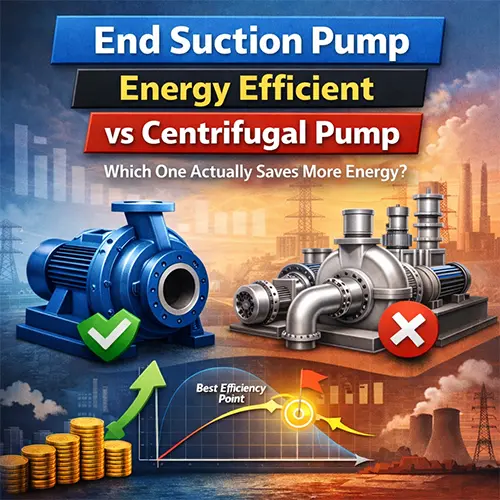
When buyers compare an end suction pump with a “centrifugal pump,” they are usually trying to answer a cost question, not a classification question.
They want to know:
- Which option will use less electricity?
- Which pump will lower long-term operating cost?
- Which design is more suitable for a real industrial or commercial system?
- Is it worth paying more for another centrifugal pump type if the goal is energy savings?
The first thing to clarify is that an end suction pump is itself a centrifugal pump. So the comparison is not really “end suction pump vs centrifugal pump.” The practical comparison is:
End suction pump vs other centrifugal pump types, such as multistage pumps, double suction pumps, or inline pumps.
That distinction matters because once the category is clear, the decision becomes much more useful. You stop asking which name sounds more efficient, and start asking which pump design matches your flow rate (the volume of liquid moved per unit time), head (the pressure or elevation the pump must overcome), and operating profile. End suction pumps are commonly defined as single-stage centrifugal pumps with axial suction and radial discharge, while DOE and Hydraulic Institute materials treat end suction, multistage, and double suction pumps as different covered centrifugal pump categories.
This is where energy efficiency becomes a serious business issue. In many pump systems, the purchase price is only a small part of the total lifecycle cost. Electricity over several years can exceed the original equipment cost, especially in systems that run continuously or for long daily operating hours. DOE pump guidance also emphasizes that improving pump-system efficiency reduces operating and maintenance cost, and it treats the Best Efficiency Point (BEP) as a central reference point for pump performance.
So the goal of this article is not to tell you that one pump is always better. That would be misleading. The goal is to help you decide, from a buyer’s perspective, when an end suction pump is the energy-efficient choice, when it is not, and what system conditions should drive your decision.
What “Energy Efficient” Actually Means in Pump Selection
If a supplier tells you a pump is “energy efficient,” that statement is incomplete. A pump does not save energy simply because it has a certain name, casing style, or brochure claim. Energy efficiency in a pump system depends on how closely the selected pump matches the system demand.
The most important concept here is the BEP (Best Efficiency Point). This is the operating point where the pump converts shaft power into hydraulic power most efficiently. DOE guidance explains that centrifugal pumps are most efficient near BEP, and it also shows that pump-system energy use depends on the full system, not the pump alone.
In practical terms, when a pump operates close to its BEP:
- internal hydraulic losses are lower
- turbulence is reduced
- vibration and wear are usually lower
- electricity consumption per unit of useful output is lower
When a pump operates far away from its BEP:
- energy is wasted as friction and turbulence
- internal recirculation can increase
- the system may require throttling or other artificial control
- operating cost rises even if the pump is mechanically sound
This is why many “efficiency problems” are not really pump-brand problems. They are selection problems or system-matching problems.
What really determines pump energy use
| Factor | Why it matters | Relative impact on energy use |
| Operating point vs BEP | Determines how efficiently the pump works in real service | Very high |
| System resistance | Pipe friction, fittings, and layout change required power | Very high |
| Control method | Variable speed control usually wastes less energy than throttling | High |
| Pump type | Different designs suit different flow/head ranges | Medium |
| Fluid condition | Viscosity, solids, and temperature affect hydraulic behavior | Medium |
The important buying insight is this:
The most energy-efficient pump is not the most advanced-looking pump.
It is the pump that matches the system curve best.
That is the right mindset before comparing end suction pumps with other centrifugal designs.
What an End Suction Pump Really Is
An end suction pump is usually a single-stage centrifugal volute pump with an axial suction port (inlet on the end) and a radial discharge port (outlet usually on the top side). Manufacturer and industry definitions are consistent on this point. Your own site’s end suction content also frames it as the standard centrifugal design for general water systems.
That configuration makes end suction pumps especially popular because they are:
- mechanically straightforward
- widely available
- relatively easy to install and service
- often cost-effective for standard water applications
From a buyer’s point of view, that simplicity matters. A simpler pump often means lower initial cost, easier spare-parts support, and less maintenance complexity. That is why end suction pumps are often the first option considered in commercial water transfer, irrigation, and general industrial water systems. Your site’s own pump-selection content consistently places end suction pumps in the “simple, economical, easy to maintain” category for standard systems.
But simplicity also has limits.
An end suction pump is generally most suitable for moderate flow and moderate head duties. It is not inherently the most efficient option for every scenario. It becomes attractive when the system duty falls squarely in the range where its hydraulic design works well.
Typical end suction pump profile
| Characteristic | Typical implication |
| Single-stage design | Good for moderate head, less ideal for very high-pressure duty |
| Compact structure | Easier installation and maintenance |
| Simple hydraulic path | Efficient in many standard water systems |
| Broad market use | Strong availability and cost competitiveness |
The key point is not that end suction pumps are basic. The key point is that they are optimized for a specific part of the centrifugal pump market.
A natural internal-link placement here would be a sentence such as:
“If you need a clearer technical definition before comparing pump efficiency, see our guide on what an end suction pump is.”
Why Other Centrifugal Pump Types Can Be More Efficient in Some Systems
Once buyers understand that an end suction pump is one kind of centrifugal pump, the next question becomes more useful:
When do other centrifugal pump types outperform it in energy efficiency?
The answer depends mainly on flow, head, and system variability.
A multistage pump (a pump with multiple impellers in series) adds energy to the liquid step by step. That is why multistage designs are widely used where high pressure or high head is required. KSB’s technical explanation of multistage high-pressure pumps and your own multistage pump guide both frame multistage pumps as the more appropriate choice for higher-pressure applications.
A double suction pump (a centrifugal pump that feeds the impeller from both sides) improves hydraulic balance and is commonly used for large-flow systems. Xylem and your own double suction content both emphasize large-capacity duty and improved hydraulic balance as core strengths of the design.
An inline pump (also called a pipeline pump) is often chosen when installation footprint is limited, but the installation advantage does not automatically make it the most energy-efficient option. Your own inline pump guide makes clear that inline pumps are selected largely for layout and installation reasons.
Practical comparison by application logic
| Pump type | Where it often performs best | Where it can lose efficiency |
| End suction pump | Moderate flow, moderate head, standard clean-water systems | High-head or extreme-flow duty |
| Multistage pump | High head, pressure-driven systems | Simpler low-head applications |
| Double suction pump | Large flow, low-to-medium head systems | Smaller systems where added size/cost is not justified |
| Inline pump | Space-constrained building systems | Systems needing broader hydraulic flexibility |
| Cause | What is happening physically | Practical effect |
| Oversizing | Pump runs far from BEP | Lower efficiency, higher operating cost |
| Throttling control | Excess energy is lost as pressure drop | Electricity wasted |
| Poor piping design | Friction losses increase required head | Pump works harder than necessary |
| Wrong pump type for duty | Hydraulic mismatch | Long-term inefficiency |
This is the part buyers need to remember:
In many systems, the energy problem is not “end suction vs centrifugal.”
It is “system mismatch vs system fit.”
A natural internal-link placement here would be:
“If you want to see how flow, head, and pipe size change pump efficiency in real projects, our pump system design guide explains the calculation logic step by step.”
When an End Suction Pump Is the Energy-Efficient Choice
Now we can finally answer the question properly.
An end suction pump is often the energy-efficient choice when the system has:
- moderate head
- moderate and fairly stable flow demand
- relatively simple piping
- clean or relatively clean liquid
- operating conditions that keep the pump near its BEP
In these situations, the end suction pump can deliver a very strong balance of:
- acceptable hydraulic efficiency
- lower initial cost
- simpler maintenance
- easier spare parts support
That combination matters because buyers are not choosing efficiency in isolation. They are choosing usable efficiency with acceptable lifecycle cost.
Situations where end suction pumps are often the right energy choice
| System condition | Why end suction pumps often work well |
| Standard water transfer | Duty is within a simple, efficient hydraulic range |
| HVAC circulation | Flow/head requirements are often moderate and predictable |
| Irrigation and general utility water | Simplicity and cost-effectiveness support good lifecycle value |
| Plants prioritizing easy maintenance | Lower service complexity helps overall efficiency economics |
This is also the point where a natural internal link to your end suction pump applications article or product page fits well, because the reader is moving from concept to product-type validation.
When an End Suction Pump Is Not the Best Energy Choice
An end suction pump becomes less attractive when the system demands move outside its natural operating range.
If the required head is high, the single-stage design may no longer be the most efficient way to generate pressure. If the flow is very large, a double suction pump may provide better hydraulic performance and better long-term efficiency. If the system varies widely and requires strong control flexibility, speed control and system design may matter more than pump type alone.
Situations where another centrifugal design may be better
| System condition | More suitable pump direction |
| High-pressure service | Multistage pump |
| Very large flow volume | Double suction pump |
| Strongly variable demand | Pump + VFD + system optimization |
| Tight installation with building services focus | Inline pump in some layouts |
The buyer-level conclusion is straightforward:
An end suction pump is efficient when used where it belongs.
It becomes inefficient when asked to do a job better suited to another hydraulic design.
A natural internal-link placement here would be:
“For larger-flow systems where hydraulic balance matters more than compactness, our double suction pump guide explains when that design becomes the better choice.”
How Buyers Should Actually Make the Decision
The most useful decision sequence is not “Which pump is best?”
It is:
- What flow do I need?
- What head do I need?
- How stable is the duty?
- How much does electricity cost matter over time?
- Do I need simplicity, higher pressure capability, or higher flow capability?
Once those answers are clear, the right pump type usually becomes much easier to identify.
Buyer decision guide
| If your priority is… | Most likely direction |
| General-purpose water pumping with moderate duty | End suction pump |
| High pressure | Multistage pump |
| High flow | Double suction pump |
| Lowest total energy waste in a variable system | System optimization first, then pump selection |
The biggest mistake is choosing the pump type first and then trying to force the system to fit the choice.
This is exactly why your own pump selection guide based on flow, head, pipe size, and NPSH is a useful natural internal link here: it reinforces that buyers should start from system requirements, not product labels.
Frequently Asked Questions
Buyers usually reach this point with a few final concerns. These questions often decide whether they feel confident enough to move forward.
Is an end suction pump always less efficient than other centrifugal pumps?
No. It is only less efficient when used outside the conditions it is suited for. In moderate-flow, moderate-head systems, it can be one of the most economical and energy-responsible choices available.
Can I improve energy efficiency without changing the pump?
Often, yes. DOE variable-speed pumping guidance shows that variable speed pumping can substantially reduce absorbed power when flow and head are reduced, because the operating point can stay in a more favorable region rather than being forced through throttling.
In practice, you may improve efficiency through better control, improved piping, or a closer operating point to BEP.
Should I buy a more expensive pump type to save electricity?
Not automatically. If the real problem is oversizing or poor system design, a higher-end pump may not solve it. A better-matched system can outperform a more expensive but mismatched pump.
What is the biggest buying mistake in this comparison?
Treating “centrifugal pump” as a separate alternative to “end suction pump,” instead of recognizing that end suction is one centrifugal subtype and the real decision is about system fit.
Conclusion
The comparison between an end suction pump and a “centrifugal pump” is misleading unless it is reframed correctly.
An end suction pump is a centrifugal pump. The real decision is whether an end suction design is more energy efficient than other centrifugal pump types for your specific duty.
In many standard water systems, the answer is yes. End suction pumps often provide the best balance of efficiency, simplicity, and lifecycle value when flow and head are moderate and the system is well matched. In high-head or very large-flow applications, however, other centrifugal designs may provide better energy performance.
So the final decision is not about labels. It is about fit.
The most energy-efficient pump is not the most complex pump.
It is the pump that matches your system curve, operating range, and real duty most closely.
Get A Quote

Get A Quote
0 Comments