
Industrial Pump Selection Risk Checklist: 12 Checks Before You Approve a Quote
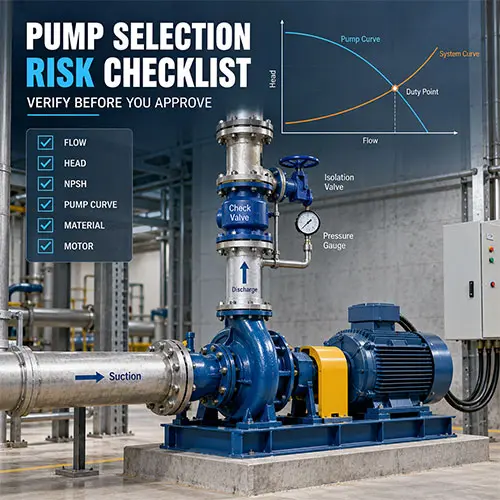
Selecting an industrial pump is not difficult because there are too few options. Usually it is difficult because too many assumptions are hidden inside a simple request such as:
“100 m³/h, 50 m head. Please quote.”
A supplier can certainly find a pump near those numbers. That does not yet prove the pump will work correctly in the actual system.
Before approving an industrial pump, the buyer should be able to connect three things: what the system really needs, where the selected pump will actually operate, and what evidence supports that selection.
If one of those pieces is missing, the selection may still be possible. It just should not be treated as final yet.
Industrial Pump Selection in 30 Seconds
Do not approve an industrial pump from flow, head, motor power and price alone.
A defensible selection should normally confirm the actual system duty, expected operating point on the pump curve, suction conditions, NPSH, liquid properties, operating range, wetted materials, driver configuration and installation constraints.
You do not need to accept these points on trust.
Most of them can be checked from the pump curve, system information, datasheet, material list, motor data and general arrangement drawing.
That is the idea behind this industrial pump selection risk checklist: not “believe the supplier,” but see whether the selection can explain itself.
The Six Risks Worth Checking First
Before going into the full technical review, these six items catch a large share of avoidable selection uncertainty.
| Selection Risk | What May Go Wrong | What the Buyer Can Verify |
|---|---|---|
| Flow is based on one rough number | Pump may be too large or too small for normal operation | Minimum, normal and maximum required flow |
| Head is estimated incorrectly | Required flow may never be reached, or excess head must be throttled | TDH calculation or the assumptions behind it |
| Duty point is not checked against the pump curve | Pump may operate far from its intended region | Marked duty point on the selected pump curve |
| Suction conditions are incomplete | Cavitation, unstable flow or loss of performance may occur | NPSHa basis, liquid level and suction arrangement |
| Liquid data is incomplete | Performance, materials or seal may be wrong | Temperature, viscosity, solids and chemical properties |
| Supplier gives a model but not the selection basis | Buyer cannot independently review the recommendation | Curve, datasheet, drawing and configuration details |
If one of these is unknown, it does not automatically mean the pump is wrong. It means there is still an assumption that needs to be checked.
Scope of This Guide
This guide is mainly written for procurement teams, engineers, EPC contractors, distributors and project owners evaluating rotodynamic pumps for applications such as water transfer, circulation, irrigation, pressure boosting, drainage and general industrial service.
The same thinking can be used for sewage, slurry and process pumping, but these services normally require additional attention to solids, abrasion, viscosity, corrosion and sealing.
It is not intended to replace a project hydraulic calculation or a manufacturer’s final technical selection.
For hazardous chemicals, very high temperatures, severe slurry service, sanitary processes, boiler feed systems or other critical duties, project-specific engineering review is still necessary.
The purpose here is narrower and practical:
How can a buyer tell whether a pump selection is ready to approve?
Risk Check 1: Do You Really Know the Required Flow?
Flow is often the first number in an RFQ, so it looks settled.
Sometimes it isn't.
A buyer may specify 100 m³/h, for example, but that number could mean peak demand, average demand, design capacity or simply the rating of the pump already installed.
Those meanings are not interchangeable.
A pump that only sees peak demand for a short period should not automatically be selected as if it operates at that condition all day. The reverse is also true. Selecting only for average demand may leave the system unable to meet a legitimate peak requirement.
For variable systems, it is more useful to know:
- minimum expected flow;
- normal operating flow;
- maximum required flow;
- how often the system operates at each condition.
You do not need a complex study to see whether this information is missing.
Look at the RFQ.
If there is one flow number and nothing describing how the process actually operates, the supplier is probably making an assumption somewhere.
How Can a Buyer Verify the Flow Requirement?
Start with the process, not the pump catalog.
Ask what consumes or receives the liquid downstream. Check production demand, tank filling requirement, irrigation demand, building consumption, cooling requirement or whatever the pump is actually serving.
If minimum, normal and maximum demand can be established from the process, you have something meaningful to select against.
If they cannot, keep the pump selection provisional.
For the hydraulic relationship between flow, head, pipe size and suction conditions, use the pump selection guide for flow, head, pipe size and NPSH as a more detailed calculation reference.
Risk Check 2: Is the Required Head Based on the Real System?
A pump does not decide how much head the system needs.
The system does.
That distinction sounds basic, but it explains many poor selections.
Total head may include elevation difference, required terminal pressure and friction losses through pipes, valves, fittings, filters, heat exchangers or other equipment.
So when a quotation says:
Duty: 100 m³/h @ 50 m
the useful question is not only:
“Can this pump produce 50 m?”
Ask:
“Where did the 50 m come from?”
If there is no answer, the pump may be accurately selected against an inaccurate requirement.
How Can You Check the Head Without Being a Pump Specialist?
You can at least check whether the calculation has the right inputs.
For a typical water system, review:
- suction and discharge liquid levels;
- required discharge pressure;
- pipe diameter;
- approximate pipe length;
- major valves and fittings;
- filters or process equipment;
- required flow.
If these items materially affect the system but nobody has asked about them, the final head deserves another look.
The Hydraulic Institute describes the operating point of a pumping system as the intersection between the pump H-Q curve and the system curve. In other words, actual operation comes from the pump and system together, not the pump curve alone.
Risk Check 3: Can the Supplier Show the Operating Point on the Pump Curve?
This is one of the easiest ways to move from a sales quotation to a technical selection.
Ask for the selected pump curve.
Then ask the supplier to mark the requested duty point.
You should be able to see where that point sits relative to the pump’s head curve, efficiency information, absorbed power and NPSH requirement.
No complicated explanation is needed.
If the supplier says a certain model is suitable, the curve should help show why.
What Does the Operating Point Tell You?
For a rotodynamic pump, the expected operating point comes from the intersection of the pump curve and system curve.
That point may be close to the pump’s Best Efficiency Point, or BEP. It may be away from it.
BEP is not simply a marketing efficiency number. It is the operating condition where hydraulic efficiency reaches its maximum for a given speed and impeller diameter.
The Hydraulic Institute also defines a Preferred Operating Region (POR) around BEP where hydraulic efficiency and operating reliability are not substantially degraded. The exact region depends on pump design, so it should not be guessed from a universal percentage.
This gives the buyer a useful way to verify a supplier’s statement.
If someone says:
“This pump is a good match.”
Ask:
“Please show the duty point and the manufacturer’s recommended operating region on the curve.”
Now the statement has evidence behind it.
Does the Pump Need to Run Exactly at BEP?
No.
Real systems change.
Water level changes, valves move, demand varies and parallel pumps start or stop.
The practical question is whether the expected operating range is reasonable for the selected pump, not whether one perfect point happens to sit exactly on BEP.
A supplier should be able to explain that range.
Risk Check 4: Is the Pump Oversized “For Safety”?
This sentence should make a buyer curious:
“We selected the next size up to be safe.”
Safe from what?
Sometimes additional capacity is justified. Future expansion may be real. A process may have a confirmed higher future demand. Redundancy strategy may require a specific arrangement.
But a vague safety margin is different from a defined future duty.
An oversized centrifugal pump can produce more head or flow than the system actually needs. The excess may then be controlled through throttling, bypassing or frequent speed reduction. The pump may also spend much of its operating time farther away from its preferred region.
The U.S. Department of Energy includes matching pumps to system requirements and correcting oversized pumps among its pump-system efficiency guidance.
How Do You Prove Whether Oversizing Is Real?
Compare three things:
- the normal system duty;
- the selected pump’s curve;
- the expected control method.
If the pump is significantly larger than normal duty, ask what happens to the extra head or flow.
If the answer is:
“The discharge valve will just be closed a little.”
that does not automatically make the design wrong. But now you know energy is being deliberately dissipated across the valve.
That deserves an engineering and lifecycle-cost check.
A proper future capacity allowance should have a number, a reason and an operating plan.
“Bigger is safer” is not yet an engineering reason.
The wrong pump sizing and hidden cost guide goes deeper into this issue.
Risk Check 5: Has Anyone Checked the Suction Side?
Buyers naturally focus on discharge pressure because that is the result they want.
The pump, however, has to receive liquid before it can deliver it.
Tank level, suction lift, inlet pressure, liquid temperature, pipe size, pipe length, strainers, valves and fittings can all affect suction performance.
This is where Net Positive Suction Head matters.
NPSHa is what the system makes available.
NPSH3 / NPSHr is a characteristic associated with the pump and operating condition.
A common mistake is to think:
NPSHa is slightly higher than the value on the pump curve, so everything is fine.
That may not be enough for reliable service.
Hydraulic Institute guidance explains that operating a pump with NPSHa merely equal to NPSH3 means the pump is already at the test condition associated with head reduction from cavitation. Adequate NPSH margin is therefore important, and the required margin varies with application and operating region.
A Simple Way to Test the Supplier’s Selection
Ask one question:
“What suction condition did you assume when selecting this pump?”
A technically useful answer should connect to real inputs such as:
- minimum liquid level;
- suction pressure or lift;
- liquid temperature;
- suction line dimensions;
- inlet losses;
- required flow.
If none of those were known, the NPSH check probably contains assumptions.
That does not mean the pump is wrong.
It means the suction review is unfinished.
For the detailed calculation logic, see the NPSH calculation and cavitation prevention guide.
Risk Check 6: Has the Liquid Been Described, or Only Named?
“Water” may be enough information for some ordinary applications.
“Chemical.”
“Wastewater.”
“Slurry.”
Those descriptions are not enough by themselves.
Two liquids carrying the same general name can behave very differently depending on temperature, concentration, viscosity or solids.
Before selection, useful liquid information may include:
- actual liquid or chemical composition;
- normal and maximum temperature;
- viscosity;
- density or specific gravity where relevant;
- solids concentration;
- maximum solids size;
- abrasive characteristics;
- corrosive characteristics;
- whether the liquid condition changes during operation.
How Can the Buyer Verify This Part?
Compare the liquid information on the RFQ with the pump datasheet or technical offer.
If the RFQ says abrasive slurry but the quotation reads like a standard clean-water selection, ask why.
If a supplier recommends a certain stainless steel because it is “corrosion resistant,” ask:
“Compatible with this exact liquid, concentration and temperature?”
The material should be selected against the actual medium.
Not against the word “corrosive.”
The same applies to seals.
A casing material may be suitable while an elastomer or seal face material is not.
The proof should be in the offered wetted-material list and the operating conditions used for the recommendation.
Risk Check 7: Is the Pump Family Right Before the Model Is Chosen?
A pump can hit the required flow and head and still be the wrong pump for the service.
That is why pump-family selection comes before model selection.
An end suction clean-water pump may achieve the hydraulic duty of a dirty-water application. That does not prove it can pass the solids.
A sewage pump may have a large discharge connection. That alone does not prove it will handle long fibrous material.
A high-head multistage pump may produce the pressure required. The suction condition still has to work.
So instead of asking:
“Which model gives me this flow and head?”
start one level higher:
“What type of pump should be doing this job?”
A practical starting point looks like this:
| Application | Pump Family Often Considered | What Still Needs Verification |
|---|---|---|
| Clean-water transfer | End suction or other single-stage centrifugal pump | Duty, NPSH, materials, control |
| Large-volume clean water | Split case or other suitable high-flow pump | System curve, suction, operating range |
| Higher-pressure clean water | Multistage pump | Stage selection, pressure, suction condition |
| Building circulation / boosting | Inline or booster pump arrangement | Demand variation, controls, maintenance |
| Wastewater with solids | Solids-handling / sewage pump | Solids size, fibrous material, clogging risk |
| Abrasive slurry | Purpose-designed slurry pump | Particle characteristics, wear and material |
| Suction-lift drainage | Suitable self-priming arrangement | Real suction lift and priming conditions |
“Usually considered” is intentional here.
This table is a shortlist, not a final selection.
If a supplier moves directly from application name to model number without asking about the duty and medium, the buyer should ask what assumptions filled the gap.
Risk Check 8: Can the Material and Seal Choice Be Defended?
Material discussions often become too simple:
Cast iron is cheaper. Stainless steel is better.
That is not a useful selection rule.
Better for what?
The answer depends on what the wetted parts actually see.
A material decision may involve casing, impeller, shaft, shaft sleeve, mechanical seal, O-rings and other wetted parts. Temperature, solids and chemistry can change what is acceptable.
Ask for the Wetted-Material List
This is one of the easiest self-checks in the whole purchasing process.
Do not accept only:
“SS pump.”
Ask which parts are stainless steel.
Then compare the offered material against the real medium.
For chemically aggressive liquids, the supplier should know enough about composition, concentration and temperature to make the recommendation.
If those inputs were never supplied, a confident material recommendation should be treated cautiously.
Sometimes the correct answer is simply:
“We need the liquid data before confirming the material.”
That is not weakness.
That is a technical boundary.
Risk Check 9: What Happens Away From the Rated Duty?
A pump curve shows more than one point because a real pump does not live at one point forever.
A tank level changes.
A filter becomes dirty.
An operator partially closes a valve.
A second pump starts.
Demand falls overnight.
Any of these can move the operating point.
So after verifying the normal duty, look at the likely operating range.
The Buyer Does Not Need to Guess This
Ask the supplier to mark:
- minimum expected operating point;
- normal duty;
- maximum expected operating point.
Then compare these points with the manufacturer’s acceptable or preferred operating region.
This is especially important when demand varies widely.
A Variable Frequency Drive can help change pump speed as system demand changes, but it does not magically fix an unsuitable pump. The pump curve and system curve still interact at every speed.
If the application varies so much that one pump works poorly at the low end and the high end, that may be a reason to examine parallel pumps, staging or another arrangement.
The point is not that multiple pumps are always better.
The point is that the operating range should be visible before the equipment arrives.
Risk Check 10: Does the Motor Match the Pump and the Site?
A quotation may show:
Motor: 30 kW
That is not yet enough to approve it.
The buyer should know whether that motor is suitable for:
- the pump’s power requirement; and
- the site’s electrical system.
For the hydraulic side, compare the pump’s absorbed-power curve with the proposed motor.
For the electrical side, confirm items such as:
- voltage;
- frequency;
- phase;
- motor speed;
- starting method;
- VFD operation if required;
- enclosure and environmental requirement where relevant.
This can catch a surprisingly simple purchasing problem: hydraulically correct pump, electrically wrong motor.
What Is the Evidence?
The evidence is not the sentence “motor matched.”
It is the pump power information plus the motor datasheet.
Put them side by side.
If the motor selection cannot be explained from those two documents, ask again before approval.
The pump motor selection guide covers these electrical checks in more detail.
Risk Check 11: Will the Pump Fit the Real Installation?
A pump can be hydraulically correct and still create a bad project.
This happens when selection stops at the datasheet and nobody looks at the equipment arrangement.
Before final approval, especially for replacement work or tight pump rooms, review:
- overall dimensions;
- suction and discharge orientation;
- flange size and standard;
- baseplate dimensions;
- foundation arrangement;
- coupling access;
- motor removal space;
- seal or bearing maintenance access;
- lifting space;
- nearby piping and equipment.
Do Not Assume the Same Flange Size Means the Same Pump Fit
Two pumps can have similar hydraulic duties and the same nominal connections but different centerline heights, footprints or flange positions.
You can verify this before shipping.
Ask for the general arrangement drawing and compare it with the actual installation.
For a replacement project, compare dimensions one by one.
This is cheaper than discovering the difference when the old pump has already been removed.
Hydraulic similarity does not prove dimensional interchangeability.
Risk Check 12: Can the Supplier Show Why This Exact Pump Was Selected?
This final check ties everything together.
A professional technical offer does not need to be fifty pages long.
But there should be enough information for another person to follow the logic.
A buyer should normally be able to connect:
application → duty → pump curve → configuration → installation
without having to rely on:
“Our engineer says this model is suitable.”
Maybe the engineer is right.
The documents should still show why.
Evidence Worth Asking for Before Final Approval
| Evidence | What You Can Check Yourself |
|---|---|
| Exact pump model | Whether the quotation and curve refer to the same pump |
| Performance curve | Whether the duty is actually within the pump’s capability |
| Marked duty point | Where the selected operating condition sits |
| Efficiency data | Expected efficiency around the required duty |
| Absorbed-power data | Whether the driver selection makes sense |
| NPSH data | Suction requirement at the expected operating condition |
| Wetted materials | Whether the offered configuration matches the liquid |
| Seal information | Whether the sealing arrangement matches the service |
| Motor datasheet | Whether power and site electricity are compatible |
| GA drawing | Whether the equipment physically fits |
| Connection information | Whether piping interfaces are correct |
| Test scope | What will be checked before shipment |
Not every project needs every document at the same level.
A small clean-water transfer pump and a critical process pump are not the same procurement exercise.
But the principle is useful:
The higher the consequence of getting the selection wrong, the stronger the evidence should be before approval.
Red Flags That Deserve One More Question
A red flag is not proof that a supplier is bad.
It is simply a reason not to stop asking yet.
| What You See in the Quotation | The Next Question to Ask |
|---|---|
| Pump selected from flow only | What head was used and how was it determined? |
| Selection based on pipe size | What is the actual system duty? |
| No pump curve | Can you send the curve for this exact configuration? |
| Pump selected larger “for safety” | What future or peak condition requires the larger selection? |
| No suction data requested | What NPSH / suction assumptions were used? |
| Medium listed only as “chemical” | What composition and temperature was used for material selection? |
| Solids present but not discussed | What particle size, concentration and type did you assume? |
| Motor shown without power curve | What is the maximum absorbed power in the expected operating range? |
| Replacement pump chosen from old model only | Has the current system condition been checked? |
| No dimensional drawing | How will connection and installation compatibility be confirmed? |
This style of technical review changes the supplier conversation.
Instead of asking:
“Are you sure?”
you ask:
“Show me what the selection is based on.”
Much better question.
A Practical Industrial Pump Selection Approval Checklist
Use this table during technical bid review.
It is intentionally simple.
If the information is confirmed, move on.
If it is still based on an assumption that could materially change the selection, hold that item.
| Check | Evidence | Decision |
|---|---|---|
| Required flow | Minimum / normal / maximum process requirement | Confirm / Hold |
| Required head | TDH calculation or system assumptions | Confirm / Hold |
| System behavior | System curve or sufficient piping information | Confirm / Hold |
| Pump capability | Selected model performance curve | Confirm / Hold |
| Operating point | Duty marked on curve | Confirm / Hold |
| Operating region | BEP / manufacturer operating limits reviewed | Confirm / Hold |
| Suction condition | Liquid level, pressure/lift and suction losses | Confirm / Hold |
| NPSH | NPSHa compared with pump requirement and appropriate margin | Confirm / Hold |
| Liquid | Temperature, viscosity, solids and chemistry | Confirm / Hold |
| Materials / seal | Offered wetted-material and seal specification | Confirm / Hold |
| Motor | Power curve + motor datasheet + site electricity | Confirm / Hold |
| Installation | GA drawing and site dimensions | Confirm / Hold |
A “Hold” does not mean reject the supplier.
It means:
Do not turn an unknown into a purchase order yet.
What If You Do Not Know All the Pump Data?
This is common.
A buyer does not have to be a pump engineer before sending an RFQ.
The important part is to tell the supplier what is known, what is not known and what can be measured or calculated.
For example, if TDH is unknown, send:
- required flow;
- source liquid level;
- discharge elevation;
- required downstream pressure;
- pipe size;
- approximate pipe length;
- major valves and fittings.
Now the supplier has something from which head can be estimated or calculated.
If NPSHa is unknown, send the suction arrangement, minimum liquid level, elevation, temperature and suction piping information.
If material is uncertain, send the actual liquid composition and temperature rather than guessing a material yourself.
A useful supplier should help close these information gaps.
But there is a difference between helping calculate a missing value and quietly assuming a missing value.
The first can be reviewed.
The second is hard to see.
What Should Go Into an Industrial Pump RFQ?
A good RFQ is not necessarily long.
It is specific where the selection depends on it.
| RFQ Item | Useful Information |
|---|---|
| Application | What the pump actually does |
| Required flow | Normal plus relevant minimum/maximum conditions |
| Head / pressure | Required condition or enough system data to calculate it |
| Suction source | Tank, pit, river, well, pressurized line, etc. |
| Suction condition | Liquid level, pressure/lift, suction line information |
| Medium | Actual liquid |
| Temperature | Normal and relevant maximum/minimum |
| Viscosity | If materially different from water |
| Solids | Size, concentration, shape and abrasive nature where relevant |
| Material concern | Corrosion, erosion or hygiene requirement |
| Duty pattern | Continuous, intermittent, standby or variable |
| Power supply | Voltage, frequency and phase |
| Speed control | Fixed speed / VFD / pressure control / level control |
| Installation | Indoor/outdoor, available space, orientation |
| Connections | Flange or interface requirement |
| Documentation | Curve, GA drawing, datasheet, testing or project documents required |
If some of these are not relevant to the application, leave them out.
A useful RFQ should reduce uncertainty, not become paperwork for the sake of paperwork.
How Should You Compare Two Pump Quotations?
Do not compare prices first.
First make sure you are comparing the same duty and the same assumptions.
Suppose Supplier A quotes a smaller pump with a higher-speed motor while Supplier B quotes a larger pump operating at a different point.
The prices are different.
But at this stage, you still do not know whether you are comparing equivalent solutions.
Check in this order:
same system duty → same liquid → same operating assumptions → pump curve → materials and seal → motor → installation → testing/documentation → maintenance/spares → commercial terms
Only then does the price comparison start to mean something.
This is also where lifecycle cost matters.
DOE pump-system guidance recommends evaluating the pumping system and lifecycle economics, not just the efficiency or purchase price of one component.
The cheapest pump to buy is not automatically the cheapest pump to own.
The most expensive quotation is not automatically better either.
Both still need to prove the selection.
When Should You Stop and Ask for More Information?
Some RFQs reach a point where another pump model will not solve the real problem.
Stop the selection when:
- required head cannot be established;
- suction conditions are unknown but could affect NPSH;
- the liquid cannot be adequately described;
- solids are present but their characteristics are unknown;
- the operating range is still changing;
- installation dimensions are critical but unavailable;
- a replacement pump is requested without understanding the old pump’s operating problem.
This last situation deserves attention.
If the old pump suffers low flow, vibration or repeated seal failure, replacing it with a larger pump is not automatically a solution.
The problem may be in the system.
So before asking:
“What bigger model can replace this?”
ask:
“Do we know why the current pump is not working correctly?”
Sometimes the professional answer is:
We do not have enough information to select yet.
That can save more time than a fast quotation.
FAQ About Industrial Pump Selection Risk
These questions usually appear when an enquiry moves from basic quotation to technical approval.
Is Flow and Head Enough to Select an Industrial Pump?
They are essential, but not always sufficient.
Flow and head define the hydraulic duty. Final selection may also depend on the system curve, suction conditions, NPSH, liquid properties, solids, materials, sealing arrangement, operating range, motor and installation.
You can see whether more information is required by looking at the application.
A clean-water transfer pump with flooded suction is relatively simple.
A viscous, abrasive or suction-lift application is not the same selection problem.
How Can I Tell Whether the Supplier’s Pump Curve Is Correct for My Duty?
First confirm that the curve belongs to the exact model, speed and relevant configuration being quoted.
Then mark your duty point.
Check the expected efficiency, power and NPSH information around that operating condition and review its position relative to the manufacturer’s preferred or allowable operating region.
If demand varies, mark more than one operating point.
Do not review only the single rated condition.
Should I Buy a Bigger Pump for Future Expansion?
Only when the future requirement is defined well enough to design for.
Ask:
- How much future flow?
- How much future head?
- When will that condition occur?
- How will the pump operate before the expansion happens?
Once those questions have answers, future capacity can be engineered.
Without them, “future expansion” may simply mean permanent oversizing.
Is the Pump With the Highest Efficiency the Best Pump?
Not necessarily.
The highest efficiency value matters only in relation to where the pump actually operates.
A pump can have an excellent peak efficiency and still be a poor choice if your system operates far from that condition.
Efficiency also does not replace checks for NPSH, liquid compatibility, solids, installation or maintainability.
Can I Compare Pump Suppliers by Motor Power?
Not by motor power alone.
A larger motor can come from a different pump selection, different speed, different efficiency or simply a conservative driver choice.
Compare the hydraulic duty and absorbed-power curve first.
Then compare the proposed motor.
What Is the Best Question to Ask a Pump Supplier Before Ordering?
A very useful one is:
“Can you show me why this exact pump fits my actual system?”
The answer should connect the duty, curve, suction condition, liquid, configuration and installation.
If the explanation can be checked against the documents, you are no longer relying only on a sales claim.
Technical References and Verification Basis
This guide uses established pump-system principles rather than a proprietary selection formula.
The Hydraulic Institute describes how system curves and pump curves interact to establish the operating point and provides definitions and guidance for BEP, Preferred Operating Region and NPSH margin.
The U.S. Department of Energy’s pump-system resources use the same system-level approach, including matching pumps to system requirements, addressing oversized pumps and considering lifecycle economics rather than judging a pump as an isolated component.
Project-specific limits should still be checked against the selected manufacturer’s current technical data and any applicable project standard.
Final Decision: Do Not Approve the Pump Before You Can Explain It
Industrial pump selection becomes risky when assumptions disappear inside a quotation.
One person assumes the flow.
Another adds a little extra head.
Someone chooses a larger motor to be safe.
The pump still gets a model number, a price and a delivery time. It can look complete.
That is why a buyer needs an industrial pump selection risk checklist.
Not to redo the supplier’s engineering.
To see whether the engineering can be followed.
Before releasing the purchase order, try to answer three questions:
What does the system really require?
Where will this pump actually operate?
What document or calculation proves that?
If the answers line up, the selection has a reasonable technical basis.
If one answer is still guesswork, do not cover it with a larger pump.
Find the missing information first.
Get A Quote

Get A Quote
0 Comments