
What Is NPSH in Pumps? Calculate NPSHa, Read NPSHr & Prevent Cavitation
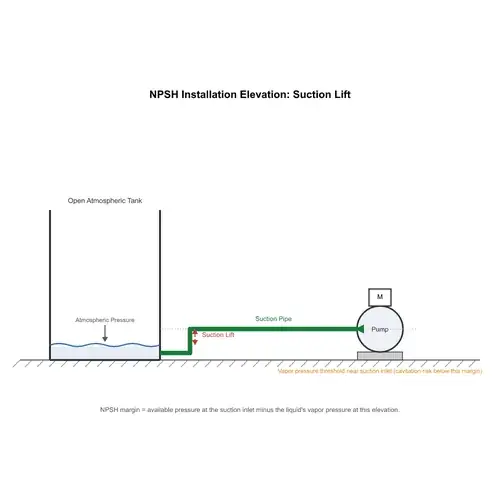
NPSH — Net Positive Suction Head — is the pressure margin keeping the liquid at your pump suction above its vapor pressure. If that margin disappears, the liquid flashes into vapor bubbles at the impeller eye, and those bubbles collapse violently a split-second later. That's cavitation, and it destroys impellers faster than almost any other failure mode. Your real job as the buyer or system engineer isn't just knowing the definition. It's making sure the available NPSH (NPSHa) your installation provides is higher than the required NPSH (NPSHr) the manufacturer tested on their curve — with a genuine safety margin that accounts for field conditions, not just a catalog number.
This is the part of pump selection that trips up even experienced contractors. A pump can meet the flow and head perfectly on paper and still destroy its impeller in a matter of months because the suction side was an afterthought. When you're sourcing a centrifugal pump for a plant water supply, a cooling tower circuit, a condensate return loop, or any application where the liquid is hot or the suction lift is tight, the NPSH calculation is what separates a ten-year pump from a six-month warranty headache.
This guide walks you through exactly how to work out NPSHa step by step, how to read the NPSHr line on a real pump curve, what safety margin to apply, and what to demand from your supplier before you commit to a purchase order. If you're responsible for avoiding field failures and downtime cost, consider this your practical verification framework.
Quick Answer: The Buyer's 30-Second NPSH Decision Rule
Here's the logic in one breath. NPSHa is what your system gives you — it's calculated from atmospheric pressure, suction lift (or submergence), piping losses, and the liquid's vapor pressure. NPSHr is what the pump needs — it's printed on the manufacturer's performance curve and rises as flow increases. The rule is simple: NPSHa must exceed NPSHr by a safety margin (often 0.5 to 1 meter for cold water, more for hot liquids or long suction lines). If it doesn't, bubbles form, cavitation starts, and the impeller, mechanical seal, and bearings take a beating. When you review a pump selection, don't accept a supplier's verbal assurance. Make them show you the NPSHr curve, make your own NPSHa calculation, and confirm the margin at the actual operating flow — not just at best efficiency point.
Scope of This Guide
This page is built for industrial pump buyers, system designers, and maintenance engineers who need to prevent cavitation through correct suction analysis — not generic theory. We cover:
- What NPSH, NPSHa, and NPSHr mean in terms you can use on a construction site or RFQ review
- How vapor pressure and atmospheric pressure change with fluid temperature and elevation
- A full step-by-step NPSHa calculation with a worked water-system example
- How to find and read the NPSHr line on a centrifugal pump curve
- Realistic NPSH safety margins — not just textbook numbers
- The installation sins that quietly eat your suction margin (undersized pipes, bad reducers, clogged strainers)
- What to ask the pump vendor and what to check during commissioning
We won't duplicate cavitation failure symptoms in detail — for that, see the separate troubleshooting reference. We won't teach you how to design the entire pump room. This is the suction-side engineering and procurement guide.
What Is NPSH in a Centrifugal Pump?
NPSH is net positive suction head — "net" meaning after you've subtracted vapor pressure, "positive" meaning above that threshold, and "head" meaning it's expressed in meters or feet of liquid column. Inside a centrifugal pump, liquid accelerates into the impeller eye, and the pressure drops. If the pressure at the impeller inlet falls below the liquid's vapor pressure, part of the liquid flashes to vapor instantly. Those vapor bubbles travel a short distance into the impeller passages, where pressure recovers just as quickly — and the bubbles collapse with enough force to pit cast iron, eat through stainless steel, and destroy mechanical seal faces.
From a procurement standpoint, NPSH has to be understood as two separate things that must never be confused:
- NPSHa (available): entirely a system value. You calculate it from the installation. The pump manufacturer cannot change it — they can only give you a pump that works within it.
- NPSHr (required): entirely a pump value. It comes from the hydraulic design of the impeller eye and inlet casing. It's tested in the factory under controlled conditions and published on the pump curve.
When a pump fails from cavitation after six months of operation, the root cause is almost never a "bad pump." It's almost always that someone selected a pump whose NPSHr looked fine on paper but whose NPSHa in the real installation was smaller than expected — because the suction pipe had three extra elbows, the strainer was partially blocked, the cooling water temperature was 10°C higher than designed, or the pump was running 20% to the right of BEP where NPSHr spikes.
NPSHa vs NPSHr: The Difference That Decides Cavitation
This is the single most important distinction to internalize before you look at any pump curve or write any RFQ.
| Parameter | Controlled by | Changes with system conditions? | Where verified | Procurement risk |
|---|---|---|---|---|
| NPSHa (available) | System designer, installer, site conditions | Yes — pipe size, elevation, temperature, fouling | Field measurement or design calculation | Underestimating losses; assuming ideal conditions |
| NPSHr (required) | Pump manufacturer's hydraulic design | No — fixed pump geometry, but varies with flow rate | Factory test curve, ISO 9906 test report | Treating catalog NPSHr as safe field minimum |
NPSHr is most commonly defined at the NPSH3 point — the suction head at which the pump's total developed head drops by 3%. That's the industry standard test criterion. But note: a 3% head drop already means cavitation is occurring. That's why you need a margin.
If you only remember one thing: NPSHa and NPSHr are controlled by different parties, verified in different ways, and the gap between them is the only thing standing between your pump and destructive cavitation.
Why Pumps Cavitate When NPSH Is Too Low

Cavitation isn't just noise. It's a lifecycle cost bomb. When suction pressure drops below vapor pressure:
- Vapor bubbles form at the impeller eye, reducing the effective flow area and chopping efficiency.
- Bubbles collapse a few centimeters downstream as pressure recovers, producing local shock waves that pit the impeller material — even hard stainless or duplex alloys — and generate the characteristic "gravel-in-the-pump" noise.
- Mechanical seal faces fracture. The vibration and pressure pulsation from cavitation can crack carbon seal rings and destroy hard faces in a matter of weeks under severe conditions.
- Bearings take impact loads far above design limits, cutting L10 bearing life dramatically.
- Flow becomes unstable, making it impossible to balance process systems, cooling loops, or distribution networks.
From a buyer's perspective, cavitation damage means that a pump that should deliver 15 years of service in clean water might need impeller replacement at 18 months and a full rebuild at 3 years. That extra maintenance cost plus unplanned downtime almost always exceeds the purchase price difference between a correctly selected pump and the cheaper one that "met the flow and head" but didn't have the right suction characteristics.
When you troubleshoot pump cavitation in the field, you'll typically find the damage pattern concentrated on the visible suction side of the impeller vanes — exactly where the bubbles first collapse. But the smarter strategy is to prevent it at the selection stage through a rigorous NPSHa calculation.
How to Calculate NPSHa Step by Step
Calculating NPSHa is the single highest-value task you can do before ordering a pump. It forces you to gather the right site data, think through suction piping losses, and spot dangerous conditions — hot liquids, high site elevation, long suction lines — that will bite you later.
The standard formula, referenced in Hydraulic Institute standards and pump engineering texts:
NPSHa = Ha ± Hs − Hf − Hvp (expanded form — see the variable table below)
Where each term is expressed in meters or feet of liquid. Let's define every variable clearly, because missing even one can make the difference between a safe selection and a cavitating pump.
NPSHa Formula Variables Explained
When you sit down with a pump data sheet or a commissioning report, these are the numbers you need.
| Variable | Name | What it accounts for | Where the buyer gets it | Common mistakes |
|---|---|---|---|---|
| Ha | Atmospheric pressure head | Ambient air pressure at the pump site converted to liquid head | Site elevation above sea level (look up standard pressure table) | Using sea-level pressure for a high-altitude installation |
| Hs | Static suction head (or lift) | Vertical distance from liquid surface to pump centerline | Site drawing; measured on-site | Confusing suction lift with discharge head; wrong sign (+ for flooded suction, − for lift) |
| Hf | Suction line friction loss | Pipe friction, elbows, valves, strainers, reducers on the suction side | Hydraulic calculation, pipe friction tables, component manufacturer K-factors | Ignoring fittings; assuming clean strainer; using nominal pipe size for velocity calcs |
| Hvp | Vapor pressure head | Liquid vapor pressure converted to head at the pumping temperature | Fluid property tables, steam tables | Ignoring temperature during high-ambient summer conditions or process heating |
| Hi | Inlet velocity head (sometimes separated) | Kinetic energy of liquid entering pump suction | Calculated from flow rate and suction pipe ID | Usually small and sometimes combined with Hf, but relevant in large-diameter low-head pumps |
The sign on Hs depends on your installation: if the liquid level is above the pump centerline (flooded suction, a positive static head), you add it; if the pump is pulling from a lower tank or sump (suction lift, negative static head), you subtract it. This is the single most common algebra error in NPSH calculations — and it's shockingly common in contractor submittals.
For practical project work, always calculate NPSHa at the maximum expected liquid temperature (highest vapor pressure) and at the maximum flow the pump might run (not just BEP). That's the worst case for NPSHa, and if the margin survives that, it survives normal operation.
Example NPSHa Calculation for an Industrial Water System
Let's walk through a realistic clean-water application so you can apply the same method to your own RFQs. Assume:
- Pump taking suction from an open atmospheric tank
- Tank water level 1.5 m below pump centerline (suction lift scenario)
- Suction piping: 5 meters of DN150 steel pipe, one 90° elbow, one strainer (pressure drop of 0.2 m when clean)
- Flow rate: 180 m³/h
- Water temperature: 85°C (hot water return loop)
- Site elevation: 800 m above sea level
- We'll use meters and metric units throughout
Step 1 — determine Ha (atmospheric pressure at 800 m elevation). Standard atmospheric head at sea level is about 10.33 m. At 800 m, an approximate correction factor (losing roughly 1.2 m per 1000 m of elevation) gives: Ha ≈ 10.33 − (0.8 × 1.2) ≈ 9.37 m
Step 2 — Hs (suction lift). Free surface is below the pump, so this is negative suction head. Hs = −1.5 m
Step 3 — Hf (friction loss). Let's estimate total suction line losses: - 5 m DN150 pipe at ~2.8 m/s velocity → friction loss approximately 0.35 m (using typical pipe friction tables; exact value depends on pipe schedule and roughness) - One 90° long-radius elbow → K ≈ 0.3, velocity head ~0.4 m, loss ≈ 0.12 m - Strainer pressure drop (clean) → 0.20 m Total Hf = 0.35 + 0.12 + 0.20 = 0.67 m
Step 4 — Hvp (vapor pressure at 85°C). Saturated water vapor pressure at 85°C is roughly 57.8 kPa absolute. Convert to head: Hvp = 57.8 kPa ÷ (9.81 m/s² × density) — for water near 85°C, density ~968 kg/m³; this gives approximately 6.1 m (Always confirm with your project's fluid property data.)
Step 5 — put it together. NPSHa = Ha + Hs − Hf − Hvp NPSHa = 9.37 + (−1.5) − 0.67 − 6.1 NPSHa ≈ 1.1 m
Now compare this to a typical end-suction pump's NPSHr: at 180 m³/h, many standard single-stage centrifugal pumps show NPSHr values around 3.5 to 5.0 m. Our calculated NPSHa of ~1.1 m is dramatically insufficient. The pump would cavitate severely from day one.
What options does the buyer have? Lower the pump (increase submergence, flip Hs to positive), cool the water (reduce Hvp), oversize the suction pipe (reduce Hf), or select a pump with a much lower NPSHr — perhaps a double-suction or a low-NPSH impeller design. This is exactly the kind of calculation that separates a reliable system design from a procurement mistake that shows up only at commissioning. For a deeper look at suction pipe sizing and how it integrates with total system head estimation, see the total dynamic head calculation guide.
How to Read NPSHr on a Pump Curve
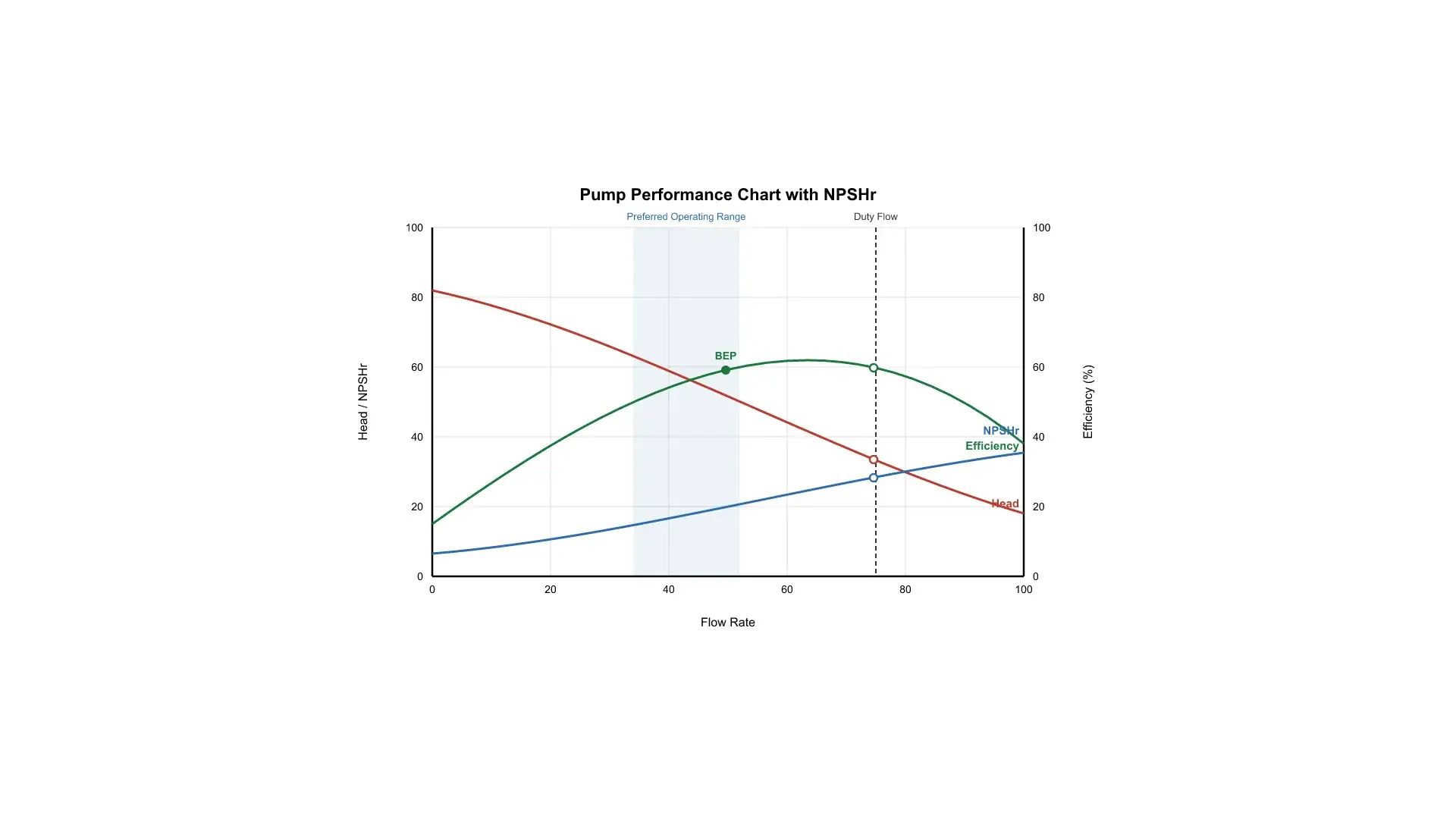
Every centrifugal pump performance curve includes an NPSHr line — but in my experience, many engineers look at the head-flow curve and efficiency and skip the NPSHr curve entirely during selection. That's a dangerous habit.
The NPSHr line on a pump curve is the manufacturer's tested value of required suction head, plotted against flow rate. For most industrial centrifugal pumps, this line rises as flow increases. Why? At higher flows, the velocity at the impeller eye increases, which lowers the local pressure — so you need more suction-side energy to prevent vapor formation.
Here's how to read it in practice:
- Find your operating flow on the horizontal axis. Don't just use BEP flow — check the actual flow range the pump will see in service, especially if it will occasionally run further to the right on the curve.
- Trace vertically up to the NPSHr curve. Read the corresponding NPSHr value on the vertical axis (usually on the right Y-axis or a separate scale).
- Compare that NPSHr value to your calculated NPSHa. If your NPSHa is comfortably above the NPSHr at the highest expected flow, you're in safe territory.
But pay attention to a subtlety here: standard catalog curves show NPSHr at the NPSH3 point — when head has already dropped 3%. Some manufacturers might show NPSHr tested at a 1% drop (more conservative) or might not state the criterion at all. A 3% head drop may already push your system out of its process tolerance long before cavitation noise is obvious. This is exactly why you need a margin — the catalog NPSHr is a test benchmark, not a safe operating recommendation.
When you learn how to read a pump curve before buying, you'll find the NPSHr line is often the least-discussed curve on the page — yet it's the one that determines whether your impeller survives the first year.
What Is a Safe NPSH Margin?
No generic standard dictates exactly how much higher NPSHa must be than NPSHr — and that's actually good, because it forces you to think instead of blindly applying a number from a textbook. Your minimum margin depends on what you're pumping and how much risk you can absorb.
The following values reflect common engineering practice and field experience — they are not universal mandates, but they provide a sensible starting point for review.
| Application condition | Recommended minimum NPSH margin (NPSHa minus NPSHr) | Reasoning |
|---|---|---|
| Clean cold water, short suction pipe, conservative duty point near BEP | 0.5 to 1.0 meters | Low vapor pressure, low uncertainty, stable system |
| General industrial water, moderate pipe length, some temperature variation | 1.0 to 1.5 meters | Accounts for minor fouling and summer temperature swings |
| Hot water, condensate, or boiler feed (above 80°C) | 1.5 to 2.5 meters or 20–30% of NPSHr | Vapor pressure is highly sensitive to temperature; a small upset can erase margin quickly |
| Light hydrocarbon or volatile liquids | Depends on fluid; consult specialist curves | Vapor pressure at pumping temperature dominates — standard water margins don't apply |
| Pump running extended periods well beyond BEP | Add 0.5 to 1.0 meters beyond the above | NPSHr rises at high flow; runout conditions may see the highest NPSH demand |
| Systems with known fouling, dirty strainers, variable suction levels | Additional 0.5 to 1.0 meters for degradation allowance | Suction piping performance can degrade significantly between maintenance windows |
One calibration point engineers sometimes miss: a 1-meter margin on a pump whose NPSHr is 2 meters is a 50% cushion; the same 1-meter margin on a pump with NPSHr of 8 meters is only a 12.5% cushion. Percentages don't govern everything, but they tell you where the relative sensitivity sits.
The margin you pick should be defensible in a design review. If your supplier tells you "the pump NPSHr is lower than your NPSHa, so it's fine," push back. A margin of 0.2 meters above NPSHr on a warm-water application is a pending field failure — not a safe selection.
System Factors That Reduce NPSHa (and How Buyers Prevent Them)
The NPSHa you calculate at the design desk assumes clean, new pipe, correct installation, and design temperatures. In the real plant, all of those assumptions degrade over time. Here are the practical suction-side killers I see repeatedly on commissioning reports and failure investigations — and what you can do as the buyer to head them off before the order is placed.
| System factor | How it reduces NPSHa | Typical field symptom | Prevention method for the buyer |
|---|---|---|---|
| Undersized suction pipe diameter | Increases friction loss Hf significantly — velocity head rises with the square of flow reduction | Pump noisy at high flow, quieter at low flow; pressure gauge at suction flange reads lower than calculated | Specify suction pipe one size larger than pump nozzle; require suction velocity below 1.5–2.0 m/s |
| Long suction line or excessive elbows | Cumulative friction loss from pipe length and fittings can eat 1–2 meters of NPSHa | Low suction pressure, especially noticeable at commissioning compared to design estimate | Minimize suction pipe run; use long-radius elbows; model all fittings in the NPSHa calc |
| Bad reducer orientation (concentric instead of eccentric) | Air pocket forms at the reducer top, reducing effective flow area and inducing vibration | Intermittent cavitation, especially after pump start or during level changes | Use eccentric reducers with flat side up on horizontal suction lines |
| High liquid temperature | Vapor pressure rises sharply above 60–70°C, directly subtracting from NPSHa | Pump cavitates only when process temperature rises (a common condensate pump failure) | Calculate NPSHa at the maximum expected temperature, not the design average; check summer ambient |
| High site elevation | Atmospheric pressure drops roughly 1.2 m per 1000 m elevation, reducing Ha | Pump that works perfectly at sea-level test stand cavitates at a high-altitude site | Always correct Ha for actual site elevation in NPSHa calculations |
| Partially blocked suction strainer or foot valve | Pressure drop across dirty strainer can exceed 0.5–1.0 m — easily enough to erase a thin margin | Cavitation develops gradually over weeks, not at day one; flow decays | Add strainer pressure drop into Hf with a reasonable fouling allowance; specify low-loss strainer designs |
| Vortex formation and air entrainment | Surface vortices draw air into suction pipe, reducing effective NPSHa and causing knock | Irregular vibration and flow instability that doesn't track with any single operating condition | Ensure adequate submergence depth; install vortex breakers on vertical suction intakes |
The buyer's leverage: you can specify suction pipe size, reducer type, submergence requirements, and temperature limits in your equipment data sheet and vendor coordination documents. If you don't write it down, the installing contractor will default to what's cheapest and fastest — and you'll inherit the NPSH margin problem after handover.
How Buyers Should Verify NPSH During Pump Selection and Commissioning
NPSH verification isn't something you check once and forget. You verify during selection (on paper, before the PO) and again during commissioning (with actual readings, before the pump goes into full production service). Here's the actionable logic for each stage.
Pre-Purchase NPSH Verification Checklist
Before you issue a purchase order for any centrifugal pump where suction conditions are not extremely simple (flooded cold water, short pipe, no lift), run through these points:
- Confirm duty flow and maximum operating flow. Which flow point did you use for NPSHr lookup? If the pump will ever run to the right of that point, check NPSHr at that higher flow.
- Confirm fluid temperature range — including the maximum case. NPSHa falls as temperature rises; the design-average temperature is not the safety case.
- Confirm site elevation and corresponding atmospheric pressure. A pump selected at sea-level assumptions but installed at 1200 m elevation will arrive with a built-in margin error.
- Calculate suction piping losses with all fittings included. Do not assume clean-pipe straight-run only. Add elbows, valves, strainers, and a fouling or degradation allowance.
- Review the pump curve and locate the NPSHr line. Read the value at your operating flow — not just at BEP.
- Verify actual NPSH margin. Compare your calculated NPSHa to the NPSHr from the curve. Is the margin consistent with the application risk table in the previous section? If not, you're selecting the wrong pump.
- Consider a factory witness test if the application is critical. Ask the vendor whether they can run an NPSH test per ISO 9906 (or equivalent) and provide the witnessed curve — not just the standard catalog curve. Some pump suppliers offer this for larger or high-value orders; confirm availability directly with your vendor.
RFQ and Supplier Documentation to Request
When you send an RFQ for a centrifugal pump where cavitation risk matters, ask for these items specifically — not generic "pump data sheet," but these:
- Full pump performance curve including NPSHr line — at the rated speed, for the impeller diameter offered
- NPSHr test condition statement — clarify whether it's NPSH3 (3% head drop) or another criterion
- Recommended minimum suction pipe size — the vendor's engineering recommendation, not just matching the flange diameter
- Maximum allowable suction lift for the offered pump — at the rated flow and temperature
- Test report availability — whether a standard or witnessed performance test can be arranged, and under which standard (ISO 9906, HI, other)
Requesting these does not make you a difficult buyer. It makes you a professional one. A competent pump supplier will have this information ready — and if they don't, that's a supplier evaluation signal in itself.
Commissioning Checks
On site, before you accept the pump and sign off, three quick checks can catch NPSH problems that paper calculations missed:
- Measure suction pressure at the pump flange (compound gauge for lift conditions, standard gauge for flooded suction) and compare to design NPSHa. If the reading is materially lower, you have a piping or strainer issue.
- Listen for cavitation noise at maximum duty flow. The characteristic crackling sound is unmistakable and should not be present at the operating point.
- Check for vibration that increases with flow. Cavitation often produces a broadband vibration signature that rises as the pump moves toward runout — not a single frequency peak from imbalance or misalignment.
When you integrate NPSH verification into your complete pump selection guide, you'll catch design-phase issues early — the cheapest place to fix them — rather than troubleshooting an already-installed pump that's eating impellers.
FAQ — NPSH Questions Buyers Ask Before Ordering
Below are the questions I hear most often from engineers and procurement managers who are trying to get the NPSH decision right before they commit to a pump order.
Is NPSHa universally higher than NPSHr?
No — and if you assume it always will be, you're walking into a common trap. NPSHa is a calculated system value that drops with high temperature, elevation, and pipe losses. A pump with a catalog NPSHr of 4 meters can be perfectly suitable for cold water in a flooded suction at sea level, but that same pump placed in a suction lift at high altitude with hot condensate will have NPSHa well below 4 meters and will cavitate badly. There is no universal superiority — only a system-specific margin that either exists or doesn't.
What happens if NPSHa equals NPSHr?
Mathematically, when NPSHa equals NPSHr, you are exactly at the incipient cavitation point — the pump may be losing head already (depending on the NPSHr test basis, 1% or 3%), and any minor upset in temperature, strainer fouling, or flow increase will push you into full cavitation. In practice, targeting NPSHa = NPSHr means you have zero safety margin and are gambling that the real installation matches the ideal calculation exactly. It almost never does.
Does larger suction piping improve NPSH?
Yes — significantly, and this is where a few hundred dollars in pipe upsizing can save a multi-thousand-dollar pump. Oversizing the suction pipe by one or two nominal diameters reduces fluid velocity, which directly reduces friction loss Hf in the NPSHa formula. It's one of the cheapest NPSH improvements available. But be careful: the pipe must also transition correctly into the pump suction flange using an eccentric reducer (flat side up for horizontal suction), or you'll create an air trap that defeats the gain.
How does liquid temperature affect NPSH?
Temperature affects NPSH through vapor pressure. As the liquid temperature rises, its vapor pressure increases — sometimes dramatically. Water at 60°C has a vapor pressure head of about 2.0 m; at 95°C, it's about 8.6 m. That's a 6.6-meter reduction in your NPSHa purely from temperature, even if nothing else in the system changes. This is why hot-water and condensate pumps so commonly cavitate, and why you must calculate NPSHa at the maximum expected operating temperature, not the design average.
Can self-priming pumps reduce cavitation risk?
A self-priming pump can handle air and re-prime itself, which helps with suction line priming problems and occasional suction loss — but a self-priming pump does not magically improve NPSH. Its NPSHr is still determined by its hydraulic design, and if NPSHa falls below NPSHr, it will cavitate just like any other centrifugal pump. The self-priming feature solves air-handling, not suction energy deficiency. For more on the difference between these pump types, see the engineering comparison of self-priming vs centrifugal pump design rules.
Why does cavitation still happen after installation when the pump seemed correctly sized?
This is the most frustrating post-commissioning phone call I hear. Cavitation after installation almost always comes from one of these: (a) the NPSHa calculation used average or design temperature, but the real process runs hotter; (b) suction piping included more fittings or a longer run than drawn; (c) the strainer was already partially fouled at startup; (d) the pump is running farther out on its curve than assumed because the system resistance is lower than designed; or (e) the site elevation data was wrong or not applied. Each of these erodes the margin between NPSHa and NPSHr. The fix is to re-measure suction pressure and temperature at the pump inlet and recalculate the actual NPSHa — and then modify the system or re-select the pump based on real numbers, not design assumptions.
Official Sources and Compliance References
While this guide is built on practical sourcing and engineering experience rather than copying any single standard, the following references form the technical backbone of NPSH testing and terminology. Buyers specifying pumps for critical service should reference them in RFQs where appropriate:
- Hydraulic Institute (HI) Standards — authoritative definitions of NPSH, NPSH3, and NPSH test procedures for centrifugal pumps. Referencing HI standards in a purchase specification signals a serious technical requirement.
- ISO 9906: Rotodynamic pumps — Hydraulic performance acceptance tests — the international standard governing pump performance testing, including NPSH test methods. When you request a witnessed performance test, ISO 9906 is the typical reference framework.
- Fluid property references — vapor pressure and density data for water, hydrocarbons, and other process liquids at various temperatures (commonly sourced from engineering handbooks, steam tables, or process simulation software). No NPSH calculation is better than the vapor pressure data behind it — confirm your source.
Conclusion: The NPSH Sequence That Prevents Cavitation Before It Starts
Here's the workflow that has saved more pump selections than I can count — and it's one you can apply to any centrifugal pump RFQ starting today.
- Calculate NPSHa first, not last. Gather site elevation, suction pipe geometry, fitting count, liquid temperature range, and tank levels before you look at any pump data sheet.
- Check NPSHr from the pump curve at your actual operating flow — not just at BEP, and not just at the rated point. Look at the full operating band and use the worst case.
- Apply a real margin. 0.2 meters above NPSHr is a gamble. 1 meter is the minimum sensible starting point for cold water; hot liquids and long suction lines need more.
- Specify the suction pipe properly in the RFQ and installation instructions. Pipe size, reducer type, strainer type, submergence depth — these are all part of the NPSH equation, and the installer won't prioritize them unless the buyer writes them down.
- Verify on site with a suction pressure gauge during commissioning. If the measured pressure doesn't match your calculation, stop and find out why. A few hours of investigation at startup beats months of impeller damage and unscheduled downtime later.
NPSH is the margin between a pump that runs quietly for a decade and one that's ready for a rebuild before it's paid for. Treat the suction side as carefully as you treat the discharge head and flow, and you'll stop cavitation at the source — on the calculation sheet, where it belongs.
Get A Quote

Get A Quote
0 Comments