
How to Reduce Pump Electricity Cost: A Practical Buyer’s Guide to Lower Pump Energy Bills
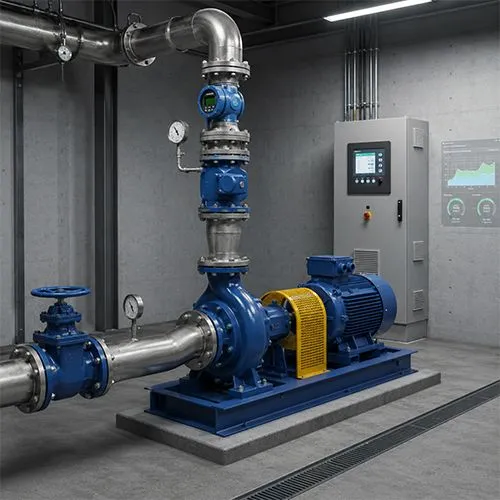
Reducing pump electricity cost starts with one principle: do not treat the pump as an isolated machine. A pump consumes electricity based on the real flow, total dynamic head, pump efficiency, motor efficiency, operating hours, control method, and system resistance. If any of these factors are wrong, the site may pay for wasted energy every day.
For industrial buyers, the lowest pump price is not always the lowest-cost decision. A cheaper pump with poor efficiency, wrong sizing, continuous throttling, excessive head margin, or weak control logic can cost far more in electricity than the initial purchase saving. The best way to reduce pump electricity cost is to match the pump to the real duty point, operate it close to its efficient range, reduce unnecessary system resistance, and verify energy performance before and after purchase.
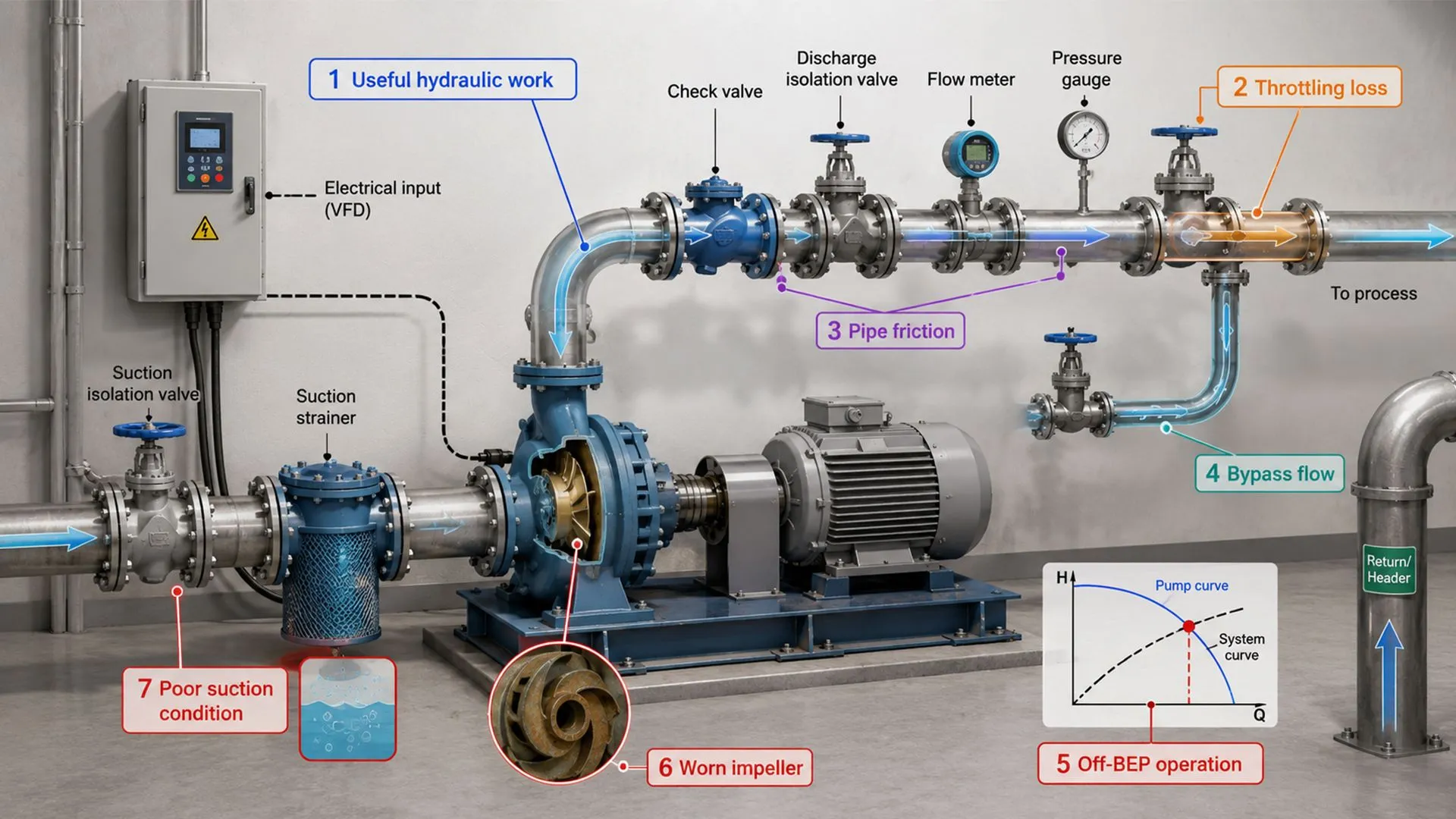
Pump electricity cost is the total power cost required to deliver a specific flow and head over a defined operating period. It can be reduced by lowering unnecessary flow, unnecessary head, throttling loss, bypass loss, pipe friction, off-BEP operation, and maintenance-related efficiency loss.
Quick Answer: How Can You Reduce Pump Electricity Cost?
You can reduce pump electricity cost by confirming the real duty point, selecting the right pump size, avoiding excessive throttling, operating near the Best Efficiency Point (BEP), using a Variable Frequency Drive (VFD) only when the system demand varies, reducing pipe and valve losses, maintaining clear suction conditions, and verifying supplier pump curves before purchase.
The largest pump electricity savings usually come from system correction, not motor replacement. Buyers should first verify actual flow, head, kW, valve position, pump curve, and system curve before investing in a VFD or a new pump.
For most industrial pump systems, the first practical step is to measure actual flow, discharge pressure, suction pressure, motor current, operating hours, valve position, and power consumption. Without these data points, energy-saving decisions become guesswork.
Scope of This Guide: Which Pump Systems Does This Apply To?
This guide applies mainly to centrifugal pump systems used in water supply, industrial transfer, cooling water, HVAC circulation, irrigation, municipal pumping, RO pretreatment, booster systems, wastewater transfer, and general process water service.
It is especially relevant when pumps run for many hours per year. A pump that runs only a few hours per month may not justify major energy optimization. A pump that runs 4,000–8,000 hours per year can create a large electricity cost difference even from a moderate efficiency improvement.
Applicable Pump Types
This guide is suitable for common centrifugal pump systems where flow, head, pump curve, and system curve determine electricity consumption.
| Pump Type | Electricity Cost Risk | Why Optimization Matters |
|---|---|---|
| End suction pump | High | Common in transfer systems and often oversized with safety margin. |
| Split case pump | High | Large flow and long operating hours can multiply energy cost. |
| Multistage pump | Medium to high | Excess head can cause throttling and high-pressure losses. |
| Inline pump | Medium | Often used in circulation systems where control strategy matters. |
| Pipeline pump | Medium | Pipe friction and valve loss strongly affect operating power. |
| Booster pump system | High | Poor pressure settings can cause cycling or excessive pressure. |
| Submersible pump | Medium | Wrong head estimation can cause inefficient operation or cycling. |
| Cooling water pump | High | Long continuous operation makes efficiency critical. |
| Irrigation pump | Medium to high | Seasonal runtime and pipe friction can drive large energy bills. |
Use With Adjustment for These Pump Types
This guide should be adjusted for slurry pumps, chemical pumps, dosing pumps, screw pumps, diaphragm pumps, and positive displacement pumps. These systems may be governed by solids velocity, viscosity, corrosion resistance, dosing accuracy, pressure relief, or process safety rather than typical centrifugal pump BEP logic.
For slurry pumps, reducing speed or flow without checking settling velocity can create pipe blockage. For dosing pumps, energy optimization should not compromise dosing accuracy. For chemical pumps, material compatibility and seal safety may be more important than a small energy gain.
30-Second Decision Table for Buyers
This table helps buyers quickly decide where to start when pump electricity cost is too high. It should not replace a full engineering review, but it can prevent the common mistake of buying new equipment before finding the real cause.
| If You See This Problem | Most Likely Energy Waste | First Action |
|---|---|---|
| Discharge valve is normally partly closed | Throttling loss | Check actual flow and pump curve. |
| Bypass line runs continuously | Pumped liquid not doing useful work | Confirm minimum flow need. |
| Pump runs far from BEP | Low hydraulic efficiency | Ask supplier to mark duty point. |
| High kW but normal process flow | Oversizing or excessive system resistance | Measure flow, head, and power together. |
| Frequent pump cycling | Wrong capacity or control logic | Review tank volume and pressure settings. |
| Rising energy cost over time | Wear, blockage, or operating change | Inspect strainer, impeller, wear rings, and valves. |
| Variable demand with fixed-speed pump | Poor control method | Review VFD or multi-pump option. |
| High pipe noise or valve noise | High velocity or pressure drop | Review pipe size and valve loss. |
If one of these symptoms appears, do not approve a replacement pump only by matching the old nameplate. The old pump may be the reason electricity cost is high.
What Actually Determines Pump Electricity Cost?
Pump electricity cost is determined by how much useful hydraulic work the system requires and how efficiently the pump system delivers it. The key variables are flow, head, efficiency, operating hours, and electricity price.
A practical electricity cost estimate is:
Pump Electricity Cost = Operating Power × Operating Hours × Electricity Price
The operating power is influenced by required flow rate, total dynamic head, pump efficiency, motor efficiency, drive efficiency, pipe and valve losses, control method, pump operating point, fluid density, fluid viscosity, and maintenance condition.
A buyer should not evaluate pump electricity cost only from motor kW on the nameplate. A 30 kW motor does not always consume 30 kW, and a smaller motor does not automatically mean lower cost. The real question is: how many kW does the pump consume while delivering the required flow and head at the actual site condition?
Engineering Formula for Hydraulic Power
For water-like liquids, a simplified hydraulic power estimate is:
Hydraulic Power (kW) ≈ Q(m³/h) × H(m) ÷ 367 ÷ Pump Efficiency
Where:
- Q means flow rate in cubic meters per hour.
- H means total dynamic head in meters.
- 367 is a conversion factor for water under standard engineering approximation.
- Pump efficiency should be written as a decimal, such as 0.70 for 70%.
This formula helps buyers understand why excessive flow, excessive head, and low efficiency directly increase electricity cost. It also shows why reducing only motor losses cannot solve a system-level energy problem.
Why Pump Electricity Cost Becomes Too High
High pump electricity cost usually comes from a mismatch between the pump, system, and control method. In many cases, the pump is not “bad.” It is simply operating under conditions it was not optimized for.
The most common causes are oversizing, excessive head, throttling, bypass flow, poor pipe design, clogged components, low efficiency at the operating point, and poor control logic.
Cause 1: The Pump Is Oversized
An oversized pump produces more flow or head than the system needs. The extra energy may be lost through throttling valves, bypass lines, frequent cycling, heat, vibration, or off-BEP operation.
This is one of the most common hidden causes of high electricity cost because the system may still appear to work. The process receives enough water, but the site pays for unnecessary energy every operating hour.
If your site frequently runs with a throttled discharge valve or continuous bypass flow, this guide explaining why oversized pumps waste energy can help you verify whether the selected pump is larger than the real demand.
Cause 2: The Pump Runs Far From BEP
The Best Efficiency Point (BEP) is the operating point where a centrifugal pump converts mechanical input into hydraulic output most efficiently. A pump does not need to run exactly at BEP all the time, but normal operation should stay within the manufacturer’s recommended operating range.
When a pump operates far left or far right of BEP, efficiency drops. The pump may also experience higher vibration, radial load, internal recirculation, seal stress, and bearing load. This means energy cost and maintenance cost can rise together.
Cause 3: The System Has Excessive Pipe or Valve Loss
Sometimes the pump is blamed for high electricity cost when the real issue is the system. Undersized pipes, unnecessary elbows, partially closed valves, clogged strainers, dirty filters, restricted heat exchangers, or poor suction layout can all increase total dynamic head.
When system resistance increases, the pump must work harder to deliver the same useful flow. Before replacing the pump, buyers should check whether the pipeline is forcing the pump to consume more power than necessary.
Cause 4: The Control Method Is Inefficient
A fixed-speed pump controlled by throttling may waste energy if the system demand varies. A VFD may reduce energy use in variable-flow systems, but it is not always the best solution.
Control strategy must match the system curve. If the system has mostly static head, speed reduction may produce less energy saving than expected. If the pump has minimum flow requirements, reducing speed too much may create reliability risks.
Cause 5: Maintenance Problems Reduce Efficiency
Wear rings, impellers, bearings, seals, strainers, and suction conditions all affect energy use. A worn impeller may require longer runtime. A clogged strainer may increase suction loss. Poor alignment may increase mechanical losses. A damaged bearing may increase vibration and heat.
A maintenance problem can therefore become an electricity problem.
What Should Buyers Check First When Pump Electricity Cost Is Too High?
When electricity cost is high, buyers should not start by asking, “Which new pump should we buy?” The better first question is, “Where is the power being wasted?”
The following priority order helps buyers avoid unnecessary spending.
| Priority | Check Item | Why It Matters | Action |
|---|---|---|---|
| 1 | Operating hours and measured kW | Confirms the real annual electricity cost | Calculate annual cost before changing equipment. |
| 2 | Discharge valve position | Finds throttling loss | Check whether the valve is normally partly closed. |
| 3 | Bypass flow | Finds wasted circulation | Confirm whether bypass is protective or excessive. |
| 4 | Actual flow and head | Confirms the real duty point | Compare field data with design data. |
| 5 | Pump curve and BEP | Finds off-BEP operation | Ask supplier to mark actual duty point. |
| 6 | Pipe and valve loss | Finds system resistance | Check strainers, valves, filters, heat exchangers, and pipe size. |
| 7 | Control method | Finds control-related energy waste | Review VFD, sequencing, or multi-pump option. |
| 8 | Maintenance condition | Finds efficiency loss over time | Inspect impeller, wear rings, alignment, bearings, and suction condition. |
This order matters because many sites buy a VFD or replacement pump before confirming whether the main problem is throttling, pipe restriction, poor maintenance, or incorrect duty data.
How to Measure Pump Electricity Cost Before Changing Equipment
Before replacing a pump, adding a VFD, trimming an impeller, or changing pipework, buyers should measure the actual operating condition. Energy-saving decisions based only on assumptions often fail.
A simple site survey can reveal whether the electricity cost comes from wrong sizing, system resistance, poor control, or equipment degradation.
Data Buyers Should Collect
The following data should be collected before selecting an energy-saving action.
| Data Point | Why It Matters | What It Helps Diagnose |
|---|---|---|
| Actual flow rate | Confirms real demand | Oversizing, underflow, process mismatch |
| Suction pressure | Shows inlet condition | NPSH risk, clogged suction, suction loss |
| Discharge pressure | Shows output pressure | Excess head, throttling, system resistance |
| Differential head | Allows curve comparison | Pump operating point |
| Motor current | Indicates motor loading | Overload or unusual load |
| Measured kW | Direct energy cost input | Real electricity consumption |
| Valve position | Shows artificial resistance | Throttling loss |
| Bypass flow | Shows wasted circulation | Oversizing or minimum flow issue |
| Pump speed | Needed for VFD systems | Control performance |
| Operating hours | Converts kW into annual cost | Payback calculation |
| Vibration/noise | Shows mechanical or hydraulic stress | Off-BEP operation, cavitation, bearing issues |
A buyer should measure flow, head, and power together. Measuring only pressure or current can mislead the decision.
The Pump Electricity Cost Formula Buyers Can Use
A practical electricity cost estimate is:
Annual Electricity Cost = Pump Input Power (kW) × Annual Operating Hours × Electricity Price
Example:
- Pump input power: 37 kW
- Operating hours: 6,000 hours/year
- Electricity price: $0.12/kWh
Annual Cost = 37 × 6,000 × 0.12 = $26,640/year
If optimization reduces input power from 37 kW to 28 kW:
Annual Cost = 28 × 6,000 × 0.12 = $20,160/year
Estimated Annual Saving = $6,480/year
This simple calculation helps procurement teams compare pump purchase price with lifetime electricity cost. In many industrial applications, electricity cost over several years can be higher than the pump purchase price.
Energy Saving Example: Right-Sizing vs Operating an Inefficient Pump
Assume a plant operates a cooling water pump for 6,500 hours per year. The installed pump consumes 45 kW because it is oversized and throttled. After reviewing the duty point and system curve, the buyer selects a right-sized pump or trims the impeller, reducing operating power to 34 kW.
| Item | Current Pump | Corrected Pump |
|---|---|---|
| Useful system flow | 180 m³/h | 180 m³/h |
| Operating power | 45 kW | 34 kW |
| Annual operating hours | 6,500 h | 6,500 h |
| Electricity price | $0.12/kWh | $0.12/kWh |
| Annual energy use | 292,500 kWh | 221,000 kWh |
| Annual electricity cost | $35,100 | $26,520 |
| Estimated annual saving | — | $8,580 |
This example does not include reduced valve wear, lower seal stress, lower bearing load, reduced vibration, or less downtime. In real projects, the total life-cycle saving may be higher than the electricity saving alone.
How to Calculate Payback Period for Pump Energy Saving
For procurement approval, annual savings alone are often not enough. Buyers also need to know how quickly the project can recover its cost.
The simple payback formula is:
Simple Payback Period = Upgrade Cost ÷ Annual Energy Saving
Using the previous example:
| Item | Value |
|---|---|
| Estimated upgrade cost | $12,000 |
| Annual energy saving | $8,580 |
| Simple payback period | 1.4 years |
A 1.4-year payback is often easier to approve than a project with a 5-year payback, but each company has its own investment rule. Some buyers require a payback under 2 years. Others may accept 3–5 years if reliability also improves.
This is why pump electricity cost reduction should be presented as a life-cycle cost decision, not only an energy-saving idea.
Step-by-Step: How to Reduce Pump Electricity Cost
Reducing pump electricity cost should be done in a controlled order. If buyers jump directly to buying a new pump or installing a VFD, they may spend money without solving the real cause.
The best process starts with data, then system review, then pump selection or control correction.
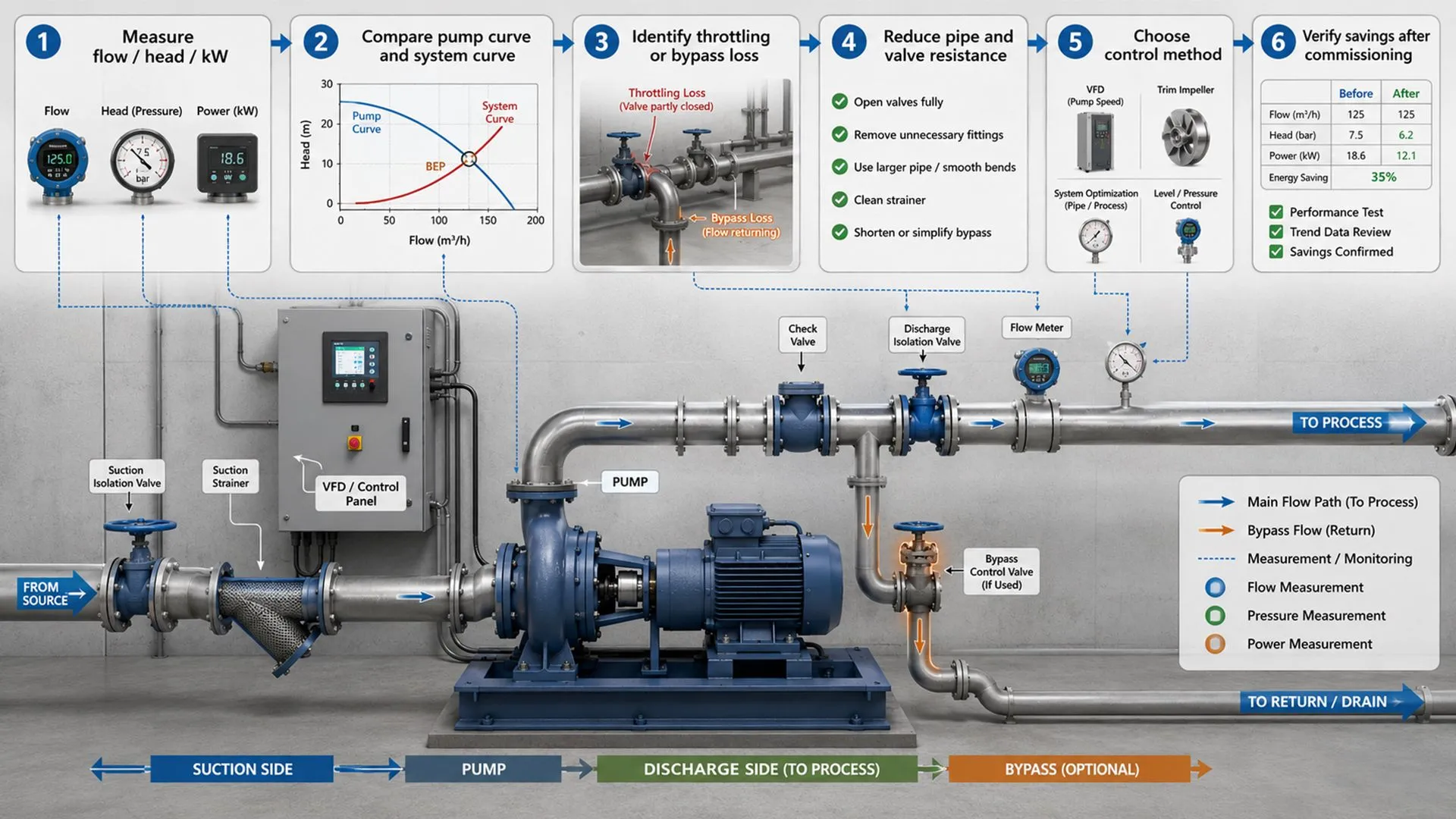
Step 1: Confirm the Real Duty Point
The duty point is the required flow and head at the actual operating condition. Many pump energy problems begin because the pump was selected for an estimated or inflated duty point.
Buyers should confirm normal flow, peak flow, minimum flow, total dynamic head, static head, pipe friction loss, required terminal pressure, fluid temperature, fluid density, operating hours, and seasonal or shift-based variation.
A pump selected for peak duty may waste electricity if it operates most of the year at normal or low demand. The normal duty point deserves more attention than a rare peak condition.
Step 2: Compare the Pump Curve With the System Curve
A pump curve shows how the pump performs across different flow rates. A system curve shows how much head the system requires across different flow rates. The real operating point is where these two curves meet.
If the operating point is far from BEP, the pump may consume more power than necessary. Buyers should ask suppliers to mark the normal duty point, peak duty point, and expected operating range on the pump curve.
A quotation without a pump curve is incomplete for any energy-sensitive project.
Step 3: Reduce Throttling Loss
Throttling is common, but continuous heavy throttling is often a sign of wasted energy. When a discharge valve is partially closed to control excess flow, the pump still produces energy that the valve destroys as pressure loss.
Actions to reduce throttling loss include trimming the impeller if demand is stable, using a properly selected VFD if demand varies, replacing the pump if it is severely oversized, using multiple smaller pumps for variable demand, or recalculating the system curve before final selection.
Throttling may be acceptable for occasional adjustment, but it should not be the main long-term control method for a continuously operating pump.
Step 4: Check Pipe Size, Fittings, and Valve Loss
Pipe friction can create unnecessary head. The pump must overcome this resistance every hour it runs.
Buyers should check pipe diameter, pipe length, number of elbows, valve type, valve opening position, strainer condition, filter condition, heat exchanger pressure drop, check valve loss, and suction line restrictions.
In a new project, pipe diameter and valve selection should be optimized before the pump is purchased. In an existing project, pipe modification must be evaluated against downtime cost, installation cost, and payback period. Long-distance and high-flow systems usually offer stronger pipe-optimization value than short, low-flow systems.
Step 5: Use VFD Control Only When It Matches the System
A Variable Frequency Drive (VFD) can reduce pump speed to match demand. In variable-flow systems, this can reduce electricity cost significantly.
In friction-dominated variable-flow systems, reducing pump speed can strongly reduce power demand because pump power generally changes with the cube of speed. However, the actual saving depends on the system curve, static head ratio, minimum flow requirement, and control stability.
VFDs are usually more useful when demand changes during the day, pressure setpoints vary, flow demand is seasonal, multiple operating zones exist, the pump runs many hours per year, and the system has a strong friction-head component.
VFDs may be less effective when the system has mostly static head, constant demand, severe oversizing, or strict minimum flow limits. For buyers comparing control options, this VFD pump vs fixed-speed pump guide can help evaluate when variable speed control is worth the investment.
Step 6: Trim the Impeller When Demand Is Stable
Impeller trimming reduces the pump impeller diameter so the pump produces less head and flow. It can be an effective way to reduce electricity cost when the pump is moderately oversized and the demand is stable.
Impeller trimming is often suitable when the pump is centrifugal, the current impeller has trimming allowance, the pump is oversized by a moderate amount, demand does not vary widely, the supplier can provide a revised pump curve, and the final operating point remains in the safe operating range.
Impeller trimming should not be done blindly. Too much trimming can reduce efficiency, create hydraulic instability, or limit future capacity.
Step 7: Use Multiple Pumps for Variable Demand
One large pump may be inefficient when demand changes widely. A multi-pump system can run one smaller pump during low demand and start additional pumps during peak demand.
This is useful for municipal water supply, building booster systems, cooling water systems, irrigation zones, wastewater transfer, and industrial circulation loops.
Buyers should ask suppliers to explain sequencing logic, duty/standby arrangement, minimum flow protection, and failure mode. A multi-pump system should improve both energy efficiency and reliability.
Step 8: Improve Maintenance to Recover Efficiency
A pump that was efficient when new may become inefficient after wear, corrosion, clogging, or poor alignment. Maintenance has a direct effect on electricity cost.
Key maintenance checks include clean suction strainers, check impeller wear, inspect wear rings, verify alignment, monitor bearing condition, check seal leakage, remove air from the system, inspect suction pipe restrictions, clean filters and heat exchangers, and check vibration trends.
If energy consumption rises while the process demand remains the same, the pump or system condition may have degraded.
If corrosion or material mismatch is affecting pump performance, this pump corrosion troubleshooting guide can help buyers check whether liquid chemistry, material selection, or site conditions are reducing pump life and efficiency.
Which Pump Energy-Saving Method Has the Best Payback?
The best payback usually comes from the solution that removes the largest waste with the lowest risk and lowest disruption. The best method is not always the newest technology.
For example, a VFD may have excellent payback in a variable-flow cooling loop, but weak payback in a constant-flow system with mostly static head. Impeller trimming may have excellent payback for a moderately oversized constant-duty pump, but it may be wrong for a system with confirmed future expansion.
| Situation | Best First Review | Likely Energy-Saving Action |
|---|---|---|
| Pump is oversized and demand is stable | Pump curve and actual duty point | Impeller trimming or pump replacement |
| Demand varies daily | System curve and control method | VFD or multi-pump control |
| Discharge valve is always throttled | Valve position and duty point | Right-sizing, trimming, or VFD |
| Pipe pressure loss is high | Pipe size, fittings, strainers, valves | Pipe or valve optimization |
| Pump runs far from BEP | Pump curve and BEP range | New selection or impeller correction |
| Energy cost rose over time | Maintenance and wear inspection | Clean, repair, align, or replace worn parts |
| Frequent cycling | Tank/control settings and flow demand | Control redesign or smaller pump |
| Supplier quote lacks curve data | RFQ review | Request pump curve and efficiency data |
The most reliable strategy is to combine measurement, curve review, and life-cycle cost comparison before investing in equipment changes.
When Not to Reduce Pump Power Too Aggressively
Reducing electricity cost should not compromise reliability, safety, or process performance. A pump must still deliver the required flow and head under real operating conditions.
The goal is not to minimize kW at any cost. The goal is to deliver the required process performance with the lowest practical life-cycle cost and acceptable reliability.
| Risk Condition | Why Power Reduction Can Be Dangerous | Buyer Action |
|---|---|---|
| Fire or emergency service | Flow and pressure reliability is more important than energy saving | Do not reduce capacity without code and safety review. |
| Emergency cooling | Insufficient flow may damage critical equipment | Confirm minimum safe cooling flow. |
| Slurry service | Low velocity may cause solids settling and pipe blockage | Check minimum transport velocity. |
| Minimum flow required | Pump may overheat or operate unstably at too low flow | Keep minimum flow protection. |
| Low NPSH margin | Cavitation risk may remain or worsen at wrong duty | Check NPSHa vs NPSHr. |
| Process pressure critical | Energy saving cannot reduce required process pressure | Confirm process pressure requirement. |
| Motor not inverter-duty | VFD may cause motor overheating or insulation stress | Verify motor compatibility. |
| Confirmed future expansion | Too much reduction may limit future capacity | Separate current and future duty. |
This module is important for procurement teams because energy-saving projects often fail when cost reduction is pursued without checking system safety boundaries.
Buyer Checklist Before Approving a Pump for Low Electricity Cost
Procurement teams should not evaluate only pump price and delivery time. For long-running pumps, electricity cost should be part of the purchase decision.
| Required Check | Why It Matters | What to Ask the Supplier |
|---|---|---|
| Normal duty point | Prevents peak-only selection | What is the normal flow and head? |
| Peak duty point | Confirms maximum requirement | How often does peak demand occur? |
| Pump curve | Shows pump performance | Can you mark the selected duty point? |
| Efficiency curve | Shows energy performance | What is efficiency at normal duty? |
| BEP range | Avoids unstable operation | How close is normal duty to BEP? |
| Power curve | Predicts kW demand | What is shaft power at normal and peak duty? |
| NPSHr curve | Prevents cavitation risk | What NPSH margin is required? |
| System curve | Confirms pump-system match | Can you review our system curve? |
| Control method | Prevents throttling waste | Fixed speed, VFD, or multiple pumps? |
| Operating hours | Determines life-cycle cost | What is annual energy cost estimate? |
| Margin explanation | Avoids oversizing | What safety margin was applied? |
| Maintenance access | Protects efficiency over time | How easy is inspection and service? |
A supplier who can answer these questions clearly is more likely to support a reliable and energy-efficient pump selection.
Who Should Be Responsible for Reducing Pump Electricity Cost?
Pump electricity cost is rarely caused by one party alone. The buyer may provide incomplete duty data. The engineer may use conservative assumptions. The supplier may select too much margin. The installer may create extra pipe resistance. The commissioning team may fail to measure real performance.
Clear responsibility boundaries help buyers prevent repeated energy waste.
| Role | Responsibility | What Can Go Wrong |
|---|---|---|
| Buyer / End User | Provide real duty point, operating hours, electricity price, site limits, and future expansion plan | Supplier selects based on assumptions. |
| Engineering Designer | Calculate system curve, static head, friction losses, valve losses, and normal/peak demand | Pump is selected for incorrect head. |
| Pump Supplier | Provide pump curve, efficiency curve, power curve, BEP, NPSHr, and selection explanation | Buyer cannot verify energy performance. |
| Installer / Contractor | Install correct pipe size, suction layout, valves, strainers, and instruments | Field resistance becomes higher than design. |
| Commissioning Team | Measure flow, head, kW, vibration, valve position, and control response | Energy waste remains hidden after startup. |
| Maintenance Team | Track wear, blockage, alignment, bearing condition, and energy trend | Gradual efficiency loss becomes normal. |
This table is useful in B2B projects because it prevents the common argument that “the pump is bad” when the real problem may be incomplete data, poor pipe layout, wrong control logic, or missing commissioning checks.
Supplier Verification: What Data Should Prove Energy Efficiency?
A professional pump supplier should provide more than a model name and price. For energy-sensitive systems, buyers need technical evidence.
The supplier should prove that the pump can meet duty with reasonable efficiency, stable operation, acceptable NPSH margin, and a practical control method.
| Verification Item | What the Supplier Should Provide | Buyer Benefit |
|---|---|---|
| Pump curve | Flow-head curve with duty point | Confirms hydraulic match. |
| Efficiency curve | Efficiency at normal and peak duty | Predicts electricity cost. |
| Power curve | Shaft power across operating range | Prevents motor and cost surprises. |
| BEP location | Best Efficiency Point and preferred range | Reduces off-BEP risk. |
| NPSHr data | Required suction head at duty | Helps avoid cavitation. |
| Impeller diameter | Selected diameter and trim options | Allows future correction. |
| Motor efficiency | Motor class and rated efficiency | Improves energy estimate. |
| Control recommendation | Fixed speed, VFD, or multi-pump logic | Prevents poor control strategy. |
| Annual energy estimate | kW × hours × electricity price | Supports life-cycle cost comparison. |
| Margin explanation | Flow and head safety factor | Prevents hidden oversizing. |
| Commissioning checklist | Flow, pressure, current, vibration | Confirms real performance after startup. |
If a supplier cannot provide the pump curve, efficiency curve, or operating point explanation, the buyer should not treat the quotation as complete.
RFQ Questions to Reduce Pump Electricity Cost Before Purchase
A strong RFQ helps prevent future electricity waste. Buyers should include technical questions that force suppliers to explain sizing, efficiency, and control logic.
Use these RFQ questions:
- What normal flow and head did you use for selection?
- What peak duty did you consider, and how often is it expected?
- Can you mark the normal duty point on the pump curve?
- What is the pump efficiency at normal duty?
- Where is the BEP, and how close is the operating point to it?
- What is the expected shaft power at normal and peak duty?
- What safety margin did you apply to flow and head?
- Will this pump require throttling during normal operation?
- Is a VFD recommended, and why?
- Would impeller trimming be possible if the site demand is lower?
- What NPSH margin is required?
- What annual electricity cost do you estimate?
- What field data should be checked during commissioning?
- What happens if actual flow is 20% lower than expected?
These questions help buyers compare suppliers based on life-cycle cost, not only purchase price.
How Maintenance Teams Can Keep Pump Electricity Cost Low
Electricity cost reduction is not only a procurement task. Maintenance teams play a major role after installation.
A pump system should be monitored because efficiency can decline slowly over time. The site may not notice the problem until the energy bill rises or the pump no longer meets flow requirements.
Maintenance Actions That Protect Pump Efficiency
The following maintenance actions help protect hydraulic efficiency and prevent avoidable energy waste.
| Maintenance Action | Energy Impact | Warning Sign if Ignored |
|---|---|---|
| Clean suction strainers | Reduces suction loss | Cavitation, noise, lower flow |
| Inspect impeller wear | Maintains hydraulic performance | Higher runtime, lower head |
| Check wear rings | Reduces internal leakage | Efficiency decline |
| Maintain alignment | Reduces mechanical loss | Vibration, bearing heat |
| Monitor bearings | Prevents friction and failure | Noise, heat, vibration |
| Check valve position | Finds throttling loss | Partly closed discharge valve |
| Remove air pockets | Restores stable flow | Noise, unstable pressure |
| Clean heat exchangers | Reduces pressure drop | Higher discharge pressure |
| Track kW trend | Detects hidden changes | Rising energy cost |
| Record flow/head trend | Confirms duty stability | Performance drift |
For sites seeing gradual performance loss, this pump efficiency decline guide can help identify whether the issue comes from hydraulic wear, system resistance, suction condition, or operating point change.
What Mistakes Make Pump Electricity Cost Higher?
Many pump electricity problems are created before operation begins. Others appear slowly because the site does not monitor pump performance.
Avoiding these mistakes is often cheaper than correcting them later.
Mistake 1: Buying the Cheapest Pump Without Energy Comparison
A low purchase price can be misleading if the pump has lower efficiency or poor duty matching. For long-running pumps, annual electricity cost may exceed the price difference between models.
Buyers should compare life-cycle cost, not only purchase price.
Mistake 2: Oversizing for Safety Without Proof
A larger pump may feel safer, but excessive oversizing can increase energy cost, throttling loss, seal stress, vibration, and maintenance risk.
Safety margin should be calculated and documented.
Mistake 3: Ignoring the System Curve
A pump cannot be selected correctly without understanding system resistance. If the system curve is wrong, the pump selection may be wrong.
Buyers should review pipe length, elevation, fittings, valves, filters, and required terminal pressure before final selection.
Mistake 4: Installing a VFD Without Checking the System
A VFD can save energy, but only when the pump and system respond well to speed reduction. If the system has mostly static head or the pump is severely oversized, savings may be limited.
VFD decisions should be based on pump curve and system curve review.
Mistake 5: Ignoring Suction Conditions
Poor suction conditions can reduce performance and increase energy waste. Undersized suction piping, clogged strainers, air leaks, or low NPSH margin can create cavitation and unstable operation.
A pump energy review should include both suction and discharge sides.
Mistake 6: Not Verifying Performance After Commissioning
Even a correctly selected pump can operate inefficiently if the site installation differs from the design. After commissioning, buyers should verify flow, pressure, current, kW, vibration, valve position, and control response.
Should You Use a VFD, Trim the Impeller, Replace the Pump, or Fix the Piping?
The table below helps buyers choose the most practical first action based on symptoms. It should be used after field data is collected, not before.
| Scenario | Best Option | Why |
|---|---|---|
| Constant demand and moderate oversizing | Impeller trimming | Lower cost than full replacement. |
| Variable demand and long runtime | VFD | Matches pump speed to demand. |
| Severe oversizing and poor BEP operation | Pump replacement | Corrects hydraulic mismatch. |
| Wide demand variation | Multiple pumps | Improves part-load efficiency. |
| High pipe friction | Pipe or valve optimization | Reduces required head. |
| Rising energy cost over time | Maintenance inspection | Finds wear or blockage. |
| Frequent cycling | Control and tank review | Reduces starts and instability. |
| Missing supplier curves | Technical RFQ review | Prevents blind selection. |
| High valve noise | Check throttling and velocity | Finds wasted pressure. |
| Cavitation signs | Suction-side review | Protects pump and efficiency. |
The best decision is usually not one single action. Many systems require a combination of correct sizing, better control, lower pipe resistance, and maintenance recovery.

Commissioning Checklist: How to Verify Real Pump Energy Savings
Energy-saving projects should be verified after installation or adjustment. Without commissioning data, buyers cannot prove whether the selected action actually reduced electricity cost.
The following checklist helps confirm whether the pump system is operating as expected.
| Commissioning Check | Why It Matters | Acceptable Result |
|---|---|---|
| Actual flow | Confirms useful output | Matches process requirement. |
| Suction pressure | Confirms inlet condition | Stable and within NPSH margin. |
| Discharge pressure | Confirms system head | Matches expected duty. |
| Measured kW | Confirms energy reduction | Lower than previous baseline. |
| Valve position | Confirms less throttling | No heavy permanent throttling. |
| Bypass flow | Confirms useful flow | No excessive continuous bypass. |
| Vibration | Confirms stable operation | Within site or supplier limit. |
| Noise | Finds cavitation or valve loss | No abnormal hydraulic noise. |
| Control response | Confirms VFD or sequencing logic | Stable without hunting. |
| Bearing and seal temperature | Confirms mechanical health | No abnormal heat increase. |
Commissioning should compare the new data against the old baseline. If kW decreased but vibration increased, the project is not automatically successful. Energy saving must be balanced with pump reliability.
FAQ: Buyer Questions About Reducing Pump Electricity Cost
Pump electricity cost can be difficult to reduce because the problem may come from pump selection, system design, control method, or maintenance condition. These questions address the concerns buyers usually have before investing in energy-saving changes.
What is the fastest way to reduce pump electricity cost?
The fastest practical step is to measure actual flow, head, kW, valve position, and operating hours. If the discharge valve is heavily throttled or bypass flow is continuous, the pump may be oversized or poorly controlled. Correcting throttling or bypass waste often gives faster savings than changing the motor alone.
Does a high-efficiency motor reduce pump electricity cost?
Yes, but only partly. A high-efficiency motor can reduce electrical losses, but it cannot fix an oversized pump, poor system curve, heavy throttling, or off-BEP operation. Motor efficiency should be considered after confirming that the pump and system are correctly matched.
Can a VFD always reduce pump electricity cost?
No. A VFD is effective when demand varies and the system curve allows meaningful speed reduction. It may not save much energy in systems with mostly static head, constant flow demand, severe pump oversizing, or strict minimum flow requirements. VFD selection must be based on pump curve and system curve review.
How do I know if my pump is wasting electricity?
Signs include high measured kW, heavily throttled discharge valve, continuous bypass flow, operation far from BEP, frequent cycling, high pipe noise, repeated seal or bearing failures, and rising electricity cost without higher process demand. The best confirmation is to compare actual site data with the pump curve.
Should I replace the pump to save electricity?
Not always. If oversizing is moderate and demand is stable, impeller trimming may be enough. If demand varies, a VFD or multi-pump system may work better. If the pump is severely oversized, worn, or operating far from the safe range, replacement may be the most economical long-term solution.
How much electricity can pump optimization save?
Savings depend on operating hours, electricity price, current pump efficiency, system losses, and control method. A pump running 6,000 hours per year can justify optimization even if the power reduction is only several kW. Buyers should calculate annual savings and payback period before approving changes.
Is throttling a pump valve always bad?
Not always. Some throttling may be acceptable during commissioning or occasional adjustment. Heavy continuous throttling is a warning sign because the valve is destroying pressure energy that the pump already consumed electricity to produce.
What data should I ask from a pump supplier?
Ask for the pump curve, efficiency curve, power curve, BEP location, selected duty point, NPSHr data, impeller diameter, motor efficiency, control recommendation, safety margin explanation, and estimated annual electricity cost. These data help verify whether the pump can reduce life-cycle cost.
Can maintenance reduce pump electricity cost?
Yes. Cleaning strainers, removing restrictions, restoring impeller condition, checking wear rings, correcting alignment, monitoring bearings, and cleaning filters or heat exchangers can recover lost efficiency. Maintenance is especially important when energy cost rises gradually over time.
What is more important: pump efficiency or system efficiency?
System efficiency is more important. A pump with good catalog efficiency can still waste electricity if it is oversized, throttled, poorly controlled, installed with high pipe loss, or operated far from BEP. Buyers should evaluate the pump and system together.
Should I install a VFD first or check the pump curve first?
Check the pump curve and system curve first. A VFD can be a strong solution when demand varies, but it may have weak payback or create operating risk if the pump is severely oversized, the system has mostly static head, or minimum flow cannot be maintained.
What if electricity cost is high but the pump flow is low?
High electricity cost with low flow may indicate throttling, clogged filters, high system resistance, impeller wear, suction restriction, off-BEP operation, or wrong pump selection. Buyers should measure flow, suction pressure, discharge pressure, kW, and valve position together before choosing a solution.
Conclusion: Reducing Pump Electricity Cost Requires System-Level Thinking
The best way to reduce pump electricity cost is to match real demand with the right pump, efficient operating point, correct control method, and low-resistance system design. Buyers should not focus only on motor size or pump purchase price.
A pump that runs thousands of hours per year should be evaluated by life-cycle cost. The most important checks are actual duty point, pump curve, system curve, BEP range, measured kW, valve position, bypass flow, operating hours, maintenance condition, and commissioning data.
For procurement teams, the most important question is:
Can the supplier prove that this pump will deliver the required flow and head with low electricity cost under our real operating conditions?
If the answer is supported by pump curves, system data, efficiency points, control logic, and commissioning checks, the buyer is more likely to reduce electricity cost without sacrificing reliability. If the answer is only based on a larger motor, a bigger pump, or a lower purchase price, the project may save money upfront but pay more every year in electricity.
Get A Quote

Get A Quote
0 Comments