
Diesel Engine Driven Water Pump: When It Beats Electric & Sizing Guide
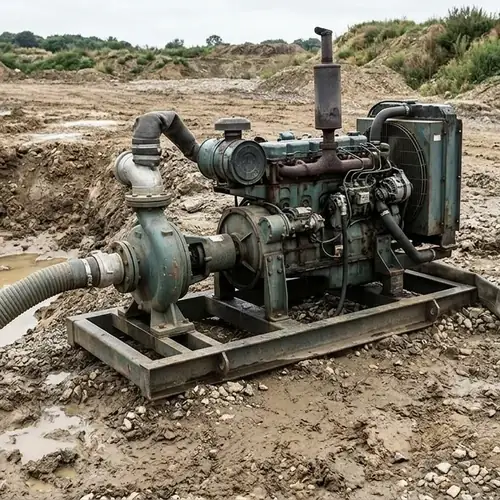
A diesel engine driven water pump is the right purchase when your site has no stable grid connection, when the pump has to move with the work, or when water flow must keep running through a blackout. It is not the default choice for a fixed plant that sits next to cheap, reliable power. Fuel consumption is not a fixed number; you calculate it from engine load and an engine-specific fuel curve.
For project managers and pump wholesalers, the expensive mistakes are almost never about pump hydraulics alone. They are about specifying an engine too small to survive the end of the pump curve, discovering fuel cost in month three, or accepting a package with no clear engine-pump warranty split. This guide takes the decision past "diesel for off-grid." You will see how to sequence hydraulic power into shaft power into engine power, how to estimate diesel pump fuel consumption from a datasheet, where diesel actually beats an electric pump on total cost, and what belongs in the RFQ so suppliers cannot hide behind a catalog curve.
After you work through the site conditions, send a specification that forces every bidder to state engine service margin, derating, fuel use at load, mounting configuration, test documentation, and warranty responsibility. If a proposal cannot answer those, do not approve it.
Quick Answer / 30-Second Buyer Decision
Choose a diesel engine driven water pump when at least one of these conditions is true:
- The pump site has no stable electrical supply, or grid extension would require transformer/switchgear/cable work that dwarfs pump cost.
- The pump must be moved between fields, pits, sites, or flood zones on a skid or trailer.
- The pump is a standby fire pump or emergency backup where it must start without grid power.
- The job is short-duration or temporary and the electrical infrastructure does not need to stay after the project.
Stay with an electric motor pump when the installation is permanent, the grid is reliable, electricity cost is low, and noise or emissions restrictions are tight.
Engine sizing rule of thumb: the diesel engine should deliver more continuous power than the pump's maximum shaft power at the worst expected duty point, with a service margin of roughly 10–25% depending on rating and site. The worst duty point usually sits away from best efficiency, so do not size the engine at best-efficiency shaft power. Fuel use then follows engine load and must be pulled from the engine datasheet, not estimated from pump horsepower alone.
When Diesel Engine-Driven Water Pumps Beat Electric Pumps
Diesel wins on grid independence, mobility, and standby readiness; electric wins on steady-site operating cost and lower routine maintenance. Scope the decision to the actual site. Do not buy on general preference.
No reliable power at the pump location
The clearest case is a site where there simply is no usable grid. A remote irrigation field, a flooded underpass, a mine pit, a temporary construction dewatering sump — none of these have a motor control center waiting 10 meters away. The cost of extending power is not just cable. You need service connection, isolation, breakers, weatherproof enclosure, and often a transformer sized for starting current. For a pump that will run for a season and then move, that infrastructure is usually the wrong capital spend.
Mobility and temporary deployment
A packaged engine driven pump on a steel skid or trailer can be towed, lifted, or crane-placed close to the water source. Electric packages need cable runs, permitted power drops, and motor starter panels. When the deployment is a two-week flood response or a three-month construction dewatering job, the speed of setup is the deciding factor. Physical format matters as much as pump performance here.
Standby and emergency reliability
Electric pumps stop when the grid stops. A diesel engine driven water pump carries its own energy source and can start on battery power with an auto-start controller. This is the core reason diesel remains common for fire pump drivers and critical bypass service in markets where the fuel supply is controlled and the engine is test-run weekly.
Where diesel does not win
In a permanent water treatment plant with stable three-phase power, the electric pump is typically easier to live with: lower energy unit cost, no fuel delivery logistics, no exhaust, much lower noise with motor only, and fewer wearing parts. Specifying diesel there creates ongoing fuel and maintenance cost without a reliability advantage.
Core Industrial and Municipal Applications
A diesel engine driven water pump is not one product. The same driver can sit behind a clear-water end-suction pump, a semi-trash dewatering pump, a fire pump, or a high-pressure irrigation set. The application changes impeller, pump casing, suction requirements, and control logic more than it changes the engine.
Diesel Irrigation Pump Selection
For off-grid agricultural irrigation, the buyer usually needs a simple, field-serviceable end-suction centrifugal pump coupled to a diesel engine. Flow and head are driven by field size, sprinkler or drip pressure requirement, and elevation change from the water source to the delivery point. Two points to verify before quoting a diesel irrigation pump: suction lift from the canal or pond, and whether the water carries sand or plant trash that will destroy a closed-impeller pump. A foot valve or strainer is not optional for open water.
Liqen carries end-suction diesel-powered agricultural models, including 4-inch to 8-inch configurations. Use the diesel irrigation pump product page when you need to check a specific pressure and flow range, but do not finalize a model until total dynamic head and suction NPSHa are on the table.
Construction and Mining Dewatering
Construction and mining dewatering often means dirty water: silt, sand, clay, stones, or fine tailings. A diesel dewatering pump specified for clean water will wear the impeller and volute quickly or clog. The critical specification is the maximum spherical solid size the pump can pass, plus whether the impeller is open, semi-open, or closed. Semi-trash and trash-handling pumps are common for site dewatering; a clear-water pump is wrong for a sump with suspended solids.
For heavy mining water, the buyer should also check the distance between the pump and the deepest water level. Diesel pumps can be mounted up on a bank, but the suction lift available at the pump must be less than the pump's NPSH margin at site altitude and water temperature. NPSH, net positive suction head, is the pressure margin above the liquid vapor pressure at the pump suction. If available NPSH falls below the pump's required NPSH, the pump cavitates. Get the suction layout drawn before the engine is selected, because suction changes alter the flow point and therefore the shaft power.
Flood Response and Emergency Bypass Pumping
Flood response favors trailer-mounted or skid-mounted packages with quick-connect hose couplings and manual or electric starting. Municipal crews need the pump operational within minutes of arrival. That means a self-priming pump or a vacuum-assisted priming system, not a standard end-suction pump that needs an operator to fill the casing with water. Bypass pumping during a sewer or water-main repair has the same logic: temporary, unattended, and sometimes running around the clock.
For unattended duty, fuel tank capacity and low-fuel alarms become part of the selection. A pump that runs out of fuel at 3 a.m. during a bypass operation is a site failure, not just a nuisance.
Fire Pump and Standby Duty
Diesel fire pump systems are a separate procurement conversation. The engine-driver logic is different from irrigation or dewatering because the driver must start automatically when system pressure drops, and it must run under the fire protection code adopted for the project. This is project-specific, not a universal pump catalog.
One mechanical point worth knowing before you compare fire packages: engine-driven fire pumps can take their engine cooling water from the pump discharge, which affects whether a separate circulation relief valve is required. Do not assume the same relief-valve arrangement as an electric fire pump. Confirm the driver listing, auto-start controller, fuel tank duration, and acceptance test protocols against the applicable fire code and the authority having jurisdiction. Liqen's fire fighting pump system page is the correct starting point for electric and diesel package options.
How to Size Engine Power to Pump Demand
The engine rating must be larger than the hydraulic power of the water. That gap comes from pump efficiency, any coupling or transmission losses, the need for continuous overload margin, and site derating. Sizing the engine at best-efficiency shaft power is one of the most common causes of a pump that stalls or trips when the system curve moves toward runout.
Step 1: Calculate hydraulic power
For clean water, hydraulic power can be approximated as:
P_hydraulic (kW) ≈ Q (m³/h) × H (m) ÷ 367
Q is flow rate and H is total dynamic head from suction water level to discharge pressure point. For slurry or high-solids water, multiply the water formula by the actual specific gravity. This keeps you from specifying an engine that is fine for clean water but too small for heavier fluid. Work this for your actual duty point, and do not accept a supplier's stated "engine power" as a substitute for the calculation.
Step 2: Convert to required shaft power
Pump efficiency sits between hydraulic power and shaft power. Shaft power is what the engine must physically turn the pump shaft with:
P_shaft (kW) ≈ P_hydraulic ÷ pump efficiency
Efficiency is never a single number across the curve. The pump curve may show best efficiency at design flow and lower efficiency at lower or higher flow. The engine must cover the highest shaft power point the pump is expected to actually run at, not only the design point.
Do not confuse hydraulic power with electrical kW. A common procurement error is to send the supplier only "flow and head" and accept an engine sized against hydraulic power as if it were the total load.
Step 3: Add engine service margin
The engine should have more continuous power than the pump's maximum shaft power. The margin accounts for fuel quality variation, coupling loss, governor speed droop, some system head uncertainty, and the need to keep the engine from running at 100% continuously. Treat this as engine reserve, separate from the pump shaft power calculation.
| Pump required shaft power | Recommended engine service margin | Notes |
|---|---|---|
| Under 15 kW | 20–25% | Small engines are more sensitive to load step and site derating. |
| 15–55 kW | 15–20% | Typical industrial package range. |
| Over 55 kW | 10–15% | Larger engines have flatter torque and more stable governing; review with the engine manufacturer. |
These margins are starting guidance, not a substitute for the engine manufacturer's application rating. At high altitude or high ambient temperature the engine must be derated first, then the margin applied to the derated rating.
Step 4: Apply altitude and temperature derating
Air-cooled and radiator-cooled diesel engines lose output at high altitude because air density drops. At high elevation—often above roughly 1,500 m, depending on the engine and intake design—naturally aspirated engines lose meaningful output. Hot air also reduces air mass and heat rejection. Ask the engine supplier for the power correction factor table for the proposed model at your actual site altitude and maximum ambient temperature. If the supplier cannot provide this table, treat the rating as unverified.
Engine selection is covered more fully in the choose the right diesel engine water pump guide, including TDH calculation and pump size selection.
Estimating Fuel Consumption and Running Costs
Diesel pump fuel consumption cannot be read off pump horsepower. It comes from the engine's specific fuel consumption (SFC), normally expressed in grams of fuel per kilowatt-hour at a stated load, and from the load the pump actually imposes. Any supplier that gives one universal L/h figure before seeing the duty point is guessing.
The calculation method
The practical formula is:
Fuel consumption (L/h) ≈ (engine load kW × SFC g/kWh) ÷ fuel density g/L
Diesel fuel density is usually around 830–850 g/L depending on temperature and blend; use the value relevant to the site fuel supply. Engine load is the shaft power plus coupling and accessory load the engine actually sees at a given duty point.
Copy the SFC value from the engine datasheet at the same load point you are calculating; do not transplant a figure from another engine. The resulting L/h is a planning number for that engine and duty band only.
Why load matters more than horsepower
Diesel engines do not burn fuel in a straight line with load. At 75–100% load a well-matched engine tends to sit in a relatively efficient SFC band; at very light load the grams per kilowatt-hour rise because the engine still has to turn itself, operate the oil pump, fan, and alternator. A pump sized to run at 30% of engine rating all day can have poor fuel efficiency per cubic meter of water moved. Engine and pump matching is not just about avoiding stall; it also decides OPEX.
A pump running at fixed engine speed and shifting along its system curve changes load as discharge pressure changes. The buyer should estimate fuel cost from the expected operating band, not a single point.
What to request from the supplier
- Engine datasheet showing SFC at 50%, 75%, and 100% load.
- Governor type and speed setting if you need steady pressure.
- Engine fuel curve or load profile chart for the proposed pump-engine combination.
- Fuel tank size, usable volume, and expected runtime at rated load.
Then calculate OPEX as L/h × local fuel price × expected annual operating hours, and add oil, filters, coolant, and labor. The fuel number is only the start of the engine side of lifecycle cost.
Mounting, Cooling, and Coupling Configurations
The physical package is often the part buyers under-specify. The engine and pump can be chosen correctly, but if the base frame flexes, the coupling misaligns, the radiator recirculates hot air, or the fuel tank cannot contain a spill, the site operator will feel the failure before the hydraulics show any problem.
Skid mount versus trailer mount
A skid-mounted package sits on a rigid steel frame and is moved by crane or forklift. It is the standard for semi-permanent remote installations and fire pump packages. A trailer-mounted pump adds road mobility and is the better choice for flood response, multiple-field irrigation, or contractors who move equipment weekly. Skid is usually cheaper and more compact; trailer adds towing, brakes, and road compliance. Pick based on how often the pump actually moves, not on a vague preference.
Direct coupling versus gearbox
Most industrial engine driven pump sets are directly coupled with an SAE flywheel housing and a flexible coupling between the engine and pump shaft. Direct coupling is simpler, lowers parts count, and removes belt slip. A gearbox is added when the pump needs a different speed than the engine's governed speed, or when transmitting very high torque while keeping alignment compact.
For large engines, torsional vibration between the engine and pump rotor becomes a real design consideration. Ask the package supplier whether the engine-pump combination has been checked for torsional compatibility. Many catalog packages skip this and then show coupling wear or shaft failure.
Cooling, exhaust, and noise
Radiator-cooled engines reject heat from the jacket coolant through a fan and radiator. The package needs enough cool air entry and an exhaust path that does not recirculate hot air back through the radiator. Exhaust should be routed upward and away from the operator, fuel tank, and any space where fumes can collect. If the pump sits in a sound-attenuated canopy, the canopy needs its own airflow and cooling capacity rating. A weather enclosure without cooling airflow can push engine temperatures into a derated or shutdown condition.
Noise limits vary by site and local rules. A standard open diesel pump can be loud enough to be unusable near residential or occupied construction areas. Specify an attenuated canopy and a residential or critical-grade silencer only if the site noise limit is actually measured, not as a decorative extra.
The full mechanical integration logic is in the integrate diesel engines with water pumps article, including common misalignment and mounting failures.
Diesel vs Electric Pump: Total Cost of Ownership
A straight diesel versus electric decision is usually lost if you compare only energy cost per kilowatt-hour. The correct comparison is landed lifecycle cost for the actual site, including grid extension, fuel, maintenance labor, downtime risk, and how long the pump stays in one place.
| Cost or risk factor | Diesel engine pump | Electric motor pump |
|---|---|---|
| Power source independence | Runs on stored fuel, independent of grid | Stops during outage unless backed by generator |
| Initial equipment CAPEX | Often higher because engine, battery, controls, radiator, fuel tank, skid, and exhaust are included | Motor and starter less costly than a comparable engine package |
| Site power infrastructure | Low; no transformer, switchgear, or permanent cable needed at pump | Can be high at remote sites due to cable, trenching, transformer, isolation, and protection |
| Energy operating cost | Fuel-based; varies with load, fuel price, and SFC | Electricity usually lower per unit of water moved |
| Maintenance frequency | Higher; oil, oil filter, fuel filter, air filter, coolant, battery, belts, hoses, seals | Lower; bearing and mechanical seal service, motor checks |
| Mobility and relocation | Simple with skid or trailer | Requires new power drop and starter/wiring relocation |
| Standby/emergency fit | Strong if test-run and maintained weekly | Needs separate generator for true blackout independence |
| Best applications | Remote sites, mobile fleets, flood response, fire backup, no-grid irrigation | Fixed plant, stable cheap power, indoor areas with noise and heat constraints |
The nuance most comparisons miss is the site infrastructure cost. An electric pump is not just the motor. If the water source is a half-kilometer from a transformer and the project needs pumps for only four months, the diesel package may have higher fuel cost but far lower total project spend because the electrical work goes away. Do that comparison on paper with the project team before deciding the power source.
For a more detailed comparison focused on the trigger points, the diesel vs electric water pump selection guide covers the decision logic in more granular site scenarios.
Buyer Checklist and RFQ Requirements for Diesel Pumps
Send this as a two-column specification to every bidder. A supplier that responds line-by-line is easy to compare; a supplier that ignores half the rows is a risk.
| RFQ field | What to specify / confirm |
|---|---|
| Liquid type | Clean water, dirty water, slurry, sewage; note pH, temperature, viscosity, and whether chlorides or chemicals are present |
| Flow rate | Duty flow in m³/h or L/s, minimum and maximum expected flow |
| Total dynamic head | Static lift plus friction and discharge pressure, in meters or bar |
| Suction condition | Flooded suction or suction lift; NPSHa available at the pump suction |
| Solids content | Maximum particle size in mm and total suspended solids concentration if dewatering |
| Pump type | End-suction centrifugal, self-priming, trash/semi-trash, multistage, or positive displacement |
| Engine power and margin | Request the engine's continuous rating, proposed shaft power, service margin, and maximum power at runout |
| Site conditions | Altitude above sea level, maximum and minimum ambient temperature, humidity, dust |
| Emissions compliance | Any applicable local emission standard, for example EPA Tier 4, EU Stage V, or a project-specific requirement |
| Runtime and fuel tank | Required continuous hours between refueling; bunded or double-wall tank requirement |
| Configuration | Skid, trailer, open package, or sound-attenuated canopy; lifting and towing points |
| Starting and control | Manual, electric start, auto-start on pressure drop, low-fuel alarm, or telemetry |
| Documentation | ISO 9906 hydraulic test curve, engine datasheet with SFC at load points, material certificates, dimensional drawing, O&M manual |
| Testing and inspection | Factory performance test, witness or third-party inspection, dynamic balance where applicable |
| Packaging | Export crate, marine-grade packing, moisture protection, spare parts kit |
| Quantity, delivery, warranty | Number of units, expected delivery window, warranty period and responsibility split between engine and pump |
The list is long because a diesel package spans two supply chains. The engine side and pump side can fail independently, so the RFQ must force the assembler to own the interface.
Supplier Verification Before You Commit
Before placing an order, test the supplier on the same points that would expose a paper integrator:
- Ask for the actual test curve on your pump and engine set, not a generic catalog curve. The curve should come from factory testing at the real speed, with the real impeller trim and the real driver.
- Ask for engine power correction at your altitude and ambient temperature. If the answer is only "our engine is fine," that is not an engineering answer.
- Request the engine SFC curve at 50%, 75%, and 100% load. This single request separates a real assembler from a reseller.
- Ask where the engine and pump warranty responsibility sits. If engine failures go to one party and pump failures to another, the customer is the integrator. That is acceptable only if you are staffed for it.
- Ask for the spare parts list for 12 months of operation, including filters, belts, gaskets, mechanical seal, and instruments. A supplier that cannot provide a spares list has not serviced the product.
- Check packaging against your site. If the unit will go by sea container to a humid site, ask for marine crate, desiccant or VCI protection, and a sealed control panel.
- Request a factory acceptance test or pre-shipment inspection report if the project is critical, and specify who witnesses it.
If you are buying from Liqen, send the RFQ table above and ask the sales contact to fill in the engine rating, base frame material, test curve, emissions status, and packaging proposal for your destination. Do not accept blank cells.
Common Mistakes When Buying Engine-Driven Pumps
Even experienced buyers make these errors because the diesel package crosses hydraulic and engine disciplines.
- Sizing the engine at best efficiency instead of maximum shaft power. A pump's shaft power can continue to rise beyond best efficiency toward runout; an engine sized for the design point may overload at 110% of design flow. Ask for the complete pump power curve.
- Ignoring altitude and temperature derating. The engine datasheet rating is usually for standard reference conditions. At altitude, usable engine power falls. Request the correction table.
- Treating fuel consumption as a constant. Two pumps with identical flow and head can consume differently because they run at different engine load points and SFC values. A supplier cannot quote L/h without the operating point and engine curve.
- Choosing a pump type without solids in the water sample. Clean-water pumps fail quickly in construction dewatering with sand. Get a water sample and specify maximum solid size.
- Forgetting the fuel tank and spill containment. Diesel spill is a compliance problem. If the site requires bunded storage, say so in the RFQ; do not assume the supplier will include it.
- Not verifying coupling and torsional compatibility on larger engines. Ask who owns the rating between the engine flywheel and the pump shaft.
- Buying on delivered cost without checking warranty labor and parts availability. A cheap package with no support now is a downtime cost later.
- Assuming fire pumps behave like commercial irrigation pumps. Fire pump drivers follow code requirements for listing, auto-start, testing, and system integration. Do not buy a general diesel pump and try to make it a fire pump.
FAQ
These are the questions buyers repeat when a diesel pump moves from budget into an RFQ, normally right before they call a factory.
What is a diesel engine driven water pump?
A diesel engine driven water pump is a water pump whose impeller shaft is coupled to a diesel engine instead of an electric motor, allowing fluid transfer independent of the electric grid. In an industrial package it usually includes the engine, coupling, pump casing and impeller, base frame or trailer, fuel tank, radiator or heat exchanger, battery, and control panel.
How much fuel does a diesel water pump use per hour?
There is no universal "X liters per hour" figure because consumption depends on engine load, the engine's specific fuel consumption in g/kWh, and site fuel density. The formula is L/h ≈ (load kW × g/kWh) ÷ fuel density. For a 50 kW load, multiply 50 by the datasheet SFC at that load, then divide by local fuel density. The answer is only valid for that engine and duty point. Ask the supplier for consumption at 50%, 75%, and 100% load.
Can a diesel engine driven water pump run continuously?
Yes, an industrial diesel pump can be specified for continuous duty, but the engine and the package must be designed for it. Continuous operation means confirming rated power margin, cooling airflow, fuel tank runtime and refueling schedule, oil change intervals, belt and hose condition, and monitoring. A small air-cooled utility engine is not automatically correct for unattended continuous use; request the duty cycle rating from the engine supplier.
What is the maintenance schedule for a diesel engine driven water pump?
Maintenance follows the engine manufacturer's schedule. Typical duties include daily checks of oil level, coolant, fuel level, leaks, belt condition, air filter indicator, battery charge, and pump gland or seal leakage. Hour-based service normally includes oil and filter changes, fuel filter replacement, coolant checks, valve clearance inspection, and occasional injection system service. Build the schedule from the actual engine manual, not from a generic recommendation. If the supplier cannot give an engine manual in the project language, treat that as a procurement warning.
How do I reduce noise from a diesel engine driven pump?
First specify a quiet or residential-grade exhaust silencer and, if the site requires it, a sound-attenuated canopy. Then deal with the mechanical path: flexible pipe connections, rigid base frame, and anti-vibration mounts reduce vibration that becomes radiated noise. Keep the exhaust routed away from operating areas and confirm the canopy does not block radiator airflow. Noise reduction adds cost and heat, so ask for sound-pressure level at a stated distance, not just "low noise."
Is a diesel pump always more expensive to run than an electric pump?
Not necessarily. Diesel fuel cost per unit of shaft output is often higher than grid electricity, and maintenance is heavier, so energy and service OPEX can be higher. But for a remote or temporary site, electric power may require transformer, switchgear, cable, and utility work that dwarfs the diesel OPEX difference over the project life. The correct answer is a total cost comparison for your site's distance from the grid, project duration, and runtime per year.
Official Sources and Compliance References
Use these references in the RFQ and inspection stages, not as decoration:
- ISO 9906 — defines acceptance tests for rotodynamic pump performance; use it to require a factory hydraulic test curve for flow, head, and efficiency at the chosen acceptance grade. This keeps bidders from quoting a theoretical catalog curve as verified performance.
- SAE flywheel housing standards — standardize the interface dimensions between an engine bell housing and a driven component; use them to confirm the coupling or gearbox adaptation is dimensioned for the specific engine, not a random adapter plate.
- Engine manufacturer's application datasheet — provides fuel consumption at load points, power correction for altitude and temperature, and maintenance intervals. This is the only valid source for the fuel figures in your OPEX model.
- Referenced national fire pump code, for example NFPA 20 where adopted — governs diesel fire pump driver listing, auto-start, fuel tank duration, and acceptance tests when the site is under a fire protection code. Confirm which code and edition the authority having jurisdiction enforces before quoting.
- Local emission regulations, such as EPA Tier 4 or EU Stage V where applicable — determine whether a new engine can legally be operated on the site. Engine emission tier is a market-access issue, not just a performance choice.
Do not accept a supplier's verbal claim that an engine or pump complies with any of these. Put the standard, edition, and required document in the purchase order.
Bottom Line: How to Buy the Right Diesel Pump
A diesel engine driven water pump is the right fit for off-grid, mobile, and emergency water duties, but it is only as reliable as the engine margin and package integration behind it. The buyers who get into trouble are the ones who size the engine from hydraulic power, ignore altitude derating, treat fuel use as a fixed L/h number, and never write down the interface between the engine and pump suppliers.
Go back to the flow, head, liquid, altitude, temperature, runtime, and mounting questions. Run the shaft power calculation. Add a real service margin. Pull the SFC curve from the engine datasheet and build a fuel OPEX number the project can defend. Then put the ISO 9906 test curve, engine derating, fuel tank bunding, and warranty responsibility into the RFQ and force every bidder to answer line-by-line.
Send that specification to Liqen with the checklist filled in. After the quote comes back, ask for the actual test curve, the engine load profile, and the mounting drawing that prove the package will survive the site. That documentation check is what separates a packaged pump from a catalog guess.
Get A Quote

Get A Quote
0 Comments