
Copper Winding vs Aluminum Winding Pump Motor: Which One Should Buyers Choose?
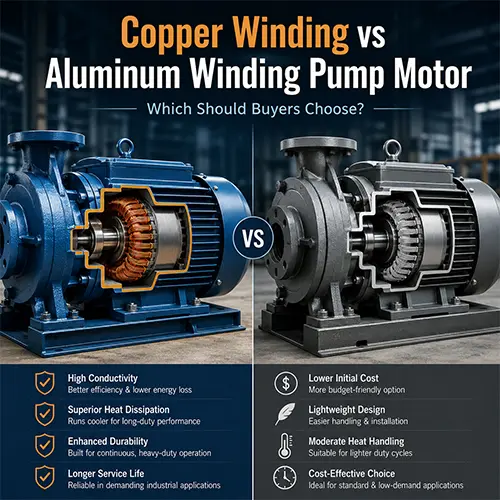
Copper winding vs aluminum winding pump motor selection should be based on duty cycle, motor load, operating hours, heat rise, starting frequency, voltage stability, ambient temperature, cooling condition, repair difficulty, energy cost, downtime risk, and supplier transparency—not on purchase price alone. A copper winding pump motor is usually the safer choice for long-running, high-load, industrial, submersible, deep well, booster, irrigation, sewage, and critical water supply applications. An aluminum winding pump motor may be acceptable for light-duty, intermittent, low-risk, price-sensitive applications when the motor is correctly designed and the supplier clearly confirms the winding material, duty rating, warranty conditions, and performance data.
For buyers, contractors, distributors, project engineers, and procurement teams, the real question is not: “Is copper winding always better than aluminum winding?” The better question is: “Will this motor survive the real operating hours, starting load, temperature, voltage condition, cooling condition, and failure consequence of my pump system?”
Copper winding (a motor winding made mainly from copper conductor) usually provides better conductivity (the ability of a material to carry electrical current), lower resistance (the opposition to electric current flow), stronger thermal behavior (how a material or component responds to heat during operation), and better long-duty reliability. That is why many B2B buyers prefer copper winding motors for industrial pumps and long-hour operation.
Aluminum winding (a motor winding made mainly from aluminum conductor) is not automatically unusable. It can work in low-cost domestic pumps, short-runtime clean-water pumps, temporary transfer pumps, backup pumps, or light garden irrigation pumps. The risk appears when an aluminum winding motor is used in a heavy-duty application where the buyer expects the same heat margin, efficiency, overload tolerance, and service life as a copper winding motor.
Choose a copper winding pump motor when reliability, long operating hours, heat control, efficiency, and downtime risk matter. Consider aluminum winding only for light-duty, intermittent, low-risk pumps when the supplier clearly confirms the winding material, motor design, duty rating, and warranty conditions.
Quick Decision Summary for Buyers
Copper winding motors are usually safer for long-running, high-load, hot, frequently started, or difficult-to-repair pump applications. Aluminum winding motors may be acceptable only when the pump is light-duty, intermittent, easy to replace, and non-critical. This first table helps buyers make a fast procurement decision before reviewing detailed motor data.
| Buyer Condition | Better Direction | Why It Matters |
|---|---|---|
| Continuous 8–24 hours/day pump operation | Copper winding motor | Better heat handling and long-duty reliability |
| Industrial pump, irrigation station, factory utility water | Copper winding motor | Lower failure risk under heavier duty |
| High ambient temperature or poor cooling condition | Copper winding motor | Aluminum winding may run hotter if not properly designed |
| Frequent start-stop operation | Copper winding motor | Starting current and heat accumulation matter |
| Low-cost light-duty clean-water pump | Aluminum winding may be acceptable | Only if intermittent and non-critical |
| Temporary or backup pump with short runtime | Aluminum winding may be acceptable | Lower failure consequence |
| Remote site or difficult maintenance access | Copper winding motor | Reliability and repair cost matter |
| Energy cost is important | Copper winding motor often safer | Lower resistance can support better efficiency |
| Buyer needs stable long-term service life | Copper winding motor | Better for lifecycle cost |
| Supplier cannot clearly confirm winding material | Avoid or verify before purchase | Risk of mislabeling or low-quality motor |
The practical conclusion is simple: choose copper winding for industrial, long-running, high-load, hot-environment, or critical applications. Consider aluminum winding only for light-duty, intermittent, low-risk applications when the supplier clearly confirms the motor design, performance, and warranty conditions.
Key Takeaway for Buyers
Copper winding pump motors are usually safer for long-running, high-load, high-temperature, frequent-start, industrial, submersible, deep well, and critical pump applications. Aluminum winding pump motors may be acceptable for light-duty, intermittent, low-risk, and easy-to-replace applications if the supplier clearly confirms the winding material, motor design, duty rating, and warranty terms.
This takeaway matters because buyers often compare only pump price or motor power. But the winding material affects heat behavior, efficiency potential, overload margin, and long-term motor risk. If the pump runs only occasionally, aluminum winding may be a reasonable cost-saving option. If the pump supports production, irrigation, building water supply, sewage drainage, or remote water transfer, copper winding is usually the safer procurement choice.
30-Second Buyer Decision Table
This table gives buyers, engineers, and procurement teams a fast first filter before requesting a detailed quotation. It does not replace motor testing or pump selection, but it prevents the most common mistake: treating copper and aluminum winding motors as equal simply because the nameplate power looks the same.
| If Your Pump Is... | Choose First | Reason |
|---|---|---|
| Running 8–24 hours/day | Copper winding | Heat and insulation life matter |
| Deep well or submersible pump | Copper winding | Removal and repair cost are high |
| Factory utility or industrial cooling pump | Copper winding | Downtime risk is high |
| Frequent start-stop booster pump | Copper winding | Starting heat accumulation matters |
| High ambient temperature pump room | Copper winding | Better thermal margin is needed |
| Remote or hard-to-repair pump station | Copper winding | Service cost can exceed purchase saving |
| Small domestic clean-water pump | Aluminum may be acceptable | Light intermittent duty |
| Temporary backup pump | Aluminum may be acceptable | Low runtime and low consequence |
| Supplier cannot confirm winding material | Do not approve | Transparency risk |
| Very low price but “full copper” claim | Inspect before purchase | Mislabeling risk |
This table should be used as a first decision tool. Final approval still requires rated current, insulation class, duty rating, temperature rise, cooling condition, pump curve, and warranty verification.
Scope of This Guide: Applicable Pump Types and Operating Conditions
This guide applies to electric pump motors used in clean water transfer, pressure boosting, irrigation, industrial water supply, drainage, sewage pumping, deep well pumping, HVAC circulation, and general utility pumping. It helps buyers understand when copper winding is worth the extra cost and when aluminum winding may be acceptable under controlled, low-risk conditions.
This guide applies well to:
- End suction pumps
- Inline pumps
- Multistage pumps
- Pipeline pumps
- Submersible pumps
- Submersible sewage pumps
- Deep well pumps
- Booster pumps
- Irrigation pumps
- Centrifugal pumps
- Domestic water pumps
- Industrial water pumps
- Electric pump packages
- OEM pump motor procurement
This guide is especially useful for:
- Household water transfer
- Building pressure boosting
- Agricultural irrigation
- Factory utility water
- Industrial cooling circulation
- Clean water transfer
- Drainage and sewage pumping
- Deep well pumping
- Booster stations
- Commercial water supply
- Municipal auxiliary systems
- Long-hour pump operation
This guide needs adjustment or separate engineering verification for:
- Explosion-proof motors
- Fire pump motors governed by local codes
- High-voltage motors
- Heavy-duty VFD-controlled motors
- Submersible motors with special insulation requirements
- Mining slurry pumps
- Seawater pumps
- Chemical pumps
- Food-grade sanitary pumps
- Motors requiring IEC (International Electrotechnical Commission) or NEMA (National Electrical Manufacturers Association) certification
- Very high-power industrial motors where detailed motor test data controls selection
For special applications, winding material is only one part of the decision. Buyers should also verify insulation class, IP protection (Ingress Protection rating, a rating that describes dust and water resistance), cooling method, duty rating, bearing design, voltage tolerance, efficiency, and project documentation.
If the buyer is comparing pump operating cost and long-term performance, this pump efficiency loss guide can help identify how motor condition, pump wear, and wrong operating points affect energy use and output.
Engineering Boundary: Winding Material Is Not the Only Motor Quality Factor
Copper winding is important, but winding material alone does not determine motor quality. A copper winding motor can still fail if the insulation system is weak, the pump is overloaded, the voltage is unstable, the cooling is poor, or the supplier does not test the motor properly.
Buyers should evaluate the complete motor system:
| Motor Quality Factor | Why It Matters |
|---|---|
| Winding material | Affects conductivity, resistance, heat, and cost |
| Insulation class | Defines the temperature tolerance of the insulation system |
| Duty rating | Confirms whether the motor is suitable for continuous or intermittent operation |
| IP protection class | Shows protection against dust and water ingress |
| Motor efficiency class | Affects energy cost and heat loss |
| Bearing quality | Affects service life, noise, and mechanical reliability |
| Cooling method | Controls motor temperature during operation |
| Voltage tolerance | Affects performance under unstable power supply |
| Cable sizing | Prevents voltage drop and overheating |
| Overload protection | Helps prevent motor burnout |
| Pump curve | Confirms whether the motor is matched to the pump load |
| Factory testing | Verifies current, insulation, temperature, and performance |
| Stator core quality | Affects magnetic efficiency and heat |
| Winding process | Affects consistency, insulation integrity, and reliability |
This boundary is important because some buyers over-simplify the decision. Copper winding is usually better for demanding duty, but a properly engineered motor is more than copper wire. The safest procurement decision combines material verification, motor performance data, application matching, and supplier transparency.
Practical Buyer Rule for Copper Winding vs Aluminum Winding Pump Motor
A copper winding pump motor is the safer choice when the pump runs many hours, starts frequently, works in hot conditions, supports production, or failure creates high downtime cost. An aluminum winding motor may be acceptable when the pump is small, low-cost, intermittent, easy to replace, and non-critical.
This rule matters because the real cost of a pump motor is not only the motor price. A cheaper winding material can reduce upfront cost, but if the motor overheats, burns out, trips frequently, or fails in a remote site, the buyer may pay much more through downtime, labor, replacement, warranty disputes, and lost operation.
Before choosing copper or aluminum winding, buyers should answer these questions:
- How many hours per day will the pump run?
- Will the pump start frequently?
- Is the power supply stable?
- Is the ambient temperature high?
- Will the motor run close to full load?
- Is the pump difficult to remove, repair, or replace?
- Will pump failure affect production, irrigation, building water supply, drainage, or customer operation?
- Can the supplier clearly confirm winding material, rated current, insulation class, temperature rise, and warranty conditions?
A good purchasing rule is: if the motor failure cost is higher than the winding cost difference, copper winding is usually the safer procurement choice.
What Is a Copper Winding Pump Motor?
A copper winding pump motor uses copper conductors in the motor winding. The winding is the coil inside the motor that creates the electromagnetic field needed to rotate the rotor and drive the pump.
Copper has better electrical conductivity than aluminum. In pump motor applications, this usually means lower electrical resistance, better current transmission, lower heat generation under comparable design conditions, and better long-duty stability. That is why copper winding motors are usually preferred for industrial pumps, submersible pumps, deep well pumps, booster pumps, irrigation pumps, and long-running systems.
Definition of Copper Winding Pump Motor
A copper winding pump motor is a pump motor whose winding coils are made mainly from copper conductor. The copper winding carries current and creates the magnetic field that drives motor rotation.
Important terms buyers should understand:
- Copper winding: Motor winding made mainly from copper conductor.
- Motor winding: The coil section inside the motor that carries current and creates the magnetic field.
- Conductivity: The ability of a material to carry electrical current.
- Resistance: The opposition to electric current flow.
- Heat dissipation: The ability to move heat away from the motor winding and internal parts.
- Continuous duty: A condition where the motor runs for long periods without extended rest.
- Full-load current: The current drawn when the motor operates at its rated load.
- Temperature rise: The increase in motor temperature during operation.
Copper winding does not mean the motor is automatically perfect, but it usually gives the motor designer a stronger electrical and thermal foundation.
Typical Applications of Copper Winding Pump Motors
Copper winding motors are usually selected where pump reliability, efficiency, heat control, and service life matter more than the lowest purchase price. They are especially suitable when the motor runs for many hours, starts under load, or operates in difficult conditions.
Typical applications include:
- Industrial water pumps
- Agricultural irrigation pumps
- Deep well pumps
- Submersible pumps
- Sewage pumps
- Booster pump systems
- HVAC circulation pumps
- Multistage pumps
- Factory cooling water pumps
- Long-hour water transfer pumps
- Remote site pumping systems
- Municipal auxiliary pumping systems
A copper winding motor is often the better choice when failure would require crane lifting, well pulling, emergency replacement, production stoppage, or customer complaint handling.
Common Advantages of Copper Winding Motors
Copper winding motors are valued because they usually provide better electrical performance and thermal margin under demanding pump duty. The advantage is not cosmetic. It affects motor heat, efficiency, load tolerance, and service reliability.
| Advantage | Buyer Meaning |
|---|---|
| Better electrical conductivity | Lower resistance and better current transmission |
| Better heat handling | Safer for long running and high-load duty |
| Better efficiency potential | Can reduce energy loss when motor design is correct |
| Better overload tolerance | More stable under demanding conditions |
| Longer expected service life | Lower motor failure risk in industrial duty |
| Stronger resale and market trust | Easier for buyers to accept in B2B procurement |
| Better for critical systems | Reduces downtime and warranty disputes |
For long-running pumps, even a small difference in motor efficiency and heat behavior can become important over months or years of operation.
Common Limitations of Copper Winding Motors
Copper winding is a strong advantage, but it does not replace correct motor design, pump selection, voltage stability, cooling, and supplier verification. Buyers should not approve a motor only because the supplier says “full copper.”
| Limitation | Buyer Meaning |
|---|---|
| Higher purchase cost | Not always necessary for low-risk light-duty pumps |
| More attractive for material substitution fraud | Buyers must verify supplier transparency |
| Still fails if pump is overloaded | Copper does not fix wrong pump sizing |
| Still affected by poor cooling or voltage | System conditions still matter |
| Not a guarantee of premium quality alone | Motor design, insulation, testing, and assembly also matter |
A copper winding motor can still fail if the pump runs off its curve, the voltage is unstable, the cooling is poor, or the motor is undersized for the actual load.
What Is an Aluminum Winding Pump Motor?
An aluminum winding pump motor uses aluminum conductors in the motor winding. Aluminum has lower material cost and lighter weight, but its electrical conductivity and thermal behavior are usually not as strong as copper under comparable design conditions.
This does not mean aluminum winding cannot be used. It means the application boundary must be clear. Aluminum winding motors can be acceptable in light-duty, intermittent, easy-to-replace pump applications. They become risky when used in long-running industrial systems, hot environments, frequent-start systems, or remote installations where motor failure is expensive.
Definition of Aluminum Winding Pump Motor
An aluminum winding pump motor is a pump motor whose winding coils are made mainly from aluminum conductor. Because aluminum has higher resistance than copper, the motor must be properly designed to control heat, current, efficiency, and service life.
Important terms buyers should understand:
- Aluminum winding: Motor winding made mainly from aluminum conductor.
- Thermal rise: The increase in motor temperature during operation.
- Insulation class: The temperature tolerance rating of the motor insulation system.
- Full-load current: The current drawn when the motor runs at rated load.
- Derating: Operating a motor below its rated capacity to reduce heat and improve reliability.
- Copper-clad aluminum: Aluminum conductor covered with a thin copper layer; it should not be treated as the same as full copper winding.
The buyer should not only ask whether the motor can start the pump. The buyer should ask whether the motor can run safely under the real duty for the expected service life.
Why Aluminum Winding Requires Proper Motor Design
Because aluminum has lower conductivity than copper, an aluminum winding motor must be designed with suitable conductor size, slot fill, insulation system, cooling margin, and current control. If a supplier simply substitutes aluminum for copper without redesigning the motor properly, heat rise and service-life risk increase.
This is the main reason aluminum winding quality varies widely. A properly engineered aluminum winding motor used in light duty may perform acceptably. A poorly designed aluminum winding motor used in heavy duty can overheat, draw excessive current, reduce efficiency, and shorten insulation life.
Buyers should therefore never judge aluminum winding only by price. They should confirm motor design, rated current, temperature rise, insulation class, duty rating, and warranty exclusions.
Typical Applications of Aluminum Winding Motors
Aluminum winding motors may be acceptable when the application is light, intermittent, easy to replace, and not critical. They are more common where the buyer’s priority is low purchase price and the failure consequence is limited.
Typical applications include:
- Low-cost domestic water pumps
- Small clean-water transfer pumps
- Temporary water transfer
- Backup pumps with rare use
- Light garden irrigation
- Low-duty drainage
- Non-critical small pump applications
- Price-sensitive markets with clear warranty terms
For example, a small clean-water pump used occasionally for household transfer may not require a copper winding motor. But a deep well pump used every day in a remote irrigation system should not be treated the same way.
Common Advantages of Aluminum Winding Motors
The main advantage of aluminum winding motors is lower upfront cost. This can be useful when the pump is light-duty, non-critical, and easy to replace.
| Advantage | Buyer Meaning |
|---|---|
| Lower material cost | Lower purchase price |
| Lighter winding material | May reduce motor weight |
| Acceptable for light-duty use | Can work if duty is low and design is correct |
| Useful in price-sensitive markets | Allows lower-cost pump options |
| Suitable for non-critical applications | Failure consequence is lower |
Aluminum winding should be treated as a cost-driven option with defined limits, not as an equal substitute for copper in every pump application.
Common Limitations of Aluminum Winding Motors
The main risks of aluminum winding motors are higher resistance, more heat sensitivity, lower overload margin, lower market trust, and greater dependence on honest motor design. These risks become more serious under long running hours or heavy pump load.
| Limitation | Buyer Risk |
|---|---|
| Lower conductivity than copper | Higher resistance and more heat if not compensated |
| Higher thermal stress risk | Shorter insulation life under heavy duty |
| Lower overload margin | Higher risk in voltage fluctuation or heavy load |
| Lower market trust in B2B projects | Buyers may question durability |
| Higher risk in continuous operation | Not ideal for long-hour industrial duty |
| Supplier mislabeling risk | Must verify actual winding material |
If an aluminum winding motor is used, the buyer should verify current, temperature rise, insulation class, duty rating, and warranty terms more carefully.
Copper vs Aluminum Winding Pump Motor: Core Difference for Buyers
The core difference between copper and aluminum winding pump motors is not the color of the wire. It is the difference in conductivity, resistance, heat behavior, overload margin, efficiency potential, service life boundary, and procurement risk.
| Comparison Point | Copper Winding Motor | Aluminum Winding Motor | Buyer Meaning |
|---|---|---|---|
| Conductivity | Higher | Lower | Copper usually handles current more efficiently |
| Resistance | Lower | Higher | Aluminum may produce more heat if design is weak |
| Heat dissipation | Better | Weaker | Copper is safer for long-duty operation |
| Efficiency potential | Higher | Lower to moderate | Depends on full motor design |
| Starting performance | Usually better | More sensitive | Important for pump starting load |
| Continuous duty | Better suited | Riskier if not designed well | Industrial pumps usually favor copper |
| Purchase cost | Higher | Lower | Aluminum saves upfront cost |
| Service life | More stable in demanding duty | More duty-sensitive | Depends on load and cooling |
| Market trust | Higher | Lower | Copper is preferred in many B2B projects |
| Best use | Industrial, long-hour, high-duty pumps | Light-duty, intermittent, low-cost pumps | Duty controls selection |
The simplest buyer conclusion is: copper winding is usually the safer choice for pumps that run longer, start more often, carry heavier load, or operate in hotter conditions. Aluminum winding should only be used when the duty is light, the risk is low, and the supplier clearly confirms the motor design and warranty.
Copper-Clad Aluminum Motor Winding: Why Buyers Should Verify Carefully
Copper-clad aluminum motor winding is not the same as full copper winding. Copper-clad aluminum uses an aluminum conductor covered with a thin copper layer. It may look similar to copper at first glance, but its electrical and thermal performance should not be assumed to equal a full copper conductor.
This topic matters because some price-sensitive markets use vague terms such as “copper color,” “copper-coated,” “copper wire type,” or “premium winding.” Buyers should require clear material wording before approving a pump motor quotation.
What Is Copper-Clad Aluminum?
Copper-clad aluminum is aluminum conductor with a thin copper layer on the surface. The core material is still aluminum, so buyers should not compare it directly with full copper winding in demanding pump applications.
Important buyer distinction:
| Winding Description | Buyer Interpretation |
|---|---|
| Full copper winding | Winding conductor is mainly copper |
| Aluminum winding | Winding conductor is mainly aluminum |
| Copper-clad aluminum | Aluminum conductor with a copper surface layer |
| Copper color winding | Not a technical material statement |
| “Good motor” | Not enough for procurement approval |
If the supplier offers copper-clad aluminum, it must be clearly disclosed and matched only to suitable low-risk duty.
Why Copper-Clad Aluminum Is a Procurement Risk
Copper-clad aluminum becomes risky when buyers pay for full copper performance but receive a different material. The issue is not only material cost. The issue is application suitability.
Risks include:
- Lower performance than expected
- Higher heat under demanding duty
- Confusion during warranty claims
- Project acceptance disputes
- Inconsistent batch quality
- False premium pricing
- Lower trust from B2B customers
For industrial pumps, deep well pumps, submersible pumps, irrigation pumps, and continuous-duty pumps, buyers should verify whether the winding is full copper, aluminum, or copper-clad aluminum before placing an order.
How Buyers Should Handle Copper-Clad Aluminum Offers
Buyers should not automatically reject copper-clad aluminum for every low-risk application, but they should never accept it as full copper. The supplier must clearly state the material and application boundary.
Buyers should ask:
- Is the winding full copper, aluminum, or copper-clad aluminum?
- Is the material written in the datasheet or only mentioned verbally?
- What is the rated current?
- What is the temperature rise?
- What is the duty rating?
- What warranty exclusions apply?
- Is the motor suitable for continuous operation?
- Can a sample be inspected before bulk purchase?
If the supplier avoids these questions, the quotation should be treated as high risk.
Why Buyers Confuse Copper Winding and Aluminum Winding Pump Motors
Buyers often confuse copper winding and aluminum winding pump motors because the difference is not visible from outside the pump. Two motors may have the same power rating, same voltage, same frame appearance, and similar nameplate information, but they may not perform the same under heat, load, voltage fluctuation, and long operating hours.
The real procurement risk is that the buyer may approve a low-cost motor and then use it in a duty that requires better thermal margin and stronger reliability.
Mistake 1: Thinking Motor Power Alone Proves Motor Quality
The same kW or HP rating does not prove the same motor quality, thermal behavior, efficiency, or service life. A motor can be labeled with the same rated power but have different winding material, insulation quality, temperature rise, current behavior, and manufacturing standard.
Common risks include:
- Same power rating but different heat rise
- Higher full-load current
- Lower efficiency
- Shorter insulation life
- Motor burnout under heavy load
- Warranty dispute
- Higher electricity cost
- Shorter bearing and insulation life due to heat
A buyer should not compare only “1.5 kW vs 1.5 kW” or “2 HP vs 2 HP.” The better comparison is full-load current, efficiency, insulation class, duty rating, temperature rise, winding material, and real application suitability.
Mistake 2: Choosing Only by Low Purchase Price
A low purchase price is only useful when the application risk is low. If the pump runs for long hours or failure causes downtime, a cheaper aluminum winding motor may become more expensive over its service life.
Possible hidden costs include:
- More energy loss
- Higher repair cost
- More downtime
- Shorter service life
- Repeated motor replacement
- Customer complaints
- Emergency labor cost
- Warranty disputes
A buyer should compare lifecycle cost, not just purchase price.
Mistake 3: Assuming All “Copper Motors” Are Really Copper
Some suppliers may use unclear wording, copper-clad aluminum, or vague descriptions that do not prove full copper winding. This is a serious issue in price-sensitive pump procurement.
Possible risks include:
- Mislabeling
- Incomplete motor specification
- False premium pricing
- Copper-clad aluminum being presented as full copper
- Difficult warranty verification
- Project acceptance failure
- Inconsistent quality across batches
For bulk purchase or B2B project supply, the buyer should require a winding material statement, motor datasheet, test data, or sample verification.
Duty Cycle: The Most Important Selection Factor
Duty cycle is one of the most important factors when choosing between copper winding and aluminum winding pump motors. A pump that runs 20 minutes per day is very different from a pump that runs 12 hours per day, even if both use the same rated power.
The longer the operating time, the more important heat control becomes. Heat is one of the main reasons motor insulation ages and fails.
What Is Duty Cycle?
Duty cycle means how long and how often the motor runs within a defined period. For pump motors, duty cycle affects winding temperature, insulation life, bearing life, energy cost, and failure risk.
| Duty Type | Typical Use | Recommended Winding Direction |
|---|---|---|
| Occasional use | Temporary transfer, backup pump | Aluminum may be acceptable |
| Intermittent light duty | Garden, domestic water transfer | Aluminum or copper |
| Several hours/day | Irrigation, small commercial water | Copper preferred |
| 8–16 hours/day | Factory utility, cooling, booster system | Copper strongly recommended |
| 24/7 continuous duty | Industrial, municipal, critical systems | Copper winding motor |
If the motor runs several hours per day or more, copper winding usually becomes the safer long-term choice.
Why Aluminum Winding Is Riskier Under Long Duty
Aluminum winding becomes riskier under long duty because higher resistance can lead to more heat if the motor is not carefully designed. Heat does not only make the motor hot to the touch. It reduces insulation life and increases the chance of burnout.
Possible consequences include:
- Higher winding temperature
- Faster insulation aging
- Motor current increase
- Reduced efficiency
- Shorter service life
- Motor burnout
- More frequent overload protection trips
- Higher maintenance cost
A well-designed aluminum motor can work in light duty, but buyers should be cautious when the pump runs continuously or near full load.
How Buyers Should Estimate Duty Before Purchase
Buyers should define the real operating duty before asking for the lowest price. Vague descriptions such as “normal use” or “common water pump use” are not enough for motor selection.
Buyers should confirm:
- How many hours per day will the pump run?
- How many starts per hour or per day?
- Is the pump controlled by a pressure switch, float switch, control panel, or VFD (Variable Frequency Drive, a device that controls motor speed by changing frequency)?
- Is the pump close to full-load operation?
- Is the power supply stable?
- Is the ambient temperature high?
- Is cooling airflow sufficient?
- For submersible pumps, is the motor always properly submerged or cooled by water flow?
- Is the pump used seasonally for long irrigation duty?
- Is the pump critical to the system?
The more demanding the duty, the stronger the reason to choose copper winding.
Heat, Efficiency, and Motor Life
The practical difference between copper and aluminum winding often appears as heat, efficiency, and motor life. A pump motor may start normally at the beginning, but if it runs hotter every day, the insulation system can age faster and fail earlier.
Heat control is especially important for pumps because many pumps operate for long periods, often in hot pump rooms, outdoor sites, deep wells, or submerged environments where cooling conditions vary.
Why Heat Rise Matters
Heat rise is the temperature increase inside the motor during operation. Excessive heat damages insulation and shortens motor life.
The heating process is simple:
- Motor winding carries current.
- Electrical resistance produces heat.
- Higher resistance can create more heat.
- Poor cooling traps heat inside the motor.
- High temperature accelerates insulation aging.
- Once insulation fails, short circuit or motor burnout may occur.
This is why copper winding is usually preferred for heavy-duty applications. Copper’s lower resistance can help reduce electrical losses when the motor is correctly designed.
Efficiency Difference and Energy Cost
Copper winding can support better efficiency because copper has lower resistance, but actual energy saving depends on the complete motor design and pump operating point. Buyers should not assume that every copper motor is high efficiency or every aluminum motor is poor efficiency.
| Factor | Buyer Impact |
|---|---|
| Lower resistance | Less electrical loss |
| Better heat control | More stable long operation |
| Better efficiency potential | Lower energy cost in long-running pumps |
| Correct motor design | More important than material label alone |
| Pump operating point | Wrong pump selection can waste energy even with copper motor |
| Motor efficiency class | Needed for reliable energy comparison |
| Full-load current | Helps judge actual electrical load |
If the existing pump shows higher energy use, reduced output, or abnormal motor heating, this pump efficiency loss guide can help buyers check whether the issue comes from motor condition, pump wear, wrong sizing, or system resistance.
Motor Life and Insulation Aging
Motor life is strongly affected by winding temperature and insulation aging. Even a good winding material can fail if voltage, load, cooling, insulation class, or pump selection is wrong.
Buyers should understand these points:
- Copper helps reduce electrical loss.
- Insulation class defines temperature tolerance.
- Overload shortens motor life.
- Voltage fluctuation increases current and heat.
- Poor cooling causes thermal stress.
- Frequent starting increases heat accumulation.
- Winding material alone does not replace correct motor design.
The best motor is not just “copper.” It is a correctly designed, properly cooled, properly protected, and properly tested motor that matches the pump duty.
Starting Torque, Voltage Fluctuation, and Overload Risk
Pump motors often face high current during startup, especially when the pump starts under pressure, deep water lift, high head, blocked impeller, or unstable voltage. Copper winding usually provides a stronger safety margin, while aluminum winding is more sensitive when motor design is weak or the application is demanding.
Starting and overload conditions matter because many pump failures do not happen during easy steady operation. They happen during startup, voltage drop, overload, clogging, or high temperature.
Starting Torque Requirement
Starting torque is the rotational force needed to start the pump from rest. Some pump systems require stronger starting performance than others.
High-risk starting scenarios include:
- Deep well pumps
- Sewage pumps with solids
- High-head pumps
- Booster pumps starting against pressure
- Frequent restart systems
- Low-voltage areas
- Long cable installations
- Pumps with higher rotating inertia
- Pumps with clogged or partially blocked impellers
If starting is difficult, the motor draws higher current and creates more heat. Copper winding usually gives a better margin in these conditions.
Voltage Fluctuation Risk
Voltage fluctuation can increase motor current and heat, even if the winding material is good. Poor power supply is a common cause of motor overheating and premature failure.
| Site Condition | Risk |
|---|---|
| Low voltage | Higher current and heat |
| Frequent voltage drop | Hard starting |
| Long cable distance | Voltage loss |
| Poor phase balance | Motor overheating |
| Weak generator power | Starting failure |
| Frequent starts | Heat accumulation |
| Undersized cable | Voltage drop and high current |
| Poor control panel protection | Delayed fault detection |
Copper winding does not make a motor immune to bad power supply, but it usually provides a better electrical and thermal margin than aluminum under demanding conditions.
Overload and Wrong Pump Selection
Wrong pump selection can overload any motor, including a copper winding motor. If the pump operates far from its correct duty point, the motor may draw excessive current, overheat, trip protection, or fail.
Common causes include:
- Wrong flow/head selection
- Impeller too large for the motor
- Pipe resistance different from design
- Valve position causing abnormal load
- Clogged impeller
- Bearing friction
- Poor suction condition
- Cavitation (the formation and collapse of vapor bubbles inside the pump, which can damage impellers and reduce performance)
- Wrong liquid density or viscosity
If the buyer is unsure whether the pump is operating near the correct duty point, this high head pump vs high flow pump guide can help clarify whether the system requires pressure, flow, or a different pump selection.
Copper Winding vs Aluminum Winding by Pump Type
Different pump types create different motor risks. Deep well pumps, submersible pumps, sewage pumps, industrial pumps, irrigation pumps, and continuous-duty pumps usually require stronger winding reliability because they are harder to access, operate longer, or face heavier load.
| Pump Type | Recommended Winding Direction | Why |
|---|---|---|
| Domestic clean water pump | Aluminum or copper | Depends on price and duty |
| Garden pump | Aluminum may be acceptable | Light intermittent use |
| Booster pump | Copper preferred | Frequent start-stop and pressure load |
| Deep well pump | Copper strongly recommended | Difficult removal and high repair cost |
| Submersible pump | Copper preferred | Cooling and sealing risks matter |
| Sewage pump | Copper preferred | Heavy load and clogging risk |
| Irrigation pump | Copper preferred | Long seasonal operation |
| Industrial pump | Copper strongly recommended | Long duty and reliability |
| HVAC circulation pump | Copper preferred for long operation | Energy and heat matter |
| Emergency drainage pump | Copper preferred if critical | Failure consequence matters |
| Factory utility pump | Copper strongly recommended | Downtime risk and long operation |
| Remote pump station | Copper strongly recommended | Maintenance access is difficult |
The key rule is: the harder the pump is to access, repair, or replace, the stronger the reason to choose copper winding.
When to Choose a Copper Winding Pump Motor
A copper winding pump motor is usually the correct choice when long-term reliability matters more than the lowest purchase price. This includes long-hour operation, high load, hot environment, frequent start-stop, poor voltage conditions, remote installation, and critical water systems.
Copper winding is often the safer procurement decision because it reduces motor risk over the full service life.
Choose Copper Winding for Industrial and Continuous-Duty Pumps
If the pump runs several hours per day or supports industrial operation, copper winding is usually the safer choice. Continuous operation creates heat, and heat is one of the main enemies of motor life.
Suitable applications include:
- Factory utility water
- Industrial cooling water
- Booster stations
- Irrigation stations
- Municipal auxiliary systems
- HVAC long-hour circulation
- Production support pumps
- Commercial building water supply
- Long-distance water transfer
- Pump rooms with continuous operation
In these systems, the cost of failure is usually much higher than the winding material cost difference.
Choose Copper Winding for High-Temperature or Poor Cooling Conditions
Copper winding is safer when the motor works in high ambient temperature or limited cooling conditions. Heat margin becomes more important when the motor cannot easily release heat.
Suitable conditions include:
- Hot climate regions
- Pump rooms with poor ventilation
- Outdoor pump installations
- Submersible pumps in low water level
- Motors near full-load operation
- Long cable or voltage drop sites
- Frequent start-stop systems
- Dusty or enclosed environments
A motor that is acceptable in a cool laboratory may not survive the same way in a hot pump room or remote irrigation site.
Choose Copper Winding for Remote or Difficult Maintenance Sites
Copper winding is usually the safer choice when the pump is difficult or expensive to remove. In these cases, motor reliability directly affects labor cost and downtime.
Suitable applications include:
- Deep well pumping
- Remote irrigation stations
- Mine drainage
- Construction drainage
- Remote farm water supply
- Offshore or hard-to-access systems
- Submersible installations
- Municipal auxiliary sites
For a deep well pump, the cost of pulling the pump can be much higher than the initial difference between copper and aluminum winding.
When Aluminum Winding May Be Acceptable
Aluminum winding motors are not automatically wrong. They may be acceptable when the application is light-duty, intermittent, low-risk, easy to replace, and price-sensitive. The condition is that the supplier must be honest and the motor must be designed for the stated use.
The buyer should treat aluminum winding as a controlled-cost option, not as a universal replacement for copper.
Aluminum May Be Acceptable for Light-Duty Domestic Pumps
Aluminum winding can be acceptable for small domestic pumps used for short, clean-water, non-critical operation. In these cases, the failure consequence is low and replacement is usually easy.
Suitable conditions include:
- Short daily runtime
- Clean water
- Low head
- Low failure consequence
- Easy replacement
- Clear warranty
- Honest supplier specification
- Price-sensitive use
- Non-industrial operation
A small household transfer pump used occasionally does not have the same motor requirement as a factory cooling pump or deep well pump.
Aluminum May Be Acceptable for Temporary or Backup Pumps
Aluminum winding can also be acceptable for temporary or backup pumps if runtime is very limited. The key is that the pump is not expected to perform long-duty operation.
Suitable conditions include:
- Temporary water transfer
- Backup pump
- Occasional garden irrigation
- Non-critical drainage
- Spare unit available
- Short operating window
- Easy replacement
- Low downtime cost
For backup use, buyers should still test the pump periodically. A backup pump that fails when needed is not a useful backup.
Aluminum Must Be Properly Designed
An aluminum winding motor is not simply a copper motor with a cheaper wire. To compensate for aluminum’s different conductivity and thermal behavior, the motor design must be suitable.
Buyers should confirm:
- Rated current
- Temperature rise
- Insulation class
- Motor efficiency
- Duty rating
- Warranty terms
- Actual application examples
- Cooling condition
- Motor protection
- Full-load test data if available
A properly designed aluminum motor used in light duty may be acceptable. A poorly designed aluminum motor used in heavy duty is a high-risk purchase.
When NOT to Choose Aluminum Winding Pump Motor
Aluminum winding should be avoided when the pump application is long-running, high-load, hot, frequently started, difficult to repair, remote, or critical. In these cases, a lower purchase price can become a false saving.
The buyer should not use aluminum winding just to win a low-price comparison if the application actually requires industrial reliability.
Do Not Choose Aluminum for Continuous Industrial Duty
Aluminum winding is risky for pumps that run 8–24 hours per day unless the motor is specifically designed and tested for that duty. Long operation exposes weak heat control quickly.
Risks include:
- Higher winding temperature
- Shorter insulation life
- Motor burnout
- Energy loss
- Repeated replacement
- Downtime
- Customer complaints
- Warranty disputes
For continuous industrial duty, copper winding is usually the safer procurement choice.
Do Not Choose Aluminum for Hard-to-Repair Pumps
Aluminum winding is not recommended when the pump is difficult to remove or repair. The labor and downtime cost can exceed the original saving.
High-risk pumps include:
- Deep well pumps
- Large submersible pumps
- Remote pump station pumps
- Mine drainage pumps
- Irrigation pumps in remote fields
- Critical drainage pumps
- Sewage pumps with difficult access
For these pumps, reliability is usually more valuable than the lowest motor cost.
Do Not Choose Aluminum When Supplier Specification Is Unclear
If the supplier cannot clearly confirm winding material, insulation class, rated current, temperature rise, duty rating, and warranty terms, the buyer should not approve the motor for serious applications.
Warning signs include:
- “Good motor” but no technical data
- No clear winding material statement
- Very low price compared with market level
- No rated current
- No insulation class
- No temperature rise information
- No warranty detail
- Refusal of sample inspection
- Unclear copper, aluminum, or copper-clad aluminum wording
Supplier transparency is part of product quality.
When Copper Winding Alone Is Not Enough
Copper winding is an important advantage, but it is not a complete guarantee of motor quality. A copper motor can still fail if the pump is wrongly selected, overloaded, poorly cooled, supplied with unstable voltage, or manufactured with poor insulation and assembly quality.
Buyers should treat copper winding as one important factor within a complete motor verification process.
Copper Does Not Fix Wrong Pump Sizing
If the pump operates at the wrong duty point, a copper winding motor can still overheat or overload. Winding material cannot correct wrong hydraulic selection.
Buyers should check:
- Pump curve
- Required flow and head
- Motor current
- Pipe resistance
- Impeller condition
- Valve position
- Suction condition
- Bearing friction
- Cavitation risk
- Whether the motor is matched to the impeller
A correctly selected pump protects the motor. A wrongly selected pump can destroy even a good motor.
Copper Does Not Fix Poor Voltage or Cooling
Poor voltage and poor cooling can damage any motor. Copper winding gives better margin, but it cannot overcome severe electrical or cooling problems.
Buyers should check:
- Voltage stability
- Phase balance
- Cable size
- Cooling airflow
- Pump room ventilation
- Submersible water level
- Motor protection
- Control panel quality
- Overload protection setting
- Ambient temperature
For submersible pumps, cooling depends on water condition and flow around the motor. If the pump runs without proper cooling, winding material alone cannot protect it.
Copper Does Not Replace Motor Testing
Buyers should still request motor data even if the supplier claims full copper winding. Reliable pump procurement requires evidence, especially for bulk orders and B2B projects.
Buyers should confirm:
- No-load current
- Full-load current
- Temperature rise
- Insulation resistance
- Efficiency class
- IP protection class
- Duty rating
- Warranty conditions
- Nameplate information
- Factory test report if available
Copper winding is valuable, but verified motor performance is more valuable.
Real Buyer Cases: When Copper Is Worth It and When Aluminum May Be Acceptable
Real buyer cases show why winding selection depends on duty risk, not on material opinion alone. Aluminum can be acceptable in low-risk use, but it becomes a costly mistake when buyers use it in hard-running or hard-to-repair pump systems.
| Case | Initial Choice | Result | Better Decision |
|---|---|---|---|
| Deep well irrigation pump running many hours/day | Aluminum winding | Motor burnout caused high pulling and labor cost | Copper winding |
| Domestic clean-water transfer pump used occasionally | Aluminum winding | Acceptable for short runtime and easy replacement | Aluminum acceptable |
| Factory cooling pump supporting production | Aluminum winding | Overheating and downtime risk increased | Copper winding |
| Backup drainage pump used rarely | Aluminum winding | Acceptable because runtime and consequence were low | Aluminum acceptable |
| Supplier claimed “full copper” but provided no datasheet | Unknown | High procurement risk | Verify or reject |
| Remote farm pump with unstable voltage | Aluminum winding | Starting and heat risk increased | Copper winding with protection review |
| Booster pump with frequent start-stop | Aluminum winding | Heat accumulation and trip risk increased | Copper winding |
| Price-sensitive market for small garden pump | Aluminum winding | Acceptable if warranty and duty are clear | Aluminum acceptable with transparent specification |
These cases help buyers explain the decision internally. Procurement may focus on price, but engineering and after-sales teams must consider heat, downtime, repair cost, and supplier verification.
How to Verify Copper Winding Before Purchase
Buyers should not rely only on verbal claims such as “100% copper motor” or “full copper winding.” For B2B procurement, especially bulk purchasing, OEM supply, or industrial pump projects, winding material should be verified through documents, samples, inspection, or testing.
This is important because unclear winding material can cause both technical risk and commercial disputes.
Supplier Document Verification
A reliable supplier should be able to provide basic motor information before order confirmation. The higher the duty risk, the more detailed the verification should be.
Buyers may request:
- Motor datasheet
- Winding material statement
- Efficiency data
- Insulation class
- IP protection class
- Duty rating
- Test report if available
- Warranty terms
- Nameplate photo
- Similar project reference
- Motor current data
- Temperature rise information
If the supplier cannot provide any of these, the buyer should treat the quotation as incomplete.
Physical and Testing Verification
For bulk procurement or critical projects, buyers can verify winding material and motor behavior through sample inspection or testing. This reduces the risk of paying for copper but receiving lower-grade material.
Possible methods include:
- Sample inspection
- Cut sample verification
- Resistance test
- Weight comparison
- Thermal rise test
- Full-load current test
- Third-party inspection
- Factory audit
- Random batch inspection
- Motor teardown inspection if agreed
Not every small order needs full testing, but high-risk projects should not rely only on supplier promises.
Warning Signs of Unclear Winding Quality
Unclear winding quality often appears before the order is placed. Buyers should pay attention to vague language and incomplete technical data.
| Warning Sign | Buyer Risk |
|---|---|
| Supplier only says “good motor” | No technical proof |
| No winding material statement | Copper/aluminum unclear |
| Very low price | Possible material substitution |
| No current data | Cannot judge load and efficiency |
| No insulation class | Heat risk unclear |
| No warranty detail | Dispute risk |
| Refuses sample verification | Transparency problem |
| Uses vague terms such as “copper color” | Material may not be full copper |
| Cannot explain duty rating | Application risk unclear |
A professional supplier should not be afraid to clarify winding material and motor data.
Quotation Review: How to Compare Copper and Aluminum Motor Offers
A pump motor quotation should be reviewed by technical completeness, not only by total price. Copper and aluminum winding offers may look similar if the buyer only compares motor power, but the real difference appears in material, current, temperature rise, insulation, efficiency, duty rating, and warranty.
| Quote Item | Copper Winding Offer | Aluminum Winding Offer | Buyer Check |
|---|---|---|---|
| Winding material | Must be clearly stated | Must be clearly stated | Avoid vague claims |
| Motor power | Rated kW/HP | Rated kW/HP | Same power does not mean same quality |
| Current data | Should be provided | Should be provided | Compare full-load current |
| Temperature rise | Important | Very important | Heat risk check |
| Insulation class | Required | Required | Check thermal margin |
| Efficiency | Should be compared | Should be compared | Lifecycle cost impact |
| Duty rating | Required | Required | S1 continuous or intermittent |
| Warranty | Usually stronger for premium offer | Must be clear | Check exclusions |
| Application limit | Broader | Narrower | Match real duty |
| Price | Higher | Lower | Compare lifecycle cost |
| Test data | Recommended | Strongly recommended | Confirms real performance |
| Supplier transparency | Required | Critical | Reduces mislabeling risk |
A lower quotation may be correct for light-duty pumps. But if the quotation hides winding material, current data, insulation class, and warranty limits, the buyer is not comparing equivalent products.
Troubleshooting Matrix: Is Winding Material Causing Motor Problems?
If a pump motor overheats, burns out, starts poorly, trips frequently, or consumes too much energy, winding material may be one possible cause—but not the only cause. Buyers should check motor data and site conditions together.
| Site Symptom | Possible Cause | What to Check |
|---|---|---|
| Motor overheats quickly | High resistance, overload, poor cooling | Winding material, current, voltage, load |
| Motor burns after long running | Thermal aging or wrong duty | Duty cycle, temperature rise, insulation |
| Starting is difficult | Low torque or voltage drop | Voltage, cable, starting current, pump load |
| Energy use is high | Low efficiency or wrong duty point | Motor efficiency, pump curve, current |
| Motor trips frequently | Overload or protection issue | Current, voltage, impeller, bearing |
| Repeated motor replacement | Wrong motor grade for duty | Copper vs aluminum, duty, cooling |
| Warranty dispute | Application exceeded design | Supplier terms, duty record, test data |
| Pump output drops | Not necessarily winding issue | Pump wear, impeller, suction, system resistance |
| Motor noise increases | Bearing or overload issue | Bearing, load, voltage, alignment |
| Cable becomes hot | Cable undersized or high current | Cable size, voltage drop, current |
This matrix prevents a common mistake: blaming winding material before checking the full system. A copper winding motor can fail under overload, and an aluminum winding motor can work in light duty if correctly designed.
Supplier Verification: What Buyers Should Ask Before Purchase
Buyers should verify winding material as part of the complete motor selection process. A good supplier should explain why the motor fits the buyer’s real operating hours, power supply, cooling condition, pump type, and risk level.
| Verification Item | Why It Matters |
|---|---|
| Is the winding copper, aluminum, or copper-clad aluminum? | Prevents material confusion |
| What is the motor duty rating? | Confirms continuous or intermittent use |
| What is the insulation class? | Shows heat tolerance |
| What is the rated current? | Helps check load and efficiency |
| What is the temperature rise? | Shows thermal safety margin |
| What is the motor efficiency? | Affects energy cost |
| What is the IP protection class? | Affects dust/water protection |
| What is the warranty condition? | Defines responsibility |
| Is the pump suitable for the buyer’s operating hours? | Matches real duty |
| Are test reports or samples available? | Reduces procurement risk |
| What voltage fluctuation can the motor tolerate? | Important for unstable power regions |
| What protection is recommended? | Prevents overload and burnout |
The supplier should not recommend aluminum winding for heavy-duty use without explaining how the motor design controls current, temperature, insulation life, and warranty risk.
Step-by-Step Buyer Checklist Before Final Selection
A structured checklist helps buyers avoid choosing pump motors only by price or nameplate power. This checklist can be used before internal approval, supplier negotiation, or RFQ release.
| Step | Buyer Question | Why It Matters |
|---|---|---|
| 1 | How many hours per day will the pump run? | Determines copper/aluminum suitability |
| 2 | Is the pump critical or non-critical? | Determines failure consequence |
| 3 | Is the pump easy to repair or replace? | Determines lifecycle risk |
| 4 | Is the power supply stable? | Voltage affects motor heat |
| 5 | Is ambient temperature high? | Heat margin matters |
| 6 | Does the pump start frequently? | Starting heat accumulation |
| 7 | Is the pump near full load? | Overload risk |
| 8 | What is the winding material? | Core material verification |
| 9 | What is the insulation class? | Heat tolerance |
| 10 | What is the rated current and efficiency? | Performance and energy cost |
| 11 | What warranty exclusions apply? | Avoid disputes |
| 12 | Is sample testing needed? | Important for bulk or critical orders |
Buyers should not approve a pump motor until the application duty and supplier data are aligned.
RFQ Checklist for Copper vs Aluminum Winding Pump Motor Procurement
A clear RFQ (Request for Quotation, a formal inquiry used to request technical and commercial offers from suppliers) helps buyers avoid vague low-price quotations. It also forces suppliers to clarify whether the quotation difference comes from real material, motor design, testing, or only cost reduction.
| RFQ Item | Information to Provide or Request |
|---|---|
| Pump application | Domestic, irrigation, industrial, drainage, booster |
| Operating hours | Occasional, intermittent, continuous |
| Starts per hour/day | Frequent start-stop risk |
| Flow/head | Required pump duty |
| Motor power | kW/HP |
| Voltage/frequency/phase | Power supply condition |
| Ambient temperature | Heat risk |
| Installation condition | Indoor, outdoor, submersible, poor ventilation |
| Winding material | Copper, aluminum, or copper-clad aluminum |
| Insulation class | Required |
| Rated current | Required |
| Efficiency data | Required for long-running pumps |
| Duty rating | S1 continuous or other |
| Protection class | IP rating |
| Warranty terms | Including exclusions |
| Sample/test request | For bulk or critical projects |
A good RFQ should not simply ask “price for 2 HP pump.” It should ask whether the motor is suitable for the real duty and what data proves it.
Best Option by Scenario: Copper or Aluminum Winding Pump Motor?
Different pump applications require different winding decisions. This scenario table helps procurement teams, engineers, and business owners make a first judgment before technical confirmation.
| Scenario | Better Winding Direction | Reason |
|---|---|---|
| Home clean-water transfer | Aluminum or copper | Depends on price and runtime |
| Garden irrigation 1 hour/day | Aluminum may be acceptable | Light intermittent duty |
| Small booster pump | Copper preferred | Frequent start-stop risk |
| Deep well pump | Copper strongly recommended | Hard to remove and repair |
| Submersible sewage pump | Copper preferred | Heavy load and clogging risk |
| Industrial cooling pump | Copper strongly recommended | Long-duty reliability |
| Factory utility pump | Copper strongly recommended | Downtime risk |
| Agricultural irrigation pump | Copper preferred | Seasonal long operation |
| Temporary backup pump | Aluminum may be acceptable | Low runtime and low risk |
| Remote pump station | Copper strongly recommended | Maintenance access is difficult |
| Price-sensitive light-duty market | Aluminum possible | Must confirm honest specification |
| Critical water supply | Copper strongly recommended | Failure consequence is high |
This table gives a first direction, not a final approval. Final selection should still confirm motor data, pump curve, cooling condition, voltage, and warranty.
Final Decision Matrix: Copper, Aluminum, or Verified Alternative?
The final decision should be based on operating hours, failure consequence, repair difficulty, thermal risk, and supplier transparency. Copper is usually safer when duty risk is high. Aluminum is only reasonable when duty risk is low and supplier data is clear.
| Real Condition | Recommended Choice | Buyer Reasoning |
|---|---|---|
| Long operating hours | Copper winding | Heat and efficiency matter |
| Frequent start-stop | Copper winding | Starting heat accumulation |
| High ambient temperature | Copper winding | Better thermal margin |
| Remote or hard-to-repair pump | Copper winding | Repair cost is high |
| Industrial or critical system | Copper winding | Downtime risk dominates |
| Light domestic intermittent use | Aluminum may be acceptable | Low risk if honestly specified |
| Temporary backup use | Aluminum may be acceptable | Limited runtime |
| Supplier cannot confirm material | Do not approve | Transparency risk |
| Copper-clad aluminum offered | Verify carefully | May not match copper performance |
| Very low price but “full copper” claim | Inspect or reject | Mislabeling risk |
| Project requires documentation | Copper with test data preferred | Easier approval |
| Energy cost is high | Copper or high-efficiency verified motor | Lifecycle cost matters |
The best choice is not always the cheapest motor. The best choice is the motor that matches the real duty with acceptable lifecycle cost and risk.
FAQ About Copper Winding vs Aluminum Winding Pump Motors
These FAQ answers address common buyer questions about price, service life, efficiency, heat, fake copper claims, application boundaries, and supplier verification. The goal is to help buyers avoid both overpaying for unclear claims and underbuying for demanding pump duty.
Is a Copper Winding Pump Motor Always Better?
A copper winding pump motor is usually better for long-running, high-load, industrial, or critical pump applications, but copper is not the only factor. Motor design, insulation, cooling, voltage, pump sizing, bearing quality, protection, and testing also matter.
Copper gives the motor a better electrical and thermal foundation. But a poorly designed copper motor can still fail if it is overloaded, poorly cooled, or used under unstable voltage.
Is an Aluminum Winding Pump Motor Always Bad?
No. An aluminum winding pump motor is not always bad. It can be acceptable for light-duty, intermittent, low-risk pumps if the motor is properly designed and the supplier clearly states the winding material, duty rating, and warranty conditions.
The problem is not aluminum itself. The problem is using aluminum winding in a duty that requires copper-level heat margin and long-term reliability.
Why Is Copper Winding More Expensive?
Copper winding is more expensive because copper material costs more and usually provides better conductivity and thermal performance. In pump motors, this can support better efficiency, lower heat, stronger overload margin, and longer service life under demanding duty.
For industrial buyers, the higher price may be justified when downtime and maintenance cost are considered.
Does Copper Winding Save Electricity?
Copper winding can support better efficiency because of lower resistance, but actual electricity saving depends on the complete motor and pump system. Buyers should review motor efficiency, full-load current, pump operating point, and system resistance.
A copper motor running on a wrongly selected pump can still waste energy. Efficiency depends on the entire pump system.
How Can I Know If the Motor Is Really Copper Winding?
Buyers can verify copper winding by requesting a winding material statement, motor datasheet, sample inspection, resistance test, third-party inspection, or factory verification. For bulk orders or critical projects, buyers should not rely only on verbal claims.
If the supplier refuses basic verification, the buyer should treat the quotation as high risk.
Can Aluminum Winding Be Used in Industrial Pumps?
Aluminum winding is risky for long-running or critical industrial pumps unless the motor is specially designed and tested for that duty. Copper winding is usually safer for industrial pump applications because heat, load, starting, and downtime risks are higher.
For non-critical light industrial use, aluminum may be considered only if the supplier provides clear data and warranty terms.
Which Winding Is Better for Submersible Pumps?
Copper winding is usually preferred for submersible pumps because repair is more difficult, cooling conditions vary, and failure cost can be high. A submersible pump motor failure may require lifting, disassembly, downtime, and site labor.
For deep well and sewage submersible pumps, copper winding is usually the safer procurement decision.
Which Winding Is Better for Irrigation Pumps?
Copper winding is usually preferred when irrigation pumps run for many hours during the season. Agricultural irrigation often requires long daily operation, outdoor installation, voltage variation, and seasonal peak load.
Aluminum winding may be acceptable only for short, light-duty irrigation where runtime and failure consequence are low.
What Is Copper-Clad Aluminum, and Should Buyers Accept It?
Copper-clad aluminum is aluminum conductor covered with a thin copper layer. It should not be treated as the same as full copper winding. Buyers should verify whether the motor is full copper, aluminum, or copper-clad aluminum before approval.
Copper-clad aluminum may be offered in price-sensitive markets, but it should be clearly disclosed and matched only to suitable duty.
What Should I Ask the Supplier Before Choosing?
Buyers should ask about winding material, duty rating, insulation class, rated current, efficiency, temperature rise, IP protection, warranty exclusions, test data, and whether the motor fits the buyer’s operating hours. The supplier should also explain whether the pump is suitable for the real site conditions.
A quotation without motor data is not a complete technical quotation.
Conclusion: How Buyers Should Choose Between Copper and Aluminum Winding Pump Motors
The final decision between copper winding and aluminum winding pump motors should be based on duty risk and lifecycle cost, not only purchase price. Copper winding is usually safer for long operating hours, high load, high ambient temperature, frequent starts, industrial operation, critical systems, remote sites, and difficult-to-repair pumps. Aluminum winding may be acceptable for light-duty, intermittent, non-critical, easy-to-replace pumps when the supplier is transparent and the motor design is suitable.
Buyers should not choose copper only because it sounds premium. They should also not choose aluminum only because it is cheaper. Both choices can be wrong if the motor does not match the pump load, voltage condition, cooling condition, duty cycle, and failure consequence.
Choose a copper winding pump motor when reliability, long operating hours, heat control, efficiency, and downtime risk matter. Consider aluminum winding only for light-duty, intermittent, low-risk pumps when the supplier clearly confirms the winding material, motor design, duty rating, and warranty conditions.
Before final purchase, buyers should verify winding material, rated current, insulation class, duty rating, temperature rise, motor efficiency, voltage condition, cooling method, pump curve, warranty terms, and supplier transparency. That is the difference between buying a low-price pump motor and selecting a reliable pump system.
Get A Quote

Get A Quote
0 Comments