
Chinese-Made Pumps vs Pumps Made in Other Countries: How Should Industrial Buyers Evaluate Origin, Quality, Cost, and Long-Term Risk?
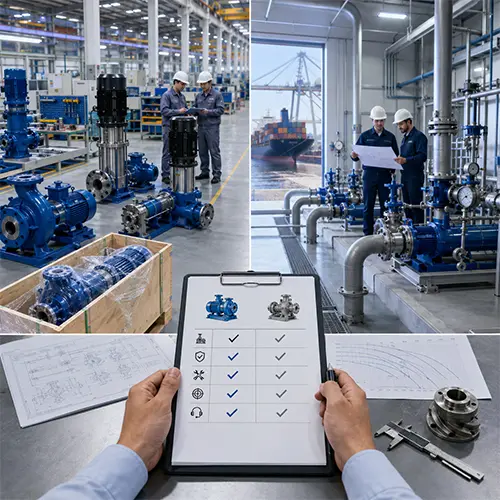
Chinese-made pumps vs pumps made in other countries should not be judged by country label alone. For industrial buyers, distributors, EPC contractors, and project owners, the real decision should be based on pump application, duty condition, material standard, supplier capability, factory testing, documentation quality, spare parts support, local service availability, and lifecycle risk.
Chinese-made pumps are usually strong in cost control, broad product coverage, OEM flexibility, fast customization, and mid-range industrial water applications. Pumps made in Germany, Japan, Italy, the United States, India, Turkey, South Korea, or other regions may be stronger in specific brand approvals, strict tender compliance, premium engineering reputation, local service networks, or specialized applications.
The practical question is not “Which country makes the best pump?” The better question is:
Which pump origin and supplier can meet the required flow, head, liquid condition, testing standard, documentation requirement, spare parts plan, and acceptable lifecycle cost for this specific project?
A well-selected Chinese-made pump can perform reliably in many standard industrial and commercial water applications. A premium imported pump can still fail if it is selected with the wrong material, wrong seal, wrong motor, wrong suction condition, or poor installation. Country of origin matters, but it should never replace engineering verification.
This guide explains how buyers should compare Chinese-made pumps with pumps made in other countries from a practical sourcing, engineering, and project-risk perspective.
Quick Decision Summary for Buyers
Chinese-made pumps are usually a practical choice when buyers need competitive cost, broad model availability, OEM customization, fast production, and export-oriented support. Pumps made in other countries may be better when tenders specify approved brands, local service is mandatory, documentation is strict, or the application is highly specialized.
This summary helps buyers avoid two common mistakes: assuming all Chinese pumps are low-end, or assuming all foreign-origin pumps are automatically better. Both assumptions are too simple for real industrial procurement.
| Buyer Condition | Better Direction | Why It Matters |
|---|---|---|
| Need competitive price with acceptable industrial quality | Chinese-made pump | China has strong manufacturing scale and supply chain depth |
| Need full product range for distribution | Chinese pump manufacturer | Broad model coverage and OEM packaging are often strong |
| Need private label or customized configuration | Chinese manufacturer | Many Chinese factories are flexible with OEM/ODM |
| Tender specifies European or US approved brands | Specified international brand | Tender compliance controls acceptance |
| Project requires strict local service support | Local or regional brand | Spare parts and technician response matter |
| Critical process with high downtime cost | Verified supplier, not country alone | Testing, material, and service determine real risk |
| Standard clean water transfer | Verified Chinese or regional supplier | Premium origin may be unnecessary |
| API, chemical, nuclear, or severe service | Certified specialist supplier | Compliance and engineering qualification dominate |
| Replacement for existing installed pump | Same brand or verified interchangeable supplier | Dimensional and spare parts compatibility matter |
| High-volume OEM sourcing | Chinese manufacturer | Cost, customization, and batch supply are often stronger |
The best purchasing decision is not based on nationalism, brand emotion, or the lowest price. It is based on verified fit between pump design and project risk.
Scope of This Guide: What Pump Types and Projects This Comparison Covers
This guide mainly applies to industrial and commercial water pump procurement, especially where buyers compare country of origin, supplier capability, cost, lead time, documentation, and service support. It is most useful for clean water, general industrial water, building service, irrigation, pressure boosting, and municipal support applications.
This guide is relevant for:
- End suction pumps
- Inline pumps
- Multistage pumps
- Split case pumps
- Submersible sewage pumps
- Diesel engine pumps
- Irrigation pumps
- Booster pump sets
- General centrifugal pumps
- Industrial clean water pumps
- HVAC circulation pumps
- Utility water pumps
This guide needs adjustment for:
- API process pumps
- Chemical pumps
- Slurry pumps
- Explosion-proof pumps
- Food-grade sanitary pumps
- Fire pumps governed by local codes
- Nuclear or power plant pumps
- High-temperature process pumps
- Highly corrosive liquid systems
- Severe mining applications
For standard water transfer, building supply, irrigation, and industrial circulation, country-of-origin comparison can help buyers optimize cost and risk. For highly specialized applications, country of origin becomes secondary. Compliance, material compatibility, engineering qualification, and safety standards become more important.
If the buyer is still comparing pump structures before evaluating country of origin, this end suction vs inline vs multistage pump guide can help clarify which pump type fits the required flow, head, and installation layout.
For regulated applications such as fire protection, explosion-proof systems, API process service, chemical transfer, food-grade sanitary pumping, or nuclear-related systems, buyers should confirm local standards, third-party certification, and project-specific engineering approval before selecting by country of origin.
Practical Buyer Rule for Comparing Pump Origin
Pump origin is a sourcing factor, not a quality certificate. A pump’s real reliability depends on hydraulic selection, material compatibility, manufacturing quality, testing level, installation quality, maintenance condition, spare parts support, and supplier accountability.
A Chinese-made pump is a practical choice when the application is standard, specifications are verified, cost-performance matters, and the supplier can provide pump curves, testing evidence, spare parts, and documentation. A premium international or local-origin pump is safer when the project requires approved brands, strict compliance, immediate local service, or specialized engineering support.
This rule is important because many buyers compare origin before they define risk. That is backwards. The buyer should first classify the project risk, then choose the origin and supplier level that can manage that risk.
| Project Risk Level | Typical Application | Recommended Sourcing Logic |
|---|---|---|
| Low risk | Simple clean water transfer, temporary pumping | Verified cost-effective supplier may be enough |
| Medium risk | Building water supply, irrigation, factory utility water | Compare Chinese, regional, and international suppliers by specification |
| High risk | Hospital, municipal supply, critical industrial line | Prioritize testing, documentation, local service, and spare parts |
| Very high risk | API, chemical, fire protection, nuclear, explosion-proof | Use certified specialist suppliers and project-specific approval |
The more critical the system, the less buyers should rely on purchase price alone. The less critical the system, the more buyers can optimize for cost-performance if specifications are verified.
Why Country of Origin Matters — But Should Not Be the Only Decision Factor
Country of origin affects pump cost, lead time, supplier ecosystem, documentation habits, certification familiarity, brand trust, spare parts access, and after-sales structure. However, country of origin does not automatically prove whether a pump is suitable for the project.
A pump made in a premium manufacturing country can fail if it is selected incorrectly. A pump made in China can perform well if the supplier has proper engineering capability, material control, hydraulic testing, and service support.
What Country of Origin Usually Affects
Country of origin usually affects the commercial and supply-chain side of pump procurement. Buyers often feel this through price, delivery time, documentation, import process, and service response.
Country of origin can influence:
- Manufacturing cost structure
- Casting and machining supply chain
- Motor and component sourcing
- Seal and bearing options
- Production lead time
- OEM customization flexibility
- Export packaging quality
- Documentation completeness
- Certification familiarity
- Import duties and tariffs
- Buyer confidence
- Spare parts lead time
- Local service availability
For example, a Chinese pump manufacturer may offer competitive pricing and fast OEM customization. A European or Japanese brand may provide stronger brand recognition and standardized documentation. A local US or regional supplier may offer faster service response in a specific market.
The buyer should compare these factors according to the project’s real risk level.
Why Country of Origin Can Mislead Buyers
Country of origin can mislead buyers when it replaces technical verification. Pump failure is often caused by wrong selection, poor installation, material mismatch, cavitation, poor suction condition, or weak maintenance—not simply by where the pump was made.
Common causes of failure include:
- Wrong flow and head selection
- Pump operating far from BEP
- Poor suction design
- Cavitation
- Wrong material for corrosive liquid
- Wrong mechanical seal
- Motor overload
- Poor alignment
- Improper installation
- No dry-run protection
- Lack of maintenance
BEP (Best Efficiency Point) means the operating point where the pump works with the highest hydraulic efficiency and usually lower vibration. Cavitation means vapor bubble formation and collapse inside the pump due to insufficient suction pressure or poor suction conditions. Both issues can damage pumps from any country.
If these problems exist, an expensive imported pump can also fail. If these risks are controlled, a verified Chinese-made pump can serve reliably in many applications.
Real Manufacturing Landscape: How China Fits into the Global Pump Supply Chain
Chinese pump manufacturing is not defined only by low cost. China’s real advantage is a deep supply chain, broad pump categories, flexible production, component availability, OEM support, and strong export experience.
China has manufacturers at very different levels. Some factories focus on low-cost commodity pumps. Others have modern machining, testing benches, engineering teams, export documentation, and long-term OEM customers. This wide range is why buyers must verify the supplier rather than judge only by “made in China.”
What Chinese Pump Manufacturing Is Strong At
Chinese pump manufacturers are often strong when buyers need product range, price-performance balance, customization, and fast batch supply. This is especially useful for distributors, OEM buyers, agricultural projects, building water supply, and general industrial users.
Common strengths include:
- Broad pump model coverage
- Competitive casting and machining ecosystem
- Flexible OEM and ODM support
- Private label packaging
- Fast sample development
- Mixed container supply
- Multiple motor voltage options
- Material upgrade options
- Pump set customization
- Export packing experience
- Spare parts bundle support
- Competitive price-performance ratio
For distributors, China can be practical because one manufacturer or export group may cover several product lines: centrifugal pumps, multistage pumps, sewage pumps, diesel pumps, and booster sets. This helps buyers reduce sourcing fragmentation.
For OEM buyers, Chinese factories are often more flexible with nameplate, color, packaging, motor brand, control panel, seal brand, and market-specific configuration.
Where Chinese Pumps Can Vary Significantly
Chinese pump quality varies greatly by supplier level. The difference between a low-cost trader and an engineering-oriented manufacturer can be very large.
Buyers should pay attention to variation in:
- Casting quality
- Machining accuracy
- Impeller balance
- Pump efficiency
- Shaft material
- Mechanical seal quality
- Bearing brand
- Motor efficiency grade
- Coating thickness
- Hydrostatic testing
- Performance testing
- Export packaging
- Documentation
- Spare parts continuity
This variation does not mean Chinese pumps are unreliable. It means buyer verification is essential. A serious Chinese supplier should be able to explain pump curve, material, motor, seal, testing, spare parts, and installation risks clearly.
How Buyers Should Identify a Strong Chinese Pump Manufacturer
A strong Chinese pump manufacturer should provide technical evidence, not only a low price. Buyers should ask for pump curves, material details, test reports, drawings, manuals, and spare parts recommendations.
| Verification Item | Strong Chinese Manufacturer | Low-End Supplier Risk |
|---|---|---|
| Pump curve | Provides clear curve and duty point | Only provides power and outlet size |
| Material details | Confirms casing, impeller, shaft, seal | Uses vague material descriptions |
| Testing | Offers performance or hydrostatic test when needed | No test data or generic certificate |
| Motor | Confirms voltage, frequency, insulation, protection | Unknown or inconsistent motor quality |
| Seal and bearing | Can provide brand or specification | Uses lowest-cost components |
| Documentation | Datasheet, drawing, manual, spare parts list | Minimal documents |
| QC process | Inspection before shipment | Only visual check |
| Spare parts | Clear spare parts support | No long-term parts plan |
| Export experience | Knows packaging, documents, shipping | Weak after-sales and communication |
A serious supplier should not be afraid of technical questions. If the supplier cannot explain the duty point, material, motor, seal, or testing process, the buyer should be cautious.
Pumps Made in Germany, Japan, Italy, the United States, India, Turkey, and Other Countries: Realistic Origin Differences
Pumps made in other countries should not be treated as one group. Different origins have different strengths, cost structures, brand reputations, service networks, and application focus.
German-Made Pumps: Engineering Reputation and Brand Trust
German-made pumps are often associated with engineering discipline, documentation quality, and premium industrial trust. They are commonly considered for projects where consultant approval, brand reputation, lifecycle reliability, and technical documentation are important.
Typical advantages may include:
- Strong engineering reputation
- Mature documentation culture
- High trust in premium industrial projects
- Established brand history
- Good fit for specification-driven projects
- Strong acceptance in some international tenders
Potential limitations include:
- Higher purchase price
- Longer lead time for some models
- More expensive spare parts
- Less flexibility for OEM customization
- Higher cost when the duty is simple
German pumps can be the right choice when the project requires approved brands or strict specifications. They may be unnecessary for simple clean water applications where a verified mid-range supplier can meet the duty safely.
Japanese-Made Pumps: Precision and Consistency
Japanese-made pumps are often valued for manufacturing consistency, mechanical precision, and stable product quality. Buyers who prioritize long-term reliability and stable production culture may consider Japanese brands.
Typical advantages may include:
- Good manufacturing consistency
- Strong mechanical precision
- Reliable product reputation
- Stable quality control culture
- Good fit for quality-sensitive users
Potential limitations include:
- Higher initial cost
- Less flexible OEM customization in some cases
- Limited model availability depending on region
- Spare parts cost or lead time depending on market
Japanese pumps can be a good fit for customers who value stable performance more than customization flexibility.
Italian-Made Pumps: Building Services, Compact Systems, and Water Applications
Italian-made pumps are often visible in building services, HVAC, domestic and commercial water supply, stainless steel multistage pumps, and compact pressure systems. Italian suppliers can be attractive for buyers serving building and light industrial markets.
Typical advantages may include:
- Strong presence in building water systems
- Good product design for compact applications
- Common use in HVAC and pressure boosting
- Strong stainless steel multistage pump options
- Good fit for European-style building applications
Potential limitations include:
- Higher price than many Chinese alternatives
- OEM flexibility varies by brand
- Spare parts availability depends on regional distributor
- Not always necessary for budget-sensitive utility duty
Italian pumps can be strong in building service applications where product compactness, design, and regional approval matter.
US-Made Pumps: Local Compliance and Service Network
US-made pumps may be preferred when local compliance, domestic sourcing preference, municipal approvals, or North American service support are important. In the US market, local service can be more valuable than lower overseas purchase price.
Typical advantages may include:
- Stronger local support in North America
- Useful for municipal and regulated projects
- Better fit for domestic sourcing requirements
- Faster service response in some regions
- Easier communication for local projects
Potential limitations include:
- Higher labor and manufacturing cost
- Higher purchase price
- May not be necessary for export projects outside North America
- Some brands may still use global components or assembly
US-made pumps can be a safer choice when tender rules, service speed, and domestic sourcing requirements are strict.
Indian-Made Pumps: Regional Strength and Cost-Competitive Supply
Indian pump manufacturers have strong relevance in agricultural pumps, water supply, and regional industrial markets. They may be competitive in South Asia, Africa, the Middle East, and other price-sensitive markets.
Typical advantages may include:
- Strong agricultural pump market base
- Cost-competitive categories
- Growing export capability
- Regional service familiarity in some markets
- Practical options for irrigation and water supply
Potential limitations include:
- Supplier quality varies
- Documentation should be verified
- Customization ability varies
- Material and testing standards need confirmation
Indian pumps can be practical where regional channels, irrigation demand, and cost-performance matter.
Turkish, Korean, Southeast Asian, and Other Regional Pump Sources
Regional pump sources may be attractive when logistics, local support, trade routes, or tender preferences matter. The best origin depends on the destination market and application.
Examples include:
- Turkey for Europe, Middle East, and Central Asia access
- South Korea for industrial and technology-driven sectors
- Southeast Asia for regional assembly and supply
- Eastern Europe for near-market manufacturing
- Mexico for North American nearshoring in some categories
These origins may not always beat China on cost or Germany/Japan on premium reputation, but they can offer regional advantages in delivery, service, or compliance.
Chinese-Made Pumps vs Pumps Made in Other Countries: Core Comparison for Buyers
Buyers should compare supplier capability rather than national labels. Origin affects cost and supply chain, but real project risk depends on whether the pump is suitable, tested, documented, and serviceable.
| Comparison Point | Chinese-Made Pumps | Pumps Made in Other Countries | Buyer Decision Meaning |
|---|---|---|---|
| Initial cost | Usually more competitive | Often higher for premium brands | China often wins budget-sensitive projects |
| Product range | Very broad | Depends on brand and country | China suits distributors needing full range |
| OEM flexibility | Often strong | Varies; premium brands may be less flexible | China suits private label and custom projects |
| Lead time | Often fast for standard models | May be longer for premium imports | China can support fast batch supply |
| Quality consistency | Varies by factory level | More stable among premium brands | Supplier verification is essential |
| Documentation | Varies greatly | Usually stronger in mature brands | EPC and tender projects need documentation |
| Certifications | Available but must be verified | Often stronger in regulated markets | Check certificate scope and validity |
| Spare parts | Good if supplier is stable | Good if local distributor exists | Service network matters more than country |
| Engineering support | Varies | Stronger in premium brands | Ask for curves, reports, and material data |
| Best-fit buyer | Distributor, OEM, mid-range industrial buyer | Spec-driven, regulated, premium projects | Match origin to project risk |
The correct question is not whether China or another country is “better.” The correct question is whether the supplier can prove the pump will work under the buyer’s real duty condition.
When Chinese-Made Pumps Are Usually the Better Choice
Chinese-made pumps are often the better choice when buyers need cost control, model variety, export flexibility, OEM support, and practical industrial performance. This is especially true for standard water applications where the risk level is manageable.
For Distributors and High-Volume Buyers
Chinese-made pumps are often suitable for distributors who need a wide product range, private label support, and competitive pricing. Many Chinese manufacturers understand export packaging, container loading, mixed models, spare parts bundles, and market-specific labeling.
Distributor advantages may include:
- Full product range
- Private label packaging
- Flexible MOQ
- Mixed container orders
- Spare parts supply
- Market-specific model selection
- Fast sample iteration
- Competitive price ladder
- OEM nameplate support
- Export documentation experience
MOQ (Minimum Order Quantity) means the smallest order quantity a supplier accepts. For distributors, flexible MOQ is important because it allows market testing before large-scale inventory investment.
For distributors, supplier stability is critical. A low price is not enough if the supplier changes components frequently or cannot support spare parts after one or two years.
For OEM and Project Customization
Chinese pump manufacturers are often strong when buyers need OEM customization. Many premium international brands have standardized product lines and may not be flexible for small or medium customization requests.
Chinese factories may support:
- Motor voltage and frequency customization
- Pump color customization
- Logo and nameplate customization
- Material upgrades
- Mechanical seal options
- Bearing brand options
- Diesel engine matching
- Control cabinet configuration
- Export packaging adjustment
- Documentation customization
This flexibility is useful for OEM buyers, regional distributors, and project contractors who need pumps adapted for local market requirements.
For Budget-Sensitive Industrial Water Projects
Chinese-made pumps can be practical for standard industrial water projects where the duty is clear and the supplier is verified. These projects often need acceptable industrial quality at a controlled cost.
Suitable applications may include:
- Clean water transfer
- Agricultural irrigation
- Building pressure boosting
- HVAC circulation
- Factory utility water
- General industrial circulation
- Temporary pumping
- Non-critical municipal support
- Standard booster pump systems
For these applications, a verified Chinese pump can offer strong cost-performance. However, buyers should still confirm pump curve, material, seal, motor, and testing.
When Pumps Made in Other Countries May Be the Better Choice
Pumps made in other countries may be better when the project requires strict brand approval, local service, specialized compliance, or high-risk engineering support. In these cases, higher purchase cost may reduce project risk.
When the Tender Specifies Approved Brands or Origins
International or local tenders sometimes specify approved brands, approved vendor lists, or country-of-origin requirements. In these cases, even a technically suitable Chinese pump may not be accepted.
This may happen in:
- Municipal tenders
- Government projects
- International EPC contracts
- Consultant-controlled projects
- Insurance-sensitive projects
- Utility projects
- Projects with approved vendor lists
Buyers should check tender documents before comparing pump price. If the tender requires a specific brand or origin, technical suitability alone may not be enough.
When Local Service Network Is More Important Than Unit Price
Local or regional pump brands may be better when downtime cost is high and immediate service is required. A lower-cost imported pump can become expensive if spare parts take weeks to arrive.
Local service matters for:
- Hospitals
- Data centers
- High-rise buildings
- Municipal water supply
- Critical industrial lines
- Mining operations
- Power plants
- Large commercial buildings
If one day of downtime costs more than the pump price difference, local service and spare parts availability become major decision factors.
When the Application Is Highly Specialized
Highly specialized pump applications should be sourced by engineering qualification and compliance capability, not by country or price. Severe service conditions need specialist suppliers.
Examples include:
- API process pumps
- Chemical transfer pumps
- Corrosive liquid systems
- Explosion-proof applications
- High-temperature thermal oil systems
- Food-grade sanitary pumping
- Nuclear or power plant systems
- Severe slurry service
For these applications, buyers should evaluate standards, certificates, material traceability, test plans, and project references before considering price.
Same-Spec Quotation Comparison: Why One Pump Is Cheaper Than Another
A lower pump price does not always mean better value, and a higher pump price does not always mean lower risk. Buyers should compare quotations only after confirming that the two pumps have the same duty point, material, motor standard, seal grade, testing level, documentation, warranty, and delivery terms.
A common sourcing mistake is comparing a low-cost Chinese pump quotation with a premium international brand quotation without checking specification differences. Sometimes the price gap comes from real engineering differences. Sometimes it comes from brand premium, distributor margin, or local service structure. Sometimes it comes from hidden downgrades.
| Price Difference Source | What Buyers Should Check | Why It Changes the Price |
|---|---|---|
| Pump material | Casing, impeller, shaft, stainless steel grade | Better material costs more but improves corrosion or wear resistance |
| Motor efficiency | IE2, IE3, IE4, insulation class, IP rating | Higher efficiency and protection increase cost |
| Mechanical seal | Seal brand, elastomer, faces, spring material | Better seal improves leakage control and service life |
| Bearing grade | Brand, load rating, lubrication | Better bearings reduce vibration and downtime risk |
| Casting quality | Wall thickness, casting defects, machining tolerance | Better casting and machining require better process control |
| Impeller balancing | Static or dynamic balancing | Better balancing reduces vibration and bearing stress |
| Testing level | Visual inspection, run test, performance test, witnessed test | More testing increases cost but reduces uncertainty |
| Documentation | Generic document vs project-specific datasheet/report | Better documents support tender, installation, and warranty |
| Packaging | Basic wooden case vs export seaworthy packaging | Better packaging reduces transport damage |
| Local service | Overseas support vs local technician and stocked parts | Service structure increases price but reduces downtime |
| Brand premium | Brand trust, approval, reputation | Some projects pay for acceptance and reduced approval risk |
The buyer should not automatically reject a higher price. Instead, ask: What risk does this price include or remove? If the higher price includes better testing, local service, spare parts stock, and approval value, it may be justified. If it only reflects brand markup for a simple duty, a verified Chinese pump may be more economical.
Step-by-Step Sourcing Process: How to Verify a Pump Supplier Before Bulk Order
A structured sourcing process helps buyers avoid both low-cost supplier risk and overpaying for unnecessary premium origin. This process is useful for distributors, OEM buyers, EPC contractors, and project procurement teams.
Step 1: Confirm the Real Application Before Asking for Price
The first step is to define the duty condition clearly. Without application data, every quotation is partly a guess.
Buyers should confirm:
- Application
- Liquid type
- Flow rate
- Total head
- Suction condition
- Operating hours
- Temperature
- Solid content if any
- Corrosion risk
- Required motor standard
- Site voltage and frequency
- Installation position
- Control requirement
A supplier that gives a final recommendation without these details may be selling by model availability rather than engineering fit.
Step 2: Request Pump Curve, Datasheet, and Material Details
The second step is to verify whether the pump matches the required duty point. A professional supplier should provide at least a pump curve and datasheet for industrial procurement.
Buyers should request:
- Pump curve
- Duty point confirmation
- Motor power
- Efficiency information if available
- NPSH data if relevant
- Casing material
- Impeller material
- Shaft material
- Seal type
- Bearing specification
- Pump dimensions
NPSH (Net Positive Suction Head) refers to suction pressure margin required to avoid cavitation. It is especially important when suction condition is difficult.
Step 3: Compare Equal Specifications Before Negotiating Price
The third step is to make sure quotations are technically comparable. If one supplier quotes cast iron and another quotes stainless steel, the price comparison is not fair.
Buyers should create a comparison sheet with:
- Same flow
- Same head
- Same pump type
- Same material
- Same motor efficiency
- Same seal standard
- Same testing requirement
- Same documentation requirement
- Same warranty
- Same spare parts condition
- Same freight and delivery terms
This prevents false savings caused by hidden specification differences.
Step 4: Use Sample Order, Trial Batch, or Factory Inspection When Risk Is High
The fourth step is to verify supplier capability before large-scale purchase. This is especially important for new suppliers, private-label orders, and project-critical equipment.
Depending on project risk, buyers may use:
- Sample order
- Trial batch
- Video factory inspection
- Third-party inspection
- Witnessed performance testing
- Pre-shipment inspection
- Packaging inspection
- Nameplate verification
- Spare parts verification
For distributors, a small trial batch can reveal packaging quality, nameplate accuracy, documentation quality, and real customer feedback before full container purchase.
Step 5: Confirm Spare Parts and Warranty Before Bulk Approval
The final step is to confirm after-sales support before approving a bulk order. Many pump problems become expensive because spare parts and warranty terms were unclear.
Buyers should confirm:
- Recommended spare parts list
- Mechanical seal lead time
- Bearing availability
- Impeller availability
- Warranty period
- Warranty exclusions
- Failure reporting process
- Installation requirements
- Maintenance requirements
- Local service partner if any
A supplier who cannot support spare parts should not be treated as a long-term partner, even if the first order price is attractive.
High-Risk Project Testing Checklist
High-risk projects require stronger verification than standard clean water applications. The more critical the pump, the more evidence the buyer should request before shipment.
A standard irrigation pump may not need the same documentation as a municipal pump station or hospital water supply system. The buyer should match testing level with project consequence.
| Project Risk | Recommended Verification | Why It Matters |
|---|---|---|
| Low-risk clean water transfer | Datasheet, curve, photos, basic run test | Confirms model and basic operation |
| Distributor private label | Sample test, packaging inspection, spare parts list | Reduces batch quality and market risk |
| Building water supply | Curve, motor data, hydrostatic test if needed, manual | Supports installation and warranty |
| Municipal or EPC project | Performance test, GA drawing, material certificate, manual | Supports approval and handover |
| Critical industrial application | Witnessed test, vibration/noise check, material traceability | Reduces downtime and liability risk |
| Corrosive or chemical liquid | Material certificate, seal compatibility, corrosion review | Prevents early corrosion and leakage |
| Fire or regulated system | Local approval, certified equipment, code compliance | Required for legal and safety acceptance |
A buyer does not need to over-test every pump. But for high-risk applications, insufficient testing can create larger losses than the cost of verification.
When NOT to Choose a Pump Only Because It Is Made in China
Buyers should not choose a Chinese-made pump only because the price is low. China has many supplier levels, and the lowest price may hide material downgrades, weak testing, poor motor selection, or unstable spare parts support.
Do Not Choose Only by Lowest Price
The lowest price can create hidden lifecycle cost. If the supplier reduces cost through lower-grade materials, poor balancing, weak motor, low-quality bearing, or no performance testing, the pump may fail early.
Possible risks include:
- Shorter service life
- Higher vibration
- Lower efficiency
- Seal leakage
- Motor overheating
- Corrosion
- Frequent maintenance
- No spare parts
- Warranty dispute
- Project delay
A low-cost pump is acceptable only when the specifications are clear and the supplier can prove the pump meets them.
Do Not Choose Without Confirming Test Capability
A pump supplier should be able to explain what tests are performed before shipment. The required test level depends on project risk, but there should be a clear inspection process.
Buyers may request:
- Performance test report
- Hydrostatic test
- Material certificate
- Motor test report
- Impeller balancing report if required
- Pump curve
- Assembly inspection
- Run test video
- Packing photos before shipment
Hydrostatic test means a pressure test used to check pressure-retaining parts such as pump casing. It helps verify that the casing can withstand required pressure without leakage.
For critical projects, the buyer may require witnessed testing or third-party inspection. For standard projects, factory inspection documents and run test evidence may be enough.
Do Not Choose Without Checking Application Fit
A well-made Chinese pump can still fail if it is wrong for the application. Buyers should not blame country of origin when the real issue is wrong selection.
Common application mismatches include:
- Wrong flow and head
- Wrong pump type
- Wrong material
- Wrong mechanical seal
- Wrong motor protection
- Wrong suction condition
- Wrong installation position
- Wrong control method
- Wrong liquid assumption
If the liquid contains chloride, chemicals, or aggressive water, this pump corrosion troubleshooting guide can help buyers check whether the selected pump material matches the real liquid condition.
When NOT to Choose a Pump Only Because It Is Made in Europe, Japan, or the United States
Premium origin does not automatically remove project risk. Buyers can overpay or still face failure if they choose by brand reputation without checking duty condition, spare parts, lead time, and local service.
Do Not Overpay for Premium Origin When the Duty Is Simple
For simple clean water applications, premium-origin pumps may be technically excellent but economically unnecessary. A verified Chinese or regional pump may provide enough performance at lower lifecycle cost.
This may apply to:
- Simple water transfer
- Agricultural irrigation
- Non-critical circulation
- Temporary pumping
- Standard clean water duty
- Basic utility water systems
The buyer should ask whether the premium pump reduces a real risk or only increases purchase cost.
Do Not Ignore Spare Parts Lead Time
A premium pump can still cause downtime if spare parts are expensive or slow to obtain. Buyers should check service response before purchase.
Important spare parts include:
- Mechanical seals
- Bearings
- Impellers
- Shaft sleeves
- Wear rings
- Gaskets
- Couplings
- Motors
- Control components
The buyer should ask whether local stock exists, what parts should be stocked on site, and how long emergency parts delivery takes.
Do Not Assume Brand Origin Equals Manufacturing Origin
Brand country and actual manufacturing country may be different. Many international brands use global manufacturing, regional assembly, or outsourced components.
Buyers should verify:
- Brand origin
- Actual manufacturing origin
- Assembly location
- Component origin
- Certificate scope
- Nameplate origin
- Tender compliance wording
This is especially important when the tender requires country-of-origin documentation.
Quality Control: How Buyers Should Compare Pumps from Any Country
Quality control matters more than country label. Whether the pump is made in China, Germany, Japan, Italy, the United States, India, or another country, buyers should check material, machining, assembly, testing, documentation, and spare parts.
Material Verification
Material selection directly affects corrosion resistance, wear resistance, strength, and service life. The wrong material can make any pump fail quickly.
Buyers should check:
- Pump casing material
- Impeller material
- Shaft material
- Shaft sleeve material
- Mechanical seal material
- Bearing brand
- Coating thickness
- Stainless steel grade
- Rubber and elastomer compatibility
- Fastener material
For clean water, cast iron may be enough. For corrosive water, stainless steel or special materials may be required. For abrasive liquid, wear resistance becomes more important than country of origin.
Performance Testing
Performance testing verifies whether the pump can meet flow, head, efficiency, power, and operation expectations. For critical projects, testing should be part of supplier evaluation.
Buyers may request:
- Pump curve
- Duty point confirmation
- Flow and head test
- Efficiency data if needed
- Motor current
- Noise and vibration check
- Hydrostatic pressure test
- Run test video
- Test bench photos
- Serial number traceability
If the pump is not tested, the buyer takes more risk. If the supplier cannot explain test capability, the buyer should be careful.
Documentation and Traceability
Documentation is not just paperwork for B2B buyers. It supports installation, commissioning, maintenance, warranty, tender approval, and internal reporting.
| Document | Why It Matters |
|---|---|
| Datasheet | Confirms selected model and duty point |
| Pump curve | Confirms hydraulic performance |
| GA drawing | Confirms installation dimensions |
| Manual | Supports installation and maintenance |
| Test report | Confirms factory verification |
| Material certificate | Confirms material compliance |
| Spare parts list | Supports future maintenance |
| Warranty terms | Clarifies responsibility |
| Packing list | Supports import and receiving inspection |
| Certificate | Supports tender or compliance requirement |
GA drawing (General Arrangement drawing) means a dimensional layout drawing showing the pump’s main installation dimensions, nozzle orientation, base size, and connection information.
A supplier that provides clear documentation is easier to manage during installation, warranty, and maintenance.
Cost Comparison: Purchase Price vs Lifecycle Cost
Country of origin strongly affects purchase price, but lifecycle cost determines the real purchasing result. A cheap pump that fails frequently can become more expensive than a premium pump. A premium pump used in a simple low-risk duty may also be over-investment.
Initial Purchase Cost
Chinese-made pumps often have an initial cost advantage because of manufacturing scale, mature supply chains, and flexible sourcing. Premium pumps from Europe, Japan, or the United States often cost more because of labor, brand value, documentation, compliance, and service structures.
Initial cost may include:
- Pump unit price
- Motor price
- Mechanical seal grade
- Bearing grade
- Control panel
- Base frame
- Testing
- Certification
- Export packaging
- Freight
- Import duty
- Local distributor margin
- Commissioning
Buyers should avoid comparing two quotations unless specifications match. A cheaper quote may use different material, lower motor efficiency, lower seal grade, or no test requirement.
Lifecycle Cost
Lifecycle cost includes energy consumption, maintenance, spare parts, downtime, repair labor, and replacement. In many industrial applications, downtime cost can exceed pump purchase price.
| Cost Factor | Why It Matters |
|---|---|
| Efficiency | Affects long-term power cost |
| Seal life | Affects leakage and maintenance frequency |
| Bearing life | Affects vibration and downtime |
| Spare parts | Affects repair speed |
| Downtime cost | Often higher than pump price |
| Warranty support | Affects post-failure risk |
| Local service | Affects response time |
| Replacement compatibility | Affects future upgrade cost |
| Documentation | Affects installation and maintenance quality |
If the buyer is comparing lifecycle cost because an existing pump already shows lower output or rising power use, this pump efficiency loss guide can help identify whether the issue comes from pump wear, wrong sizing, or system conditions.
Practical Lifecycle Risk Formula for Buyers
A practical pump sourcing decision should include both cost and failure consequence. Buyers do not need a complicated financial model for every purchase, but they should compare the main risk drivers.
A simple sourcing risk logic is:
Lifecycle sourcing risk = downtime consequence + spare parts lead time + supplier response risk + specification uncertainty
This means a low-cost pump may be acceptable when downtime consequence is low and spare parts are available. A premium or local-origin pump may be justified when downtime is expensive and service response must be fast.
A fair quotation comparison should follow this rule:
Fair comparison = same duty point + same pump type + same material + same motor + same seal level + same test level + same documentation + same warranty terms
If those items are not equal, the buyer is not comparing the same product.
Best Option by Scenario: Which Origin Should Buyers Consider?
The best pump origin depends on project risk, budget, certification, lead time, service, and maintenance capability. Buyers can use the following scenario matrix as a practical first filter.
| Scenario | Recommended Direction | Reason |
|---|---|---|
| Distributor wants private label pump range | Chinese manufacturer | Strong OEM flexibility and product range |
| Municipal tender requires approved European brand | European brand | Tender compliance controls decision |
| Agricultural irrigation with limited budget | Chinese or Indian pump | Cost-performance is usually important |
| High-end industrial process | Certified specialist supplier | Engineering qualification matters most |
| Remote project needing local spare parts | Regional supplier with local stock | Service speed matters |
| Standard building water supply | China, Italy, or regional brand | Depends on budget, approval, and service |
| Critical hospital water supply | Verified brand with local service | Downtime risk dominates |
| Temporary dewatering | Chinese or regional diesel pump | Cost and availability matter |
| EPC project with strict documents | Top-tier Chinese or international brand | Documentation and testing are essential |
| Replacement of existing pump | Same brand or verified interchangeable supplier | Dimensional compatibility matters |
This matrix should not replace final engineering review. It helps buyers decide where to start supplier evaluation.
Practical Case Matrix: How Different Buyers Should Decide
Different buyers should not use the same country-of-origin logic. A distributor, EPC contractor, hospital facility manager, irrigation buyer, and factory maintenance team all have different risk priorities.
| Buyer Scenario | Main Concern | Recommended Sourcing Logic | Key Verification |
|---|---|---|---|
| Distributor building private-label pump line | Price, product range, packaging, repeat supply | Chinese manufacturer often fits well | OEM ability, spare parts, stable components |
| EPC contractor for municipal project | Documentation, compliance, project approval | Top-tier Chinese or approved international brand | Test reports, certificates, GA drawings |
| Hospital or data center facility | Downtime risk, local service, fast repair | Local/service-backed brand often safer | Spare parts stock, technician response |
| Agricultural irrigation buyer | Budget, water output, maintenance | Chinese, Indian, or regional pump may be practical | Flow/head match, motor, seal, parts |
| Factory utility water system | Cost-performance, reliability | Verified Chinese or regional supplier | Duty point, material, test evidence |
| Chemical or corrosive liquid project | Material compatibility, leakage risk | Specialist supplier, not country-first | Material certificate, seal compatibility |
| Replacement pump purchase | Fit to existing base and pipes | Same brand or verified interchangeable supplier | Dimensions, flange, curve, shaft/seal parts |
| High-volume OEM buyer | Customization, branding, batch stability | Chinese OEM factory often strong | Sample approval, QC plan, component consistency |
This scenario view helps buyers avoid one-size-fits-all sourcing. The best origin depends on what failure would cost in that specific project.
Common Mistakes When Comparing Chinese Pumps and Foreign Pumps
Most sourcing mistakes happen because buyers compare country labels, not real specifications. The following errors create unnecessary cost, quality disputes, and project risk.
Mistake 1: Assuming All Chinese Pumps Are the Same
China has low-end traders, mid-range factories, and engineering-oriented manufacturers. Grouping them together leads to poor decisions.
Consequences include:
- Missing strong cost-performance suppliers
- Choosing weak suppliers by lowest price
- Overgeneralizing quality risk
- Misjudging Chinese manufacturing capability
- Losing customization opportunities
The correct approach is to evaluate the factory, not the stereotype.
Mistake 2: Assuming Foreign Brand Always Means Better Performance
A premium brand can still fail if the pump is selected or installed incorrectly. Brand reputation does not cancel hydraulic rules.
Consequences include:
- Overpaying for simple duty
- Long spare parts lead time
- Higher maintenance cost
- Continued failure from wrong application
- False confidence during project approval
The correct approach is to verify duty condition, material, seal, motor, and installation requirements.
Mistake 3: Ignoring Actual Manufacturing Location
Brand origin, assembly origin, and component origin may be different. This matters when tenders require country-of-origin proof.
Consequences include:
- Tender compliance risk
- Import declaration problems
- Certificate mismatch
- Buyer trust issue
- Legal or contractual dispute
The buyer should ask for manufacturing origin and certificate details when origin is part of the purchasing requirement.
Mistake 4: Comparing Quotations Without Matching Specifications
Two pump quotations may look similar while using different materials, seals, motors, testing standards, and warranty terms. Price comparison without specification matching is misleading.
Consequences include:
- False savings
- Hidden quality gap
- Wrong supplier selection
- Shorter service life
- Future dispute
- Higher maintenance cost
The buyer should create a technical comparison sheet before choosing a supplier.
Step-by-Step Buyer Checklist Before Choosing Pump Origin
Buyers should confirm project requirements before deciding whether to buy Chinese-made pumps or pumps made in other countries. This checklist can be used by procurement teams, engineers, and project managers.
| Step | Buyer Question | Why It Matters |
|---|---|---|
| 1 | What is the pump application? | Different applications need different standards |
| 2 | Is the liquid clean, corrosive, abrasive, or hot? | Determines material and seal |
| 3 | What are flow and head requirements? | Determines hydraulic selection |
| 4 | Is the project critical or non-critical? | Determines acceptable risk |
| 5 | Is country of origin specified by tender? | Controls supplier eligibility |
| 6 | Is local service required? | Affects downtime risk |
| 7 | What documentation is required? | Affects approval and handover |
| 8 | What is the acceptable lead time? | Affects origin selection |
| 9 | Is OEM or private label needed? | China may be more flexible |
| 10 | Are spare parts available locally? | Affects maintenance |
| 11 | Is the buyer comparing equal specifications? | Prevents false price comparison |
| 12 | Has the supplier provided test evidence? | Reduces quality uncertainty |
| 13 | Is third-party inspection needed? | Useful for critical or first-time orders |
| 14 | Is a trial order required before bulk purchase? | Reduces batch sourcing risk |
This checklist helps buyers move from emotional origin comparison to practical project risk control.
RFQ Checklist: What Buyers Should Ask Suppliers from Any Country
A clear RFQ prevents suppliers from quoting under-designed pumps. Whether the supplier is Chinese, European, Japanese, Indian, American, or regional, the buyer should provide complete operating data and request equal technical standards.
| RFQ Item | Information to Provide or Request |
|---|---|
| Application | Building, irrigation, industrial, municipal, mining |
| Liquid | Clean water, sewage, chemical, slurry, hot water |
| Flow rate | m³/h or L/s |
| Total head | m |
| Suction condition | Tank, well, pipeline, river |
| Pump type | End suction, inline, multistage, split case |
| Material requirement | Cast iron, stainless steel, duplex, bronze |
| Seal requirement | Mechanical seal, packing, special seal |
| Motor standard | Voltage, frequency, efficiency, protection |
| Testing requirement | Performance test, hydrostatic test, run test |
| Documentation | Datasheet, curve, manual, drawing, certificate |
| Certification | CE, ISO, local approval, tender-specific requirement |
| Spare parts | Recommended spare parts and lead time |
| Warranty | Warranty scope and exclusions |
| Country of origin | Manufacturing origin and certificate if needed |
RFQ (Request for Quotation) means a formal inquiry document used to request supplier pricing and specifications. A strong RFQ helps serious suppliers quote accurately and exposes weak suppliers who cannot provide technical detail.
Supplier Verification Questions Before Final Purchase
A reliable pump supplier should explain selection logic, not only provide a price. Buyers can use the following questions to test supplier professionalism.
| Supplier Question | Why Buyers Should Ask |
|---|---|
| Where is the pump actually manufactured? | Confirms origin compliance |
| Can you provide the pump curve for my duty point? | Confirms hydraulic suitability |
| What material is used for casing, impeller, and shaft? | Confirms durability |
| What seal and bearing specification are used? | Confirms component quality |
| What tests are performed before shipment? | Confirms QC level |
| Can you provide a performance test report? | Reduces performance uncertainty |
| What spare parts should I stock? | Supports maintenance planning |
| What is the lead time for spare parts? | Affects downtime risk |
| What warranty exclusions apply? | Avoids future disputes |
| Can you provide installation and maintenance manuals? | Supports project handover |
| Have you supplied similar projects before? | Checks experience |
| Can the pump be customized for local voltage or standards? | Checks project fit |
| Can you keep key components consistent across batches? | Important for distributors and OEM buyers |
| Can you support third-party inspection if needed? | Important for critical projects |
If the supplier cannot answer these questions, the buyer should not rely on country of origin as a substitute for supplier capability.
FAQ About Chinese-Made Pumps vs Pumps Made in Other Countries
These questions reflect the real concerns buyers usually have when comparing pump origin, quality, price, service, and risk. The answers are written to support practical sourcing decisions rather than country stereotypes.
Are Chinese-Made Pumps Reliable?
Chinese-made pumps can be reliable when the supplier has proper engineering selection, material control, testing capability, and spare parts support. The key question is not simply whether the pump is made in China, but whether the manufacturer can verify pump curve, material, motor, seal, testing, and application fit.
China has both low-end suppliers and strong engineering-oriented manufacturers. Buyers should verify the factory before judging reliability.
Are German or Japanese Pumps Always Better Than Chinese Pumps?
German or Japanese pumps are not always better for every project. They often have strong engineering reputation, documentation culture, and brand trust, but a premium-origin pump can still fail if it is selected incorrectly.
For standard clean water applications, a verified Chinese pump may provide better cost-performance. For strict tender, critical service, or premium specifications, German or Japanese brands may be more appropriate.
Why Are Chinese Pumps Usually Cheaper?
Chinese pumps are often cheaper because of manufacturing scale, mature casting and machining supply chains, flexible sourcing, and strong export competition. However, an extremely low price may also indicate material downgrade, weaker motor selection, reduced testing, or limited after-sales support.
Buyers should separate reasonable cost advantage from unsafe cost cutting.
When Should Buyers Avoid Low-Cost Chinese Pumps?
Buyers should avoid low-cost Chinese pumps when the supplier cannot provide pump curves, material details, motor specifications, seal information, testing evidence, spare parts support, or clear warranty terms. A low price without technical proof increases project risk.
For critical applications, buyers should require stronger documentation, testing, and supplier references.
When Should Buyers Choose a Premium International Pump Brand?
Premium international brands may be better when tenders specify approved brands, local service is mandatory, documentation requirements are strict, downtime cost is very high, or the application is specialized and heavily regulated. In these cases, higher purchase cost may reduce project risk.
Premium brand choice should still be verified by pump curve, material, seal, and application fit.
Does Country of Origin Matter for Pump Warranty?
Country of origin affects warranty indirectly, but supplier stability and warranty terms matter more. A strong warranty depends on clear responsibility, spare parts availability, installation requirements, and failure analysis.
Many warranty disputes happen because the failure is caused by wrong selection, dry running, cavitation, poor installation, or site conditions rather than manufacturing defect.
How Can Buyers Compare Quotations Fairly?
Buyers should compare quotations only when specifications are equal. The same flow, head, pump type, material, motor efficiency, seal grade, bearing standard, testing level, documentation, delivery terms, and warranty should be compared.
If one quotation includes testing, premium seals, and spare parts while another does not, the lower price is not necessarily a better deal.
What Information Should Buyers Provide Before Asking for a Quotation?
Buyers should provide application, liquid, flow, head, suction condition, material requirement, motor standard, testing requirement, documentation requirement, certification requirement, and country-of-origin constraints if required by the tender. Complete information helps suppliers recommend the correct pump.
A vague inquiry usually leads to inaccurate quotations and higher project risk.
Should Buyers Always Ask for Third-Party Inspection?
Third-party inspection is not always necessary, but it is useful for first-time suppliers, high-value orders, critical projects, or strict EPC requirements. For standard low-risk orders, supplier test evidence, photos, videos, and clear documentation may be enough.
For high-risk projects, third-party inspection can reduce uncertainty before shipment.
What Is the Safest Way to Start with a New Pump Supplier?
The safest way is to start with a complete RFQ, request technical documents, compare equal specifications, place a sample or trial order when possible, verify testing and packaging, and confirm spare parts before bulk purchase. This process reduces risk regardless of supplier country.
A strong supplier should be able to support this process without avoiding technical questions.
Conclusion: How Buyers Should Decide Between Chinese Pumps and Pumps from Other Countries
The final decision between Chinese-made pumps and pumps made in other countries should be based on application risk, supplier capability, verified quality, documentation, service support, and lifecycle cost. Chinese-made pumps are often strong in cost, range, customization, and supply flexibility. Pumps made in Germany, Japan, Italy, the United States, or other countries may be better for strict approvals, premium brand trust, local service, or specialized applications.
For buyers, the most practical rule is this: choose Chinese-made pumps when the application is standard, specifications are verified, cost-performance matters, and the supplier can prove quality. Choose premium international or local-origin pumps when the project requires approved brands, strict compliance, immediate local service, or specialized engineering support.
Country of origin is important, but it should not replace technical verification. Before final purchase, buyers should compare pump curve, material, seal, motor, testing, documentation, spare parts, warranty, and service response. The best supplier is not always from the most famous country or the lowest-cost country. It is the supplier that can meet the duty condition with verified quality, acceptable lifecycle cost, and manageable project risk.
Get A Quote

Get A Quote
0 Comments