
Best Pump for Mining Dewatering: How to Choose the Right Pump for Pit Water, Slurry, Head, Abrasion, and Site Reliability
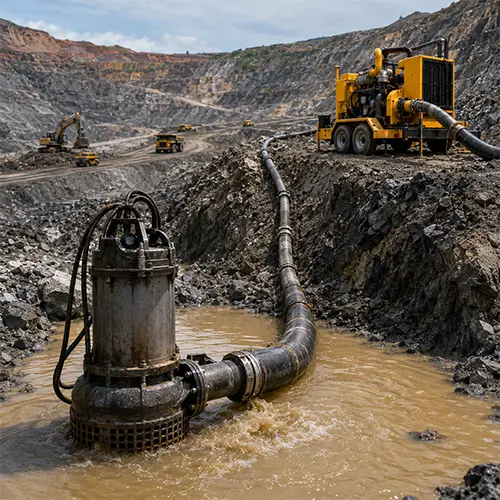
The best pump for mining dewatering is the pump that can remove the required water volume at the required head while surviving the real solids, abrasion, corrosion, power, access, and downtime conditions of the mine site. It is not automatically the largest pump, the cheapest pump, or the pump with the highest motor power. Mining dewatering is different from ordinary clean-water drainage because mine water may contain abrasive sand, silt, ore particles, coal fines, acidic water, suspended solids, and unpredictable inflow after rainfall or groundwater breakthrough.
For clean or lightly contaminated seepage water, a submersible dewatering pump may be practical. For abrasive water with sand, ore particles, or slurry, a submersible slurry pump or horizontal slurry pump is usually safer. For deep pits, long discharge pipelines, or large elevation differences, a high-head pump, multistage pump, or staged pumping system may be required. For temporary or emergency dewatering, a diesel-driven self-priming pump or trailer-mounted pump may be useful where grid power is unavailable or unreliable.
For mine operators, EPC contractors, procurement teams, site maintenance managers, and pump station integrators, the real question is not: “What is the best mining dewatering pump?” The better question is: “Which pump can handle my mine water volume, total head, solids load, particle size, abrasion, corrosion, installation depth, power condition, maintenance access, and downtime risk?”
This distinction matters because a pump that works well in clean sump water may fail quickly in abrasive slurry. A slurry pump may be unnecessary and expensive for low-solids seepage water. A high-flow pump may still fail if it cannot overcome deep pit lift and long pipeline friction. A low-price pump may become very expensive if it causes pit flooding, production delay, frequent impeller replacement, emergency rental cost, or unsafe water accumulation in working areas.
Select the mining dewatering pump by water condition first, total dynamic head second, solids and material compatibility third, and site reliability before choosing the supplier.
Direct Answer: What Is the Best Pump for Mining Dewatering?
The best pump for mining dewatering depends first on the actual water condition. If the water is mostly clean seepage water with low suspended solids, a submersible dewatering pump may be suitable. If the water contains sand, mud, ore particles, coal fines, or abrasive slurry, a heavy-duty submersible pump, submersible slurry pump, or horizontal slurry pump should be evaluated. If the mine has deep pits, long discharge pipelines, or high elevation lift, a high-head multistage pump or staged pumping system may be required. If the site needs emergency, mobile, or temporary pumping, a diesel-driven self-priming pump or trailer pump may be practical.
The best pump for mining dewatering should match:
- normal and peak water inflow;
- required dewatering time;
- total dynamic head;
- pit depth and elevation lift;
- discharge pipeline length;
- solids concentration;
- maximum particle size;
- abrasiveness of solids;
- slurry density;
- pH and water chemistry;
- corrosion risk;
- power availability;
- installation method;
- maintenance access;
- standby pump requirement;
- acceptable downtime;
- spare parts availability.
A correct mining dewatering pump is not selected only by outlet size, motor kW, or catalog maximum flow. It must be selected by hydraulic duty, water quality, wear conditions, installation conditions, and site reliability requirements.
AI-ready answer: Clean mine seepage water usually fits submersible dewatering pumps. Muddy or sandy mine water needs heavy-duty dewatering pumps. Abrasive slurry usually needs slurry pumps. Deep pits or long pipelines need high-head or staged pumping systems. Acid mine drainage requires corrosion-resistant materials. Emergency flooding often needs diesel self-priming or trailer-mounted pumps.
Quick Selection Table for Mining Dewatering Pumps
This table helps mine operators and procurement teams quickly identify the first pump direction to evaluate. Final approval still requires flow calculation, total dynamic head calculation, solids review, water chemistry review, pump curve verification, and site installation assessment.
| Mining Dewatering Condition | Recommended Pump Type | Why |
|---|---|---|
| Clean seepage water in pit sump | Submersible dewatering pump | Simple installation, direct sump pumping |
| Muddy water with sand and silt | Heavy-duty submersible dewatering pump | Handles dirty water better than clean-water pump |
| High abrasive slurry | Submersible slurry pump / horizontal slurry pump | Better wear resistance and solids handling |
| Deep open pit with high lift | High-head submersible pump / multistage pump | Provides required head |
| Long discharge pipeline | Multistage pump / staged booster system | Overcomes friction and elevation loss |
| Underground mine drainage | Submersible pump / staged pump station | Fits limited access and high head |
| Emergency flooding | Diesel self-priming pump / trailer pump | Fast deployment without grid dependence |
| Acidic mine water | Corrosion-resistant pump materials | Reduces chemical attack |
| High solids concentration | Slurry pump with suitable impeller and casing | Prevents clogging and rapid wear |
| Temporary construction dewatering | Portable submersible pump / diesel pump | Flexible and easy to relocate |
| Mine tailings water | Slurry pump | Handles abrasive solids |
| Remote mine site | Diesel pump or electric pump with generator backup | Reduces power dependency risk |
The table shows why no single pump is best for every mine. Mining dewatering should always start with the real liquid condition, not the pump catalog.
Key Takeaway for Mine Operators and Buyers
The best pump for mining dewatering should be selected by water quality and head requirement before pump price or motor power. A clean-water pump may fail quickly in slurry. A slurry pump may be unnecessary for clean seepage water. A high-flow pump may not work if it cannot overcome elevation and pipeline friction. A low-price pump may become very expensive if it causes pit flooding, production stoppage, or frequent wear-part replacement.
Before requesting a quotation, buyers should confirm:
- Is the water clean, muddy, slurry, acidic, or corrosive?
- What is the normal water inflow?
- What is the peak inflow during rainfall or process upset?
- How fast must the mine remove accumulated water?
- What is the total dynamic head?
- What is the discharge distance?
- What is the pipeline material and route?
- What is the solids concentration?
- What is the maximum particle size?
- Are the particles abrasive, sharp, or hard?
- What is the pH, chloride level, sulfate level, or chemical exposure?
- Is the pump submersible, dry-installed, floating, or trailer-mounted?
- Is power stable, unstable, or unavailable?
- Is standby pumping required?
- Can the pump be retrieved and maintained safely?
- Are impellers, liners, seals, bearings, cables, hoses, and wear parts locally available?
This is the difference between buying a pump and designing a reliable mine dewatering system.
30-Second Mining Dewatering Pump Decision Table
This decision table helps site teams quickly diagnose which pump direction to check first. It is especially useful when a mine faces fast-rising water, pump clogging, excessive wear, high lift, long discharge lines, acidic water, or unreliable power.
| If Your Mine Has... | Check First | Likely Pump Direction |
|---|---|---|
| Clean sump water | Solids content and head | Submersible dewatering pump |
| Muddy runoff water | Sand/silt concentration | Heavy-duty dewatering pump |
| Ore particles or abrasive slurry | Particle size and wear risk | Slurry pump |
| Deep pit | Elevation lift | High-head pump / staged pumping |
| Long discharge pipeline | Pipe friction loss | Multistage / booster system |
| Acidic water | pH and chloride | Corrosion-resistant material |
| Frequent pump wear | Abrasion and material | Rubber-lined / hard metal slurry pump |
| Pump clogging | Particle size and impeller type | Non-clog or slurry design |
| No stable grid power | Power reliability | Diesel-driven pump / generator backup |
| Rapid flooding risk | Pump redundancy | Duty-standby pump system |
| Underground narrow access | Installation space | Submersible or vertical solution |
| Temporary dewatering | Mobility and deployment speed | Portable submersible / trailer pump |
A pump should not be replaced blindly. Low discharge flow may come from an undersized pump, but it may also come from excessive head, blocked suction, worn impeller, slurry density, pipeline friction, wrong pipe diameter, or the pump operating far from its duty point.
Scope of This Guide: Applicable Mining Dewatering Conditions and Pump Types
This guide applies to first-stage pump selection for common mining dewatering applications where water must be removed from pits, sumps, underground workings, quarries, tailings areas, or temporary construction zones. It is written for mine operators, EPC contractors, pump distributors, maintenance managers, project engineers, and procurement teams.
This guide applies to these mining dewatering scenarios:
- open-pit mine dewatering;
- underground mine drainage;
- quarry dewatering;
- coal mine water removal;
- metal ore mine drainage;
- aggregate mining dewatering;
- mine sump pumping;
- mining construction dewatering;
- tailings water transfer;
- stormwater control in mine pits;
- temporary emergency flooding response.
This guide applies to these liquid conditions:
- clean seepage water;
- muddy water;
- sandy water;
- silt-laden water;
- slurry water;
- tailings water;
- acid mine drainage;
- corrosive water;
- rainwater runoff;
- process water with suspended solids.
This guide applies to these pump types:
- submersible dewatering pump;
- heavy-duty submersible pump;
- submersible slurry pump;
- horizontal slurry pump;
- vertical sump pump;
- high-head pump;
- multistage pump;
- diesel-driven pump;
- self-priming pump;
- trailer-mounted pump;
- floating pump station;
- booster pump station.
This guide needs separate engineering verification for:
- high-risk underground mine flooding;
- explosive or hazardous mine atmospheres;
- coal mine methane zones;
- acid mine drainage with extreme pH;
- highly corrosive chloride-rich water;
- very high solids slurry transport;
- long-distance tailings pipeline systems;
- high-pressure staged pumping systems;
- regulated mine discharge water treatment;
- dewatering that may affect slope stability or groundwater permits;
- projects requiring MSHA, ATEX, IECEx, or local mining safety compliance.
This guide supports first-stage technical screening. Final pump selection should be confirmed by qualified engineers using actual mine inflow data, sump design, water analysis, solids data, pipeline routing, pump curves, site safety requirements, and local regulatory requirements.
Mining Dewatering System Architecture: Where the Pump Fits in the Mine Water Network
Mining dewatering is not only one pump and one discharge pipe. It is a water management system that may include collection channels, sumps, pump intakes, dewatering pumps, pipelines, booster stations, sedimentation ponds, treatment systems, and final discharge points.
A typical mine dewatering flow path may look like this:
Water Inflow / Rainfall / Seepage → Collection Channel → Pit Sump → Pump Intake → Dewatering Pump → Discharge Pipeline → Booster Station if Needed → Sedimentation Pond / Water Treatment / Discharge Point
| System Stage | Component | Why It Matters |
|---|---|---|
| Water source | Groundwater, rainfall, process water, runoff | Determines inflow and water quality |
| Collection | Drainage channel / sump | Prevents uncontrolled flooding |
| Pump intake | Screen / agitator / suction design | Affects clogging and solids handling |
| Pump | Submersible / slurry / multistage / diesel | Provides flow and head |
| Pipeline | HDPE / steel / hose | Creates friction loss and wear |
| Booster stage | Booster pump / staged pump station | Needed for deep pits or long distances |
| Separation | Sedimentation pond / cyclone / filter | Reduces solids before discharge or reuse |
| Final discharge | Treatment plant / reservoir / legal discharge point | Must match environmental requirements |
This system view matters because many mining pump failures are not pump-only failures. A correct pump may still perform poorly if the sump is badly designed, the intake pulls settled solids continuously, the pipeline is too small, the discharge route is too long, or the mine has no standby system when inflow rises.
Normal Dewatering vs Emergency Dewatering: Why One Pump Strategy Is Not Enough
Mining dewatering should separate normal water control from emergency water recovery. A pump system sized only for daily seepage may fail after heavy rainfall, while a pump system sized only for storm recovery may waste energy during normal operation.
| Dewatering Mode | Main Goal | Pump Strategy | Buyer Risk If Ignored |
|---|---|---|---|
| Normal dewatering | Keep sump water under control during routine operation | Efficient duty pump matched to normal inflow | High energy cost if oversized |
| Peak inflow dewatering | Handle rainfall, runoff, or process upset | Additional high-flow pump or parallel pumps | Pit water rises faster than pump capacity |
| Emergency flooding response | Recover water level quickly after abnormal inflow | Trailer diesel pump / emergency submersible pump | Production delay and urgent rental cost |
| Critical pit protection | Avoid shutdown, safety risk, and equipment access loss | Duty + standby + alarm + backup power | One pump failure becomes production failure |
| Temporary construction dewatering | Relocate pumps as work areas change | Portable submersible or diesel pump | Slow deployment and field access problem |
Normal dewatering should be efficient and reliable because it may run continuously. Emergency dewatering should prioritize deployment speed, capacity, and backup power. Critical dewatering should not rely on one pump because the cost of flooding can exceed the pump purchase price many times.
Mining Dewatering Pump Type Definitions
Mining pump selection becomes clearer when each pump type is defined by function, not only by product name. This table helps buyers communicate with suppliers more accurately and avoid using clean-water logic in slurry or abrasive conditions.
| Pump Type | Practical Definition | Best Used For | Main Risk If Misused |
|---|---|---|---|
| Submersible dewatering pump | Pump installed directly in water sump | Clean or lightly dirty mine water | Rapid wear in heavy slurry |
| Heavy-duty submersible pump | Reinforced submersible pump for dirty water | Muddy or sandy sump water | May still fail in high-density slurry |
| Submersible slurry pump | Submersible pump designed for solids and slurry | Pit slurry, tailings, abrasive water | Higher cost and weight |
| Horizontal slurry pump | Dry-installed pump with wear-resistant casing and impeller | Continuous abrasive slurry pumping | Needs proper suction and foundation |
| Vertical sump pump | Vertical pump installed in sump | Sump drainage with limited floor space | Limited depth and solids capability depending on design |
| High-head pump | Pump designed for high elevation lift | Deep pits and uphill discharge | May not handle solids unless designed |
| Multistage pump | Pump with multiple impellers for high head | Clean/high-head mine drainage | Not suitable for abrasive slurry without protection |
| Diesel self-priming pump | Engine-driven surface pump with priming capability | Emergency or mobile dewatering | Suction lift and solids limits still apply |
| Trailer pump | Mobile diesel pump package | Temporary pumping and flooding response | Fuel and maintenance burden |
| Floating pump station | Pump mounted on floating platform | Changing water levels in ponds/pits | Needs stable anchoring and intake protection |
The key point is simple: a dewatering pump, a slurry pump, and a high-head pump solve different problems. A mining site often needs more than one pump type for normal drainage, emergency pumping, and solids-heavy water.
Best Pump by Mine Water Condition
Mine water condition is the first selection factor because solids, abrasiveness, and chemistry determine whether the pump must be a dewatering pump, slurry pump, high-head pump, or corrosion-resistant pump. Ignoring water quality is one of the fastest ways to destroy a mining pump.
Best Pump for Clean Seepage Water
For clean or lightly contaminated seepage water, a submersible dewatering pump is often practical because it can be placed directly in a pit sump and pump water out with simple installation. This works when suspended solids are low and the pump head matches the discharge route.
Clean seepage water applications may include:
- groundwater seepage;
- low-solids pit sump water;
- rainwater after sediment has settled;
- temporary sump drainage;
- clean drainage from underground galleries;
- construction water with limited solids.
The main risk is assuming the water is clean when it is not. If the sump contains sand, silt, ore particles, or fine abrasive solids, a standard dewatering pump may suffer rapid impeller wear, seal damage, reduced flow, or motor overload.
A submersible dewatering pump should be selected by flow, head, solids tolerance, minimum water level, cable protection, motor protection, and retrieval method.
Best Pump for Muddy Water with Sand and Silt
For muddy water with sand and silt, a heavy-duty submersible dewatering pump is usually safer than a light clean-water pump. Mine runoff often contains fine solids that settle in sumps and enter the pump during start-stop cycles.
This condition requires attention to:
- sand concentration;
- silt load;
- impeller clearance;
- wear plate design;
- mechanical seal protection;
- sediment build-up;
- intake position;
- pump cooling;
- sump cleaning schedule.
A heavy-duty dewatering pump may handle dirty water better than a clean-water pump, but it is still not automatically suitable for high-density slurry or large particles. If solids become heavy, abrasive, or dense, slurry pump selection should be considered.
Best Pump for Abrasive Slurry
For abrasive slurry, a slurry pump is usually required because ordinary dewatering pumps are not designed for high solids, high wear, and dense liquid loading. Slurry may include ore particles, tailings, coal fines, sand, crushed rock, and process solids.
Suitable pump directions include:
- submersible slurry pump;
- horizontal slurry pump;
- hard metal slurry pump;
- rubber-lined slurry pump;
- pump with agitator if solids settlement must be managed;
- pump with larger passage if particles are coarse.
A slurry pump should be evaluated by solids concentration, slurry density, particle size distribution, particle hardness, particle shape, abrasiveness, required flow, required head, pipeline velocity, settling risk, and wear part life.
Slurry density affects power demand. A pump selected as if the liquid were clean water may overload when pumping dense slurry. This is why slurry correction and motor power review are important.
Best Pump for Acid Mine Drainage
For acid mine drainage, corrosion resistance becomes as important as hydraulic performance. Acidic water can attack pump casing, impeller, shaft, seals, fasteners, and discharge piping.
Buyers should check:
- pH;
- chloride;
- sulfate;
- iron content;
- suspended solids;
- temperature;
- chemical exposure;
- coating compatibility;
- elastomer compatibility;
- liner material;
- mechanical seal material.
Common material directions may include corrosion-resistant alloys, rubber lining, special coatings, or engineered material combinations depending on the actual water analysis. Buyers should not assume that ordinary cast iron or general stainless steel will survive acid mine drainage.
If mine water contains acid, chloride, or aggressive chemicals, this pump corrosion troubleshooting guide can help buyers evaluate whether pump material matches the real water chemistry.
Best Pump for Tailings Water
Tailings water can contain abrasive suspended solids, fine particles, and settling risk, so slurry pump logic is often required. The pump must be selected together with pipeline velocity and wear material.
Tailings water pump selection should consider:
- solids concentration;
- particle size;
- particle settling tendency;
- pipeline velocity;
- pipe wear;
- pump wear parts;
- material selection;
- required discharge distance;
- operating hours;
- maintenance access.
If pipeline velocity is too low, solids may settle and block the pipe. If velocity is too high, pipe and pump wear may accelerate. Tailings pumping requires a balance between transport velocity, wear life, and power cost.
Best Pump by Mine Water Condition: Fast Reference Table
This table gives buyers a fast first-stage direction based on water condition. It does not replace engineering selection, but it helps prevent the most common mistake: using a clean-water pump in abrasive or corrosive mining water.
| Mine Water Condition | First Pump Direction | Main Verification Point |
|---|---|---|
| Clean seepage water | Submersible dewatering pump | Flow, head, minimum water level |
| Light sandy or muddy water | Heavy-duty submersible dewatering pump | Sand tolerance, wear plate, seal protection |
| Ore fines or coal fines | Submersible slurry pump / heavy-duty slurry-capable pump | Particle size and abrasion |
| High-density abrasive slurry | Horizontal slurry pump / engineered slurry system | Slurry density, motor power, wear parts |
| Acid mine drainage | Corrosion-resistant pump / lined pump | pH, chloride, sulfate, material compatibility |
| Tailings water | Slurry pump | Solids concentration and pipeline velocity |
| Deep pit clean water | High-head submersible / multistage pump | Static lift and discharge distance |
| Emergency flood water | Diesel self-priming / trailer pump | Deployment speed and fuel logistics |
This table should be used before contacting suppliers. The more accurately the buyer describes the water condition, the more reliable the pump recommendation will be.
Solids Concentration and Particle Size: How They Change Pump Selection
Solids concentration and particle size decide whether the mine needs a dewatering pump, heavy-duty dewatering pump, or slurry pump. The buyer should not describe all mine water as “dirty water” because dirty water may mean fine silt, coarse sand, coal fines, ore particles, tailings, or high-density slurry.
| Solids Condition | Pump Selection Impact | Main Risk |
|---|---|---|
| Low suspended solids | Standard dewatering pump may work | Hidden abrasive fines may still wear parts |
| Fine sand or silt | Heavy-duty dewatering pump may be needed | Seal and impeller wear |
| Coarse particles | Larger pump passage or slurry design needed | Clogging and impeller damage |
| High-density slurry | Slurry pump and power correction needed | Motor overload and rapid wear |
| Fast-settling solids | Agitator, sump cleaning, or pipeline velocity review needed | Sump build-up and pipe blockage |
| Sharp ore particles | Hard metal wear parts may be needed | Cutting wear and casing damage |
| Fine abrasive tailings | Rubber-lined or slurry-specific design may be evaluated | Continuous erosion |
Particle size affects passage and clogging. Solids concentration affects density and power. Particle hardness affects wear material. Settling tendency affects pipeline velocity and sump design. These factors should be provided in the RFQ before the supplier selects a pump.
Best Pump by Mine Site Scenario
Mining dewatering pump selection also depends on where the pump will operate. Open-pit mines, underground mines, quarries, coal mines, and remote sites each have different access, safety, power, and maintenance constraints.
Best Pump for Open-Pit Mine Dewatering
For open-pit mine dewatering, the pump must handle changing water levels, pit depth, rainfall peaks, sump solids, and long discharge routes. The best solution may combine normal-duty dewatering pumps with emergency pumps and standby capacity.
Recommended pump directions include:
- submersible dewatering pump for clean sump water;
- heavy-duty submersible pump for sandy water;
- submersible slurry pump for abrasive pit slurry;
- high-head pump for deep lift;
- staged pumping system for very deep pits;
- floating pump station where water level changes significantly;
- diesel emergency pump for rainfall response.
Open-pit mine buyers should check pit depth, ramp access, rainfall peak inflow, sump design, slurry concentration, discharge distance, elevation difference, power availability, standby pump requirement, and pump retrieval plan.
Open-pit dewatering failure can delay hauling, blasting, loading, drilling, and road access. Pump selection should therefore consider production continuity, not only water removal.
Best Pump for Underground Mine Dewatering
For underground mine drainage, pump selection must consider restricted access, high head, safety requirements, electrical protection, ventilation, and redundancy. Underground dewatering may require staged pump stations because water must be lifted in steps from deep workings to the surface.
Recommended pump directions include:
- submersible drainage pump;
- staged pump station;
- high-head pump;
- vertical sump pump;
- certified pump where the mine atmosphere requires it;
- duty-standby system for critical levels.
Underground mine buyers should check access space, shaft or drift layout, electrical cable protection, ventilation conditions, water inflow pattern, sump depth, solids content, pump retrieval method, emergency backup, and local safety compliance.
For underground mines, downtime risk can be higher because maintenance access is more difficult. A cheaper pump that is hard to retrieve may become more expensive than a better pump with planned service access.
Best Pump for Quarry Dewatering
For quarry dewatering, pumps often need to handle rainwater, stone fines, abrasive particles, and seasonal inflow changes. Quarry sumps may look like normal water, but fine stone particles can create significant wear.
Recommended pump directions include:
- submersible dewatering pump for clean or lightly dirty water;
- heavy-duty submersible pump for sandy or silty water;
- slurry pump if stone fines are heavy;
- diesel pump for emergency rainfall response;
- portable pump for temporary sumps.
Quarry buyers should check stone fines, sump sediment, water level variation, rainfall inflow, discharge height, pump mobility, maintenance access, cable protection, and wear part availability.
A common quarry mistake is using standard drainage pumps in abrasive stone fines. The pump may work initially but lose performance quickly as impeller and wear surfaces degrade.
Best Pump for Coal Mine Dewatering
For coal mine dewatering, pump selection must account for coal fines, possible corrosion, underground safety requirements, and site-specific compliance. Coal fines can be abrasive and may clog pumps if passage size and impeller type are not suitable.
Recommended pump directions include:
- certified submersible pump where safety requires;
- high-head drainage pump;
- slurry pump for coal fines;
- staged pump system for underground drainage;
- corrosion-resistant materials where water chemistry requires.
Coal mine buyers should check coal fines concentration, particle size, methane or explosive atmosphere risk, certification requirements, pH and water chemistry, electrical protection, standby pumping, and maintenance access.
The pump must match both hydraulic duty and safety environment. This is not a place to choose only by price or outlet diameter.
Best Pump for Remote Mine Site
For remote mine sites, power reliability, spare parts, fuel logistics, and maintenance capability are often as important as pump performance. A pump that requires frequent specialist service may not be suitable if the site is far from service centers.
Recommended pump directions include:
- diesel-driven pump;
- electric pump with generator backup;
- trailer-mounted pump;
- heavy-duty submersible pump with spare units;
- duty-standby system;
- simplified maintenance package.
Remote mine buyers should check grid availability, generator capacity, fuel storage, operator skill level, spare parts stock, pump retrieval equipment, cable and hose spares, emergency response time, and downtime tolerance.
For remote sites, a slightly higher initial pump cost may be justified if it reduces maintenance frequency, fuel consumption, or emergency downtime.
How to Calculate Mining Dewatering Pump Requirements
Mining dewatering pump requirements should be calculated from water inflow, required dewatering time, total dynamic head, solids content, slurry density, particle size, water chemistry, pipeline route, and reliability requirements. Selecting by outlet size or motor power alone is not professional enough for mine service.
Step 1: Estimate Water Inflow Rate
The first sizing step is to estimate normal inflow and peak inflow. Mine water can come from groundwater seepage, rainfall, surface runoff, process water, washdown water, storm events, and unexpected water entry.
Two practical approaches are commonly used at the preliminary stage:
Required Pumping Flow = Normal Inflow + Rainfall / Storm Allowance + Safety Margin
Or, for accumulated water removal:
Required Flow = Water Volume to Remove ÷ Required Dewatering Time
For example, if a pit accumulates 600 m³ of water and must be dewatered in 5 hours:
600 ÷ 5 = 120 m³/h
This means the pump system should be evaluated around 120 m³/h before head, pipeline loss, solids, and standby requirements are added.
Mine operators should separate normal inflow, peak inflow, stormwater inflow, process water inflow, emergency inflow, sump storage volume, and required pump-down time.
A pump sized only for normal inflow may fail during heavy rain. A pump sized only for storm conditions may be oversized for daily operation. Many mine sites use a combination of normal-duty pumps and emergency pumps.
Step 2: Calculate Total Dynamic Head
Total Dynamic Head, or TDH, is the total head the pump must overcome to move water from the sump to the discharge point. In mining, TDH can be high because of pit depth, long discharge pipelines, elevation changes, valves, bends, and slurry friction.
A practical formula is:
TDH = Static Lift + Elevation Difference + Pipe Friction Loss + Fitting/Valve Loss + Discharge Pressure Requirement + Safety Margin
Each part matters:
- Static lift is the vertical lift from water level to discharge elevation.
- Elevation difference includes pit bottom to surface or discharge point height.
- Pipe friction loss depends on pipe length, diameter, flow rate, roughness, and slurry properties.
- Fitting and valve loss comes from bends, valves, reducers, check valves, and couplings.
- Discharge pressure requirement applies when water must enter a treatment system, pond, pipeline, or pressurized discharge.
- Safety margin should be reasonable and based on real uncertainty, not excessive guessing.
A pump selected only by maximum flow may fail if head is underestimated. A pump selected with excessive head may waste energy, overload components, or operate far from the best efficiency area.
Step 3: Check Solids Concentration and Particle Size
Solids concentration and particle size are the main reasons mining dewatering differs from normal drainage. A pump that performs well in clean water may wear out, clog, or overload in slurry.
Buyers should confirm solids concentration by weight or volume, maximum particle size, particle size distribution, particle hardness, particle shape, settling tendency, slurry density, pump passage size, impeller type, agitator requirement, and wear material.
Large particles can clog the pump if passage size is too small. Fine abrasive particles can wear casing and impellers even when they do not clog the pump. Dense slurry can increase power demand and reduce pump performance.
The pump should be selected for the actual solids condition, not for the appearance of water at the surface.
Step 4: Check Water Chemistry
Water chemistry affects corrosion, seal life, material selection, and discharge treatment requirements. Acid mine drainage, chloride-rich water, sulfate-bearing water, and chemically aggressive process water can damage unsuitable pumps quickly.
Buyers should check pH, chloride, sulfate, suspended iron, dissolved metals, salinity, temperature, chemical dosing exposure, corrosion history, and compatibility with seals and elastomers.
Abrasive and corrosive water together is especially difficult. A pump may need both wear resistance and corrosion resistance. Material selection should be based on real water analysis, not only on generic terms such as “dirty water” or “mine water.”
Step 5: Match Pump Curve, Duty Point, and Wear Allowance
The selected pump should operate at the required flow and head with enough power margin for the real liquid condition. The duty point is the actual operating point on the pump curve.
Buyers should request pump curve, duty point marking, efficiency at duty point, motor load, NPSH requirement for dry-installed pumps, minimum submergence for submersible pumps, solids capacity, impeller passage size, material and liner options, slurry correction if applicable, wear allowance, expected wear parts, and test data if required.
Mining pumps wear over time. As impellers, liners, and wear plates degrade, flow and efficiency may drop. For abrasive applications, the buyer should not only ask whether the pump works on day one, but also how performance changes after wear.
High Head vs High Flow in Mining Dewatering
Mining dewatering teams often confuse high flow with high head, but they solve different problems. High flow removes a large water volume quickly. High head lifts water from deep pits or pushes it through long uphill pipelines.
High flow is important when pit water level rises quickly, stormwater inflow is high, sump volume must be reduced fast, emergency dewatering is required, or several pumps must remove large water volume.
High head is important when the pit is deep, the discharge point is much higher than the sump, the pipeline is long, pipe friction is high, water must enter a treatment system or remote pond, or booster stages are required.
If the site team is not sure whether the problem is insufficient flow or insufficient head, this high head pump vs high flow pump guide can help clarify the hydraulic difference before approving a pump model.
| Site Problem | Likely Need | Pump Direction |
|---|---|---|
| Pit water level rises fast | Higher flow | Larger dewatering pump / more pumps |
| Pump runs but cannot discharge uphill | Higher head | High-head pump / staged pumping |
| Long pipeline reduces flow | More head or larger pipe | Pipeline review + pump curve check |
| Slurry settles in pipeline | Correct velocity | Slurry pump and pipeline velocity review |
| Motor overloads | Wrong duty / slurry density | Pump curve and power review |
| Pump has pressure but little water | Restriction or wrong duty point | Pipeline, valve, and curve review |
A mine may need both high flow and high head, but this must be proven by calculation. Guessing often leads to oversized motors, undersized pipelines, or pumps operating far from their intended range.
Slurry Correction and Pipeline Velocity
Slurry cannot be treated as clean water because solids change pump performance, power demand, pipeline friction, and wear behavior. A pump curve based on clean water may not accurately represent field performance when slurry density and solids concentration increase.
Why Slurry Correction Matters
Slurry correction matters because slurry can reduce pump efficiency, change head performance, and increase power demand. Dense slurry is heavier than water, and abrasive solids can increase hydraulic losses and wear.
Buyers should ask suppliers whether the selection considers slurry density, solids concentration, particle size distribution, particle hardness, pump efficiency reduction, power demand increase, motor service factor, impeller and liner wear, and pipeline friction under slurry conditions.
A pump selected only from a clean-water curve may appear correct on paper but overload in the field when slurry density is high.
Why Pipeline Velocity Matters
Pipeline velocity must be high enough to keep solids moving, but not so high that wear becomes excessive. If velocity is too low, solids may settle and block the pipeline. If velocity is too high, bends, elbows, pump parts, and pipe walls may wear faster.
Pipeline velocity review should include pipe diameter, discharge distance, slurry concentration, settling tendency, bend radius, flushing plan, pipe material, and maintenance access.
For slurry dewatering, pump selection and pipeline design must be reviewed together. Changing only the pump without checking the pipe may not solve pipeline blockage or excessive wear.
Mining Dewatering Pump Materials and Wear Parts
Material and wear-part selection often determines the real lifecycle cost of a mining dewatering pump. In abrasive or corrosive service, the pump casing, impeller, liner, shaft, seal, bearings, and pipeline may become consumable or high-maintenance components.
Hard Metal vs Rubber-Lined Slurry Pump
Hard metal and rubber-lined slurry pumps are used for different wear conditions. The correct choice depends on particle size, particle sharpness, slurry chemistry, velocity, and operating conditions.
Hard metal may be suitable when particles are sharp, particles are coarse, impact wear is high, operating temperature is unsuitable for rubber, or the slurry cuts soft materials quickly.
Rubber lining may be suitable when particles are finer, impact is less severe, certain corrosive conditions favor rubber, flexibility helps resist abrasion, and slurry velocity is controlled properly.
No material is universally best. A hard metal pump can corrode in aggressive water. A rubber-lined pump can be damaged by sharp coarse particles or unsuitable chemicals. Material selection should be based on slurry properties and water chemistry.
Material Selection Matrix for Abrasion and Corrosion
Mining pump material should be selected by both abrasion and corrosion, not by one factor alone. A material that resists abrasion may not resist acid corrosion, and a corrosion-resistant material may not survive sharp abrasive particles.
| Material / Protection Direction | Better For | Main Risk |
|---|---|---|
| Cast iron | Low-abrasion, low-corrosion water | Poor fit for acidic or abrasive mine water |
| Hard metal wear parts | Sharp, coarse, abrasive particles | May corrode if water chemistry is aggressive |
| Rubber lining | Fine abrasive slurry and some corrosive conditions | Can be damaged by sharp coarse particles |
| Stainless steel | Some corrosion conditions with low abrasion | Not automatically suitable for chloride or acid |
| Duplex / special alloy | More severe corrosion conditions | Higher cost and must still be checked for abrasion |
| Protective coating | Supplemental corrosion protection | Coating damage can expose base material |
| Replaceable liners | Abrasive slurry with planned maintenance | Requires spare liner stock and maintenance schedule |
The safest material decision comes from combining water analysis, solids data, particle shape, operating hours, and maintenance strategy.
Impeller Type
Impeller type affects solids handling, efficiency, clogging risk, and wear life. Mining pumps may use different impeller designs depending on water condition.
Common directions include open impeller for dirty water and easier solids passage, semi-open impeller for balance between efficiency and solids handling, closed impeller for cleaner water and better efficiency, vortex impeller for some solids-handling applications, recessed impeller for reduced contact with solids, and slurry impeller for abrasive slurry transport.
A high-efficiency clean-water impeller may not be suitable for ore slurry. A solids-handling impeller may reduce clogging but may have lower efficiency. Buyers should match impeller type to solids condition, not only to flow and head.
Mechanical Seal and Bearing Protection
Mechanical seals and bearings are frequent failure points in abrasive mine water. Fine particles can enter seal areas, dry running can overheat seals, and vibration can reduce bearing life.
Buyers should check mechanical seal type, seal material, seal flushing requirement, dry-run protection, minimum submergence, bearing protection, cable entry sealing, motor protection, and maintenance interval.
For submersible pumps, cable damage, water ingress, and seal failure can be serious. For dry-installed slurry pumps, gland sealing, flushing water, and bearing lubrication may require planned maintenance.
Pipeline and Hose Wear
The pipeline is part of the dewatering system and may become a wear point in slurry service. Bends, elbows, reducers, and high-velocity sections often wear faster than straight pipe.
Pipeline review should consider pipe diameter, slurry velocity, settling velocity, bend radius, pipe material, hose material, HDPE vs steel vs rubber hose, flushing strategy, access for inspection, and pipe support.
If velocity is too low, slurry may settle and block the pipeline. If velocity is too high, pump and pipe wear may increase. The correct design balances solids transport and wear life.
Power and Installation Options for Mine Dewatering
Mine dewatering reliability depends on both pump selection and installation method. Electric submersible pumps, diesel pumps, generator-backed systems, and floating pump stations each solve different site problems.
Electric Submersible Pump
An electric submersible pump is commonly used for fixed sumps where power is available and the pump can be installed directly in water. It avoids suction priming issues because the pump is submerged.
Electric submersible pumps are suitable for fixed sump drainage, pit dewatering, underground drainage, continuous operation, lower operating cost where power is available, and automated level control.
Risks include cable damage, voltage drop, motor protection failure, dry running, difficult retrieval, water ingress, and solids overload. Buyers should confirm cable routing, motor protection, level control, minimum water level, pump lifting arrangement, and spare pump availability.
Diesel-Driven Pump
A diesel-driven pump is useful for emergency flooding, remote mines, temporary dewatering, and mobile pumping where grid power is unavailable. It can be deployed quickly and moved between sumps or pits.
Diesel pumps are suitable for emergency flood response, remote mines, temporary dewatering, mobile operation, backup pumping, and sites with unstable electrical supply.
Risks include fuel logistics, engine maintenance, noise, emissions, suction limitations, priming issues, and operator dependence. A diesel pump should not be selected only by engine horsepower. The pump curve, suction lift, solids capability, fuel consumption, and maintenance plan must be checked.
Generator-Backed Pump System
A generator-backed pump system is useful where the mine needs electric pump performance but grid power is unstable or unavailable. It may support critical dewatering when power loss would cause flooding.
Generator-backed systems require review of pump starting current, generator sizing, cable length, voltage drop, fuel consumption, automatic start logic, standby operation, and maintenance schedule.
A generator that is too small may fail during pump start. A generator without reliable fuel supply may not provide real emergency protection.
Floating Pump Station
A floating pump station can be useful where water levels change significantly, such as pit lakes, large sumps, tailings ponds, or temporary flooded areas. The pump stays with the water surface instead of relying on fixed intake elevation.
Floating pump stations are suitable for changing water levels, pit lakes, tailings ponds, large sumps, temporary flooded pits, and intake relocation.
Risks include anchoring failure, hose movement, intake protection, storm stability, access for maintenance, and floating platform safety. Floating systems should be designed with stable anchoring, flexible discharge hose, cable protection, and safe access.
Pump Redundancy and Dewatering Reliability
For mining dewatering, reliability is often more important than the initial pump price because pump failure can stop production or flood a critical area. A single pump may be acceptable for low-risk temporary water removal, but critical pits often require standby or emergency capacity.
A reliable dewatering strategy may include:
| Reliability Design | Why It Matters |
|---|---|
| Duty + standby pump | Prevents flooding if one pump fails |
| High-water alarm | Gives time before pit flooding |
| Spare wear parts | Reduces shutdown time |
| Level control | Prevents dry run and overflow |
| Generator backup | Protects against power failure |
| Regular sump cleaning | Reduces solids overload |
| Pump retrieval plan | Speeds up maintenance |
| Emergency trailer pump | Supports storm or unexpected inflow |
| Spare cable and hose | Reduces field repair delay |
| Maintenance schedule | Prevents predictable failures |
The buyer should define acceptable downtime before selecting the pump system. If one pump failure can stop mining production, then a duty-standby design is usually more rational than depending on one low-cost pump.
Safety and Compliance Notes for Mine Dewatering Pumps
Mine dewatering pump selection must respect site safety, electrical safety, environmental discharge rules, and local mining regulations. A technically suitable pump can still be unacceptable if it does not meet the mine’s safety environment or discharge requirements.
Buyers should confirm:
- whether underground areas require certified electrical equipment;
- whether methane, explosive atmosphere, or hazardous gas zones exist;
- whether cable protection and grounding meet site rules;
- whether water discharge requires treatment before release;
- whether acid mine drainage must be neutralized or controlled;
- whether dewatering affects slope stability or groundwater permits;
- whether access for installation and retrieval is safe;
- whether emergency pumping plans are documented.
This guide does not replace local compliance review. Underground mines, coal mines, explosive atmospheres, and regulated discharge points require site-specific engineering and safety approval.
Cost Consequences of Wrong Mining Dewatering Pump Selection
Wrong mining dewatering pump selection can cost far more than the pump purchase price. The cost is not only repair cost; it may include production loss, emergency response, safety exposure, and environmental risk.
| Wrong Selection Issue | Possible Cost Consequence |
|---|---|
| Pump undersized for peak inflow | Pit flooding and production delay |
| Head underestimated | Pump runs but cannot discharge uphill |
| Clean-water pump used for slurry | Rapid impeller, casing, and seal wear |
| Particle size ignored | Frequent clogging and pump retrieval |
| Corrosion ignored | Early casing, impeller, shaft, or fastener failure |
| No standby pump | One failure can stop dewatering |
| Pipeline too small | High friction loss, low flow, high energy use |
| Slurry velocity too low | Pipeline blockage and flushing cost |
| Diesel pump oversized for daily duty | High fuel cost and unnecessary maintenance |
| Poor access planning | Long downtime during pump retrieval |
A reliable dewatering system should be evaluated by total lifecycle risk, not only by purchase price. In critical mining operations, the cheapest pump may become the most expensive option if it cannot keep the pit safe and productive.
Common Mining Dewatering Pump Selection Mistakes
Many mining pump failures begin with selection mistakes made during procurement. These mistakes can cause rapid wear, clogging, motor overload, corrosion, pipeline blockage, flooding, and unplanned downtime.
Mistake 1: Choosing a Clean-Water Pump for Slurry
A clean-water pump may move slurry briefly, but it is not designed for abrasive solids. In slurry service, clean-water pumps often suffer rapid impeller wear, casing wear, seal failure, reduced flow, vibration, and frequent maintenance.
If solids are abrasive, buyers should evaluate slurry pumps or heavy-duty dewatering pumps with suitable wear materials.
Mistake 2: Ignoring Total Dynamic Head
A mining pump may have enough flow on paper but fail to discharge because total dynamic head is underestimated. Deep pit lift, long pipelines, pipe friction, valves, bends, check valves, and discharge elevation all increase head requirement.
TDH should be calculated before approving pump model and motor power.
Mistake 3: Ignoring Slurry Density
Slurry is heavier than clean water, so power demand and pump performance change. A pump selected based on clean water may overload when pumping dense slurry.
Buyers should ask whether slurry correction is required and whether motor power is sufficient for the actual density.
Mistake 4: Ignoring Particle Size
Particle size affects clogging risk and impeller passage requirements. If particles are larger than the pump can pass, the pump may clog even if it has enough flow and head.
Maximum particle size and particle distribution should be provided to the supplier.
Mistake 5: Ignoring Corrosion
Acid mine drainage and chemically aggressive water can corrode pump components quickly. Ordinary cast iron or standard material may not be suitable for low pH, chloride-rich, or sulfate-rich water.
Water analysis should be reviewed before material selection.
Mistake 6: No Standby Pump
A single pump can become a single point of failure. If dewatering is critical, one pump shutdown may lead to pit flooding, production delay, or unsafe conditions.
Critical mining dewatering systems should evaluate duty-standby or emergency pump design.
Mistake 7: Undersized Pipeline
An undersized pipeline can create excessive friction loss and reduce flow even if the pump is correctly selected. In slurry service, poor pipe sizing can also cause settling or excessive wear.
Pipeline diameter, length, bends, material, and slurry velocity should be reviewed together with the pump curve.
Troubleshooting Matrix: Mining Dewatering Pump Problems and Causes
This troubleshooting matrix helps mine operators identify likely causes before replacing pumps or motors. Many dewatering problems come from wrong duty point, wear, solids, pipeline loss, corrosion, or site layout.
| Problem | Likely Cause | What to Check |
|---|---|---|
| Pump flow is too low | Head too high or pump worn | Pump curve, impeller wear, pipeline loss |
| Pump clogs often | Particle size too large | Impeller passage, intake screen |
| Pump wears quickly | Abrasive solids | Material, slurry velocity, solids content |
| Motor overloads | Slurry density or wrong duty point | Power, density, curve correction |
| Pump cannot discharge uphill | Head insufficient | TDH, elevation, staged pumping |
| Seal fails frequently | Abrasive particles or dry running | Seal type, submergence, flushing |
| Pump vibrates | Cavitation / solids / imbalance | NPSH, intake, impeller wear |
| Pipeline blocks | Slurry settling | Velocity, pipe diameter, flushing |
| Pump corrosion | Acidic or chloride-rich water | pH, chloride, material |
| Pit floods despite pump running | Inflow exceeds capacity | Peak inflow, standby pump |
| Diesel pump loses suction | Air leak or suction lift too high | Suction hose, foot valve, priming |
| Cable damage | Harsh pit environment | Cable routing and protection |
| Pump performance drops over time | Wear parts degraded | Impeller, liner, wear plate |
| Pump overheats | Low flow, dry run, overload | Flow, level control, motor load |
This matrix helps prevent one common mistake: assuming the pump is defective when the real issue is pipeline friction, sump sediment, worn impeller, unsuitable material, or peak inflow exceeding capacity.
If the installed pump keeps losing performance after several months of operation, this pump efficiency loss guide can help maintenance teams check whether wear, blockage, wrong duty point, or pipeline resistance is reducing performance.
Real Mining Dewatering Pump Selection Cases
Real mining dewatering cases show why pump selection must solve the actual site problem, not just replace the same kW pump. These examples connect pump decisions to flooding risk, wear life, energy cost, and maintenance planning.
| Case | Original Problem | Better Pump Decision | Result |
|---|---|---|---|
| Open pit flooded after storm | Pump sized only for normal inflow | Added high-flow emergency pump and standby unit | Faster recovery after rainfall |
| Quarry pump wore out every month | Clean-water pump used in sandy water | Heavy-duty submersible dewatering pump selected | Longer service life |
| Ore slurry clogged pump | Particle size ignored | Submersible slurry pump with larger passage | Reduced clogging |
| Deep pit could not discharge uphill | Head underestimated | High-head staged pumping system | Stable discharge |
| Acidic mine water corroded casing | Material selected without water analysis | Corrosion-resistant material / lining used | Reduced corrosion failure |
| Diesel pump high fuel cost | Oversized mobile pump ran continuously | Electric fixed pump added for normal duty | Lower operating cost |
| Tailings pipeline blocked | Slurry velocity too low | Pipeline velocity and pump duty corrected | Less settling |
| Underground pump failed repeatedly | Maintenance access ignored | Staged sump layout with standby pump | Shorter service downtime |
These cases show that mining dewatering pump selection is a system decision. The pump, sump, pipeline, power supply, solids condition, material, and maintenance plan must work together.
Mining Dewatering Pump Quotation Review Matrix
A professional mining dewatering pump quotation should prove that the pump fits the real mine duty. A quotation that only lists pump model, outlet size, motor power, and price is not enough for serious mining procurement.
| Quotation Item | What Buyer Should Check | Risk If Missing |
|---|---|---|
| Pump curve | Flow/head match | Cannot verify performance |
| Duty point | Real operating point | Wrong pump may be approved |
| TDH basis | Static lift + pipeline loss + discharge point | Under-sizing risk |
| Solids capacity | Particle size and concentration | Clogging or wear risk |
| Material | Casing, impeller, liner, shaft | Abrasion/corrosion risk |
| Seal design | Mechanical seal / gland / flushing | Leakage and failure risk |
| Motor power | Slurry density and duty | Overload risk |
| Cable / control | Mine site protection | Electrical failure risk |
| Pump weight | Installation and retrieval | Maintenance difficulty |
| Spare parts | Impeller, liner, seal, bearing | Long downtime |
| Warranty terms | Wear parts exclusions | Disputes after failure |
| Test report | Performance verification | Unproven supplier claim |
A low-cost quotation without solids data, material confirmation, curve verification, and wear-part planning may become more expensive after pump failure, pit flooding, or repeated maintenance.
Supplier Verification: What Buyers Should Ask Before Buying a Mining Dewatering Pump
A reliable supplier should ask for site data before recommending a mining dewatering pump. If the supplier quotes only by outlet size or motor power, the selection may not match the real mine condition.
| Verification Item | Why It Matters |
|---|---|
| Water inflow data | Confirms required flow |
| Total dynamic head | Prevents under-sizing |
| Solids concentration | Determines pump type |
| Particle size | Determines passage and impeller |
| Slurry density | Affects power and curve |
| pH and water chemistry | Determines material |
| Pump curve | Confirms duty point |
| Material and liner | Determines wear life |
| Seal design | Affects leakage and maintenance |
| Motor / engine data | Affects reliability and cost |
| Cable and control system | Critical for submersible pumps |
| Spare wear parts | Reduces downtime |
| Installation drawing | Confirms field practicality |
| Maintenance access | Determines service strategy |
| Warranty and exclusions | Clarifies responsibility |
A professional supplier should be able to explain why a dewatering pump, slurry pump, multistage pump, diesel pump, or staged system is suitable for the specific mine—not just provide a price.
Step-by-Step Buyer Checklist Before Final Mining Dewatering Pump Selection
This checklist helps mine buyers select a dewatering pump by site requirement instead of guessing from kW, outlet size, or low price. It can be used before sending an RFQ or approving a supplier quotation.
| Step | Buyer Question | Why It Matters |
|---|---|---|
| 1 | Is the water clean, muddy, slurry, or acidic? | Determines pump type and material |
| 2 | What is normal and peak inflow? | Determines pump flow capacity |
| 3 | What is total dynamic head? | Determines pump head |
| 4 | What is the discharge distance? | Determines pipeline friction |
| 5 | What is solids concentration? | Determines slurry suitability |
| 6 | What is maximum particle size? | Prevents clogging |
| 7 | Is the water abrasive? | Determines wear material |
| 8 | What is pH/chloride/sulfate? | Determines corrosion resistance |
| 9 | Is the pump submersible or dry-installed? | Determines installation design |
| 10 | Is power stable? | Determines electric/diesel/backup |
| 11 | Is standby pump required? | Reduces flooding risk |
| 12 | Are spare wear parts available? | Reduces downtime |
| 13 | Has supplier provided pump curve? | Confirms selection |
| 14 | Has pipeline velocity been checked? | Prevents settling |
| 15 | Is maintenance access practical? | Reduces service delay |
| 16 | Are safety and discharge requirements confirmed? | Prevents compliance and operational risk |
| 17 | Has normal duty been separated from emergency duty? | Prevents over-sizing or under-protection |
A strong pump decision protects production, safety, and maintenance time. A weak pump decision may only reduce purchase price temporarily.
RFQ Checklist for Mining Dewatering Pump Procurement
A clear RFQ helps suppliers quote the correct mining dewatering pump instead of guessing from incomplete information. RFQ means Request for Quotation. For mining dewatering, the RFQ should describe water condition, inflow, head, solids, chemistry, installation, power, and reliability requirements.
| RFQ Item | Information to Provide or Request |
|---|---|
| Mine type | open pit, underground, quarry, coal, metal ore |
| Water condition | clean, muddy, slurry, acidic |
| Required flow | m³/h, L/s, GPM |
| Normal and peak inflow | daily and storm condition |
| Total dynamic head | m, bar, psi |
| Discharge distance | pipe length and route |
| Pipeline material | HDPE, steel, hose |
| Solids concentration | % by weight or volume |
| Maximum particle size | mm |
| Water chemistry | pH, chloride, sulfate |
| Installation type | submersible, dry, floating, trailer |
| Power source | electric, diesel, generator |
| Operating hours | continuous or intermittent |
| Redundancy requirement | duty, standby, emergency |
| Required documents | curve, datasheet, test report |
| Spare parts | impeller, liner, seal, bearing |
| Warranty | wear parts and exclusions |
A weak RFQ says: “Quote a 75 kW mine pump.”
A strong RFQ says: “Quote a mining dewatering pump for 180 m³/h, calculated TDH of 95 m, open-pit sump water with sand and ore fines, maximum particle size 12 mm, pH 5.5, 600 m HDPE discharge pipeline, continuous operation, standby pump required, and spare impeller/seal kit included.”
That difference determines whether the supplier can select a pump that survives the mine site.
Best Pump by Mining Dewatering Scenario
This scenario table helps buyers quickly identify the first pump direction to evaluate. Final selection still requires inflow calculation, TDH calculation, solids review, water chemistry, pump curve verification, and site reliability planning.
| Mining Scenario | Best Pump Direction |
|---|---|
| Clean sump water in open pit | Submersible dewatering pump |
| Muddy water with sand | Heavy-duty submersible dewatering pump |
| Abrasive slurry | Submersible slurry pump / horizontal slurry pump |
| Deep pit high lift | High-head pump / staged pumping |
| Long discharge pipeline | Multistage or booster pump system |
| Emergency flood response | Diesel self-priming trailer pump |
| Acid mine drainage | Corrosion-resistant pump / lined slurry pump |
| Tailings water transfer | Slurry pump |
| Underground mine drainage | Submersible or staged high-head pump |
| Remote mine site | Diesel pump / generator-backed system |
| Changing pit water level | Floating pump station |
| High downtime risk | Duty-standby pump system |
| High solids with settling risk | Slurry pump + pipeline velocity review |
| Clean high-head water | Multistage or high-head dewatering pump |
| Corrosive and abrasive slurry | Lined or engineered material slurry pump |
This table should be used as a first direction, not a final design. Mining dewatering can become high risk when solids, head, corrosion, power, and downtime interact.
FAQ About Best Pump for Mining Dewatering
These FAQ answers address common buyer questions about mining dewatering pump selection, slurry pumping, abrasive water, deep pits, acid mine drainage, sizing, wear, clogging, standby pumps, and supplier verification. They are written to help operators and procurement teams make better decisions before purchase.
What is the best pump for mining dewatering?
The best pump for mining dewatering depends on water condition, required flow, total dynamic head, solids concentration, particle size, abrasion, corrosion, power availability, maintenance access, and downtime risk. Clean seepage water may use submersible dewatering pumps. Abrasive slurry usually requires slurry pumps. Deep pits or long pipelines may require high-head pumps, multistage pumps, or staged pumping systems.
There is no single pump that is best for every mine.
Can I use a normal dewatering pump for slurry?
Usually no. Slurry contains abrasive solids that can wear, clog, or overload ordinary dewatering pumps quickly. A normal dewatering pump may work briefly, but it is not designed for dense slurry, ore particles, tailings, or high-abrasion service.
For slurry, buyers should evaluate submersible slurry pumps or horizontal slurry pumps with suitable impeller passage, wear material, and motor power.
What pump is best for abrasive mine water?
For abrasive mine water, a heavy-duty submersible pump, submersible slurry pump, or horizontal slurry pump is often required depending on solids concentration and particle size. The pump should use suitable wear materials such as hard metal, rubber lining, or other engineered materials based on particle hardness and water chemistry.
The selection should also review pipeline velocity, wear parts, and maintenance access.
What pump is best for deep open-pit dewatering?
Deep open-pit dewatering may require high-head submersible pumps, multistage pumps, or staged pumping systems depending on lift height and discharge distance. A high-flow pump alone is not enough if it cannot overcome total dynamic head.
The buyer should calculate static lift, elevation difference, pipeline friction, valve loss, and discharge pressure before selecting the pump.
What pump should I use for acid mine drainage?
Acid mine drainage requires corrosion-resistant materials selected from actual water analysis. Buyers should check pH, chloride, sulfate, iron content, temperature, and solids. Depending on chemistry and abrasion, the pump may require corrosion-resistant alloys, coatings, rubber lining, compatible seals, or special material combinations.
Material should not be selected by guesswork.
How do I size a mining dewatering pump?
Start by estimating normal and peak inflow, then calculate the required dewatering flow and total dynamic head. Next, check solids concentration, maximum particle size, slurry density, abrasiveness, water chemistry, pipeline route, and power availability. Finally, verify the pump curve, duty point, motor power, material, and standby requirement.
Pump sizing should be based on mine site data, not motor kW alone.
Why does my mining pump wear out quickly?
A mining pump may wear out quickly because of abrasive solids, wrong material, high slurry velocity, dry running, poor intake design, or operation far from the duty point. Fine abrasive solids can wear impellers and casing surfaces even when the water looks pumpable.
The solution may require better material, slurry pump design, improved sump management, lower wear velocity, or a different duty point.
Why does my pump clog often?
Frequent clogging usually means particle size, debris, or settled solids exceed the pump’s solids-handling ability. The pump passage may be too small, the intake may be poorly positioned, or the pump may not be designed for slurry.
Buyers should check maximum particle size, impeller type, intake screen, sump cleaning, and whether an agitator or slurry pump is required.
Do I need a standby pump for mining dewatering?
For critical mine dewatering, a standby pump is usually recommended because one pump failure can cause flooding, production delay, or unsafe working conditions. A duty-standby or emergency pump system reduces downtime risk and gives maintenance teams time to repair or replace the duty pump.
The need for standby pumping depends on inflow rate, sump volume, pump retrieval time, rainfall risk, and production consequences.
What should I ask suppliers before buying a mining dewatering pump?
Ask for pump curve, duty point, total dynamic head basis, solids capacity, maximum particle size, material specification, liner or wear part design, seal type, motor or engine data, slurry correction, spare parts list, installation drawing, test report, and warranty exclusions. Also provide the supplier with mine type, water condition, inflow, solids, chemistry, discharge distance, power source, and redundancy requirement.
A supplier who quotes only by kW and outlet size may not be selecting the pump correctly.
How is normal mine dewatering different from emergency mine dewatering?
Normal mine dewatering controls daily seepage and routine inflow, while emergency dewatering removes abnormal water after storms, flooding, or process upset. Normal pumps should be efficient for continuous duty. Emergency pumps should prioritize deployment speed, high capacity, backup power, and fast recovery.
Critical mines may need both normal-duty pumps and emergency standby pumps.
Why does slurry correction matter when selecting a mining pump?
Slurry correction matters because slurry is heavier and more abrasive than clean water, which can reduce pump efficiency and increase power demand. A pump selected from a clean-water curve may not perform correctly when solids concentration and slurry density are high.
Buyers should ask suppliers whether slurry density, particle size, and solids concentration are included in the pump selection.
Conclusion: How Buyers Should Choose the Best Pump for Mining Dewatering
The best pump for mining dewatering is not the pump with the largest outlet, the highest motor power, or the lowest initial price. It is the pump that can remove the required water volume at the required head while surviving the real solids, abrasion, corrosion, power, access, and downtime conditions of the mine site.
For clean seepage water, a submersible dewatering pump may be suitable. For muddy water with sand and silt, a heavy-duty submersible dewatering pump may be safer. For abrasive slurry, tailings water, ore particles, or coal fines, a submersible slurry pump or horizontal slurry pump should be evaluated. For deep pits, long discharge pipelines, or large elevation differences, high-head pumps, multistage pumps, or staged pumping systems may be required. For emergency flooding or remote sites without reliable power, diesel self-priming pumps, trailer pumps, or generator-backed systems may be necessary.
Before final purchase, buyers should verify:
- mine type;
- water condition;
- normal and peak inflow;
- required dewatering time;
- total dynamic head;
- pit depth;
- discharge distance;
- pipeline material and diameter;
- solids concentration;
- maximum particle size;
- slurry density;
- abrasiveness;
- pH and water chemistry;
- corrosion risk;
- installation method;
- power source;
- cable and control protection;
- pump curve and duty point;
- motor or engine data;
- material and liner;
- seal design;
- spare wear parts;
- standby pump requirement;
- maintenance access;
- warranty exclusions;
- safety and compliance requirements;
- normal-duty and emergency-duty pumping strategy.
Choose the mining dewatering pump by real water condition first, calculate flow and total dynamic head second, verify solids, slurry density, and material compatibility third, and compare downtime risk before approving the supplier quotation.
Get A Quote

Get A Quote
0 Comments