
Booster Set vs Single Pump: Which Is Better for Stable Water Pressure and Industrial Pumping Systems?
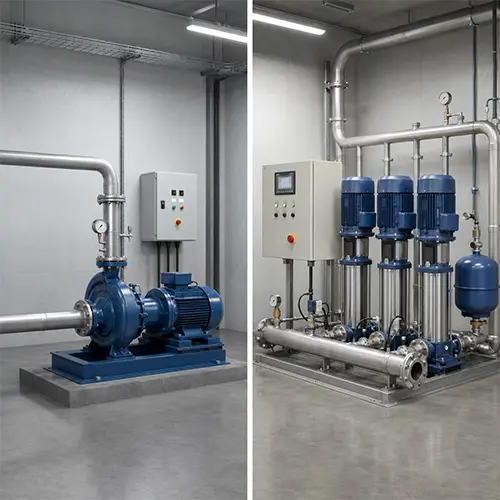
Booster set vs single pump selection should be based on real water demand, pressure stability, redundancy requirement, energy cost, maintenance capability, and downtime risk. A booster set is usually the better choice when the system has variable demand, multiple users, constant pressure requirements, or backup requirements. A single pump is usually better when the application has one stable duty point, a limited budget, simple operation, and acceptable shutdown risk.
For buyers, engineers, contractors, and facility managers, the decision should not start with “How many pumps should I buy?” It should start with a more practical question: Which pumping configuration can deliver the required flow and pressure under real operating conditions, without creating unnecessary cost, pressure instability, or maintenance difficulty?
A single pump may look more economical during procurement, but it can become expensive if it causes pressure fluctuation, frequent start-stop operation, user complaints, high energy consumption, or full system shutdown after one failure. A booster set may look more professional, but it can also become over-designed if the application is simple, the demand is stable, or the site cannot maintain VFDs, sensors, control panels, and multi-pump logic.
This guide explains how to compare a booster set and a single pump from a practical B2B decision-making perspective. It is designed for buyers who need to select a reliable water pressure boosting system for buildings, factories, municipal water supply, commercial facilities, irrigation systems, and general industrial water applications.
Quick Decision Summary for Buyers
A booster set is better for variable demand, constant pressure, redundancy, and critical water supply. A single pump is better for simple transfer, stable flow, lower budget, and easier maintenance.
This is the fastest first-level decision rule. If your system demand changes throughout the day, pressure must stay stable, and one pump failure cannot stop the system, a booster set is usually safer. If your system only needs one fixed flow and head, and a short shutdown is acceptable, a single pump may be the more practical solution.
| Project Condition | Better Choice | Why It Matters |
|---|---|---|
| Demand changes during the day | Booster set | Multiple pumps can start or stop according to real demand |
| Constant pressure is required | Booster set | Control panel and VFD can maintain pressure more accurately |
| One fixed operating point | Single pump | Simpler, lower cost, and easier to maintain |
| Backup is required | Booster set | A standby pump can keep the system running during failure or maintenance |
| Limited initial budget | Single pump | Fewer components and lower installation cost |
| Large building with many users | Booster set | Handles peak and low-demand periods better |
| Remote site with limited maintenance | Single pump | Easier troubleshooting and fewer control components |
| High downtime cost | Booster set | Redundancy reduces full shutdown risk |
| Future expansion expected | Booster set | Easier to add capacity through pump staging |
| Simple water transfer | Single pump | No need for complex pressure control |
The safest decision is not always the most expensive system. A booster set is only valuable when the system truly needs pressure control, capacity staging, or backup. A single pump is only safe when demand is predictable and system shutdown risk is acceptable.
Scope of This Guide: Applicable Pump Types and Operating Conditions
This guide applies mainly to clean water pressure boosting and surface-mounted centrifugal pump systems. It is most relevant for building water supply, industrial utility water, commercial pressure boosting, municipal secondary water supply, factory process water, irrigation booster stations, and constant pressure water systems.
This comparison is especially useful for systems using:
- End suction pumps
- Inline pumps
- Horizontal centrifugal pumps
- Vertical multistage pumps
- Stainless steel booster pumps
- VFD-controlled booster sets
- Packaged water pressure boosting systems
- Clean water transfer pumps
This article is suitable for:
- Apartment buildings
- Hotels
- Hospitals
- Schools
- Office buildings
- Commercial complexes
- Factories
- Municipal secondary water supply stations
- Irrigation booster stations
- Industrial water supply systems
- Cooling water make-up systems
This guide is not directly suitable for every pump system. Fire pump systems must follow local fire codes and fire safety standards. Sewage pump stations, slurry pump systems, chemical dosing systems, high-viscosity liquid systems, and corrosive liquid applications require different pump selection logic. Deep well submersible pump systems may also require different control and standby strategies.
If the buyer is still deciding which pump structure fits the installation, this end suction vs inline vs multistage pump guide can help compare layout, pressure range, and application limits before choosing a booster set or single pump.
This guide does not replace final hydraulic calculation, electrical design, local code review, or supplier engineering confirmation. It is designed to help buyers ask better questions, compare quotations more accurately, and avoid wrong system configuration.
What Is a Single Pump System?
A single pump system uses one pump to deliver the required flow and head for the application. It is simple, economical, and suitable when water demand is stable, pressure fluctuation is acceptable, and backup is not critical.
In a single pump system, one pump usually handles the full duty. The pump may be fixed speed or VFD-controlled. VFD (Variable Frequency Drive) means a motor speed control device that adjusts pump speed by changing the motor frequency. A VFD can improve pressure control, but it does not turn a single pump into a redundant system because there is still only one pump.
How a Single Pump Works
A single pump works by operating at one selected duty point, which is determined by the required flow and head. The duty point means the actual operating condition where the pump flow and pressure match the system resistance.
The pump is selected based on several basic requirements:
- Flow rate
- Total head
- Liquid type
- Pipe resistance
- Suction condition
- Operating hours
- Motor power
- Control method
A single pump can be very reliable when the application is simple. For example, if water needs to be transferred from one tank to another at a fixed flow rate, one well-selected pump may be enough. The system has fewer components, fewer sensors, fewer valves, and easier maintenance.
The main weakness is that one pump becomes a single point of failure. A single point of failure means one component failure can stop the entire system. If the pump motor burns out, the mechanical seal leaks, the impeller is damaged, or the control device fails, the water supply usually stops unless a separate standby pump is installed.
Where a Single Pump Is Commonly Used
A single pump is commonly used when the demand is predictable and the consequence of pump shutdown is acceptable. It is often selected for smaller systems, simple water transfer, irrigation, and non-critical industrial water supply.
Typical applications include:
- Tank-to-tank water transfer
- Small building water supply
- Agricultural irrigation
- Single equipment water supply
- Temporary pumping
- Factory non-critical utility water
- Simple clean water transfer
- Low-budget projects
- Fixed-flow process supply
For these applications, a booster set may add unnecessary cost. If the system does not need constant pressure, does not have large demand fluctuation, and can tolerate short downtime, a single pump is often the better economic choice.
However, buyers should still avoid undersizing or oversizing the pump. An undersized pump cannot meet peak demand. An oversized pump may cause energy waste, valve throttling, frequent start-stop operation, water hammer, and premature wear.
What Is a Booster Set?
A booster set is a packaged pumping system that usually includes two or more pumps, a control panel, pressure sensors, valves, manifold piping, and often VFDs. It is designed to maintain stable pressure under changing water demand.
A booster set is not simply “several pumps placed together.” A proper booster set is an integrated pressure control system. It monitors system pressure, starts or stops pumps according to demand, adjusts pump speed if VFD control is used, and may provide standby capacity if redundancy is designed into the system.
How a Booster Set Works
A booster set works by matching pump operation to real-time water demand. When demand is low, one pump may run at reduced speed. When demand increases, additional pumps start automatically. When demand drops, pumps stop or slow down.
A typical booster set may include:
- Duty pump
- Assist pump
- Standby pump
- Control panel
- Pressure sensor
- VFD
- Check valves
- Isolation valves
- Common suction manifold
- Common discharge manifold
- Pressure tank
A duty pump is the pump that normally operates first. An assist pump starts when the duty pump cannot meet demand alone. A standby pump remains available as backup when one operating pump fails or is under maintenance. These definitions matter because two or three pumps do not automatically mean the system has backup capacity.
A booster set can maintain constant pressure by using pressure feedback. A pressure sensor measures system pressure and sends data to the controller. The controller then adjusts pump speed or starts additional pumps. This makes booster sets useful for buildings and industrial systems where water demand changes throughout the day.
Main Components of a Booster Set
Understanding booster set components helps buyers compare supplier quotations correctly. A cheaper booster set may use lower-grade sensors, weaker valves, poor wiring, undersized manifolds, or no true standby pump.
| Component | Function | Buyer Checkpoint |
|---|---|---|
| Pumps | Provide flow and pressure | Pump type, material, efficiency, and duty point |
| Control panel | Controls pump start, stop, switching, and protection | PLC, relay logic, protection level, wiring quality |
| VFD | Adjusts pump motor speed | Brand, parameter setting, cooling, service support |
| Pressure sensor | Measures discharge pressure | Accuracy, reliability, spare availability |
| Check valve | Prevents reverse flow through stopped pumps | Valve quality and pressure rating |
| Isolation valve | Allows one pump to be serviced without shutting all pumps | Accessibility and durability |
| Manifold | Connects pumps to suction and discharge piping | Material, welding quality, pressure rating |
| Base frame | Supports the full package | Strength, alignment, anti-vibration design |
| Pressure tank | Reduces frequent start-stop cycles | Volume, pressure rating, bladder quality |
| Control logic | Determines pump rotation and failover | Duty/assist/standby settings and alarm logic |
The quality of a booster set depends not only on pump quality. The controller, sensors, valves, pipework, pressure tank, wiring, and commissioning all affect long-term performance.
Booster Set vs Single Pump: Core Differences Buyers Should Compare
The real difference between a booster set and a single pump is not only pump quantity. Buyers should compare pressure stability, redundancy, control complexity, initial cost, lifecycle cost, energy efficiency, space requirement, and maintenance capability.
| Comparison Point | Booster Set | Single Pump | Buyer Decision Meaning |
|---|---|---|---|
| Number of pumps | Two or more | One | Booster set can stage capacity |
| Pressure stability | Higher | Moderate | Booster set is better for changing demand |
| Redundancy | Available if designed | Usually none | Important for critical water supply |
| Initial cost | Higher | Lower | Single pump is cheaper upfront |
| Control complexity | Higher | Lower | Booster set requires better commissioning |
| Maintenance | More components | Simpler | Single pump is easier to maintain |
| Energy efficiency | Better under variable demand | Better under stable duty | Depends on load profile |
| Space requirement | Larger | Smaller | Booster set needs more installation space |
| Failure impact | Lower if standby exists | Higher | Single pump failure can stop the system |
| Best-fit scenario | Variable demand, constant pressure, critical supply | Stable demand, simple transfer, low budget | Selection depends on system behavior |
A booster set offers better control flexibility, but it also needs better design and maintenance. A single pump is simpler, but it provides less protection against demand fluctuation and pump failure.
The buyer should not choose by pump count alone. A three-pump booster set may have no real standby capacity if all three pumps are required to meet peak demand. A single pump with a separate standby pump may provide better redundancy than a poorly configured booster set. Therefore, the buyer must confirm the actual duty logic, not just the number of pumps.
Demand Profile: Why Minimum, Average, and Peak Flow Matter
A booster set vs single pump decision should start with the demand profile, not with the pump model. Demand profile means how water use changes across time, including minimum flow, average flow, and peak flow.
Many wrong pump selections happen because buyers only provide peak flow. Peak flow is important, but it does not describe how the system behaves most of the day. A pump sized only for peak demand may be too large during low-demand periods. A pump sized only for average demand may fail during peak hours.
| Demand Period | Typical Meaning | Selection Impact |
|---|---|---|
| Minimum flow | Lowest expected demand, often at night or low-use periods | Shows whether one large pump may cycle too often |
| Average flow | Normal operating demand for most of the day | Helps identify the most common operating point |
| Peak flow | Maximum short-term demand | Determines whether system capacity is enough |
| Future flow | Expected demand after expansion | Helps avoid early replacement or undersizing |
Why Variable Demand Favors a Booster Set
Variable demand favors a booster set because multiple pumps can stage capacity according to real flow. When the system needs little water, one pump can run. When demand increases, additional pumps start. This reduces the mismatch between pump output and real demand.
For example, a hotel may have very low water demand at night, moderate demand during the day, and high demand in the morning. If one large pump is selected for the morning peak, it may be oversized for most of the day. This can create pressure fluctuation, frequent start-stop cycles, and energy waste.
A booster set can handle this more smoothly because it does not need to run full capacity all the time.
Why Stable Demand Favors a Single Pump
Stable demand favors a single pump because one correctly selected pump can operate near its intended duty point. If the system needs a consistent flow and pressure for long periods, a single pump may be efficient and reliable.
For example, a tank filling system may require a fixed flow from a storage tank to another tank. If the flow and head are stable, a single pump can be selected accurately. Adding multiple pumps and controls may not provide enough additional value.
The key is not whether one pump or multiple pumps look better. The key is whether the water demand changes enough to justify staging and pressure control.
Pump Curve and System Curve: Why Wrong Sizing Causes Pressure Problems
Pump selection must consider both the pump curve and the system curve. The pump curve shows how much flow and head the pump can provide. The system curve shows how much head the piping system requires at different flow rates.
A pump does not operate wherever the buyer wants. It operates where the pump curve and system curve meet. If this point is wrong, the system may experience insufficient pressure, excessive flow, vibration, frequent cycling, or energy waste.
Why One Large Pump Can Cause Problems
One large single pump can cause problems when it is selected only for peak demand but operates most of the time at low demand. In this condition, the system may need throttling, frequent start-stop operation, or VFD speed reduction to avoid overpressure.
Possible results include:
- Higher energy consumption
- Pressure overshoot
- Water hammer
- More valve wear
- Higher motor stress
- Shorter mechanical seal life
- User complaints from pressure fluctuation
Water hammer means a pressure shock in the pipeline caused by sudden flow change or valve closure. Over time, water hammer can damage pipes, valves, joints, and equipment.
Why Booster Sets Need Correct Control Logic
A booster set can also perform poorly if the control logic does not match the system curve. Poor control settings can cause pumps to start and stop too frequently, fight each other, or fail to maintain stable pressure.
Common control problems include:
- Pressure setpoint too high
- Sensor position too far from the real demand point
- VFD parameters set incorrectly
- Assist pump starts too late
- Standby pump logic not tested
- Pressure tank too small
- Minimum flow not considered
When pressure control is a major concern, this VFD pump vs fixed speed pump guide can help buyers understand how variable speed control affects pressure stability, energy use, and system response.
Which Applications Are Better for a Booster Set?
A booster set is better when water demand changes, pressure must remain stable, or the system cannot tolerate full shutdown from one pump failure. It is especially suitable for multi-user and variable-demand water supply systems.
Buildings With Variable Water Demand
Buildings usually have strong water demand variation, so booster sets are often the better solution. Morning and evening peak water use may require high flow, while nighttime demand may be very low.
Typical building applications include:
- Hotels
- Apartments
- Hospitals
- Schools
- Office buildings
- Shopping malls
- Commercial complexes
- High-rise buildings
- Mixed-use developments
A single pump selected for peak demand may be oversized during low-demand periods. This can cause frequent start-stop operation, pressure fluctuation, noise, water hammer, and energy waste.
A booster set can reduce this problem by staging pump operation. At low demand, one pump runs. At medium demand, another pump assists. At peak demand, multiple pumps operate together. This makes the system more responsive to real water use.
Constant Pressure Water Supply Systems
A booster set is usually the better choice when outlet pressure must remain stable under changing flow. Constant pressure control is one of the main reasons buyers choose booster sets.
In a constant pressure system, the controller monitors discharge pressure and adjusts pump operation. If demand increases and pressure drops, the system increases pump speed or starts another pump. If demand decreases and pressure rises, the system slows down or stops pumps.
This is useful for:
- High-rise building water supply
- Industrial process water
- Commercial water systems
- Municipal secondary water supply
- Equipment requiring stable inlet pressure
- Hotels and hospitals with user comfort requirements
A single VFD pump can sometimes maintain pressure for moderate demand variation, but it still has no backup pump. For high-demand variation, multi-user buildings, or critical systems, a booster set is usually more stable.
Critical Systems Requiring Backup
A booster set is better when water interruption creates production, service, safety, or operational risk. A properly designed booster set can include one standby pump so the system continues operating if one pump fails.
Typical critical applications include:
- Hospital water supply
- Industrial production lines
- Data center cooling make-up water
- Municipal water supply
- Commercial buildings
- High-end residential projects
- Facilities that cannot easily shut down
A common configuration is 2 duty + 1 standby, meaning two pumps can meet required demand and one additional pump is available as backup. Another configuration is 1 duty + 1 standby, meaning one pump handles normal demand and the second pump is backup.
The buyer must confirm whether the standby pump is actually sized to maintain required system performance. A booster set without true standby capacity may not reduce downtime risk as expected.
Which Applications Are Better for a Single Pump?
A single pump is better when system demand is stable, the application is simple, and the buyer wants lower initial cost with easier maintenance. It is the practical choice when pressure control and redundancy are not major concerns.
Fixed Flow Transfer Applications
A single pump is often enough when the system only needs to move water from one point to another at a relatively stable flow and head. In this case, a booster set may add unnecessary complexity.
Typical examples include:
- Tank filling
- Tank-to-tank transfer
- Irrigation main line supply
- Factory non-critical water transfer
- Single equipment feed
- Temporary water transfer
- Simple utility water supply
If the pump can operate near its BEP (Best Efficiency Point), it may be efficient and reliable. BEP means the point on the pump curve where the pump operates with the highest hydraulic efficiency and lowest vibration risk.
Low-Budget or Small-Scale Projects
A single pump is usually better for small projects where the extra cost of a booster set cannot be justified. A booster set includes multiple pumps, manifolds, valves, sensors, control panels, and commissioning work. These add cost.
Single pump systems offer:
- Lower initial price
- Smaller footprint
- Easier installation
- Fewer components
- Simpler electrical control
- Easier troubleshooting
- Lower spare parts complexity
For small buildings, farms, temporary projects, and simple industrial transfer systems, a single pump may deliver the best balance between cost and function.
Sites With Limited Technical Maintenance
A single pump may be more reliable in practice when the site cannot maintain VFDs, pressure sensors, control panels, and multi-pump logic. Simpler systems often work better in remote or low-support environments.
This applies to:
- Remote farms
- Small factories
- Temporary construction sites
- Rural water transfer systems
- Basic irrigation stations
- Facilities without electrical technicians
A booster set can fail or perform poorly if pressure sensors drift, VFD parameters are wrong, control logic is misconfigured, or valves are not maintained. If the site team cannot diagnose these problems, a simple single pump may be the safer choice.
When NOT to Choose a Booster Set
A booster set is not always the better option. If demand is stable, pressure control is not critical, or maintenance ability is limited, a booster set may add unnecessary cost and complexity.
Do Not Choose a Booster Set If Demand Is Stable and Simple
A booster set is unnecessary if the system has one predictable operating point and does not require constant pressure control. In this case, a correctly selected single pump may be more efficient, cheaper, and easier to manage.
A booster set may be excessive when:
- Flow demand is stable
- Head requirement is stable
- Pressure fluctuation is acceptable
- Backup is not required
- Downtime risk is low
- Maintenance resources are limited
- Budget is tight
For example, if a factory only needs to fill a storage tank at a fixed flow rate every day, a single pump may be enough. A booster set would add more components without creating real value.
Do Not Choose a Booster Set If the Site Cannot Maintain the Controls
A booster set depends on control quality, sensor accuracy, VFD configuration, valve condition, and electrical protection. If the site cannot maintain these components, the system may become less reliable than a simple pump.
Common control-related problems include:
- Pressure sensor failure
- Wrong VFD settings
- PLC logic errors
- Poor wiring
- Valve malfunction
- Incorrect pump rotation logic
- Frequent false alarms
- Unstable pressure control
PLC (Programmable Logic Controller) means an industrial controller used to automate pump operation. A PLC can improve control reliability, but only when it is correctly programmed and maintained.
If the buyer has limited technical support, they should ask whether the booster set has simple control logic, local service support, clear alarm messages, and accessible spare parts.
Do Not Choose a Booster Set Only Because It Looks More Professional
A booster set should be selected because the system requires capacity staging, constant pressure, or redundancy—not because it looks more advanced. Over-designed systems increase cost and maintenance burden.
A booster set can be the wrong choice if:
- The system is small
- Demand is predictable
- No backup is required
- Pressure stability is not critical
- Control maintenance is difficult
- The buyer only wants a “more professional-looking” package
In industrial procurement, complexity must have a purpose. More components mean more potential failure points unless the added functions solve real operating problems.
When NOT to Choose a Single Pump
A single pump should not be used when the system has strong demand fluctuation, strict pressure requirements, or unacceptable shutdown risk. In these cases, the lower initial cost may create higher lifecycle risk.
Do Not Choose a Single Pump If Demand Changes Significantly
A single pump is often a poor fit when minimum, average, and peak flow are very different. If the pump is selected for peak demand, it may operate inefficiently during low demand. If it is selected for average demand, it may fail during peak demand.
This can cause:
- Insufficient pressure at peak demand
- Frequent start-stop operation
- Pressure instability
- High energy consumption
- User complaints
- Pipe vibration
- Valve throttling
- Reduced pump life
In a hotel, for example, water demand may be low at night but high in the morning. One large pump may be oversized most of the time. A booster set can stage pump operation and reduce this mismatch.
Do Not Choose a Single Pump If Backup Is Required
A single pump should not be selected when one pump failure would stop a critical system. If water supply interruption affects production, safety, user comfort, or contractual performance, a single pump creates too much risk.
Applications that often need backup include:
- Hospitals
- High-rise buildings
- Industrial production lines
- Municipal water supply
- Commercial complexes
- Critical cooling water systems
- Facilities with continuous operation
A single pump can still be used with a separate standby pump, but that becomes a two-pump redundancy design rather than a basic single pump system.
Do Not Choose a Single Pump If Constant Pressure Is Critical
A single pump may struggle to maintain stable pressure when flow changes widely. A VFD-controlled single pump can help, but it still has limited capacity range and no backup pump.
Constant pressure is important when:
- Many users open taps at different times
- Equipment requires stable inlet pressure
- Upper floors need reliable pressure
- Process water pressure affects production quality
- Pressure fluctuation causes alarms or shutdowns
If pressure instability creates complaints, product quality issues, or equipment faults, a booster set is usually the more suitable solution.
N+1 Redundancy: Does Your Booster Set Really Have Backup?
N+1 redundancy means the system has one additional pump beyond the number required to meet the duty demand. In simple terms, if two pumps are required to meet peak demand, a true redundant design would include a third pump as standby.
This is one of the most important procurement details in booster set selection. Many buyers assume that “multiple pumps” automatically means backup. That is not always true.
| Configuration | What It Means | Does It Provide Backup? |
|---|---|---|
| 1 duty | One pump handles demand | No |
| 1 duty + 1 standby | One pump runs, one pump backs up | Yes, if one pump can meet demand |
| 2 duty | Two pumps together meet demand | No true standby |
| 2 duty + 1 standby | Two pumps meet demand, one backs up | Yes |
| 3 duty + 1 standby | Three pumps meet demand, one backs up | Yes, for larger systems |
Why Pump Count Can Mislead Buyers
Pump count can mislead buyers because two pumps may be designed for capacity sharing, not backup. If both pumps are required during peak demand, one pump failure means the system cannot maintain full design capacity.
For example, a two-pump booster set may be designed so each pump provides 50% of peak flow. If one pump fails, the remaining pump can only provide part of the required peak flow. That may be acceptable for some buildings, but it is not true full redundancy.
Buyers should ask suppliers to state clearly:
- How many pumps are required at peak demand?
- How many pumps are standby?
- Can the system meet peak demand if one pump fails?
- Can the system meet normal demand if one pump is under maintenance?
- Does the controller automatically rotate duty pumps?
- Does the controller automatically start standby after failure?
When N+1 Redundancy Is Worth the Cost
N+1 redundancy is worth the cost when water supply interruption is more expensive than the additional pump. It is especially important in hospitals, high-rise buildings, commercial centers, municipal supply, and industrial production systems.
It may be unnecessary for small, non-critical systems where short downtime is acceptable. The buyer should compare the cost of the standby pump with the cost of water interruption.
Pressure Tank: When Does a Booster Set Need One?
A pressure tank helps reduce frequent pump start-stop cycles and stabilize pressure during small flow demand. It does not replace the pump, and it does not replace redundancy, but it can improve system stability.
A pressure tank is a vessel that stores pressurized water and cushions pressure changes. Many pressure tanks use a bladder or diaphragm inside the tank to separate water from compressed air. When small amounts of water are used, the tank can supply water briefly without starting the pump immediately.
Why Pressure Tank Sizing Matters
Pressure tank sizing matters because an undersized tank can cause frequent pump cycling. Frequent cycling means the pump starts and stops too often, which can stress the motor, contactors, VFD, mechanical seal, and control components.
A small or incorrectly selected pressure tank may cause:
- Frequent pump starts
- Pressure fluctuation
- Shorter motor life
- More wear on contactors or control components
- Unstable VFD operation
- Higher maintenance cost
A correctly selected pressure tank can help stabilize small flow demand, reduce unnecessary pump starts, and protect the system from minor pressure changes.
Does a VFD Booster Set Still Need a Pressure Tank?
A VFD booster set may still need a pressure tank, especially when there is intermittent low flow or very small demand. Some buyers assume VFD control eliminates the need for a pressure tank. That is not always correct.
A VFD can adjust pump speed, but if the demand is extremely small, the pump may still operate inefficiently or cycle frequently. A properly sized pressure tank can help handle short, low-flow demand without forcing the pump to react every time.
The final pressure tank volume should be confirmed by the supplier based on flow pattern, pressure range, control method, and system volume.
Energy Efficiency: Booster Set vs Single Pump
Energy efficiency depends on the demand profile. A booster set is usually more efficient under variable demand, while a single pump can be efficient under stable duty conditions.
Why Booster Sets Can Save Energy Under Variable Demand
A booster set can save energy when water demand changes because it can operate only the number of pumps required. With VFD control, it can also reduce pump speed during low demand.
This helps reduce energy waste because pump power changes significantly with speed. In many centrifugal pump applications, reducing speed can reduce energy consumption sharply. The exact saving depends on the system curve, pressure setting, flow variation, and control method.
A booster set can improve efficiency by:
- Running one pump during low demand
- Starting assist pumps only when needed
- Reducing pump speed with VFD control
- Avoiding excessive throttling
- Reducing pressure overshoot
- Matching output to real demand
If the existing system already shows rising energy use or unstable performance, this pump efficiency loss guide can help identify whether the problem comes from pump sizing, control logic, or system conditions.
Why Single Pumps Can Still Be Efficient Under Stable Demand
A single pump can be efficient when the system operates near one fixed duty point. If the pump is correctly selected and runs near its BEP, a single pump may waste less energy than an oversized or poorly controlled booster set.
Single pumps work well when:
- Flow is stable
- Head is stable
- Operating hours are predictable
- Control requirements are simple
- The pump is correctly sized
- Throttling is minimal
For fixed transfer systems, a single pump may have the best energy and cost balance. The buyer should not assume that a booster set always saves energy. Energy saving depends on real demand variation.
Common Energy Mistakes Buyers Should Avoid
Energy waste often comes from oversizing, wrong pressure settings, poor control logic, and operation far from the best efficiency point. Both booster sets and single pumps can waste energy if poorly selected.
Common mistakes include:
- Selecting one large pump only for peak flow
- Setting booster pressure too high
- Using VFD control without proper parameter setting
- Running a large pump for very small flow
- Ignoring minimum flow requirements
- Not checking the system curve
- Using throttling valves to control flow
- Failing to rotate duty pumps evenly
A good supplier should ask for minimum flow, average flow, peak flow, pressure requirement, suction condition, and operating hours before recommending a pump system.
Cost Comparison: Initial Cost vs Lifecycle Cost
A single pump usually has lower initial cost, while a booster set may reduce lifecycle cost when pressure stability, redundancy, and variable demand matter. Buyers should compare total ownership cost instead of only the first quotation.
Initial Cost
A single pump costs less upfront because it has fewer components and simpler installation. A booster set costs more because it is a packaged system with multiple mechanical and electrical components.
| Cost Item | Booster Set | Single Pump |
|---|---|---|
| Pump quantity | Higher | Lower |
| Control panel | More complex | Simple or optional |
| VFD | Often included | Optional |
| Valves and manifold | Included | Minimal |
| Pressure tank | Often included | Optional |
| Sensors | Required for pressure control | Optional |
| Installation space | Larger | Smaller |
| Commissioning | More complex | Easier |
| Initial cost | Higher | Lower |
For a small or simple system, the higher initial cost of a booster set may not be justified. For a large building or critical facility, the additional cost may be reasonable because the booster set provides pressure stability and backup.
Lifecycle Cost
Lifecycle cost may favor a booster set when variable demand is large or downtime risk is high. A booster set can reduce energy waste, avoid pressure complaints, allow maintenance without full shutdown, and extend equipment life if designed correctly.
Lifecycle cost includes:
- Electricity cost
- Maintenance labor
- Spare parts
- Emergency repair
- Downtime loss
- Pump replacement
- Motor replacement
- Control system service
- User complaints or service interruption
- Production loss caused by pressure instability
For simple systems, the single pump may still have lower lifecycle cost because there are fewer parts to maintain. For variable-demand or critical systems, the booster set may reduce long-term risk.
Cost Decision Logic
Choose a single pump if the project is simple and downtime is acceptable. Choose a booster set if pressure instability, peak demand, or pump failure would create higher long-term cost than the added investment.
The buyer should estimate the cost of one hour of water system failure. If downtime cost is low, a single pump may be acceptable. If downtime cost is high, redundancy and pressure control become more valuable.
Reliability and Redundancy: Why Pump Quantity Matters
Reliability is one of the most important differences between a booster set and a single pump. A single pump has one main pumping unit, while a booster set can provide standby capacity if designed correctly.
Single Pump Failure Risk
A single pump creates a full shutdown risk unless a separate standby pump is installed. If the pump fails, the entire system may stop.
Common single pump failure causes include:
- Motor failure
- Mechanical seal leakage
- Bearing damage
- Impeller blockage
- Coupling failure
- Control failure
- Dry running
- Cavitation
- Overload
Cavitation means vapor bubble formation and collapse inside the pump due to insufficient suction pressure or poor suction conditions. Cavitation can damage impellers, create noise, reduce flow, and shorten pump life.
A single pump may be acceptable when shutdown is not critical. It is not ideal when water supply must continue.
Booster Set Redundancy
A booster set can provide redundancy when it includes a properly sized standby pump and correct control logic. This allows the system to continue operating during maintenance or pump failure.
A good booster set may include:
- Automatic duty pump rotation
- Assist pump staging
- Standby pump failover
- Alarm output
- Overload protection
- Dry-run protection
- Pressure fault detection
- Manual bypass operation
Automatic rotation helps distribute running hours across pumps. This prevents one pump from wearing much faster than others. Standby failover allows the controller to start a backup pump if one pump fails.
Important Warning About False Redundancy
A booster set does not automatically provide backup just because it has multiple pumps. Buyers must confirm whether the system has true standby capacity.
For example, if a booster set has two pumps and both are required to meet peak flow, then there is no standby pump. If one pump fails, the system may only deliver partial capacity. This may be acceptable for some projects but not for critical systems.
Buyers should ask:
- Is this 1 duty + 1 standby?
- Is this 2 duty + 1 standby?
- Can one pump meet normal demand?
- Can the system meet peak demand if one pump fails?
- What happens when one pump is under maintenance?
- Does the controller automatically start the standby pump?
These questions prevent the buyer from paying for “multiple pumps” without receiving real redundancy.
How to Compare Booster Set Quotations Without Being Misled
Booster set quotations can look similar while the real configuration is very different. Buyers should compare the complete package, not only pump model, motor power, and price.
A lower quotation may exclude important components or use lower-grade parts. This can reduce initial cost but increase future maintenance, instability, and downtime risk.
| Quotation Item | What to Check | Why It Matters |
|---|---|---|
| Pump material | Cast iron, stainless steel, or other material | Affects corrosion resistance and application suitability |
| Pump quantity | Duty, assist, and standby count | Confirms whether redundancy exists |
| VFD brand and quantity | One VFD or one per pump | Affects control flexibility and reliability |
| Pressure sensor | Brand, range, accuracy | Poor sensors cause unstable pressure |
| Control panel | PLC, wiring, protection level | Determines control reliability |
| Valves | Check valves and isolation valves | Low-quality valves cause leakage and maintenance issues |
| Manifold | Material and pressure rating | Weak manifolds can become long-term risk |
| Pressure tank | Included or excluded, correct size | Reduces frequent cycling |
| Protection functions | Dry-run, overload, phase loss, high/low pressure | Protects pump and motor |
| Commissioning | Included or not | Wrong commissioning can ruin system performance |
| Spare parts | Availability and lead time | Reduces downtime after failure |
Why the Cheapest Booster Set May Not Be the Lowest-Cost Option
The cheapest booster set may become expensive if it lacks standby capacity, stable controls, proper protection, or reliable valves. A low-priced package can create hidden costs through pressure instability, frequent alarms, emergency repairs, and early component failure.
Buyers should ask suppliers to clarify:
- Is the quotation for duty/assist only or duty/standby?
- Are VFDs included for all pumps or only one pump?
- Is dry-run protection included?
- Is pressure tank included?
- Are valves and manifolds rated for the system pressure?
- Is on-site commissioning included?
- Are spare sensors and VFD support available?
A quotation should be evaluated by system reliability, not only by price.
Common Mistakes When Choosing Booster Set or Single Pump
Many pump system problems come from choosing based on price, habit, or pump quantity instead of real demand variation and pressure requirements. Buyers should avoid the following mistakes before final procurement.
Mistake 1: Choosing One Large Single Pump for Variable Demand
One oversized single pump may meet peak demand but create pressure and energy problems during low demand. This is common in buildings and systems with large daily demand variation.
Possible consequences include:
- High energy use
- Frequent start-stop cycles
- Motor stress
- Pressure fluctuation
- Water hammer
- Valve throttling
- Poor user experience
- Shorter pump life
A booster set may solve this by staging pumps and adjusting speed based on real demand.
Mistake 2: Buying a Booster Set Without Checking Control Quality
A booster set can perform poorly if the control system is weak or poorly commissioned. The pumps may be good, but the whole package can still fail because of unstable control.
Common problems include:
- Low-quality pressure sensors
- Poor VFD settings
- Incorrect pressure setpoint
- Poor wiring
- No clear alarm logic
- Incorrect pump switching sequence
- Unstable pump start-stop behavior
- No proper overload protection
The buyer should not compare only pump brands and motor power. Control quality is a major part of booster set reliability.
Mistake 3: Assuming More Pumps Always Means Better Reliability
More pumps only improve reliability when the system has correct redundancy design. If every pump is required to meet demand, the system may still fail to maintain required pressure when one pump stops.
Buyers should confirm:
- Pump capacity per unit
- Total peak flow requirement
- Standby pump availability
- Failover logic
- Maintenance isolation
- Valve arrangement
- Control sequence
A booster set must be designed as a system, not just assembled as multiple pumps.
Mistake 4: Ignoring Pressure Tank Sizing
A pressure tank can reduce frequent pump start-stop operation, especially during small flow or intermittent demand. If the pressure tank is missing or undersized, the booster set may start and stop too often.
Ignoring pressure tank sizing can cause:
- Frequent pump starts
- Motor wear
- Pressure fluctuation
- VFD hunting
- Shorter equipment life
- Higher maintenance cost
The required tank size depends on demand pattern, pressure range, pump control method, and system volume.
Practical Case Matrix: How Different Projects Should Decide
Real project selection depends on demand variation, pressure requirement, and failure consequence. The following examples show how buyers can think through the choice more clearly.
| Project Scenario | Main Requirement | Better Direction | Decision Reason |
|---|---|---|---|
| Small tank transfer system | Fixed flow, low downtime risk | Single pump | Simple duty does not justify booster set complexity |
| Hotel water supply | Large demand variation, user comfort | Booster set | Maintains stable pressure during peak and low demand |
| Small farm irrigation | Budget-sensitive, limited maintenance | Single pump | Simple structure is easier to maintain |
| Hospital water supply | Stable pressure and backup required | Booster set with standby | Water interruption is unacceptable |
| Factory process water | Depends on process criticality | Case-dependent | Fixed process may use single pump; critical variable demand may need booster set |
| Municipal secondary supply | Constant pressure, multiple users | Booster set | Multi-user demand and reliability requirement are high |
| Commercial building | Peak demand and pressure comfort | Booster set | Better demand staging and pressure stability |
| Remote utility water system | Limited electrical maintenance | Single pump or simple duty/standby | Complex controls may be difficult to support |
These cases show why buyers should not use one rule for every project. The right system is the one that matches the demand profile and acceptable risk level.
Step-by-Step Buyer Checklist Before Final Selection
Buyers should choose between a booster set and a single pump only after confirming demand profile, pressure requirement, redundancy need, and maintenance ability. The following checklist helps procurement and engineering teams make a practical decision.
| Step | Buyer Question | Why It Matters |
|---|---|---|
| 1 | What is the minimum, average, and peak flow demand? | Determines whether one pump can handle real demand |
| 2 | Is constant pressure required? | Booster set is better for stable pressure |
| 3 | What happens if the pump fails? | Determines need for standby pump |
| 4 | Is demand stable or variable? | Affects energy efficiency and control method |
| 5 | Does the site have maintenance capability for VFD controls? | Booster sets need technical support |
| 6 | What is the available installation space? | Booster sets require more space |
| 7 | What is the budget limit? | Single pump has lower upfront cost |
| 8 | Is future expansion expected? | Booster sets are easier to scale |
| 9 | Are pressure fluctuations acceptable? | Determines control requirement |
| 10 | Has the supplier confirmed duty/assist/standby logic? | Prevents false redundancy |
| 11 | Is a pressure tank required? | Reduces frequent start-stop operation |
| 12 | What power supply is available? | Affects motor and VFD selection |
| 13 | Is noise a concern? | Multiple pumps and VFDs may affect acoustic design |
| 14 | Are spare parts locally available? | Reduces downtime after failure |
This checklist should be used before sending the RFQ and again before approving the supplier’s quotation.
RFQ Checklist for Booster Set vs Single Pump Procurement
A clear RFQ prevents suppliers from quoting under-designed or over-designed systems. Buyers should provide real operating data instead of only asking for “one pump” or “one booster set.”
| RFQ Item | Information to Provide |
|---|---|
| Application | Building, factory, irrigation, municipal, process water |
| Liquid | Clean water, treated water, cooling water, etc. |
| Minimum flow | Lowest expected flow |
| Average flow | Normal operating flow |
| Peak flow | Maximum demand |
| Required pressure | Target outlet pressure |
| Suction condition | Tank, city water, well, pipeline |
| Operating hours | Intermittent or continuous |
| Redundancy requirement | None, 1 duty + 1 standby, 2 duty + 1 standby |
| Control method | Fixed speed, VFD, constant pressure |
| Power supply | Voltage, phase, frequency |
| Space limit | Available footprint |
| Noise limit | Required if indoor |
| Maintenance level | Local technician capability |
| Expansion plan | Future flow increase possibility |
| Required materials | Cast iron, stainless steel, or other materials |
| Protection requirements | Dry-run, overload, low pressure, high pressure, phase loss |
| Communication requirement | Optional BMS or remote monitoring |
BMS (Building Management System) means a centralized building control system that monitors and controls equipment such as pumps, HVAC, lighting, and alarms. For hotels, hospitals, and commercial buildings, booster set communication with BMS may be required.
A supplier who receives complete information can provide a safer and more accurate quotation. A supplier who only receives “need pump for building” may quote a system that works on paper but fails in real operation.
Supplier Verification Questions Before Purchase
A reliable supplier should explain why they recommend a booster set or a single pump. Buyers should not accept a quotation that only lists pump model, motor power, and price.
| Supplier Question | Why Buyers Should Ask |
|---|---|
| Why do you recommend a booster set or single pump? | Tests whether supplier understands the application |
| What flow range was used for selection? | Prevents peak-only or average-only sizing |
| Can one pump meet peak demand alone? | Clarifies capacity logic |
| Is there a standby pump? | Confirms backup capability |
| What control logic is used? | Prevents pressure instability |
| Is VFD included? | Affects energy and pressure control |
| What pressure tank volume is recommended? | Prevents frequent start-stop operation |
| What happens if one pump fails? | Confirms failover behavior |
| Can the system support future expansion? | Avoids early replacement |
| What maintenance is required? | Helps estimate lifecycle cost |
| What protection functions are included? | Reduces failure risk |
| What valves and sensors are included? | Prevents hidden quotation differences |
| Is commissioning support included? | Ensures correct control setup |
A good supplier should be able to explain duty pump, assist pump, standby pump, pressure setting, flow range, control sequence, and protection logic. If the supplier cannot explain these clearly, the buyer should be cautious.
Recommended Internal Decision Logic for Buyers
The final decision should connect hydraulic demand, pressure requirement, failure consequence, and maintenance capability. Buyers can use the following logic before approving the pump system.
Choose a single pump when:
- Flow demand is stable
- Pressure variation is acceptable
- The system has one clear duty point
- Downtime risk is low
- Budget is limited
- Maintenance team is small
- Installation space is limited
- No future expansion is expected
Choose a booster set when:
- Demand changes significantly
- Constant pressure is required
- Multiple users depend on the system
- Peak and low-demand periods are very different
- One pump failure would create unacceptable downtime
- Energy saving under variable demand matters
- Future expansion is possible
- The site can maintain controls and sensors
For continuous-duty or high-load systems, this water-cooled vs air-cooled pump motor guide can help buyers check whether motor cooling method may affect long-term reliability.
FAQ About Booster Set vs Single Pump
These questions reflect real buyer concerns before selecting a pressure boosting system. The answers focus on selection logic, cost, energy use, redundancy, maintenance, and purchasing risk.
Is a Booster Set Always Better Than a Single Pump?
A booster set is not always better than a single pump. It is better for variable demand, constant pressure, redundancy, and critical water supply, but it may be unnecessary for simple fixed-flow applications.
A single pump is often better when the system has one stable duty point, limited budget, easy maintenance requirements, and acceptable downtime risk. Buyers should not choose a booster set only because it looks more advanced.
When Should I Choose a Booster Set Instead of a Single Pump?
Choose a booster set when water demand changes significantly, stable pressure is required, peak flow varies, or pump failure would cause unacceptable downtime. Booster sets are especially suitable for buildings, hotels, hospitals, factories, municipal secondary water supply, and commercial water systems.
A booster set is also useful when future expansion is expected. Multiple pumps and control logic make it easier to adjust capacity than replacing one oversized single pump.
When Is a Single Pump Enough?
A single pump is enough when the system has one stable duty point, pressure variation is acceptable, and shutdown risk is low. It is suitable for simple water transfer, small-scale water supply, irrigation, and non-critical utility systems.
The buyer should still confirm that the pump is not oversized or undersized. Correct pump selection is still necessary even when the system is simple.
Does a Booster Set Save More Energy Than a Single Pump?
A booster set can save energy under variable demand because it can stage pumps and adjust speed. However, it does not always save energy in every application.
If the system operates at one stable flow and pressure, a correctly selected single pump can be very efficient. Energy saving depends on the demand profile, pressure setting, pump efficiency, VFD configuration, and control logic.
Does a Booster Set Always Provide Backup?
A booster set provides backup only if it includes a properly sized standby pump and correct control logic. Multiple pumps do not automatically mean redundancy.
For example, two pumps may both be required to meet peak demand. In that case, if one pump fails, the system cannot deliver full capacity. Buyers must confirm whether the configuration is duty/assist, duty/standby, or duty/assist/standby.
Is a Booster Set Harder to Maintain?
A booster set is generally harder to maintain than a single pump because it has more components. It may include multiple pumps, pressure sensors, VFDs, control panels, valves, manifolds, pressure tanks, and alarm logic.
This does not mean booster sets are unreliable. It means they require proper commissioning, trained maintenance, and access to spare parts. In critical systems, the added maintenance may be justified by better pressure control and redundancy.
Which Option Has Lower Initial Cost?
A single pump usually has lower initial cost because it has fewer components, simpler installation, and easier commissioning. A booster set costs more upfront because it includes multiple pumps, controls, valves, manifolds, sensors, and often VFDs.
However, initial cost should not be the only decision factor. If pressure instability or pump failure creates high long-term cost, a booster set may be more economical over the system lifecycle.
What Information Should I Provide Before Asking for a Quotation?
Buyers should provide minimum flow, average flow, peak flow, required pressure, suction condition, operating hours, redundancy requirement, control method, power supply, installation space, and maintenance capability. This helps the supplier quote the correct system.
If the buyer only provides peak flow and pressure, the supplier may oversize the system or miss important control requirements.
Can I Use One VFD Single Pump Instead of a Booster Set?
One VFD single pump can work when the demand variation is moderate and backup is not required. It can adjust speed to maintain pressure within a limited range.
However, it cannot provide pump redundancy. If the pump fails, the system stops. It may also be inefficient or unstable if demand varies too widely. For large buildings or critical applications, a multi-pump booster set is usually safer.
What Is the Most Common Wrong Choice?
The most common wrong choice is selecting one large single pump for a system with highly variable demand. This often causes energy waste, pressure instability, frequent start-stop operation, and premature wear.
Another common mistake is buying a booster set without confirming standby capacity and control quality. Both mistakes can lead to poor system performance.
Conclusion: How Buyers Should Make the Final Decision
The final decision between a booster set and a single pump should be based on demand variation, pressure stability, redundancy requirement, maintenance capability, and lifecycle cost. A single pump is better for simple, stable, low-cost systems. A booster set is better for variable demand, constant pressure, critical water supply, and systems that require backup.
For buyers, the most practical rule is this: choose a single pump when the system has one stable duty point and shutdown risk is acceptable; choose a booster set when demand changes, pressure must stay stable, and one pump failure cannot stop the system.
Before final purchase, buyers should confirm minimum flow, average flow, peak flow, required pressure, suction condition, operating hours, control method, standby logic, pressure tank requirement, maintenance ability, and future expansion needs. The right system should not only meet the quotation requirement. It should provide stable pressure, acceptable downtime risk, manageable maintenance, and the lowest practical lifecycle cost.
Get A Quote

Get A Quote
0 Comments