
Mechanical Seal vs Packing Seal: Which Pump Sealing Method Should Industrial Buyers Choose?
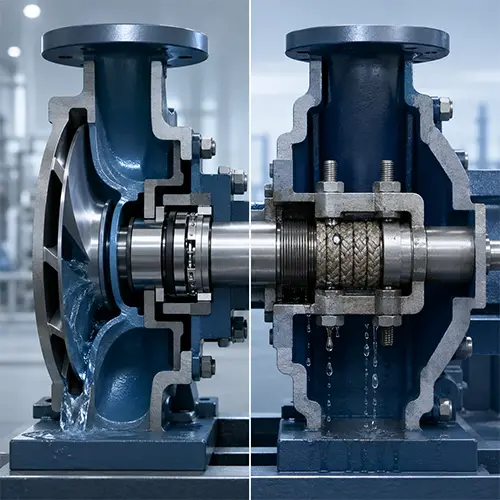
Mechanical seal vs packing seal selection should be based on leakage tolerance, liquid condition, maintenance capability, downtime cost, and total lifecycle cost—not only on the initial seal price. For most modern clean water pumps, HVAC circulation pumps, booster pumps, and continuous industrial water systems, a mechanical seal is usually the better long-term choice because it reduces visible leakage, routine adjustment, pump room contamination, and shaft sleeve wear. For simple, non-critical, field-maintained systems where slight controlled leakage is acceptable, a packing seal can still be a practical and economical option.
The real question for buyers is not “Which seal is better?” The practical question is: which sealing method creates the lowest operational risk for this specific pump, liquid, site condition, and maintenance model?
A wrong sealing choice can cause repeated leakage, dry-running damage, overheated packing, shaft sleeve grooves, bearing contamination, pump room corrosion, safety risks, and unplanned shutdown. A correct sealing choice helps the pump run cleaner, safer, and with lower long-term maintenance cost.
Best Answer for Buyers
For most clean water, HVAC, booster, and continuous industrial water systems, a mechanical seal is usually the better long-term sealing method because it controls leakage better and reduces routine manual adjustment. For low-cost, outdoor, non-critical, or field-maintained systems where controlled leakage is acceptable and simple repair is more important than a dry pump room, a packing seal can still be a practical choice.
The safest buyer decision is to compare the seal by application risk, not by price alone. If leakage creates safety, cleanliness, environmental, or downtime problems, mechanical seal should normally be the first option. If the pump is simple, accessible, and maintained regularly by field technicians, packing may be acceptable.
| Buyer Situation | Better Starting Choice | Reason |
|---|---|---|
| Indoor pump room must stay dry | Mechanical seal | Lower visible leakage and cleaner operation |
| HVAC or building booster system | Mechanical seal | Less routine adjustment and better cleanliness |
| Continuous industrial cooling water | Mechanical seal | Better for long operating hours |
| Outdoor irrigation pump | Packing seal or mechanical seal | Depends on budget, inspection, and leakage tolerance |
| Simple non-critical water transfer | Packing seal | Lower initial cost and easier field repair |
| Chemical or hazardous liquid | Mechanical seal | Better leakage control and safety when properly selected |
| Slurry or abrasive liquid | Special review required | Packing, special mechanical seal, or slurry seal arrangement may be needed |
| Remote unmanned pump station | Mechanical seal | Less routine manual gland adjustment |
| Site has strong field maintenance but limited spare seal access | Packing seal may be practical | Easier to adjust and repack locally |
For buyers still comparing the pump category before selecting the sealing method, this water pump types explained guide can help clarify how different pump types affect sealing, maintenance access, and operating risk.
Key Facts About Mechanical Seal vs Packing Seal
Mechanical seal and packing seal are both used to control leakage around the rotating shaft of a pump, but they work in different ways and create different maintenance outcomes. These key facts summarize the decision logic before going into deeper technical details.
- A mechanical seal uses precision sealing faces to control leakage around the pump shaft. Under normal conditions, visible leakage is very low.
- A packing seal, also called gland packing or compression packing, uses compressed packing rings around the shaft or shaft sleeve. It normally requires a small amount of controlled leakage for lubrication and cooling.
- Mechanical seals usually reduce water loss, pump room contamination, shaft sleeve wear, and routine manual adjustment.
- Packing seals usually reduce initial purchase cost and simplify field repair, but they require regular inspection and correct adjustment.
- Mechanical seals are not always better if the liquid contains abrasive solids, the pump often runs dry, the shaft vibrates, or the installation is poor.
- Packing seals are not always cheaper over the full lifecycle because leakage loss, labor, sleeve wear, and frequent repacking can increase operating cost.
- The final decision should consider liquid type, pressure, temperature, pump speed, leakage tolerance, maintenance skill, spare parts availability, and downtime cost.
Quick Decision Table: Mechanical Seal vs Packing Seal
A quick decision table helps buyers, engineers, and maintenance teams screen the correct sealing direction before requesting a final quotation. This table is not a substitute for engineering review, but it prevents the common mistake of choosing the cheapest sealing method without checking leakage, maintenance, and downtime consequences.
| User Priority / Operating Condition | Better Choice | Why It Matters |
|---|---|---|
| Lowest visible leakage requirement | Mechanical seal | Better leakage control under normal conditions |
| Lowest initial purchase cost | Packing seal | Packing material and structure are usually cheaper |
| Easy field adjustment | Packing seal | Packing can be tightened, adjusted, or replaced on site |
| Clean water pump room | Mechanical seal | Cleaner operation and lower water accumulation |
| HVAC circulation system | Mechanical seal | Less routine maintenance and better indoor cleanliness |
| Building booster pump | Mechanical seal | Low leakage is usually expected |
| Continuous operation | Mechanical seal | Lower friction and less routine adjustment |
| Remote pump station | Mechanical seal | Reduces manual inspection frequency |
| Basic irrigation pump | Packing seal or mechanical seal | Depends on cost and maintenance access |
| Chemical liquid | Mechanical seal | Leakage control and material compatibility are critical |
| Slurry or sandy water | Special review required | Packing or special mechanical seal may be required |
| Limited spare parts access | Depends | Packing is easier to source, but requires routine attention |
The simplest rule is this: choose mechanical seal when leakage control and lower routine maintenance matter most; choose packing seal when low initial cost, simple field repair, and acceptable controlled leakage matter more.
Scope of This Guide: Applicable Pump Types and Working Conditions
This guide mainly applies to centrifugal pumps used for clean water, cooling water, HVAC circulation, booster systems, irrigation, municipal water transfer, and general industrial water service. It is especially useful when buyers are comparing standard mechanical seals and gland packing in common water pump applications.
It should not be used as the only decision basis for hazardous liquids, high-temperature fluids, explosive environments, API process pumps, sanitary pumps, or severe slurry applications. In those cases, seal selection must be reviewed by a pump engineer or seal specialist.
Applicable Pump Types
Mechanical seal vs packing seal decisions appear in many pump categories. The selection logic changes depending on pump structure, operating pressure, liquid cleanliness, shaft speed, and maintenance access.
| Pump Type | Applicability | Notes for Buyers |
|---|---|---|
| End suction pump | High | Common area for mechanical seal and packing comparison |
| Inline pump | High | Mechanical seals are common because compact systems usually need cleaner operation |
| Booster pump | High | Mechanical seals are usually preferred for low leakage and compact installation |
| Split case pump | High | Packing is still common in some large water systems, but mechanical seals are also widely used |
| Multistage pump | Medium to high | Mechanical seals are common, but pressure rating must be checked carefully |
| Cooling water pump | High | Mechanical seals usually fit continuous-duty systems better |
| Irrigation pump | Medium | Packing may be acceptable if leakage and routine adjustment are acceptable |
| Slurry pump | Needs adjustment | Packing, mechanical seal, expeller seal, or special slurry seal may be used |
| Sewage pump | Needs adjustment | Solids, fibers, access, and seal chamber design matter |
| Chemical pump | Needs expert review | Material compatibility and leakage safety are critical |
If your project involves pump structure selection as well as seal selection, this end suction vs inline vs multistage pump guide can help you evaluate layout, pressure range, and maintenance access before finalizing the sealing method.
Conditions That Need Engineering Review
Some applications require seal engineering beyond a standard mechanical seal vs packing seal comparison. In these cases, buyers should not rely only on a catalog description or a supplier’s generic “standard seal” statement.
Engineering review is needed for corrosive liquids, seawater, high-temperature water, chemical wastewater, flammable liquids, explosive environments, boiler feed systems, API 610 process pumps, food-grade sanitary pumps, pharmaceutical systems, and severe abrasive slurry.
| Condition | Why Standard Selection Is Risky | What Buyers Must Verify |
|---|---|---|
| Corrosive liquid | Elastomers, springs, and metal parts may corrode | Seal face, elastomer, spring, and metal compatibility |
| Hot water | Elastomer and face materials may fail from heat | Temperature rating and cooling requirement |
| Seawater | Chloride corrosion risk | SS316, duplex, or other suitable material review |
| Sandy water | Abrasive particles can damage seal faces or sleeves | Flush plan, sleeve material, and wear resistance |
| Chemical liquid | Leakage may be unsafe | Chemical compatibility and containment strategy |
| Slurry | Abrasion can destroy standard seals | Slurry-specific sealing arrangement |
| Dry-running risk | Mechanical seal faces can burn quickly | Priming, protection, and suction condition |
If liquid corrosion is already a concern, this pump corrosion troubleshooting guide can help buyers understand how liquid chemistry and material selection affect pump reliability.
What Is a Mechanical Seal?
A mechanical seal is a shaft sealing device that controls leakage by pressing two precision sealing faces together. One face rotates with the shaft, while the other face remains stationary. A very thin liquid film between the faces helps lubricate and cool the contact area.
For pump buyers, the main value of a mechanical seal is low visible leakage and cleaner operation. It is widely used in modern centrifugal pumps because it reduces routine adjustment and helps keep pump rooms dry, safe, and easier to maintain.
How a Mechanical Seal Works
A mechanical seal controls leakage at the point where the rotating shaft passes through the pump casing. Without a seal, liquid would escape along the shaft. The mechanical seal prevents this by using a rotating face and a stationary face pressed together by a spring or bellows.
The sealing faces should not run dry. They need a thin liquid film for lubrication and cooling. If the pump loses prime, runs dry, cavitates, or handles liquid that vaporizes at the seal faces, the seal can overheat and fail quickly.
| Mechanical Seal Part | Plain-Language Explanation | Buyer Concern |
|---|---|---|
| Rotating face | Seal face that rotates with the shaft | Must resist wear, heat, and liquid attack |
| Stationary face | Fixed seal face installed in the seal chamber or gland | Must match the rotating face material |
| Spring or bellows | Pushes the seal faces together | Must resist corrosion and fatigue |
| Elastomer | Flexible sealing element such as O-ring | Must match liquid temperature and chemistry |
| Seal chamber | Area around the seal | Must provide stable liquid and pressure condition |
| Flush | Liquid used to cool, clean, or lubricate the seal area | Important for hot, dirty, or crystallizing liquids |
A mechanical seal performs well when the seal material, pump operating point, suction condition, and installation quality are correct. It performs poorly when the pump is allowed to run dry, vibrate heavily, or operate far from its intended duty point.
Common Mechanical Seal Materials
Mechanical seal material selection directly affects seal life. Buyers should never assume that all mechanical seals are the same. A low-cost seal with the wrong material can fail faster than a more expensive seal selected correctly for the liquid.
| Seal Part | Common Materials | Buyer Concern |
|---|---|---|
| Seal face | Carbon, ceramic, silicon carbide, tungsten carbide | Wear resistance, heat resistance, and chemical compatibility |
| Elastomer | NBR, EPDM, Viton, PTFE | Temperature and liquid compatibility |
| Spring | Stainless steel | Corrosion resistance and fatigue resistance |
| Metal parts | SS304, SS316, duplex stainless steel | Corrosion resistance in water or chemical service |
For clean cold water, standard seal materials may be enough. For hot water, seawater, chemical liquid, or abrasive water, the material combination must be verified carefully. A quotation should state the seal face material, elastomer material, spring material, and metal part material.
Where Mechanical Seals Are Commonly Used
Mechanical seals are commonly used in clean water transfer pumps, HVAC circulation pumps, booster pumps, inline pumps, end suction pumps, multistage pumps, cooling water pumps, and many chemical process pumps.
They are preferred where leakage must be minimized, pump rooms must stay clean, maintenance access is limited, or continuous operation is required. Modern building water systems, automated booster systems, and industrial cooling loops often favor mechanical seals because manual gland adjustment is not practical.
What Is a Packing Seal?
A packing seal, also called gland packing or compression packing, uses rings of soft packing material compressed around the pump shaft or shaft sleeve. The packing is tightened by a gland follower to reduce leakage.
For buyers, the most important point is that packing seals normally require controlled leakage. This leakage is not always a defect. It helps lubricate and cool the packing. If the packing is tightened until there is no leakage, friction can increase, the packing can overheat, and the shaft sleeve can wear quickly.
How Packing Seal Works
Packing rings are installed inside a stuffing box around the shaft sleeve. A gland follower presses the rings inward. The pressure between the packing and the shaft sleeve reduces leakage, but it also creates friction.
Because packing works through contact, some liquid must pass through slowly to cool and lubricate the contact area. This is why packing may drip during normal operation.
| Packing Seal Term | Plain-Language Explanation | Buyer Concern |
|---|---|---|
| Packing rings | Soft rings compressed around the shaft sleeve | Material must match liquid and temperature |
| Gland follower | Part that compresses the packing | Over-tightening can damage the sleeve |
| Lantern ring | Ring that distributes flush water into the packing area | Useful for cooling, lubrication, or dirty liquid control |
| Shaft sleeve | Replaceable sleeve protecting the pump shaft | Can wear if packing is too tight or abrasive |
| Controlled leakage | Small leakage allowed for cooling and lubrication | Must be acceptable for the site |
Packing seals are mechanically simple, but they require regular human attention. If the site has trained maintenance staff, packing can be adjusted and replaced without advanced tools. If the pump is unattended, packing may become a long-term leakage and wear problem.
Common Packing Materials
Different packing materials are used for different liquid conditions, temperatures, and maintenance priorities. Buyers should ask what packing material is supplied instead of accepting a vague description such as “standard packing.”
| Packing Material | Typical Use | Buyer Concern |
|---|---|---|
| Graphite packing | Higher temperature or chemical resistance | Better heat tolerance |
| PTFE packing | Chemical compatibility and lower friction | Useful for many chemical services |
| Aramid fiber packing | Abrasive liquids | Better wear resistance |
| Cotton or flax packing | Basic water service | Low cost but limited performance |
| Carbon fiber packing | Industrial-duty service | Higher performance and better durability |
Packing material affects leakage rate, friction, shaft sleeve wear, and replacement frequency. A low-cost packing material may be acceptable for basic water service, but it may fail quickly in abrasive, hot, or chemically aggressive liquid.
Where Packing Seals Are Commonly Used
Packing seals are still used in older large water pumps, split case pumps, irrigation pumps, mining pumps, slurry pumps, low-cost pump stations, and field-maintained systems.
They are often selected when buyers want low initial cost, simple repair, and tolerance for some leakage. In remote agricultural or mining applications, field serviceability may be more valuable than very low leakage. In clean indoor pump rooms, however, continuous dripping may be unacceptable.
Mechanical Seal vs Packing Seal: Core Differences Buyers Must Understand
The main difference between mechanical seal and packing seal is not only the physical structure. The real difference is how each sealing method affects leakage, maintenance, shaft sleeve wear, energy loss, installation sensitivity, spare parts, and lifecycle cost.
Buyers should compare these factors before choosing the sealing method.
Leakage Control
Leakage control is usually the first reason buyers compare mechanical seals and packing seals. A mechanical seal normally provides very low visible leakage when correctly selected and installed. A packing seal normally allows controlled dripping during operation.
| Factor | Mechanical Seal | Packing Seal |
|---|---|---|
| Visible leakage | Very low under normal conditions | Controlled leakage is expected |
| Pump room cleanliness | Better | Water around the pump base is more likely |
| Water loss | Lower | Higher over long operation |
| Hazardous liquid suitability | Better with correct design | Usually not preferred |
| Operator behavior | Monitor leakage changes | Adjust leakage regularly |
For indoor pump rooms, booster systems, HVAC systems, clean production areas, and chemical services, mechanical seals are usually preferred because leakage control matters. For basic irrigation or non-critical clean water transfer where dripping is acceptable, packing may still be reasonable.
Maintenance Frequency
Mechanical seals usually require less routine adjustment. Once properly installed, the maintenance team mainly monitors leakage, vibration, temperature, and operating condition. If the seal fails, it usually needs replacement rather than simple tightening.
Packing seals require regular inspection. Maintenance staff may need to adjust the gland, check leakage rate, replace packing rings, and inspect the shaft sleeve. This can be simple but labor-intensive.
The buyer’s maintenance model matters. A plant with trained maintenance staff may accept packing. A remote or automated system usually benefits from mechanical seals because fewer routine adjustments are needed.
Shaft and Sleeve Wear
Packing seals create continuous contact between packing material and the shaft sleeve. If the packing is too tight, abrasive, poorly lubricated, or contaminated with particles, the shaft sleeve can wear. Once the sleeve is worn, leakage becomes harder to control, and repair cost increases.
Mechanical seals usually reduce shaft sleeve wear because the sealing action occurs at the seal faces rather than by compressing soft material against the shaft sleeve. However, mechanical seals can still fail quickly if the seal faces run dry, if solids enter the seal interface, or if shaft vibration is excessive.
If your pump already has seal leakage, abnormal vibration, or bearing heating, this pump seal leak troubleshooting guide can help identify whether the root cause is the seal itself, dry running, misalignment, cavitation, or operating condition.
Power Consumption and Friction Loss
Packing seals generally create more friction than mechanical seals because the packing material is compressed around the shaft sleeve. If the gland is over-tightened, friction increases further. Higher friction can increase heat, power consumption, and sleeve wear.
Mechanical seals usually have lower friction when correctly lubricated by the liquid film. This makes them more suitable for long running hours and continuous operation.
For a small pump running occasionally, the difference may not be financially important. For a larger pump running 24/7, friction loss and maintenance labor can become part of the total ownership cost.
Installation Sensitivity
Mechanical seals are more sensitive to installation and operating conditions. They require correct face handling, clean installation, correct shaft alignment, proper lubrication, and avoidance of dry running.
Packing seals are usually more forgiving during installation. The packing can be adjusted after startup, and minor leakage can be controlled by the gland. However, this does not mean packing is risk-free. Over-tightening, uneven compression, wrong packing material, or poor sleeve condition can still cause failure.
The practical decision is this: mechanical seals need better initial correctness; packing seals need more ongoing attention.
Spare Parts and Field Repair
Packing is often easier to stock and replace in the field. Maintenance teams can cut packing rings, install them, and adjust the gland if they have basic tools and experience.
Mechanical seals require correct size, type, material, and installation dimensions. The replacement seal must match the pump design. A wrong seal size or elastomer material can lead to immediate leakage or early failure.
For procurement teams, this means the quotation should include spare parts information. Do not buy a pump without knowing the mechanical seal model or packing size.
Seal Selection by Liquid Condition
Liquid condition is one of the most important seal selection factors. A sealing method that works well for clean cold water may fail quickly in sandy water, hot water, seawater, slurry, or chemical liquid.
Buyers should define the liquid before comparing seal prices. The supplier cannot recommend a reliable sealing method without knowing whether the fluid is clean, abrasive, corrosive, hot, hazardous, or prone to crystallization.
| Liquid Condition | Main Seal Risk | Recommended Direction |
|---|---|---|
| Clean cold water | Low wear and low chemical risk | Mechanical seal usually preferred for clean operation |
| HVAC water | Indoor leakage and maintenance concerns | Mechanical seal usually preferred |
| Hot water | Elastomer and face temperature risk | Mechanical seal with correct temperature-rated materials |
| Seawater | Chloride corrosion risk | Mechanical seal with corrosion-resistant materials; packing also needs sleeve review |
| Sandy water | Abrasive wear | Packing or special mechanical seal with flushing may be needed |
| Chemical liquid | Compatibility and leakage safety | Mechanical seal with verified material compatibility |
| Slurry | Severe abrasion | Slurry-specific seal, packing, expeller, or special plan required |
| Wastewater | Solids and fibers | Seal design must match solids, access, and maintenance plan |
| Crystallizing liquid | Deposits at seal faces | Flush plan and special seal review required |
A buyer should not describe the liquid only as “water” if it contains sand, chloride, chemicals, oil, solids, or high temperature. Those details can completely change the correct sealing method.
When Should You Choose a Mechanical Seal?
A mechanical seal is usually the better option when leakage must be minimized, operation is continuous, routine maintenance should be reduced, or the pump room must remain clean and safe.
For most modern clean water pumps, booster pumps, HVAC pumps, and industrial cooling water systems, mechanical seals are commonly preferred.
Choose Mechanical Seal When Leakage Must Be Minimized
Mechanical seals are preferred when visible leakage is not acceptable. This includes indoor pump rooms, clean equipment areas, chemical liquid handling, water-saving systems, and facilities where liquid around the pump base creates safety or corrosion problems.
Leakage is not only a water loss issue. It can also cause wet floors, slip hazards, corrosion around the pump base, bearing housing contamination, motor base corrosion, staining, scaling, environmental concerns, hygiene concerns, and extra cleaning labor.
If the liquid is hazardous, hot, chemical, or expensive, packing leakage is usually unacceptable unless specifically designed and approved.
Choose Mechanical Seal for Continuous or Automated Operation
Mechanical seals are usually better for pumps that run continuously or operate in automated systems. The reason is simple: continuous systems cannot rely on frequent manual gland adjustment.
Examples include booster water supply systems, HVAC circulation systems, industrial cooling water loops, remote pump stations, automatic water treatment systems, and production process water circulation.
In these systems, a seal that needs less routine adjustment can reduce labor and improve reliability.
Choose Mechanical Seal When Shaft Wear Must Be Reduced
If shaft sleeve wear is a concern, a mechanical seal is often a better choice. Packing can wear the sleeve if adjusted too tightly or exposed to abrasive particles. Sleeve replacement adds cost and downtime.
Mechanical seals reduce this type of sleeve friction when correctly selected and installed. However, the pump must still operate under stable conditions. Vibration, cavitation, dry running, or misalignment can damage the mechanical seal.
If bearing wear or vibration is already present, seal replacement alone may not solve the issue. This pump bearing failure diagnosis guide can help maintenance teams check whether seal damage is connected to deeper mechanical problems.
Choose Mechanical Seal When Lifecycle Cost Matters More Than Initial Cost
Mechanical seals usually cost more at the purchase stage. However, they can reduce long-term cost by lowering leakage, routine maintenance, water loss, sleeve wear, and pump room cleanup.
For critical systems, the lowest initial seal cost is rarely the best decision. If downtime affects production, cooling, building water supply, or customer service, the lower-maintenance option may be more economical over the full service life.
When Should You Choose a Packing Seal?
A packing seal is still a practical option in many applications. It should not be treated as outdated in every case. For some field-maintained, low-cost, non-critical, or dirty liquid systems, packing can be more practical than a standard mechanical seal.
The key condition is that the buyer must accept controlled leakage and routine adjustment.
Choose Packing Seal When Initial Budget Is Limited
Packing seals usually have a lower initial cost than mechanical seals. This makes them attractive for simple water transfer, irrigation, temporary pumping, low-cost pump stations, and non-critical systems.
If the liquid is clean water, slight leakage is acceptable, and maintenance staff can inspect the pump regularly, packing may be a reasonable economical choice.
However, buyers should not stop at initial cost. They should also calculate water loss, labor, sleeve wear, cleanup, and downtime.
Choose Packing Seal When Field Adjustment Is Important
Packing seals are easier to adjust in the field. A technician can tighten the gland slightly, monitor leakage, and replace packing rings when needed.
This is useful in remote sites where replacement mechanical seals are not always available or where maintenance staff prefer simple mechanical repair. In some regions, packing material may be easier to source than a specific mechanical seal model.
This field service advantage is real, but it only works when the site has regular inspection. Packing that is ignored can leak excessively or damage the shaft sleeve.
Choose Packing Seal for Some Dirty or Abrasive Services
Some dirty or abrasive services can damage standard mechanical seals quickly. In such cases, packing, special slurry mechanical seals, flush systems, expeller seals, or other arrangements may be considered.
This does not mean packing is always best for slurry. It means the seal selection must account for solids concentration, particle size, flush water availability, shaft sleeve material, pump speed, and maintenance access.
For severe slurry pumps, buyers should not apply clean water pump sealing logic directly.
Choose Packing Seal When Slight Leakage Is Acceptable
Packing can be acceptable when the pumped liquid is non-hazardous, the pump room has drainage, slight leakage does not create safety problems, and water loss is not a major cost.
For example, some irrigation systems, outdoor water transfer pumps, and non-critical utility pumps may accept packing leakage because simple repair and low initial cost are more important than a dry pump room.
Mechanical Seal vs Packing Seal Cost Comparison
Cost comparison should include total ownership cost, not only the purchase price. Packing is usually cheaper at the beginning, while mechanical seals often reduce long-term operating and maintenance costs.
A buyer who only compares quotation price may choose packing and later pay more through water loss, labor, sleeve wear, cleanup, and downtime.
Initial Purchase Cost
Packing seals usually have a lower initial cost. The components are simple, and replacement packing material is usually inexpensive.
Mechanical seals cost more because they use precision faces, springs, elastomers, metal parts, and more accurate manufacturing. If the seal material is upgraded to silicon carbide, tungsten carbide, Viton, PTFE, or stainless steel, the price increases further.
For a simple, low-duty, non-critical pump, packing’s lower initial cost may be justified.
Maintenance Labor Cost
Packing needs routine attention. The gland may need adjustment, the leakage rate must be observed, and the packing rings eventually need replacement.
Mechanical seals normally require less routine adjustment. Maintenance focuses on monitoring conditions rather than tightening parts. When a mechanical seal fails, replacement is more technical, but the routine labor between failures is usually lower.
For systems with limited maintenance staff, mechanical seals often reduce workload.
Water Loss and Leakage Cost
Packing leakage may seem small, but continuous dripping can add up over months and years. It can also cause floor cleaning costs, corrosion, safety risk, and nuisance complaints.
Mechanical seals reduce visible leakage and help keep the pump room cleaner.
For sites where water cost, cleanliness, or safety matters, this difference should be included in the cost calculation.
Shaft Sleeve and Downtime Cost
Packing can wear the shaft sleeve, especially if over-tightened or used with dirty liquid. Sleeve replacement can require downtime and disassembly.
Mechanical seal failure may also cause downtime, but if selected correctly, it usually avoids continuous sleeve friction from gland packing.
| Cost Factor | Mechanical Seal | Packing Seal |
|---|---|---|
| Initial price | Higher | Lower |
| Routine adjustment | Lower | Higher |
| Leakage loss | Lower | Higher |
| Shaft sleeve wear | Usually lower | Higher if over-tightened |
| Repair complexity | Higher | Lower |
| Spare part specificity | More specific | Easier to source |
| Downtime risk | Lower if selected correctly | Depends on inspection and adjustment |
| Lifecycle cost | Better for critical or clean systems | Better for simple non-critical systems |
The correct cost decision depends on the application. Packing is cheaper to buy; mechanical seals are often cheaper to operate in clean, continuous, or maintenance-sensitive systems.
Example: How to Compare Packing Leakage Cost vs Mechanical Seal Cost
A simple cost comparison helps buyers avoid false savings. Packing may look cheaper in the quotation, but repeated inspection, leakage, sleeve wear, and downtime can change the final cost.
The purpose of this calculation is not to create a universal number. The purpose is to show buyers what cost items should be included before deciding.
Basic Lifecycle Cost Formula
A practical seal cost comparison should include purchase cost, maintenance labor, leakage loss, sleeve wear, replacement parts, and downtime risk.
Annual seal-related cost =
seal parts cost + maintenance labor cost + leakage loss cost + shaft sleeve wear cost + cleanup or corrosion cost + downtime cost
For packing seals, the hidden cost usually comes from routine adjustment, water loss, repacking labor, and sleeve wear. For mechanical seals, the hidden cost usually comes from incorrect installation, dry-running damage, and replacement parts if the operating condition is not stable.
Example Calculation for a Non-Critical Water Pump
Assume a clean water pump runs many hours per year and packing leakage is accepted by the site. The buyer should estimate the real yearly cost instead of comparing only seal price.
| Cost Item | Packing Seal Example | Mechanical Seal Example |
|---|---|---|
| Initial seal cost | Lower | Higher |
| Routine inspection | Weekly or monthly | Less frequent |
| Leakage loss | Continuous small leakage | Very low visible leakage |
| Sleeve wear | Possible over time | Usually lower |
| Repair skill | Basic field repair | More precise installation |
| Downtime risk | Low if maintained | Low if installed correctly |
| Best use case | Simple accessible pump | Clean continuous pump |
If the pump is non-critical, outdoors, and easy to inspect, packing may still be economical. If the pump is indoors, runs continuously, and causes cleanup cost when leaking, mechanical seal may provide better total value.
How Buyers Should Use This Calculation
Buyers should ask three practical questions before choosing the cheaper option. First, how much does leakage cost over a year? Second, how many labor hours are needed for inspection and adjustment? Third, what is the cost if the pump stops unexpectedly?
If the answers are small, packing may be acceptable. If the answers are large, mechanical seal usually becomes the safer long-term decision.
Failure Risks If You Choose the Wrong Seal Type
Wrong seal selection can create failures that appear to be product quality problems, but the real cause is often mismatch between sealing method and operating condition.
Buyers should understand what can happen before choosing by price or habit.
Using Packing Seal Where Leakage Is Not Acceptable
If packing is used where leakage is unacceptable, the buyer may face pump room water accumulation, slippery floors, corrosion, bearing contamination, motor base rust, and higher cleaning cost.
This is especially problematic in indoor pump rooms, building water systems, chemical areas, production workshops, or environments where cleanliness is required.
If the site cannot tolerate regular dripping, packing is usually the wrong choice.
Using Mechanical Seal in Poor Suction or Dry Running Conditions
Mechanical seals rely on a liquid film for lubrication and cooling. If the pump runs dry, loses prime, cavitates, or operates with insufficient liquid at the seal faces, the seal can fail quickly.
Dry-running damage may include burned seal faces, cracked ceramic or carbon faces, hardened elastomers, sudden leakage, seal face distortion, and spring damage.
Before choosing a mechanical seal, buyers should confirm suction conditions, NPSH margin, priming method, and dry-running protection.
Using Wrong Seal Material for Liquid Chemistry
Seal material compatibility is critical. The wrong elastomer can swell, harden, crack, or dissolve. The wrong metal spring can corrode. The wrong seal face can wear or crack.
For example, NBR may not suit some chemicals or high temperatures. EPDM may suit hot water in some cases but not petroleum oils. Viton may handle many chemicals but is not universal. SS304 may not be enough for chloride-rich water. Carbon faces may not suit abrasive solids.
Buyers should provide liquid composition, temperature, pH, solids content, and chemical concentration to the supplier.
Over-Tightening Packing Seal
Packing should not be tightened until all leakage disappears. If the gland is over-tightened, friction rises, heat builds up, and the shaft sleeve can wear quickly.
A packing seal needs controlled leakage. The correct leakage rate depends on pump size, packing material, liquid, and operating condition. Buyers should ask the supplier what leakage rate is considered normal.
Common Seal Failure Symptoms and What They Mean
Seal failure symptoms can help users identify whether the problem is the seal itself or the operating condition around the pump. Replacing the seal without checking the root cause often leads to repeated failure.
This troubleshooting table is not a substitute for site inspection, but it helps buyers and maintenance teams ask the right questions.
| Symptom | Possible Cause | What User Should Check |
|---|---|---|
| Mechanical seal leaks immediately after startup | Wrong installation, wrong size, damaged faces | Check seal model, installation steps, and face condition |
| Mechanical seal fails after a short running time | Dry running, cavitation, poor suction | Check priming, suction pipe, and NPSH condition |
| Seal faces are burned or cracked | No liquid film or overheating | Check dry-running risk and cooling |
| Packing area becomes very hot | Gland too tight or insufficient leakage | Loosen gradually and confirm controlled leakage |
| Packing leakage increases gradually | Packing wear or sleeve wear | Adjust gland or repack |
| Shaft sleeve has grooves | Packing abrasion or over-tightening | Check packing material and sleeve hardness |
| Pump base is always wet | Packing leakage too high or seal failure | Confirm normal leakage range and repair plan |
| Repeated seal replacement does not solve leakage | Vibration, misalignment, bearing wear, cavitation | Check full pump condition, not only the seal |
| Leakage worsens with pressure increase | Seal rating or packing compression inadequate | Verify pressure rating and gland adjustment |
| Chemical attack on elastomer | Wrong material compatibility | Check elastomer against liquid chemistry |
If the same seal fails repeatedly, the problem is often not only the seal. The buyer should check pump operation, suction condition, shaft movement, vibration, bearing condition, and liquid properties.
Step-by-Step Selection Process for Buyers
A practical sealing decision should follow a step-by-step process. This helps buyers avoid choosing based on habit, price, or a supplier’s generic recommendation.
Each step should be documented before placing the order, especially for industrial or continuous-duty systems.
Step 1: Confirm the Liquid Type
The liquid is the first decision factor. Clean water, seawater, hot water, chemical liquid, wastewater, slurry, and sandy water require different sealing logic.
Buyers should confirm whether the liquid is clean or dirty, whether it contains solids, whether it is corrosive, whether it is hot, whether it is hazardous, whether it crystallizes, and whether it provides enough lubrication.
Clean water systems often favor mechanical seals. Abrasive or dirty systems may require special review.
Step 2: Define Leakage Tolerance
The buyer should ask a practical question: Can this pump leak during normal operation?
If the answer is no, mechanical seal is usually preferred. If slight dripping is acceptable and drainage is available, packing may be possible.
Leakage tolerance depends on indoor or outdoor installation, safety risk, floor drainage, liquid cost, environmental requirements, chemical hazard, cleanliness requirements, and nearby electrical equipment.
Step 3: Check Pressure, Temperature, and Speed
Higher pressure, higher temperature, and higher speed make seal selection more sensitive.
Mechanical seals must be rated for the operating pressure and temperature. Packing must be suitable for the shaft speed, friction heat, and compression load.
For multistage pumps, high-pressure pumps, and hot water systems, buyers should not accept a generic seal description. They should request specific seal data.
Step 4: Evaluate Maintenance Capability
Maintenance capability is often more important than the seal type itself. A good sealing method for one site can become a bad choice at another site if the maintenance model is different.
Buyers should ask whether the site has trained technicians, whether staff can inspect leakage regularly, whether they can adjust packing correctly, whether they can replace a mechanical seal correctly, and whether spare seals are available locally.
If nobody will inspect the pump regularly, packing may become a leakage problem. If nobody can install a mechanical seal correctly, mechanical seal failures may repeat.
Step 5: Calculate Downtime Cost
A seal failure on a non-critical pump may be a small maintenance issue. A seal failure on a cooling water pump, production pump, booster system, or remote station can become expensive.
If downtime cost is high, a properly selected mechanical seal usually has stronger value. If the system is simple and field repair is easy, packing can still be practical.
Step 6: Ask Supplier for Seal Details
Buyers should request clear seal details before placing the order. A supplier quotation should not only say “mechanical seal” or “packing seal.”
For mechanical seals, ask for seal type, seal face material, elastomer material, spring material, pressure rating, temperature rating, installation dimensions, flush requirement, and spare seal model.
For packing seals, ask for packing material, packing size, number of rings, gland design, normal leakage requirement, shaft sleeve material, lantern ring requirement, and flush requirement.
Application-Based Recommendation
Different applications have different leakage, maintenance, and cost priorities. The table below gives practical starting recommendations for common pump systems.
Final selection must still match the liquid, pump speed, pressure, temperature, seal chamber design, and maintenance plan.
| Application | Recommended Seal | Reason |
|---|---|---|
| HVAC circulation pump | Mechanical seal | Cleaner operation and less routine maintenance |
| Building booster pump | Mechanical seal | Low leakage and compact system design |
| Clean water end suction pump | Mechanical seal | Good balance of cleanliness and service life |
| Irrigation pump | Packing or mechanical seal | Depends on cost, maintenance, and leakage tolerance |
| Industrial cooling water pump | Mechanical seal | Better for continuous duty and cleaner operation |
| Split case pump for municipal water | Both possible | Depends on leakage tolerance and maintenance plan |
| Slurry pump | Packing or special seal | Abrasive service needs engineering review |
| Chemical pump | Mechanical seal | Safety and leakage control are critical |
| Remote pump station | Mechanical seal | Less routine manual adjustment |
| Low-cost temporary water transfer | Packing seal | Simple and economical |
| Seawater or corrosive water pump | Mechanical seal with correct materials | Material compatibility must be verified |
The recommendation should be treated as a starting point. A supplier should still confirm seal material, pressure, temperature, and installation details.
Mechanical Seal vs Packing Seal for Different Pump Types
Seal choice should also reflect the pump type. A small inline pump, a large split case pump, a multistage pump, and a slurry pump do not have the same sealing priorities.
The pump structure affects pressure, shaft movement, maintenance access, and sealing environment.
End Suction Pumps
End suction pumps commonly use mechanical seals, especially in clean water, HVAC, booster, and industrial circulation systems.
Packing may still be used in some lower-cost or field-maintained end suction pumps, but mechanical seals are usually preferred when the pump is installed indoors or runs continuously.
Split Case Pumps
Split case pumps, also called double suction pumps, have historically used packing in many large water systems. Packing allowed simple field adjustment and was familiar to maintenance teams.
Modern split case systems increasingly use mechanical seals when leakage control, water saving, and lower routine maintenance are important. However, large split case pumps require careful seal chamber design and correct installation.
Multistage Pumps
Multistage pumps operate at higher pressure, so seal selection is more sensitive. Mechanical seals are common, but the buyer must verify pressure rating, temperature, seal arrangement, and material.
Packing may not be suitable for many high-pressure multistage pump applications unless specifically designed.
For buyers comparing pressure-building pump options, this single stage vs multistage pump guide can help clarify why pressure and pump structure affect seal requirements.
Slurry Pumps
Slurry pumps require special consideration. Abrasive solids can damage mechanical seal faces quickly if the seal arrangement is not designed for slurry service.
Packing is often used in some slurry pumps because it can tolerate harsh field conditions and can be adjusted. However, it may require flush water and can wear the sleeve.
A slurry pump may use packing, mechanical seal, expeller seal, or a combined arrangement. Buyers should not choose based on clean water pump rules.
Chemical Pumps
Chemical pumps usually require mechanical seals because leakage can create safety, environmental, and corrosion risks. But the mechanical seal must be correctly selected.
Buyers must verify seal face material, elastomer, spring material, metal parts, flush plan, and chemical compatibility. A standard water pump mechanical seal may be unsafe for chemical liquid.
Startup and Maintenance Checks After Seal Selection
Seal selection does not end after purchase. Many failures occur because the correct seal is installed incorrectly, started under poor conditions, or maintained with the wrong routine.
Buyers should ask suppliers for startup and maintenance instructions and train operators to recognize abnormal leakage, temperature, and vibration.
Mechanical Seal Startup Checks
A mechanical seal should never be started dry. Before startup, the pump should be properly primed, the seal chamber should contain liquid, and suction conditions should be stable.
Before startup, check that the pump is filled with liquid, the suction valve is open, the discharge valve position is correct, the rotation direction is correct, and the pump is not running against a closed or blocked system.
After startup, check for abnormal leakage, vibration, noise, seal area heating, pressure instability, and dry-running risk. If leakage appears immediately, stop and inspect installation before continuing operation.
Packing Seal Startup Checks
A packing seal should be adjusted gradually. The gland should not be tightened aggressively before operation. Some leakage is normally required to lubricate and cool the packing.
After startup, check the packing temperature, leakage rate, gland position, sleeve condition, and water around the pump base. If the packing becomes hot, the gland may be too tight or the leakage may be insufficient.
The packing should be adjusted in small steps. Over-tightening to stop all leakage can damage the shaft sleeve and shorten packing life.
Routine Maintenance Checks
Routine maintenance should focus on trend changes rather than one-time observations. A sudden change in leakage, temperature, noise, vibration, or power consumption often indicates a deeper problem.
| Check Item | Mechanical Seal | Packing Seal |
|---|---|---|
| Visible leakage | Should be very low under normal conditions | Controlled leakage is expected |
| Temperature | Abnormal heating may indicate dry running or friction | Overheating may indicate over-tightening |
| Vibration | Can damage seal faces | Can worsen leakage and sleeve wear |
| Shaft sleeve | Usually less wear | Must be checked for grooves |
| Adjustment | Usually no routine tightening | Requires periodic gland adjustment |
| Spare parts | Correct seal model required | Correct packing size and material required |
A maintenance team should document leakage and temperature changes. This helps identify whether the seal is wearing normally or failing early due to operating conditions.
Supplier Questions Before Confirming the Seal Type
Supplier communication is critical. Many seal problems begin before installation because the buyer did not provide enough operating data or the supplier quoted a generic seal.
A professional supplier should help match the sealing method to the actual operating condition.
Questions About Mechanical Seal
Before choosing a mechanical seal, buyers should ask detailed questions about design, materials, operating limits, and spare parts. A vague answer such as “standard mechanical seal” is not enough for industrial applications.
- What type of mechanical seal is supplied?
- What are the seal face materials?
- What elastomer material is used?
- Is the seal suitable for the liquid temperature and chemistry?
- Is flushing or cooling required?
- Can the seal operate under the expected pressure?
- What leakage level is expected under normal conditions?
- What spare seal model should be ordered?
- What installation tolerance is required?
- What dry-running protection is recommended?
- Can the seal handle the expected solids content?
- What failure conditions are excluded from warranty?
Questions About Packing Seal
Before choosing a packing seal, buyers should ask about material, leakage, sleeve wear, adjustment method, and maintenance interval. Packing is simple, but poor specification can still create high maintenance cost.
- What packing material is supplied?
- What leakage rate is considered normal?
- How often should packing be adjusted?
- Is a lantern ring required?
- Is external flushing required?
- What shaft sleeve material is used?
- What happens if the gland is over-tightened?
- How many packing rings are installed?
- Can the packing be replaced without removing the pump?
- What spare packing size should be stocked?
- What sleeve wear should be expected?
- What maintenance interval is recommended?
Documents Buyers Should Request
Document review reduces seal selection risk. Buyers should ask for more than a simple quotation.
| Document | Why It Matters |
|---|---|
| Pump curve | Confirms operating point and avoids unstable operation |
| Seal specification | Confirms design, material, pressure, and temperature suitability |
| Material list | Confirms liquid compatibility |
| Section drawing | Shows seal chamber, stuffing box, shaft sleeve, and gland arrangement |
| Installation manual | Reduces installation errors |
| Spare parts list | Supports long-term maintenance planning |
| Warranty terms | Clarifies responsibility for seal failure |
| Test report | Confirms factory inspection and performance verification |
A supplier who can provide these documents gives buyers more confidence. A supplier who only says “standard seal” without details creates more risk.
Red Flags When Comparing Supplier Quotations
Seal problems often begin at the quotation stage. A low-price quotation may look attractive, but if it lacks seal details, material data, and spare parts information, the buyer may face higher risk later.
Procurement teams should compare technical completeness, not only price.
| Red Flag in Quotation | Why It Is Risky | What Buyer Should Ask |
|---|---|---|
| Only says “standard mechanical seal” | Material may not match liquid | Request face, elastomer, spring, and metal materials |
| No packing material listed | Packing may not suit temperature or abrasion | Request packing type and size |
| No spare seal model | Future maintenance becomes difficult | Request spare part code and dimensions |
| No leakage expectation | User cannot judge normal vs abnormal | Ask for normal leakage standard |
| No flush information | Seal may fail in dirty or hot liquid | Ask whether flushing or cooling is required |
| No warranty boundary | Seal failure responsibility may be unclear | Ask what conditions void warranty |
| No section drawing | Installation and retrofit risk increase | Request seal chamber or stuffing box drawing |
| No operating limit | Pressure or temperature may exceed seal capacity | Request pressure and temperature rating |
A complete quotation should make future operation easier, not just purchase cheaper.
Retrofit Decision: Should You Replace Packing Seal with Mechanical Seal?
Many pump users consider replacing packing with a mechanical seal to reduce leakage and maintenance. This retrofit can be useful, but it is not always successful.
The pump must be mechanically suitable for the conversion.
When Retrofit Makes Sense
Replacing packing with a mechanical seal may make sense when packing leakage is excessive, pump room cleanup cost is high, shaft sleeve wear is frequent, maintenance labor is too high, water loss is significant, the pump runs continuously, leakage affects safety, or the system needs lower routine adjustment.
In these cases, a mechanical seal retrofit can improve cleanliness and reduce maintenance if the pump condition is good.
When Retrofit May Not Be Worth It
A retrofit may fail or cost too much if the pump is old, worn, unstable, or unsuitable for mechanical seal installation.
Be cautious if shaft runout is too high, bearings are worn, pump vibration is excessive, the shaft sleeve is damaged, the seal chamber dimension is unsuitable, suction condition is poor, the pump often runs dry, the liquid contains abrasive solids, spare parts are hard to obtain, or total retrofit cost is close to pump replacement cost.
In some cases, replacing the pump is more economical than modifying an old pump.
What Must Be Checked Before Retrofit
Before converting packing to mechanical seal, buyers should check the full mechanical condition of the pump. A mechanical seal retrofit will not solve bearing wear, shaft runout, cavitation, or vibration problems.
| Retrofit Check Item | Why It Matters |
|---|---|
| Shaft sleeve condition | Worn sleeves can cause seal leakage |
| Seal chamber dimensions | Mechanical seal must physically fit |
| Shaft runout | Excessive runout damages seal faces |
| Bearing condition | Worn bearings cause vibration and seal failure |
| Pump vibration | High vibration shortens seal life |
| Suction condition | Poor suction can cause dry running and cavitation |
| Flush requirement | Some seals need cooling or cleaning liquid |
| Spare parts availability | Future maintenance must be possible |
| Installation skill | Incorrect installation causes early failure |
| Retrofit cost vs pump replacement | Sometimes a new pump is more economical |
A retrofit should be treated as an engineering decision, not a simple parts replacement.
Common Mistakes Buyers Should Avoid
Most seal problems come from a small number of repeated mistakes. Avoiding these mistakes can reduce leakage, downtime, and unnecessary disputes with suppliers.
A strong buyer decision should consider operation, maintenance, and supplier support together.
Mistake 1: Choosing Only by Initial Price
Packing is usually cheaper at the beginning, but it can become more expensive if it causes constant leakage, sleeve wear, water loss, and labor demand.
Mechanical seals cost more initially, but they may reduce lifecycle cost in clean, continuous, and maintenance-sensitive systems.
The better question is not “Which seal is cheaper?” The better question is “Which seal creates lower total cost for this operating condition?”
Mistake 2: Assuming Mechanical Seal Means Zero Maintenance
A mechanical seal does not eliminate maintenance. It reduces routine adjustment, but it still needs correct installation, stable operation, proper liquid film, and compatible materials.
Mechanical seals can fail quickly if the pump runs dry, vibrates, cavitates, overheats, or handles the wrong liquid.
Mistake 3: Tightening Packing Until There Is No Leakage
Packing usually needs controlled leakage. If a technician tightens the gland until leakage stops completely, the packing may overheat and damage the shaft sleeve.
A small drip can be normal. The correct leakage rate should be confirmed with the supplier.
Mistake 4: Ignoring Liquid Chemistry
Seal material must match the liquid. A seal that works in clean water may fail in seawater, chemical liquid, hot water, or wastewater.
Buyers should provide liquid details before finalizing the seal.
Mistake 5: Ignoring Pump Operating Point
A pump operating far from its best efficiency point can vibrate, heat, cavitate, and create unstable hydraulic forces. These conditions can damage both mechanical seals and packing seals.
Seal selection cannot compensate for a badly selected pump. The pump duty point must be checked first.
Buyer Checklist Before Final Selection
This checklist can help procurement teams, engineers, and maintenance managers make a final decision before ordering.
The checklist should be reviewed with the supplier so that the quotation matches the real operating condition.
| Checklist Item | Why It Matters | Mechanical Seal | Packing Seal |
|---|---|---|---|
| Liquid is clean | Reduces wear risk | Good | Good |
| Liquid contains solids | Seal wear risk | Needs special design | Often more tolerant |
| Leakage must be minimal | Safety and cleanliness | Better | Not ideal |
| Maintenance team available | Routine adjustment | Less needed | Required |
| Initial budget is limited | Purchase cost | Higher | Lower |
| Downtime is expensive | Reliability | Better if selected correctly | Depends on site repair capability |
| Shaft sleeve wear concern | Lifecycle cost | Usually better | Higher risk |
| Remote operation | Less routine service | Better | Not ideal |
| Field repair simplicity | On-site repair | More complex | Better |
| Chemical compatibility | Safety | Must verify | Usually limited |
| Pump runs continuously | Maintenance reduction | Usually better | Requires regular attention |
| Slight leakage acceptable | Cost flexibility | Good but may be more than needed | Practical |
The final selection should be based on the full operating environment, not only on the pump model or quotation price.
FAQ About Mechanical Seal vs Packing Seal
These questions reflect common buyer concerns before selecting a water pump seal. Each answer focuses on practical decision-making rather than theory.
What is the main difference between mechanical seal and packing seal?
The main difference is how each method controls leakage around the pump shaft. A mechanical seal uses precision sealing faces and normally has very low visible leakage. A packing seal uses compressed packing rings around the shaft sleeve and normally allows controlled leakage for lubrication and cooling.
For buyers, the practical difference is maintenance behavior. Mechanical seals usually need less routine adjustment but require correct installation and material selection. Packing seals are easier to adjust in the field but require regular inspection.
Is a mechanical seal better than packing?
A mechanical seal is better when low leakage, cleaner operation, lower routine maintenance, and better long-term reliability are important. It is commonly preferred for modern clean water pumps, booster pumps, HVAC systems, and continuous industrial water systems.
Packing is better when initial cost is limited, slight leakage is acceptable, and field repair simplicity is more important than a dry pump room. Therefore, mechanical seal is not always better in every application, but it is often the better long-term choice for clean and continuous service.
Does packing seal need to leak?
Yes, packing seals usually need a small amount of controlled leakage. This leakage lubricates and cools the packing and shaft sleeve contact area.
If the packing is tightened until there is no leakage at all, it may overheat, increase friction, damage the shaft sleeve, and shorten packing life. Buyers should ask the supplier what leakage rate is considered normal for the pump size and packing material.
Why do mechanical seals fail quickly?
Mechanical seals often fail quickly because of dry running, poor installation, vibration, shaft runout, wrong material, abrasive particles, cavitation, high temperature, or pump operation far from the correct duty point.
The seal itself is not always the root cause. Many mechanical seal failures are symptoms of suction problems, alignment problems, bearing problems, or wrong operating conditions.
Which seal is better for clean water pumps?
For most modern clean water pumps, mechanical seals are usually the better choice. They reduce visible leakage, keep the pump room cleaner, require less routine adjustment, and are well-suited for booster systems, HVAC circulation, inline pumps, and standard end suction pumps.
Packing may still be acceptable for simple, low-cost, non-critical clean water systems where controlled leakage and regular inspection are acceptable.
Which seal is better for slurry pumps?
There is no single answer for slurry pumps. Slurry service can use packing, mechanical seals, expeller seals, or special sealing arrangements depending on solids concentration, particle size, flush water availability, pressure, and wear cost.
A standard clean water mechanical seal may fail quickly in abrasive slurry. Buyers should ask the supplier for a slurry-specific sealing recommendation.
Is packing cheaper than mechanical seal?
Packing is usually cheaper at the initial purchase stage. However, it may not be cheaper over the full lifecycle if it causes continuous leakage, sleeve wear, labor cost, water loss, and downtime.
Mechanical seals usually cost more initially, but they can reduce total cost in clean, continuous, and maintenance-sensitive systems.
Can I replace packing with a mechanical seal?
Yes, packing can often be replaced with a mechanical seal, but the pump must be checked first. Buyers should verify shaft sleeve condition, seal chamber dimensions, shaft runout, bearing condition, vibration level, suction condition, dry-running risk, and flush requirement.
A retrofit should not be done only by comparing seal price. If the pump is old or unstable, a mechanical seal conversion may fail.
Which seal is easier to repair in the field?
Packing seals are usually easier to repair in the field. Technicians can adjust the gland and replace packing rings with basic tools.
Mechanical seals are more precise. They require correct size, correct material, clean installation, and careful handling. They are not difficult for trained technicians, but they are less forgiving than packing.
Which seal is better for chemical liquids?
Mechanical seals are usually better for chemical liquids because leakage control is more important. However, the mechanical seal must be selected with compatible seal faces, elastomers, springs, and metal parts.
A standard mechanical seal used for clean water may not be suitable for chemical service. Buyers must provide the chemical composition, concentration, temperature, and safety requirements.
How do I know if packing is too tight?
Packing may be too tight if the stuffing box area becomes very hot, leakage stops completely, the pump power rises, smoke or smell appears near the gland, or the shaft sleeve develops grooves.
Packing should be adjusted gradually. A small amount of controlled leakage is usually required for cooling and lubrication.
How do I know if a mechanical seal is running dry?
A mechanical seal may be running dry if leakage appears suddenly after startup, the seal area heats quickly, the seal faces show burn marks, the pump loses prime, or the pump operates with poor suction.
Dry running can destroy a mechanical seal quickly. Buyers should check priming, suction piping, liquid level, air entry, and pump operating condition.
What should I ask the pump supplier before choosing the seal?
Buyers should ask for the seal type, seal material, pressure and temperature rating, leakage expectation, flush requirement, spare parts model, installation requirement, maintenance instructions, and warranty terms.
For packing seals, buyers should also ask for packing material, normal leakage rate, packing size, shaft sleeve material, adjustment method, and replacement interval.
Conclusion: How to Choose Between Mechanical Seal and Packing Seal
Mechanical seal vs packing seal selection should be based on leakage tolerance, liquid condition, maintenance capability, pressure, temperature, shaft speed, downtime cost, and total ownership cost.
Choose a mechanical seal if your system needs low leakage, clean operation, lower routine maintenance, better efficiency, and stronger long-term reliability. This is usually the better choice for modern clean water pumps, booster systems, HVAC circulation pumps, inline pumps, multistage pumps, and continuous industrial water systems.
Choose a packing seal if your system is simple, cost-sensitive, field-repair oriented, non-critical, and able to accept controlled leakage. Packing can still be practical for irrigation pumps, outdoor utility pumps, older split case pumps, and some dirty liquid applications where field adjustment is valuable.
The final buyer takeaway is clear: for most clean water and continuous industrial systems, mechanical seals provide better lifecycle value; for simple, low-cost, field-maintained systems where slight leakage is acceptable, packing seals can still be a reasonable choice.
Get A Quote

Get A Quote
0 Comments