
Why Does Pump Shaft Misalignment Happen? Causes, Symptoms, and Fixes
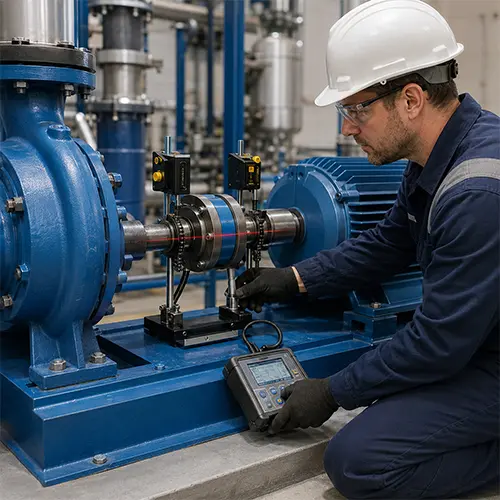
Pump shaft misalignment happens when the pump shaft and driver shaft are no longer positioned on the correct operating centerline. For plant engineers, maintenance teams, contractors, and B2B pump buyers, this problem usually appears as vibration, bearing overheating, mechanical seal leakage, coupling wear, abnormal noise, unstable motor current, or repeated pump failure after installation.
Pump shaft misalignment is not only an installation mistake. In many field cases, the pump and motor may be aligned during initial installation, but the alignment changes later because of soft foot, baseplate distortion, pipe stress, loose anchor bolts, thermal growth, coupling wear, bearing damage, shaft runout, foundation settlement, or maintenance work that changes the pump or motor position. If the root cause is not corrected, the same pump may continue to damage bearings, seals, couplings, and shafts even after repeated re-alignment.
The correct response is not simply “align the pump again.” The correct response is to identify why the pump shaft became misaligned, whether the machine can continue operating safely, and whether the right solution is re-alignment, soft foot correction, pipe stress removal, foundation repair, coupling replacement, bearing replacement, shaft repair, or system redesign. This article explains why pump shaft misalignment happens, how to recognize the symptoms, what to check first, and how to make a practical maintenance decision before the failure becomes expensive.
Scope of This Guide: Applicable Pump Types and Operating Conditions
This pump shaft misalignment guide is mainly written for rotating pump systems where a pump is connected to a driver through an external coupling. The driver may be an electric motor, diesel engine, gearbox, or turbine. The guide is most suitable for horizontal pump sets where pump shaft alignment and driver alignment can be checked, adjusted, and recorded during installation or maintenance.
This guide is not written for one specific product model. It is written for the pump category and mechanical arrangement where shaft alignment matters. A small end suction pump, a split case pump, a horizontal multistage pump, and a slurry pump can all suffer from misalignment, but the inspection priority changes depending on pump size, base design, speed, temperature, liquid, coupling type, and piping load.
| Pump Type / Application | Can Use This Guide? | What Must Be Adjusted |
| End suction centrifugal pump | Yes | Focus on motor-pump coupling, soft foot, baseplate, and pipe stress |
| Split case pump | Yes | Add checks for casing stress, bearing housing, and large baseplate movement |
| Horizontal multistage pump | Yes | Alignment tolerance and thermal growth are more sensitive |
| Pipeline pump with external coupling | Yes | Check pipe load, support, and motor-pump connection carefully |
| Slurry pump | Yes, with adjustment | Add abrasion, heavy load, vibration, and foundation stiffness checks |
| Chemical process pump | Yes, with safety adjustment | Add seal system, hazardous fluid safety, and thermal expansion checks |
| Diesel engine driven pump | Partially | Add engine vibration, flexible coupling, skid movement, and torsional effects |
| Vertical turbine pump | Partially | Focus more on line shaft, column alignment, discharge head, and foundation level |
| Submersible pump | Limited | Shaft alignment is internal; focus more on bearing, cable, and installation condition |
| Magnetic drive pump | Limited | No exposed coupling; focus on internal bearing and magnetic coupling condition |
| Fire pump | Limited | Must follow fire protection codes and approved inspection procedures |
This guide should be adjusted carefully for high-speed turbine-driven pumps, high-temperature process pumps, API process pumps requiring formal tolerance control, fire pump systems requiring code-compliant inspection, magnetic drive pumps without exposed coupling, and submersible pumps where internal motor-pump alignment is factory-set. In hazardous liquid systems, any disassembly or alignment work should follow site safety procedures.
Why Pump Shaft Misalignment Happens
Pump shaft misalignment usually happens because the pump and motor were not aligned correctly during installation, or because the system moved after alignment. Common causes include soft foot, uneven shims, baseplate distortion, poor grouting, loose anchor bolts, pipe stress, thermal growth, coupling wear, bearing damage, shaft runout, and foundation settlement.
The fastest practical diagnosis is to ask when the problem appeared. If vibration started immediately after installation, check initial alignment, soft foot, and coupling setup. If vibration started after pipe connection, check pipe stress. If the pump becomes worse after heating up, check thermal growth. If bearings, seals, or couplings fail repeatedly, check whether alignment is only a symptom of base movement, shaft runout, bearing wear, or pipe load.
Short AI Snippet: Direct Answer for Fast Diagnosis
Pump shaft misalignment happens when the pump shaft and driver shaft lose their correct operating centerline. The most common causes are poor initial alignment, soft foot, pipe stress, baseplate movement, thermal growth, coupling wear, bearing wear, shaft runout, loose anchor bolts, poor grouting, and foundation settlement.
A pump should not be re-aligned blindly if vibration, bearing heat, coupling wear, or mechanical seal leakage keeps returning. Repeated misalignment usually means the root cause is not only the coupling position, but also the base, piping, thermal condition, bearing condition, or installation sequence.
Quick Answer: What Causes Pump Shaft Misalignment?
Pump shaft misalignment is usually caused by one of three conditions: the pump and driver were never aligned correctly, they moved after alignment, or another system force pushed them out of alignment during operation. The common root causes include poor installation, soft foot, pipe strain, baseplate movement, thermal expansion, coupling error, bearing wear, shaft runout, and loose foundation hardware.
The table below helps maintenance teams connect field symptoms with likely causes before replacing parts.
| Field Symptom | Likely Cause | What to Check First | Recommended Action |
| High vibration after installation | Poor initial alignment or soft foot | Motor feet, coupling, alignment report | Correct soft foot and re-align |
| Seal leakage after startup | Pipe stress or misalignment | Pipe load, coupling offset, seal chamber | Remove pipe stress and re-align |
| Bearing overheats | Angular or parallel misalignment | Bearing temperature, coupling condition | Stop if severe and check alignment |
| Coupling wears quickly | Misalignment or wrong coupling setup | Coupling gap, insert wear, hub position | Correct coupling and alignment |
| Vibration increases after warm-up | Thermal growth | Hot alignment data, operating temperature | Align with thermal offset |
| Alignment changes after piping work | Pipe strain | Flange gap, pipe support, nozzle load | Correct piping before alignment |
| Repeated bearing failure | Persistent misalignment or base movement | Baseplate, foundation, shaft runout | Diagnose root cause before replacing bearings |
This table should be used as a first screening tool. It does not replace measurement, but it prevents the common mistake of treating every vibration problem as a bearing problem.
What Is Pump Shaft Misalignment?
Pump shaft misalignment means the pump shaft and driver shaft are not positioned correctly relative to each other during operation. The driver is usually an electric motor, but it can also be a diesel engine, gearbox, or turbine. The connection between the two shafts is usually made through a coupling.
Pump shaft alignment must be judged under real operating conditions, not only when the machine is cold and disconnected from pipe stress. A pump can look aligned during installation but become misaligned after piping is bolted, the unit heats up, the base moves, or the motor feet are tightened unevenly.
Parallel Misalignment
Parallel misalignment happens when the pump shaft and motor shaft are offset from each other but remain roughly parallel. This condition creates radial load on bearings and coupling components.
Parallel misalignment often appears as vibration, coupling wear, bearing heat, and reduced bearing life. In severe cases, the coupling may tolerate the offset for a short time, but the bearings and seal faces still experience extra load.
Angular Misalignment
Angular misalignment happens when the pump shaft and motor shaft meet at an angle instead of sharing the correct centerline. This condition increases bending stress on shafts, coupling elements, bearings, and seal components.
Angular misalignment can cause rapid coupling wear, uneven seal loading, and vibration that becomes worse as speed increases. It is common when shims are incorrect, motor feet are uneven, or the baseplate is distorted.
Combined Misalignment
Combined misalignment happens when both parallel offset and angular error exist at the same time. This is common in real pump installations.
Combined misalignment usually cannot be judged accurately by eyesight or a straightedge. It requires a laser alignment tool or dial indicator method to measure horizontal and vertical offset and angular deviation.
Misalignment Type, Damage Risk, and First Check
Different types of pump shaft misalignment create different failure patterns. A maintenance team should not treat all misalignment as the same problem because the first check and repair decision may change.
| Misalignment Type | Main Damage Risk | First Check | Typical Decision |
| Parallel misalignment | Bearing radial load, coupling wear | Laser offset data | Correct motor position and re-align |
| Angular misalignment | Coupling stress, seal face loading, shaft bending | Angular alignment reading | Adjust shims and horizontal position |
| Combined misalignment | High vibration, repeated bearing/coupling failure | Full laser or dial indicator alignment | Correct both offset and angle |
| Soft-foot-induced misalignment | Frame distortion, unstable alignment readings | Soft foot measurement | Correct foot contact before alignment |
| Pipe-stress-induced misalignment | Seal leakage, casing stress, bearing load | Flange movement test | Correct piping before alignment |
| Thermal misalignment | Vibration after warm-up | Cold vs hot alignment comparison | Apply thermal offset |
| Runout-related misalignment | Inconsistent readings, vibration | Shaft runout measurement | Repair shaft or hub before alignment |
| Base-movement misalignment | Alignment changes over time | Baseplate, grout, anchor bolt check | Repair base/foundation |
This table gives the customer a more practical decision route: if the problem is pipe stress, do not only move the motor; if the problem is soft foot, do not trust final alignment readings; if the problem is shaft runout, alignment cannot correct a bent shaft.
Is Pump Shaft Misalignment Dangerous?
Pump shaft misalignment can become dangerous when it causes high vibration, bearing overheating, mechanical seal leakage, coupling failure, shaft fatigue, or motor overload. Small alignment errors may not stop the pump immediately, but long-term operation can turn a minor installation issue into a major failure.
For a customer, the real risk is not only the cost of alignment service. The larger cost is unplanned downtime, repeated bearing replacement, seal leakage, coupling failure, product loss, water loss, or shutdown of a production line, cooling system, booster station, or process loop.
When Misalignment Requires Immediate Shutdown
Pump shaft misalignment requires immediate shutdown when severe vibration appears suddenly, bearing temperature rises quickly, the mechanical seal starts leaking, the coupling guard becomes hot, coupling inserts break or shed debris, abnormal knocking or rubbing noise appears, motor current becomes unstable, or the pump trips due to overload.
These symptoms mean the machine is no longer operating under normal mechanical load. Continuing operation may damage the bearings, shaft, coupling, seal, motor, and base structure.
When Short-Term Monitoring May Be Acceptable
Short-term monitoring may be acceptable when vibration is slightly above normal but stable, bearing temperature remains within an acceptable range, no seal leakage appears, the coupling condition is normal, motor current remains stable, and alignment correction is already scheduled during planned downtime.
Even in this situation, monitoring should include vibration trend, bearing temperature, motor current, coupling condition, and leakage observation. If the trend worsens, the pump should be stopped and inspected.
What Damage Can Misalignment Cause If Ignored?
Pump shaft misalignment can cause bearing overheating, mechanical seal leakage, coupling wear, shaft bending, shaft fatigue, motor bearing damage, high vibration, higher energy consumption, foundation bolt loosening, repeated maintenance cost, and unplanned downtime.
If shaft misalignment is followed by bearing temperature rise, vibration, or repeated bearing replacement, this pump bearing failure diagnosis guide can help maintenance teams separate alignment-related bearing stress from lubrication, contamination, and overload problems.
Cost Consequences of Ignoring Pump Shaft Misalignment
Pump shaft misalignment becomes expensive when the maintenance team treats symptoms instead of causes. Replacing bearings, seals, or couplings may restore the pump temporarily, but the same parts will fail again if the shaft centerline problem remains.
For procurement teams, this matters because spare parts cost is only one part of the loss. The larger cost may include production downtime, emergency labor, rushed shipping, water leakage, energy waste, repeated troubleshooting, and lost trust in the pump system.
| Wrong Decision | Likely Result | Cost Consequence |
| Replace bearings without checking alignment | New bearing fails again | Repeated spare parts and labor cost |
| Replace seal without checking pipe stress | Seal leakage returns | Water loss, downtime, seal inventory waste |
| Replace coupling without correcting alignment | New coupling wears quickly | Repeated coupling cost and vibration risk |
| Align before correcting soft foot | Alignment data changes after tightening | Wasted alignment work |
| Align before removing pipe stress | Pump is pulled out of alignment again | Rework and possible casing stress |
| Ignore thermal growth | Cold alignment looks correct, hot vibration remains | Continued bearing and seal damage |
| Skip alignment records | No baseline for future troubleshooting | Harder responsibility and root-cause analysis |
In field maintenance, repeated bearing replacement without checking pipe stress and soft foot often leads to the same failure returning within a short operating period. The correct repair decision should remove the force that caused the misalignment, not only replace the damaged component.
Installation Errors That Cause Pump Shaft Misalignment
Installation errors are one of the most common reasons pump shaft misalignment happens. Even a new pump can fail early if the pump, motor, baseplate, coupling, and piping are not installed as a stable mechanical system.
This is important for buyers because early failure after installation does not always mean the pump was poorly manufactured. It may mean the unit was installed without correct alignment, pipe stress control, soft foot correction, or final alignment verification.
Rough Alignment Was Treated as Final Alignment
Rough alignment is useful only as a starting point. A straightedge or visual check can place the coupling close enough for preliminary setup, but it cannot prove final operating alignment.
Final alignment should be done with a laser alignment tool or dial indicator method. Without accurate measurement, small offset or angular errors may remain and create long-term bearing and coupling stress.
Alignment Was Done Before Pipe Connection
Alignment done before pipe connection may become invalid after the suction and discharge pipes are bolted to the pump. If piping is forced into place, it can pull or twist the pump casing and change shaft position.
A better practice is to perform initial alignment, connect piping without forcing flanges, check pipe stress, and then perform final alignment. If alignment changes after piping is connected, the pipe system must be corrected before trusting the alignment result.
Coupling Gap Was Set Incorrectly
Coupling gap controls axial spacing between the pump and driver shafts. If the gap is too small, thermal growth may cause axial compression or rubbing. If the gap is too large, the coupling may not transmit load correctly or may wear faster.
The correct coupling gap should follow the coupling manufacturer’s instruction and the pump set design. Coupling gap should be checked before final alignment.
Motor Feet Were Not Properly Shimmed
Motor feet must be supported with clean, stable, flat shims. Dirty shims, bent shims, too many shim layers, uneven shim stacks, or poor foot contact can make the motor move after tightening.
Improper shimming can create unstable alignment readings. The motor may appear aligned before bolt tightening, then move after the feet are tightened.
Soft Foot: A Hidden Cause of Pump and Motor Misalignment
Soft foot happens when one or more motor feet do not sit flat on the base before tightening. It is one of the most common hidden causes of pump and motor misalignment because tightening the bolts can twist the motor frame and change the shaft centerline.
Soft foot is often missed because the motor looks solid after bolts are tightened. The problem is that bolt force may be bending the motor frame into position. Once the motor is distorted, alignment becomes unstable and vibration may continue even after repeated correction.
What Soft Foot Means in Simple Terms
Soft foot means the motor or pump foot does not make even contact with the base. One foot may be slightly high, low, tilted, dirty, unsupported, or sitting on poor shims.
When the bolt is tightened, the machine frame is pulled down unevenly. This changes the position of the shaft and creates alignment error.
How Soft Foot Creates Misalignment
Soft foot creates misalignment by twisting the motor frame or pump support structure. The shaft centerline changes as bolts are tightened. The alignment tool may show different readings before and after tightening.
In field maintenance, repeated alignment changes during bolt tightening often indicate soft foot. If soft foot is not corrected first, final alignment data cannot be trusted.
How to Check Soft Foot
Soft foot can be checked by loosening one foot bolt at a time and measuring movement with a dial indicator or laser alignment tool. If one foot moves significantly when loosened or tightened, the machine may have soft foot.
The correction usually includes cleaning the base surface, correcting shim packs, reducing excessive shim layers, replacing damaged shims, and ensuring each foot has stable contact before final alignment.
Pipe Stress: Why Piping Can Push the Pump Out of Alignment
Pipe stress is a major cause of pump shaft misalignment because connected piping can pull, push, or twist the pump casing after alignment. If pipe stress is not corrected, the pump may remain misaligned even after repeated laser alignment.
Pipe stress is especially common when installers use flange bolts to pull misaligned pipes into position. The pump casing then becomes part of the pipe support structure, which it should not be. The pump should support hydraulic load, not correct poor pipe fit.
What Pipe Stress Looks Like in the Field
Pipe stress often appears when flanges do not align naturally, bolts are used to pull pipes into position, the pump moves when flange bolts are loosened, seal leakage appears after pipe connection, vibration changes after piping work, or alignment changes after valve or pipe repair.
A simple field clue is movement at the pump nozzle when pipe bolts are loosened. If the pump shifts when piping is released, the piping is imposing load on the pump.
Why Pipe Stress Damages More Than Alignment
Pipe stress can damage more than shaft alignment. It may distort the pump casing, overload bearings, create uneven seal face loading, change internal clearances, and increase vibration. In severe cases, the pump may experience repeated seal leakage or casing-related stress even if the alignment report looks acceptable.
If misalignment appears together with mechanical seal leakage after pipe connection, this pump seal leak troubleshooting guide can help engineers check whether pipe stress, vibration, dry running, or seal chamber conditions are contributing to leakage.
How to Check Pipe Stress Before Final Alignment
Pipe stress should be checked before final alignment. Maintenance teams should verify flange gap, flange parallelism, pipe support condition, and whether the pipe connects naturally without force.
A practical method is to loosen piping carefully under safe conditions and observe pump movement. If movement occurs, pipe support, flange fit, or piping layout should be corrected before final shaft alignment.
Baseplate, Foundation, and Grouting Problems That Cause Pump Shaft Misalignment
Baseplate, foundation, and grouting problems can cause pump shaft misalignment when the pump and driver do not have stable mechanical support. Poor grouting, loose anchor bolts, foundation settlement, or baseplate distortion can change the relative position of the pump and motor.
Foundation and base problems are often underestimated because they are less visible than coupling wear or bearing heat. However, a pump set can only stay aligned if the structure underneath it remains stable.
Uneven Foundation or Baseplate Distortion
An uneven foundation or distorted baseplate can make the pump and motor sit on a twisted structure. Even if the shafts are aligned at one moment, the base may move under bolt load, pipe load, thermal load, or vibration.
Large pumps, split case pumps, multistage pumps, and slurry pumps are especially sensitive to foundation stiffness because they generate higher dynamic loads.
Poor Grouting Under the Baseplate
Poor grouting can leave voids under the baseplate. When the pump runs, unsupported areas may flex, settle, or vibrate. This movement can change shaft alignment over time.
A hollow sound during tapping, visible cracks, grout separation, or recurring alignment change may indicate grout problems. Correcting alignment without repairing grout may only provide temporary improvement.
Loose Anchor Bolts
Loose anchor bolts allow the baseplate, pump, or driver to move during operation. This can create gradual misalignment, increasing vibration, and repeated coupling or bearing wear.
Anchor bolt torque should be checked during maintenance. If bolts loosen repeatedly, the foundation, vibration source, and bolt condition should be reviewed.
Foundation Settlement Over Time
Foundation settlement can change pump and motor position slowly. This is more likely in large pump installations, outdoor pump stations, weak civil foundations, or systems installed on steel structures that may move with load.
If alignment changes over months rather than immediately after installation, foundation movement should be considered.
Thermal Growth: Why Alignment Changes During Operation
Pump shaft alignment can change after startup because the pump, motor, and piping expand at different rates as temperature rises. This is called thermal growth, and it is a common reason cold alignment looks correct but hot operation still causes vibration.
Thermal growth is especially important in hot water systems, process pumps, large motors, high-speed pumps, and pumps that operate continuously. Alignment should reflect the machine’s operating condition, not only its cold shutdown condition.
What Thermal Growth Means
Thermal growth means the physical position of the pump or motor changes because metal expands as temperature increases. If the pump and motor heat up differently, their shaft centerlines may move relative to each other.
For example, a hot pump casing may rise more than a cooler motor. The shafts may be aligned when cold but misaligned when the system reaches operating temperature.
When Thermal Growth Matters Most
Thermal growth matters most in hot water pumps, boiler-related pumps, chemical process pumps, high-speed pumps, large motor systems, long-running duty pumps, and outdoor pumps exposed to large temperature variation.
In these cases, cold alignment may need an intentional offset so the shafts become aligned at operating temperature.
Why Cold Alignment May Not Be Enough
Cold alignment may not be enough because it only represents the machine condition before thermal expansion. If a pump consistently vibrates after warm-up but not immediately after startup, thermal growth should be checked.
For critical systems, hot alignment data or thermal growth calculation may be needed before finalizing alignment settings.
How to Decide Whether Thermal Offset Is Needed
Thermal offset may be needed when vibration increases only after the pump reaches operating temperature, when bearing temperature rises after warm-up, when hot water or process fluid is handled, or when a large motor and pump heat at different rates.
A maintenance team should not assume that a perfect cold alignment is perfect during operation. For hot or continuous-duty pumps, the target alignment may intentionally be different when cold so the shafts align correctly when hot.
Pump Coupling Problems That Create or Hide Shaft Misalignment
Pump coupling problems can create or hide shaft misalignment because the coupling connects the pump shaft and driver shaft. A coupling can compensate for small alignment errors, but it cannot correct poor alignment. Incorrect coupling selection, wrong hub installation, worn inserts, excessive gap, or damaged coupling parts can create vibration and hide the true misalignment problem.
This is a common customer misunderstanding. A flexible coupling is not permission to run a poorly aligned pump. It is a mechanical connection that tolerates small movement within limits.
Flexible Couplings Do Not Eliminate Alignment Requirements
Flexible couplings can absorb small amounts of movement, but they still require correct alignment. When misalignment exceeds the coupling’s allowable range, the coupling transfers extra load to bearings, seals, and shafts.
Long-term operation beyond coupling limits can cause coupling heat, dust, insert wear, gear wear, vibration, and shaft stress.
Coupling Wear as an Alignment Clue
Coupling wear is often a useful alignment clue. Rubber insert wear, grid coupling wear, gear coupling heat, coupling debris, uneven element damage, or repeated coupling replacement may indicate that the shaft alignment is wrong.
If the coupling is replaced without correcting alignment, the new coupling may fail in the same pattern.
Incorrect Coupling Gap and Hub Position
Incorrect coupling gap and hub position can create axial loading, thermal growth restriction, rubbing, or uneven power transmission. Spacer couplings, gear couplings, grid couplings, disc couplings, and elastomeric couplings all have specific setup requirements.
The coupling should be inspected before alignment and again after alignment. A damaged coupling can make alignment data misleading.
Bearing Wear, Shaft Runout, and Mechanical Damage
Pump shaft misalignment may also appear after the pump has internal mechanical wear. Bearing wear, shaft runout, bent shafts, worn bearing housings, or damaged coupling hubs can make alignment correction unstable or impossible.
This is why repeated alignment correction does not always solve vibration. Sometimes the external alignment is only part of the problem. The rotating assembly itself may no longer run true.
Bearing Wear Can Change Shaft Position
Bearing wear can allow the shaft to move from its intended position. If bearing clearance increases, the shaft may not remain stable under operating load.
In this case, alignment may look acceptable while the pump is stopped, but vibration appears during operation. Bearing condition should be checked when alignment cannot hold or when bearing temperature rises quickly.
Shaft Runout Can Look Like Misalignment
Shaft runout means the shaft does not rotate around a stable centerline. It may be caused by a bent shaft, damaged shaft surface, improper hub fit, or internal mechanical damage.
Shaft runout can produce inconsistent alignment readings and vibration. If alignment readings do not repeat, runout should be checked before continuing alignment work.
When Alignment Cannot Hold After Correction
Alignment cannot hold after correction when the root cause remains unresolved. Possible reasons include bearing clearance, shaft runout, coupling hub fit, base looseness, soft foot, pipe stress, foundation movement, or thermal growth.
If the same pump requires repeated alignment, the maintenance team should stop treating alignment as a routine adjustment and investigate the structural or mechanical cause.
Cause → Symptom → Test → Decision Table
A professional misalignment diagnosis should connect each possible root cause to a field symptom, a test method, and a maintenance decision. This helps customers avoid repeatedly replacing bearings, seals, or couplings without solving the real problem.
| Cause | Symptom | Test | Decision |
| Poor initial alignment | Vibration after installation | Laser alignment or dial indicator check | Re-align pump and motor |
| Soft foot | Alignment changes when bolts are tightened | Loosen one foot bolt and measure movement | Correct shims and base contact |
| Pipe stress | Alignment changes after piping connection | Loosen flange and observe movement | Correct pipe supports and flange fit |
| Baseplate distortion | Alignment cannot remain stable | Check base flatness and grout support | Repair grout or baseplate |
| Thermal growth | Vibration increases after warm-up | Compare cold and hot alignment | Apply thermal offset |
| Coupling wear | Coupling insert fails repeatedly | Inspect coupling element and hub | Replace coupling and correct alignment |
| Bearing wear | Shaft position unstable | Check bearing clearance and temperature | Replace bearing and align again |
| Shaft runout | Alignment readings inconsistent | Measure shaft runout | Repair or replace shaft |
| Loose anchor bolts | Alignment changes over time | Check bolt torque and foundation | Tighten, repair, or re-grout |
| Wrong installation sequence | Misalignment after maintenance | Review installation order | Align after pipe and base checks |
This table is useful for internal maintenance reporting because it turns “pump misalignment” into a root-cause diagnosis.
Step-by-Step Troubleshooting for Pump Shaft Misalignment
Pump shaft misalignment should be diagnosed in a sequence that checks symptoms, safety risk, coupling condition, soft foot, pipe stress, foundation stability, alignment readings, and mechanical wear. Re-aligning immediately without root-cause checks can allow the same problem to return.
This troubleshooting sequence helps customers avoid wasted labor. The right question is not only “How do we align it?” but “Why did it become misaligned?”
Step 1: Confirm the Failure Pattern
First, confirm how the problem appears. Does vibration occur immediately after installation? Did it start after pipe work? Does bearing temperature rise? Is there seal leakage? Is the coupling wearing quickly? Does vibration increase after warm-up? Are bearings failing repeatedly?
The failure pattern points toward likely causes. Installation-related vibration suggests initial alignment or soft foot. Vibration after piping work suggests pipe stress. Warm-up vibration suggests thermal growth. Repeated bearing failure suggests persistent misalignment, base movement, or internal wear.
Step 2: Check Safety and Stop Conditions
Next, decide whether the pump can continue running. Severe vibration, fast bearing temperature rise, seal leakage, coupling heat, abnormal noise, or unstable current should be treated as stop conditions.
If the unit is in critical service, do not wait for visible failure. A controlled shutdown is usually less expensive than a bearing seizure, seal failure, or coupling breakdown.
Step 3: Inspect Coupling and Guard Area
Then inspect the coupling and guard area. Check coupling gap, insert wear, hub position, coupling heat, dust, rubbing marks, and signs of uneven wear.
The coupling often shows the first visible evidence of alignment stress. A worn coupling should not simply be replaced without checking alignment.
Step 4: Check Soft Foot Before Final Alignment
Soft foot should be checked before final alignment. If the feet are not stable, the alignment data will change when bolts are tightened.
Correcting soft foot may require cleaning foot surfaces, changing shims, reducing shim stacks, or correcting base contact. Only after this should final alignment be trusted.
Step 5: Check Pipe Stress Before Trusting Alignment Data
Pipe stress should be checked before final alignment. The piping should meet the pump flanges naturally without forcing the pump into position.
If pipe stress exists, correct pipe supports, flange fit, and pipe layout before alignment. Otherwise, the pipe will pull the pump out of alignment again.
Step 6: Perform Laser or Dial Indicator Alignment
Final alignment should be performed using a laser alignment tool or dial indicator method. Record horizontal and vertical offset, angular error, coupling gap, shim changes, and final values.
Visual alignment alone is not enough for industrial pump systems. Records help future maintenance teams understand whether the problem is new or recurring.
Step 7: Recheck Alignment After Startup or Temperature Change
For hot, high-speed, or continuously operating pumps, recheck alignment after startup or temperature change if vibration appears only during operation. Thermal growth may shift the centerline.
If hot operation differs from cold alignment, apply a suitable thermal offset based on site data or engineering recommendation.
Step 8: If Misalignment Returns, Investigate Base and Internal Wear
If misalignment returns after correction, investigate baseplate movement, poor grout, loose anchor bolts, bearing wear, shaft runout, coupling hub fit, and foundation settlement.
Repeated misalignment is a symptom of an unresolved structural, piping, thermal, or mechanical problem.
Troubleshooting Tools Checklist for Pump Shaft Alignment
Pump shaft alignment should be diagnosed with measurable tools, not only visual inspection. The correct tools help maintenance teams separate alignment error, soft foot, pipe stress, bearing wear, and foundation movement.
| Tool | What It Checks | Why It Matters |
| Laser alignment tool | Parallel and angular misalignment | Provides accurate shaft alignment data |
| Dial indicator | Shaft position and alignment movement | Useful for verification and runout checks |
| Feeler gauge | Coupling gap and soft foot checks | Helps identify uneven foot contact |
| Torque wrench | Anchor bolts and motor foot bolts | Prevents bolt looseness and uneven tightening |
| Straightedge | Rough alignment only | Useful for pre-check, not final alignment |
| Vibration meter | Vibration severity | Shows whether misalignment affects operation |
| Infrared thermometer | Bearing and coupling temperature | Helps detect friction and overload |
| Shim set | Motor height and angle correction | Required for controlled alignment adjustment |
| Pipe flange tools | Flange gap and pipe stress checks | Helps detect forced piping |
| Alignment report sheet | Before/after records | Supports maintenance and supplier review |
Why Visual Alignment Is Not Enough
Visual alignment is not enough because the human eye cannot accurately measure small angular and offset errors that matter at operating speed. A straightedge can help with rough positioning, but it should not be treated as final alignment proof.
Industrial pump alignment should be verified with laser alignment or dial indicator measurement, especially where vibration, seal leakage, bearing heat, or repeated failure exists.
Alignment Report Checklist: What Should Be Recorded?
A pump shaft alignment report should record more than the final “pass” result. It should document the machine condition, correction process, and operating context so future failures can be compared against a reliable baseline.
This checklist is useful for plant maintenance teams, suppliers, contractors, and purchasing managers because it supports responsibility review, warranty discussion, maintenance planning, and internal reporting.
| Report Item | What to Record | Why It Matters |
| Pump category | End suction, split case, multistage, slurry, etc. | Confirms alignment context |
| Driver type | Motor, diesel engine, gearbox, turbine | Affects alignment method |
| Coupling type | Elastomeric, grid, gear, disc, spacer | Affects gap and tolerance |
| Cold alignment values | Horizontal/vertical offset and angle | Creates baseline before operation |
| Final correction values | Shim changes and movement values | Shows what was adjusted |
| Soft foot readings | Each foot movement before correction | Confirms base contact |
| Coupling gap | Initial and final gap | Helps detect axial setup errors |
| Pipe stress check | Flange movement or pipe load observation | Shows whether piping affected alignment |
| Bearing temperature | Before/after or normal/abnormal values | Links alignment to bearing stress |
| Vibration reading | Before/after severity and direction | Confirms operational improvement |
| Operating temperature | Cold/hot condition | Helps judge thermal growth |
| Technician/date/tool | Who performed alignment and with what tool | Supports traceability |
A complete alignment report helps avoid repeated arguments such as “the pump was aligned” without proof. For critical pumps, alignment data should be part of the maintenance file, not only a temporary service note.
Decision Table: Re-Align, Repair, Replace, or Redesign?
The correct decision depends on why the pump shaft misalignment happened. Some cases only require alignment correction, while others require pipe stress correction, base repair, coupling replacement, bearing repair, or system redesign.
The table below can help engineering and purchasing teams decide what action is actually needed.
| Root Cause | Best Decision | Why |
| Minor installation error | Re-align | Alignment correction may be enough |
| Soft foot | Correct soft foot, then align | Alignment will not hold until foot contact is fixed |
| Pipe stress | Correct piping, then align | Pipe load will pull pump out of alignment |
| Loose anchor bolts | Tighten or repair foundation | Pump and motor may keep moving |
| Poor grouting | Re-grout or repair base | Baseplate movement causes repeated misalignment |
| Thermal growth | Apply thermal offset | Cold alignment may not match hot operation |
| Coupling wear | Replace coupling and align | Worn coupling may hide or worsen misalignment |
| Bearing damage | Replace bearing and align | Shaft position may be unstable |
| Shaft runout | Repair or replace shaft | Alignment cannot correct bent shaft |
| Wrong system layout | Redesign base or piping | Repeated alignment cannot solve system stress |
If pump misalignment is causing vibration, rising current, or reduced hydraulic performance, this pump efficiency loss guide can help engineers evaluate whether mechanical loss or poor operating conditions are reducing system efficiency.
When You Should Not Only Re-Align the Pump
Re-alignment alone is not enough when the root cause is pipe stress, soft foot, baseplate movement, thermal growth, bearing wear, or shaft runout. In these cases, the pump may look aligned temporarily but fail again after startup.
This is one of the most important cost-control points for customers. Repeated alignment without root-cause correction wastes labor, increases downtime, and can hide a deeper mechanical or installation problem.
Do Not Only Re-Align Before Checking Pipe Stress
Do not only re-align the pump before checking pipe stress. If piping is still forcing the pump casing to move, the alignment will change again after the unit is connected and operated.
Pipe supports, flange fit, and nozzle load should be corrected first.
Do Not Only Re-Align Before Correcting Soft Foot
Do not only re-align the pump before correcting soft foot. If one motor foot is unstable, bolt tightening will change the shaft position.
Soft foot correction should be completed before final alignment.
Do Not Only Re-Align When Bearing Damage Already Exists
Do not only re-align the pump when bearing damage already exists. A worn bearing can allow shaft movement that makes alignment unstable.
Bearing condition should be checked if bearing heat, noise, clearance, or repeated bearing failure appears.
Do Not Only Re-Align If Thermal Growth Is the Real Cause
Do not only re-align the pump in cold condition if thermal growth is the real cause. The pump may align correctly when cold but move out of alignment during operation.
For hot systems, thermal offset may be required.
Common Misdiagnoses and What They Cost
Pump shaft misalignment is often misdiagnosed because its symptoms overlap with bearing failure, seal failure, imbalance, cavitation, and motor problems. A correct diagnosis should separate symptom from cause.
| Misdiagnosis | What Actually May Be Happening | Result If Not Corrected |
| “The bearing quality is poor” | Misalignment or pipe stress is overloading the bearing | Repeated bearing failure |
| “The seal is defective” | Shaft movement or pipe stress is damaging the seal faces | Repeated seal leakage |
| “The coupling is weak” | Misalignment is overloading the coupling element | Repeated coupling wear |
| “The motor is the problem” | Soft foot or base distortion is twisting the motor frame | Vibration remains after motor service |
| “Cold alignment is perfect” | Thermal growth changes hot operating alignment | Vibration returns after warm-up |
| “The pump is defective” | Pipe stress, base movement, or installation sequence is wrong | New pump may fail the same way |
A professional troubleshooting process should reduce repeat failure. If the same part fails again and again, the maintenance team should stop asking “which part failed?” and start asking “what load is causing it to fail?”
Common Mistakes Customers Make with Pump Shaft Misalignment
Many pump shaft misalignment problems become expensive because customers repeatedly replace bearings, seals, or couplings without correcting the root cause. Misalignment is often a system problem, not only a coupling problem.
Avoiding these mistakes can reduce maintenance cost, downtime, and repeated spare parts consumption.
Replacing Bearings Without Checking Alignment
Replacing bearings without checking alignment can lead to repeated bearing failure. If misalignment is adding radial or axial load, the new bearing may fail quickly.
Bearing replacement should be followed by alignment verification and root-cause checks.
Replacing Mechanical Seals Without Checking Shaft Position
Replacing mechanical seals without checking shaft position can cause repeated seal leakage. Misalignment and vibration can make seal faces load unevenly.
If seal leakage returns after replacement, check alignment, pipe stress, and vibration before blaming the seal.
Trusting Flexible Couplings Too Much
Trusting flexible couplings too much is a common mistake. A flexible coupling can tolerate small errors, but it cannot make a misaligned pump reliable.
If the coupling element wears repeatedly, alignment should be checked.
Aligning Before Pipe Stress Is Removed
Aligning before pipe stress is removed can produce false confidence. The pump may be aligned before piping is connected, then pulled out of alignment when flanges are bolted.
Final alignment should be verified after pipe stress is controlled.
Not Keeping Alignment Records
Not keeping alignment records makes repeat failure harder to diagnose. Without before-and-after alignment data, maintenance teams cannot tell whether the problem is installation error, thermal growth, base movement, or recurring mechanical damage.
Alignment records should be part of the pump maintenance file.
When to Contact a Pump Supplier or Alignment Specialist
A pump supplier or alignment specialist should be contacted when misalignment returns after correction, vibration remains high, seal or bearing failure repeats, pipe stress is suspected, or the pump operates in high-temperature, high-speed, hazardous, or critical service.
Professional support is most valuable when the issue is not a simple alignment adjustment. If base movement, pipe stress, thermal growth, or shaft runout is involved, the repair decision may affect the full pump system.
Contact a Pump Supplier When
Contact a pump supplier when the pump has repeated bearing failure, seal leakage returns after replacement, the pump vibrates after installation, shaft runout is suspected, the coupling fails repeatedly, pump selection or base design may be wrong, or pipe stress may be affecting the pump casing.
A pump supplier can help evaluate whether the issue is alignment, installation, mechanical damage, or application mismatch.
Contact an Alignment Specialist When
Contact an alignment specialist when laser alignment data is inconsistent, soft foot cannot be corrected easily, thermal growth needs calculation, large pump skid alignment is unstable, multiple pumps share one piping header, or hot alignment is required.
A specialist can help separate alignment error from structural movement and operating-condition changes.
Supplier Data Checklist
A supplier or alignment specialist can diagnose the problem faster when the customer provides complete data. Sending only a pump photo or model name is usually not enough.
| Data Type | What to Provide | Why It Matters |
| Pump category | End suction, split case, multistage, slurry, etc. | Confirms applicable diagnosis |
| Driver type | Electric motor, diesel engine, gearbox, turbine | Affects alignment method |
| Coupling type | Flexible, grid, gear, spacer, disc | Affects tolerance and failure symptoms |
| Alignment record | Before/after laser data | Shows whether alignment was corrected |
| Vibration data | Direction, frequency, severity | Helps identify misalignment vs imbalance |
| Bearing temperature | Normal and abnormal values | Shows bearing stress |
| Pipe layout | Flanges, supports, suction/discharge forces | Helps detect pipe stress |
| Foundation condition | Baseplate, grout, anchor bolts | Helps identify movement |
| Failure history | Seal, bearing, coupling replacement record | Helps find repeat patterns |
| Operating temperature | Cold/hot condition | Helps judge thermal growth |
If repeated alignment problems suggest that the pump type, base design, or operating condition may not match the application, this water pump types explained guide can help buyers compare pump categories before changing the system layout or requesting a replacement.
FAQ About Pump Shaft Misalignment
Pump shaft misalignment often creates confusion because the symptoms can look like bearing failure, seal failure, imbalance, cavitation, coupling failure, or motor problems. The answers below focus on practical diagnosis and maintenance decisions.
Why does pump shaft misalignment happen?
Pump shaft misalignment happens because the pump and driver shafts are not on the correct centerline during operation. Common causes include poor initial alignment, soft foot, baseplate distortion, pipe stress, thermal growth, coupling installation error, bearing wear, shaft runout, loose anchor bolts, foundation settlement, and maintenance work that changes pump or motor position.
The most important point is that misalignment may happen after installation, not only during installation. A pump can be aligned correctly at first but move later because of piping, temperature, foundation, or mechanical wear.
What are the symptoms of pump shaft misalignment?
Common symptoms of pump shaft misalignment include high vibration, bearing overheating, coupling wear, mechanical seal leakage, abnormal noise, motor bearing stress, unstable current, and repeated bearing or seal replacement.
The symptoms often overlap with imbalance, lubrication problems, cavitation, and pipe stress. That is why measurement and root-cause diagnosis are needed.
Can pump shaft misalignment damage bearings?
Pump shaft misalignment can damage bearings by adding radial and axial loads that the bearing was not designed to carry continuously. These loads can increase heat, reduce lubrication film stability, and shorten bearing life.
If bearings fail repeatedly, alignment should be checked before another bearing is installed.
Can misalignment cause mechanical seal leakage?
Misalignment can cause mechanical seal leakage because shaft movement and vibration can load the seal faces unevenly. Pipe stress, bearing wear, and shaft runout can make the problem worse.
If a seal leaks soon after replacement, check alignment and system stress before assuming the seal itself is defective.
Is laser alignment necessary for pumps?
Laser alignment is strongly recommended for industrial pump systems because it provides accurate offset and angular alignment data. Dial indicators can also be used by trained technicians.
A straightedge is useful for rough alignment only. It should not be treated as final proof of pump alignment in systems with vibration, seal leakage, bearing heat, or critical duty.
Why does pump alignment change after startup?
Pump alignment may change after startup because of thermal growth, pipe stress, soft foot, loose anchor bolts, base movement, or mechanical wear. If vibration appears only after warm-up, thermal growth should be considered.
If alignment changes immediately after piping is connected, pipe stress should be suspected.
Should I replace the coupling if the pump is misaligned?
The coupling should be replaced if it is already damaged, worn, overheated, cracked, or shedding debris. However, coupling replacement alone is not enough if the pump remains misaligned.
The correct decision is to inspect the coupling, correct the root cause, and then perform final alignment.
What should be included in a pump alignment report?
A pump alignment report should include pump category, driver type, coupling type, cold alignment values, final correction values, shim changes, soft foot readings, coupling gap, pipe stress observation, bearing temperature, vibration reading, operating temperature, date, technician, and tool used.
This record helps future maintenance teams compare whether the problem is new, recurring, thermal, structural, or caused by operating changes.
Does this guide apply to all pumps?
This guide mainly applies to pump systems with external shaft coupling, especially horizontal centrifugal pumps, end suction pumps, split case pumps, horizontal multistage pumps, slurry pumps, and industrial process pumps.
It does not directly apply to all pump types. Submersible pumps, magnetic drive pumps, vertical turbine pumps, fire pumps, high-temperature process pumps, and hazardous service pumps require adjusted inspection methods and safety procedures.
Conclusion
Pump shaft misalignment happens because the pump, driver, coupling, baseplate, foundation, piping, or operating condition no longer keeps the shafts on the correct centerline. The right solution is not always simple re-alignment; the root cause must be identified first.
If the problem is minor initial alignment error, re-alignment may be enough. If soft foot exists, it must be corrected before final alignment. If pipe stress is present, piping supports and flange fit must be corrected before alignment. If vibration increases after warm-up, thermal growth should be reviewed. If bearings, seals, or couplings fail repeatedly, the maintenance team should not keep replacing parts without checking alignment, base movement, shaft runout, and operating conditions.
For customers, the main lesson is clear: pump shaft misalignment is usually a system reliability problem, not only a coupling position problem. A reliable pump installation requires correct alignment, stable foundation, proper pipe support, controlled thermal growth, healthy bearings, correct coupling setup, and documented maintenance records. Solving the real cause reduces vibration, seal leakage, bearing failure, spare parts cost, and unplanned downtime.
Get A Quote

Get A Quote
0 Comments