
VFD vs Fixed Speed Energy Comparison: How Buyers Can Choose the Lower-Cost Pump System
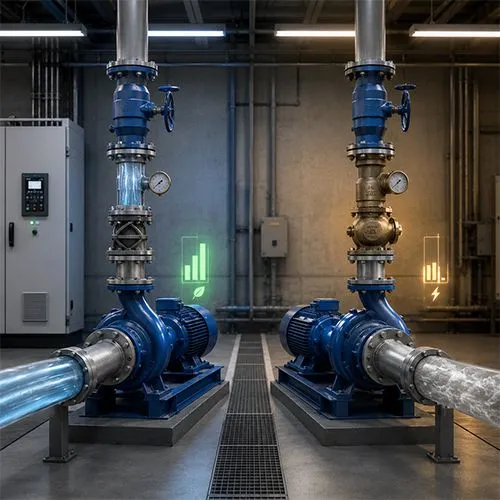
A VFD vs fixed speed energy comparison should not start with the question “Does a VFD save energy?” The better question is: does your pump system have variable demand, enough friction head, long operating hours, and the right control conditions for a Variable Frequency Drive to reduce real kW consumption?
A VFD vs fixed speed energy comparison compares the real annual electricity cost, control suitability, system curve behavior, operating hours, and payback period of a variable-speed pump system and a constant-speed pump system under the same site duty profile.
A VFD pump system can reduce electricity cost when flow demand changes and the pump does not need to run at full speed all the time. A fixed speed pump system can be more cost-effective when flow and head are stable, the pump is correctly sized, and the operating point is close to the Best Efficiency Point. The wrong choice can waste energy, increase maintenance cost, or create control problems.
Quick Answer: Is a VFD Pump More Energy Efficient Than a Fixed Speed Pump?
A VFD pump is usually more energy efficient than a fixed speed pump when system demand varies, the pump runs many hours per year, and speed reduction can reduce real flow or pressure without violating process requirements. A fixed speed pump can be more efficient and reliable when the system has stable flow, stable head, low variation, correct pump sizing, and no heavy throttling.
Best answer: A VFD is usually better when pump demand varies and friction loss is significant, while a fixed speed pump is usually better when flow and head are stable, the pump is correctly sized, and the operating point stays near BEP.
In simple terms:
- Choose a VFD pump system when demand changes during the day, pressure varies, flow is often below peak demand, and the existing pump is controlled by throttling.
- Choose a fixed speed pump system when demand is constant, the pump operates near BEP, the system curve is stable, and the extra cost and complexity of VFD control are not justified.
- Do not choose VFD only because the supplier says “VFD saves energy.” Ask for a pump curve, system curve, power curve, duty profile, expected kW reduction, payback calculation, and commissioning acceptance data.
Key takeaway: VFD saves energy by reducing speed under partial demand. Fixed speed saves money by staying simple and efficient when the duty point is stable and correctly selected.
30-Second Decision Table: VFD or Fixed Speed?
This table gives buyers a fast first judgment before asking suppliers for detailed calculations. It does not replace engineering selection, but it helps avoid the common mistake of treating VFD as automatically better.
| Site Condition | Better First Choice | Why |
|---|---|---|
| Flow changes frequently | VFD pump system | Speed can follow demand and reduce kW |
| Flow and head are stable | Fixed speed pump | Simpler, lower cost, easier maintenance |
| Pump is heavily throttled | VFD or impeller correction | Throttling wastes pressure energy |
| Pump runs only a few hours per week | Fixed speed pump | VFD payback may be weak |
| Pump runs 4,000–8,000 hours per year | VFD may be worth checking | Long runtime improves payback potential |
| System has mostly friction head | VFD often saves more | Speed reduction reduces flow and friction loss |
| System has mostly static head | VFD savings may be limited | Static lift does not reduce much with speed |
| Process needs constant flow | Fixed speed or controlled system | VFD may disturb process if poorly tuned |
| Pressure demand varies | VFD pump system | Maintains setpoint with lower speed |
| Supplier cannot provide curves | Do not approve yet | Energy claim is not proven |
The most important point is that buyers should compare systems using measured or calculated operating conditions. A VFD selected without system data is a risk, not a guarantee.
30-Second Field Check: Is Your Pump a Good VFD Candidate?
Many buyers ask about VFD only after seeing high electricity cost, throttled valves, unstable pressure, or repeated pump complaints. This field check helps the buyer decide whether VFD is worth evaluating before paying for a retrofit or new pump package.
| Field Observation | What It Means | First Action |
|---|---|---|
| Discharge valve is often partly closed | Possible throttling loss | Measure flow, head, kW, and valve position |
| Pump runs many hours at partial load | VFD may save energy | Build duty profile by operating hours |
| Flow demand changes by time or season | VFD or multi-pump system may fit | Compare demand profile with pump curve |
| System has high static lift | VFD savings may be limited | Split static head and friction head |
| Pump runs near one stable duty point | Fixed speed may be better | Check BEP and operating point |
| Existing pump is severely oversized | VFD may not be enough | Review impeller trim or replacement |
| Motor is old or not inverter-duty | VFD retrofit risk exists | Check motor insulation, cooling, cables |
| Pressure setpoint changes often | VFD may improve control | Confirm sensor location and control logic |
| Continuous bypass flow exists | Useful flow may be lower than pump output | Check whether bypass is required or caused by oversizing |
| Pump starts and stops frequently | Control or storage issue may exist | Review pressure tank, sequencing, and VFD option |
This table helps buyers avoid two common mistakes: installing VFD where fixed speed is already suitable, or keeping fixed speed where variable demand is wasting electricity every day.
Scope of This Guide: Which Pump Systems Does This Apply To?
This guide applies mainly to centrifugal pump systems where energy consumption depends on flow, head, system resistance, pump curve, motor load, control method, and operating hours. It is most useful for water supply, HVAC circulation, cooling water, industrial water transfer, municipal pumping, irrigation, booster systems, RO pretreatment, wastewater transfer, and process water circulation.
The comparison is most valuable when the buyer needs to decide whether to buy a new VFD pump system, keep a fixed speed pump, retrofit VFD control to an existing pump, trim the impeller, resize the pump, or redesign the piping system.
Applicable Pump Types
This comparison is suitable for common centrifugal pump systems where speed control or fixed speed selection affects electricity cost and reliability.
| Pump Type | VFD Potential | Fixed Speed Potential | Notes for Buyers |
|---|---|---|---|
| End suction pump | Medium to high | High in stable duty | Common for water transfer and process service |
| Split case pump | High | High in stable large-flow systems | Small efficiency changes can mean large annual cost |
| Multistage pump | Medium to high | Medium to high | Pressure control and minimum flow must be checked |
| Inline pump | High in HVAC | Medium | Often used with VFD in building circulation |
| Pipeline pump | Medium to high | Medium | Pipe resistance strongly affects savings |
| Booster pump package | Very high | Limited in variable demand | VFD control is often useful for pressure stability |
| Vertical turbine pump | Conditional | High in stable duty | Suction and column conditions must be reviewed |
| Submersible pump | Conditional | Medium | Motor cooling and control limits must be checked |
| Slurry pump | Use with caution | Often safer | Solids velocity may limit speed reduction |
| Fire pump | Not energy-first | Code-driven | Required flow and pressure override energy saving |
Use With Adjustment for Special Pump Systems
This guide should be adjusted before applying it to slurry pumps, chemical pumps, dosing pumps, fire pumps, screw pumps, diaphragm pumps, and other positive displacement pumps.
For slurry pumps, reducing speed may save energy but can also reduce velocity below the solids transport limit, causing pipe blockage. For chemical pumps, seal safety, material compatibility, and process control may be more important than a small energy gain. For fire pump systems, regulatory flow and pressure requirements must come before energy optimization.
What Is the Difference Between VFD and Fixed Speed Pump Operation?
A VFD pump system uses a Variable Frequency Drive to change motor speed. By reducing speed, the pump can reduce flow, pressure, and power consumption when full output is not needed. A fixed speed pump runs at one motor speed, usually based on the power supply frequency and motor pole design.
A fixed speed pump can still be efficient if the pump is correctly sized and operates near its Best Efficiency Point. A VFD system becomes valuable when the pump does not need full capacity all the time.
| Comparison Point | VFD Pump System | Fixed Speed Pump System |
|---|---|---|
| Motor speed | Adjustable | Constant |
| Best for | Variable demand | Stable demand |
| Energy saving method | Reduces speed and kW at lower demand | Relies on correct sizing and efficient duty point |
| Initial cost | Higher | Lower |
| Control complexity | Higher | Lower |
| Maintenance skill needed | Higher | Lower |
| Risk if misapplied | Control instability, weak payback, motor issues | Throttling loss, oversizing, energy waste |
| Best verification method | Duty profile + system curve + kW calculation | Pump curve + BEP + operating point |
| Typical use | HVAC, booster, variable process flow | Constant transfer, stable cooling, fixed process duty |
A VFD is not a more efficient pump by itself. It is a control method. Its value depends on whether speed reduction matches real system demand.
Why Can a VFD Save Energy in Pump Systems?
A VFD saves energy by reducing pump speed when less flow or pressure is needed. In many centrifugal pump systems, lower speed can reduce power consumption significantly because pump power is related to speed and flow behavior.
For centrifugal pumps, the affinity laws are often used to estimate how speed affects pump performance:
- Flow changes approximately in proportion to speed.
- Head changes approximately with the square of speed.
- Power changes approximately with the cube of speed.
Affinity laws are useful for preliminary estimation, but final savings must be checked against the real system curve, static head, pump efficiency change, motor and drive losses, minimum flow limits, and measured kW after commissioning.
In a friction-dominated system, reducing flow reduces pipe friction significantly. In a static-head-dominated system, the pump still needs enough head to overcome elevation or process pressure, so speed reduction has less room to save energy.
VFD energy savings are strongest when:
- demand changes frequently
- the system has significant friction loss
- the pump runs many hours per year
- the pump currently uses throttling for flow control
- pressure setpoint can be reduced or controlled
- sensors are reliable
- minimum flow is protected
- the motor is suitable for inverter operation
- commissioning verifies real kW reduction
If these conditions are not present, VFD savings may be much lower than expected.
When Can Fixed Speed Pumps Be More Energy Efficient Than VFD?
A fixed speed pump can be energy efficient when the system duty is stable and the pump is selected correctly. Many buyers assume fixed speed is outdated, but this is not always true. A fixed speed pump running near BEP with minimal throttling can be simple, reliable, and cost-effective.
Fixed speed is energy-efficient only when the selected duty point is close to BEP and does not require permanent throttling or bypass flow.
Fixed speed systems are often strong choices when:
- flow demand is constant
- required head is stable
- operating point is close to BEP
- the pump is correctly sized
- throttling is minimal
- the system does not need pressure variation
- annual operating hours are moderate
- maintenance team prefers simple equipment
- capital budget is limited
- downtime risk from control complexity must be minimized
For buyers who want to confirm whether the selected pump is operating in the efficient range, this pump BEP operation guide explains how to compare the duty point with the Best Efficiency Point before approving VFD or fixed speed operation.
If the pump is already oversized or permanently throttled, the solution may not always be VFD. In some cases, impeller trimming, pump resizing, or pipe optimization may create a better life-cycle result.
If your system already shows permanent throttling or excessive bypass flow, this guide explaining why oversized pumps waste energy can help verify whether pump sizing is the real problem before approving a VFD retrofit.
VFD vs Fixed Speed Energy Comparison by System Condition
Energy comparison should be based on system behavior. The same pump can show different energy results depending on whether the system is friction-dominated, static-head-dominated, constant-flow, or variable-flow.
| System Condition | VFD Energy Result | Fixed Speed Energy Result | Buyer Judgment |
|---|---|---|---|
| Variable flow with high friction loss | Usually strong savings | Often wastes energy through throttling | VFD likely worth evaluating |
| Constant flow with stable head | Limited savings | Often efficient if correctly sized | Fixed speed may be better |
| Mostly static head system | Savings may be limited | Can be reliable if duty is stable | Check system curve carefully |
| Heavy throttling at discharge valve | VFD may reduce loss | Fixed speed wastes pressure energy | Review VFD, impeller trim, or pump resizing |
| Wide daily demand range | Strong potential | One pump may run inefficiently | VFD or multi-pump system |
| Low annual operating hours | Weak payback | Lower capital cost | Fixed speed often better |
| Existing motor not inverter-duty | Retrofit risk | No inverter stress | Check motor before VFD |
| Poor suction condition | VFD does not fix root cause | Fixed speed also risky | Fix suction first |
| Slurry or solids service | Speed reduction may be risky | Stable velocity may be safer | Check minimum transport velocity |
| Fire or emergency service | Not energy-first | Code-driven operation | Safety and compliance first |
This table shows why there is no universal answer. The best energy choice depends on the real duty profile and system curve.

How to Calculate Pump Energy Cost for VFD and Fixed Speed Systems
A serious VFD vs fixed speed energy comparison must include electricity cost. Purchase price alone is not enough because pump systems often operate for thousands of hours per year.
The basic formula is:
Annual Electricity Cost = Input Power (kW) × Annual Operating Hours × Electricity Price
For a fixed speed pump, the input power may remain close to the operating load whenever the pump runs. For a VFD pump, input power changes by speed and demand condition. Therefore, buyers should calculate energy cost across different operating periods.
Example: Fixed Speed Pump With Throttling
Assume a fixed speed pump runs at 45 kW input power for 6,000 hours per year. Electricity price is $0.12/kWh.
Annual Electricity Cost = 45 × 6,000 × 0.12 = $32,400/year
If the discharge valve is throttled most of the time, part of this power is wasted as pressure loss across the valve.
Example: VFD Pump With Variable Demand
Assume the same system can use VFD control and operates at different loads:
| Operating Condition | Input Power | Annual Hours | Electricity Price | Annual Cost |
|---|---|---|---|---|
| High demand | 45 kW | 1,500 h | $0.12/kWh | $8,100 |
| Medium demand | 30 kW | 3,000 h | $0.12/kWh | $10,800 |
| Low demand | 18 kW | 1,500 h | $0.12/kWh | $3,240 |
| Total | — | 6,000 h | — | $22,140 |
In this simplified example, the VFD system saves:
$32,400 − $22,140 = $10,260/year
If the VFD upgrade costs $18,000, the simple payback period is:
$18,000 ÷ $10,260 = 1.75 years
This type of calculation is useful for procurement approval. However, buyers should remember that real performance must be verified after commissioning.
Why Are VFD Energy Savings Sometimes Overestimated?
VFD savings are often overestimated when suppliers assume ideal speed reduction without checking the real system curve. A VFD can only save energy if the system can actually operate at reduced speed while still meeting required flow, head, pressure, cooling, process, or safety requirements.
Common reasons for overestimated savings include:
- using peak flow instead of normal flow
- ignoring static head
- assuming cube-law savings in all systems
- ignoring minimum flow requirements
- ignoring pump efficiency changes at reduced speed
- ignoring motor and drive losses
- using wrong operating hours
- ignoring sensor location
- ignoring process pressure limits
- ignoring existing pump wear
- ignoring suction restrictions
- assuming VFD can fix oversizing without curve review
A static-head-dominated system is a common example. If most of the required head is elevation or fixed process pressure, reducing speed may quickly reduce flow below the required condition. In that case, VFD energy savings may be much lower than expected.
When VFD Is the Better Energy Choice
A VFD is usually the better energy choice when the pump system operates under variable demand. The VFD allows the pump to slow down when the system does not need full flow or pressure.
VFD Works Best When Demand Changes
A VFD pump system is especially valuable when demand varies by time, season, production load, building occupancy, tank level, irrigation zone, cooling requirement, or pressure setpoint.
Common examples include:
- HVAC chilled water circulation
- building pressure booster systems
- municipal water supply
- industrial cooling water
- irrigation systems with different zones
- process water systems with changing demand
- transfer systems with variable tank levels
- multi-shift production plants
- cooling tower circulation with load variation
In these applications, fixed speed operation may produce more flow or pressure than needed for long periods. If the excess output is controlled by throttling, energy is wasted.
VFD Works Best When Throttling Is Common
If the discharge valve is often partly closed, the pump is producing more head than the system needs. A VFD may reduce speed and reduce the energy wasted across the throttling valve.
However, the buyer should not approve VFD only because throttling exists. First check whether the pump is oversized, whether the impeller can be trimmed, whether a smaller pump is more suitable, and whether a multi-pump system would match the demand better.
For systems where speed control is being considered, this VFD pump vs fixed-speed pump guide can help compare control logic, reliability, and application suitability before final selection.
VFD Works Best When Annual Runtime Is High
VFD investment becomes easier to justify when the pump runs many hours per year. If a pump runs 6,000 to 8,000 hours per year, even small kW reductions can create meaningful annual savings.
For low-runtime pumps, VFD may still be useful for control or soft starting, but energy payback may be weak.
When Fixed Speed Is the Better Energy Choice
Fixed speed is the better energy choice when the required duty point is stable and the pump is correctly selected. In this case, simplicity itself becomes an advantage.
A fixed speed pump has fewer control components, simpler maintenance, lower initial cost, and fewer drive-related concerns. If the pump operates near BEP, the energy benefit from VFD may not justify the added cost.
Fixed Speed Works Best for Stable-Duty Systems
Fixed speed is often suitable for constant flow transfer, stable cooling water loops, process systems with fixed flow requirement, tank-to-tank transfer with stable head, RO pretreatment with steady duty, industrial water supply with predictable demand, and applications where operator simplicity matters.
The key is that the pump must be selected correctly. A fixed speed pump that is oversized and throttled is not energy efficient.
Fixed Speed Works Best When Control Complexity Adds Risk
Some plants prefer fixed speed systems because maintenance teams are more familiar with them. VFD systems require correct parameter settings, sensor feedback, motor compatibility, cable quality, electrical protection, cooling, and commissioning.
Fixed speed may be safer when the site lacks trained electrical technicians, when process stability is more important than energy optimization, or when downtime risk from control faults is unacceptable.
VFD vs Fixed Speed Payback Period: What Buyers Should Check
The payback period shows how long it takes for energy savings to recover the extra investment. A VFD may look attractive when annual savings are high, but the real result depends on accurate input data.
Simple Payback Period = Extra Investment Cost ÷ Annual Energy Saving
Buyers should include:
- VFD purchase cost
- control panel cost
- sensors and instrumentation
- motor replacement if required
- cable and grounding upgrades
- installation cost
- commissioning cost
- downtime during retrofit
- maintenance and spare parts
- expected annual electricity saving
| Payback Factor | Why It Matters |
|---|---|
| Annual operating hours | More runtime improves payback |
| Electricity price | Higher energy price improves payback |
| Real kW reduction | Determines actual savings |
| Demand profile | Shows how often reduced speed is used |
| Static vs friction head | Strongly affects VFD savings |
| Existing throttling | Indicates possible wasted energy |
| VFD and installation cost | Determines investment size |
| Maintenance capability | Affects long-term reliability |
| Commissioning quality | Confirms whether projected savings are real |
A good supplier should be able to provide a payback estimate and explain the assumptions behind it. Buyers should reject payback claims that do not show duty profile, kW data, operating hours, and electricity price.
Hidden Costs Buyers Should Include in VFD vs Fixed Speed Comparison
A VFD project may look attractive if the buyer compares only pump price and drive price. In real projects, the total cost may also include electrical, control, installation, commissioning, training, and downtime costs.
This does not mean VFD is a bad investment. It means the buyer should compare full life-cycle cost instead of a partial quotation.
| Hidden Cost Item | Why It Matters | Buyer Question |
|---|---|---|
| VFD control panel | Drive may require enclosure, cooling, protection, and controls | Is the full panel included or only the drive? |
| Pressure or flow sensors | VFD needs reliable feedback for stable control | Where will sensors be installed? |
| Flow meter or power meter | Needed to verify real energy savings | Is measurement included in commissioning? |
| Shielded cable and grounding | Reduces electrical noise and drive-related issues | Are cable and grounding requirements included? |
| Harmonic filter or reactor | May be needed depending on site electrical system | Has harmonic risk been reviewed? |
| Motor replacement | Old motor may not be inverter-duty | Is the existing motor suitable for VFD? |
| Bearing protection | Some VFD systems may need bearing current mitigation | Does motor size and cable length require protection? |
| Commissioning | Poor setup can destroy savings | Who tunes speed, PID, ramps, and limits? |
| Operator training | Site team must understand alarms and setpoints | Is training included? |
| Downtime during retrofit | Installation may interrupt production | How many hours or days are required? |
| Spare parts | Drive, fan, sensor, and control parts may be needed | What spares are recommended? |
| Maintenance support | VFD troubleshooting needs electrical skill | Who supports faults after startup? |
Fixed speed systems can also have hidden costs if the pump is oversized, throttled, or poorly selected. The correct comparison is not “VFD cost vs pump cost.” It is total installed cost + annual energy cost + maintenance risk + downtime risk.

Common Mistakes in VFD vs Fixed Speed Energy Comparison
Many buyers make the wrong decision because they compare equipment labels instead of system behavior. VFD and fixed speed are not just product options. They are different operating strategies.
Mistake 1: Assuming VFD Always Saves Energy
VFD does not always save enough energy to justify the investment. If demand is stable, static head is high, runtime is low, or the pump is already correctly sized, the energy saving may be small.
Mistake 2: Comparing Purchase Price Only
A fixed speed pump may have lower initial cost, but if it runs heavily throttled for 8,000 hours per year, electricity waste can exceed the purchase price difference. A VFD may cost more upfront but save more over the pump’s life if the system is suitable.
Mistake 3: Ignoring the System Curve
The system curve is essential for energy comparison. Without it, the supplier cannot accurately estimate how the pump will behave at reduced speed.
Mistake 4: Ignoring Motor Compatibility
Not every existing motor is suitable for VFD operation. Retrofit projects should check insulation, cooling, cable length, grounding, bearing currents, and motor service factor.
Mistake 5: Ignoring Minimum Flow
Reducing speed too much may push the pump below minimum continuous stable flow. This can cause overheating, recirculation, vibration, seal damage, or bearing stress.
Mistake 6: Not Verifying Savings After Installation
Projected savings are not enough. Buyers should measure real kW, flow, pressure, valve position, speed, and operating hours after commissioning.
VFD Retrofit vs New Fixed Speed Pump: Which Is Better?
When an existing fixed speed pump wastes energy, buyers often ask whether they should add a VFD or replace the pump. The answer depends on the cause of energy waste.
| Existing Problem | Better Direction | Why |
|---|---|---|
| Variable demand with throttling | VFD retrofit may work | Speed reduction can reduce wasted pressure |
| Pump severely oversized | New pump or impeller trim may be better | VFD may not fix poor hydraulic selection |
| Motor not inverter-duty | New VFD-rated motor or fixed speed replacement | Retrofit may create reliability risk |
| System demand is stable | Fixed speed replacement may be better | VFD savings may be weak |
| Pipe friction is too high | Pipe and valve optimization first | New control may not fix resistance loss |
| Pump is worn | Repair or replace hydraulic parts first | VFD cannot restore worn efficiency |
| Need future flexibility | VFD or multi-pump system | Better for changing demand |
| Low operating hours | Fixed speed often better | Payback may be too long |
If the system has rising energy use, declining flow, or unstable performance, this pump efficiency decline guide can help separate hydraulic wear, system resistance, and control problems before approving a retrofit.
Who Is Responsible for Proving VFD or Fixed Speed Energy Savings?
Energy saving is not proven by a product label. It is proven by data, design assumptions, installation quality, and commissioning results. A clear responsibility boundary helps buyers avoid disputes after startup.
| Role | Responsibility | Common Failure |
|---|---|---|
| Buyer / End User | Provide real duty profile, operating hours, electricity price, process limits, and future demand | Only provides peak flow or outdated duty data |
| Engineering Designer | Calculate system curve, static head, friction head, pipe losses, and valve losses | Ignores pipe resistance, elevation, or real operating variation |
| Pump Supplier | Provide pump curve, efficiency curve, power curve, BEP, NPSHr, and selected operating points | Gives only model name and motor kW |
| VFD / Control Supplier | Verify motor compatibility, sensor location, control logic, speed limits, and protection settings | Ignores harmonics, cable length, sensor placement, or minimum speed |
| Installer / Contractor | Install valves, gauges, flow meter, wiring, grounding, and control panel correctly | Poor piping layout, wrong sensor location, or weak grounding |
| Commissioning Team | Measure flow, head, kW, speed, valve position, vibration, and compare with baseline | Only checks whether pump starts |
| Maintenance Team | Track operating hours, sensor drift, valve changes, pump wear, and VFD alarms | Allows control changes or clogged strainers to distort savings |
This responsibility table is useful for procurement because it turns energy saving from a sales promise into a verifiable project requirement.
Supplier Verification: What Data Should Buyers Request?
A supplier should prove the VFD vs fixed speed recommendation with data. A statement such as “VFD saves 30% energy” is not enough unless the supplier shows how that number was calculated.
Buyers should request:
- pump curve
- efficiency curve
- power curve
- system curve
- operating duty profile
- normal flow and peak flow
- minimum flow requirement
- static head and friction head split
- expected kW at each operating condition
- annual operating hours
- electricity price assumption
- VFD loss estimate
- motor compatibility check
- control logic description
- sensor location
- payback calculation
- commissioning checklist
| Verification Item | Why It Matters |
|---|---|
| Pump curve | Confirms selected operating range |
| Power curve | Shows kW at different flows |
| System curve | Determines whether speed reduction works |
| Duty profile | Shows how often partial load occurs |
| Static head split | Reveals whether VFD savings may be limited |
| Minimum flow | Prevents low-flow damage |
| VFD control logic | Confirms pressure or flow control method |
| Payback calculation | Supports procurement approval |
| Commissioning plan | Verifies real savings after startup |
A serious supplier should explain when VFD is not the best choice. If the supplier recommends VFD for every application, the buyer should ask for stronger technical justification.
Supplier Red Flags in VFD vs Fixed Speed Quotations
Some quotations look attractive but do not prove energy savings. Buyers should identify red flags before signing the purchase order.
| Supplier Red Flag | Why It Is Risky | What Buyers Should Ask |
|---|---|---|
| No system curve | VFD savings cannot be estimated accurately | Ask for pump curve and system curve comparison |
| No duty profile | Supplier does not know how often speed will reduce | Ask for operating hours by demand level |
| No power curve | kW savings are not proven | Ask for input power at operating points |
| “VFD saves 30%” without calculation | Generic claim may not apply to your site | Ask for site-specific energy model |
| No static head review | Savings may be overstated | Ask for static head and friction head split |
| No minimum flow check | Pump may run too low | Ask for minimum continuous stable flow |
| No motor compatibility review | Retrofit may damage motor | Ask for motor and cable suitability |
| No sensor plan | Control may be unstable | Ask where pressure or flow sensor will be installed |
| No commissioning acceptance data | Savings cannot be verified | Ask for field test requirements |
| Only lowest price is emphasized | Life-cycle cost is ignored | Ask for energy cost and maintenance cost comparison |
This table helps procurement teams compare suppliers by engineering quality, not only by price.
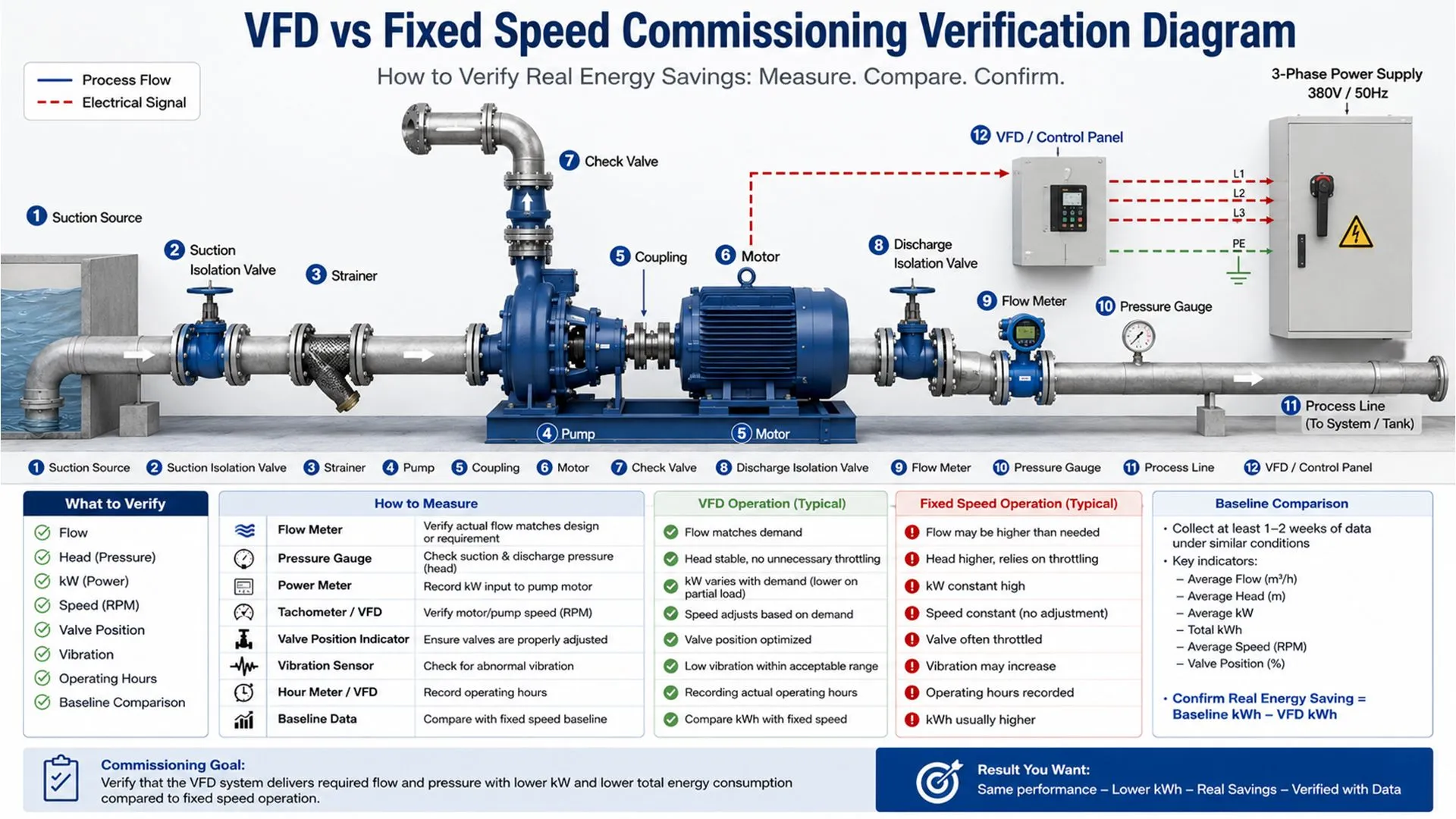
Commissioning Checklist: How to Verify Real Energy Savings
Commissioning is where the VFD vs fixed speed decision is proven. A system that looks efficient on paper may not save energy if control settings, valve position, pipe resistance, or sensor location are wrong.
Buyers should measure and record:
| Commissioning Check | Why It Matters | What to Confirm |
|---|---|---|
| Actual flow | Confirms useful output | Meets process requirement |
| Suction pressure | Checks inlet condition | Stable and safe |
| Discharge pressure | Confirms system head | Matches design |
| Pump speed | Confirms VFD response | Changes according to demand |
| Input kW | Measures energy use | Lower than baseline when demand drops |
| Motor current | Checks overload risk | Within rating |
| Valve position | Finds throttling | No unnecessary permanent throttling |
| Bypass flow | Finds wasted flow | No excessive bypass |
| Pressure setpoint | Confirms control target | Matches process need |
| Control stability | Avoids hunting | Smooth response without oscillation |
| Vibration | Confirms mechanical health | Within accepted limit |
| Bearing temperature | Checks mechanical load | Stable |
| Seal condition | Checks hydraulic stability | No abnormal leakage |
| Operating hours | Supports energy calculation | Recorded by demand level |
| Baseline comparison | Proves savings | New kWh lower than old system |
Energy saving should not be accepted only because the VFD display shows lower speed. The buyer should verify useful flow, required head, measured kW, and process stability.
When NOT to Choose VFD for Energy Saving
VFD is useful in the right system, but it should not be selected blindly. Buyers should know when fixed speed or another correction is safer.
VFD may not be the best choice when:
- flow demand is stable
- annual runtime is low
- most head is static head
- process requires constant full flow
- motor is not suitable for inverter operation
- minimum flow cannot be protected
- suction conditions are poor
- the pump is mechanically worn
- slurry velocity may become too low
- control sensors cannot be installed correctly
- site maintenance team cannot support VFD troubleshooting
- payback period is too long
In these cases, buyers should consider right-sizing, impeller trimming, pipe optimization, motor replacement, pump replacement, or fixed speed operation before approving VFD.
When NOT to Choose Fixed Speed for Energy Saving
Fixed speed is also not always the right choice. A fixed speed pump can waste electricity when it is selected for peak demand but operates most of the time under lower demand.
Fixed speed may not be the best choice when:
- demand changes widely
- discharge valve is often throttled
- bypass flow is continuous
- pressure setpoint changes
- pump runs long hours
- electricity price is high
- one oversized pump serves all loads
- process needs smooth pressure control
- cycling is frequent
- operators manually adjust valves to control flow
In these cases, VFD control or multi-pump sequencing may reduce energy cost and improve stability.
Best Option by Buyer Scenario
The best choice depends on the buyer’s real operating profile. The table below helps match common project situations with the better first direction.
| Buyer Scenario | Better Choice | Reason |
|---|---|---|
| New HVAC circulation system | VFD pump system | Load changes with building demand |
| Stable tank-to-tank transfer | Fixed speed pump | Constant duty and simple operation |
| Municipal booster station | VFD or multi-pump package | Demand varies by time of day |
| Industrial cooling with stable load | Fixed speed or VFD after review | Depends on load variation |
| Existing pump with throttled valve | VFD, impeller trim, or resizing | Need to remove throttling loss |
| Pump runs less than 500 hours/year | Fixed speed usually better | Energy payback is weak |
| Pump runs 6,000+ hours/year | VFD worth evaluating | Runtime makes savings meaningful |
| Mostly static lift application | Fixed speed may be better | VFD savings can be limited |
| High friction pipeline | VFD may save more | Speed reduction can reduce friction loss |
| Slurry transfer | Fixed speed often safer | Must maintain solids velocity |
| Fire system | Fixed speed/code-compliant | Energy saving is not the priority |
| Poor suction layout | Neither until fixed | Suction problem must be corrected first |
This table should be used before supplier selection. It helps buyers ask better RFQ questions and avoid unsuitable quotations.
Maintenance Differences Between VFD and Fixed Speed Pump Systems
Energy comparison should include maintenance capability. VFD systems can save energy, but they also require electrical and control maintenance. Fixed speed systems are simpler, but they may waste energy if the pump is poorly selected.
| Maintenance Factor | VFD Pump System | Fixed Speed Pump System |
|---|---|---|
| Control panel | More complex | Simpler |
| Sensors | Required for effective control | Often fewer sensors |
| Motor stress | Needs inverter-duty review | Standard motor operation |
| Electrical troubleshooting | Higher skill needed | Lower skill needed |
| Harmonics and grounding | Must be checked | Usually simpler |
| Mechanical wear | Can reduce if operation improves | Can increase if throttled/off-BEP |
| Spare parts | Drive components may be needed | Standard electrical components |
| Operator training | More important | Easier |
| Energy monitoring | Better if properly instrumented | Needs external measurement |
| Failure mode | Control faults possible | Mechanical and hydraulic issues dominate |
A buyer should not evaluate energy cost without evaluating maintenance readiness. A poorly commissioned VFD system can create complaints even if it saves electricity.
FAQ: Buyer Questions About VFD vs Fixed Speed Energy Comparison
Buyers usually ask about VFD and fixed speed pumps because they need to justify a purchase, retrofit, or energy-saving project. These questions address the most common technical and procurement doubts.
Does a VFD pump always save more energy than a fixed speed pump?
No. A VFD pump saves more energy when demand varies and speed reduction can reduce real kW consumption. If the flow and head are stable, a correctly sized fixed speed pump may be more cost-effective.
When is fixed speed better than VFD?
Fixed speed is better when the duty point is stable, the pump operates near BEP, throttling is minimal, annual operating hours are limited, and the added cost and complexity of VFD control are not justified.
Why does VFD save energy in pump systems?
VFD saves energy by reducing motor speed when full flow or pressure is not required. In suitable centrifugal pump systems, reduced speed can lower flow, head, and power consumption.
Why might VFD not save energy?
VFD may not save much energy if the system has mostly static head, constant demand, low runtime, poor suction conditions, minimum flow limits, wrong sensor placement, or a severely oversized pump.
How do I calculate VFD energy savings?
Calculate annual electricity cost for both systems. Use input kW, operating hours, and electricity price for each demand condition. Then compare fixed speed annual cost with VFD annual cost and calculate payback.
What is a good payback period for VFD pump systems?
A good payback period depends on project requirements, electricity price, operating hours, and capital budget. Many industrial buyers prefer short payback periods, but reliability and process stability should also be considered.
Can I add VFD to an existing fixed speed pump?
Yes, but only after checking motor compatibility, pump curve, system curve, minimum flow, suction condition, cable length, grounding, sensor location, and expected energy savings. Retrofit VFD should not be approved based only on motor power.
Is VFD better for oversized pumps?
Sometimes, but not always. If the pump is severely oversized, impeller trimming, pump replacement, or resizing may be better. A VFD may reduce speed, but it cannot fully correct poor hydraulic selection in every case.
Does fixed speed waste energy?
Fixed speed wastes energy when the pump is oversized, heavily throttled, bypassing flow, or operating far from BEP. Fixed speed can be efficient when the pump is correctly sized for stable duty.
What data should suppliers provide for VFD vs fixed speed comparison?
Suppliers should provide pump curve, power curve, efficiency curve, system curve, duty profile, static head and friction head split, annual kWh estimate, payback calculation, motor compatibility review, control logic, and commissioning checklist.
Should I choose VFD for high static head systems?
Not automatically. High static head systems may have limited speed reduction potential because the system still needs enough pressure to overcome static lift. A system curve review is required before claiming VFD savings.
Can VFD reduce pump maintenance cost?
It can reduce mechanical stress if it eliminates throttling, reduces cycling, and keeps operation stable. But poor VFD setup can create control instability, low-flow problems, or electrical issues. Maintenance benefit depends on correct design and commissioning.
Can VFD damage an old motor?
It can, if the existing motor is not suitable for inverter operation or if the cable, grounding, insulation, cooling, and bearing protection are not reviewed. Before adding VFD to an old motor, buyers should request a motor compatibility check from the supplier or electrical engineer.
Is VFD better than impeller trimming?
Not always. VFD is better when demand varies and speed control is useful. Impeller trimming may be better when the pump is moderately oversized and the system demand is stable. The correct choice should be based on pump curve, system curve, duty profile, and future operating needs.
Conclusion: VFD vs Fixed Speed Energy Comparison Must Be Based on Real System Data
A VFD vs fixed speed energy comparison is not a simple technology comparison. It is a system decision based on real duty profile, pump curve, system curve, operating hours, electricity price, throttling loss, static head, friction head, motor compatibility, hidden retrofit cost, maintenance capability, and commissioning verification.
A VFD pump system is usually the better energy choice when demand changes, runtime is long, friction loss is significant, and speed control can reduce real kW without harming process performance. A fixed speed pump system is often the better choice when demand is stable, the pump is correctly sized, operation is near BEP, and control complexity is not justified.
Before approving either option, buyers should ask one practical question:
Can the supplier prove, with curves, kW data, duty profile, payback calculation, and commissioning checks, that this pump system will reduce life-cycle cost under our real operating conditions?
If the answer is yes, the buyer can make a defensible decision. If the answer is unclear, the next step is not to choose the cheaper quotation or the more advanced label. The next step is to measure the real duty, review the system curve, compare VFD and fixed speed energy cost, and verify the result after installation.
Get A Quote

Get A Quote
0 Comments