
How to Verify Pump Test Reports: A Buyer’s Guide Before Pump Acceptance

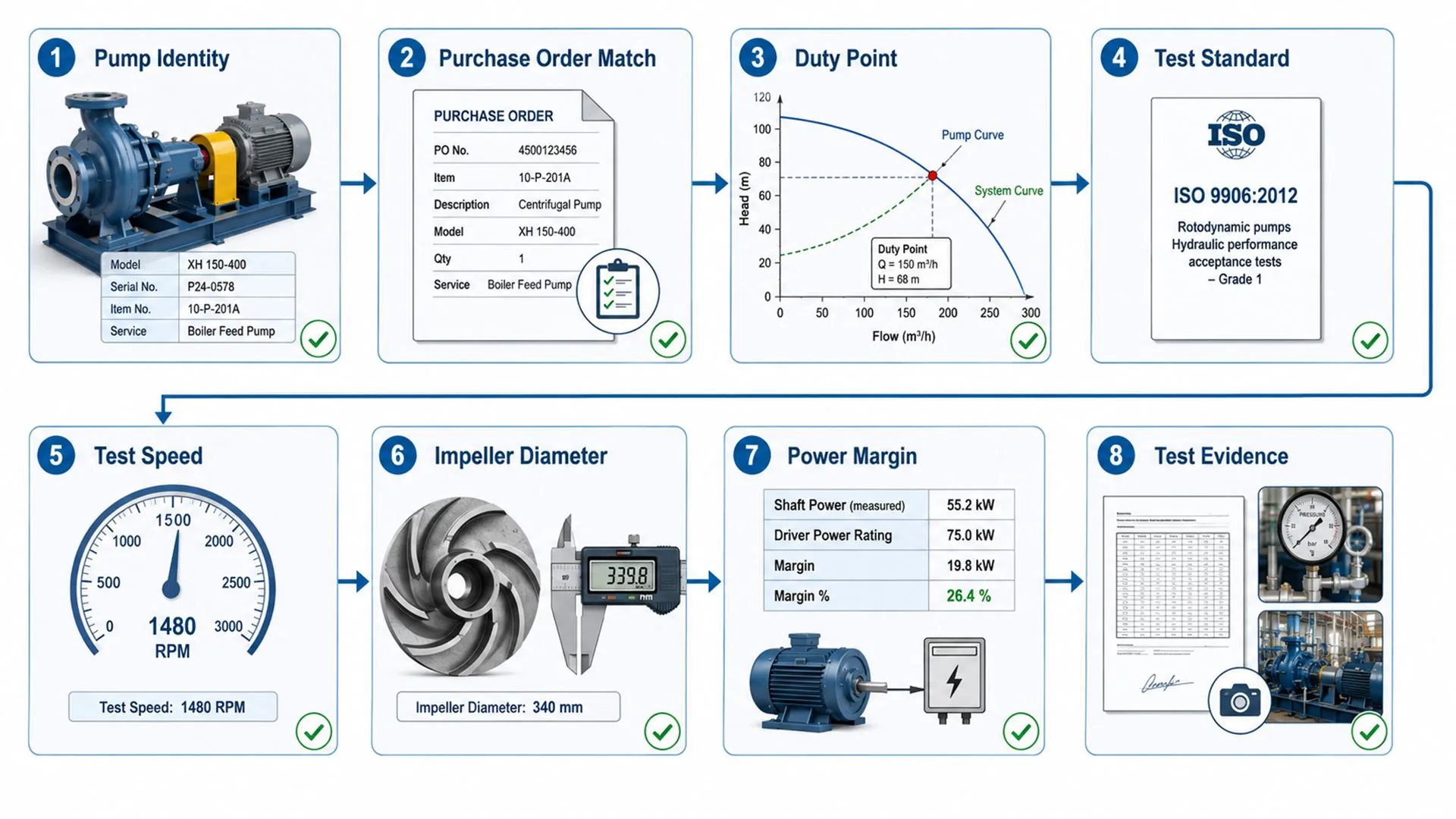
A pump test report is acceptable only when the pump identity, duty point, test standard, test speed, impeller diameter, performance curve, absorbed power, and acceptance tolerance can be traced to the exact pump being supplied. Buyers should not approve shipment, balance payment, or project acceptance based only on a factory stamp, catalog curve, or a simple “PASS” result.
For industrial pump procurement, the real risk is not whether the supplier can provide a document. The real risk is whether that document can prove the supplied pump meets the agreed performance under defined test conditions. A professional-looking report with missing serial numbers, unclear duty points, wrong frequency, no acceptance standard, or no curve may still leave the buyer exposed to site failure, warranty disputes, project delay, and payment risk.
A reliable pump test report should help the buyer answer four practical questions:
- Is this report for the exact pump I ordered?
- Does the pump meet the required flow and head at the agreed speed?
- Is the report based on an accepted test method or only internal factory data?
- Should I accept, clarify, retest, reject, or hold payment?
ISO 9906:2012 specifies hydraulic performance tests for customer acceptance of rotodynamic pumps, including centrifugal, mixed flow, and axial pumps. It is intended for pump acceptance testing at test facilities such as manufacturer test facilities or laboratories and applies to pumped liquids that behave as clean, cold water. ANSI/HI 14.6-2022 covers uniform testing and acceptance of rotodynamic pumps, including centrifugal, mixed flow, and axial flow pumps; the Hydraulic Institute describes its test types as including hydraulic performance, hydrostatic pressure, mechanical integrity, and NPSH.
This guide explains how buyers, engineers, EPC contractors, distributors, and project owners can verify pump test reports before accepting shipment or releasing final payment.
Quick Answer: What Makes a Pump Test Report Reliable?
A pump test report is reliable when it identifies the exact pump unit, states the test standard, records the tested flow and head at the required duty point, shows the actual test speed and impeller diameter, includes absorbed power or motor current, and defines the tolerance used to judge pass or fail.
The buyer should first verify traceability before reviewing performance. If the report cannot be linked to the purchase order, pump nameplate, serial number, and approved datasheet, the performance values may not protect the buyer in a dispute.
| First Check | What the Buyer Should Verify | Why It Matters | Buyer Decision if Missing |
|---|---|---|---|
| Pump identity | Model, serial number, PO number, nameplate photo | Confirms the report belongs to the supplied pump | Request revised report before approval |
| Duty point | Required flow and head are tested or clearly shown | Confirms hydraulic performance | Ask for full curve or retest |
| Test standard | ISO 9906, ANSI/HI 14.6, or agreed internal test method | Defines how pass/fail is judged | Treat as weak factory data until clarified |
| Test speed | RPM, frequency, voltage, motor configuration | Pump curve changes with speed | Request correct-speed test or approved conversion |
| Impeller diameter | Final tested impeller diameter | Confirms tested configuration matches supplied pump | Do not accept if final diameter is unclear |
| Power and current | Absorbed power, motor rating, current, safety margin | Prevents overload after installation | Request engineering review |
| Curve and tolerance | Performance curve and acceptance grade | Shows whether data is complete and fair | Request full performance evidence |
| Mechanical checks | Hydrostatic test, leakage, vibration if required | Confirms basic mechanical integrity | Clarify scope or request additional test |
Scope of This Guide: Which Pump Test Reports Can This Method Verify?
This guide is mainly written for industrial rotodynamic pumps where hydraulic performance testing is used for factory acceptance. Buyers should not apply one test-report review method blindly to every pump type because some applications require additional verification for solids, slurry, corrosion, temperature, certification, or site-specific risks.
Applicable Pump Types
This verification method is most suitable for pumps where flow, head, power, efficiency, speed, and performance curve data are the main acceptance items. These values are commonly used in factory acceptance tests, pump performance reports, and pump FAT documentation.
Applicable pump types include:
- End suction centrifugal pumps
- Horizontal split case pumps
- Double suction pumps
- Inline pumps
- Multistage pumps
- Pipeline booster pumps
- Vertical turbine pumps
- Submersible sewage pumps
- Industrial clean water transfer pumps
- General water supply and drainage pumps
For these pumps, the buyer can usually verify basic acceptance by checking pump identity, duty point, speed, impeller diameter, curve, absorbed power, and acceptance tolerance.
Use With Adjustment
Some pump types need additional review because their real operating risks are not fully represented by clean-water hydraulic performance data. The report still matters, but it must be reviewed together with application-specific requirements.
Use this guide with adjustment for:
- Slurry pumps, where abrasion, solids concentration, and material wear matter
- Sewage pumps, where solids passage and clogging resistance may matter
- Chemical pumps, where material compatibility and seal selection are critical
- Seawater pumps, where corrosion resistance must be verified separately
- Mining dewatering pumps, where suction condition and continuous operation risk are high
- High-temperature pumps, where factory test fluid may differ from real operating fluid
- Fire pumps, where local fire-code approval and certification may override ordinary factory reports
- Custom pump packages, where test scope should follow the approved inspection and test plan
For example, a sewage pump may pass a clean-water hydraulic test but still be unsuitable if the real wastewater contains long fibers, rags, grit, or oversized solids. A chemical pump may meet flow and head but fail early if the selected material or mechanical seal does not match the liquid.
Not Suitable as the Only Acceptance Method
This guide should not replace formal third-party inspection, owner-witnessed testing, or project-specific acceptance procedures when the application is safety-critical, regulated, or contractually tied to a specific approval standard.
Do not use this guide as the only acceptance method for:
- Nuclear, offshore, or hazardous-area projects
- API refinery pump packages
- Fire protection systems requiring local authority approval
- Legal disputes or warranty claims
- Public infrastructure projects with strict owner acceptance procedures
- Projects requiring SGS, BV, TÜV, Lloyd’s, or owner-appointed inspection
- Pumps where failure may cause major safety, environmental, or production loss
In these cases, the pump test report should be reviewed together with the purchase specification, approved datasheet, inspection and test plan, material certificates, quality records, and contractual acceptance documents.
Why Pump Test Reports Matter in B2B Pump Procurement
A pump test report is not only a technical document. It is also a commercial risk-control document that affects payment approval, shipment release, site commissioning, warranty responsibility, and project handover.
In international procurement, the buyer often cannot stand beside the test bench. The report becomes one of the main pieces of evidence showing that the pump was manufactured, tested, and accepted under agreed conditions. If the report is incomplete, the buyer may only discover the problem after installation, when correction costs are much higher.
| User Role | What They Need From the Test Report | Main Concern |
|---|---|---|
| Procurement manager | Proof that the supplier delivered the ordered pump | Payment safety and supplier accountability |
| Project engineer | Confirmation that the pump meets the duty point | System performance and technical responsibility |
| EPC contractor | Evidence for owner acceptance | Project delay, penalty, and handover risk |
| Distributor | Technical support for resale confidence | Customer trust and after-sales risk |
| Maintenance team | Baseline data for future troubleshooting | Vibration, power, efficiency, and warranty comparison |
| Finance team | Objective basis for balance payment | Avoid paying before key evidence is complete |
| End user | Confirmation that the pump can support real operation | Downtime, energy cost, and service life |
A good pump test report should reduce uncertainty before the pump leaves the factory. It should not create more questions after the pump arrives on site.
Practical Review Sequence: What Buyers Should Do After Receiving the Report
Buyers should review a pump test report in a fixed sequence instead of reading it casually from top to bottom. The safest method is to compare the report against the purchase order, approved datasheet, pump nameplate, curve, and inspection photos at the same time.
Step 1: Put All Reference Documents in One Review Folder
The buyer should first collect all documents used to verify the report. Reviewing the test report alone is not enough because the report must be checked against the agreed purchase and technical documents.
Prepare these files:
- Purchase order
- Approved technical datasheet
- Approved pump curve
- Supplier quotation or technical offer
- Test report
- Nameplate photo
- Packing photo
- Motor datasheet
- Inspection and test plan if available
- Previous email confirmations about duty point, material, voltage, or testing
This step is simple, but it prevents many mistakes. If the buyer does not have the approved datasheet open during review, they may accidentally compare the test report with the wrong duty point.
Step 2: Check Traceability Before Performance
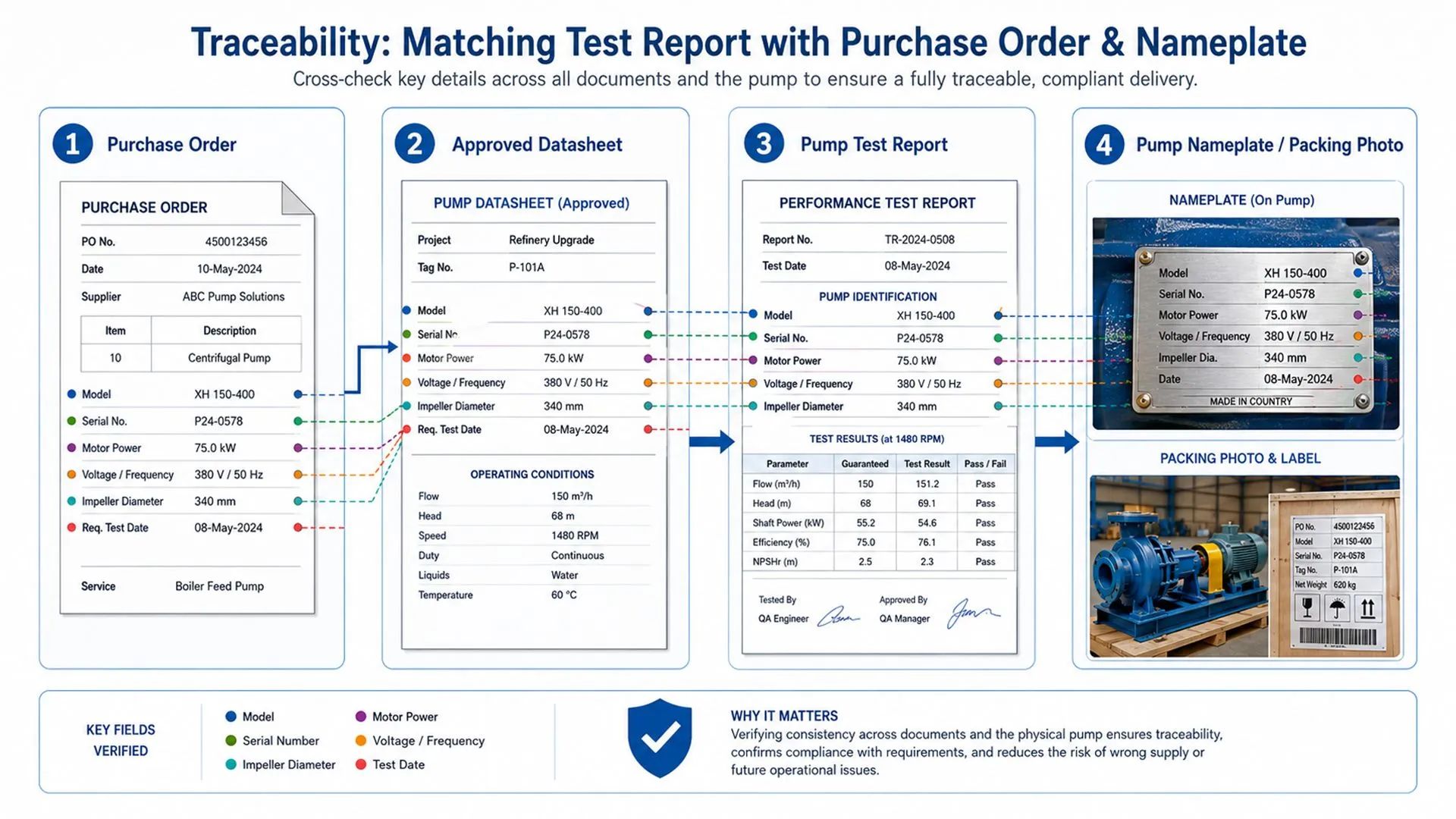
The buyer should confirm model, serial number, order number, and nameplate information before checking flow or head. Performance data has little acceptance value if the tested pump cannot be linked to the supplied pump.
Check whether these fields match:
- Report model number
- Purchase order model
- Pump serial number
- Nameplate serial number
- Motor power
- Voltage and frequency
- Impeller diameter
- Quantity
- Project name or order number
If these items do not match, stop the technical review and request clarification.
Step 3: Mark Missing or Unclear Items Before Asking Questions
The buyer should not send vague questions such as “Please confirm the report.” Instead, mark missing items clearly and ask for specific corrections.
A useful clarification request should say:
- Which field is missing
- Why it matters
- What document is required
- Whether shipment or payment approval is on hold
For example: “The test report does not show the pump serial number or final impeller diameter. Please issue a revised report matching the nameplate and approved datasheet before shipment approval.” This type of request is stronger than a general complaint because it ties the missing data to acceptance.
What a Complete Pump Test Report Should Include
A complete pump test report should allow the buyer to identify the tested pump, understand the test condition, compare the result with the guaranteed duty point, and decide whether the pump passes the agreed acceptance criteria.
Pump Identification Information
Pump identification is the first traceability checkpoint. If the report does not identify the exact pump, the performance data may not belong to the supplied unit.
A complete report should include:
- Pump model
- Pump serial number
- Production order number
- Customer purchase order number
- Project name if applicable
- Pump type
- Impeller diameter
- Material configuration
- Mechanical seal or packing type
- Motor power
- Voltage and frequency
- Rated speed
- Test date
- Inspector or witness name if applicable
The serial number is especially important for multi-pump orders. If the buyer orders three pumps of the same model but with different duty points or impeller diameters, one generic model-level report is not enough for unit-level acceptance.
Test Condition Information
Test condition information explains how the data was produced. Without test conditions, the buyer cannot judge whether the report reflects the expected operating condition.
A useful test report should include:
- Test fluid
- Fluid temperature
- Test bench setup
- Suction condition
- Discharge condition
- Flow measurement method
- Pressure measurement points
- Test speed
- Instrument calibration status
- Measurement uncertainty if required by contract
- Test standard and acceptance grade
Factory hydraulic performance tests are commonly performed with clean water or water-like liquid. This can be appropriate for many rotodynamic pump acceptance tests, but buyers should not assume that clean-water performance automatically verifies corrosion resistance, solids handling, high-temperature behavior, or chemical compatibility.
If the actual liquid does not behave like clean cold water, the buyer should confirm whether correction, material verification, or additional application-specific testing is required.
Hydraulic Performance Data
Hydraulic performance data is the core of the report. It should show whether the pump can deliver the required flow and head at the agreed operating speed.
A complete hydraulic test section should include:
- Flow rate
- Total head
- Efficiency
- Shaft power or absorbed power
- Motor current if measured
- Speed
- Performance curve
- Guaranteed duty point
- Acceptance tolerance
- NPSH data if required
A single duty point may be acceptable if the contract only requires a specified single-point test. However, for project pumps, high-value pumps, or pumps with strict performance responsibility, a full or partial performance curve is much stronger evidence than a one-line result.
Mechanical and Electrical Test Data
Mechanical and electrical data help the buyer identify risks that hydraulic values alone cannot show. A pump may meet flow and head but still have leakage, vibration, motor current, insulation, or pressure-containing part issues.
Depending on pump type and project requirements, the report package may include:
- Hydrostatic pressure test result
- Seal leakage observation
- Vibration reading
- Noise reading if required
- Bearing temperature if tested
- Motor current
- Insulation resistance for submersible or motor-integrated pumps
- Rotation direction confirmation
- Visual inspection record
For small standard pumps, not every item is required. For critical pumps, however, these requirements should be defined before production in the inspection and test plan.
Minimum Acceptable Report Package by Order Type
Buyers should not require the same documentation level for every pump order. A standard small pump and a custom project pump do not carry the same commercial or operational risk.
| Order Type | Minimum Acceptable Documents | When to Ask for More |
|---|---|---|
| Small standard pump | Basic test report, nameplate photo, packing photo | New supplier, export order, or repeated quality issues |
| Medium industrial pump | Test report, performance curve, nameplate photo, motor data | Continuous operation or difficult replacement |
| Project pump | Full curve, duty point report, hydrostatic test, serial traceability | EPC, municipal, mining, wastewater, or owner approval |
| Custom pump | Approved datasheet, test procedure, full report, inspection record | Any design deviation or special material requirement |
| Critical pump package | Witnessed FAT, calibration record, ITP, photos/video, full report | High downtime cost, penalty clause, or safety risk |
| Repeat order from proven supplier | Compare with previous accepted report and current nameplate | Any specification change from previous order |
This table helps buyers avoid two common mistakes: over-testing simple pumps and under-testing critical pumps.
How to Match the Test Report With the Purchase Order and Nameplate
The first practical verification step is document matching. Buyers should compare the test report against the purchase order, approved datasheet, nameplate photo, inspection photo, and packing record before reviewing detailed performance values.
Match Model, Serial Number, and Order Number
The pump model and serial number should match across the test report, nameplate, packing photo, and order document. Any mismatch should be clarified before shipment or balance payment.
Check the following:
- Report model = purchase order model
- Report serial number = nameplate serial number
- Motor power = approved datasheet
- Impeller diameter = approved curve or datasheet
- Material code = purchase specification
- Voltage and frequency = site electrical system
- Quantity = order quantity
- Test date = reasonable production timeline
A common buyer mistake is checking only the model number. This is not enough. If an order contains several pumps with the same model but different impeller trimming, motors, or duty points, the serial number and impeller diameter become essential.
Match Motor and Speed Conditions
Pump performance changes with speed. A report tested at a different speed cannot be accepted without proper explanation, curve conversion, correct-speed retesting, or written engineering approval.
For international orders, buyers must be especially careful with 50 Hz and 60 Hz projects. A centrifugal pump running at 60 Hz usually operates at a higher speed than the same pump running at 50 Hz, which changes flow, head, and power demand.
| Item | Why It Must Match |
|---|---|
| Frequency | 50 Hz and 60 Hz operation may produce different speed and curve |
| RPM | Flow, head, and power depend heavily on rotational speed |
| Motor power | Determines whether the pump can operate safely |
| Voltage | Must match the site electrical supply |
| Phase | Must match the electrical system |
| Current | Helps detect overload risk |
| Service factor | Helps judge motor safety margin |
If the project requires 50 Hz operation but the test report shows 60 Hz performance, the buyer should request a correct-speed test, an approved converted curve, or written confirmation from the responsible engineer.
Match Impeller Diameter
Impeller diameter directly affects head, flow, power, and efficiency. If the report does not show impeller diameter, the buyer cannot confirm whether the tested configuration matches the selected pump curve.
This is especially important for trimmed impellers. A supplier may select a pump from a standard curve, trim the impeller to meet the duty point, and then test the final unit. The report should identify the final impeller diameter. If the pump was tested with one diameter but supplied with another, the report may not represent the delivered pump.
How to Verify the Duty Point: Flow, Head, and Efficiency
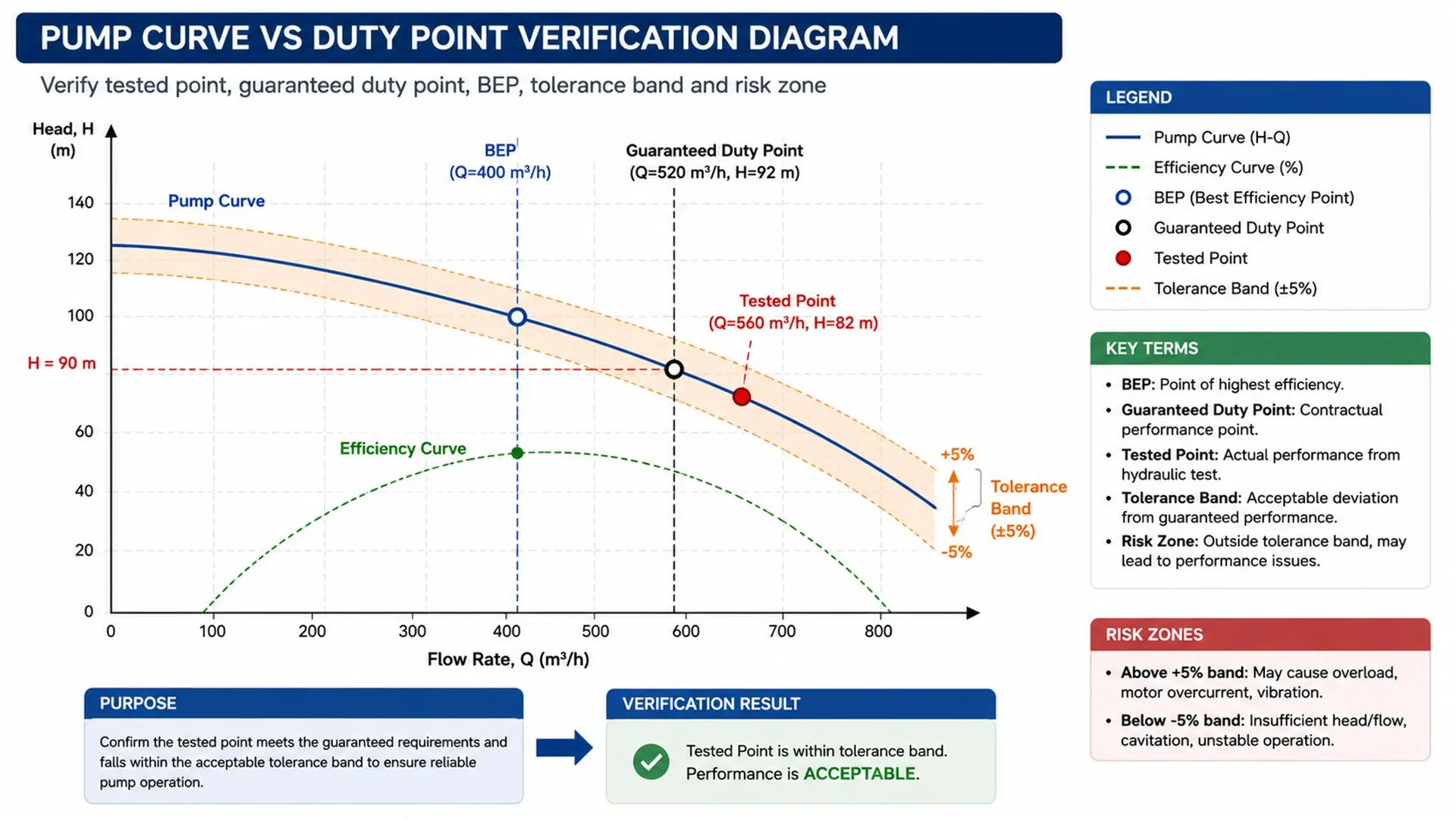
The duty point is the core of pump performance verification. Buyers should not accept a report simply because the pump runs; the pump must deliver the required flow and head under the agreed operating conditions and within the agreed acceptance tolerance.
What Is the Duty Point?
The duty point is the required operating condition where the pump must deliver a specified flow rate at a specified total head. In procurement, this is usually the most important performance commitment in the contract.
For example, if a buyer orders a pump for 200 m³/h at 60 m head, the test report should show whether the pump can achieve that operating point at the correct speed and impeller diameter. A pump that delivers 200 m³/h at only 52 m head does not meet the same requirement. A pump that delivers 60 m head at only 160 m³/h also does not meet the same requirement.
How to Check Flow and Head
Flow and head should always be checked together. A pump may reach the required flow at a lower head, or reach the required head at a lower flow. Neither situation proves that the pump meets the guaranteed duty point.
Buyers should follow this sequence:
- Find the guaranteed flow in the purchase specification.
- Find the guaranteed head in the approved datasheet.
- Find the tested flow and head in the report.
- Confirm that the test speed matches the project speed.
- Locate the tested duty point on the pump curve.
- Apply the agreed acceptance tolerance.
- Decide whether the pump passes, needs clarification, needs retesting, or should be rejected.
The buyer should not let the supplier compare the pump against a different duty point unless the buyer has formally approved the change.
How to Check Efficiency
Efficiency should be checked because it affects lifecycle energy cost. However, buyers should first confirm whether efficiency was a guaranteed value or only a reference value in the selection curve.
Efficiency matters most when the pump runs many hours per day. A small efficiency difference can become expensive over years of operation. This is especially important for continuous water supply, HVAC circulation, mining dewatering, municipal transfer, and process cooling.
| Result Pattern | What It Means | Buyer Action |
|---|---|---|
| Flow and head meet guarantee | Hydraulic duty point is likely acceptable | Continue checking power, curve, and tolerance |
| Flow meets but head is low | Pump may not overcome system resistance | Request explanation or retest |
| Head meets but flow is low | System delivery may be insufficient | Do not approve without clarification |
| Efficiency is much lower than expected | Energy cost may increase | Ask whether efficiency was guaranteed |
| Power exceeds safe motor margin | Motor overload risk exists | Require engineering review |
| Duty point is far from BEP | Pump may run with higher vibration or lower stability | Review operating range |
The buyer should avoid judging efficiency alone. A pump with high efficiency but wrong duty point is still unsuitable. A pump that meets duty point but requires excessive power may also create long-term reliability problems.
How to Check Whether the Report Follows ISO 9906 or ANSI/HI 14.6
A pump test report should state the test standard and acceptance grade clearly. Without a standard, the buyer may see many numbers but still have no fair method to judge whether the pump passes.
Why the Test Standard Matters
The test standard defines how performance data is measured, how tolerance is applied, and how acceptance is judged. A supplier cannot simply claim that a pump “passed” unless the pass/fail rule is defined.
ISO 9906:2012 is used for hydraulic performance acceptance testing of rotodynamic pumps, including centrifugal, mixed flow, and axial pumps. ANSI/HI 14.6-2022 covers uniform testing and acceptance of rotodynamic pumps and includes test types such as hydraulic performance, hydrostatic pressure, mechanical integrity, and NPSH.
The buyer should confirm the test standard before production. If the contract does not specify a standard, later disputes become harder to resolve because each side may use a different acceptance expectation.
Acceptance Grade and Tolerance
Acceptance grade matters because different grades allow different tolerance bands. A pump may pass under a looser grade but fail under a stricter project requirement.
| Acceptance Element | Buyer Should Confirm |
|---|---|
| Test standard | Which standard was used? |
| Acceptance grade | Which grade applies to this order? |
| Guaranteed value | Which flow, head, or efficiency value is guaranteed? |
| Tolerance band | How much deviation is allowed? |
| Test speed | Was the pump tested at the agreed speed? |
| Measurement method | How were flow, pressure, and power measured? |
| Witness requirement | Was the test witnessed or self-declared? |
For standard commercial pumps, a normal factory report may be acceptable. For project pumps, the acceptance grade should be written into the purchase agreement, inspection plan, or technical specification before production.
What If the Report Does Not Mention Any Standard?
If no standard is listed, the buyer should treat the report as internal factory data, not a formal acceptance report. It may still be useful, but it is weaker as a contractual acceptance document.
The buyer should request:
- The test standard used
- The acceptance grade or tolerance
- The guaranteed duty point
- The tested performance curve
- Instrument calibration confirmation
- Test bench photo or video if needed
- A revised report with clear pass/fail basis
For critical projects, the buyer should request witnessed retesting instead of accepting a vague report.
Measured Data vs Calculated Data: What Buyers Must Clarify
Buyers should know which values in the report were directly measured and which values were calculated from measured data. This distinction matters because a report may look complete even when key values are derived, estimated, or taken from catalog data.
Directly Measured Data
Directly measured data usually comes from test instruments installed on the test bench. These values are the foundation of the test report.
Common measured data includes:
- Flow rate from flow meter
- Suction pressure
- Discharge pressure
- Rotational speed
- Motor current
- Voltage
- Input power if measured
- Vibration if measured
- Temperature if recorded
The buyer should ask whether the instruments were calibrated and whether calibration records are available for critical orders.
Calculated or Derived Data
Some values are calculated from measured data. This is normal, but the buyer should understand the basis.
Common calculated values include:
- Total head
- Hydraulic power
- Pump efficiency
- Shaft power if not directly measured
- Corrected performance at another speed
- Converted curve values
- NPSH margin based on site assumptions
Calculated data is not automatically unreliable. The issue is whether the calculation method, assumptions, and source measurements are clear.
Catalog Data or Selection Software Data
Catalog curves and selection software outputs are useful during pump selection, but they should not be confused with unit-level test data.
A catalog curve may show expected performance for a pump model, while a factory test report should show the tested performance of the actual supplied pump or tested batch. For critical orders, the buyer should ask whether the curve in the report is measured, corrected, or simply copied from selection software.
| Data Type | Example | Buyer Risk | What to Ask |
|---|---|---|---|
| Measured data | Flow, pressure, speed | Instrument accuracy issue | Are instruments calibrated? |
| Calculated data | Total head, efficiency | Formula or assumption issue | What measured values were used? |
| Corrected data | Converted 60 Hz curve to 50 Hz | Speed conversion risk | Who approved the conversion? |
| Catalog data | Standard pump curve | May not represent supplied unit | Was the actual pump tested? |
| Site assumption | NPSHa estimate | Installation may differ | Was site piping considered? |
How to Detect Red Flags in Pump Test Reports
Most problematic pump test reports do not look obviously false. Buyers should look for small inconsistencies between model, serial number, curve, speed, power, test date, and performance values.
Red Flag 1: No Serial Number or Traceable Pump ID
A test report without a serial number cannot prove that the tested pump is the delivered pump. This is one of the most important warning signs for overseas buyers.
If the report has only a model number, the buyer should request a revised report showing the serial number, nameplate photo, and packing photo. For multi-pump orders, each unit should be traceable.
Red Flag 2: Only One Test Point Is Shown
A single test point may not reveal unstable curve shape, overload risk, poor efficiency, or unsafe operation away from the duty point. Buyers should request a performance curve when the project is important.
A one-line report may be acceptable for low-risk standard pumps, but it is not enough for high-value project pumps, continuous-duty pumps, or pumps with strict performance guarantees.
Red Flag 3: Flow, Head, and Power Do Not Follow Engineering Logic
Pump data must be physically consistent. If flow increases but power does not change reasonably, or if different models show suspiciously identical values, the buyer should question the data.
For centrifugal pumps, power generally changes with flow and speed. Head, flow, efficiency, and absorbed power should form a reasonable curve. If the report appears copied or physically inconsistent, the buyer should request raw test data or retesting.
Red Flag 4: Same Report Values Used for Different Pumps
Using the same report template is normal. Using identical values, identical curves, or repeated test dates across different pump models is not normal.
If several pumps have exactly the same readings despite different duties, impeller diameters, or motors, the buyer should ask whether the values were measured, calculated, or copied from catalog data.
Red Flag 5: No Test Standard, No Tolerance, No Calibration Reference
Without test standard and tolerance information, the buyer cannot determine whether the pump actually passed acceptance requirements.
The report may still show numbers, but numbers without an acceptance basis do not protect the buyer in a dispute.
Red Flag 6: Test Speed Does Not Match Supplied Motor
A pump tested at a different speed may produce misleading performance results. This is especially important when comparing 50 Hz and 60 Hz operation.
If the speed is different, the buyer should request a correct-speed test, an approved converted curve, or written confirmation from the engineer responsible for selection.
| Red Flag | Possible Meaning | Buyer Response |
|---|---|---|
| No serial number | Report may not match the supplied pump | Request nameplate photo and revised report |
| No test standard | No formal acceptance basis | Ask for ISO 9906, ANSI/HI 14.6, or agreed method |
| No curve | Limited performance evidence | Request full performance curve |
| Power too close to motor rating | Overload risk | Ask for motor safety margin |
| Identical values across different models | Possible template reuse or batch-level data | Request raw test data or unit-level traceability |
| No test date | Poor traceability | Ask for dated report and inspection evidence |
| Test speed mismatch | Performance may not represent site operation | Request correct-speed test or approved conversion |
How to Judge Supplier Responses After You Question the Report
Buyers often ask the right questions but accept weak answers. A good supplier should be able to explain the test method, data source, and missing fields clearly. If the response avoids the technical issue, the buyer should continue holding approval.
| Supplier Response | Buyer Judgment | Recommended Buyer Action |
|---|---|---|
| “This is our standard report format.” | Not enough if serial number, duty point, or test standard is missing | Request revised report with required fields |
| “The pump model is the same, so the report is valid.” | Acceptable only for low-risk batch order if agreed | Ask whether each unit was tested or batch sampled |
| “The curve is from our catalog.” | Useful for selection, weak for unit acceptance | Request actual test data or clarify no unit test was done |
| “Our test bench is 60 Hz, but your site is 50 Hz.” | Not automatically unacceptable, but needs engineering basis | Request correct-speed test or approved conversion |
| “The report has our factory stamp.” | Stamp does not replace technical traceability | Ask for serial number, standard, and measured data |
| “NPSH was not tested.” | May be acceptable if not required, risky for suction-sensitive systems | Ask for NPSHr curve and site NPSHa review |
| “Power is close to motor rating but still passed.” | Needs review under full operating range | Ask for maximum power on curve and motor margin |
| “The buyer did not request this before.” | Contract scope matters, but critical missing data still creates risk | Clarify whether shipment approval depends on updated evidence |
| “We can provide video but no full data.” | Video supports evidence but does not replace measured values | Request written data with video as supplement |
This table is especially useful for procurement teams because supplier replies often sound reasonable at first. The buyer should judge whether the answer closes the technical risk, not whether it sounds polite.
How to Verify the Pump Curve Against the Test Report
The pump curve is often more valuable than a single result table because it shows whether the pump behaves normally across the operating range. Buyers should compare the tested curve with the approved selection curve before accepting the report.
Compare the Tested Curve With the Approved Curve
The tested curve should be reasonably close to the approved selection curve after considering tolerance, speed, and impeller diameter. Large deviation may indicate incorrect impeller trimming, casting variation, wrong model selection, testing error, or a curve copied from another configuration.
The buyer should check:
- Does the tested curve pass through or near the guaranteed duty point?
- Is the tested speed the same as the approved curve speed?
- Is the impeller diameter the same as the selected curve?
- Is the efficiency curve reasonable?
- Does absorbed power stay within motor safety margin?
- Is the curve shape stable and normal?
If the curve is missing, the buyer should not rely only on a single flow/head value for critical applications.
Check the Best Efficiency Point
The best efficiency point (BEP) is the operating range where the pump usually runs with better hydraulic stability. A duty point far from BEP may increase vibration, reduce efficiency, and shorten component life.
For many industrial buyers, the question is not only “Does the pump pass the test?” The better question is: “Will the pump run safely and efficiently near the real system operating point?”
If the duty point is far left of BEP, the pump may operate near low-flow conditions, which can increase internal recirculation, heat, vibration, and seal stress. If the duty point is far right of BEP, the pump may operate near runout, where power demand and cavitation risk may increase.
Check Whether the Duty Point Is Near the End of the Curve
A pump may technically meet a report value but still be poorly selected if the duty point sits near the unstable or extreme end of the curve. This is especially risky when the real site condition is uncertain.
If the buyer also needs to understand why the same pump may lose performance after installation, this pump efficiency loss guide can help compare factory test data with real site operating conditions.
How to Check Power, Current, and Motor Overload Risk
A pump may pass flow and head requirements but still create motor overload risk. Buyers should verify absorbed power, motor rated power, current, voltage, frequency, and operating margin before accepting the report.
Why Power Data Matters
Absorbed power shows how much power the pump needs at the tested operating point. If absorbed power is too close to or higher than the motor rating, the pump may trip under real site conditions.
This is a common issue when the system operates at higher flow than expected. A pump may pass the duty point during factory testing, but if the site system has lower resistance, the pump may run farther to the right on the curve and absorb more power.
What Buyers Should Compare
The buyer should not only check motor kilowatts. Motor current, voltage, frequency, service factor, and maximum power on the curve should be reviewed together.
Check the following:
- Rated motor power
- Absorbed power at duty point
- Maximum absorbed power on the curve
- Motor current during test
- Voltage
- Frequency
- Rated speed
- Service factor if applicable
- Safety margin under possible runout condition
For example, if the pump absorbs 29 kW at the tested point and the motor is rated 30 kW, the buyer should ask whether the pump may exceed the motor limit under real site conditions. A very small margin may be risky for continuous operation.
When the Buyer Should Question the Report
The buyer should request engineering clarification if:
- Absorbed power is too close to motor rating
- Current is higher than expected
- Motor size differs from the approved datasheet
- The report does not show power data
- The curve does not show maximum power
- The pump is used for continuous operation
- The site operating point is uncertain
If the report shows high absorbed power or unstable current, the buyer can use this pump motor overload troubleshooting guide to understand whether the risk comes from selection, operating point, or system conditions.
How to Verify NPSH, Cavitation, and Suction-Side Risk
NPSH data is often overlooked, but it can decide whether the pump will run quietly or fail early from cavitation. Buyers should check whether NPSH was tested, calculated, or only taken from the catalog curve.
What Is NPSH?
NPSH means Net Positive Suction Head. It indicates whether the pump has enough suction pressure to avoid cavitation, which occurs when vapor bubbles form and collapse inside the pump.
For buyers, NPSH is critical when the suction tank is low, the liquid is hot, suction piping is long, the inlet pipe is undersized, or the pump is installed above the liquid source.
What the Report Should Show
For ordinary orders, NPSH may not always be tested unless required by the contract. For critical applications, buyers should request NPSH data or at least confirm the NPSHr curve and compare it with the site NPSHa margin.
The buyer should check:
- NPSHr at the duty point
- Whether NPSH was tested or taken from catalog data
- Suction pressure during test if available
- Liquid temperature
- Site NPSHa margin
- Whether the pump uses flooded suction or suction lift
- Whether suction pipe losses were considered
NPSHr means Net Positive Suction Head Required. NPSHa means Net Positive Suction Head Available. The buyer’s site must provide more NPSHa than the pump requires, with a reasonable safety margin.
When to Require More Evidence
Buyers should request additional NPSH confirmation when the pump is used for:
- Hot water
- Condensate
- Long suction piping
- Tank transfer with low liquid level
- Mining dewatering
- Boiler feed applications
- High elevation sites
- Systems with unstable suction pressure
If the application has suction-side uncertainty, this pump cavitation causes and solutions guide can help buyers connect NPSH data with real installation risk.
How to Verify Hydrostatic Pressure, Leakage, and Mechanical Test Results
Hydraulic performance is not the only acceptance requirement. Buyers should also check whether the casing, seals, joints, and mechanical parts can withstand pressure and normal operation.
Hydrostatic Pressure Test
A hydrostatic pressure test confirms whether the pump casing and pressure-containing parts can withstand pressure without leakage or visible deformation.
The report should show:
- Test pressure
- Holding time
- Test medium
- Test date
- Pass/fail result
- Leakage observation
- Inspector confirmation
This is important because a pump can meet flow and head but still have casting defects, flange leakage, casing cracks, or weak pressure-containing parts.
Seal and Leakage Check
Seal leakage should be checked because even a pump that meets hydraulic performance may fail acceptance if the mechanical seal leaks during operation.
The buyer should check:
- Mechanical seal type
- Packing type if packing is used
- Seal chamber observation
- Leakage during running test
- Leakage after pressure test
- Whether leakage is acceptable under the selected seal design
For mechanical seals, visible leakage during factory running should be questioned. For gland packing, a small controlled leakage may be normal because packing often requires lubrication and cooling, but the acceptable level should be understood and documented.
Vibration and Noise
Vibration and noise data help identify mechanical imbalance, misalignment, bearing problems, hydraulic instability, or assembly quality issues. These checks are especially important for larger pumps and continuous-duty systems.
A buyer should request vibration data when:
- The pump is large or high power
- The pump will run continuously
- The project has strict reliability requirements
- The pump is part of a packaged system
- The customer has experienced previous vibration issues
- The duty point is far from BEP
If vibration data is not provided for a critical pump, the buyer should ask whether vibration was measured, visually observed, or not included in the factory test scope.
Factory Test vs Site Performance: What the Report Can and Cannot Prove
A factory pump test report proves performance under controlled test conditions. It does not automatically prove that the pump will perform correctly after installation if the site system, piping, suction condition, electrical supply, or operating method differs from the tested condition.
What Factory Testing Can Prove
Factory testing can confirm that the pump unit or tested batch meets specified performance under defined test conditions. This is valuable because it separates manufacturing performance from later site variables.
A factory test report can help prove:
- Pump identity and traceability
- Flow and head under test conditions
- Absorbed power or current during test
- Curve behavior under controlled setup
- Hydrostatic pressure integrity if tested
- Basic leakage and mechanical condition
- Compliance with agreed acceptance criteria
This gives the buyer a baseline before shipment.
What Factory Testing Cannot Prove Alone
Factory testing cannot prove that the final site installation is correct. If the pump underperforms after installation, the cause may be outside the pump itself.
Site performance may differ because of:
- Incorrect pipe diameter
- Excessive elbows or fittings
- Partially closed valve
- Blocked suction strainer
- Air pocket in suction line
- Wrong rotation direction
- Voltage instability
- System curve mismatch
- Insufficient NPSHa
- Liquid properties different from test fluid
- Poor foundation or misalignment
- Installation not following manual requirements
This distinction protects both buyer and supplier. The factory report is the baseline, while site troubleshooting determines whether the problem is manufacturing, selection, installation, operation, or system design.
How Buyers Should Use the Factory Report After Installation
Buyers should keep the factory report as a reference baseline for commissioning and warranty discussions. If site performance is lower than factory performance, compare:
- Site flow and head vs factory curve
- Site speed vs test speed
- Site current vs factory current
- Valve position
- Suction pressure
- Discharge pressure
- Pipe losses
- Rotation direction
- Liquid condition
- Vibration and noise
This approach helps avoid blaming the wrong party too early.
Should Buyers Require Witness Testing or Third-Party Inspection?
Not every pump order needs third-party inspection, but high-value, critical, custom, or project-sensitive pumps should not rely only on supplier self-declared reports. The inspection level should match the cost of failure.
When Factory Self-Test May Be Enough
Factory self-test may be acceptable when the pump is standard, the application is low risk, and the supplier has a reliable track record.
Factory self-test may be enough for:
- Standard pump models
- Small or medium-value orders
- Non-critical water transfer
- Repeat orders from a trusted supplier
- Spare pumps for non-critical systems
- Applications where site failure cost is low
In these cases, the buyer should still check the model, serial number, duty point, curve, speed, power, and test date. Low risk does not mean no verification.
When Witness Testing Is Recommended
Witness testing is recommended when the cost of failure is higher than the inspection cost. This includes critical systems, high flow/high head pumps, public infrastructure, mining, wastewater, industrial plants, and projects with penalty clauses.
Witness testing is recommended for:
- Large pump packages
- Custom-engineered pumps
- High-value export orders
- EPC projects
- Municipal water and wastewater projects
- Mining dewatering systems
- Pumps with strict energy consumption targets
- Projects with liquidated damages or delay penalties
- Orders requiring owner approval before shipment
The purpose of witness testing is not only to watch the pump run. It is to confirm that the test setup, instruments, measured values, pump identity, and acceptance criteria are valid.
What to Ask the Third Party to Witness
The third-party inspector or buyer representative should verify more than the final result. The inspection scope should be written clearly before testing.
Witness scope may include:
- Serial number and nameplate verification
- Test bench setup
- Instrument calibration certificates
- Flow measurement method
- Pressure gauge location
- Speed measurement
- Flow/head/power readings
- Performance curve
- Hydrostatic pressure test
- Vibration measurement
- Leakage observation
- Packing and shipping marks
- Final report review
For critical orders, the inspection and test plan should define hold points before testing. A hold point means the supplier cannot proceed without buyer or inspector approval.
How Buyers Should Use Test Reports for Shipment and Payment Approval
A pump test report should be tied to shipment and payment control when the order is high-value, custom-built, or project-critical. Buyers should define this requirement before production, not after a weak report arrives.
Before Production: Define the Acceptance Documents
Buyers should write the required test documents into the purchase order or technical agreement. If this is not defined early, the supplier may only provide a standard factory report that does not meet the project’s acceptance needs.
Define:
- Required test standard
- Acceptance grade
- Guaranteed duty point
- Whether full curve is required
- Whether hydrostatic test is required
- Whether vibration data is required
- Whether NPSH test is required
- Whether third-party witness is required
- Required document package before shipment
- Whether balance payment depends on report approval
Before Shipment: Hold Approval Until Key Mismatches Are Closed
Buyers should not approve shipment if critical mismatches remain unresolved. Once the pump is shipped, correction becomes slower, more expensive, and harder to negotiate.
Hold shipment approval if:
- Serial number does not match
- Test speed is wrong
- Duty point is not tested or not shown
- Power margin is unsafe
- Acceptance standard is missing
- Curve is missing for a critical pump
- Hydrostatic test is missing when required
- Witness test was agreed but not performed
A clear approval condition protects the buyer without creating unnecessary conflict.
Before Final Payment: Keep Written Evidence
For orders with balance payment before shipment, the buyer should keep written confirmation that the test report was accepted or that remaining issues were closed.
Good evidence includes:
- Revised test report
- Supplier technical clarification
- Nameplate photo
- Test bench photos or video
- Inspector report
- Email confirmation
- Final packing photos
- Shipping mark confirmation
This documentation can be useful later if a site performance or warranty issue occurs.
Buyer Checklist: Step-by-Step Pump Test Report Verification Process
This checklist is the practical decision tool. A buyer should be able to copy it and use it before approving shipment, releasing balance payment, or accepting the pump for project documentation.
Step 1: Confirm Report Identity
Start by confirming whether the report belongs to the exact pump being shipped. This prevents the most basic but costly acceptance mistake.
Check:
- Pump model
- Serial number
- Nameplate photo
- Purchase order number
- Project name
- Test date
- Quantity
- Motor information
- Impeller diameter
If the serial number is missing, ask for a revised report and nameplate photo before approval.
Step 2: Confirm Test Standard and Acceptance Basis
A report without acceptance basis cannot clearly prove pass or fail. The buyer should request the standard, grade, and tolerance before judging the numbers.
Check:
- ISO 9906, ANSI/HI 14.6, or project standard
- Acceptance grade
- Guaranteed flow
- Guaranteed head
- Guaranteed efficiency if applicable
- Tolerance band
- Witness requirement
- Calibration status
If no standard is mentioned, classify the report as internal factory data until the supplier clarifies the acceptance basis.
Step 3: Confirm Hydraulic Performance
Hydraulic performance should be checked by comparing tested flow, head, efficiency, and curve shape against the approved duty point.
Check:
- Tested flow
- Tested head
- Efficiency
- Pump curve
- Duty point location
- BEP location
- Impeller diameter
- Test speed
- Curve shape
If the tested point does not meet the guarantee within tolerance, do not accept the pump without written engineering approval.
Step 4: Confirm Power and Motor Safety
Power and current data protect the buyer from overload, overheating, nuisance tripping, and warranty disputes after installation.
Check:
- Absorbed power
- Motor rated power
- Test current
- Voltage
- Frequency
- Maximum power on curve
- Service factor if applicable
- Motor safety margin
If absorbed power is too close to motor rating, request explanation before shipment.
Step 5: Confirm Mechanical and Pressure Test Results
Mechanical checks confirm whether the pump can operate safely, not only whether it produces flow during a short test.
Check:
- Hydrostatic test pressure
- Holding time
- Leakage result
- Seal condition
- Vibration
- Noise if required
- Bearing temperature if tested
- Rotation direction
- Insulation resistance for relevant pumps
For larger or critical pumps, a report with hydraulic data but no mechanical acceptance evidence may be incomplete.
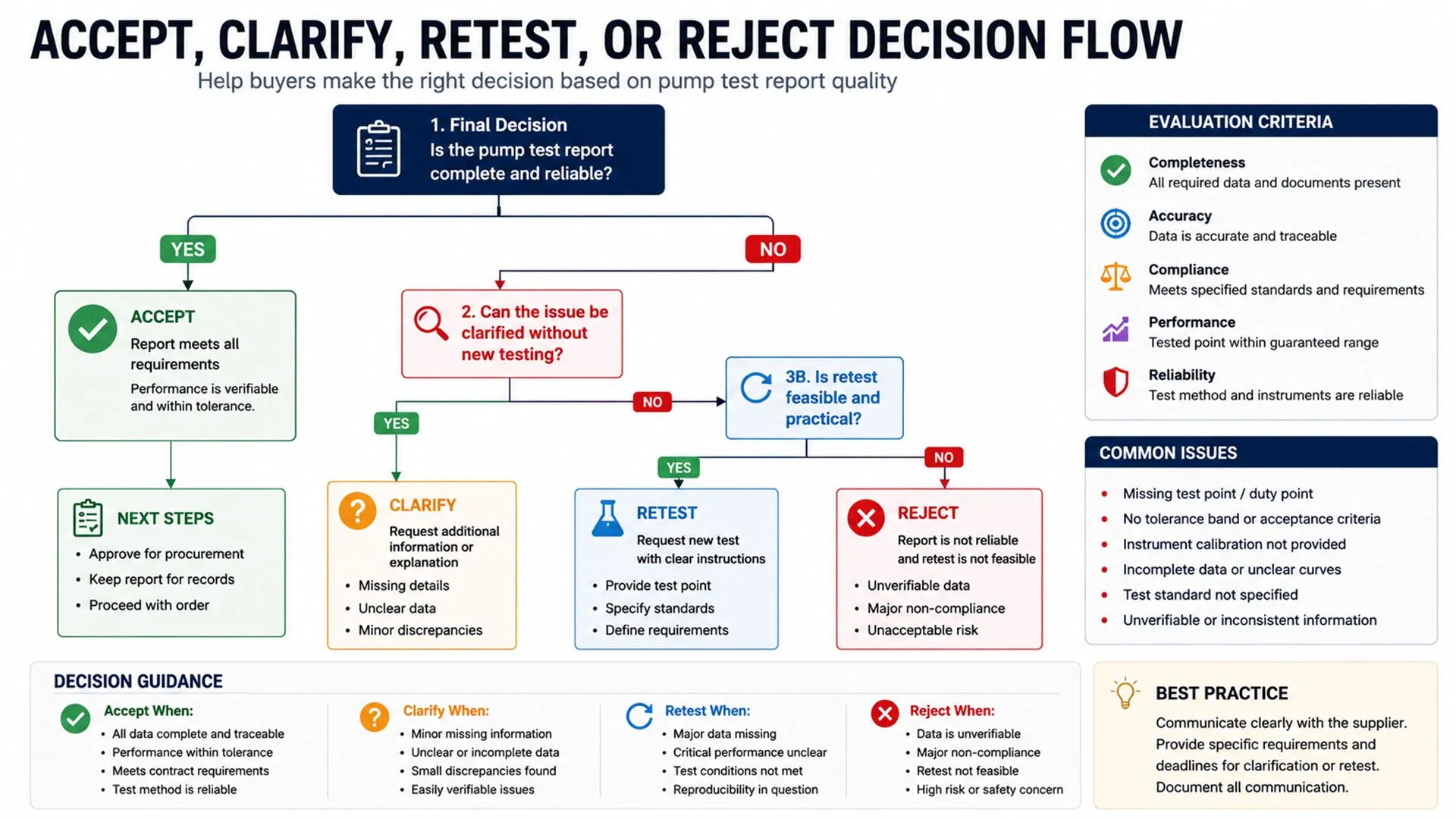
Step 6: Decide Accept, Clarify, Retest, or Reject
The final decision should be based on risk, not supplier assurance. The buyer should classify the report into one of four actions.
| Report Result | Buyer Decision |
|---|---|
| Complete report, traceable identity, correct standard, acceptable duty point | Accept |
| Minor missing information but core data is reasonable | Clarify before shipment |
| Missing serial number, test standard, curve, or tolerance | Request revised report or retest |
| Data mismatch, overload risk, wrong speed, or failed duty point | Reject or hold payment |
This four-action method helps procurement teams avoid vague internal discussions. Instead of saying “the report looks okay,” the team can decide what evidence is still needed.
Common Mistakes Buyers Make When Reviewing Pump Test Reports
Many pump acceptance problems happen because buyers check whether a report exists, but not whether the report is technically meaningful. A report should be reviewed as evidence, not as a formality.
Mistake 1: Only Checking Whether the Report Says “PASS”
The word “PASS” is not enough unless the acceptance standard, tolerance, duty point, and measured data are clearly shown. A report can say “PASS” but still fail to prove that the pump meets the buyer’s real requirement.
The buyer should ask: pass under which standard, at which duty point, with which tolerance, and under which test condition?
Mistake 2: Ignoring Speed and Frequency
Speed and frequency are common sources of misunderstanding in international pump orders. A pump tested under 60 Hz conditions may not deliver the same performance under 50 Hz operation.
Before accepting the report, the buyer should compare the tested RPM with the approved datasheet and site power supply.
Mistake 3: Ignoring Power Absorption
Flow and head may look acceptable, but excessive absorbed power can create motor overload, higher energy cost, or nuisance tripping.
Buyers should always check whether the motor has enough margin not only at the duty point but also across the expected operating range.
Mistake 4: Not Asking for the Full Curve
A single operating point cannot show whether the pump curve is stable, whether efficiency is reasonable, or whether the pump is close to unsafe operating zones.
For project pumps, a full curve is much more useful than a one-line pass statement.
Mistake 5: Treating Catalog Curves as Factory Test Reports
A catalog curve is a selection reference. A factory test report should reflect the tested pump unit or tested batch.
If the supplier only sends a catalog curve and calls it a test report, the buyer should request actual factory test data or clarify that no unit-level test was performed.
Mistake 6: Checking Documents After Shipment
The best time to verify a pump test report is before shipment and before balance payment. After shipment, the buyer has less leverage and correction costs are higher.
For important orders, test report approval should be defined as a shipment release condition in the purchase agreement.
How to Choose the Right Acceptance Level for Different Pump Orders
Not every pump order needs the strictest test level. Buyers should balance inspection cost, pump criticality, project risk, supplier history, and consequences of failure.
Best Option by Scenario
The right verification level depends on how expensive failure would be. Over-testing every pump wastes money, but under-testing critical pumps creates serious project risk.
| Pump Order Scenario | Recommended Verification Level |
|---|---|
| Standard small pump, non-critical use | Supplier factory report + nameplate/photo check |
| Medium industrial pump | Full performance curve + power and speed check |
| Continuous-duty process pump | Performance report + vibration + hydrostatic test |
| High-value project pump | Witnessed FAT or video-recorded test |
| EPC / municipal / mining project | Third-party witnessed test + full documentation |
| Custom pump package | Pre-agreed test procedure + inspection and test plan |
| Repeat order from proven supplier | Compare new report with previous accepted baseline |
| New supplier, first order | Stronger document verification and test evidence |
When NOT to Accept a Supplier’s Standard Report
A supplier’s standard report should not be accepted when the order has strict performance guarantee, penalty clauses, site risk, or custom engineering requirements.
Do not directly accept the report if:
- The report has no serial number.
- The report does not state the test standard.
- Flow and head are not tested at the guaranteed point.
- Motor power margin is unclear.
- Test speed differs from project speed.
- The performance curve is missing.
- Third-party witness was agreed but not performed.
- The pump is critical to project operation.
- The supplier cannot explain the data.
In these cases, the buyer should ask for a revised report, additional test data, video evidence, or witnessed retesting before shipment approval.
Supplier Questions Buyers Should Ask Before Shipment
A good supplier should be able to explain the test report clearly. If the supplier cannot answer basic report questions, the buyer should slow down acceptance and request stronger evidence.
Before shipment, buyers should ask:
- Which test standard was used for this pump?
- What acceptance grade or tolerance applies to this order?
- Does the serial number match the pump nameplate?
- Was the pump tested with the final impeller diameter?
- What was the test speed and frequency?
- Is the reported power shaft power, absorbed power, or motor input power?
- Was the full performance curve measured, corrected, or copied from catalog data?
- Was NPSH tested or taken from catalog data?
- Are the instruments calibrated?
- Can you provide test bench photos or video?
- Was the test witnessed by the buyer or a third party?
- What happens if site performance differs from factory test results?
- Does the report include hydrostatic pressure test results?
- Was vibration measured or only visually checked?
- Is the report valid for each pump unit or only for the batch?
- Is test report approval required before shipment?
- What corrective action is available if the pump does not meet the guaranteed point?
Before approving a supplier only by price, buyers can also use this global pump supplier selection guide to evaluate factory testing capability, documentation quality, and after-sales responsibility.
FAQ About Pump Test Report Verification
Buyers often review pump test reports under time pressure before shipment, payment, or project handover. These answers focus on the practical questions procurement teams, engineers, distributors, and EPC contractors usually ask when deciding whether a report is acceptable.
Is a pump test report required for every industrial pump order?
A full formal pump test report is not always required for every small standard pump, but every B2B order should have enough traceable performance evidence to protect the buyer. For low-risk standard pumps, a factory inspection report, nameplate photo, and basic performance confirmation may be enough.
For project pumps, customized pumps, high-value pumps, continuous-duty systems, or orders from a new supplier, a formal test report is strongly recommended. The report should include pump identity, duty point, test condition, performance curve, speed, power, and acceptance basis.
Can I accept a pump report without ISO 9906 or ANSI/HI 14.6?
You can accept it only if the contract allows a factory internal test method and the application risk is low. For formal acceptance, the report should reference an agreed standard or clearly define the acceptance criteria.
If no standard is stated, the report may still provide useful information, but it does not give the buyer a strong pass/fail basis. For critical projects, ask the supplier to identify the test method, tolerance, and acceptance grade before approval.
What is the biggest warning sign in a pump test report?
The biggest warning sign is lack of traceability. If the report has no serial number, no model match, no test date, no test standard, and no curve, the buyer cannot prove that the data belongs to the delivered pump.
A report without traceability may be a general factory template, a catalog data sheet, or a report from another pump. The buyer should request revised documentation before accepting shipment.
Should I ask for a video of the pump test?
A test video is useful, but it should not replace data verification. A video can help confirm that a pump was tested, but it does not automatically prove that the flow, head, power, and acceptance tolerance are correct.
A useful test video should show the pump nameplate, test bench, flow meter, pressure gauges, motor reading, running condition, and inspector view if possible. For critical orders, video evidence should support the written report, not replace it.
What data should be included in a pump FAT report?
A pump FAT report should include pump identity, serial number, test standard, test procedure, duty point, tested flow and head, speed, impeller diameter, absorbed power, motor current, curve, acceptance tolerance, hydrostatic test result if required, leakage observation, vibration data if required, witness record, and final acceptance decision.
For critical orders, the FAT report should also include calibration references, photos, inspector comments, nonconformity records, corrective actions, and buyer or third-party sign-off.
Can a pump test report be used for warranty claims?
A pump test report can be used as a baseline for warranty discussions, but it usually cannot prove responsibility by itself. If a pump fails on site, the buyer should compare factory test data with site installation data, operating conditions, liquid properties, electrical supply, maintenance records, and failure evidence.
For example, if the factory report shows acceptable flow, head, power, and vibration, but the site pump later cavitates because of insufficient suction pressure, the issue may relate to installation or system design rather than factory performance. The test report is important evidence, but it must be combined with site records.
What should I do if the tested flow is slightly lower than required?
The buyer should compare the result with the agreed acceptance tolerance. If the deviation is within the agreed tolerance, the pump may still be acceptable. If the deviation is outside tolerance, the buyer should request explanation, impeller adjustment, retesting, or written engineering approval.
The buyer should not accept verbal assurance if the report shows performance below the guaranteed duty point. The supplier should provide a technical reason and a corrective action.
Can a supplier reuse one test report for multiple pumps?
For identical batch pumps, some suppliers may provide batch test data or sample test data depending on the agreement. However, project-critical pumps should have unit-level traceability.
If the buyer orders multiple pumps with different duty points, motors, impeller diameters, or materials, one shared report is not enough. Each pump should be identified clearly.
Is a catalog curve the same as a factory test report?
No. A catalog curve is a selection reference, while a factory test report should reflect actual measured or verified data from the supplied pump or tested batch.
Catalog curves are useful during selection, but they do not prove that the delivered pump was tested. For acceptance, the buyer should request factory test data, especially for project pumps.
When should I request third-party inspection?
Third-party inspection is recommended when the pump is high-value, custom-built, critical to project operation, or linked to owner acceptance, liquidated damages, or strict performance guarantees.
It is also recommended when the supplier is new, the project is overseas, the pump package is complex, or the buyer cannot personally witness the test.
What if the supplier says factory testing is not necessary?
The buyer should ask why. For some small standard pumps, a full performance test may not be commercially necessary. However, for industrial project pumps, the supplier should at least provide traceable quality documents and performance confirmation.
If the supplier cannot provide meaningful testing or documentation for a critical order, the buyer should classify it as a procurement risk and request additional evidence before approval.
Should I approve final payment based only on the test report?
For low-risk orders, a complete and traceable test report may be enough. For higher-risk orders, final payment should depend on a complete document package, including test report, nameplate photo, inspection photos, packing photos, certificates, and any required witness records.
The buyer should define payment release documents in the purchase agreement before production. This avoids disputes when the supplier asks for balance payment but the report is incomplete.
Conclusion: A Reliable Pump Test Report Must Be Traceable, Standard-Based, and Technically Consistent
A reliable pump test report must prove three things clearly: the tested pump is the pump being supplied, the test condition matches the purchase requirement, and the measured performance meets the agreed acceptance criteria.
Buyers should not accept a report only because it looks official or says “PASS.” They should verify model, serial number, duty point, test standard, speed, impeller diameter, flow, head, efficiency, absorbed power, curve, hydrostatic pressure, leakage, mechanical test evidence, and acceptance tolerance.
For standard low-risk pumps, a supplier factory report may be enough if it is traceable and technically reasonable. For high-value, custom, continuous-duty, or project-critical pumps, buyers should request a full performance curve, defined acceptance standard, clear tolerance, and witnessed or third-party testing when needed.
The safest decision process is simple: Accept, Clarify, Retest, or Reject. A good pump test report should help the buyer choose one of these actions with confidence before shipment, not after the pump has already failed on site. For critical orders, unresolved report mismatches should be closed before shipment approval or balance payment.
Get A Quote

Get A Quote
0 Comments