
Electric Pump vs Diesel Pump: Which Power Source Is Better for Your Water Pumping System?
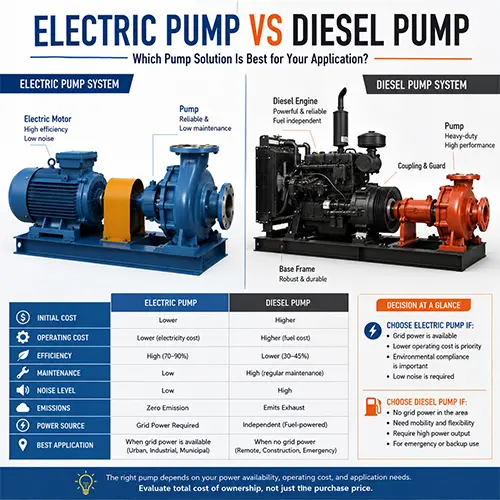
Electric pump vs diesel pump selection should start from the real site condition, not only from pump price, motor power, or flow rate. An electric pump is usually better when the site has stable electricity, long operating hours, lower noise requirements, automation needs, and a fixed pump room. A diesel pump is usually better when the site has no reliable grid power, needs emergency backup, requires mobile pumping, or must keep running during power failure.
Electric pumps use an electric motor to drive the pump. Diesel pumps use a diesel engine to drive the pump through a coupling, belt, gearbox, or direct connection. The pump side may look similar in some applications, but the power system, maintenance workload, operating cost, noise, emissions, and failure risks are very different.
For B2B buyers, engineers, contractors, irrigation managers, municipal operators, and project decision makers, the wrong power-source choice can create serious long-term problems. An electric pump may stop completely during a power outage if there is no backup plan. A diesel pump may solve power independence but increase fuel cost, engine maintenance, noise, exhaust handling, and operator workload. The right choice should match power availability, duty cycle, mobility, emergency risk, control requirements, maintenance capability, and total cost of ownership.
An electric pump is powered by electricity and is usually preferred for stable, continuous, and automated pumping systems. A diesel pump is powered by a diesel engine and is usually preferred for remote, mobile, or emergency applications where grid power is unavailable or unreliable. The safest pump decision is not “electric is better” or “diesel is stronger”; it is whether the power source can support the real operating condition throughout the pump’s service life.
Quick Answer: Electric Pump vs Diesel Pump
Electric pump vs diesel pump selection is mainly a power-source decision. If the site has stable electricity and the pump runs frequently or continuously, an electric pump is usually the first choice. If the site has no grid power, frequent outage, emergency drainage needs, or mobile operation, a diesel pump should usually be evaluated first.
| Decision Factor | Electric Pump | Diesel Pump |
| Power source | Electricity | Diesel fuel |
| Best for | Stable power supply, continuous operation, automation | Remote sites, emergency backup, mobile pumping |
| Operating cost | Usually lower if electricity is stable and affordable | Usually higher during long continuous operation due to fuel cost |
| Daily maintenance | Lower routine workload | Higher engine-side maintenance workload |
| Startup reliability | Depends on power availability and motor protection | Depends on fuel, battery, engine, and test-run condition |
| Noise level | Usually lower | Usually higher |
| Local emissions | No local exhaust emissions | Produces exhaust emissions |
| Automation | Easier with VFD, sensors, PLC, and control cabinet | Possible but more complex |
| Mobility | Better for fixed installation | Better for trailer, skid, and temporary field use |
| Main risk if misused | Stops during power outage if no backup is prepared | High fuel, noise, and maintenance cost if used unnecessarily |
The practical first decision is simple: choose an electric pump when stable grid power and long-term operating efficiency matter most; choose a diesel pump when independent power, mobility, and emergency reliability matter more than daily operating cost.
30-Second Decision Table for Buyers
A fast decision table helps buyers screen the power source before requesting a full pump quotation. This table does not replace engineering selection, but it can prevent obvious mistakes at the early procurement stage.
| If Your Site Condition Is... | Choose First | Why |
| Stable three-phase power is available | Electric pump | Lower routine cost and easier control |
| Pump runs many hours every day | Electric pump | Electric operation is usually more economical for long duty |
| VFD pressure control is required | Electric pump | Easier to integrate with sensors and control cabinet |
| Indoor pump room with noise limits | Electric pump | Lower noise and no exhaust management |
| No grid electricity on site | Diesel pump | Independent fuel-powered operation |
| Emergency drainage during power failure | Diesel pump | Can operate when grid power is unavailable |
| Construction site dewatering | Diesel pump | Mobile and suitable for temporary use |
| Remote irrigation without electrical infrastructure | Diesel pump | Avoids the cost of building power supply first |
| Normal operation plus emergency protection | Electric pump + diesel backup | Balances low daily cost with outage protection |
| Strict emissions or indoor ventilation limits | Electric pump | Avoids exhaust, fuel storage, and ventilation risk |
A diesel pump is not automatically more reliable, and an electric pump is not automatically cheaper in every project. Reliability depends on what failure scenario the buyer is trying to prevent. If the failure scenario is power outage, diesel backup can be valuable. If the failure scenario is poor fuel, weak battery, and missed engine maintenance, a diesel pump can also fail at the exact moment it is needed.
Normal Duty vs Emergency Duty Strategy
Electric pump vs diesel pump selection becomes clearer when buyers separate normal daily operation from emergency operation. Many projects do not need only one pump type. They need the right strategy for normal duty, standby duty, and outage protection.
A common mistake is asking, “Should I buy an electric pump or a diesel pump?” In critical systems, the better question is: “Which pump should run every day, and which pump should protect the system when power, weather, or site conditions fail?”
| System Need | Recommended Strategy | Why |
| Daily continuous operation with stable grid power | Electric pump only | Lower routine cost, easier control, lower noise |
| Emergency-only pumping | Diesel pump | Independent power during outage or field emergency |
| Daily operation plus outage protection | Electric duty pump + diesel standby pump | Electric pump handles normal duty; diesel pump protects emergency operation |
| Remote temporary site | Diesel pump | Avoids electrical infrastructure and improves mobility |
| Fixed site with unstable power | Electric pump + generator or diesel backup | Keeps automation while reducing outage risk |
| Municipal drainage or flood control | Electric main pump + diesel emergency pump | Supports normal efficiency and storm/outage security |
| Firefighting or safety-critical standby | Diesel backup or code-compliant standby system | Power independence may be required by project risk or local code |
| Large industrial plant with high downtime cost | Electric pump set + standby pump + backup power plan | Reduces production shutdown risk |
For normal operation, an electric pump is often more economical, quieter, and easier to automate. For emergency operation, a diesel pump may be more valuable because it can run when grid power is unavailable. In critical systems, the safest design is often not “electric or diesel,” but electric for daily duty and diesel for emergency backup.
What Is an Electric Pump?
An electric pump is a pump driven by an electric motor. It is commonly selected when the site has stable power supply, predictable operation, lower noise requirements, and the buyer wants easier automation with lower daily maintenance.
How an Electric Pump Works
An electric pump uses an electric motor to rotate the pump shaft and impeller. The motor converts electrical energy into mechanical energy, and the pump converts mechanical energy into liquid flow and pressure.
Electric pumps may use single-phase power for smaller systems or three-phase power for industrial systems. In many industrial water pump applications, three-phase motors are preferred because they provide better efficiency, smoother operation, and better suitability for larger power ranges.
An electric pump can also work with a VFD, or Variable Frequency Drive. A VFD controls motor speed so the pump can adjust flow or pressure according to demand instead of running at one fixed speed all the time. This is valuable in building pressure boosting, RO system feed, HVAC circulation, and industrial process water systems.
In many industrial pump rooms, electric pump failure is not caused by the pump body itself. It is often caused by voltage instability, phase loss, wrong motor sizing, undersized cables, weak control cabinet protection, poor grounding, or lack of backup power planning. Buyers should evaluate the full electrical system, not only the pump model.
Common Applications of Electric Pumps
Electric pumps are commonly used when the power supply is stable and the system needs repeatable, controllable, and efficient operation. They are especially suitable for fixed pump rooms and automated systems.
| Application | Why an Electric Pump May Be Suitable |
| Factory water supply | Stable power and continuous operation |
| HVAC circulation | Low noise and automatic control |
| Industrial process water | Predictable duty point and easy control |
| Building pressure boosting | Works well with VFD, pressure sensors, and control cabinets |
| RO system feed pump | Stable pressure control is important |
| Clean water transfer | Lower daily maintenance and cleaner operation |
| Fixed pump room installation | Permanent power supply is usually available |
If the system requires stable pressure and controlled operation, this single stage vs multistage pump guide can help buyers decide whether the pump also needs higher pressure-building capability.
What Is a Diesel Pump?
A diesel pump is a pump driven by a diesel engine instead of an electric motor. It is commonly selected when grid electricity is unavailable, unreliable, or unsuitable for emergency, mobile, remote, or temporary pumping conditions.
How a Diesel Pump Works
A diesel pump uses a diesel engine to generate mechanical power and drive the pump shaft. The engine may connect to the pump through a coupling, bell housing, gearbox, belt drive, or other mechanical transmission arrangement depending on pump type and package design.
A diesel pump package usually includes more than only the pump and engine. It may include a fuel tank, battery, radiator, cooling system, air filter, exhaust system, base frame, coupling guard, control panel, and sometimes trailer or skid structure. These parts are not accessories only; they directly affect startup reliability and long-term service.
In a correctly designed diesel pump set, the pump should be connected to the diesel engine’s flywheel or power output side, not to the radiator side. The radiator, fan, and cooling end belong to the engine’s cooling side, while the pump is normally connected through the flywheel housing, coupling, or bell housing. This detail matters because professional buyers can quickly recognize whether the pump set layout is mechanically realistic.
In many emergency pumping projects, diesel pump reliability depends not only on the pump model, but also on fuel quality, battery condition, engine maintenance, cooling system condition, air intake condition, and whether operators test-run the unit regularly. A diesel pump that sits unused for months without inspection may fail during emergency startup.
Common Applications of Diesel Pumps
Diesel pumps are commonly used when pumping must continue without grid power or when the system must be moved between sites. They are common in emergency drainage, construction dewatering, remote irrigation, mining drainage, and temporary water transfer.
| Application | Why a Diesel Pump May Be Suitable |
| Emergency flood control | Can run during power failure |
| Construction site dewatering | Mobile and independent power source |
| Remote irrigation | Useful where grid electricity is unavailable |
| Mining drainage | Suitable for remote and heavy-duty conditions when power is limited |
| Firefighting backup | Can operate when electrical supply is interrupted |
| Municipal emergency drainage | Fast deployment and independent operation |
| Temporary water transfer | Suitable for short-term field use |
If the project involves temporary drainage or unstable suction conditions, this self priming vs centrifugal pump guide can help buyers judge whether the pump also needs self-priming capability.
Electric Pump vs Diesel Pump: Core Differences Buyers Must Understand
The main difference between electric and diesel pumps is not hydraulic performance alone. The real decision depends on power availability, emergency requirement, operating hours, fuel logistics, maintenance capacity, environmental limits, and lifecycle cost.
Power Availability Difference
Power availability is usually the first decision point. If the site has stable grid power, an electric pump is usually more practical. If the site has no power, weak power, frequent outages, or emergency operation requirements, a diesel pump may be safer.
| Power Condition | Better First Choice | Reason |
| Stable industrial power supply | Electric pump | Lower daily cost and easier control |
| No grid electricity | Diesel pump | Independent power source |
| Frequent power outage | Diesel pump or electric pump with generator backup | Avoids system shutdown during outage |
| Remote field operation | Diesel pump | Often easier than building electrical infrastructure |
| Fixed pump room with control cabinet | Electric pump | Better automation and lower routine maintenance |
| Emergency backup system | Diesel pump | Can run when electricity fails |
Electric pump reliability depends on voltage quality, phase protection, cable sizing, motor protection, and control cabinet design. Diesel pump reliability depends on fuel, oil, coolant, battery, engine condition, and regular test operation. Buyers should compare the full power chain, not just the pump head and flow.
Operating Cost Difference
Operating cost should include electricity or fuel cost, labor, maintenance, spare parts, downtime risk, and energy efficiency. Electric pumps usually have lower daily operating cost in stable power systems, while diesel pumps may have higher fuel and engine maintenance cost.
For long continuous operation, the cost difference can become significant. A diesel pump consumes fuel every hour and requires oil, filters, coolant, battery care, and engine service. An electric pump also needs maintenance, but it normally has fewer daily service items and is easier to automate.
For emergency or short-term mobile operation, diesel cost may be acceptable because the value is not low energy cost; the value is independent operation when electricity is unavailable. Buyers should decide whether the pump is a daily production asset or an emergency security asset.
Maintenance Difference
Maintenance difference is one of the biggest practical factors. Electric pumps usually require pump-side and electrical inspection. Diesel pumps require all pump-side maintenance plus engine-side maintenance.
| Maintenance Area | Electric Pump | Diesel Pump |
| Pump seal and bearing | Required | Required |
| Motor inspection | Required | Not applicable |
| Control cabinet | Required | May be required for engine control system |
| Engine oil and filters | Not applicable | Required |
| Fuel system | Not applicable | Required |
| Battery inspection | Usually control-related | Required for engine starting |
| Cooling system | Motor cooling or ventilation | Engine radiator or cooling system |
| Exhaust system | Not applicable | Required |
| Operator skill | Electrical and pump knowledge | Engine plus pump knowledge |
Diesel pump maintenance is not difficult when a trained team manages it, but it is less forgiving when ignored. A standby diesel pump that is not test-run regularly can fail due to weak battery, stale fuel, blocked filter, low coolant, or starting system problems.
Reliability Difference
Reliability depends on the failure scenario. An electric pump is reliable when power is stable and electrical protection is designed correctly. A diesel pump is reliable when grid power is unavailable, but only if the engine system is maintained.
An electric pump can fail because of power outage, low voltage, phase loss, overload, water entering the motor, poor cable sizing, or control cabinet failure. A diesel pump can fail because of fuel contamination, empty tank, weak battery, clogged filter, low oil pressure, overheating, or engine neglect.
The key question is not which pump is theoretically more reliable. The key question is which failure risk is more likely at the site. For a factory with stable power and skilled electrical maintenance, electric pumps are usually reliable. For emergency flood control where grid power may fail during storms, diesel pumps may provide more practical security.
Noise and Emissions Difference
Noise and emissions can affect site approval, worker comfort, environmental compliance, and indoor installation feasibility. Electric pumps usually create less noise and no local exhaust emissions, while diesel pumps require exhaust management and noise control.
Electric pumps are usually better for indoor pump rooms, building systems, factories, water treatment rooms, and urban projects where noise and ventilation are controlled. Diesel pumps require exhaust routing, ventilation, heat management, and sometimes acoustic enclosures.
Diesel pumps can still be appropriate in outdoor emergency, remote, and mobile applications. However, buyers should check local noise limits, emission requirements, fuel storage rules, and ventilation needs before selecting diesel power.
Automation and Control Difference
Automation is usually easier with electric pumps. Electric pumps can connect directly with VFDs, pressure sensors, level sensors, PLC systems, SCADA systems, and remote alarms.
PLC means Programmable Logic Controller, which is an industrial control computer. SCADA means Supervisory Control and Data Acquisition, which is a monitoring and control system used in industrial and municipal projects.
Diesel pumps can also be automated, but engine start, warm-up, fuel monitoring, battery health, oil pressure, coolant temperature, and shutdown protection make the control system more complex. For normal continuous process control, electric pumps usually provide better control accuracy and easier integration.
For buyers trying to control long-term energy use, this pump efficiency loss guide explains why pump efficiency, duty point, and control method can strongly affect operating cost.
Simple Lifecycle Cost Calculation Example
Lifecycle cost gives buyers a more realistic comparison than purchase price alone. Electric pumps and diesel pumps should be compared by daily operating cost, maintenance workload, downtime risk, and backup cost.
A simple cost comparison does not need to be complicated. The buyer should estimate how many hours the pump runs, what energy source it consumes, and what maintenance items are required.
| Cost Item | Electric Pump | Diesel Pump |
| Energy or fuel cost | Electricity tariff × motor power × operating hours | Fuel consumption × diesel price × operating hours |
| Routine maintenance | Pump seal, bearing, motor, control cabinet | Pump parts + engine oil, filters, coolant, fuel system, battery |
| Operator workload | Usually lower in automatic systems | Higher if manual start, refueling, and engine checks are needed |
| Backup cost | Generator, standby pump, or diesel backup may be needed | Fuel storage, test-run, battery replacement, and engine service |
| Downtime risk | Power outage, electrical fault, control cabinet failure | Fuel shortage, battery failure, engine fault, poor maintenance |
| Compliance cost | Electrical safety and control protection | Noise, exhaust, fuel storage, ventilation, emissions |
For example, if a pump runs many hours every day in a factory with stable electricity, the electric pump usually has a stronger lifecycle-cost advantage. If a pump only runs during emergencies or temporary site drainage, the diesel pump may be justified even if fuel cost is higher, because its main value is independent power.
The important point is this: daily-duty pumps should be evaluated by energy efficiency and maintenance economy, while emergency pumps should be evaluated by startup reliability and failure consequence.
When Should You Choose an Electric Pump?
An electric pump is usually the better choice when the site has stable power supply, long operating hours, automation requirements, lower noise limits, and the buyer wants lower routine maintenance.
Choose an Electric Pump When Grid Power Is Stable
Electric pumps should usually be evaluated first when the pump room has reliable grid electricity. Stable electricity allows the pump to run continuously, connect to automatic controls, and operate with lower routine service workload.
This applies to factory water supply, building booster systems, HVAC circulation, RO water treatment, cooling water circulation, industrial process water, and clean water transfer. These systems often require predictable performance more than mobile independence.
The buyer should still confirm voltage, phase, frequency, available power capacity, cable route, motor protection, and control cabinet specification. A good electric pump can fail if the electrical system is poorly designed.
Choose an Electric Pump for Continuous Operation
Electric pumps are often more suitable for continuous operation because electricity is usually easier to manage than diesel fuel logistics in fixed industrial systems. When a pump runs many hours per day, energy efficiency and control become important cost factors.
Continuous-duty systems should not be evaluated only by equipment price. Buyers should compare motor efficiency, pump curve, duty point, operating hours, energy tariff, and VFD control needs. A slightly more efficient electric pump package may reduce long-term operating cost compared with a cheaper but poorly selected pump.
Choose an Electric Pump When Automation and Control Matter
Electric pumps are usually better when the system needs stable pressure, flow control, automatic start-stop, remote monitoring, multi-pump sequencing, or integration with plant control systems.
VFD control can help reduce energy waste when demand changes. Pressure sensors can maintain stable discharge pressure. Level sensors can protect the pump from dry running. Remote alarms can warn operators before a fault becomes a shutdown.
For building pressure systems, RO systems, process water, and HVAC applications, electric control is often one of the main reasons to choose electric power.
When Not to Choose an Electric Pump
An electric pump may not be suitable when the site has no reliable electricity, frequent outages, temporary field conditions, emergency drainage needs, or no practical way to install electrical infrastructure.
The main risks include system shutdown during power failure, motor damage from unstable voltage, high cost of temporary power installation, delayed emergency response, and unsuitable fixed wiring for mobile projects.
If the pump is critical during power failure, an electric pump alone may not be enough. The buyer should consider a generator, diesel standby pump, or dual-system design.
When Should You Choose a Diesel Pump?
A diesel pump is usually the better choice when the site needs independent power, emergency backup, mobility, or reliable operation during grid power failure.
Choose a Diesel Pump When Grid Power Is Unavailable
Diesel pumps should usually be evaluated first when the project site has no grid power or when installing electrical infrastructure is too slow, expensive, or temporary.
This is common in remote irrigation, mining drainage, construction dewatering, river intake, field transfer, and temporary pumping stations. In these applications, diesel power allows the pump to operate without waiting for permanent electrical installation.
The buyer should still confirm fuel supply, refueling access, engine service, operator skill, noise limits, and storage conditions. Diesel independence is useful only when fuel and maintenance can be managed reliably.
Choose a Diesel Pump for Emergency Backup
Diesel pumps are often selected when pumping must continue during power failure. In emergency applications, the value of diesel power is system security, not low daily operating cost.
Typical emergency applications include flood control, firefighting backup, municipal drainage, stormwater pumping, factory accident drainage, and critical water transfer. If the power grid fails during the event that creates the pumping need, electric-only systems may be exposed.
However, standby diesel pumps must be test-run regularly. A diesel backup pump that is never started until an emergency may fail because the battery is weak, fuel is degraded, filters are blocked, or coolant is low.
Choose a Diesel Pump for Mobile or Temporary Pumping
Diesel pumps are practical for mobile pumping because they can be mounted on a trailer, skid, or temporary base without relying on fixed electrical infrastructure.
This makes diesel pumps suitable for construction dewatering, temporary irrigation, emergency water transfer, disaster response, mining drainage, and municipal temporary bypass pumping.
In mobile projects, buyers should check lifting points, trailer structure, fuel tank capacity, suction hose layout, discharge piping, engine protection, and site access. A diesel pump is not only a pump; it is a complete mobile power and pumping package.
When Not to Choose a Diesel Pump
A diesel pump should not be selected only because it seems more independent. If the site already has reliable electricity and the pump runs many hours per day, diesel operation may increase fuel cost, maintenance workload, noise, and emissions.
The main risks include high fuel consumption, engine maintenance requirements, battery failure after long standby, ventilation problems, exhaust risk, noise complaints, fuel storage issues, and higher operator workload.
For fixed, long-running systems with stable electricity, a diesel pump may be more expensive over its lifecycle than an electric pump.
Electric Pump vs Diesel Pump by Application Scenario
Different applications require different power strategies. Buyers should choose based on power availability, operating mode, emergency requirement, mobility, and maintenance capability.
| Application Scenario | Recommended Pump Type | Reason |
| Factory water supply | Electric pump | Stable power and continuous operation |
| HVAC circulation | Electric pump | Low noise and easy automation |
| RO system feed pump | Electric pump | Stable pressure control |
| Building pressure boosting | Electric pump | Works well with VFD and sensors |
| Remote irrigation without grid power | Diesel pump | Independent power source |
| Construction site dewatering | Diesel pump | Mobile and temporary operation |
| Emergency flood control | Diesel pump | Can run during power outage |
| Firefighting backup | Diesel pump | Emergency reliability |
| Municipal drainage pump station | Electric pump + diesel backup | Normal operation plus emergency security |
| Mining drainage | Diesel or electric depending on site power | Depends on infrastructure and duty cycle |
This table should be used as a first screening tool. The final selection still needs flow rate, total dynamic head, suction condition, pump curve, liquid type, site power condition, operating hours, backup plan, and maintenance capability.
Real Application Cases: How the Choice Changes by Site
Real application cases help buyers understand why electric vs diesel pump selection must be based on actual operating conditions. The same flow and head requirement can lead to different power-source decisions depending on electricity, mobility, and emergency risk.
Case 1: Factory Cooling Water System With Stable Power
A factory cooling water system usually runs for long hours and has stable electrical infrastructure. In this case, an electric pump is usually the better choice because operating cost, automation, and routine maintenance matter more than mobility.
The main risk is not the lack of diesel power. The main risk is poor electrical protection, wrong duty point, inefficient operation, or lack of backup planning for critical production lines.
If cooling water is essential to production, the buyer may still need standby electric pumps or generator backup. But the normal-duty pump should usually be electric if the power supply is stable.
Case 2: Construction Site Dewatering Without Permanent Power
A construction site dewatering project often has temporary working conditions, changing water levels, and no permanent electrical infrastructure. In this case, a diesel pump is often more practical.
The diesel pump can be moved between locations and started without grid power. If the pump must handle suction lift or air in the suction line, the buyer may also need a diesel-driven self-priming pump.
The main risk is ignoring fuel logistics, suction hose condition, and engine service. A diesel pump is useful only when fuel, battery, oil, filters, and operator checks are managed properly.
Case 3: Municipal Drainage Pump Station
A municipal drainage pump station may use electric pumps for normal operation and diesel pumps for emergency backup. This combination is common because daily operation should be efficient, but storm or outage conditions require independent power.
The main risk is assuming one power source solves all situations. Electric pumps reduce daily cost and improve control. Diesel backup improves emergency security. A mixed strategy can be more reliable than choosing only one option.
Case 4: Remote Irrigation Field
A remote irrigation field may not have reliable electricity. If building electrical infrastructure is too expensive or slow, a diesel pump may be the practical first choice.
However, if the irrigation system runs for many hours every day and grid power can be built economically, an electric pump may become more attractive over time.
The buyer should compare short-term installation cost with long-term fuel cost. Diesel may be easier to start the project, but electricity may reduce operating cost if the system becomes permanent.
Case 5: Indoor Building Booster Pump Room
An indoor building booster pump room usually favors electric pumps because noise, exhaust, ventilation, automation, and safety requirements are easier to manage with electric motors.
Diesel pumps are usually not preferred for normal indoor building boosting unless they are part of a properly designed emergency system with ventilation, exhaust, fuel storage, and fire safety controls.
The main risk is using diesel equipment indoors without proper exhaust and ventilation planning. This can create safety and compliance problems.
Field Service Notes From Real Pump Projects
Field service experience shows that many electric pump and diesel pump failures are not caused by the pump hydraulic end alone. They often come from the power system, installation condition, maintenance routine, or missing standby strategy.
For electric pumps, factory failures often come from voltage instability, phase loss, undersized cables, poor control cabinet protection, or pumps operating far from the correct duty point. The pump may be blamed first, but the root cause can be electrical protection or system design.
For diesel pumps, emergency failure is often caused by weak battery, old fuel, blocked filters, low coolant, poor test-run discipline, or operators who are unfamiliar with engine startup procedures. A diesel pump that is not tested regularly should not be considered a reliable standby system.
For indoor projects, diesel pumps are often rejected or modified later because exhaust, heat, noise, and fuel storage were not planned during procurement. Buyers should check these requirements before purchase, not after installation.
For municipal and flood control projects, the strongest strategy is often electric daily operation plus diesel emergency backup. Electric pumps reduce normal operating cost, while diesel pumps protect the system during grid failure.
Common Selection Mistakes When Comparing Electric and Diesel Pumps
Most pump power-source mistakes happen because buyers compare only pump price or rated flow and head. A correct decision must include power reliability, operating hours, fuel logistics, automation, maintenance skill, noise, emissions, and downtime consequences.
Mistake 1: Choosing an Electric Pump Without Backup in an Outage-Prone Site
An electric pump without backup can stop the entire system if the site loses power frequently. The pump may be hydraulically correct, but the power strategy is incomplete.
This mistake is common in drainage, municipal, irrigation, and industrial safety systems where pumping is still required during power failure. If downtime is unacceptable, the buyer should consider generator backup, diesel standby, or redundant pump configuration.
Mistake 2: Choosing a Diesel Pump for Long Continuous Operation Without Cost Calculation
A diesel pump can be reliable in remote or emergency conditions, but long continuous operation may create high fuel and maintenance cost.
This mistake happens when buyers focus only on independence and ignore daily fuel consumption, oil changes, filter replacement, operator time, engine wear, and noise. If the pump runs many hours per day and electricity is available, an electric pump often deserves first evaluation.
Mistake 3: Ignoring Fuel Quality and Storage
Diesel pump reliability depends on clean fuel, proper storage, fuel filters, and regular inspection. Poor fuel can cause engine starting problems, unstable running, blocked filters, and injector issues.
For standby diesel pumps, fuel may sit for long periods. The buyer should confirm storage practice, fuel rotation, water contamination control, and filter inspection schedule.
Mistake 4: Ignoring Battery and Test-Run Schedule
A diesel pump used as emergency backup may fail if the battery is weak or the engine has not been test-run regularly.
Emergency diesel pumps should not be treated as “install and forget” equipment. Buyers should set a test-run schedule, battery inspection plan, oil check routine, coolant check, and startup log.
Mistake 5: Comparing Pump Flow and Head Without Comparing Power System
Two pumps may have similar flow and head, but their real reliability depends on whether the power source fits the site.
An electric pump with perfect hydraulic performance is not reliable if power is unstable. A diesel pump with enough rated flow is not reliable if fuel, battery, and engine maintenance are ignored. The power system is part of pump selection.
Mistake 6: Ignoring Noise and Emission Limits
Diesel pumps can create noise and exhaust that may not be acceptable in urban, indoor, residential, or regulated industrial environments.
Before choosing a diesel pump, buyers should confirm whether the project requires acoustic enclosure, exhaust pipe design, ventilation, emission control, or fuel storage approval. These costs can change the real comparison.
Step-by-Step Guide: How to Choose Between Electric and Diesel Pump
The correct selection process should start from power availability and duty cycle, then compare hydraulic requirement, operating cost, maintenance capacity, and emergency risk.
Step 1: Confirm Power Availability
Power availability determines whether an electric pump is practical or whether a diesel pump should be considered first.
Buyers should confirm whether grid power is available, whether voltage is stable, whether three-phase power exists, whether outages are frequent, whether a generator is available, and whether the pump is fixed or mobile.
If stable power is available and the pump is fixed, electric power is usually easier to justify. If power is unavailable or unreliable, diesel power may reduce project risk.
Step 2: Confirm Operating Hours
Operating hours strongly affect lifecycle cost. A pump running continuously should be evaluated differently from a pump used only during emergencies.
Buyers should confirm daily operating hours, continuous or intermittent duty, emergency-only use, electricity tariff, diesel fuel cost, operator availability, and service interval.
If the pump runs many hours per day, electric operation often has a cost advantage. If the pump is rarely used but must work during outages, diesel backup may be worth the additional maintenance.
Step 3: Confirm Flow, Head, and Pump Type
Electric vs diesel is the power-source decision, but the pump must still meet hydraulic requirements. Buyers still need to confirm flow rate, total dynamic head, pump curve, suction condition, and liquid type.
A diesel engine does not automatically make a pump stronger. An electric motor does not automatically make a pump more efficient. The pump hydraulic selection must still match the duty point.
If the system requires high pressure, buyers may need a multistage pump. If the suction condition is unstable, buyers may need a self-priming pump. If the liquid contains solids, buyers may need a sewage or slurry pump design.
Step 4: Review Maintenance Capability
Maintenance capability affects long-term reliability. Electric pumps need electrical and pump maintenance. Diesel pumps need both pump-side and engine-side maintenance.
Buyers should confirm who maintains the pump, whether engine technicians are available, whether spare parts are available locally, whether operators can check oil, filters, coolant, battery, fuel system, and whether regular test-run is possible.
A diesel pump may be the right technical choice but the wrong operational choice if no one can maintain the engine system properly.
Step 5: Compare Lifecycle Cost and Downtime Risk
Lifecycle cost includes purchase price, installation, electricity or fuel, maintenance, labor, downtime, backup system, spare parts, and compliance cost.
| Cost Factor | Electric Pump | Diesel Pump |
| Initial equipment cost | Often lower for comparable fixed-duty systems | Often higher with engine package |
| Energy or fuel cost | Usually lower in fixed long-duty systems | Higher if used continuously |
| Maintenance labor | Lower routine workload | Higher engine maintenance |
| Automation cost | Easier and common | Possible but more complex |
| Backup requirement | May need generator or diesel backup | Built-in power independence |
| Downtime risk | Power outage risk | Fuel, engine, and battery risk |
| Noise and emissions | Easier to manage | May require enclosure, exhaust, and ventilation |
The best pump power source is the one that reduces total project risk, not only purchase price. Buyers should calculate normal operating cost and failure consequence separately.
Information to Send Before Asking for a Pump Quotation
Complete quotation information helps the supplier recommend the correct power source. If buyers only send flow and head, the supplier may quote a pump that works hydraulically but does not match site power or emergency requirements.
| Information to Send | Why It Matters |
| Required flow rate | Confirms pump capacity |
| Total dynamic head | Confirms pressure requirement |
| Power availability | Determines electric or diesel feasibility |
| Voltage, phase, and frequency | Confirms motor selection |
| Power outage frequency | Determines backup requirement |
| Daily operating hours | Affects operating cost |
| Emergency or normal duty | Affects reliability strategy |
| Site location | Affects power, fuel, noise, and maintenance |
| Mobility requirement | Determines skid, trailer, or fixed base |
| Fuel availability | Affects diesel pump feasibility |
| Noise limit | Affects acoustic enclosure need |
| Emissions or ventilation limits | Affects diesel suitability |
| Automation requirement | Affects control system |
| Liquid type and suction condition | Affects pump type selection |
A buyer who provides site power and duty information usually receives a more reliable recommendation than a buyer who only asks for a pump price. Power-source selection is part of engineering risk control.
Supplier Quotation Red Flags Before Final Selection
Supplier quotation red flags help buyers identify whether the electric or diesel pump recommendation is technically reliable. A quotation should explain why the power source fits the site, not only list model, motor power, and price.
| Red Flag | Why It Is Risky | What Buyers Should Ask |
| No power condition review | Pump may not match site energy supply | Ask whether site voltage or fuel availability was checked |
| No pump curve | Hydraulic duty point cannot be verified | Ask for flow-head curve and selected duty point |
| No motor protection details | Electric pump may be exposed to power faults | Ask for overload, phase loss, and protection configuration |
| No engine data | Diesel package cannot be evaluated | Ask for engine brand, rated power, fuel use, and service needs |
| No fuel consumption estimate | Diesel operating cost is unclear | Ask for fuel consumption under expected load |
| No control system details | Automation may not meet project needs | Ask for VFD, sensor, PLC, or engine controller options |
| No noise or exhaust information | Site compliance risk may be hidden | Ask for noise level, exhaust layout, and ventilation guidance |
| No maintenance schedule | Reliability cannot be planned | Ask for service interval and spare parts list |
| No backup strategy discussion | Critical system may stop during failure | Ask whether standby pump or generator is needed |
A reliable supplier should be able to explain the power-source logic. If a quotation only gives the lowest price without discussing power, duty cycle, fuel, control, or maintenance, the buyer should not treat it as final engineering confirmation.
Documents Buyers Should Request from the Pump Supplier
Supplier documents help buyers verify whether the pump and power source are technically justified. These documents are especially important for continuous-duty systems, emergency systems, municipal projects, irrigation projects, and remote job sites.
| Document | Why It Matters |
| Pump datasheet | Confirms model, flow, head, speed, power, and connection size |
| Pump curve | Shows whether the duty point is suitable |
| Efficiency curve | Helps estimate energy cost |
| Motor specification | Confirms voltage, phase, insulation, protection class |
| Control cabinet diagram | Helps verify electrical protection and automation |
| Diesel engine datasheet | Confirms engine power, speed, and performance |
| Fuel consumption data | Helps estimate operating cost |
| Installation drawing | Helps verify footprint, base, piping, and maintenance access |
| Noise and exhaust information | Helps evaluate site compliance |
| Operation manual | Helps prevent startup and maintenance mistakes |
| Spare parts list | Helps reduce downtime during repair |
For B2B procurement, documentation is part of risk control. A supplier that can provide complete technical documents is easier to evaluate than a supplier that only provides a low-price quotation.
Acceptance Test Checklist Before Final Handover
Acceptance testing helps buyers confirm that the delivered pump package matches the quotation and can operate under real site conditions. The test should check hydraulic performance, power system reliability, safety protection, and maintenance readiness.
| Test Item | Electric Pump | Diesel Pump |
| Flow and pressure test | Confirm flow, head, current, vibration, and pressure stability | Confirm flow, head, engine load, vibration, and pressure stability |
| Startup test | Check motor start, control cabinet, VFD, and protection settings | Check cold start, battery, starter, fuel supply, and engine response |
| Running current or engine load | Confirm motor current is within safe range | Confirm engine runs without overload or abnormal smoke |
| Vibration and noise | Check pump, motor, base, and pipe support | Check pump, engine, base frame, coupling, and exhaust noise |
| Protection test | Test overload, phase loss, low water level, or pressure alarms | Test oil pressure, coolant temperature, overspeed, and emergency stop |
| Backup operation | Test generator or standby pump if included | Test automatic or manual emergency startup procedure |
| Maintenance access | Confirm seal, bearing, motor, and control access | Confirm filter, oil, battery, fuel tank, radiator, and coupling access |
| Documentation | Confirm datasheet, curve, wiring diagram, manual, and spare parts list | Confirm engine manual, fuel data, maintenance schedule, and spare parts list |
For electric pumps, the acceptance test should focus on voltage stability, current, protection settings, VFD operation, pressure control, and pump performance. For diesel pumps, the acceptance test should focus on cold start, battery condition, fuel supply, oil pressure, coolant temperature, engine load, exhaust, vibration, and test-run procedure.
A pump should not be accepted only because it starts once. Buyers should confirm that the pump can start, run, stop, restart, and maintain stable performance under the expected operating condition.
Applicable Pump Types and Scope of This Guide
This guide applies mainly to water pump power-source selection where buyers are comparing electric motor drive and diesel engine drive. It is most useful for clean water, drainage, irrigation, emergency pumping, industrial water transfer, municipal pumping, and general pumping systems.
Applicable Pump Types
This guide is most applicable when the pump hydraulic design can be driven by either electric motor or diesel engine, and the buyer must decide which power source better fits the site.
| Pump Type | Applicability |
| End suction pump | Can be electric or diesel driven |
| Self priming pump | Often used with diesel engine for mobile drainage |
| Split case pump | Electric for fixed systems, diesel for emergency backup |
| Multistage pump | Usually electric, diesel possible in special systems |
| Irrigation pump | Electric or diesel depending on power availability |
| Drainage pump | Diesel common for emergency and mobile use |
| Fire pump | Diesel often used for backup, electric used when power is reliable |
Use With Adjustment
Some pump applications require additional selection logic because safety, certification, liquid condition, or installation environment may dominate the decision.
Fire pump systems may need certified equipment and code review. Chemical transfer may require explosion-proof motors, compatible materials, and seal review. Slurry or sewage applications may need solids-handling hydraulic design. High-temperature liquids may affect seals, bearings, and cooling requirements. Remote mining drainage may require special engine protection, heavy-duty filtration, and rugged base design.
In these applications, electric vs diesel is only one part of the final decision. Pump material, seal design, safety standard, solids handling, suction condition, and local regulation may be more important.
Not Suitable For
This guide should not replace project-specific engineering design for certified, hazardous, or legally regulated pumping systems.
It should not be used as the only basis for certified fire protection design, explosion-proof fuel or chemical areas, hazardous chemical transfer, severe slurry service, systems requiring environmental approval, or projects with strict emission and acoustic regulations.
In these cases, buyers should request engineering review, local code confirmation, supplier documentation, and project-specific risk evaluation before final selection.
Practical Decision Framework: Which Pump Should You Choose?
The simplest decision framework is to start with power availability, then check duty cycle, then evaluate emergency risk and maintenance capability.
Choose an electric pump if the site has stable electricity, the pump is fixed, the system runs many hours, automation is needed, noise must be controlled, and the buyer wants lower routine maintenance.
Choose a diesel pump if the site has no reliable electricity, the pump must move between sites, emergency operation is required, or pumping must continue during grid power failure.
Choose an electric pump with diesel backup if the system runs normally every day but must also operate during power outage. This is often the safest strategy for municipal, drainage, critical industrial, and emergency water systems.
| Final Decision Question | Why It Matters |
| Is stable electricity available? | Determines whether electric power is practical |
| Is the pump fixed or mobile? | Determines installation and power strategy |
| How many hours does the pump run per day? | Determines operating cost |
| Must the pump work during power failure? | Determines backup requirement |
| Can the site manage diesel fuel and engine service? | Determines diesel reliability |
| Are noise and emissions restricted? | Determines diesel feasibility |
| Is automation required? | Determines control system complexity |
| What happens if the pump stops? | Determines risk tolerance |
If the answer to any of these questions is unclear, buyers should not confirm the order yet.
FAQ About Electric Pump vs Diesel Pump
The following questions reflect real buyer concerns about power source, reliability, fuel cost, maintenance, emergency operation, noise, emissions, and application suitability.
Is an electric pump better than a diesel pump?
An electric pump is better when the site has stable power, continuous operation, lower noise requirements, and automation needs. It is usually easier to control and maintain in fixed pump rooms.
A diesel pump is better when grid power is unavailable, unreliable, or emergency operation is required. The better choice depends on site power and operating risk, not only pump performance.
Is a diesel pump more reliable?
A diesel pump can be more reliable during power failure because it does not depend on grid electricity. However, it is reliable only if fuel, battery, engine oil, cooling system, filters, and test-run schedules are properly managed.
A poorly maintained diesel pump can fail during emergency startup. Reliability depends on the full system, not only the pump type.
Which pump has lower operating cost?
An electric pump usually has lower operating cost in fixed systems with stable electricity. It normally requires less routine service and can be controlled more efficiently.
A diesel pump may have higher fuel and maintenance cost during long operation. Diesel may still be justified for emergency or remote use where power independence is more important than daily energy cost.
Which pump is better for irrigation?
An electric pump is often better for irrigation if stable electricity is available and the pump runs for long hours. It can reduce fuel handling and long-term operating cost.
A diesel pump may be better for remote irrigation sites without reliable grid power. It is also practical when the pump must be moved between fields or temporary water sources.
Which pump is better for emergency drainage?
A diesel pump is often better for emergency drainage because it can run without grid electricity and can be moved between sites.
However, emergency diesel pumps must be tested and maintained regularly. Fuel, battery, oil, filters, and cooling system should be inspected before emergency use is needed.
Can an electric pump be used with a generator?
Yes. An electric pump can be used with a generator, but the generator must be correctly sized for motor starting current and operating load.
Motor startup may require much higher current than normal running current. Buyers should confirm generator capacity, starting method, VFD compatibility, cable sizing, and protection settings.
Does a diesel pump need regular testing?
Yes. A diesel pump used for standby or emergency service should be test-run regularly to confirm battery, fuel, oil, coolant, starting system, and engine condition.
Without regular testing, the pump may fail during the emergency it was purchased to handle.
Is a diesel pump suitable for indoor installation?
A diesel pump can be installed indoors only when exhaust, ventilation, heat, fuel storage, noise, and safety controls are properly designed.
For most standard indoor pump rooms, electric pumps are easier to manage because they do not produce exhaust emissions and usually create less noise.
Which pump is better for continuous factory operation?
An electric pump is usually better for continuous factory operation when stable power is available. It normally provides easier automation, lower routine maintenance, and lower long-term operating cost.
A diesel pump may be used as backup if production or safety depends on pumping during power failure.
Should I choose one pump or a duty/standby system?
A duty/standby system is better when downtime is costly or unsafe. One pump handles normal operation, while the standby pump protects the system if the duty pump fails.
For critical sites, buyers may use electric duty pumps for normal operation and diesel standby pumps for emergency power failure. This approach balances operating economy and emergency reliability.
What information should I send to a supplier?
Buyers should provide flow rate, total dynamic head, site power condition, voltage, phase, operating hours, emergency requirement, fuel availability, noise limits, emissions limits, installation layout, liquid type, and maintenance capability.
The more complete the information, the more reliable the supplier’s recommendation will be.
Conclusion: Electric or Diesel Pump — Choose by Power, Duty Cycle, and Emergency Risk
Electric pump vs diesel pump selection should be based on power availability, duty cycle, emergency requirement, maintenance capability, automation need, site environment, and lifecycle cost. Electric pumps are usually better for stable, continuous, fixed systems. Diesel pumps are usually better for remote, mobile, emergency, or outage-prone systems.
For buyers, the safest decision is to separate normal operation from emergency operation. If the pump runs every day and stable power is available, electric power is usually more economical and easier to control. If pumping must continue when electricity fails, diesel backup or generator planning becomes important. If the site is temporary or remote, diesel may be the most practical solution.
The wrong power source may still meet flow and head on paper, but it can create failure in the real project. An electric pump may stop during outage. A diesel pump may fail because of weak battery, poor fuel, lack of test-run, or engine neglect. A low-price quotation may become expensive if it ignores power reliability, maintenance labor, fuel logistics, noise, emissions, and downtime consequence.
Before final selection, buyers should ask the supplier to explain the power-source logic, pump curve, motor or engine configuration, control method, maintenance plan, backup strategy, acceptance test requirements, and lifecycle cost. A technically justified recommendation is more valuable than a quotation that only lists model name, motor power, and price.
Get A Quote

Get A Quote
0 Comments