
Best Pump for Power Plants: How to Choose Pumps for Cooling Water, Boiler Feed, Condensate, Drainage, and Auxiliary Systems
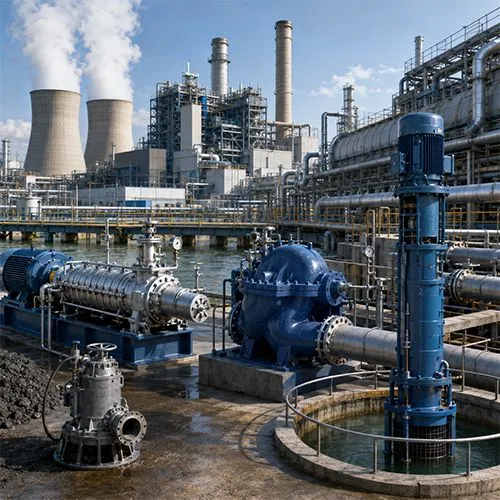
The best pump for power plants depends on the service duty: boiler feed water requires high-pressure multistage pumps, cooling water systems usually need high-flow centrifugal, split case, vertical turbine, mixed flow, or axial flow pumps, condensate systems need stable low-NPSH condensate extraction pumps, while drainage, wastewater, slurry, fire water, and auxiliary systems require different pump designs.
Power plant pump selection is not a simple “flow and head” purchase. A power plant pump may affect boiler stability, condenser vacuum, turbine cycle efficiency, cooling water reliability, ash handling uptime, fire protection readiness, auxiliary equipment cooling, and plant safety. Choosing the wrong pump can cause cavitation, vibration, seal leakage, overheating, reduced unit output, emergency shutdown, or long unplanned downtime.
The best pump for a power plant is the pump that can deliver the required flow, head, temperature resistance, reliability, and redundancy for a specific power plant service while minimizing outage risk, cavitation, energy loss, and maintenance failure.
For buyers, EPC contractors, power plant engineers, and maintenance teams, the correct question is not “What is the best power plant pump?” The correct question is: Which pump is best for this exact power plant service, fluid, temperature, pressure, suction condition, redundancy requirement, and failure consequence?
Quick Answer: What Is the Best Pump for Power Plants?
The best pump for power plants depends on whether the service is boiler feed water, cooling water circulation, condensate extraction, raw water intake, ash slurry, sump drainage, fire water, wastewater, or emergency backup. A high-pressure multistage centrifugal pump is usually the best direction for boiler feed water, while horizontal split case pumps, vertical turbine pumps, mixed flow pumps, or axial flow pumps are better for high-flow cooling water service. Slurry pumps should be used for ash or abrasive solids, and submersible drainage or sewage pumps are used for plant sumps and wastewater.
A power plant pump should be selected by service duty first, then verified by flow, total dynamic head, NPSH margin, fluid temperature, material compatibility, minimum flow protection, redundancy requirement, control logic, test documentation, and supplier support.
Power plants do not use one universal pump. They use a pump system with different pump types assigned to different duties.
| Power Plant Service | Recommended Pump Type | Why It Fits | Main Risk If Wrong |
|---|---|---|---|
| Boiler feed water | Multistage high-pressure centrifugal pump | Handles high pressure and continuous duty | Boiler trip, pressure instability, severe downtime |
| Cooling water circulation | Horizontal split case pump / vertical turbine pump / mixed flow pump / axial flow pump | Moves high flow at low-to-medium head | Poor condenser cooling and efficiency loss |
| Condensate extraction | Condensate extraction pump / vertical can pump | Handles low NPSH and hot condensate | Cavitation, flow instability, turbine cycle risk |
| Circulating water intake | Vertical turbine pump / mixed flow pump | Suitable for intake wells and large water volume | Intake failure and cooling system interruption |
| Ash handling / slurry | Slurry pump | Handles abrasive solids | Rapid wear and blockage |
| Drainage and sump | Submersible drainage pump / sewage pump | Removes leakage, rainwater, wastewater | Flooding, equipment room damage |
| Fire water | Fire pump set | Meets emergency fire protection duty | Safety and compliance risk |
| Diesel backup / emergency | Diesel-driven pump / standby electric pump | Maintains critical service during power loss | Loss of backup protection |
The fastest decision rule is this: choose a multistage pump when high pressure is the main requirement, choose a split case or vertical turbine pump when high flow is the main requirement, choose a condensate pump when NPSH is the main risk, choose a slurry pump when abrasive solids are present, and choose submersible drainage or sewage pumps when the job is sump water removal.
Scope of This Guide: Which Power Plant Pump Applications Does This Article Cover?
This guide applies to power plant pump selection for water, condensate, cooling, drainage, slurry, fire water, auxiliary, and emergency services. It is written for B2B buyers, EPC engineers, power plant maintenance teams, procurement managers, and project decision-makers who need practical pump selection logic before asking for quotations or reviewing supplier proposals.
Applicable Power Plant Types
This power plant pump selection guide is suitable for common thermal and industrial power generation facilities where pumps support steam-water cycles, cooling systems, water treatment, drainage, ash handling, and auxiliary services.
- Thermal power plants
- Coal-fired power plants
- Gas-fired power plants
- Combined cycle power plants
- Biomass power plants
- Waste-to-energy power plants
- Industrial captive power plants
- District heating and power facilities
- Auxiliary pump systems in renewable energy plants
- Power plant water treatment and cooling systems
These plants may use different fuels and process layouts, but many pump selection questions are similar: flow, head, temperature, NPSH, material, reliability, redundancy, maintenance access, and supplier verification.
Applicable Pump Services
Power plant pumps should be selected by service duty. A boiler feed pump, cooling water pump, condensate extraction pump, slurry pump, fire pump, and drainage pump are not interchangeable.
- Boiler feed water
- Cooling water circulation
- Condensate extraction
- Circulating water intake
- Raw water supply
- Demineralized water transfer
- Auxiliary cooling
- Fire water
- Sump drainage
- Wastewater handling
- Ash slurry or abrasive solids
- Chemical dosing support
- Emergency backup pumping
The article focuses on buyer decision logic: what pump type fits which service, where pump selection fails, what data must be verified, and what questions should be asked before purchase.
Not Suitable as the Only Selection Method
This guide is not a substitute for project-specific hydraulic design, pump curve review, NPSH calculation, material selection, vibration analysis, safety review, or engineering approval. Power plant critical-service pumps should be selected by qualified engineers and verified against plant specifications.
- Main boiler feed pump for high-pressure units
- Nuclear power plant safety-class pumps
- API / ISO / plant-specific critical service pumps
- High-temperature, high-pressure, hazardous-fluid systems
- Large condenser cooling systems with civil intake structures
- Safety-critical fire systems
- Projects requiring third-party certification or authority approval
- Systems tied directly to turbine, boiler, condenser, or DCS trip logic
For these systems, buyers should combine this article with plant design documents, process data sheets, pump curves, NPSH calculations, metallurgy requirements, mechanical seal plans, motor specifications, vibration limits, test standards, and commissioning requirements.
Why Power Plant Pump Selection Is Different From General Industrial Pump Selection
Power plant pump selection is different because many pumps operate in continuous-duty, high-consequence systems. In a normal industrial water transfer job, a pump failure may reduce production or delay a process. In a power plant, the wrong pump can affect boiler feed pressure, condenser cooling, turbine cycle stability, fire safety, drainage safety, and plant availability.
Power plant applications also involve more demanding operating conditions than many general water systems. Hot condensate, high-pressure boiler feed water, low-NPSH suction conditions, high-flow cooling circuits, abrasive ash slurry, treated cooling water, and outdoor intake structures all create different pump risks.
| Power Plant Condition | Why It Affects Pump Choice |
|---|---|
| Continuous operation | Pump must withstand long runtime and thermal cycling |
| High pressure | Boiler feed pumps need high head and robust construction |
| High flow | Cooling water pumps need hydraulic efficiency and large capacity |
| Hot water or condensate | NPSH and cavitation risk increase |
| Critical service | Pump failure can cause unit derating or shutdown |
| Abrasive solids | Ash and slurry systems require wear-resistant pump design |
| Redundancy requirement | Standby pumps must be ready and tested |
| Plant control system | Pump must integrate with alarms, interlocks, and protection logic |
A power plant pump should therefore be selected by system function, not only by flow and head. Buyers must verify temperature, pressure, NPSH, fluid condition, materials, seal arrangement, minimum flow protection, operating range, redundancy, and test documentation.
Which Power Plant Pumps Are Critical and Which Are Auxiliary?
Power plant buyers should classify each pump by failure consequence before comparing price or pump type. A critical pump failure may cause a boiler trip, load reduction, condenser efficiency loss, steam-water cycle instability, fire protection failure, equipment room flooding, or unsafe maintenance conditions. An auxiliary pump failure may be easier to manage, but it can still affect plant reliability if no standby plan exists.
This classification helps buyers decide whether they need 2×100% redundancy, N+1 configuration, a standby pump, spare parts, online monitoring, factory testing, or stricter documentation.
| Pump Service | Critical Level | Failure Consequence | Selection Priority |
|---|---|---|---|
| Boiler feed water | Critical | Boiler trip, load reduction, or unstable feedwater pressure | Reliability, high-pressure capability, NPSH, minimum flow, redundancy |
| Condensate extraction | Critical | Steam-water cycle instability and cavitation risk | NPSH margin, hotwell level, standby pump |
| Main cooling water | Critical / semi-critical | Condenser cooling loss and reduced plant efficiency | High flow, efficiency, intake reliability |
| Fire water | Safety-critical | Fire protection failure | Applicable fire protection requirements, test readiness |
| Ash slurry | Process-critical in coal plants | Ash handling interruption and rapid wear | Wear resistance and spare wear parts |
| Drainage sump | Area-critical | Flooding, electrical risk, equipment damage | Automatic control, alarm, standby pump |
| Auxiliary cooling | Medium to critical | Equipment overheating or reduced auxiliary reliability | Duty-based selection and maintainability |
| Chemical dosing support | Medium / critical depending on system | Water chemistry instability | Compatibility and spare dosing pump |
The key decision is simple: critical pumps should be selected by reliability and verified data first; auxiliary pumps can be selected more economically, but they still need correct duty-point matching and maintenance access.
Best Pump by Power Plant Type
Different power plant types use different pump priorities. A coal-fired power plant may pay more attention to ash slurry and cooling water reliability, while a combined cycle plant may focus more on HRSG feedwater, condensate extraction, and auxiliary cooling. A waste-to-energy plant may need stronger wastewater and leachate handling review.
Buyers should identify the plant type before finalizing pump priorities.
| Power Plant Type | Pump Systems Buyers Should Prioritize | Buyer Note |
|---|---|---|
| Coal-fired power plant | Boiler feed, cooling water, ash slurry, drainage, fire water | Slurry wear and cooling water reliability are major concerns |
| Gas-fired power plant | Boiler feed / HRSG feed, condensate, cooling water, auxiliary cooling | Condensate and HRSG feed stability are important |
| Combined cycle plant | HRSG feed, condensate extraction, cooling water, auxiliary systems | Multiple operating modes affect pump selection |
| Biomass power plant | Boiler feed, cooling water, wastewater, ash or residue handling | Residue and wastewater duties need material review |
| Waste-to-energy plant | Boiler feed, cooling, wastewater, leachate, drainage | Corrosion, solids, and wastewater are higher risks |
| Industrial captive power plant | Boiler feed, cooling, service water, drainage, backup | Practical maintenance and spare parts availability matter |
This table does not replace engineering design, but it helps procurement teams focus their RFQ. A supplier recommending the same pump package for every plant type is not providing a reliable power plant pump selection.
What Types of Pumps Are Used in Power Plants?
Power plants use many pump types because each plant service has a different hydraulic duty and failure consequence. A pump that is excellent for cooling water may be completely wrong for boiler feed water, and a pump that is suitable for drainage may fail quickly in ash slurry.
Multistage Boiler Feed Pumps for High-Pressure Service
A multistage boiler feed pump is usually the best pump type for high-pressure boiler feed water service. It uses multiple impeller stages to generate the high head needed to deliver feedwater into the boiler, heat recovery steam generator, or high-pressure feedwater system.
Boiler feed pumps are among the most critical pumps in thermal power plants, biomass plants, waste-to-energy plants, industrial boiler houses, and combined cycle power plants. They must handle required flow, discharge pressure, feedwater temperature, continuous operation, minimum flow conditions, and redundancy expectations.
Choose a multistage boiler feed pump when high pressure and continuous boiler feed stability are required. Do not choose it for slurry, drainage, dirty wastewater, or low-head cooling water service.
- Required boiler feed flow
- Boiler system pressure
- Feedwater temperature
- NPSH margin
- Minimum flow recirculation
- Mechanical seal plan
- Bearing design
- Axial thrust balance
- Material compatibility
- Vibration limit
- Standby pump arrangement
If the plant is comparing high-pressure pump options, this multistage pump overview can help buyers understand why multistage hydraulic design is used for high-head applications.
Horizontal Split Case Pumps for Cooling Water Circulation
Horizontal split case pumps are commonly used for power plant cooling water circulation because they can deliver large flow with good efficiency and convenient maintenance access. They are often selected for condenser cooling water, auxiliary cooling water, cooling tower circulation, and large clean-water circulation systems.
A split case pump has a casing that can be opened along the split line, making inspection and maintenance easier than some other large-flow pump designs. This matters in power plants because cooling water pumps often need regular inspection, alignment checks, bearing maintenance, seal inspection, and impeller condition review.
Choose a split case cooling water pump when high flow, efficiency, and serviceability matter. Do not choose it for high-pressure boiler feed or abrasive ash slurry.
Vertical Turbine Pumps for Intake and Circulating Water
Vertical turbine pumps are widely used for raw water intake, circulating water intake, river intake, cooling tower basin pumping, seawater intake, and deep sump applications. They are useful when the water level is below the pump discharge level or when the pump must be installed in an intake structure.
Choose a vertical turbine pump when the intake structure, water level, basin depth, or high-flow intake duty requires vertical installation. Do not choose it for ash slurry, dirty sludge, or abrasive solids unless the pump is specifically designed for that service.
For seawater intake, buyers should verify not only casing material but also impeller, shaft, bowl assembly, line shaft bearings, fasteners, coating, and seal material. Chloride corrosion often attacks small components before buyers notice major casing damage.
Condensate Extraction Pumps for Low-NPSH Condensate Systems
A condensate extraction pump should be selected primarily by NPSH margin, condensate temperature, hotwell level, suction condition, required flow, discharge head, and continuous operation stability. Condensate service is different from ordinary clean-water pumping because hot condensate and low suction pressure can create cavitation risk.
Choose a condensate extraction pump when hot condensate and low-NPSH suction conditions are the main risk. Do not treat condensate service as ordinary cold-water transfer.
End Suction and Inline Pumps for Auxiliary Power Plant Systems
End suction pumps and inline pumps are commonly used for auxiliary clean-water systems in power plants. They may serve equipment cooling, service water, chemical water transfer, demineralized water transfer, small cooling loops, HVAC water, and non-critical utility systems.
Choose end suction or inline pumps when the service is clean, non-slurry, moderate-pressure, and auxiliary. Do not choose them for high-pressure boiler feed, main cooling water circulation, abrasive slurry, or safety-critical fire systems unless the project specification clearly allows it.
If the project needs to compare auxiliary pump configurations, this end suction vs inline vs multistage pump guide can help buyers separate auxiliary circulation from high-pressure service.
Slurry Pumps for Ash Handling and Abrasive Solids
Slurry pumps are required when the power plant service contains ash, abrasive particles, sludge, high solids, or sediment. Coal-fired power plants, ash ponds, desulfurization systems, settlement areas, wastewater treatment pits, and solids handling systems may need slurry-capable pumps instead of standard clean-water pumps.
Choose a slurry pump when abrasive solids or high solids content are present. Do not use a standard clean-water centrifugal pump for ash slurry because it may wear quickly, clog, lose performance, and increase maintenance cost.
If the application involves ash slurry, abrasive particles, or high-solids wastewater, this slurry pump category page can help buyers evaluate wear-resistant pump options before selecting a standard clean-water pump.
Submersible Drainage and Sewage Pumps for Plant Sumps
Submersible drainage and sewage pumps are used for cable trenches, pump room sumps, drainage pits, wastewater pits, rainwater collection, low-area flooding, and utility drainage. They may not be part of the main power cycle, but they are still important for plant safety and maintenance reliability.
Choose submersible drainage or sewage pumps for sump and wastewater duties. Do not use them for boiler feed, cooling water pressure control, condensate extraction, or slurry service unless the design specifically matches the duty.
Diesel-Driven and Standby Pumps for Emergency Service
Diesel-driven pumps and standby electric pumps are used where pumping must continue during power failure, emergency conditions, or critical service interruption. They may be applied in fire water systems, emergency cooling, remote backup, drainage protection, and plant contingency systems.
Choose diesel-driven or standby pumps when pump failure or power outage could create plant safety, cooling, fire protection, or flooding risk. Do not treat standby pumps as optional accessories for critical services.
Fire water pump selection should follow the applicable fire protection code, project specification, authority approval, and testing requirement. It should not be selected only by general industrial pump logic.
Pump Type Decision Boundary: Which Pump Fits Which Power Plant Service?
Power plant pump type boundaries prevent costly misapplication. A pump should be selected by service duty, not by price, catalog flow, or existing pipe size. Boiler feed, cooling water, condensate, slurry, drainage, fire protection, and emergency backup have different design priorities.
| Pump Type | Best For | Not Suitable For | Buyer Decision Note |
|---|---|---|---|
| Multistage centrifugal pump | Boiler feed, high-pressure feedwater | Slurry, drainage, dirty water | Choose when high head and continuous pressure are required |
| Horizontal split case pump | Cooling water, large-flow circulation | High-pressure boiler feed | Choose when high flow and efficiency matter |
| Vertical turbine pump | Raw water intake, cooling water intake | Dirty sludge or abrasive slurry | Choose when water level or intake structure requires vertical installation |
| Condensate extraction pump | Hot condensate, low-NPSH service | Dirty water or solids | NPSH margin is the key selection factor |
| End suction pump | Auxiliary clean water, service water | Main critical power cycle service | Good for non-critical utility systems |
| Inline pump | Compact auxiliary circulation | Slurry, heavy solids, high-pressure duty | Use for clean circulation loops |
| Slurry pump | Ash slurry, abrasive solids | Clean high-efficiency cooling water | Choose when wear resistance matters more than hydraulic efficiency |
| Submersible drainage pump | Sump, wastewater, flood drainage | Boiler feed or precision cooling | Good for drainage, not process-critical pressure control |
| Fire pump | Fire protection systems | Normal cooling or process transfer | Must follow fire protection requirements |
| Diesel backup pump | Emergency operation | Normal continuous duty | Backup system, not daily first-choice pump |
A practical rule is simple: choose by service first, then verify flow, head, NPSH, temperature, material, redundancy, control logic, and supplier test capability.
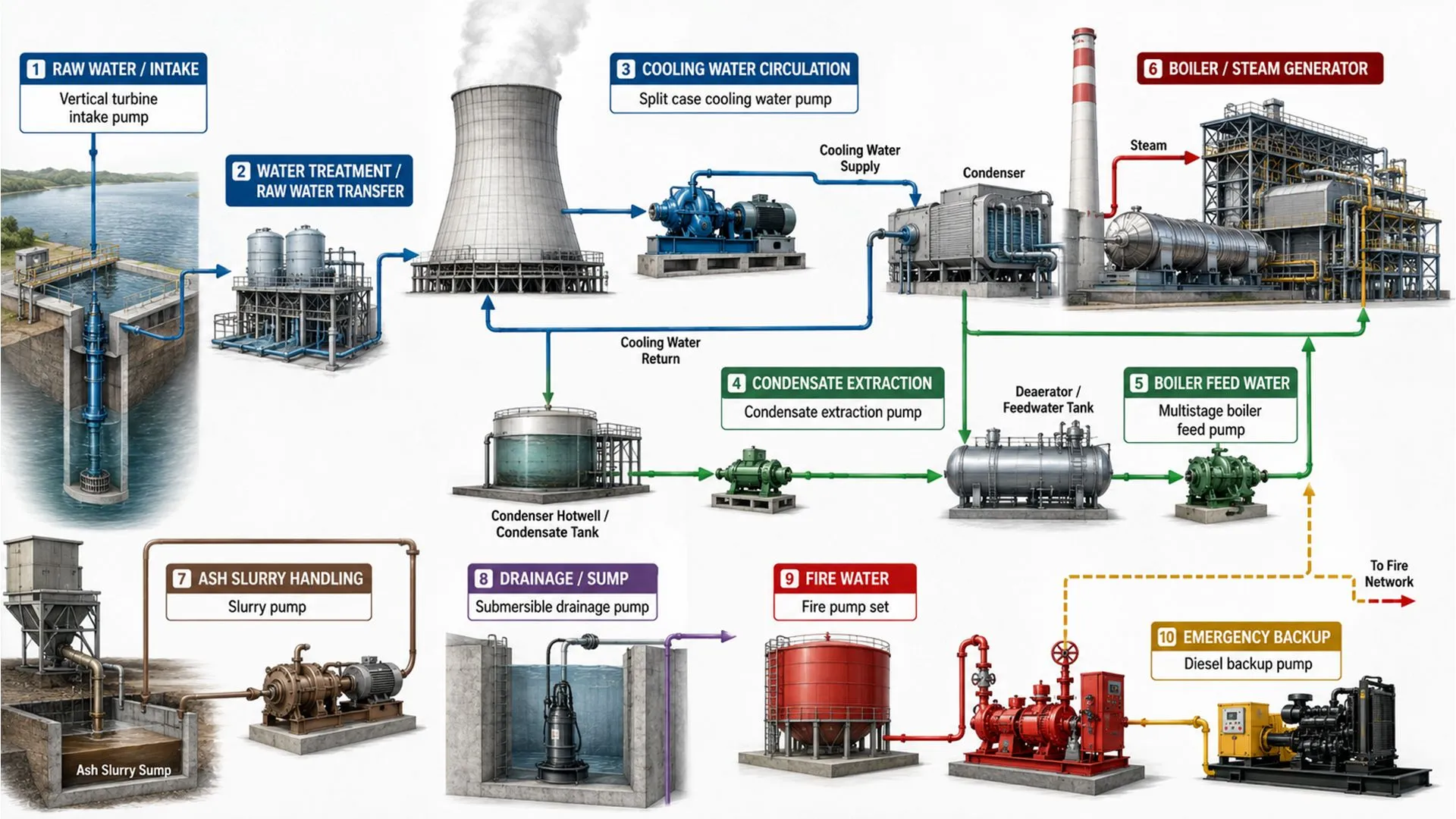
What Is the Best Pump for Boiler Feed Water in Power Plants?
For boiler feed water in power plants, the best pump is usually a high-pressure multistage centrifugal pump selected by boiler pressure, required flow, feedwater temperature, NPSH margin, continuous-duty requirement, minimum flow protection, and redundancy level. Boiler feed water is one of the highest-consequence pump services in thermal and industrial power systems.
A standard single-stage centrifugal pump is normally not suitable for boiler feed service because boiler feed systems require high head, stable pressure, robust construction, and protection against low-flow operation. The pump must deliver feedwater into a high-pressure boiler or heat recovery steam generator while maintaining reliable flow across operating load changes.
| Boiler Feed Pump Selection Factor | Why It Matters |
|---|---|
| Required flow | Must match boiler steam generation demand |
| Discharge pressure | Must overcome boiler drum or system pressure |
| Feedwater temperature | Affects NPSH and material stress |
| NPSH margin | Prevents cavitation |
| Minimum flow protection | Prevents overheating at low flow |
| Mechanical seal plan | Controls leakage and reliability |
| Redundancy | Reduces trip risk |
| Pump curve | Confirms duty point and efficiency |
Buyers should ask suppliers to mark the boiler feed duty point on the pump curve and confirm minimum continuous flow. A high-pressure boiler feed pump operating at too low a flow can overheat internally, vibrate, or suffer hydraulic instability. For critical systems, the minimum flow recirculation line is not optional; it is part of pump protection.
What Is the Best Pump for Cooling Water Systems in Power Plants?
For power plant cooling water systems, the best pump is usually a high-flow centrifugal pump, horizontal split case pump, vertical turbine pump, mixed flow pump, or axial flow pump depending on flow, head, intake structure, water source, and condenser cooling demand. Cooling water service is usually more about moving a large volume of water efficiently than generating very high pressure.
Condenser cooling, cooling tower circulation, auxiliary cooling, and circulating water intake may each require a different pump configuration. A cooling water pump should be selected by flow, total dynamic head, water source, pipe size, condenser or heat exchanger loss, material compatibility, and lifecycle energy cost.
| Cooling Water Scenario | Better Pump Choice | Why |
|---|---|---|
| Large condenser cooling | Horizontal split case / vertical turbine pump | High flow and stable operation |
| Cooling tower circulation | Split case / end suction / mixed flow pump | Depends on flow and head |
| River intake | Vertical turbine pump | Works with intake well or low water level |
| Seawater cooling | Corrosion-resistant vertical turbine / split case pump | Material compatibility is critical |
| Auxiliary equipment cooling | End suction / inline pump | Practical for smaller clean-water loops |
Cooling water pump energy consumption can be significant because these pumps often run for long hours. Buyers should compare pump efficiency at the real duty point, not only purchase price. A cheaper pump with poor efficiency may cost more over the plant lifecycle.
For seawater cooling or chloride-containing water, the material list must be checked carefully. Casing, impeller, shaft, fasteners, wear rings, seal components, and coatings may all affect corrosion resistance.
How Should Buyers Choose Pumps for Condensate Extraction Systems?
A condensate extraction pump should be selected primarily by NPSH margin, condensate temperature, hotwell level, suction condition, required flow, discharge head, and continuous operation stability. Condensate pumps often face hot water and low suction pressure, so cavitation is one of the main selection risks.
NPSH means Net Positive Suction Head. In simple terms, it is the suction energy available to keep liquid from vaporizing inside the pump. If NPSH available is too low compared with NPSH required, the pump may cavitate. Cavitation can cause noise, vibration, impeller damage, flow instability, and bearing or seal stress.
| Condensate Pump Risk | Why It Happens | Buyer Check |
|---|---|---|
| Cavitation | Hot condensate and low suction pressure | Check NPSHa vs NPSHr |
| Flow instability | Hotwell level variation | Confirm operating level range |
| Seal leakage | Temperature and vibration stress | Verify seal material and cooling |
| Pump vibration | Cavitation or hydraulic mismatch | Check duty point and foundation |
| Low discharge pressure | Wrong head calculation | Review system pressure loss |
For condensate extraction service, buyers should not choose a pump only by flow. They should provide condensate temperature, hotwell level range, suction pipe layout, discharge head, and expected operating modes. Supplier answers should include NPSH verification, not only catalog selection.
Which Pump Is Best for Power Plant Water Intake?
The best pump for power plant water intake is usually a vertical turbine pump, mixed flow pump, axial flow pump, or large-flow centrifugal pump selected by intake structure, water level variation, flow demand, head, water source, corrosion risk, and debris control. Intake pump selection must match the civil structure as much as the hydraulic duty.
Power plant intake water may come from rivers, lakes, reservoirs, seawater sources, cooling tower basins, industrial water networks, or raw water ponds. Each source creates different risks: seasonal level variation, sediment, leaves, marine fouling, chloride corrosion, debris blockage, or low submergence.
| Intake Condition | Recommended Pump Direction | Key Verification |
|---|---|---|
| Deep intake well | Vertical turbine pump | Bowl setting, shaft length, vibration |
| Low-head high-flow intake | Mixed flow / axial flow pump | Flow capacity and intake design |
| River water | Vertical turbine / split case system | Screen, debris, seasonal level |
| Seawater intake | Corrosion-resistant vertical turbine pump | Material and coating |
| Cooling tower basin | End suction / split case / vertical pump | Basin level and suction layout |
A water intake pump is not only a pump purchase. Buyers must verify intake screen design, submergence, water level range, debris handling, access for lifting, and material compatibility. A correct pump can still fail if the intake structure causes vortexing, air entrainment, or debris blockage.
Which Pump Is Best for Ash Handling and Slurry in Power Plants?
For ash handling and slurry in power plants, the best pump is a wear-resistant slurry pump selected by solids concentration, particle size, abrasiveness, pH, flow velocity, pipeline length, and wear-part life. A standard clean-water pump should not be used for ash slurry or abrasive wastewater.
Ash slurry and abrasive solids create a different failure mechanism from clean water. The main risk is not only hydraulic performance but wear. Impellers, liners, casings, seals, and wear plates may be damaged quickly if the pump is not designed for abrasive service.
| Slurry Condition | Pump Selection Impact |
|---|---|
| High ash concentration | Requires slurry pump with suitable passage |
| Abrasive particles | Needs wear-resistant material |
| Long discharge pipeline | Requires head and velocity check |
| Settling risk | Flow velocity must prevent sedimentation |
| Corrosive slurry | Material and seal compatibility required |
| High maintenance cost | Spare wear parts must be available |
Choose a slurry pump when solids and abrasion are the main risk. Choose a clean-water pump only when the fluid is actually clean or has very low solids within the pump’s allowable limits. In ash handling systems, buyers should also ask about wear parts, seal water, flushing requirements, and spare parts lead time.
When Should Power Plants Use Submersible Drainage or Sewage Pumps?
Power plants should use submersible drainage pumps or sewage pumps when the service is sump drainage, rainwater removal, wastewater pit pumping, cable trench drainage, pump room flooding protection, or low-area water removal. These pumps may not be part of the main thermodynamic cycle, but they prevent equipment damage and safety problems.
A drainage pump is suitable for clean or lightly contaminated water. A sewage pump is safer when the water contains soft solids, sludge, debris, oil-contaminated wastewater, or organic matter. For sediment-heavy or abrasive water, a slurry-capable design may be needed.
| Drainage Location | Pump Type | Main Risk |
|---|---|---|
| Cable trench | Submersible drainage pump | Electrical safety risk if flooded |
| Pump room sump | Submersible drainage / sewage pump | Equipment room flooding |
| Wastewater pit | Sewage pump | Clogging if solids exist |
| Rainwater collection | Drainage pump | Undersized pump causes flooding |
| Coal yard runoff | Sewage / slurry-capable pump | Sediment and clogging |
Buyers should check sump volume, required drainage time, lift height, solids content, level switch reliability, automatic control, alarm output, and standby requirement. A sump pump is often ignored until flooding happens; in power plants, that is a poor risk strategy.
Power Plant Pump Redundancy: How Many Pumps Are Needed?
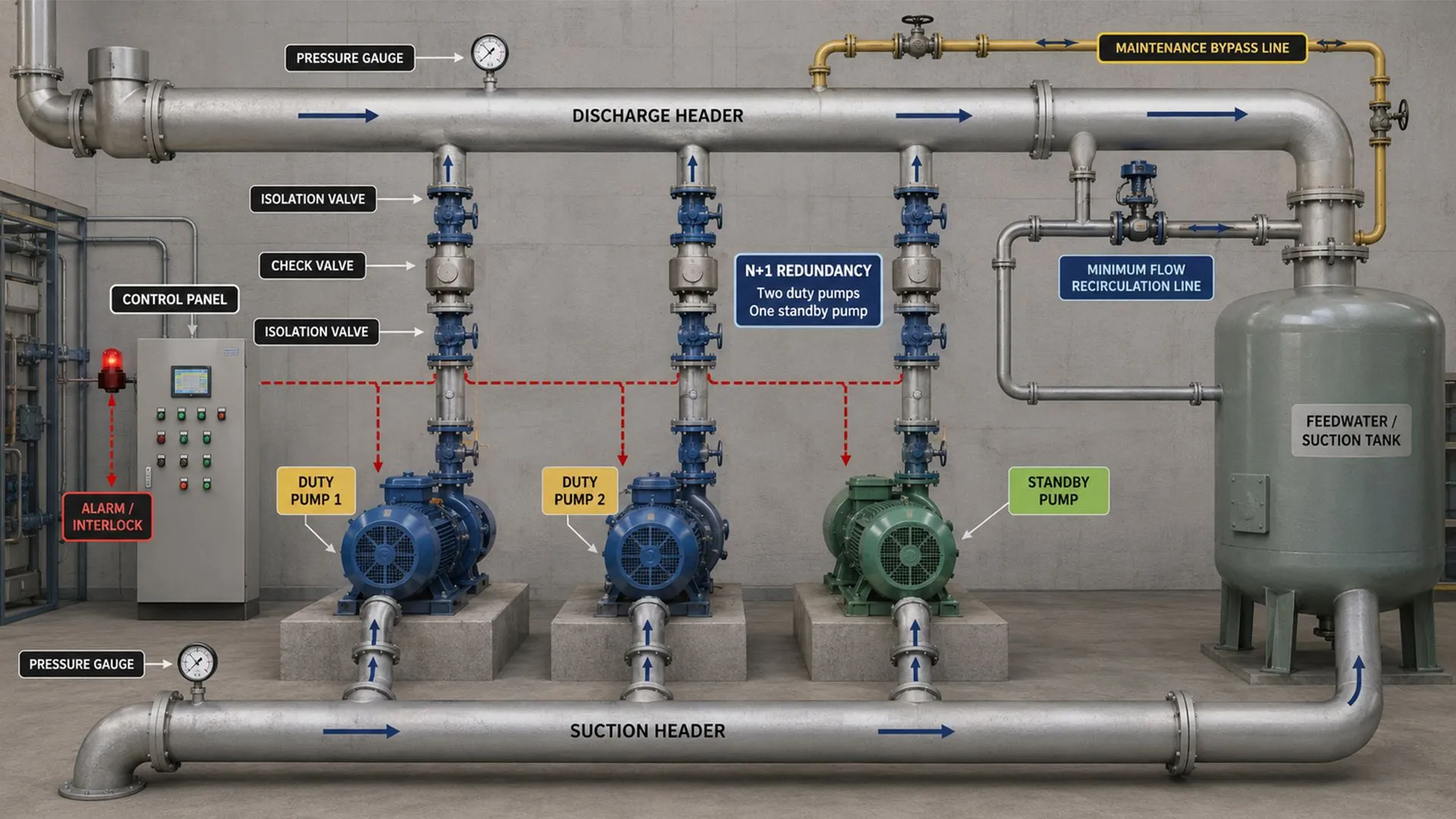
Power plant pump redundancy depends on service criticality, failure consequence, repair time, spare parts availability, operating philosophy, and project specification. Critical pumps usually require standby capacity because one pump failure can cause unit derating, shutdown, safety risk, or equipment damage.
Common redundancy arrangements include one duty plus one standby, 2×100%, 3×50%, or N+1. The correct arrangement depends on the service. A small non-critical drainage pump may not need the same redundancy level as boiler feed water or condensate extraction.
| Pump Service | Typical Redundancy Direction | Reason |
|---|---|---|
| Boiler feed water | 2×100% or N+1 depending on design | Avoid boiler trip |
| Condensate extraction | Duty + standby | Protect steam-water cycle |
| Cooling water | Multiple pumps with capacity sharing | Allows partial operation |
| Fire water | Dedicated fire pump set | Safety requirement |
| Drainage sump | Duty + standby for critical areas | Prevent flooding |
| Chemical dosing | Spare dosing pump recommended | Avoid treatment interruption |
| Slurry handling | Standby or spare wear parts | High wear and maintenance demand |
A standby pump must be tested. A pump that sits idle for years may fail when it is finally needed. Buyers should include test procedures, rotation schedule, lubrication checks, seal inspection, motor insulation checks, and control panel verification in the plant maintenance plan.
How Do Engineers Size Pumps for Power Plant Applications?
Power plant pump sizing should start with service duty, then confirm flow, head, NPSH, temperature, material, operating range, redundancy, and control logic. Buyers should not size a power plant pump only by pipe diameter, motor power, or a previous project’s pump model.
Step 1: Define the Pump Service
The first step is to define the service clearly. Boiler feed, cooling water, condensate extraction, raw water intake, drainage, slurry, chemical dosing, and auxiliary cooling all require different pump designs.
A buyer should state the pump service in the RFQ. “Water pump for power plant” is not enough. A supplier needs to know whether the pump is for boiler feed water, cooling water, condensate, ash slurry, drainage, fire protection, or auxiliary service.
Step 2: Calculate Required Flow
Required flow depends on system function. Boiler feed flow may be based on steam generation demand. Cooling water flow may be based on condenser heat load or cooling tower circulation. Drainage flow may be based on sump volume and required drainage time. Slurry flow may be based on solids concentration and required transport velocity.
| Pump Service | Flow Basis |
|---|---|
| Boiler feed water | Boiler load and steam generation demand |
| Cooling water | Condenser heat duty and cooling system design |
| Condensate extraction | Condensate recovery rate |
| Raw water intake | Plant water demand and cooling makeup |
| Drainage | Sump volume and acceptable drainage time |
| Slurry | Solids concentration and transport velocity |
| Auxiliary cooling | Equipment cooling demand |
The buyer should avoid using oversized flow as a safety shortcut. Oversizing may cause low-efficiency operation, valve throttling, vibration, minimum-flow problems, and unnecessary power cost.
Step 3: Calculate Total Dynamic Head
TDH (Total Dynamic Head) is the total head the pump must overcome. In power plant systems, TDH can include static head, pipe friction, valve losses, heat exchanger losses, condenser losses, filter losses, boiler system pressure, elevation difference, and required discharge pressure.
TDH should be calculated from the actual system layout. A pump selected at catalog maximum flow may deliver much less flow after real pipe loss, heat exchanger loss, and elevation are included.
Step 4: Check NPSHa vs NPSHr
NPSH (Net Positive Suction Head) is critical for hot water, condensate, boiler feed, and low-suction-pressure systems because insufficient suction energy can cause cavitation, vibration, impeller damage, and unstable flow.
NPSHa means Net Positive Suction Head Available. It is the suction head provided by the actual system. It depends on liquid level, suction pressure, vapor pressure, fluid temperature, suction pipe loss, and installation layout.
NPSHr means Net Positive Suction Head Required. It is the suction head required by the pump at a given flow. It comes from the pump manufacturer’s test data or pump curve.
For safe selection, NPSHa must be higher than NPSHr with a suitable margin. If the margin is too small, the pump may cavitate during high temperature, low liquid level, blocked suction strainer, or off-design operation.
Step 5: Confirm Pump Curve and Operating Range
The supplier should mark the selected duty point on the pump curve. The selected pump should operate within an acceptable range, not at an extreme end of the curve.
- Rated flow
- Rated head
- Efficiency
- NPSHr
- Motor power
- Minimum flow
- Allowable operating range
- Seal plan
- Vibration limit
- Material
- Redundancy configuration
A pump curve is not just a catalog page. It is the evidence that the pump matches the plant service.
Example: Choosing Pumps for a Medium-Sized Thermal Power Plant Auxiliary Water System
A medium-sized thermal power plant may need an auxiliary cooling water pump for equipment cooling and heat exchanger supply. This is not the same as boiler feed service and not the same as main condenser circulating water service.
Assume the auxiliary cooling system uses water from a cooling tower basin. The system includes a filter, heat exchanger, control valves, and a long pipe network. The pump must provide stable flow for equipment cooling, but it does not need boiler feed pressure.
| Decision Item | Buyer Check |
|---|---|
| Pump service | Auxiliary cooling, not boiler feed |
| Water quality | Cooling tower water, possible scale and debris |
| Flow | Based on equipment cooling demand |
| Head | Includes pipe, valve, filter, and heat exchanger loss |
| Material | Check corrosion and scaling risk |
| Pump type | End suction / split case / inline depending on flow |
| Redundancy | Duty + standby recommended if cooling is critical |
| Control | Pressure or temperature-based control may be needed |
For auxiliary cooling in a power plant, an end suction pump may be enough for smaller loops, while a split case pump is safer for large-flow cooling duty. A multistage boiler feed pump would be unnecessary unless the system requires high pressure.
This example shows why “power plant pump” is not a single category. The service must be defined before the pump type is selected.
What Test Documents Should Buyers Request Before Delivery?
Power plant pump buyers should request test documents before delivery because many pump failures are expensive to correct after installation. A pump that looks correct in a quotation may still create commissioning risk if performance, material, balancing, motor data, seal arrangement, and spare parts are not documented.
For critical service pumps, documentation should match the project specification. For auxiliary service pumps, documentation can be simpler, but buyers should still require enough records to verify the pump they receive matches the agreed duty.
| Document / Test | Why It Matters |
|---|---|
| Pump performance curve | Confirms flow, head, and efficiency at the selected duty point |
| Hydrostatic test report | Confirms pressure boundary integrity |
| Material certificate | Confirms casing, impeller, shaft, and wear part material |
| Dynamic balancing record | Reduces vibration risk |
| Mechanical seal specification | Confirms leakage control and compatibility |
| Motor test report | Confirms motor rating and electrical readiness |
| Dimensional drawing | Confirms foundation, piping, and installation fit |
| Spare parts list | Supports maintenance planning |
| O&M manual | Supports commissioning, operation, and maintenance |
| Inspection record | Confirms factory quality checks before delivery |
A buyer should be cautious if a supplier can only provide a catalog and price. For power plant applications, especially boiler feed water, condensate extraction, cooling water circulation, slurry handling, and fire water service, test documentation is part of the reliability package.
Pre-Commissioning Checklist for Power Plant Pumps
A power plant pump should not be accepted into operation only because it has been delivered and installed. Pre-commissioning checks help confirm that the pump, motor, piping, valves, instruments, protection logic, standby arrangement, and control system are ready for safe operation.
This checklist is especially important for boiler feed pumps, condensate extraction pumps, cooling water pumps, fire pumps, drainage pumps in critical areas, and slurry pumps with high wear risk.
| Check Item | What to Verify | Risk If Missed |
|---|---|---|
| Pump alignment | Coupling alignment within tolerance | Vibration and bearing damage |
| Foundation and grouting | Baseplate stable and level | Long-term vibration |
| Suction line | No air pocket, restriction, or vortex risk | Cavitation |
| Discharge valve | Correct position and control logic | Overload or low flow |
| Minimum flow line | Installed and tested if required | Overheating |
| Pressure gauges | Installed at suction and discharge | No diagnostic data |
| Motor rotation | Correct direction | Pump damage or no flow |
| Seal flush / cooling | Connected and verified | Seal failure |
| Standby pump test | Start and load test completed | Backup failure |
| Alarm / interlock | DCS or local panel verified | Protection failure |
Pre-commissioning is where many hidden problems appear. A pump may be correctly selected but still fail because of wrong rotation, air pocket in suction piping, poor alignment, blocked strainer, closed valve, incorrect minimum-flow line, or missing alarm signal.
Common Mistakes When Choosing Power Plant Pumps
Power plant pump mistakes usually happen when buyers simplify the application too much. Flow and head matter, but they are not enough for critical plant service. NPSH, temperature, material, redundancy, control logic, minimum flow, test records, and maintenance access can be just as important.
Mistake 1: Using One Pump Type for All Power Plant Services
One pump type cannot serve boiler feed, cooling water, condensate, slurry, drainage, and fire water correctly. Each service has different hydraulic and mechanical demands.
Choose pumps by service duty. A multistage pump is suitable for high-pressure boiler feed, while a split case pump is better for many large cooling water systems. A slurry pump is required for abrasive ash service, and a submersible drainage pump is appropriate for sump removal.
Mistake 2: Choosing by Flow and Head Only
Flow and head are necessary, but they do not complete the selection. Power plant pumps also require NPSH verification, temperature check, material review, seal plan, vibration limit, minimum flow protection, and redundancy planning.
A pump can match flow and head but still fail because of cavitation, thermal stress, chemical corrosion, abrasive wear, or poor standby readiness.
Mistake 3: Ignoring NPSH in Condensate and Boiler Feed Systems
Ignoring NPSH can cause cavitation in hot water and condensate systems. Cavitation can damage impellers, create vibration, reduce flow, and shorten bearing and seal life.
For condensate extraction and boiler feed systems, NPSH should be reviewed early, not after the pump is already installed.
Mistake 4: Using Clean-Water Pumps for Ash or Slurry
A clean-water pump is not suitable for ash slurry, abrasive solids, or sediment-heavy wastewater. The pump may wear quickly, lose performance, clog, or require frequent maintenance.
Use a slurry pump when wear resistance matters more than clean-water efficiency.
Mistake 5: Ignoring Minimum Flow Protection
Some high-pressure pumps, especially boiler feed pumps, may be damaged if they operate at too low a flow for too long. Low flow can cause internal heating, vibration, recirculation, and hydraulic instability.
Buyers should ask suppliers about minimum continuous stable flow and recirculation requirements.
Mistake 6: Treating Standby Pumps as Optional
In power plants, standby pumps are often part of reliability design, not a luxury. If a critical pump fails and no standby unit is available, the plant may reduce load or shut down.
Buyers should evaluate standby needs by failure consequence, repair time, and service criticality.
Troubleshooting: Wrong Pump Selection or System Problem?
Power plant pump problems may come from wrong pump selection, installation error, changing system resistance, poor suction conditions, material mismatch, control instability, or maintenance issues. A structured troubleshooting approach helps buyers avoid replacing pumps without fixing the real cause.
| Problem | Possible Cause | First Check |
|---|---|---|
| Pump vibration | Cavitation, misalignment, foundation issue | Check NPSH, alignment, vibration data |
| Flow lower than expected | Head underestimated, valve loss, blocked strainer | Check pressure and system resistance |
| Boiler feed pressure unstable | Wrong duty point, recirculation issue, control instability | Check pump curve and minimum flow line |
| Condensate pump cavitates | Low hotwell level, hot condensate, low NPSH | Check NPSHa and suction condition |
| Cooling water temperature rises | Insufficient flow or fouled heat exchanger | Check pump flow and condenser/heat exchanger pressure loss |
| Slurry pump wears quickly | Wrong material or velocity | Check solids and wear parts |
| Sump overflows | Pump undersized or level switch failure | Check pump capacity and control |
| Seal fails repeatedly | Dry running, temperature, chemical attack, vibration | Check seal plan and operating condition |
If the plant is facing repeated seal leakage, this pump seal leak troubleshooting guide can help separate dry running, vibration, temperature, chemical attack, and installation-related causes.
The first troubleshooting step should be evidence-based: collect pressure readings, flow data, vibration data, motor current, fluid temperature, suction condition, pump curve, operating history, and maintenance records.
Supplier Verification Checklist for Power Plant Pump Buyers
Power plant pump buyers should verify supplier recommendations before approving a quotation. A strong supplier should ask about service duty, fluid, temperature, NPSH, material, operating hours, redundancy, and testing requirements. A supplier who only asks for flow and head may not understand the application risk.
| Supplier Question | Why It Matters |
|---|---|
| Can you mark the selected duty point on the pump curve? | Confirms real hydraulic selection |
| What is the NPSH margin? | Prevents cavitation |
| Is this pump suitable for continuous operation? | Critical for power plant reliability |
| What material is used for casing, impeller, shaft, seal, and wear parts? | Confirms temperature, corrosion, and wear compatibility |
| What is the minimum flow requirement? | Prevents overheating or instability |
| What redundancy configuration is recommended? | Reduces outage risk |
| What spare parts should be stocked? | Supports maintenance planning |
| What testing can you provide before delivery? | Confirms performance and quality |
| What applications are not suitable for this pump? | Reveals technical honesty |
| Can you support installation and commissioning review? | Reduces start-up risk |
A professional supplier should explain application limits clearly. The most reliable recommendation is not the one that says “yes” to every service. It is the one that explains where the pump works, where it does not work, and what must be verified before ordering.
For buyers comparing power plant pump manufacturers, this reliable pump manufacturer evaluation guide can help verify supplier testing, documentation, spare parts, and after-sales capability before ordering.
Acceptable Supplier Answers Buyers Should Expect
Power plant buyers should judge supplier answers by specificity. A technical answer should mention pump curves, NPSH, material limits, seal plan, minimum flow, test reports, and spare parts. A vague answer creates project risk.
| Buyer Must Ask | Acceptable Answer | Risky Answer |
|---|---|---|
| Can you show the pump curve? | Provides curve with duty point | Only gives flow and head |
| What is the NPSH margin? | Shows NPSHa vs NPSHr | Says “no cavitation problem” |
| Is it suitable for this fluid temperature? | Confirms material and seal limits | Says “normal water pump is okay” |
| What happens at low flow? | Explains minimum flow protection | No answer |
| What spare parts are critical? | Lists seal, bearing, impeller, wear ring | No spare plan |
| Can it handle solids? | States solids limit or recommends slurry pump | Claims all water is fine |
| What test report is available? | Provides performance or hydrostatic test record | Only sends catalog |
A supplier that clearly states application limits is more trustworthy than a supplier that claims one pump can handle every power plant service. Clear limitations reduce commissioning problems and warranty disputes.
RFQ Checklist: What Information Should Buyers Provide Before Asking for a Quote?
A power plant pump RFQ should provide enough information for real selection, not just a pump model request. The more critical the service, the more complete the RFQ should be. Missing data often leads to wrong pump selection, quotation gaps, delivery delays, or commissioning problems.
- Power plant type
- Pump service
- Fluid type
- Temperature
- Flow rate
- Discharge pressure or head
- Suction condition
- NPSHa if available
- Pipeline length and diameter
- Solids content if any
- Corrosion risk
- Operating hours
- Duty / standby requirement
- Motor voltage and frequency
- Control method
- Material preference
- Testing requirement
- Documentation requirement
- Spare parts requirement
- Applicable standard or project specification
| RFQ Information | Why Supplier Needs It |
|---|---|
| Pump service | Defines pump type |
| Fluid temperature | Affects material, seal, and NPSH |
| Flow and head | Defines hydraulic selection |
| NPSHa | Prevents cavitation |
| Solids content | Determines clean-water vs slurry pump |
| Redundancy | Defines number of pumps |
| Operating hours | Confirms continuous-duty requirement |
| Testing requirement | Affects inspection and delivery scope |
A clear RFQ reduces technical misunderstanding. It also allows buyers to compare suppliers fairly because each supplier is responding to the same duty, fluid, and reliability requirements.
FAQ About the Best Pump for Power Plants
Power plant pump buyers usually ask practical questions because pump selection affects reliability, outage risk, maintenance planning, and plant safety. These answers help buyers separate boiler feed, cooling water, condensate, slurry, drainage, fire water, and emergency pump decisions.
What is the best pump for boiler feed water in power plants?
The best pump for boiler feed water in power plants is usually a high-pressure multistage centrifugal pump. It should be selected by required boiler feed flow, boiler pressure, feedwater temperature, NPSH margin, minimum flow requirement, mechanical seal plan, motor power, and redundancy level.
A standard single-stage pump is not normally suitable for boiler feed water because the service requires high head, stable pressure, continuous operation, and protection against low-flow operation.
What pump is used for power plant cooling water?
Power plant cooling water systems commonly use horizontal split case pumps, vertical turbine pumps, mixed flow pumps, axial flow pumps, or large centrifugal pumps. The best choice depends on cooling water flow, total dynamic head, condenser or heat exchanger loss, intake structure, water source, and material requirements.
For large condenser cooling, split case and vertical turbine pumps are common choices. For auxiliary cooling loops, end suction or inline pumps may be enough if the flow and pressure are moderate.
What is the difference between a boiler feed pump and a cooling water pump?
A boiler feed pump is designed for high-pressure feedwater service and must handle boiler pressure, feedwater temperature, NPSH margin, minimum flow protection, and continuous-duty reliability. A cooling water pump is usually designed for high flow at low-to-medium head and must support condenser cooling, cooling tower circulation, or auxiliary cooling.
In simple terms, boiler feed pumps prioritize pressure and reliability, while cooling water pumps prioritize flow and efficiency. Using a cooling water pump for boiler feed service is normally unsafe, while using a boiler feed pump for cooling water is usually unnecessary and inefficient.
Can one pump type be used for all power plant systems?
One pump type should not be used for all power plant systems. Boiler feed water, cooling water, condensate extraction, ash slurry, drainage, fire water, and emergency backup have different hydraulic, material, temperature, NPSH, and reliability requirements.
Using one pump type for all services can lead to cavitation, wear, clogging, pressure instability, energy waste, or unexpected downtime.
Why is NPSH important for power plant pumps?
NPSH is important because hot water, condensate, boiler feed water, and low-suction-pressure systems can cavitate if suction energy is insufficient. Cavitation can cause noise, vibration, impeller damage, unstable flow, seal stress, and bearing damage.
Power plant buyers should verify NPSHa versus NPSHr, especially for condensate extraction pumps, boiler feed pumps, and pumps with long or restricted suction lines. NPSHa must be higher than NPSHr with enough safety margin for real operating conditions.
What pump is best for ash slurry in coal power plants?
A wear-resistant slurry pump is best for ash slurry in coal power plants. The pump should be selected by solids concentration, particle size, abrasiveness, pH, density, pipeline length, flow velocity, and wear-part life.
A clean-water centrifugal pump should not be used for ash slurry because it may wear quickly, clog, and require frequent maintenance.
Do power plants need standby pumps?
Power plants need standby pumps for critical services where pump failure can cause shutdown, derating, flooding, safety risk, or process interruption. Common arrangements include duty plus standby, 2×100%, 3×50%, or N+1.
Boiler feed water, condensate extraction, cooling water, fire water, drainage in critical areas, and chemical dosing often need redundancy depending on plant design.
When should a power plant choose a vertical turbine pump?
A power plant should choose a vertical turbine pump when the pump must operate from an intake well, river intake, seawater intake, cooling tower basin, deep sump, or low-water-level source. Vertical turbine pumps are useful when suction lift is difficult or when the pump bowls must be submerged below the water level.
Buyers should verify submergence, shaft length, bowl setting, line shaft bearings, vibration, intake screen design, and material compatibility. For seawater or chloride-containing water, material selection is especially important.
What material should be used for power plant cooling water pumps?
Power plant cooling water pump material depends on whether the water is freshwater, seawater, treated cooling water, chloride-containing water, abrasive water, or chemically dosed water. Buyers should check casing, impeller, shaft, wear rings, fasteners, coating, and mechanical seal material.
Seawater and chloride-containing water require stronger corrosion review than ordinary freshwater cooling.
What documents should I request before accepting a power plant pump?
Buyers should request the pump performance curve, hydrostatic test report, material certificate, mechanical seal specification, motor test report, dimensional drawing, spare parts list, O&M manual, and inspection record. Critical-service pumps may require additional project-specific test and inspection documents.
These documents help confirm that the delivered pump matches the selected duty, material requirement, pressure boundary, motor rating, and maintenance plan.
What information should I give a pump supplier for power plant selection?
A power plant buyer should provide pump service, fluid type, temperature, flow, head, suction condition, NPSHa if available, material preference, solids content, operating hours, redundancy requirement, motor voltage, control method, testing requirement, documentation requirement, and applicable project specification.
The supplier cannot make a reliable selection from flow and head alone for critical power plant service.
How do I know if a pump problem is caused by wrong selection or installation?
Start by checking pump curve, duty point, NPSH, suction pressure, discharge pressure, vibration data, alignment, foundation, valve position, strainer condition, pipe resistance, motor current, fluid temperature, and operating records. If the pump is running far from the selected duty point, selection may be wrong. If the pump matches the curve but field pressure or flow is abnormal, system resistance or installation may be the cause.
Repeated seal leakage, cavitation noise, vibration, or overheating should be investigated before replacing the pump.
Is a multistage pump always the best pump for power plants?
A multistage pump is not always the best pump for power plants. It is best for high-pressure services such as boiler feed water or high-head feed systems. Cooling water, condensate extraction, slurry handling, drainage, and fire water may require split case, vertical turbine, condensate, slurry, submersible, or dedicated fire pumps.
Choose multistage pumps when high head is required. Choose other pump types when high flow, low NPSH, solids handling, drainage, or emergency protection is the main requirement.
Final Decision Framework: How Should Buyers Choose the Best Pump for Power Plants?
The best pump for power plants should be selected by service duty first, then verified by flow, head, temperature, NPSH, material, fluid quality, runtime, redundancy, control logic, supplier test capability, and commissioning requirements. A pump that is correct for boiler feed may be wrong for cooling water, and a pump that is suitable for drainage may fail quickly in slurry.
For boiler feed water, buyers should usually evaluate high-pressure multistage centrifugal pumps. For cooling water, they should compare split case, vertical turbine, mixed flow, axial flow, or large centrifugal pumps depending on flow and intake structure. For condensate extraction, NPSH margin and hotwell conditions are critical. For ash slurry, wear-resistant slurry pumps are required. For plant sumps and drainage, submersible drainage or sewage pumps are usually more practical. For emergency and fire services, standby capability and test readiness matter as much as pump capacity.
Before ordering, buyers should require pump curves, NPSH verification, material lists, seal plans, minimum flow requirements, redundancy recommendations, performance test records, hydrostatic test reports, spare parts lists, O&M manuals, commissioning checks, and clear application limits.
The best pump for a power plant is not the most powerful pump; it is the pump that matches the exact plant service, protects system reliability, reduces outage risk, and can be verified by pump curve, NPSH margin, material compatibility, redundancy plan, supplier testing records, and commissioning readiness.
Get A Quote

Get A Quote
0 Comments