
Best Pump for Hotels: A Practical Selection Guide for Stable Water Pressure, Hot Water, Drainage, HVAC, and Guest Comfort
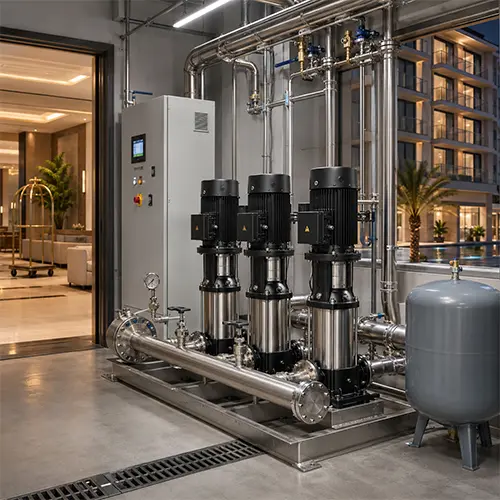
Best pump for hotels is not a single pump model. For a hotel, the best pump is a correctly designed pump system that keeps water pressure stable, delivers hot water quickly, removes wastewater safely, supports HVAC circulation, operates quietly, and keeps the hotel running even when one pump needs service.
A hotel pump decision is not only an engineering decision. It affects guest reviews, room availability, maintenance cost, electricity consumption, water damage risk, and the reputation of the property. A guest may never see the pump room, but they immediately feel the result when the shower pressure is weak, hot water arrives slowly, the basement smells bad, or a pump room creates noise near guest areas.
This guide is written for hotel owners, engineering managers, procurement teams, MEP contractors, and project buyers who need a practical, decision-ready framework before selecting hotel water pumps. It explains which pump types are used in hotels, how to calculate basic requirements, when to use booster pumps, when to use multistage pumps, how to avoid common failures, and what information to request from suppliers before placing an order.
Direct Answer: What Is the Best Pump for Hotels?
The best pump for hotels is usually a combination of pump systems, not one universal pump. A hotel normally needs a VFD-controlled booster pump system for domestic water supply, vertical multistage pumps for high-rise pressure, inline pumps for hot water circulation, submersible sewage pumps for drainage, and end suction or inline pumps for HVAC water circulation.
For hotel domestic water supply, the best option is usually a duplex or triplex VFD booster pump system. For high-rise hotels, the best option is usually a zoned vertical multistage booster system. For hotel wastewater and basement drainage, the best option is usually a duplex submersible sewage pump system with alarm control. For hotel hot water circulation, the best option is usually a low-noise inline circulation pump rated for continuous hot water operation.
| Hotel System | Best Pump Direction | Why It Is Usually Suitable |
|---|---|---|
| Guest room water supply | VFD booster pump system | Maintains stable pressure under changing demand |
| High-rise hotel pressure | Vertical multistage booster pump | Provides higher head in a compact footprint |
| Hot water circulation | Inline circulation pump | Reduces guest waiting time for hot water |
| Basement drainage | Duplex submersible sewage pump | Handles wastewater and provides backup |
| HVAC circulation | End suction or inline pump | Supports chilled water or hot water loops |
| Service water transfer | End suction or centrifugal pump | Works well for utility water movement |
The main rule is simple: do not choose a hotel pump only by motor power or price. Choose it by application, flow, head, pressure stability, redundancy, noise, material, serviceability, and supplier support.
Scope of This Guide: Which Hotel Pump Applications Are Covered?
This guide covers hotel pump systems used for comfort, water supply, drainage, utility circulation, and mechanical building operation. It is suitable for small hotels, business hotels, resort hotels, apartment hotels, high-rise hotels, mixed-use commercial hotels, and hotels with restaurants, laundry rooms, spas, basements, or HVAC systems.
This guide is especially useful when the buyer needs to understand the difference between domestic water booster pumps, multistage pumps, hot water circulation pumps, sewage pumps, and HVAC circulation pumps before requesting quotations.
Applicable Pump Systems
The pump systems covered here are the most common systems involved in hotel daily operation. These systems should be selected according to real application conditions instead of being treated as interchangeable products.
- Domestic water booster pump systems
- Vertical multistage pumps
- Inline hot water circulation pumps
- End suction pumps
- HVAC chilled water and hot water circulation pumps
- Submersible sewage pumps
- Basement drainage pumps
- Transfer pumps
- Duty/standby pump arrangements
- VFD-controlled pump packages
These pump systems serve different purposes. A booster pump solves guest room water pressure, but it does not solve basement drainage. A sewage pump protects the basement, but it does not improve hot water waiting time. A hot water circulation pump improves comfort, but it does not replace a domestic booster pump.
Not Suitable For Final Design Without Engineering Review
This guide does not replace final hydraulic calculation, local code review, or licensed engineering design. Fire pump systems, large mixed-use towers, chemical wastewater, hospital-grade hotel buildings, and special local compliance projects require professional MEP design and authority approval.
Fire pump systems are especially code-sensitive. They should be selected according to local fire regulations, approved drawings, certification requirements, and authority requirements. This article can help buyers understand pump logic, but it should not be used as the final fire pump design document.
Why Hotel Pump Selection Is Different from Ordinary Building Pump Selection
Hotel pump selection is different because guest comfort depends on stable water pressure, fast hot water delivery, quiet operation, and reliable drainage. In a factory, short water pressure variation may be inconvenient. In a hotel, it may become a negative review within the same day.
Hotel water demand also changes sharply. Morning shower peaks, breakfast kitchen operation, laundry use, housekeeping, spa operation, and evening guest use can overlap. The pump system must handle both peak demand and low nighttime demand without causing pressure swings, short cycling, high noise, or energy waste.
Hotels Have Variable Demand Throughout the Day
Hotel water demand is not constant, so a fixed single-pump mindset often creates problems. During peak hours, many rooms may use showers at the same time. During late-night hours, only a few fixtures may be active. A pump system that cannot adjust smoothly may either fail during peak demand or waste energy during low demand.
This is why many hotel projects use VFD, which means Variable Frequency Drive. A VFD adjusts pump motor speed according to actual water demand. When demand rises, the pump speeds up. When demand drops, the pump slows down. This helps maintain stable pressure and reduces unnecessary power consumption.
Hotels Need Redundancy Because Downtime Is Expensive
A hotel should not rely on one pump for critical systems if failure would interrupt guest operation. Domestic water supply, hot water circulation, sewage drainage, and basement sump systems often need duty/standby or duty/assist/standby arrangements.
A standby pump may increase upfront cost, but it protects the business. If one pump fails during full occupancy, the hotel can continue operating while maintenance is arranged. Without backup, a pump failure can lead to room shutdowns, emergency repair cost, water damage, odor complaints, or refunds.
Hotel Pump Noise Is a Guest Experience Problem
Pump noise and vibration are not just mechanical issues in hotels. If the pump room is near guest rooms, meeting rooms, restaurants, spa areas, or quiet corridors, poor pump selection or installation can affect guest comfort.
Noise can come from oversizing, cavitation, poor foundation, rigid pipe connections, high-speed operation, misalignment, or poor suction conditions. The correct solution is not only choosing a quiet pump. The full installation must consider vibration isolation, flexible connectors, correct operating point, and mechanical room layout.
Main Pump Types Used in Hotels
A hotel normally needs several pump types because each water system has a different purpose. A complete hotel pump plan should separate domestic water supply, hot water circulation, wastewater drainage, HVAC circulation, and utility transfer.
For buyers, the important question is not which pump is best overall. The better question is which pump is best for this hotel application.
Domestic Water Booster Pump System
A domestic water booster pump system is usually the most important pump package in a hotel because it directly affects guest room water pressure. It supplies showers, toilets, basins, kitchens, laundry areas, public restrooms, and service points.
For most hotels, a duplex or triplex booster pump set is safer than one single large pump. Multiple pumps can share load, improve pressure stability, and provide backup if one pump needs maintenance.
| Hotel Condition | Recommended Booster Solution | Reason |
|---|---|---|
| Small low-rise hotel | Duplex booster set | Basic redundancy and simple control |
| Medium business hotel | Triplex VFD booster system | Better peak-demand pressure stability |
| High-rise hotel | Zoned vertical multistage booster system | Prevents upper-floor pressure loss and lower-floor overpressure |
| Luxury hotel | Multi-pump VFD package with standby | Better comfort, quieter operation, and lower downtime risk |
If your team is comparing different commercial pump structures before final selection, this end suction vs inline vs multistage pump guide can help clarify which pump type is more suitable for pressure boosting, circulation, and mechanical-room applications.
Vertical Multistage Pump
A vertical multistage pump is often suitable for hotel booster systems that require higher pressure in a limited pump room space. It uses multiple impeller stages to increase pressure, which makes it useful for high-rise hotels and pressure boosting applications.
Vertical multistage pumps are commonly used where the hotel needs high head, compact installation, and stable clean water delivery. They are often paired with VFD control panels in booster systems.
However, a multistage pump must still be selected carefully. If the duty point is far from the pump’s efficient operating range, the pump may create vibration, excessive heat, seal wear, bearing stress, or higher energy consumption.
Inline Hot Water Circulation Pump
An inline hot water circulation pump helps reduce guest waiting time for hot water. It keeps heated water moving through the hot water loop so distant rooms do not wait too long after the tap or shower is opened.
Long hot water waiting time is one of the most frustrating hotel comfort problems. It may not be caused by the boiler or water heater. It may come from poor circulation design, undersized circulation pump, unbalanced return lines, poor insulation, or long dead-end pipes.
A hotel hot water circulation pump should be selected for hot water temperature, continuous operation, low noise, seal compatibility, and correct circulation flow.
End Suction Pump
An end suction pump is often used for HVAC circulation, utility water transfer, and mechanical-room applications that require moderate to large flow. It is a practical pump type when the hotel has enough installation space and needs easier maintenance access.
End suction pumps are common in chilled water loops, condenser water loops, heating circulation, and service water systems. They usually require proper baseplate installation, alignment, pipe support, and vibration control.
If you are comparing end suction pumps with other pump types for hotel mechanical systems, this end suction vs centrifugal pump selection guide can help your team understand the difference between general centrifugal pump concepts and specific end suction pump applications.
Submersible Sewage Pump
A submersible sewage pump is used for hotel wastewater, basement drainage, sump pits, toilet wastewater, and low-level drainage areas where gravity flow is not enough. It must be selected differently from a clean water pump.
Hotel wastewater may contain toilet paper, fibers, grease, food particles, sand, and other debris. A sewage pump should have suitable solids-handling capacity, correct impeller design, proper level control, check valves, alarm output, and backup arrangement.
For critical drainage areas, a duplex sewage pump system is usually safer. If one pump fails, the second pump can continue operation and reduce the risk of flooding or odor.
How to Choose the Best Pump for Hotel Water Supply
The best hotel water supply pump should be selected from real building conditions, not only from room count. Room count is useful, but it does not capture building height, pipe friction, water source pressure, occupancy pattern, laundry demand, kitchen demand, and pressure zoning.
A good selection process starts with application, then flow, then head, then control, then redundancy, then material, then supplier verification.
Step 1: Confirm the Application Before Selecting the Pump
The first step is to define what the pump must do. Many hotel pump selection errors happen because the buyer asks for a hotel pump without separating the actual system.
A domestic booster pump, hot water circulation pump, sewage pump, and HVAC pump are not interchangeable. They have different operating conditions, water quality requirements, flow ranges, head requirements, and control methods.
| Application | Key Question Before Selection |
|---|---|
| Domestic water supply | How much pressure is needed at the highest and most distant guest rooms? |
| Hot water circulation | How quickly should hot water reach distant rooms? |
| Sewage drainage | What solids may enter the pump and how deep is the pit? |
| HVAC circulation | What flow and head are required by the chiller or boiler loop? |
| Water transfer | Is the pump filling a roof tank, intermediate tank, or storage system? |
Step 2: Estimate Peak Flow Demand
Peak flow demand determines whether the hotel pump can serve the building during busy periods. Average water use is not enough for hotel pump selection because the worst complaints happen during peak demand.
Peak demand is affected by guest rooms, occupancy rate, bathrooms, kitchens, laundry rooms, public restrooms, pools, spas, and housekeeping schedules. A 60-room hotel with no laundry system may require a very different pump from a 60-room hotel with a restaurant, laundry room, and spa.
- Number of guest rooms
- Number of fixtures
- Number of floors
- Peak occupancy
- Shower usage pattern
- Laundry operation
- Kitchen and restaurant demand
- Spa, gym, or pool demand
- Public restroom load
- Cleaning and housekeeping water use
The goal is not to guess the largest possible number. The goal is to estimate realistic peak demand with enough safety margin so the pump does not fail during the busiest hours.
Step 3: Calculate Required Pump Head
Required pump head tells you whether the pump can deliver water to the highest and most demanding service points. A pump with enough flow but insufficient head will still create weak pressure on upper floors.
Here is what each part means:
| Term | Simple Meaning | Why It Matters |
|---|---|---|
| Static height | Vertical distance the pump must lift water | Higher buildings need more pressure |
| Pipe friction loss | Pressure lost in pipes, elbows, valves, and fittings | Long or narrow pipes increase required head |
| Required fixture pressure | Pressure needed at showers, faucets, and equipment | Guest comfort depends on usable outlet pressure |
| Safety margin | Extra allowance for real-world uncertainty | Prevents under-selection |
Example: 12-Floor Hotel Booster Pump Head Calculation
A simple calculation example helps buyers understand why hotel pump selection cannot be based only on motor power. The following example is simplified and should be verified by project engineers, but it shows the logic.
Assume a 12-floor hotel:
- Floor-to-floor height: 3.2 m
- Highest water outlet height: about 38–40 m
- Estimated pipe friction loss: 8–12 m
- Desired pressure at top-floor fixtures: 20–25 m
- Safety margin: 5 m
In this case, the buyer may need a booster pump system capable of delivering the required flow at roughly 75–85 m head, depending on final pipe layout and actual demand. If a supplier quotes a pump without confirming this working point on the pump curve, the selection is not reliable.
The buyer should not ask only how many kilowatts the pump uses. The better question is: can this pump deliver the required flow at around 75–85 m head while operating near its efficient range?
Step 4: Decide Whether Pressure Zoning Is Required
Pressure zoning is critical for many mid-rise and high-rise hotels. Without zoning, lower floors may receive excessive pressure while upper floors still experience unstable pressure.
For low-rise hotels, one booster zone may be enough. For mid-rise hotels, pressure reducing valves or partial zoning may be needed. For high-rise hotels, multiple pressure zones, intermediate tanks, or dedicated booster systems may be necessary.
Pressure zoning protects guest comfort, pipework, valves, sanitary fixtures, water heaters, control stability, and long-term maintenance cost. If pressure zoning is ignored, the hotel may later face fixture damage, pipe leakage, valve noise, unstable shower pressure, or expensive retrofit work.
Step 5: Choose Fixed-Speed or VFD Control
VFD control is usually recommended for hotels with variable water demand. It allows the pump system to adjust speed according to actual pressure demand instead of running only at one fixed speed.
Fixed-speed pumps may still work in small hotels with simple demand. But for medium and large hotels, VFD booster systems usually provide better pressure stability and lower energy waste.
| Control Type | Suitable Hotel Scenario | Advantages | Possible Risk |
|---|---|---|---|
| Single fixed-speed pump | Very small, simple systems | Low initial cost | No redundancy, unstable pressure |
| Duplex fixed-speed system | Small hotels | Basic backup | Less efficient under variable demand |
| VFD booster system | Most modern hotels | Stable pressure and energy saving | Requires correct commissioning |
| Multi-pump VFD system | Medium and large hotels | Load sharing and standby capacity | Higher initial cost |
VFD control is not automatically successful. Pressure sensor location, control setpoint, ramp time, pressure tank condition, and pump curve selection must be correct.
Step 6: Plan Redundancy
Redundancy should be planned before the hotel has a pump failure. A single pump may look cheaper during procurement, but it creates a single point of failure.
For hotel domestic water supply, sewage drainage, and critical hot water circulation, redundancy is often worth the cost. Common arrangements include duty/standby, duty/assist/standby, duplex pump systems, triplex booster sets, emergency bypass design, spare pumps, or critical spare parts.
For hotels, backup capacity is not a luxury. It is a business continuity measure.
Best Pump by Hotel Scenario
Different hotel types require different pump configurations. The best system for a small hotel is not the same as the best system for a high-rise business hotel or coastal resort.
The following recommendations are practical starting points. Final selection should still be verified by project data, pump curves, and site conditions.
Best Pump for Small Hotels
Small hotels usually need a compact, reliable, and easy-to-maintain pump system. The priority is stable water pressure, simple control, basic redundancy, and safe drainage.
A typical small hotel may use a duplex domestic booster pump set, small inline hot water circulation pump, submersible sewage pump if basement or sump pit exists, simple control panel, and pressure tank for smoother operation.
| System | Recommended Direction | Reason |
|---|---|---|
| Domestic water | Duplex booster pump | Prevents total shutdown if one pump fails |
| Hot water | Inline circulation pump | Reduces guest waiting time |
| Drainage | Submersible sewage pump | Protects basement or low-level drainage |
| Utility water | Small centrifugal or end suction pump | Simple service use |
Small hotels should avoid buying pumps only by price. A cheaper pump without local service, spare parts, or proper control may become expensive when failure affects guests.
Best Pump for Medium Business Hotels
Medium business hotels need stronger pressure control because water demand changes sharply during peak hours. Business guests often shower in similar time windows, while restaurants, cleaning staff, and laundry areas may use water at the same time.
A medium business hotel usually benefits from a triplex VFD booster system, inline hot water circulation pumps, duplex sewage pump system, HVAC circulation pumps selected by loop requirements, proper pressure tank and pressure sensor control, and alarm functions for critical systems.
The key decision is not only capacity. It is pressure stability. A system that maintains stable pressure during morning peak hours will reduce complaints and improve guest experience.
Best Pump for High-Rise Hotels
High-rise hotels usually require vertical multistage booster pumps, pressure zoning, and strong control logic. Increasing pump pressure without zoning may create overpressure on lower floors.
A high-rise hotel should consider vertical multistage pumps, multiple pressure zones, VFD control, duty/assist/standby configuration, intermediate tanks if needed, pressure reducing valves where appropriate, and reliable sensors and control panels.
For high-rise hotels, the pump supplier should provide pump curves, operating point confirmation, control strategy, and material options. A vague quotation is not enough.
Best Pump for Resort Hotels
Resort hotels often need distributed pump systems because water demand is spread across a wide area. Villas, guest blocks, restaurants, pools, spas, landscaping, and service buildings may be far from the main pump room.
A resort hotel may need local booster stations, hot water circulation pumps for separate buildings, pool circulation pumps, drainage pumps for low-lying areas, corrosion-resistant materials for coastal conditions, and backup pumps for remote areas.
For coastal resorts, corrosion risk should be reviewed carefully. Salt air, humidity, and aggressive water can shorten pump life. If your project is choosing between cast iron and stainless steel, this cast iron vs stainless steel pump guide can help your team compare material risks before confirming the pump body and wet-end components.
Best Pump for Hotels with Large Laundry or Kitchen Loads
Hotels with large laundry rooms or commercial kitchens need extra attention because these systems can distort normal water demand. Laundry and kitchen use may overlap with guest peak demand, causing pressure drops if the booster system is undersized.
The buyer should check whether laundry and kitchen demand should be included in the main domestic water booster system or separated into a dedicated supply branch. Kitchen wastewater may also contain grease, which should not enter a sewage pump system without proper pretreatment.
Project Scenario Matrix: Symptoms, Causes, and System Fixes
A scenario matrix helps hotel buyers connect real operating problems with likely pump-system causes. This is useful for both new projects and retrofit projects where the hotel already has water pressure, hot water, or drainage problems.
| Hotel Scenario | Common Symptom | Likely Cause | Recommended Fix |
|---|---|---|---|
| High-rise hotel | Top floors have weak shower pressure | Insufficient head or poor zoning | Recalculate head and review pressure zones |
| Business hotel | Pressure drops in morning peak | Undersized booster system or poor VFD control | Check peak flow and VFD settings |
| Resort hotel | Remote building has unstable pressure | Long pipe run and high friction loss | Add local booster station or resize pipework |
| Hotel basement | Drainage pit overflows | Single sewage pump failure or float switch issue | Use duplex sewage pumps with alarm |
| Luxury hotel | Pump room noise affects rooms | Oversizing, vibration, poor installation | Add vibration isolation and check operating point |
| Coastal hotel | Pump corrodes quickly | Wrong material for environment | Review stainless steel grade and water chemistry |
| Hotel hot water system | Guests wait too long for hot water | Poor circulation loop or undersized circulation pump | Balance loop and verify pump flow |
| Hotel HVAC system | Poor cooling or heating | Wrong circulation flow or pump duty point | Check HVAC loop flow and pump curve |
This type of matrix is useful for internal discussion because it connects guest complaints with engineering actions.
Common Hotel Pump Problems and How to Troubleshoot Them
Most hotel pump problems should be diagnosed from symptoms, not guessed from the pump nameplate. If the maintenance team only replaces parts without identifying the root cause, the same problem may return.
The following problems are common in hotels and should be reviewed during both new selection and retrofit planning.
Problem 1: Guest Room Shower Pressure Fluctuates
Shower pressure fluctuation usually means the booster system cannot match demand smoothly. The cause may be undersized pumps, incorrect VFD settings, failed pressure tank, poor pressure sensor location, pipe friction loss, or missing pressure zoning.
- Measure pressure at lower, middle, and upper floors.
- Measure again during morning peak demand.
- Check whether the pressure tank is functioning correctly.
- Confirm the VFD pressure setpoint and ramp settings.
- Check whether filters or strainers are clogged.
- Compare actual demand with pump curve.
- Review whether pressure zoning is required.
Do not simply increase the pressure setpoint. Higher pressure may damage lower-floor fixtures, increase leakage risk, and create noise.
Problem 2: Hot Water Takes Too Long to Reach Guest Rooms
Long hot water waiting time usually points to circulation loop problems. The heater may be producing hot water, but the circulation system may not be delivering it efficiently.
- Undersized circulation pump
- Poor hot water return design
- Unbalanced branches
- Failed balancing valves
- Long dead-end piping
- Poor pipe insulation
- Incorrect pump temperature rating
The maintenance team should check return water temperature, pump operation, branch balance, pipe insulation, and circulation flow. If the hotel only increases water heater capacity without fixing circulation, the guest may still wait too long.
Problem 3: Basement Drainage Pump Fails During Heavy Use
Basement drainage failure can create serious hotel operation risk. It may damage equipment, create odor, flood service areas, and interrupt guest services.
- Single pump system with no standby
- Float switch failure
- Blocked impeller
- Poor solids handling
- Grease or debris entering the pit
- Undersized sump pit
- No alarm output
- Poor maintenance schedule
Critical hotel drainage systems should use duplex sewage pumps with alarm control. The system should include check valves, isolation valves, level control, and maintenance access.
Problem 4: Pump Seal or Bearing Fails Repeatedly
Repeated seal or bearing failure usually means the pump is operating under poor mechanical or hydraulic conditions. Replacing seals and bearings without correcting the cause will only create repeated maintenance cost.
- Misalignment
- Cavitation
- Dry running
- Vibration
- Incorrect duty point
- Poor lubrication
- Contaminated water
- Excessive start-stop cycles
- High temperature
- Poor installation base
If the hotel maintenance team sees repeated vibration, bearing noise, heat, or seal leakage, this pump bearing failure diagnosis guide can help identify whether the root cause is alignment, lubrication, hydraulic instability, or operating load.
Problem 5: Pump Energy Cost Is Too High
High pump energy cost usually comes from oversizing, poor control, or inefficient operation. A pump that is too large may consume unnecessary electricity and create mechanical stress.
- Oversized pump
- Fixed-speed operation under variable demand
- Throttling valve used to reduce flow
- Wrong duty point
- High pipe friction
- Poor system balancing
- Old motor efficiency class
For hotels with long operating hours, VFD control and correct pump selection can significantly reduce operating cost. If pump performance has declined over time, this pump efficiency loss guide can help the engineering team check whether the issue comes from wear, blockage, hydraulic mismatch, or system resistance.
When Not to Choose Certain Pump Options
Knowing what not to choose is part of a professional hotel pump decision. Many hotel pump failures begin with a pump that looked acceptable during procurement but did not match the real operating condition.
The wrong pump may still run at first. The problem is that it may run loudly, inefficiently, unstably, or with frequent failure.
Do Not Choose One Oversized Pump for Variable Hotel Demand
One oversized pump is usually not the best solution for hotel water supply. It may cause short cycling, pressure fluctuation, noise, water hammer, seal wear, and high electricity consumption.
A multi-pump VFD booster system is often better because it can match changing demand more smoothly. It also provides backup if one pump needs maintenance.
Do Not Use a Clean Water Pump for Sewage
A clean water pump should not be used for hotel sewage or basement wastewater. Sewage may contain solids, fibers, paper, grease, and debris that can block a standard clean water pump.
Use a sewage pump with suitable solids handling, impeller design, level control, and standby arrangement. Kitchen wastewater should be reviewed carefully because grease can create serious pump and pipe problems.
Do Not Ignore Local Code and Fire Protection Requirements
Fire pump and life-safety systems must follow local code and authority requirements. A supplier quotation is not enough for final fire pump selection.
Fire pump systems may require certified equipment, approved controllers, specific testing, and inspection procedures. Hotel buyers should involve qualified fire protection engineers and local authorities.
Do Not Buy Without Pump Curves and Control Explanation
A hotel buyer should not accept a pump quotation without a pump curve and operating point confirmation. The pump curve shows whether the pump can deliver the required flow at the required head.
A proper supplier should explain where the pump will operate, whether it is close to the efficient range, how pressure is controlled, and what happens under low and peak demand.
Key Specifications Hotel Buyers Should Compare
Hotel buyers should compare pump systems by operating suitability, not only by price. A low-cost pump may become expensive if it fails during peak occupancy or requires emergency service.
A professional quotation should include enough information for engineering and procurement teams to verify the selection.
| Specification | Why It Matters for Hotels | What to Ask the Supplier |
|---|---|---|
| Flow rate | Determines peak supply capacity | Is this based on real peak demand? |
| Head | Determines pressure delivery | Does it include height, friction, and fixture pressure? |
| Pump curve | Confirms operating range | Where is the actual duty point? |
| VFD control | Stabilizes pressure | How is pressure controlled and tested? |
| Motor efficiency | Affects electricity cost | What motor efficiency class is used? |
| Material | Affects corrosion and hygiene | Is stainless steel required for domestic water? |
| Noise and vibration | Affects guest comfort | What isolation measures are recommended? |
| Redundancy | Reduces downtime risk | Is standby capacity included? |
| Solids handling | Critical for sewage | What solids passage is available? |
| Control panel | Protects pump operation | Are dry-run, overload, and alarm functions included? |
| Spare parts | Affects maintenance speed | Are seals, bearings, sensors, and impellers available? |
| Documentation | Supports installation | Are drawings, manuals, and wiring diagrams included? |
The buyer should be cautious if the supplier only asks for kilowatts, pipe diameter, or a rough application name. Hotel pump selection requires more detailed data.
Material Selection for Hotel Pump Systems
Pump material should match water quality, application, temperature, and corrosion risk. Material selection affects hygiene, corrosion resistance, maintenance cost, and long-term reliability.
There is no one best material for every hotel pump. Stainless steel is often preferred for domestic water. Cast iron may be acceptable for HVAC closed loops and many sewage applications. Coastal hotels may need upgraded corrosion resistance.
Cast Iron Pumps
Cast iron pumps are practical for many HVAC, sewage, and utility applications. They are cost-effective, mechanically strong, and widely used in commercial building systems.
Cast iron is often suitable for closed-loop HVAC systems where water is treated and oxygen exposure is limited. It is also common in sewage pumps because mechanical strength and cost control matter.
However, cast iron may not be ideal for domestic water systems where corrosion resistance or hygiene perception is important.
Stainless Steel Pumps
Stainless steel pumps are often preferred for hotel domestic water supply and corrosion-sensitive environments. They provide better corrosion resistance and are commonly used for clean water booster systems.
Stainless steel is also useful in coastal hotels, humid environments, and systems with higher corrosion risk. However, the stainless steel grade should match water chemistry. Chloride level, temperature, pH, and dissolved solids can affect corrosion behavior.
Material Selection Table
The right material depends on where the pump is installed and what liquid it handles. Buyers should compare material risk by application instead of choosing only by price.
| Hotel Condition | Suggested Material Direction | Reason |
|---|---|---|
| Domestic water supply | Stainless steel wet parts preferred | Better hygiene and corrosion resistance |
| Standard HVAC loop | Cast iron often acceptable | Closed-loop treated water |
| Coastal resort | Stainless steel or upgraded material | Higher salt and humidity exposure |
| Basement sewage | Cast iron sewage pump common | Strength and cost balance |
| Hot water circulation | Material and seal must match temperature | Heat affects seals and elastomers |
| Aggressive wastewater | Special material review required | Chemical compatibility may be required |
Lifecycle Cost: Why the Cheapest Pump May Not Be the Best Hotel Pump
Hotel pump cost should be evaluated by lifecycle cost, not only purchase price. Pumps often run daily, and some systems run continuously. Energy use, spare parts, maintenance labor, downtime, and guest complaints can exceed the initial price difference.
A cheaper pump may be acceptable for a low-risk utility application. It may be a bad decision for domestic water supply, basement drainage, or hot water circulation where failure affects guests directly.
Main Cost Factors
The true cost of a hotel pump includes purchase, operation, maintenance, and business risk. Buyers should compare both CAPEX, meaning capital expenditure, and OPEX, meaning operating expenditure.
| Cost Item | Why It Matters |
|---|---|
| Initial pump price | Affects procurement budget |
| Installation cost | Depends on foundation, piping, control, and space |
| Electricity cost | Important for long operating hours |
| Maintenance cost | Includes labor and replacement parts |
| Downtime cost | Affects room availability and service quality |
| Emergency repair cost | Higher than planned maintenance |
| Guest complaint cost | Can affect reviews and refunds |
| Water damage risk | Severe if drainage or booster systems fail |
| Spare parts availability | Determines repair speed |
| Replacement cycle | Affects long-term ownership cost |
For hotel owners, the best pump is often not the lowest-priced pump. It is the pump system that reduces failure risk and operating cost over several years.
Why VFD Systems Often Reduce Operating Cost
VFD systems can reduce operating cost when hotel demand varies. Instead of running at full speed all the time, the pump adjusts to real demand.
However, VFD does not fix poor pump selection. A badly sized pump with a VFD may still operate inefficiently. The pump curve, duty point, control logic, and system resistance must still be checked.
Supplier Verification Checklist for Hotel Pump Procurement
A reliable hotel pump supplier should provide evidence, not just a quotation. The buyer should be able to verify the selection before placing the order.
A professional supplier should explain why the selected pump matches the hotel’s application, flow, head, material, control, and backup requirements.
Documents to Request from the Supplier
Hotel buyers should request technical documents before final approval. These documents help engineering teams review whether the pump is suitable.
| Document | Why It Is Important |
|---|---|
| Pump curve | Confirms flow and head performance |
| General arrangement drawing | Confirms installation dimensions |
| Motor datasheet | Confirms power, voltage, efficiency, and protection |
| Material list | Confirms wetted parts and corrosion suitability |
| Control panel description | Confirms VFD, protection, and alarm functions |
| Wiring diagram | Supports installation and troubleshooting |
| Test report | Confirms factory performance or inspection |
| Installation manual | Reduces installation error |
| Spare parts list | Supports maintenance planning |
| Warranty terms | Clarifies responsibility and coverage |
| Commissioning checklist | Helps verify system after installation |
If a supplier cannot provide these documents for a hotel project, the buyer should treat the quotation as incomplete.
Red Flags When Comparing Hotel Pump Suppliers
A weak supplier may quote quickly but create risk later. Hotel buyers should watch for warning signs before confirming the order.
- Supplier only asks for motor power.
- No pump curve is provided.
- No discussion of peak demand.
- No pressure zoning advice for high-rise buildings.
- No standby pump recommendation for critical systems.
- No material explanation.
- No VFD control logic.
- No alarm or protection function.
- No spare parts plan.
- No installation guidance.
- No warranty clarity.
- No response to noise or vibration concerns.
A reliable supplier should help reduce uncertainty. If the supplier only sells a model, the buyer carries more risk.
RFQ Template: What Hotel Buyers Should Send to Pump Suppliers
A clear RFQ helps suppliers quote the correct pump system instead of guessing. Hotel buyers can copy the following structure and send it to pump suppliers or internal engineering teams.
Hotel Pump RFQ Information
The RFQ should describe the application, building, operating condition, and required documents. This helps the supplier confirm the pump system rather than quote an isolated product.
| RFQ Item | Information to Provide |
|---|---|
| Hotel type | Small hotel, business hotel, resort, high-rise hotel, apartment hotel |
| Number of rooms | Total rooms and expected occupancy |
| Number of floors | Include basement and rooftop equipment if applicable |
| Building height | Approximate vertical height to highest outlet |
| Application | Domestic water, hot water circulation, sewage, HVAC, transfer |
| Water source | Municipal water, tank, well, storage tank |
| Available inlet pressure | Existing pressure if known |
| Required outlet pressure | Target pressure at guest rooms or equipment |
| Estimated flow | Peak flow or fixture information |
| Required head | If already calculated |
| Water temperature | Especially for hot water circulation |
| Liquid condition | Clean water, wastewater, sewage, treated water |
| Solids condition | For sewage or drainage pumps |
| Material preference | Cast iron, stainless steel, or supplier recommendation |
| Control method | Fixed speed, VFD, pressure control, level control |
| Redundancy | Single, duplex, triplex, duty/standby |
| Voltage and frequency | Local electrical standard |
| Pump room location | Noise-sensitive or isolated area |
| Required documents | Pump curve, drawing, datasheet, manual, spare parts list |
| Warranty requirement | Project or buyer standard |
| Delivery requirement | Lead time and packaging requirements |
A professional supplier should be able to respond with a complete technical proposal, not only a price.
Image Plan for This Reference Page
Original images can improve user understanding, page experience, and AI interpretation. The images should not be decorative only. They should explain decision logic, system layout, and risk points.
| Image File Name | Image Type | Suggested ALT Text |
|---|---|---|
| hotel-pump-system-overview.webp | System overview diagram | Hotel pump system overview for water supply, hot water circulation, sewage drainage, and HVAC circulation |
| high-rise-hotel-pressure-zoning.webp | Pressure zoning diagram | High-rise hotel pressure zoning diagram with vertical multistage booster pump system |
| hotel-booster-pump-selection-flowchart.webp | Selection flowchart | Step-by-step hotel booster pump selection flowchart for hotel buyers |
| hotel-duplex-sewage-pump-system.webp | Drainage system diagram | Duplex sewage pump system for hotel basement drainage with standby pump and alarm control |
| hotel-pump-rfq-checklist.webp | Procurement checklist graphic | Hotel pump RFQ checklist for flow, head, material, control, and supplier documents |
The best cover image should show a realistic hotel mechanical room or engineered pump system, not a generic water splash or decorative hotel lobby. A professional industrial image improves trust.
FAQ About Choosing the Best Pump for Hotels
Hotel pump buyers usually ask practical questions about pressure, hot water, noise, sewage, energy cost, and backup. These answers are designed to support real procurement and engineering decisions.
What is the best pump for hotel water supply?
The best pump for hotel water supply is usually a VFD-controlled booster pump system. For many medium and large hotels, a duplex or triplex booster system using vertical multistage pumps provides stable pressure, load sharing, and backup.
The final selection should be based on peak flow, required head, building height, pipe friction loss, outlet pressure, and pressure zoning. A pump should not be selected only by motor power.
Do hotels need booster pumps?
Hotels need booster pumps when municipal water pressure cannot maintain stable pressure across all guest rooms and service areas. High-rise hotels, hotels with large kitchens, hotels with laundry rooms, and hotels with peak morning shower demand often require booster systems.
Even if ground-floor pressure is acceptable, upper floors may still need pressure boosting. The system should be checked at the highest and most distant outlets.
What pump is used for hotel sewage?
Hotels usually use submersible sewage pumps for basement drainage, sump pits, toilet wastewater, and low-level wastewater transfer. The pump should be selected for solids handling, required head, flow rate, pit depth, and level control.
For critical drainage areas, a duplex sewage pump system with alarm control is usually safer than a single pump.
Should hotels use VFD booster pumps?
Most modern hotels should consider VFD booster pumps because hotel water demand changes throughout the day. VFD control helps maintain stable pressure, reduce energy waste, and reduce mechanical stress.
However, VFD control must be commissioned correctly. Poor sensor placement, wrong setpoints, or incorrect pump sizing can still cause pressure problems.
How many pumps should a hotel install?
The number of pumps depends on hotel size, water demand, and failure risk. Small hotels may use a duplex booster set. Medium and large hotels often use triplex or duty/assist/standby systems.
Critical systems such as domestic water supply and sewage drainage should not depend on one pump only if failure would interrupt hotel operation.
Why does hotel shower pressure fluctuate?
Hotel shower pressure usually fluctuates because the booster system cannot match real demand or pressure zoning is not correct. Causes may include undersized pumps, poor VFD settings, failed pressure tank, clogged filters, high pipe friction loss, or too many floors connected to one pressure zone.
The correct solution is to measure pressure at different floors during peak and non-peak hours, then review the pump curve, control settings, pressure tank, and zoning.
Which pump is best for hotel hot water circulation?
An inline circulation pump is commonly used for hotel hot water circulation. It keeps hot water moving through the return loop so guests receive hot water faster.
The pump should be rated for hot water temperature, continuous operation, low noise, and correct circulation flow. The pipe loop must also be balanced and insulated.
Is stainless steel necessary for hotel pumps?
Stainless steel is often recommended for hotel domestic water systems and coastal environments. It provides better corrosion resistance and is often more suitable for clean water supply.
Cast iron may still be acceptable for HVAC closed-loop systems, utility water, and many sewage applications. The final decision should consider water quality, temperature, corrosion risk, and budget.
How can hotels reduce pump noise?
Hotels can reduce pump noise through correct pump sizing, VFD control, vibration isolation, flexible connectors, good foundation, proper suction design, and correct operating point selection. Noise should be considered before installation, not only after guests complain.
If the pump room is close to guest rooms or public areas, the design should include vibration and acoustic control measures.
What information should I give a pump supplier before buying?
Hotel buyers should provide room count, number of floors, building height, water source pressure, required outlet pressure, estimated peak flow, application type, water temperature, liquid condition, voltage, control preference, redundancy requirement, and pump room location.
The buyer should also request pump curves, drawings, motor datasheets, control panel details, spare parts lists, manuals, and warranty terms.
Can one pump serve all hotel water systems?
One pump should not serve all hotel water systems because each application has different requirements. Domestic water boosting, hot water circulation, sewage drainage, and HVAC circulation require different pump types and control methods.
Using one pump concept for all systems usually leads to poor performance, higher maintenance risk, or system failure.
What is the biggest mistake when buying hotel pumps?
The biggest mistake is choosing the pump by price or motor power instead of real operating conditions. A hotel pump should be selected by flow, head, pressure stability, water quality, control method, backup requirement, noise, and maintenance support.
A low initial price can become expensive if the pump causes guest complaints, emergency repairs, or downtime.
Conclusion: The Best Pump for Hotels Is a System That Protects Guest Comfort and Business Continuity
The best pump for hotels is the pump system that keeps the hotel comfortable, safe, efficient, and operational. It should maintain stable water pressure during peak occupancy, deliver hot water without long delays, remove wastewater safely, support HVAC circulation, reduce noise, and provide backup when one pump needs service.
For most hotels, the right solution is not one pump. It is a coordinated system that may include VFD booster pumps, vertical multistage pumps, inline circulation pumps, end suction pumps, sewage pumps, control panels, pressure tanks, sensors, alarms, and standby capacity.
Before buying, hotel owners and procurement teams should ask five final questions:
- Can this pump system maintain stable pressure during peak occupancy?
- Does it include redundancy for critical hotel operation?
- Is it quiet enough for guest-sensitive areas?
- Is the material suitable for the water quality and environment?
- Can the supplier provide pump curves, documents, spare parts, and technical support?
A good hotel pump system is not noticed by guests because everything works smoothly. That is exactly the point. Stable showers, fast hot water, dry basements, quiet rooms, and reliable operation are the real signs that the pump selection was done correctly.
Get A Quote

Get A Quote
0 Comments