
Best Energy Saving Pump Systems: A Practical Buyer’s Guide to Lower Pump Electricity Cost
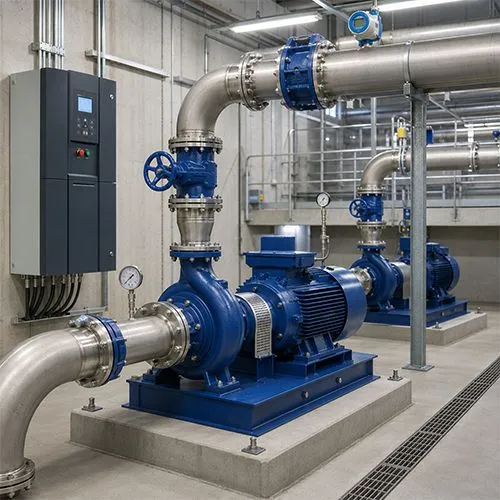
The best energy saving pump systems are not simply the pumps with the highest catalog efficiency. The best system is the one that matches the real duty point, operates near the Best Efficiency Point, uses the right control method, reduces pipe and valve losses, and keeps electricity cost low without sacrificing reliability.
An energy saving pump system is a complete pump solution that reduces electricity cost by matching the pump duty point, system curve, control method, pipe resistance, motor efficiency, operating hours, and maintenance plan to the real site demand.
For industrial buyers, this means an energy saving pump system must be evaluated as a complete package: pump, motor, impeller, VFD or control panel, pipe layout, valves, sensors, operating hours, system curve, commissioning data, and maintenance condition. A high-efficiency pump installed in a poorly designed system can still waste electricity every day. A correctly sized standard pump with good control and low pipe resistance may outperform an expensive pump selected without system data.
Quick Answer: What Is the Best Energy Saving Pump System?
The best energy saving pump system is usually a right-sized centrifugal pump operating close to its Best Efficiency Point, combined with a control method that matches demand variation. For constant-demand systems, a correctly sized fixed-speed pump with an efficient impeller and low-resistance piping may be the best choice. For variable-demand systems, a VFD pump system or multi-pump control system often delivers better energy savings.
The best energy saving pump system is not always a VFD pump system. Stable-flow systems may save more with right sizing and low-loss piping, while variable-flow systems usually benefit more from VFD control or multi-pump sequencing.
A buyer should not choose an energy saving pump system only by motor efficiency, product label, or supplier claims. The supplier should prove the selection with pump curves, efficiency curves, power curves, system curve review, BEP location, NPSH data, control logic, and annual energy cost calculation.
Scope of This Guide: Which Pump Systems Does This Apply To?
This guide applies mainly to industrial and commercial centrifugal pump systems where electricity cost is strongly affected by flow, head, operating hours, pump efficiency, pipe resistance, and control strategy.
It is especially useful for water supply, HVAC circulation, cooling water, industrial water transfer, pressure boosting, irrigation, municipal pump stations, RO pretreatment, wastewater transfer, and general process water service.
Applicable Pump Types
This guide is suitable for common centrifugal pump systems where energy cost depends on pump selection, system curve, control method, and operating hours.
| Pump Type | Energy Saving Potential | Best Use Case |
|---|---|---|
| End suction pump | Medium to high | General water transfer, stable flow, moderate head |
| Split case pump | High | Large-flow systems with long operating hours |
| Multistage pump | Medium to high | High-head systems, booster systems, boiler feed support |
| Inline pump | Medium | HVAC circulation and compact piping systems |
| Pipeline pump | Medium | Circulation and transfer systems with limited space |
| Vertical turbine pump | High in correct duty | Deep well, raw water intake, municipal supply |
| Submersible pump | Medium | Drainage, wastewater, sump, and flood control |
| Slurry pump | Conditional | Solids handling where velocity and wear dominate |
| Booster pump package | High | Variable pressure demand in buildings and industry |
Use With Adjustment for Special Pump Systems
This guide should be adjusted before applying it to slurry pumps, chemical pumps, dosing pumps, screw pumps, diaphragm pumps, and positive displacement pumps. These systems may be governed by solids velocity, viscosity, corrosion resistance, dosing accuracy, pressure relief, or process safety rather than typical centrifugal pump BEP logic.
For slurry pumps, reducing speed or flow without checking settling velocity can create pipe blockage. For chemical pumps, material compatibility and seal safety may be more important than a small energy gain. For fire protection systems, required flow and pressure compliance must come before energy-saving goals.
30-Second Decision Table for Buyers
This table gives buyers a fast way to identify the best energy saving pump system based on the real operating condition. It should not replace engineering review, but it helps procurement teams avoid choosing a system only because it sounds advanced.
| Site Condition | Best Energy Saving Pump System | Why It Works |
|---|---|---|
| Constant flow and stable head | Right-sized fixed-speed pump | Avoids unnecessary VFD cost when demand does not vary |
| Variable flow demand | VFD pump system | Reduces speed when demand is lower |
| Wide demand range | Multi-pump system with sequencing | Runs fewer pumps during low demand |
| Large flow and long operating hours | High-efficiency split case pump system | Small efficiency gains create large annual savings |
| High head with pressure variation | Multistage pump with proper control | Reduces excess pressure and throttling |
| Building pressure boosting | Booster pump package with VFD control | Matches pressure demand and reduces cycling |
| Frequent throttling | Right-sizing, impeller trim, or VFD | Removes pressure loss across the valve |
| High pipe friction | Low-loss piping and valve optimization | Reduces total dynamic head before buying a larger pump |
| Old worn pump | Repair, rebuild, or replace with efficient selection | Restores lost hydraulic efficiency |
| Unknown real duty point | Measurement-first system review | Prevents buying the wrong energy-saving solution |
The main lesson is simple: the best energy saving pump system is selected after measuring or calculating the real system demand. Buying a “high-efficiency pump” without duty data is not a reliable energy-saving strategy.
Which Energy Saving Pump System Should Buyers Choose First?
Buyers should choose the first energy-saving direction based on the real site condition, not based on the newest technology or the lowest quotation. A VFD, a multi-pump package, a high-efficiency motor, and a right-sized fixed-speed pump can all be correct in different situations.
The safest decision path is to identify the actual waste first, then select the system that removes that waste with the lowest risk.
| Real Site Condition | Best First Choice | Do Not Choose First |
|---|---|---|
| Stable flow, stable head | Right-sized fixed-speed pump | Do not add VFD only for marketing claims |
| Variable flow, long runtime | VFD pump system | Do not continue fixed-speed throttling |
| Wide demand range | Multi-pump sequencing | Do not use one oversized pump for all demand |
| High pipe friction | Piping and valve optimization | Do not replace pump before checking system loss |
| Unknown duty point | Measurement-first audit | Do not approve any “energy saving” quotation yet |
| Existing pump heavily throttled | Pump curve review and right-sizing check | Do not assume throttling is normal operation |
| Frequent cycling | Control logic and storage volume review | Do not simply increase motor power |
| High kW after years of use | Maintenance and wear inspection | Do not replace the system before checking wear |
| Safety-critical service | Reliability-first engineering review | Do not reduce capacity only for energy saving |
| Future expansion uncertain | Separate current and future duty | Do not oversize the whole system blindly |
This table is useful because many projects fail at the first decision. Buyers often choose a VFD before checking whether the system has variable demand, or they choose one large pump when a staged pump system would reduce both energy cost and operational risk.
What Makes a Pump System Energy Saving?
An energy saving pump system reduces electricity cost by delivering the required flow and head with less wasted energy. The system should reduce oversizing, throttling loss, bypass loss, off-BEP operation, pipe friction, frequent cycling, and maintenance-related efficiency loss.
A pump system becomes energy efficient when all major components work together:
- pump hydraulic selection
- motor efficiency
- impeller diameter
- control method
- pipe size
- valve selection
- suction condition
- sensor feedback
- operating schedule
- maintenance plan
- commissioning verification
A single efficient component cannot compensate for a poor system design. For example, a premium-efficiency motor will not solve high electricity cost if the pump is oversized and permanently throttled.
The Core Rule: System Efficiency Matters More Than Pump Efficiency Alone
Pump efficiency is important, but system efficiency is more important. A pump with good catalog efficiency may still waste energy if it operates far from BEP, pushes against unnecessary pipe friction, or is controlled by a throttled valve.
System efficiency asks a bigger question:
How much electricity does the entire pump system use to deliver the useful flow and head required by the process?
This is the question buyers should use when comparing quotations. A supplier who only shows motor power, model name, and “high efficiency” wording is not giving enough information for an energy-saving decision.
What Are the Main Types of Energy Saving Pump Systems?
Different pump systems save energy in different ways. Some save energy through better hydraulic selection. Some save energy through speed control. Some save energy through staging multiple pumps. Some save energy by reducing pipe losses.
The best option depends on the duty profile, operating hours, electricity price, process stability, and failure risk. Buyers should not assume one technology is always better.
Right-Sized Fixed-Speed Pump System
A right-sized fixed-speed pump system is often the best energy saving solution for stable demand. If the flow and head remain almost constant, a correctly selected fixed-speed pump can be simple, efficient, reliable, and cost-effective.
This system works best when flow demand is stable, head condition is predictable, the operating point is close to BEP, pipe losses are reasonable, throttling is minimal, operating hours are long, and the maintenance team prefers simple equipment.
The mistake is choosing a pump that is too large “for safety.” Oversizing may create throttling loss, vibration, seal stress, and unnecessary electricity cost. If your system already has a pump running with a partly closed discharge valve or continuous bypass, this guide explaining why oversized pumps waste energy can help verify whether the current pump is larger than the real demand.
VFD Pump System
A VFD pump system uses a Variable Frequency Drive to adjust motor speed according to demand. This can save energy when the system does not need full flow all the time.
A VFD pump system is usually suitable when demand changes during the day, pressure setpoint varies, flow demand is seasonal, the system has strong friction-head behavior, the pump runs many hours per year, throttling is currently used for control, the motor is suitable for inverter operation, and control sensors are reliable.
A VFD is not automatically the best solution. In systems dominated by static head, speed reduction may deliver less energy saving than expected. If the pump is severely oversized, mechanically damaged, or operating outside the safe range, a VFD may hide the problem instead of solving it.
For buyers comparing speed control with fixed-speed operation, this VFD pump vs fixed-speed pump guide can help clarify when variable speed control is technically justified.
Multi-Pump Energy Saving System
A multi-pump system uses two or more pumps to match changing demand. Instead of running one large pump inefficiently at low demand, the system can run one smaller pump during low load and start additional pumps during peak load.
This system is useful when demand changes widely, peak demand is not constant, reliability requires standby capacity, the system serves buildings, municipal networks, irrigation zones, or industrial circulation, and one large pump would run inefficiently at partial load.
Multi-pump systems can also improve redundancy. One pump can be maintained while others remain available. However, sequencing logic must be designed correctly. Poor pump staging can cause frequent starts, pressure fluctuation, uneven pump wear, and weak energy savings.
High-Efficiency Pump and Motor System
A high-efficiency pump and motor system can reduce electricity cost when the pump operates many hours per year. The benefit is strongest when the selected pump operates near BEP and the motor is properly loaded.
This system is suitable when operating hours are high, electricity price is significant, existing pump efficiency is low, duty point is confirmed, pump curve and efficiency curve are available, motor efficiency class is documented, and life-cycle cost is more important than lowest purchase price.
However, buyers should avoid focusing only on the motor. A high-efficiency motor may improve electrical efficiency, but it cannot fix pump oversizing, poor pipe design, cavitation, or heavy throttling.
Low-Loss Piping and Valve System
Sometimes the best energy saving pump system is not a new pump. It is a better system layout. Excessive pipe friction, undersized valves, unnecessary elbows, clogged strainers, dirty filters, and restricted heat exchangers can increase total dynamic head and force the pump to consume more power.
Low-loss system optimization may include larger pipe diameter where justified, fewer unnecessary elbows, lower-loss valves, clean strainers and filters, better suction layout, reduced bypass flow, properly sized check valves, smoother transition pieces, and less restrictive heat exchangers.
For new projects, pipe and valve optimization should happen before pump selection. For existing systems, pipe modification should be judged by downtime cost, installation cost, electricity saving, and payback period.
Smart Pump Monitoring System
A smart monitoring system does not save energy by itself, but it helps detect when energy is being wasted. Flow meters, pressure sensors, power meters, vibration sensors, and control dashboards can reveal whether the pump is drifting away from efficient operation.
Monitoring is useful when pumps run continuously, energy cost is high, many pumps operate across a plant, maintenance problems are frequent, operating conditions vary, or buyers need proof of savings after commissioning.
A monitored pump system can detect rising kW, increasing pressure loss, clogged strainers, worn impellers, abnormal vibration, and control instability before they become expensive failures.
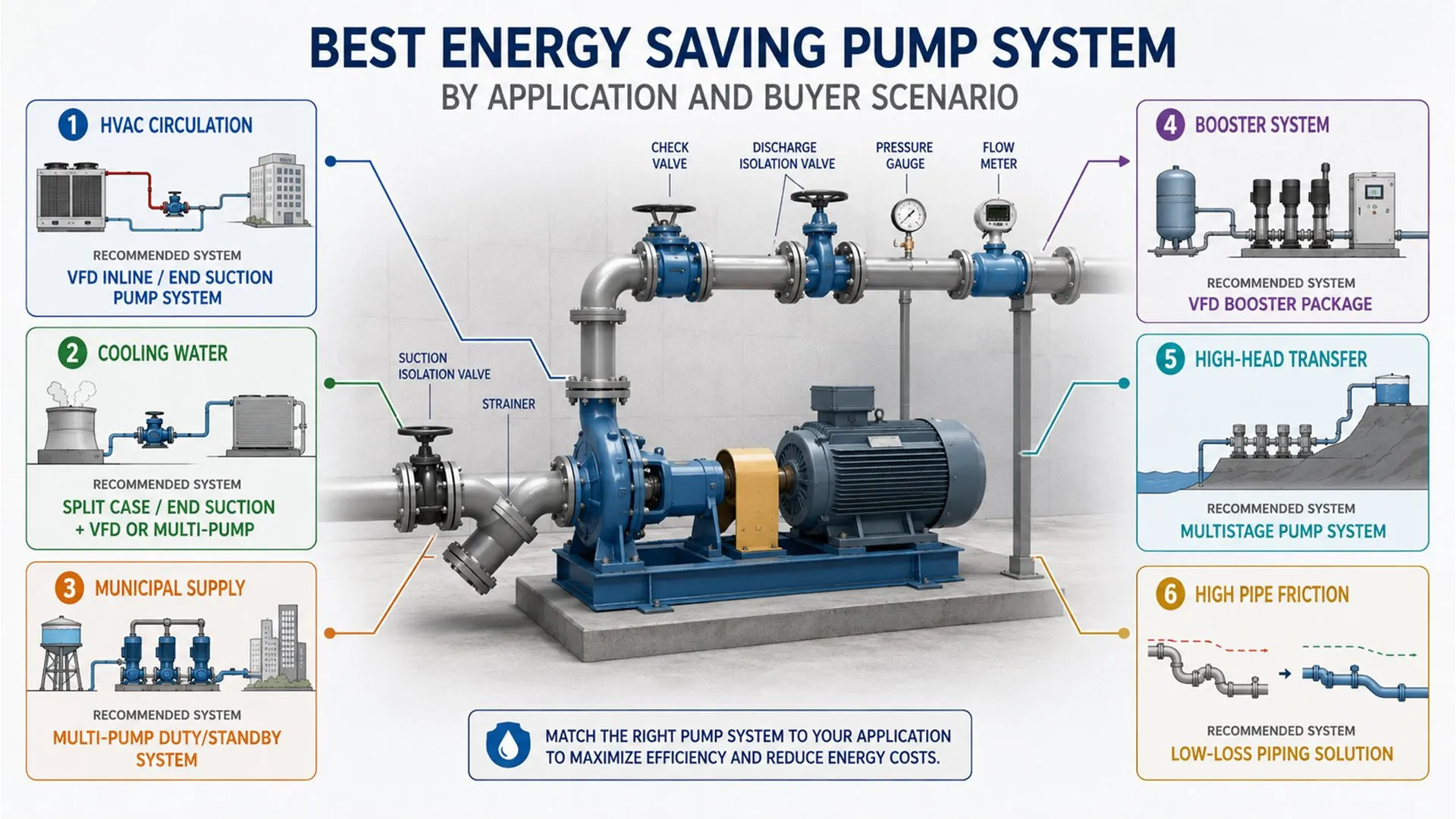
Best Energy Saving Pump System by Application and Buyer Scenario
The best pump system depends on the application. A system that works well for HVAC circulation may not be the best choice for slurry transfer, fire protection, RO pretreatment, or municipal intake.
A buyer should not copy a pump system from another project without checking the real duty point, liquid condition, control method, and operating hours.
| Application | Best Energy Saving Pump System | Buyer Decision Logic |
|---|---|---|
| HVAC circulation | VFD inline or end suction pump system | Demand changes with load, so speed control can reduce energy |
| Industrial cooling water | Split case or end suction pump with VFD or multi-pump control | Long runtime makes efficiency and control important |
| Municipal water supply | Multi-pump system with duty/standby logic | Demand changes by time of day and redundancy is needed |
| Building booster system | VFD booster package | Pressure demand varies, and cycling should be reduced |
| Irrigation system | Zone-based pump system or VFD control | Seasonal and zone demand changes affect flow |
| RO pretreatment | Stable-duty pump with accurate sizing | Flow stability and pressure control are critical |
| High-head transfer | Multistage pump with correct pressure control | Excess head can cause throttling and energy waste |
| Wastewater transfer | Correctly sized submersible or dry-installed pump | Solids handling and clogging risk must be considered |
| Slurry handling | Wear-resistant slurry pump with correct velocity | Energy saving cannot reduce solids transport velocity |
| Fire protection | Code-compliant fire pump system | Safety and required flow/pressure override energy saving |
For buyers who are still comparing pump structures before selecting an energy-saving control method, this end suction vs inline vs multistage pump selection guide can help confirm whether the basic pump type matches the duty before energy-saving features are added.
How to Choose the Best Energy Saving Pump System Step by Step
Choosing the best energy saving pump system should start with site data, not product preference. Buyers who choose the system first and check the duty later often end up with poor payback, unstable operation, or unnecessary equipment cost.
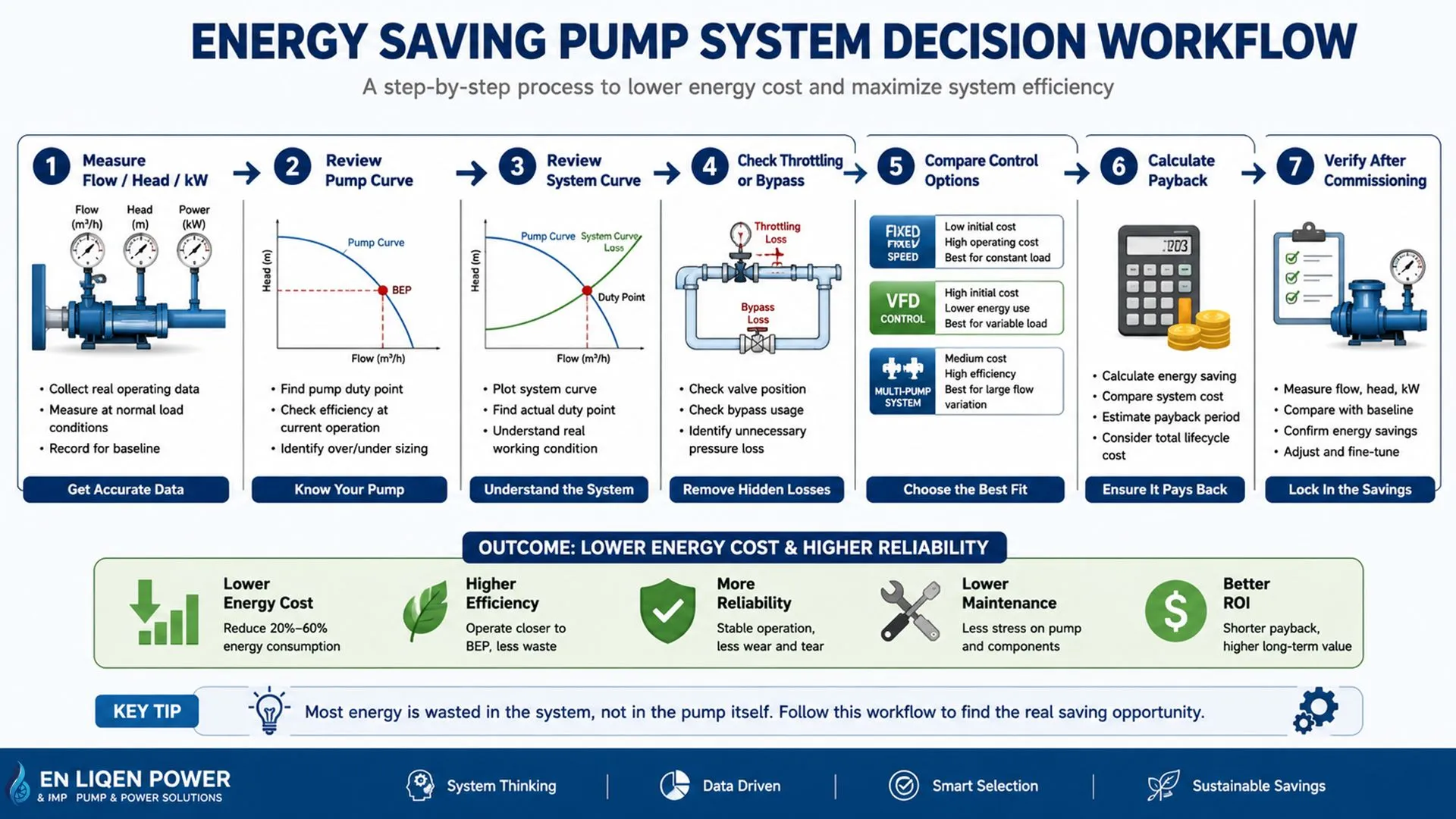
The correct process is measurement, system analysis, pump selection, control selection, cost calculation, supplier verification, and commissioning.
Step 1: Confirm the Real Flow and Head
The duty point is the required flow and total dynamic head at the actual operating condition. Many energy-saving mistakes begin when buyers use estimated, outdated, or inflated duty data.
Buyers should confirm normal flow, peak flow, minimum flow, total dynamic head, static head, pipe friction loss, terminal pressure requirement, liquid temperature, liquid density, viscosity, solids content, operating hours, seasonal variation, and future expansion plan.
A pump selected only for peak flow may waste electricity for most of the year if normal demand is much lower.
Step 2: Review the System Curve
The system curve shows how much head the system requires at different flow rates. It includes static head, pipe friction, fittings, valves, filters, heat exchangers, elevation, and required outlet pressure.
A pump cannot be selected correctly without understanding the system curve. If the system curve is wrong, even a high-efficiency pump can operate inefficiently.
Buyers should ask: does the supplier understand our system resistance, or are they only matching a flow and head number?
Step 3: Match the Pump Curve to the Real Duty Point
A pump curve shows how the pump performs across different flow rates. It should include head, efficiency, power, NPSHr, BEP, impeller diameter, and speed.
The selected operating point should not be too far from the preferred operating range. Running far from BEP may increase electricity cost, vibration, bearing load, seal stress, and hydraulic instability.
A proper quotation should show the duty point on the pump curve. If this is missing, the quotation is incomplete.
Step 4: Choose the Right Control Method
The control method should match demand behavior. A stable system may not need advanced control, while a variable-demand system may waste energy if it relies only on throttling.
| Demand Pattern | Better Control Method | Why |
|---|---|---|
| Stable flow | Fixed-speed pump | Simple, reliable, low control cost |
| Moderate variable flow | VFD control | Reduces speed when demand drops |
| Wide variable flow | Multi-pump sequencing | Runs only the needed number of pumps |
| Pressure boosting | VFD booster control | Stabilizes pressure and reduces cycling |
| Rare peak demand | Smaller base pump + standby/peak pump | Avoids oversizing for rare conditions |
| Process-critical flow | Controlled fixed flow or precision control | Avoids instability |
The wrong control method can destroy energy savings. For example, using a fixed-speed oversized pump with throttling may waste electricity even if the pump itself has good catalog efficiency.
Step 5: Calculate Life-Cycle Cost
The best energy saving pump system should be evaluated by life-cycle cost, not purchase price alone.
The basic annual electricity cost formula is:
Annual Electricity Cost = Pump Input Power (kW) × Annual Operating Hours × Electricity Price
If a pump system reduces input power by 10 kW and runs 6,000 hours per year at $0.12/kWh:
Annual Saving = 10 × 6,000 × 0.12 = $7,200/year
If the upgrade cost is $15,000:
Simple Payback Period = 15,000 ÷ 7,200 = 2.1 years
A system with higher purchase cost may be the better investment if it delivers lower energy cost, lower maintenance cost, and acceptable payback.
Fixed-Speed vs VFD vs Multi-Pump System: Which Saves More Energy?
A direct comparison helps buyers understand that “best” depends on operating pattern. The VFD system is not always best. The multi-pump system is not always necessary. The fixed-speed system is not always outdated.
The correct system is the one that saves energy under the real demand profile, not under a theoretical full-load condition.
| System Type | Best For | Energy Saving Potential | Risk if Misapplied |
|---|---|---|---|
| Right-sized fixed-speed pump | Stable flow and head | Medium to high | Poor savings if demand varies widely |
| VFD pump system | Variable flow systems | High | Weak payback in high static-head systems |
| Multi-pump system | Wide demand range and redundancy | High | Poor sequencing can cause cycling |
| High-efficiency pump and motor | Long runtime with confirmed duty | Medium | Limited benefit if system is poorly designed |
| Low-loss piping system | High friction loss systems | Medium to high | Retrofit cost may be high |
| Smart monitoring system | Plants with many pumps | Indirect but valuable | Does not save energy without corrective actions |
The best system is usually a combination. A large industrial site may need a right-sized pump, VFD control, low-loss piping, and monitoring together.
When a VFD Pump System Is the Best Choice
A VFD pump system is often the best energy saving pump system when demand varies and the system has enough friction head for speed reduction to create meaningful savings.
In friction-dominated systems, reducing pump speed can significantly reduce power demand. However, the actual saving depends on the system curve. Buyers should not assume that every VFD project has the same payback.
A VFD pump system is usually a strong choice when flow demand changes daily or seasonally, pressure setpoints vary, throttling is currently used for control, the pump runs many hours per year, electricity price is meaningful, the motor is VFD-compatible, minimum flow can be maintained, sensor feedback is reliable, and control logic is stable.
When a VFD Is Not the Best Energy Saving Solution
A VFD may not be the best choice when the pump is severely oversized, the system has mostly static head, the motor is not inverter-duty, minimum flow cannot be maintained, or the pump already suffers mechanical damage.
| Warning Condition | Why VFD May Not Work Well | Better Review Direction |
|---|---|---|
| Mostly static head system | Speed reduction may have limited savings | Recalculate system curve |
| Constant demand | VFD may not justify cost | Use right-sized fixed-speed pump |
| Severe oversizing | Low-speed operation may still be unstable | Replace pump or redesign selection |
| Minimum flow required | Pump may overheat at low flow | Add protection or select another solution |
| Motor not inverter-duty | Motor overheating or insulation stress may occur | Verify motor and cable specification |
| Poor sensor location | Pressure feedback may not reflect real demand | Correct instrumentation layout |
| Control hunting | Unstable control can increase wear and alarms | Tune control loop and setpoints |
| Poor suction condition | VFD does not fix NPSH risk | Review suction layout |
| Damaged pump | VFD cannot repair wear or vibration | Repair or replace first |
A VFD should be selected as part of a system design, not as a quick fix for every high electricity bill.
When a Multi-Pump System Is the Best Choice
A multi-pump system is often the best energy saving pump system when demand changes widely and reliability matters. Instead of forcing one large pump to serve all conditions, the system uses multiple pumps in stages.
This is common in municipal water supply, building booster systems, cooling water networks, irrigation zones, and industrial circulation systems.
A multi-pump system can provide better part-load efficiency, lower cycling risk, standby redundancy, easier maintenance, flexible operation, better pressure stability, and lower life-cycle cost.
When a Multi-Pump System Can Fail
A multi-pump system does not save energy automatically. It must have correct pump sizing, sequencing logic, lead-lag alternation, minimum runtime settings, pressure control, and protection logic.
| Failure Condition | What Happens | How to Prevent It |
|---|---|---|
| Pumps are all oversized | Low-load operation still wastes energy | Select pump sizes by normal and peak demand |
| Poor sequencing logic | Frequent start-stop and pressure swings | Define staging setpoints and delay times |
| No lead-lag alternation | One pump wears faster than others | Rotate duty pumps automatically |
| No minimum runtime | Motor and contactor stress increase | Set minimum run and stop times |
| Wrong pump combination | Efficiency drops at partial load | Match pump sizes to demand profile |
| No pressure buffer | System cycles too frequently | Use proper tank volume or control logic |
| No standby strategy | Maintenance interrupts service | Define duty/standby or N+1 logic |
| Weak commissioning | Real savings are not proven | Measure flow, pressure, kW, and cycling |
A multi-pump system should be designed as a control strategy, not just as several pumps installed in parallel.
When a Right-Sized Fixed-Speed Pump Is Still the Best Choice
Fixed-speed pumps are sometimes dismissed as less advanced, but they can be the best energy saving pump system for stable-duty applications.
A right-sized fixed-speed pump is often better when demand is constant, duty point is well known, system curve is stable, control variation is small, electricity savings from VFD would be limited, the maintenance team prefers simple operation, capital budget is limited, and reliability is more important than control flexibility.
The key is right-sizing. A fixed-speed pump that runs near BEP with minimal throttling can be efficient and reliable. A fixed-speed pump that is oversized and throttled can waste electricity continuously.
When Pipe and Valve Optimization Saves More Than Replacing the Pump
Some systems waste energy because the pump is fighting the pipeline. In these cases, buying a new pump may not solve the real problem.
Pipe and valve optimization may save energy when pipe diameter is too small, elbows and fittings are excessive, strainers are clogged, filters are dirty, valves are undersized or partly closed, heat exchangers have high pressure drop, suction piping is poorly designed, or bypass lines are open unnecessarily.
For new projects, low-loss piping should be considered during design. For existing sites, buyers should compare retrofit cost, downtime cost, and annual energy saving before modifying the system.
If the site already has rising electricity cost or lower flow from the same pump, this pump efficiency decline guide can help separate hydraulic wear, system resistance, and operating point problems.
When NOT to Choose an Energy Saving Pump System Upgrade
Energy saving is important, but not every site should immediately upgrade the pump system. In some cases, the correct first action is measurement, maintenance, safety review, or process verification.
A buyer should not approve an energy-saving upgrade until the duty point, system curve, safety requirement, and payback logic are clear.
| Situation | Why Upgrade May Not Be Worth It | Better Action |
|---|---|---|
| Pump runs only a few hours per month | Energy saving is too small to justify major investment | Focus on reliability and maintenance |
| Duty point is unknown | Wrong solution may be selected | Measure flow, head, kW, and operating hours first |
| Fire or emergency service | Safety overrides energy saving | Follow code and project requirements |
| Severe suction problem | VFD or new pump may not solve NPSH issue | Fix suction condition first |
| Slurry velocity is near minimum | Reducing speed may cause solids settling | Check minimum transport velocity |
| Existing pump is mechanically damaged | Energy upgrade may hide failure symptoms | Repair or replace damaged components first |
| Process pressure is critical | Energy saving cannot reduce required pressure | Confirm process pressure boundary |
| Future expansion is confirmed soon | A too-small upgrade may limit capacity | Separate current duty and future duty |
| Electricity price is very low and runtime is short | Payback may be weak | Calculate life-cycle cost before purchase |
| Operator training is weak | Advanced control may be misused | Improve training and commissioning support |
This section protects buyers from a common mistake: treating energy saving as a product purchase instead of an engineering decision.
Who Is Responsible for Energy Saving Pump System Performance?
Energy saving pump system performance is a shared responsibility. If one party provides incomplete data, installs the system incorrectly, or fails to verify the result, the promised savings may not appear.
A clear responsibility boundary helps procurement teams manage risk before signing the purchase order.
| Role | Main Responsibility | What Can Go Wrong |
|---|---|---|
| Buyer / End User | Provide real duty point, operating hours, electricity price, site limits, and future expansion plan | Supplier selects based on assumptions |
| Engineering Designer | Calculate system curve, static head, friction loss, valve loss, and normal/peak demand | Pump is selected for incorrect head |
| Pump Supplier | Provide pump curve, efficiency curve, power curve, BEP, NPSHr, control logic, and payback estimate | Buyer cannot verify energy-saving claim |
| Installer / Contractor | Install correct pipe size, suction layout, valves, strainers, instruments, and bypass line | Field resistance becomes higher than design |
| Control Panel / VFD Supplier | Configure sensors, setpoints, ramps, protections, and control stability | System hunts, cycles, or alarms |
| Commissioning Team | Measure flow, head, kW, vibration, valve position, and control response | Energy waste remains hidden after startup |
| Maintenance Team | Track wear, blockage, alignment, bearing condition, sensor drift, and energy trend | Gradual efficiency loss becomes normal |
This table is especially important for B2B projects because an energy-saving failure is not always a pump failure. It may come from incomplete RFQ data, wrong system curve, poor instrumentation, weak commissioning, or missing maintenance records.
Supplier Verification: How to Prove a Pump System Is Truly Energy Saving
A professional supplier should not only say “high efficiency.” They should prove the energy saving claim with data.
Buyers should request technical evidence before approving the system. A quotation without curves, power data, and control logic should be treated as incomplete for energy-sensitive projects.
| Verification Item | What the Supplier Should Provide | Why It Matters |
|---|---|---|
| Pump curve | Flow-head curve with duty point | Confirms hydraulic match |
| Efficiency curve | Efficiency at normal and peak duty | Shows real energy performance |
| Power curve | Shaft power across operating range | Helps estimate electricity cost |
| BEP and preferred range | BEP location and stable operating area | Avoids off-BEP operation |
| System curve review | Pump curve compared with system curve | Confirms pump-system compatibility |
| NPSHr curve | Required suction head at duty | Reduces cavitation risk |
| Control method | Fixed speed, VFD, or multi-pump logic | Prevents poor control selection |
| Motor efficiency | Motor class and rated efficiency | Improves energy calculation |
| Annual energy estimate | kW × hours × electricity price | Supports life-cycle cost comparison |
| Payback calculation | Upgrade cost ÷ annual saving | Supports procurement approval |
| Commissioning checklist | Flow, pressure, kW, vibration, valve position | Verifies real savings after startup |
| Maintenance plan | Inspection and efficiency recovery plan | Protects savings over time |
If a supplier cannot show pump curve, efficiency curve, and operating point, the buyer should not treat the quotation as complete.
Supplier Quotation Red Flags for Energy Saving Pump Systems
A quotation can look professional but still fail to prove energy savings. Buyers should check whether the supplier explains the operating logic or only promotes an equipment label.
The following red flags should trigger technical clarification before purchase.
| Red Flag | Why It Is Risky | What to Ask Instead |
|---|---|---|
| “High efficiency” without pump curve | Efficiency may not apply to real duty point | Ask for efficiency at normal duty |
| VFD recommended without system curve | Savings may be overestimated | Ask for static vs friction head review |
| No power curve | Annual electricity cost cannot be estimated | Ask for shaft power across operating range |
| No BEP location | Off-BEP risk is hidden | Ask where normal duty sits relative to BEP |
| No NPSH data | Cavitation risk is ignored | Ask for NPSHa vs NPSHr margin |
| No operating hours discussion | Payback cannot be calculated | Provide runtime and electricity price |
| One pump selected for all demand | Oversizing may occur | Ask about multi-pump or staged options |
| No commissioning checklist | Real savings cannot be verified | Ask for acceptance test points |
| No explanation of safety margin | Hidden oversizing may be included | Ask what margin was applied and why |
| Only lowest price is emphasized | Life-cycle cost may be higher | Ask for purchase cost + energy cost comparison |
This table helps procurement teams separate a real energy-saving proposal from a sales-driven quotation.
RFQ Questions for Best Energy Saving Pump Systems
A strong RFQ helps buyers avoid vague energy-saving claims. It also forces suppliers to explain the logic behind the selected system.
Buyers should include these questions:
- What normal flow and head did you use for selection?
- What peak flow did you consider, and how often does it occur?
- Can you mark the duty point on the pump curve?
- What is the pump efficiency at normal duty?
- How close is the operating point to BEP?
- What is the expected input power at normal duty?
- What annual energy cost do you estimate?
- Why do you recommend fixed speed, VFD, or multi-pump control?
- What happens if the actual flow is 20% lower than expected?
- Is impeller trimming possible if the pump is oversized?
- What NPSH margin is required?
- What pipe or valve losses should we review?
- What data should be checked during commissioning?
- What is the expected payback period?
- What maintenance actions are needed to keep efficiency stable?
These questions help buyers compare suppliers by life-cycle cost, not only purchase price.
Common Mistakes When Buying Energy Saving Pump Systems
Many energy-saving pump projects fail because buyers focus on equipment labels instead of system behavior. A system marketed as energy saving may still waste electricity if selected incorrectly.
The most expensive mistakes often happen before installation, during RFQ preparation and quotation approval.
Mistake 1: Choosing a Pump Only by Efficiency Percentage
A pump with high catalog efficiency is not automatically the best choice. If it operates far from BEP, the real efficiency may be much lower than expected.
Buyers should check efficiency at the actual operating point, not only maximum catalog efficiency.
Mistake 2: Assuming VFD Always Saves Energy
A VFD can save energy in variable-flow systems, but it may have weak payback in constant-flow systems or high static-head systems. It can also create reliability issues if minimum flow, motor cooling, and control stability are not checked.
VFD should be justified by system curve and demand profile.
Mistake 3: Oversizing the Pump for Safety
Oversizing may feel safe during procurement, but it can cause throttling, bypass flow, off-BEP operation, vibration, seal wear, bearing stress, and higher electricity cost.
A documented safety margin is useful. An uncontrolled safety margin is expensive.
Mistake 4: Ignoring Pipe Friction
Pipe friction can make an efficient pump consume unnecessary power. If the pipeline is undersized or full of restrictions, the pump must work harder every hour.
Buyers should review pipe losses before assuming that the pump is the only problem.
Mistake 5: Comparing Purchase Price Instead of Life-Cycle Cost
The lowest pump price may not be the lowest system cost. A higher-quality energy saving pump system may cost more upfront but save more through lower electricity cost, lower maintenance, and fewer failures.
Life-cycle cost should include purchase price, electricity cost, maintenance cost, downtime risk, spare parts, and expected operating life.
Mistake 6: Not Verifying Savings After Commissioning
An energy-saving project should be verified after installation. If no one measures flow, pressure, kW, valve position, and vibration, the buyer cannot prove whether the project succeeded.
Commissioning data should be compared against the previous baseline.
Best Energy Saving Pump System by Buyer Scenario
The following table helps buyers match their site condition with the best first option. It is designed for internal procurement discussion between engineers, purchasing teams, and project managers.
| Buyer Scenario | Best First Option | Why |
|---|---|---|
| Existing pump is throttled | Check duty point and pump curve | Oversizing may be wasting energy |
| Demand changes during the day | VFD pump system | Speed control can reduce power |
| Demand changes widely | Multi-pump system | Better part-load efficiency and redundancy |
| Stable demand | Right-sized fixed-speed pump | Simple and efficient when selected correctly |
| High pipe pressure loss | Pipe and valve optimization | Reduces required head |
| Old pump consumes more power than before | Maintenance or replacement review | Wear may reduce efficiency |
| Supplier quote only says “high efficiency” | Request pump curve and energy estimate | Claims must be proven |
| Pump runs many hours per year | Life-cycle cost comparison | Energy cost may exceed purchase price |
| Safety-critical service | Reliability-first review | Energy saving cannot reduce required performance |
| Unclear duty data | Measurement-first audit | Prevents wrong system selection |
This table helps buyers avoid a common procurement error: choosing the system that sounds most advanced instead of the system that matches the verified operating condition.
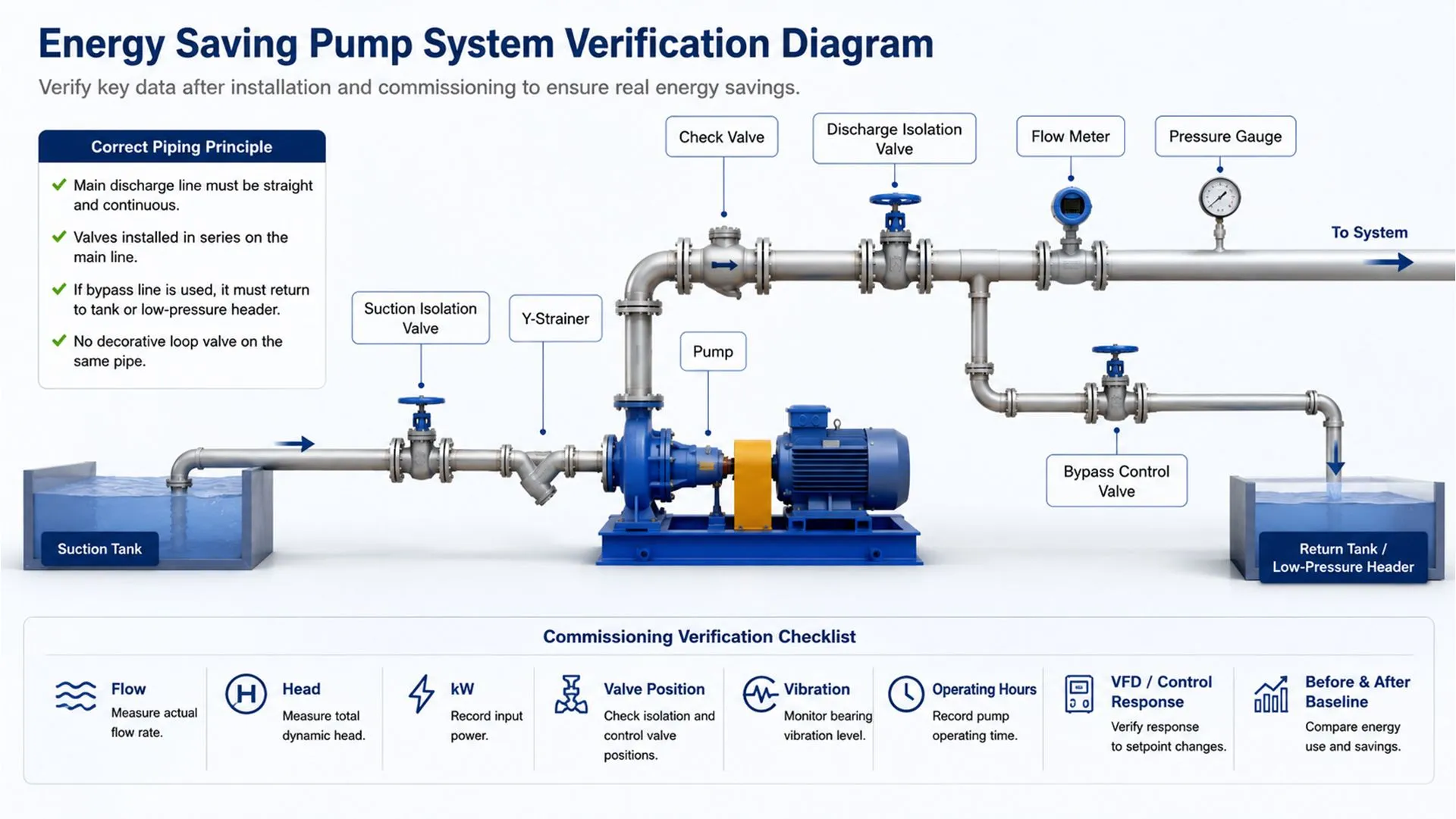
Commissioning Checklist: How to Verify Real Energy Savings
Energy saving should be verified after installation, not assumed from the quotation. A system that looks correct on paper may perform differently if the field pipe layout, valve position, sensor location, or control parameters differ from design.
The commissioning checklist should compare the new system against the previous baseline.
| Commissioning Check | Why It Matters | Acceptable Result |
|---|---|---|
| Actual flow | Confirms useful output | Matches process requirement |
| Suction pressure | Confirms inlet condition | Stable and within NPSH margin |
| Discharge pressure | Confirms system head | Matches expected duty |
| Measured kW | Confirms energy reduction | Lower than previous baseline |
| Valve position | Confirms less throttling | No heavy permanent throttling |
| Bypass flow | Confirms useful flow | No excessive continuous bypass |
| Pump speed | Confirms control logic | Matches demand without instability |
| Vibration | Confirms stable operation | Within site or supplier limit |
| Noise | Finds cavitation or valve loss | No abnormal hydraulic noise |
| Control response | Confirms VFD or sequencing logic | Stable without hunting |
| Cycling frequency | Confirms pump staging quality | No excessive start-stop cycles |
| Bearing and seal temperature | Confirms mechanical health | No abnormal heat increase |
If kW decreases but vibration, cycling, or cavitation increases, the project is not automatically successful. Energy saving must be balanced with reliability.
Maintenance Requirements for Energy Saving Pump Systems
Energy saving does not end after installation. A pump system can lose efficiency over time due to wear, clogging, misalignment, corrosion, suction problems, sensor drift, or control changes.
Maintenance actions that protect energy savings include:
| Maintenance Action | Energy Impact | What to Watch |
|---|---|---|
| Clean suction strainer | Reduces suction loss | Cavitation noise, lower flow |
| Inspect impeller | Restores hydraulic performance | Reduced head or flow |
| Check wear rings | Reduces internal leakage | Efficiency decline |
| Verify alignment | Reduces mechanical loss | Vibration and bearing heat |
| Monitor bearings | Prevents friction and failure | Noise, heat, vibration |
| Check valve position | Finds throttling loss | Partly closed discharge valve |
| Clean filters and heat exchangers | Reduces system resistance | Rising discharge pressure |
| Record kW trend | Detects hidden energy drift | Higher power at same duty |
| Check VFD settings | Maintains stable control | Hunting or unstable pressure |
| Review pump curve after changes | Confirms operating point | System changes may shift duty |
A well-maintained standard system may outperform a poorly maintained “energy saving” system.
FAQ: Buyer Questions About Best Energy Saving Pump Systems
Energy saving pump system selection often creates confusion because suppliers may promote different solutions. These questions address the practical concerns buyers usually have before investing.
What is the best energy saving pump system for industrial use?
The best energy saving pump system for industrial use is the system that matches the real duty point, operates near BEP, uses the correct control method, and minimizes pipe and valve losses. For stable demand, a right-sized fixed-speed pump may be best. For variable demand, a VFD pump system or multi-pump system may save more electricity.
What is the difference between an energy saving pump and an energy saving pump system?
An energy saving pump usually refers to a pump with good hydraulic efficiency. An energy saving pump system includes the pump, motor, control method, pipe layout, valves, sensors, operating schedule, commissioning data, and maintenance plan. The system approach is more reliable because electricity cost depends on the whole installation, not only the pump.
Is a VFD pump system always the most energy efficient?
No. A VFD pump system is often efficient in variable-flow systems, but it is not always the best choice. In constant-demand systems, high static-head systems, or severely oversized pump systems, the payback may be weak. Buyers should review the pump curve and system curve before choosing VFD control.
Are high-efficiency pumps worth the higher price?
High-efficiency pumps are often worth the higher price when operating hours are long and the duty point is confirmed. However, buyers should calculate annual electricity savings and payback period. A high-efficiency pump selected for the wrong duty may not save energy in real operation.
Is a multi-pump system better than one large pump?
A multi-pump system is better when demand changes widely or redundancy is required. It allows one pump to run during low demand and additional pumps to start during peak demand. One large pump may be less efficient at partial load and may cause throttling or cycling.
How do I know if my current pump system wastes energy?
Common signs include a partly closed discharge valve, continuous bypass flow, high kW, operation far from BEP, frequent cycling, high pipe noise, rising electricity cost, worn impellers, and repeated seal or bearing problems. The best method is to measure flow, head, kW, valve position, and compare the operating point with the pump curve.
What is more important: pump efficiency or system design?
System design is more important. Pump efficiency matters, but system design determines whether the pump operates efficiently in real conditions. Pipe friction, control method, suction condition, duty point, and maintenance condition can all affect electricity cost.
Should I choose a high-efficiency motor first?
A high-efficiency motor can help, but it should not be the first decision if the pump is oversized, throttled, or operating far from BEP. Buyers should first confirm the real duty point, pump curve, system curve, and control method. Motor efficiency is one part of system efficiency.
How do I calculate payback for an energy saving pump system?
Use this formula: Simple Payback Period = Upgrade Cost ÷ Annual Energy Saving. Annual energy saving can be estimated by comparing current kW and expected corrected kW, then multiplying the difference by annual operating hours and electricity price.
What should a supplier provide before I approve an energy saving pump system?
A supplier should provide pump curve, efficiency curve, power curve, BEP location, system curve review, NPSHr data, motor efficiency, control recommendation, annual energy estimate, payback calculation, and commissioning checklist. Without these data, energy saving claims are not fully proven.
Can energy saving reduce pump reliability?
It can if done incorrectly. Reducing speed, flow, or power without checking minimum flow, NPSH margin, slurry velocity, process pressure, or safety requirements can create reliability risks. A good energy saving system reduces electricity cost while maintaining required performance and safe operation.
Should I upgrade the pump system if the duty point is unknown?
No. If the duty point is unknown, the first step should be measurement. Buyers should measure actual flow, head, suction pressure, discharge pressure, kW, valve position, and operating hours before approving a new energy-saving system.
Conclusion: The Best Energy Saving Pump Systems Are Selected by Real Duty, Not by Label
The best energy saving pump systems are not chosen by the words “high efficiency,” “VFD,” “smart control,” or “premium motor” alone. They are chosen by matching real flow, real head, system curve, pump curve, BEP range, control method, operating hours, electricity price, and reliability requirements.
For stable demand, the best system may be a right-sized fixed-speed pump with low-loss piping. For variable demand, a VFD pump system may deliver stronger savings. For wide demand variation and reliability needs, a multi-pump system may provide the best life-cycle result. For high pipe resistance, piping and valve optimization may save more energy than replacing the pump.
Before approving a quotation, buyers should ask one key question:
Can the supplier prove that this energy saving pump system will reduce electricity cost under our real operating conditions?
If the answer is supported by pump curves, system curves, efficiency data, power calculations, payback analysis, and commissioning checks, the system is worth serious consideration. If the answer is based only on a product label or a general energy-saving claim, the buyer should request more technical evidence before purchase.
Get A Quote

Get A Quote
0 Comments