
Complete Pump Maintenance Checklist: A Practical Guide for Industrial Buyers and Maintenance Teams

A complete pump maintenance checklist should help maintenance teams detect early failure signs, protect required flow and head, reduce unplanned downtime, and create a clear record for repair, warranty, spare parts planning, and supplier verification. For industrial pump systems, the checklist should cover daily operating checks, weekly visual inspections, monthly mechanical and electrical checks, quarterly performance reviews, annual shutdown maintenance, and condition-based actions when vibration, leakage, noise, temperature, pressure, or flow changes.
The goal is not to “check the pump” in a general way. The goal is to know what to inspect, why it matters, what abnormal results mean, who should own the next action, and when the pump should continue running, be repaired, be stopped, or be escalated to a supplier.
This guide is written for plant maintenance teams, industrial buyers, facility managers, pump operators, project engineers, procurement teams, and distributors who need a practical pump maintenance checklist that can be used in real operations, RFQs, service contracts, spare parts planning, and internal maintenance SOPs.
Quick Answer: What Should a Complete Pump Maintenance Checklist Include?
A complete pump maintenance checklist should include operating condition, flow, pressure, vibration, noise, bearing temperature, seal leakage, lubrication, alignment, coupling guard, foundation bolts, suction condition, discharge condition, valve position, strainer condition, motor current, input power, VFD status, control setpoints, spare parts, maintenance records, shutdown inspection items, responsibility ownership, and post-maintenance acceptance checks.
A useful checklist should not only say “inspect bearing” or “check seal.” It should explain what the technician should look for, what a normal condition looks like, what abnormal findings may mean, and whether the next action is monitoring, cleaning, adjustment, repair, planned shutdown, immediate shutdown, or supplier support.
Definition: A complete pump maintenance checklist is a frequency-based and condition-based inspection system that records pump operating data, mechanical condition, hydraulic performance, electrical load, control status, spare parts readiness, responsibility ownership, and corrective actions to prevent unexpected pump failure.
Standard Answer: A complete pump maintenance checklist should cover daily visual and operating checks, weekly leakage and vibration review, monthly bearing, lubrication, coupling, motor, and valve inspection, quarterly performance trend review, annual shutdown inspection, spare parts control, maintenance record keeping, and post-maintenance acceptance. The checklist should connect each inspection item with the failure risk it prevents.
Pump Maintenance Schedule Summary
A pump maintenance schedule should combine routine inspections and condition-based actions. Routine inspections help teams catch early warning signs, while condition-based actions help teams respond quickly when vibration, leakage, temperature, pressure, current, or flow changes.
This summary table gives buyers, maintenance managers, and operators a fast overview of who should check what and how often.
| Frequency | Main Focus | Typical Owner | Main Decision |
|---|---|---|---|
| Daily | Operating condition, pressure, flow, leakage, noise, vibration, alarms | Operator | Continue running or report abnormal condition |
| Weekly | Leakage trend, vibration notes, strainer, valve position, housekeeping, logs | Operator + maintenance team | Monitor, clean, adjust, or plan inspection |
| Monthly | Bearings, lubrication, coupling, motor current, VFD status, alignment signs | Maintenance team | Repair, trend, or plan shutdown |
| Quarterly | Flow/head trend, energy trend, failure history, spare parts, control review | Engineer + maintenance team | Root cause review and maintenance planning |
| Annual | Shutdown inspection, internal wear, alignment, seal/bearing review, restart baseline | Maintenance + engineer + supplier if needed | Rebuild, repair, replace, or recommission |
| Condition-based | Sudden vibration, rapid leakage, cavitation, overheating, VFD trips, abnormal current | Operator + maintenance supervisor | Stop, isolate, troubleshoot, or call supplier |
A maintenance schedule should not be copied blindly from another plant. It should be adjusted based on pump criticality, liquid properties, runtime, duty severity, spare parts lead time, and site safety requirements.
30-Second Pump Maintenance Checklist for Busy Teams
This quick checklist helps maintenance teams identify the most important inspection points before a pump failure becomes obvious. It is useful for industrial centrifugal pumps, booster pumps, cooling water pumps, transfer pumps, wastewater pumps, irrigation pumps, and general utility pump systems.
The checklist should be used during daily rounds, but abnormal findings should be recorded and escalated instead of treated as routine observations.
| Check Area | What to Inspect | Why It Matters | Action If Abnormal |
|---|---|---|---|
| Flow and pressure | Actual flow, suction pressure, discharge pressure | Confirms useful duty | Compare with normal operating range |
| Leakage | Mechanical seal, packing, flange joints, drain lines | Prevents seal failure and water damage | Identify leak source and trend severity |
| Vibration | Pump, motor, baseplate, bearing housing | Detects misalignment, cavitation, bearing wear | Record trend and investigate root cause |
| Noise | Cavitation noise, bearing noise, rubbing sound | Early warning of hydraulic or mechanical issue | Check suction, bearings, and rotating parts |
| Bearing temperature | Bearing housing, motor bearing area | Prevents bearing failure | Check lubrication, alignment, load |
| Lubrication | Oil level, grease condition, contamination | Protects bearing life | Refill, replace, or investigate contamination |
| Seal condition | Leakage rate, flush flow, seal chamber condition | Prevents unexpected shutdown | Check seal plan and suction stability |
| Suction condition | Tank level, inlet valve, strainer, air ingress | Prevents cavitation and loss of prime | Clean strainer and verify NPSH risk |
| Discharge condition | Valve position, check valve, pressure stability | Prevents throttling, reverse flow, overpressure | Inspect valve function |
| Coupling and guard | Coupling wear, guard installed, alignment signs | Prevents mechanical damage and safety risk | Stop if guard is missing or coupling is unsafe |
| Motor and power | Current, temperature, wiring, insulation signs | Prevents overload and electrical failure | Compare with motor rating |
| Control system | VFD frequency, setpoint, alarms, sensor status | Prevents unstable operation | Check control logic and alarm history |
| Foundation | Anchor bolts, baseplate, grout, pipe strain | Prevents vibration and misalignment | Tighten, inspect, or plan correction |
| Records | Date, reading, technician, action taken | Supports troubleshooting and warranty | Update maintenance log |
This checklist should be treated as the front line of preventive maintenance. A plant should still use the OEM manual, site safety procedures, and application-specific inspection points for critical or hazardous services.
Scope of This Guide: Which Pump Systems Does This Checklist Apply To?
This guide applies mainly to industrial and commercial pump systems where maintenance quality affects flow, head, reliability, downtime, energy use, and lifecycle cost. It is most useful for centrifugal pump systems, including end suction pumps, split case pumps, inline pumps, multistage pumps, booster pump packages, cooling water pumps, chilled water pumps, process water pumps, municipal transfer pumps, irrigation pumps, and general industrial utility pumps.
The checklist can also be used for submersible pumps, wastewater pumps, slurry pumps, chemical pumps, and vertical turbine pumps, but some items must be adjusted for access, solids, liquid properties, materials, sealing method, installation depth, and safety requirements.
Applicable Pump Types
Different pump types need different maintenance emphasis. A single checklist can guide the routine, but the maintenance team should adjust details according to pump design and service duty.
| Pump Type | Checklist Focus | Common Maintenance Risk |
|---|---|---|
| End suction pump | Seal leakage, bearing condition, alignment, suction condition | Seal failure, vibration, off-BEP operation |
| Split case pump | Bearing temperature, casing joint leakage, alignment, flow trend | Bearing wear, casing leakage, efficiency decline |
| Multistage pump | Bearing, balance device, minimum flow, vibration, seal plan | High-pressure seal failure, low-flow overheating |
| Inline pump | Motor bearing, vibration, flange load, control setpoint | Pipe strain, poor access, VFD setting issues |
| Booster pump package | Sequencing, VFD status, pressure sensor, check valve | Short cycling, poor control, standby pump leakage |
| Vertical turbine pump | Water level, column pipe, bowl wear, motor vibration | Low water level, bowl wear, line shaft problems |
| Submersible pump | Cable, insulation, seal chamber, lifting chain, level control | Water ingress, clogging, cooling failure |
| Wastewater pump | Clogging, impeller condition, seals, guide rails, level sensors | Ragging, solids blockage, seal failure |
| Slurry pump | Wear parts, liner, impeller clearance, pipe velocity | Abrasive wear, loss of efficiency |
| Chemical pump | Seal plan, material compatibility, leakage containment | Corrosion, seal failure, safety risk |
Not Suitable Without Adjustment
This checklist should not be copied directly into every pump application without review. Fire pumps, hazardous chemical pumps, sanitary pumps, dosing pumps, diaphragm pumps, screw pumps, API process pumps, and pumps in regulated safety systems may require special procedures, certified technicians, additional documentation, or code-specific testing.
For fire pumps, inspection and testing should follow local fire code, project specifications, insurer requirements, and the applicable fire pump standard used in the project. Energy or maintenance convenience cannot override required fire protection performance.
For hazardous chemical pumps, leakage inspection must follow site safety procedures before close visual inspection. The team should confirm personal protective equipment, isolation method, containment condition, ventilation, drain handling, and emergency response requirements before working near the pump.
Why Pump Maintenance Fails: The Real Problem Is Usually Not the Checklist
Pump maintenance often fails because the checklist is too generic, not because the team does not care. A checklist that only says “check pump condition” does not help a technician decide what to inspect, what reading is abnormal, or what action should follow.
A strong pump maintenance checklist must connect inspection items with failure modes. For example, vibration is not just a number; it may indicate misalignment, cavitation, bearing wear, imbalance, foundation looseness, pipe strain, or operation far from the Best Efficiency Point. Best Efficiency Point, or BEP, means the operating point where the pump runs at its highest hydraulic efficiency for a given impeller and speed.
| Weak Checklist Item | Better Maintenance Item | Why It Works Better |
|---|---|---|
| Check pump | Record flow, suction pressure, discharge pressure, leakage, vibration, noise, bearing temperature | Gives measurable condition |
| Check seal | Record leakage rate, seal flush condition, seal chamber temperature, leakage trend | Helps identify early seal failure |
| Check bearing | Record temperature, noise, vibration, lubrication condition | Prevents bearing failure |
| Check motor | Record current, temperature, VFD frequency, alarm history | Finds overload and control problems |
| Check piping | Inspect suction restriction, discharge valve position, pipe strain, support condition | Finds system causes, not only pump symptoms |
A maintenance checklist is only valuable when it produces repeatable observations. If two technicians inspect the same pump and reach different conclusions, the checklist is not specific enough.
Daily Pump Maintenance Checklist: What Operators Should Check
Daily pump maintenance focuses on visible operating condition. The goal is to catch abnormal noise, leakage, vibration, pressure instability, overheating, and control alarms before they become failure events.
Daily checks should be simple enough for operators to perform during routine rounds, but specific enough to create useful records.
| Daily Check Item | Normal Condition | Warning Sign | Action |
|---|---|---|---|
| Pump running condition | Smooth, stable operation | Unusual noise, vibration, cycling | Record and notify maintenance |
| Suction pressure | Stable within normal range | Lower than normal or fluctuating | Check tank level, valve, strainer |
| Discharge pressure | Stable within required range | Higher or lower than normal | Check valve position and system demand |
| Flow indication | Meets process requirement | Lower flow or unstable flow | Check suction, discharge, control setting |
| Mechanical seal or packing | No abnormal leakage | Increased leakage or spray | Identify source and trend |
| Bearing housing temperature | Similar to historical normal | Sudden increase | Check lubrication and vibration |
| Motor temperature | Normal surface temperature | Hot motor or burning smell | Check current and load |
| Motor current | Within expected range | High current or imbalance | Compare with rating and duty |
| Vibration feel | No unusual increase | Noticeable shaking or rattling | Record and escalate |
| Noise | Normal operating sound | Cavitation, grinding, knocking | Check suction and bearings |
| Valve position | Matches operating requirement | Unexpected throttling or closed valve | Confirm process need |
| VFD/control panel | No active alarm | Alarm, trip, abnormal frequency | Check alarm log |
| Leakage around base | Dry or controlled drainage | Water, oil, or chemical pooling | Identify leak source |
| Safety guard | Coupling guard installed | Missing or loose guard | Stop if unsafe |
Daily checks should not require dismantling the pump. They should focus on what can be seen, heard, touched safely, measured, and recorded during normal operation.
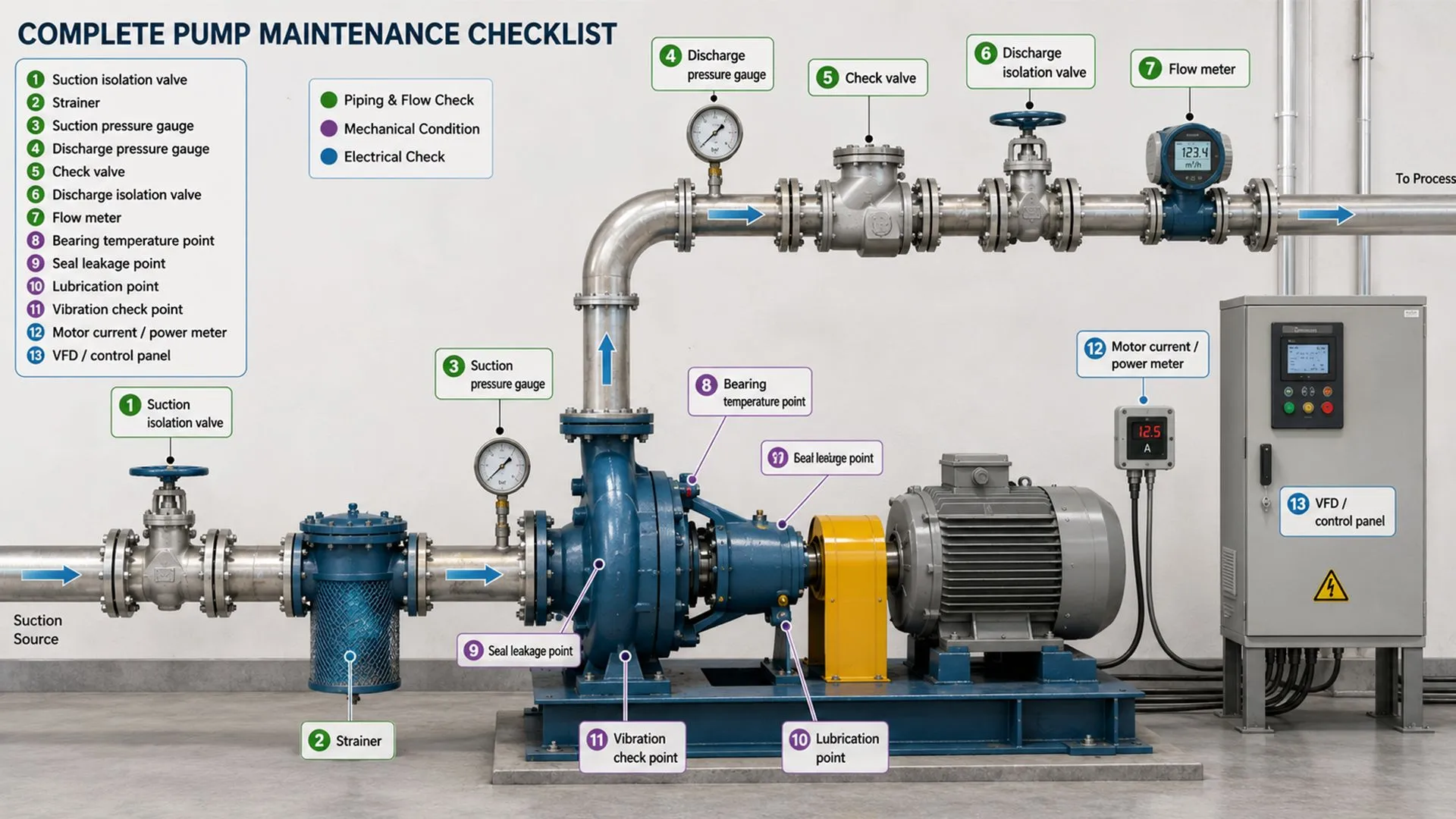
Weekly Pump Maintenance Checklist: How to Catch Repeating Warning Signs
Weekly maintenance should go deeper than daily observation. It should confirm whether early symptoms are repeating, whether leakage is increasing, whether vibration is trending upward, and whether valves, strainers, and controls remain in the correct condition.
Weekly inspection is especially important for pumps that run continuously or operate in dusty, wet, hot, corrosive, or high-vibration environments.
| Weekly Check Item | What to Do | Why It Matters |
|---|---|---|
| Review daily logs | Compare pressure, flow, current, leakage, vibration notes | Finds trends before failure |
| Check seal leakage trend | Compare with last week’s condition | Detects seal wear or suction instability |
| Inspect packing leakage if applicable | Confirm controlled leakage, not excessive leakage | Prevents shaft sleeve damage |
| Inspect strainer condition | Check differential pressure or cleaning need | Prevents low suction pressure |
| Check suction tank level | Confirm stable inlet condition | Prevents vortexing and cavitation |
| Inspect foundation bolts | Look for looseness or movement marks | Prevents vibration and misalignment |
| Check coupling guard | Confirm installed and secure | Safety requirement |
| Inspect visible coupling area | Look for dust, rubber debris, abnormal movement | Detects coupling wear |
| Check lubrication level | Confirm oil level or grease condition | Protects bearings |
| Check drain and vent points | Confirm no blockage or uncontrolled leakage | Prevents contamination |
| Check VFD alarms | Review trip, overcurrent, underload, sensor alarms | Finds control or electrical issues |
| Confirm valve positions | Verify normal suction, discharge, bypass, control valve positions | Prevents accidental throttling or bypass loss |
| Clean around pump base | Remove debris, water, oil, or chemical residue | Improves inspection quality |
Weekly checks are valuable because they turn isolated observations into trends. A single small leak may not justify shutdown, but a leak that grows every week needs action.
Monthly Pump Maintenance Checklist: Mechanical, Electrical and Hydraulic Checks
Monthly maintenance should combine visual inspection with mechanical, electrical, hydraulic, and control checks. This is where the team begins to confirm whether the pump is still operating near its normal baseline.
Monthly checks are useful for identifying developing problems such as bearing wear, lubrication contamination, alignment drift, motor overload, control instability, and system restriction.
| Monthly Check Item | What to Inspect | Maintenance Decision |
|---|---|---|
| Vibration reading | Pump bearing housing, motor, baseplate | Compare with baseline and trend |
| Bearing temperature | Pump and motor bearing areas | Investigate if rising trend appears |
| Lubricant condition | Oil color, water contamination, grease condition | Replace or sample if abnormal |
| Coupling condition | Wear, dust, heat, flexible element condition | Plan replacement if degraded |
| Alignment signs | Coupling wear, vibration, seal leakage, base movement | Schedule alignment check |
| Mechanical seal area | Leakage, flush flow, heat, residue | Review seal plan and suction stability |
| Packing condition | Leakage rate, gland temperature, sleeve wear | Adjust carefully or plan service |
| Suction strainer | Differential pressure or cleaning condition | Clean if pressure drop increases |
| Check valve | Noise, reverse flow, pressure drop | Inspect if reverse flow suspected |
| Discharge valve | Throttling, sticking, leakage | Confirm process need |
| Flow meter | Reading stability and plausibility | Verify if reading conflicts with pressure |
| Motor current | Load trend and imbalance | Compare with motor rating |
| VFD frequency | Normal operating range and minimum speed | Review setpoint and process demand |
| Control sensor | Pressure/level sensor condition | Check calibration if unstable |
| Pipe supports | Loose supports or pipe strain | Correct before alignment damage |
| Paint/corrosion | External corrosion, coating damage | Plan protection or repair |
Monthly maintenance should include trend comparison. A reading is more useful when compared with historical data, not only with a generic “normal” label.
Quarterly Pump Maintenance Checklist: Performance Trend and Failure Review
Quarterly maintenance should review pump performance, system behavior, and failure trends. This is the point where the team should ask whether the pump still matches the system demand, whether energy use has changed, and whether repeated failures share the same root cause.
Quarterly checks are also useful for maintenance planning and procurement because they help decide which spare parts, repair kits, and service support should be prepared before shutdown.
| Quarterly Check Item | What to Review | Why It Matters |
|---|---|---|
| Flow and head trend | Compare measured or indicated duty with normal baseline | Finds performance decline |
| Input kW or motor current trend | Compare energy use with output | Finds efficiency or load changes |
| Pump curve position | Compare duty point with expected range | Finds off-BEP operation |
| Vibration trend | Review three-month pattern | Detects developing mechanical faults |
| Seal failure records | Review leakage, replacement, failure cause | Avoids repeated seal replacement without root cause |
| Bearing history | Review temperature, noise, lubrication, vibration | Prevents bearing failure |
| Maintenance cost | Labor, parts, downtime, emergency repair | Supports lifecycle cost review |
| Spare parts stock | Seal, bearing, gasket, coupling, wear rings, impeller | Reduces downtime |
| VFD/control history | Trips, alarms, unstable pressure, sensor faults | Prevents control-related downtime |
| Strainer/filter cleaning frequency | Frequent clogging or pressure drop | Indicates upstream contamination |
| Pipe and valve condition | Corrosion, leakage, sticking, pressure loss | Finds system-side issues |
| Safety and access | Guard, walkway, lifting access, drainage | Protects maintenance quality |
If a pump has repeated seal, bearing, or vibration issues, quarterly review should not simply schedule another replacement. It should trigger root cause analysis.
For buyers who need to understand whether poor efficiency comes from wear, system restriction, or duty change, this pump efficiency decline troubleshooting guide can help maintenance teams separate hydraulic wear from operating point problems.
Annual Pump Maintenance Checklist: Shutdown Inspection and Restart Baseline
Annual maintenance usually requires planned shutdown, deeper inspection, and replacement of selected wear parts. The annual checklist should be based on operating hours, service severity, historical failures, manufacturer recommendations, and the criticality of the pump.
Annual maintenance is also the best time to inspect internal wear, restore alignment, replace gaskets, inspect impeller condition, review spare parts strategy, and update maintenance records.
| Annual Check Item | What to Do | Why It Matters |
|---|---|---|
| Lockout and isolation | Isolate electrical power, suction, discharge, pressure, and stored energy | Protects maintenance team |
| Drain and clean pump | Remove liquid safely before opening | Prevents contamination and injury |
| Inspect impeller | Check wear, corrosion, erosion, clogging, cracks | Restores hydraulic performance |
| Inspect wear rings | Measure clearance if applicable | Prevents internal recirculation |
| Inspect casing | Look for erosion, corrosion, cracks, gasket surface damage | Prevents leakage and efficiency loss |
| Inspect shaft sleeve | Check wear at seal or packing area | Protects seal life |
| Replace gaskets and O-rings | Use correct material and size | Prevents leakage after assembly |
| Inspect mechanical seal | Replace or rebuild if required | Prevents unplanned leakage |
| Inspect bearings | Check wear, noise, lubrication condition | Prevents bearing failure |
| Check coupling | Inspect element, hub, key, set screws | Prevents torque transmission failure |
| Perform alignment | Align pump and motor after service | Reduces vibration and seal wear |
| Inspect baseplate and grout | Check cracks, looseness, soft foot | Prevents alignment drift |
| Check pipe strain | Confirm piping does not pull pump nozzles | Prevents casing and alignment stress |
| Test motor insulation if required | Check winding condition | Prevents electrical failure |
| Review VFD settings | Confirm frequency limits, alarms, ramps, setpoints | Prevents control-related faults |
| Commission after maintenance | Record flow, pressure, current, vibration, leakage | Confirms successful restart |
Annual maintenance should end with commissioning data. If the pump is restarted without recording flow, pressure, motor current, vibration, and leakage condition, the plant loses the baseline needed for future troubleshooting.
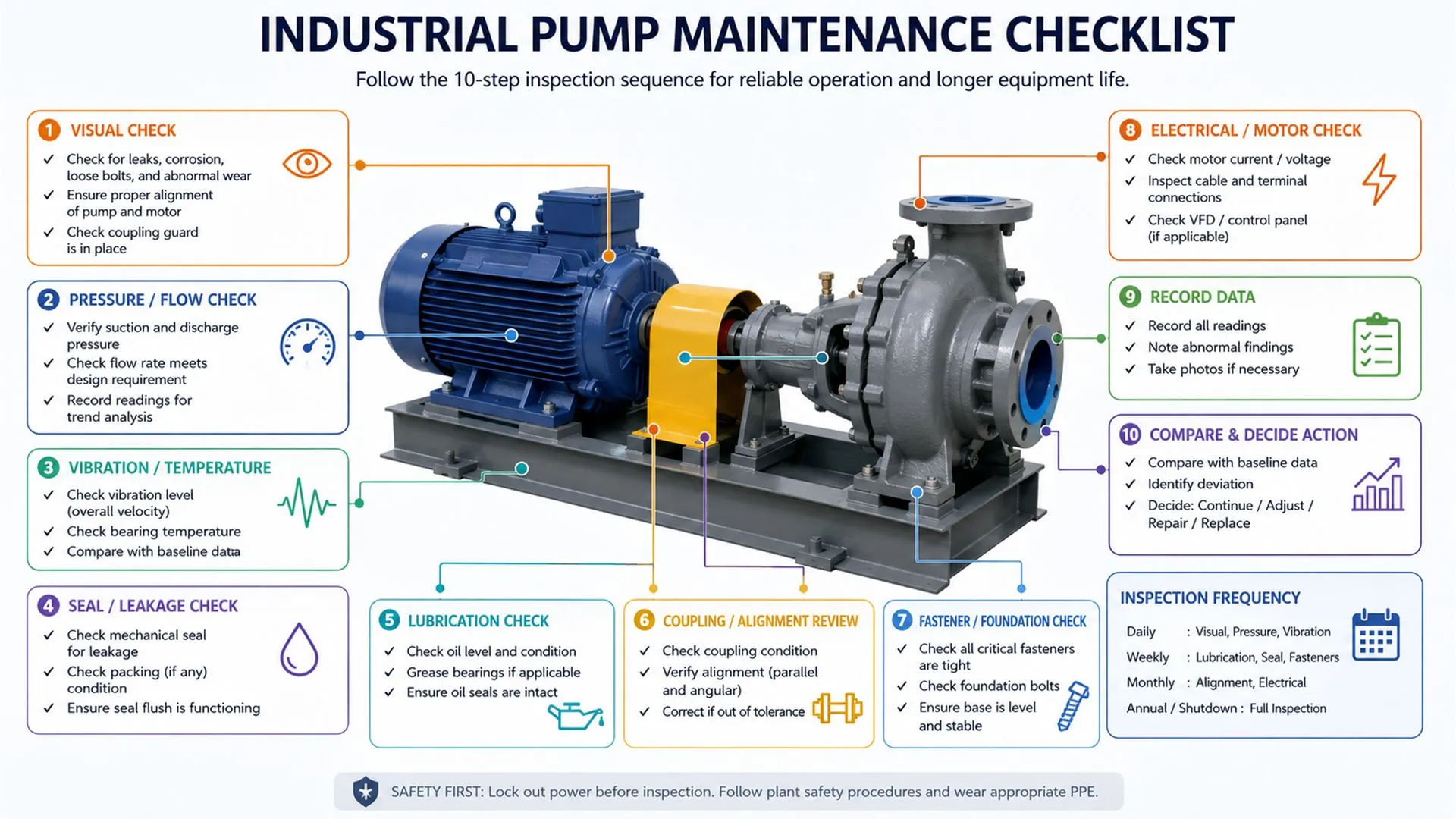
Pump Maintenance Severity Matrix: Monitor, Plan, Stop, or Call Supplier?
A complete pump maintenance checklist must tell the team what to do after an abnormal finding. Without severity grading, technicians may underreact to dangerous symptoms or overreact to minor changes.
This severity matrix helps teams decide whether to continue monitoring, plan service, stop the pump, or request engineering and supplier support. Site-specific limits from the OEM manual, project specification, safety procedure, or applicable standard should always take priority.
| Finding | Severity | Recommended Action | Who Should Own It |
|---|---|---|---|
| Slight seal weep, stable | Low | Monitor and record trend | Operator / maintenance |
| Seal leakage increasing weekly | Medium | Plan seal inspection | Maintenance team |
| Spray leakage near motor or coupling | High | Stop if unsafe and isolate | Maintenance supervisor |
| Slight vibration increase | Medium | Measure and trend | Maintenance team |
| Sudden severe vibration | Critical | Stop and inspect root cause | Maintenance + engineer |
| Bearing temperature rising slowly | Medium | Check lubrication, load, and vibration | Maintenance team |
| Bearing temperature rising rapidly | High | Stop if outside site limit | Maintenance supervisor |
| Cavitation noise appears | High | Check suction pressure, tank level, strainer, air ingress | Engineer / operator |
| Motor current above normal | High | Compare flow, head, voltage, and load | Electrical + maintenance |
| Repeated VFD trip | High | Review alarm history and process condition | Electrical + controls |
| Pump casing overheats | Critical | Stop and investigate low-flow or deadhead | Maintenance supervisor |
| Coupling guard missing or loose | Critical safety issue | Stop if exposed rotating parts are unsafe | Maintenance supervisor |
| Check valve slams or reverse flow suspected | High | Inspect valve and system pressure change | Maintenance + engineer |
| Flow drops while kW stays similar | Medium to High | Check wear, blockage, bypass, valve position | Maintenance + engineer |
| Chemical leakage near pump | High to Critical | Follow site hazardous liquid procedure | Safety + maintenance |
Do not use this matrix as a replacement for site safety rules. It is a decision aid. Each plant should define alarm and shutdown limits based on OEM guidance, site standards, process risk, and applicable safety requirements.
Condition-Based Pump Maintenance: What Should Trigger Immediate Action?
A maintenance schedule is necessary, but it cannot replace condition-based judgment. Some symptoms require immediate investigation even if the next scheduled maintenance date is weeks away.
Condition-based maintenance means that abnormal operating data triggers action. This helps prevent avoidable failures.
| Abnormal Condition | Possible Cause | Immediate Action |
|---|---|---|
| Sudden vibration increase | Misalignment, cavitation, bearing damage, imbalance | Reduce risk, inspect root cause |
| Cavitation noise | Low NPSH, clogged suction, low tank level, air ingress | Check suction pressure and inlet condition |
| Bearing temperature rising | Poor lubrication, overload, misalignment, bearing wear | Check lubrication and vibration |
| Seal leakage increasing quickly | Seal face damage, shaft movement, suction instability | Inspect seal system and operating condition |
| Motor current higher than normal | Overload, higher flow, mechanical friction, voltage issue | Compare with flow, pressure, and motor rating |
| Flow drops while kW stays similar | Wear, blockage, recirculation, closed valve | Check pump and system restrictions |
| Discharge pressure fluctuates | Air, cavitation, control instability, valve issue | Check suction, controls, valves |
| VFD trips repeatedly | Overcurrent, underload, sensor error, wrong setpoint | Review alarm history and settings |
| Pump casing overheats | Deadheading, low flow, blocked discharge | Stop and investigate if unsafe |
| Check valve noise | Reverse flow, water hammer, valve damage | Inspect valve operation |
Some conditions should trigger immediate shutdown according to site safety policy, especially severe vibration, unsafe leakage, fire risk, electrical smell, coupling guard failure, or overheating.
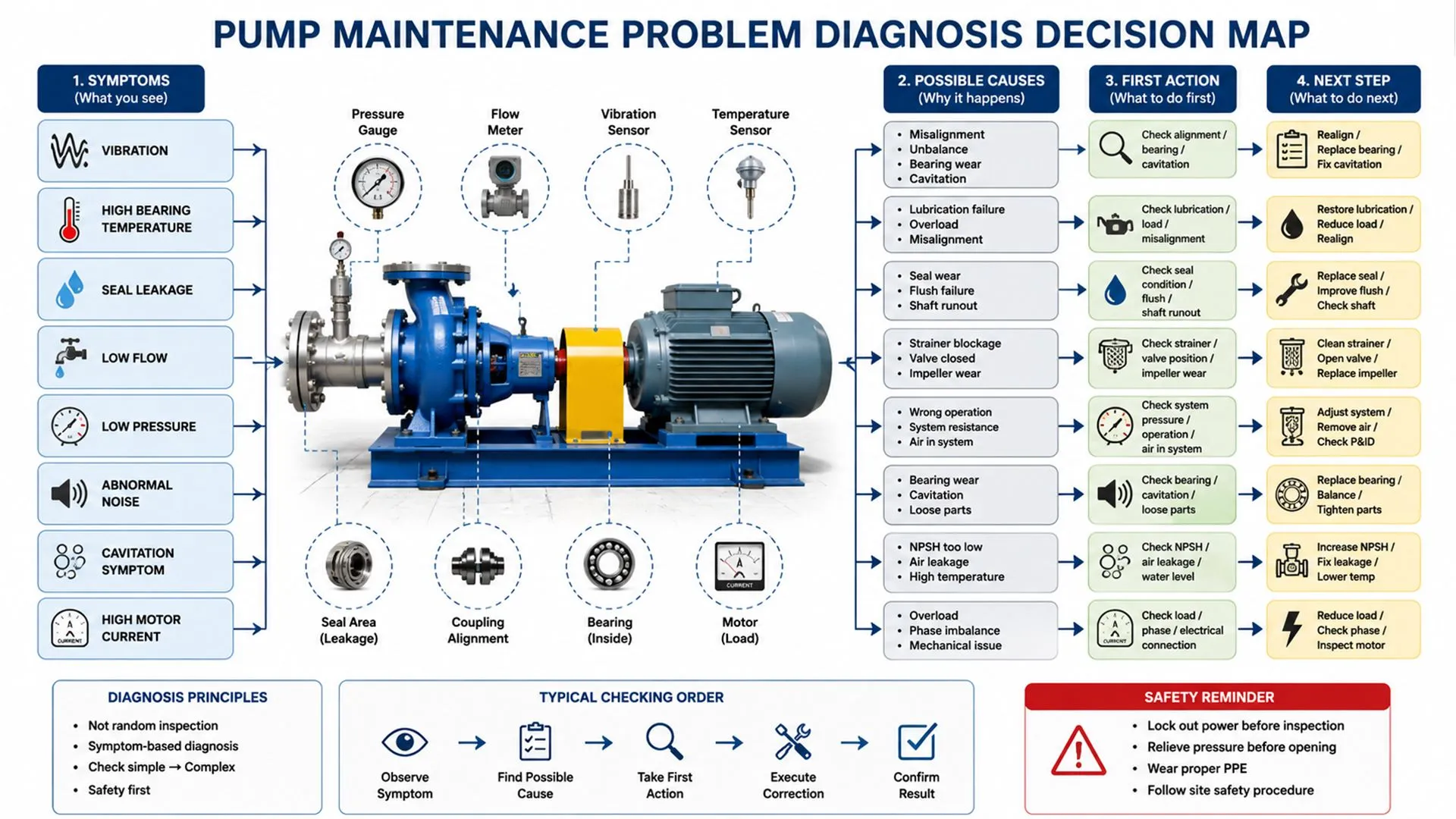
Pump Maintenance Checklist by Component: What Each Part Can Tell You
Component-based maintenance helps teams avoid missing hidden failure points. It also helps procurement prepare the correct spare parts and service tools.
Each component should be inspected with a clear purpose: preventing leakage, avoiding rotating failure, protecting hydraulic performance, or reducing downtime.
| Component | Maintenance Check | Failure Prevented |
|---|---|---|
| Pump casing | Leakage, corrosion, erosion, cracks, gasket surface | Casing leakage and efficiency loss |
| Impeller | Wear, clogging, corrosion, cracks, balance | Reduced flow and vibration |
| Wear rings | Clearance, wear, scoring | Internal recirculation |
| Mechanical seal | Leakage, flush, heat, residue | Seal failure |
| Packing | Leakage rate, gland temperature, sleeve wear | Shaft sleeve damage |
| Shaft sleeve | Wear, scoring, corrosion | Seal leakage |
| Bearings | Temperature, noise, vibration, lubrication | Bearing seizure |
| Lubrication system | Oil level, grease condition, contamination | Bearing failure |
| Coupling | Wear, element condition, guard, alignment signs | Torque transmission failure |
| Baseplate | Anchor bolts, grout, soft foot, corrosion | Misalignment and vibration |
| Suction pipe | Air ingress, clogging, valve position, strainer | Cavitation and low flow |
| Discharge pipe | Check valve, isolation valve, pressure stability | Reverse flow and throttling loss |
| Motor | Current, temperature, insulation, cooling | Electrical failure |
| VFD/control panel | Alarms, frequency, setpoints, sensor condition | Control instability |
| Instrumentation | Gauges, transmitters, flow meter, calibration | Wrong decisions from bad readings |
A component checklist should always connect findings with action. For example, seal leakage may require seal replacement, but it may also require suction correction, alignment review, or BEP review.
Hydraulic Performance Checklist: Is the Pump Still Delivering Useful Output?
Pump maintenance is not only mechanical. A pump can look clean and still waste energy or fail to deliver required flow and head. Hydraulic performance should be checked regularly, especially for high-runtime pumps.
Hydraulic checks help maintenance teams detect wear, blockage, system changes, and operating point problems.
| Hydraulic Check | What It Tells You | What to Do If Abnormal |
|---|---|---|
| Actual flow | Whether pump delivers useful output | Check restriction, wear, speed, valve position |
| Suction pressure | Whether inlet condition is healthy | Check tank level, strainer, suction valve, air ingress |
| Discharge pressure | Whether system head is normal | Check valve position, demand, blockage |
| Total dynamic head | Real pump duty point | Compare with pump curve |
| Pump curve position | Whether pump operates in safe range | Review BEP and system curve |
| Flow vs kW | Energy per useful output | Check efficiency decline |
| Pressure fluctuation | Air, cavitation, control instability | Investigate suction and controls |
| Bypass flow | Non-useful circulation | Confirm if required |
| Discharge throttling | Wasted pressure | Check oversizing or control strategy |
For systems with high energy cost or uncertain duty points, this industrial pump energy audit guide explains how to measure flow, head, input kW, pump curve position, and system losses before deciding whether maintenance or upgrade is the better action.
Mechanical Maintenance Checklist: How to Catch Bearing, Coupling and Alignment Problems Early
Mechanical failures often show early symptoms before complete breakdown. The maintenance team should track vibration, temperature, lubrication, coupling condition, and foundation stability.
A pump with repeated mechanical failures should not be repaired blindly. The team should check whether the pump is misaligned, operating off-BEP, affected by pipe strain, or suffering from poor lubrication.
| Mechanical Check | Warning Sign | Likely Risk |
|---|---|---|
| Bearing temperature | Rising trend | Lubrication problem, overload, bearing wear |
| Bearing noise | Grinding, rumbling | Bearing damage |
| Vibration | Increasing trend | Misalignment, cavitation, imbalance, looseness |
| Coupling element | Cracks, dust, wear | Coupling failure |
| Coupling guard | Loose or missing | Safety hazard |
| Alignment | Seal failure, vibration, coupling wear | Shaft and bearing stress |
| Baseplate | Loose bolts, soft foot, cracked grout | Alignment drift |
| Pipe strain | Pump moves when flange bolts are loosened | Casing stress and misalignment |
| Foundation | Settlement, cracked concrete | Vibration and misalignment |
Use the site standard, OEM guidance, or applicable vibration standard to define alarm and shutdown limits. Avoid using one universal vibration limit for all pump types, motor sizes, speeds, foundations, and services.
If vibration increases after repair, the team should not assume the repair was successful. Alignment, pipe strain, coupling condition, and hydraulic operating point should be checked again.
Seal and Packing Maintenance Checklist
Seal and packing problems are among the most common reasons for pump maintenance. However, replacing the seal without finding the cause often leads to repeated failure.
Seal maintenance should include leakage observation, flush condition, suction stability, vibration, shaft movement, and process liquid condition.
| Seal or Packing Check | What to Inspect | Why It Matters |
|---|---|---|
| Mechanical seal leakage | Drip, spray, residue, leakage trend | Detects seal face damage |
| Seal flush flow | Flow rate, blockage, pressure | Prevents dry running and heat |
| Seal chamber temperature | Heat around seal area | Detects poor lubrication or cooling |
| Packing leakage | Controlled leakage, not dry or excessive | Prevents sleeve damage |
| Gland temperature | Too hot after adjustment | Indicates over-tightening |
| Shaft sleeve | Scoring, grooves, corrosion | Causes repeated leakage |
| Vibration near seal | Shaft movement | Damages seal faces |
| Suction stability | Pressure fluctuation or cavitation | Causes seal instability |
| Liquid solids | Abrasive particles | Increases seal wear |
| Chemical compatibility | Elastomer and face material suitability | Prevents swelling or corrosion |
For pump systems with recurring leakage, this pump seal leak troubleshooting guide can help teams separate seal installation issues from suction problems, vibration, material mismatch, and operating point errors.
Electrical and Control Maintenance Checklist
Electrical and control issues can create pump failures even when the hydraulic pump is mechanically healthy. Motor overload, unstable VFD settings, poor sensor placement, and alarm history should be included in the maintenance program.
This section is especially important for booster systems, HVAC circulation pumps, variable-speed pumps, and multi-pump stations.
| Electrical / Control Check | What to Inspect | Failure Prevented |
|---|---|---|
| Motor current | Phase current, load trend | Overload and imbalance |
| Motor temperature | Cooling fan, surface heat, airflow | Overheating |
| Wiring terminals | Loose or overheated connections | Electrical failure |
| Insulation condition | Test if required by site procedure | Motor winding failure |
| VFD frequency | Actual operating speed | Wrong speed control |
| VFD alarms | Overcurrent, underload, fault history | Repeated trips |
| Pressure sensor | Stability and location | Control hunting |
| Level sensor | Correct start/stop signal | Dry running or overflow |
| Control setpoint | Pressure or flow target | Excess energy and cycling |
| Pump sequencing | Lead/lag rotation and staging | Unnecessary runtime |
| Emergency stop | Function and access | Safety protection |
A VFD should not be treated as a “set and forget” device. VFD settings should be checked when process demand changes, pressure complaints occur, or energy use increases.
For buyers comparing variable-speed and fixed-speed operation, this VFD vs fixed speed energy comparison guide explains when VFD control reduces energy cost and when fixed-speed correction may be safer or more economical.
Suction and Discharge System Checklist
Many pump failures are caused by the system around the pump, not by the pump itself. A complete pump maintenance checklist must inspect suction piping, discharge piping, valves, strainers, filters, check valves, and bypass lines.
Ignoring the system side leads to repeated repairs without solving the real problem.
| System Check | Why It Matters | Action If Abnormal |
|---|---|---|
| Suction valve fully open | Prevents inlet restriction | Open or repair valve if safe |
| Strainer condition | Prevents low suction pressure | Clean and record pressure drop |
| Suction pipe air leaks | Prevents cavitation and loss of prime | Repair joints and gaskets |
| Tank liquid level | Protects NPSH margin | Maintain required level |
| Suction elbow near pump | May create uneven flow | Review inlet layout |
| Discharge valve position | Finds throttling | Confirm process requirement |
| Check valve function | Prevents reverse flow | Inspect if noise or reverse flow occurs |
| Bypass line | May waste energy or protect minimum flow | Confirm purpose and flow |
| Pipe supports | Prevents pipe strain | Repair supports |
| Expansion joints | Prevents stress transfer | Inspect condition |
| Pressure gauges | Confirms system condition | Calibrate or replace if unreliable |
If a pump repeatedly suffers from cavitation, vibration, or seal failure, the suction system should be checked before replacing more internal parts.
Pump Maintenance Responsibility Boundary: Who Should Own Each Task?
A pump maintenance checklist becomes more effective when responsibility is clear. Operators, maintenance teams, engineers, procurement teams, and suppliers should not all assume that someone else owns the next action.
This responsibility boundary helps reduce missed inspections, delayed repairs, spare parts errors, and warranty disputes.
| Task | Operator | Maintenance Team | Engineer | Procurement | Supplier |
|---|---|---|---|---|---|
| Daily visual check | Own | Support | - | - | - |
| Leakage trend review | Record | Own | Support | - | Support if repeated |
| Vibration measurement | Report | Own | Review trend | - | Support if unresolved |
| Flow/head performance review | Record if available | Support | Own | - | Provide curve if needed |
| Pump curve review | - | Support | Own | - | Provide curve |
| Lubrication execution | Report abnormal | Own | Define method if special | Buy correct lubricant | Confirm OEM requirement |
| Spare parts planning | - | Support | Support | Own | Confirm compatibility |
| Root cause analysis | Support | Own | Own | - | Support |
| Warranty claim | Record | Support | Support | Own | Respond |
| Commissioning after repair | Support | Own | Own | - | Support if contracted |
| RFQ for maintenance service | Provide symptoms | Provide history | Define scope | Own | Quote and clarify |
For critical pumps, ownership should be written into the maintenance SOP or service contract. This prevents disputes after repeated failures or emergency repairs.
Spare Parts Checklist for Pump Maintenance
A maintenance checklist is incomplete without a spare parts strategy. A pump may be easy to repair technically, but downtime becomes expensive when the correct seal, bearing, gasket, or wear part is not available.
Procurement teams should work with maintenance and suppliers to prepare spare parts based on pump criticality, lead time, operating conditions, and historical failures.
| Spare Part | Recommended For | Procurement Note |
|---|---|---|
| Mechanical seal | Critical clean-water, process, and booster pumps | Confirm material and seal size |
| Packing set | Packed pumps | Confirm packing grade and sleeve condition |
| Bearings | High-runtime pumps | Match exact specification |
| Gasket and O-ring kit | Any pump opened during maintenance | Confirm material compatibility |
| Coupling element | Flexible coupling pumps | Keep correct size in stock |
| Wear rings | Pumps with internal recirculation risk | Confirm casing and impeller dimensions |
| Shaft sleeve | Packed or seal-wear pumps | Useful for repeated leakage |
| Impeller | Critical pumps or long lead time parts | Stock only when downtime risk justifies cost |
| Check valve parts | Systems with reverse flow risk | Confirm valve model |
| Strainer basket or screen | Dirty water or process systems | Keep cleaning interval records |
| VFD cooling fan or panel parts | Critical controlled systems | Confirm model and lead time |
| Pressure gauge or transmitter | Systems requiring accurate monitoring | Keep calibrated replacements |
A spare parts plan should not overstock every item. It should balance failure probability, lead time, pump criticality, and downtime cost.
Pump Maintenance Log: What Records Should Be Kept?
Maintenance records turn pump maintenance from guesswork into trend-based management. Without records, the plant cannot easily prove whether a problem is new, repeated, supplier-related, installation-related, or operation-related.
A good maintenance log should be easy to complete and useful for troubleshooting.
| Maintenance Record | Why It Matters |
|---|---|
| Pump tag and location | Identifies asset clearly |
| Date and time | Builds timeline |
| Operating hours | Supports maintenance interval planning |
| Flow, suction pressure, discharge pressure | Tracks hydraulic performance |
| Motor current or input kW | Tracks electrical load |
| Vibration reading | Tracks mechanical condition |
| Bearing temperature | Tracks bearing health |
| Seal leakage condition | Tracks seal degradation |
| Lubrication action | Confirms bearing care |
| Valve position | Identifies throttling or operation change |
| VFD alarms | Finds control problems |
| Parts replaced | Supports spare parts planning |
| Technician name | Creates accountability |
| Root cause found | Prevents repeated repair |
| Corrective action | Shows what was done |
| Follow-up date | Ensures unresolved issues are tracked |
For critical pumps, records should be reviewed by maintenance and engineering, not only stored. A log that nobody reviews does not prevent failure.
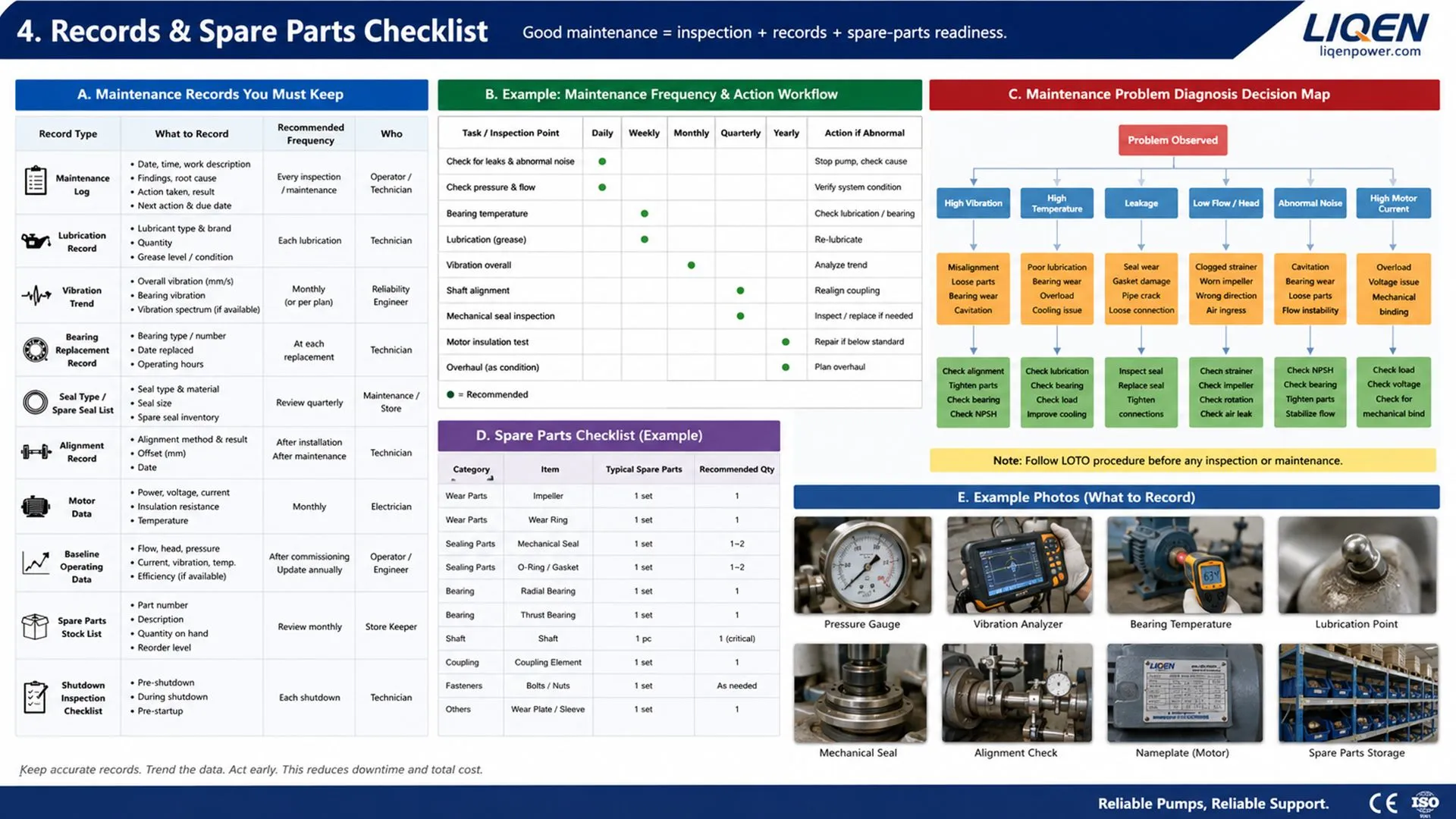
Post-Maintenance Acceptance Checklist: How to Confirm the Pump Is Safe to Restart
Maintenance does not end when the part is replaced. It ends when the pump is safely restarted, delivers the required duty, and creates a new baseline for future inspection.
Post-maintenance acceptance is especially important after seal replacement, bearing replacement, coupling service, internal inspection, impeller repair, motor service, VFD adjustment, or pump rebuild.
| Acceptance Item | Acceptable Result |
|---|---|
| Flow | Meets required duty |
| Suction pressure | Stable and not lower than normal |
| Discharge pressure | Matches system requirement |
| Total dynamic head | Consistent with expected duty |
| Motor current | Within expected range for operating condition |
| Vibration | Stable and not higher than baseline or site limit |
| Seal leakage | Normal or within allowed condition |
| Bearing temperature | Stable after running |
| Noise | No abnormal rubbing, cavitation, or bearing noise |
| Coupling guard | Installed and secure |
| Valve position | Matches normal operating requirement |
| VFD alarm | No active alarm |
| Lubrication | Correct level and no visible contamination |
| Baseplate and anchor bolts | Secure with no abnormal movement |
| Maintenance log | Completed with readings, actions, parts, and technician name |
| Follow-up check | Scheduled if new parts were installed |
For vibration, bearing temperature, and leakage acceptance, the site should use OEM guidance, historical baseline, project specification, or applicable plant standard. Avoid approving restart based only on “it sounds normal.”
How to Decide Whether to Repair, Rebuild, or Replace a Pump
Maintenance teams often face a difficult question: should they repair the pump again, rebuild it during shutdown, or replace it with a better-matched pump? The answer should be based on failure history, repair cost, energy cost, downtime risk, spare parts availability, and whether the pump still fits the system duty.
Repair is suitable when the pump is generally correct for the duty and the failure is isolated. Rebuild is suitable when multiple wear parts are degraded but the hydraulic selection remains valid. Replacement is suitable when the pump is repeatedly failing, obsolete, inefficient, or mismatched to the system.
| Decision | Best Use Case | Warning Before Approval |
|---|---|---|
| Repair | Isolated seal, bearing, gasket, or coupling issue | Do not ignore root cause |
| Rebuild | Pump is correct but internal wear is broad | Confirm parts availability and downtime |
| Replace | Pump is mismatched, obsolete, inefficient, or repeatedly failing | Compare lifecycle cost, not only purchase price |
| Upgrade material | Corrosion, abrasion, or repeated wear | Confirm compatibility and cost |
| Upgrade control | Cycling, unstable pressure, energy waste | Verify sensors and control logic |
| Modify system | Suction or discharge layout causes repeated failure | Confirm pressure loss and installation constraints |
If maintenance cost is rising and the pump no longer matches real duty, this best ROI pump upgrades guide can help buyers compare repair, rebuild, VFD tuning, impeller trimming, system correction, and replacement by payback and risk.
Common Pump Maintenance Mistakes
Many pump maintenance problems repeat because the maintenance program treats symptoms instead of causes. A complete checklist should help teams avoid these mistakes.
| Mistake | Why It Causes Problems | Better Practice |
|---|---|---|
| Replacing seals without checking suction | Seal fails again | Check cavitation, pressure fluctuation, air ingress |
| Greasing bearings without knowing grease type | Over-greasing or incompatibility | Follow OEM lubrication instructions |
| Ignoring vibration trend | Bearing or alignment failure grows | Record and compare vibration |
| Checking discharge pressure only | Suction problem is missed | Measure suction and discharge |
| Using no maintenance log | No trend or responsibility | Record readings and actions |
| Ignoring valve position | Throttling or bypass loss continues | Confirm actual operating state |
| Restarting after repair without baseline | Future comparison impossible | Record commissioning data |
| Buying cheap parts without material check | Shorter service life | Confirm material and specification |
| Ignoring pipe strain | Alignment fails repeatedly | Check piping support and nozzle stress |
| Treating VFD alarms as electrical only | Hydraulic cause may be missed | Compare controls with pump duty |
The key rule is simple: if the same part fails repeatedly, the failed part is probably not the only problem.
Supplier Verification: What Should Buyers Ask Before Maintenance Support?
A pump supplier can support maintenance, but buyers should ask for useful technical data, not only a price for parts. The supplier should help identify the correct pump model, spare parts, material, failure cause, and maintenance procedure.
Supplier verification is especially important when the pump is critical, old, custom-built, or operating in corrosive, abrasive, high-temperature, high-pressure, or dirty liquid service.
| Supplier Data to Request | Why It Matters |
|---|---|
| Pump model and serial number confirmation | Prevents wrong parts |
| Exploded view or sectional drawing | Helps identify components |
| Recommended spare parts list | Supports maintenance planning |
| Mechanical seal specification | Prevents seal mismatch |
| Bearing specification | Prevents wrong bearing selection |
| Gasket and O-ring material | Ensures liquid compatibility |
| Pump curve | Helps check duty point |
| NPSHr curve | Helps evaluate suction risk |
| Maintenance manual | Defines proper procedures |
| Lubrication instruction | Prevents bearing damage |
| Recommended torque or assembly notes | Prevents assembly errors |
| Failure analysis support | Helps avoid repeated repair |
| Commissioning checklist | Confirms successful restart |
| Lead time for critical parts | Supports downtime planning |
A professional supplier should be able to explain not only what part to replace, but why the failure happened and how to reduce the chance of recurrence.
RFQ Checklist for Pump Maintenance Service and Spare Parts
A clear RFQ helps buyers receive accurate maintenance support and comparable spare parts quotations. Without enough information, suppliers may quote the wrong seal, wrong bearing, wrong gasket material, or incomplete repair scope.
Buyers should include:
- pump tag and service location;
- pump model and serial number;
- photos of nameplate and installation;
- liquid type, temperature, solids, corrosiveness, viscosity, and density;
- current flow, suction pressure, discharge pressure, and operating hours if known;
- motor power, voltage, speed, and VFD status;
- failure symptom and failure date;
- maintenance history and repeated failures;
- photos of damaged parts if available;
- required spare parts list;
- required material specification;
- required repair scope;
- shutdown window;
- site safety requirements;
- required inspection report;
- required commissioning support;
- required warranty or service responsibility;
- required delivery time.
A maintenance RFQ should not only ask for price. It should ask suppliers to confirm compatibility, lead time, installation requirements, and inspection support.
When NOT to Continue Routine Maintenance Without Root Cause Analysis
Routine maintenance is not enough when a pump shows repeated or severe abnormal symptoms. Continuing to replace parts without root cause analysis can waste money and increase downtime risk.
Maintenance teams should stop routine replacement and investigate deeper when:
- the same seal fails repeatedly;
- bearings fail before expected service life;
- vibration returns after alignment;
- cavitation noise appears repeatedly;
- motor current increases without process change;
- flow drops while power remains similar;
- pump overheats at low flow;
- VFD trips repeatedly;
- check valve noise or reverse flow occurs;
- pipe strain is suspected;
- spare parts are replaced frequently but performance does not improve;
- maintenance cost is approaching replacement cost.
In these cases, the team should review operating point, suction conditions, alignment, lubrication, installation, material compatibility, control logic, and system curve.
Best Maintenance Plan by Pump Criticality
Not every pump needs the same maintenance intensity. A small standby drain pump and a high-runtime cooling water pump should not use the same inspection frequency or spare parts strategy.
Maintenance planning should be based on criticality, runtime, failure consequence, and repair lead time.
| Pump Criticality | Maintenance Strategy | Spare Parts Strategy |
|---|---|---|
| Critical continuous-duty pump | Daily checks, monthly measurement, quarterly trend review, planned annual service | Keep critical seals, bearings, gaskets, coupling parts |
| High-runtime utility pump | Daily/weekly checks, monthly mechanical inspection, annual shutdown service | Stock common wear parts |
| Standby pump | Periodic test run, valve/check valve review, electrical readiness | Stock basic repair kit if critical |
| Low-cost non-critical pump | Basic inspection and repair when needed | Minimal stock |
| Hazardous or chemical service pump | Strict inspection, leakage control, material verification | Stock compatible seals and containment parts |
| Wastewater or slurry pump | Frequent clogging and wear inspection | Stock wear parts and cleaning tools |
| Remote-site pump | Preventive parts replacement and higher spare inventory | Stock critical parts due to lead time |
The best maintenance plan is not the most frequent plan. It is the plan that matches failure risk, downtime cost, and operating severity.
FAQ: Buyer Questions About Complete Pump Maintenance Checklist
Buyers and maintenance teams usually ask these questions when they need to reduce downtime, standardize maintenance work, prepare spare parts, or verify supplier service quality.
What is included in a complete pump maintenance checklist?
A complete pump maintenance checklist should include flow, suction pressure, discharge pressure, leakage, vibration, noise, bearing temperature, lubrication, seal condition, coupling, alignment, baseplate, valve position, strainer condition, motor current, VFD alarms, spare parts, maintenance records, responsibility ownership, severity grading, and annual shutdown inspection items.
How often should industrial pumps be inspected?
High-runtime or critical pumps should receive daily operating checks, weekly leakage and vibration review, monthly mechanical and electrical inspection, quarterly performance trend review, and annual shutdown inspection. Low-runtime or non-critical pumps may use a lighter schedule based on risk.
What should operators check every day?
Operators should check pump noise, vibration, leakage, suction pressure, discharge pressure, flow indication, motor temperature, motor current, bearing temperature, valve position, VFD alarms, and general safety condition.
What pump maintenance tasks should be done monthly?
Monthly tasks should include vibration reading, bearing temperature trend, lubrication review, coupling inspection, seal leakage review, motor current check, VFD status check, valve position review, strainer condition, and pipe support inspection.
What should be checked during annual pump maintenance?
Annual maintenance should include safe isolation, draining, internal inspection, impeller check, wear ring check, casing inspection, gasket replacement, bearing inspection, seal inspection, coupling inspection, alignment, baseplate review, pipe strain check, and post-maintenance commissioning data.
How do I know if a pump needs repair or replacement?
Repair is suitable when the failure is isolated and the pump still matches the duty. Replacement should be reviewed when the pump is repeatedly failing, obsolete, inefficient, severely worn, or no longer matches the system flow and head requirements.
Why do pump seals keep failing after replacement?
Repeated seal failure may come from poor suction conditions, cavitation, vibration, misalignment, dry running, wrong seal material, poor flush flow, shaft sleeve wear, or operation far from BEP. The maintenance team should find the root cause before replacing another seal.
What spare parts should buyers keep for pump maintenance?
Common spare parts include mechanical seals, packing, bearings, gaskets, O-rings, coupling elements, wear rings, shaft sleeves, strainer screens, check valve parts, pressure gauges, and VFD panel parts for critical systems. The exact list should depend on pump model, criticality, lead time, and service condition.
Why is a pump maintenance log important?
A pump maintenance log helps teams track flow, pressure, current, vibration, leakage, bearing temperature, lubrication, parts replaced, and corrective actions. These records help identify trends, support warranty claims, and prevent repeated failures.
What maintenance records should be kept for warranty claims?
Warranty-related records should include pump model, serial number, operating hours, flow, suction pressure, discharge pressure, motor current, vibration trend, seal leakage trend, maintenance dates, parts replaced, photos of damaged components, installation condition, and commissioning data. These records help clarify whether the issue is related to product quality, installation, operation, or maintenance.
Who should perform pump maintenance: operator, maintenance team, engineer, or supplier?
Operators should perform daily visual and operating checks. Maintenance teams should handle lubrication, seal review, vibration checks, coupling inspection, and routine repair. Engineers should review performance trends, root causes, pump curves, and system-side problems. Suppliers should support spare parts confirmation, failure analysis, technical data, and special repair when required.
Can poor maintenance increase energy cost?
Yes. Worn impellers, excessive wear ring clearance, clogged strainers, poor lubrication, misalignment, throttled valves, and control problems can increase energy use or reduce useful flow. Maintenance should include hydraulic and electrical checks, not only mechanical inspection.
Should the pump supplier provide a maintenance checklist?
A professional supplier should provide a maintenance manual, spare parts list, seal and bearing specifications, pump curves, lubrication instructions, and commissioning checklist. However, the site team must adapt the checklist to actual liquid, runtime, duty, environment, and criticality.
What is the most common pump maintenance mistake?
The most common mistake is replacing damaged parts without identifying why they failed. If seals, bearings, or couplings fail repeatedly, the team should check suction condition, alignment, lubrication, operating point, pipe strain, and control behavior.
Is vibration always a bearing problem?
No. Vibration may come from bearing wear, misalignment, cavitation, imbalance, pipe strain, foundation looseness, coupling wear, or operation far from BEP. Vibration should be diagnosed with other readings, not treated as a single-cause symptom.
What should be checked after pump maintenance is completed?
After maintenance, the team should record flow, suction pressure, discharge pressure, motor current, vibration, bearing temperature, seal leakage, valve position, VFD status, coupling guard condition, and any abnormal noise. This creates the new baseline for future inspections.
How can procurement reduce pump maintenance risk?
Procurement can reduce maintenance risk by buying correct spare parts, confirming material compatibility, requiring supplier drawings and manuals, checking lead time, avoiding unverified low-cost substitutes, and including commissioning support in the RFQ.
Conclusion: A Complete Pump Maintenance Checklist Must Prevent Failures, Not Just Record Inspections
A complete pump maintenance checklist should help the maintenance team detect early warning signs, protect flow and head, reduce unplanned downtime, and create useful records for future troubleshooting. It should cover daily operating checks, weekly leakage and vibration review, monthly mechanical and electrical inspection, quarterly performance review, annual shutdown maintenance, spare parts planning, severity grading, responsibility ownership, post-maintenance acceptance, and maintenance log management.
The most important rule is simple:
A pump maintenance checklist is only useful when each inspection item leads to a clear decision: continue monitoring, clean, adjust, repair, shut down, prepare spare parts, or contact the supplier.
For industrial buyers, the checklist also protects procurement decisions. It helps verify spare parts, reduce emergency purchasing, compare supplier service quality, and decide whether repair, rebuild, or replacement is the better lifecycle decision. For maintenance teams, it turns pump care from reactive repair into a structured reliability program.
Get A Quote

Get A Quote
0 Comments