
Best Pump for Basement Flood Control: How to Choose the Right Pump System for Flooded Basements, Stormwater, and Emergency Drainage
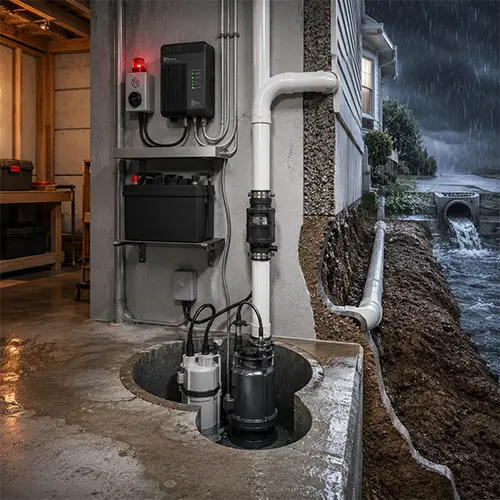
The best pump for basement flood control is not simply the biggest pump, the highest-horsepower pump, or the cheapest sump pump available online. The right basement flood control pump is the pump system that can remove water faster than it enters the basement, operate at the real discharge head, handle the actual water quality, start automatically, prevent backflow, and continue protecting the building when power fails or one pump stops working.
For homeowners, commercial building owners, hotel operators, shopping center managers, factory maintenance teams, property developers, underground parking garage contractors, and facility engineers, basement flooding is not only a water removal problem. It can damage electrical panels, elevator pits, HVAC equipment, boiler rooms, storage areas, finished interiors, tenant spaces, and critical building services. In many real projects, the failure is not caused by the pump alone. The common failure points are an undersized sump pit, wrong pump type, blocked float switch, missing check valve, restrictive discharge pipe, no high-water alarm, no backup power, or using a clean-water sump pump for sewage or muddy stormwater.
This guide explains how to choose the best basement flood control pump by water type, basement type, inflow rate, actual pump head, solids content, sump pit design, discharge piping, backup power, redundancy, installation quality, supplier documentation, commissioning checks, and long-term maintenance readiness.
Buyer Summary for Fast Decision-Making
Basement flood control buyers usually need a fast and practical answer before they compare pump models. For clean groundwater or rainwater seepage, a submersible sump pump is usually the starting point. For basement bathrooms or wastewater containing solids, a sewage pump is required. For muddy stormwater or driveway ramp runoff, a solids-handling drainage pump or dewatering pump should be reviewed. For commercial basements and underground parking garages, a duplex pump system is usually safer than one pump because flooding consequences are higher.
A basement pump should be selected by flow at actual head, not by horsepower alone. The complete system should include the sump pit, float switch or level sensor, check valve, discharge pipe, high-water alarm, backup power, and maintenance access.
| Basement Situation | Recommended Pump Direction | Main Risk If Selected Wrong |
|---|---|---|
| Clean rainwater seepage | Submersible sump pump | Pump too small during storm |
| Groundwater entering through foundation | Sump pump with perimeter drainage review | Water enters faster than pump capacity |
| Basement floor drain overflow | Submersible drainage pump / sewage pump review | Debris blocks impeller |
| Basement toilet or bathroom wastewater | Sewage pump | Clean-water pump cannot handle solids |
| Laundry or utility wastewater | Sewage pump or effluent pump | Fibers, lint, and light solids cause clogging |
| Driveway ramp stormwater | High-flow dewatering pump | Flooding during peak rainfall |
| Underground parking garage | Duplex or triplex submersible drainage system | Single-pump failure closes the garage |
| Commercial basement mechanical room | Duplex pump system with alarm | Equipment damage and business interruption |
| Muddy water with sand or debris | Solids-handling drainage pump | Clean-water pump clogs or overloads |
| Power outage during storm | Battery backup or generator-ready system | Pump stops when water rises fastest |
| Elevator pit drainage | Compact submersible drainage pump with alarm | Overflow can stop elevator operation |
A practical buying rule is simple: do not approve a basement flood control pump quotation unless the supplier explains water type, real head, flow at head, solids handling, sump pit size, switch type, check valve, discharge pipe, backup power, alarm strategy, and maintenance access.
Direct Answer: What Is the Best Pump for Basement Flood Control?
The best pump for basement flood control is usually a submersible sump pump for clean stormwater or groundwater, a sewage pump for wastewater containing solids, and a duplex submersible drainage pump system for commercial basements, underground garages, and high-risk properties. If basement flooding often happens during storms, the pump system should include backup power, a check valve, a high-water alarm, and enough discharge capacity at the real discharge head.
For most residential basements, a cast iron or stainless steel submersible sump pump with a reliable float switch, covered sump pit, check valve, and battery backup is a strong starting option. For basement bathrooms, laundry rooms, or sewage-containing water, a sewage pump is safer because it is designed with solids passage. For underground parking garages, commercial basements, and stormwater collection pits, a duplex system is usually more reliable because two pumps can alternate and provide emergency support if one pump fails.
| Pump Type | Best Used For | Not Suitable For | Buyer Must Check |
|---|---|---|---|
| Submersible sump pump | Clean groundwater, rainwater, residential basement seepage | Sewage, large solids, heavy mud | Flow at real head, pit size, switch reliability |
| Submersible sewage pump | Basement toilet, bathroom, wastewater with solids | Clean seepage where a sump pump is enough | Solids passage, sealed basin, venting |
| Grinder pump | Difficult sewage discharge with solids | Normal stormwater or clean groundwater | Cutter maintenance, application need |
| Dewatering pump | Rapid stormwater removal, temporary flood drainage, garage ramp | Permanent sewage duty | Flow, duty cycle, debris tolerance |
| Solids-handling drainage pump | Muddy water, sand, small debris | Clean-only applications where simpler pump is enough | Impeller type, solids passage, abrasion risk |
| Vertical sump pump | Shallow sump pits and accessible mechanical rooms | Deep compact pits or quiet residential spaces | Noise, footprint, service access |
| Battery backup sump pump | Residential outage protection | Main pump replacement for high inflow | Runtime, battery size, flow at head |
| Duplex pump system | Commercial basement, garage, mechanical room | Small low-risk basement where cost is priority | Control panel, alternation, alarm, pit volume |
If the basement drainage design is part of a wider building or industrial pumping system, buyers should not mix drainage duty with other pump duties. For broader facility pump planning, this factory pump selection guide can help separate drainage, wastewater, cooling water, process water, and fire protection pump responsibilities.
30-Second Basement Pump Selection Table
A 30-second selection table helps buyers quickly identify the right starting pump direction before deeper engineering review. This table does not replace site measurement, local plumbing code review, or contractor approval, but it helps prevent the most common mistake: selecting one generic pump for every basement water problem.
| Your Situation | Start With This Pump Direction | Check Before Buying |
|---|---|---|
| Clean water enters slowly through foundation | Submersible sump pump | Actual head, pit size, float switch, check valve |
| Finished residential basement | Sump pump + battery backup + alarm | Backup runtime, alarm test, discharge outlet |
| Basement floods during heavy storms | High-flow sump pump or dewatering pump | Peak inflow, pipe diameter, discharge route |
| Basement has toilet or bathroom | Sewage pump | Solids passage, sealed basin, venting |
| Basement laundry wastewater | Sewage or effluent pump | Lint, fibers, local code, basin design |
| Muddy water enters from ramp or yard | Solids-handling drainage pump | Sediment, impeller type, cleaning access |
| Underground parking garage | Duplex dewatering pump system | Large sump, alternation control, alarm, backup power |
| Commercial mechanical room | Duplex drainage system | Equipment value, alarm, control panel, maintenance access |
| Frequent power outage | Battery backup or generator-ready system | Runtime, power transfer, emergency operation |
| Elevator pit | Compact submersible drainage pump | Alarm, oil detection if required, code review |
The safest first step is not buying the pump. The safest first step is confirming water type, peak inflow, actual discharge head, solids content, pump pit volume, power reliability, and failure consequence.
Scope of This Guide: Applicable Basement Flood Control Pump Systems
Basement flood control pump selection should always begin with scope. A residential sump pit, commercial basement pump room, underground parking garage, basement bathroom, and elevator pit do not have the same risk level or pump requirement.
This guide is written for B2B buyers, property owners, contractors, facility managers, procurement teams, and engineers who need to understand pump selection logic before requesting quotations or approving a pump package. It does not replace local plumbing code review, civil drainage design, waterproofing design, electrical code review, or professional engineering approval.
Applicable Basement Applications
This guide applies to common basement flood control and emergency drainage applications where water must be automatically collected and discharged from a below-grade space.
Applicable applications include residential basement sump pits, commercial building basements, underground parking garages, basement mechanical rooms, elevator pits, stormwater collection pits, loading dock drainage, driveway ramp drainage, basement bathrooms, laundry rooms, groundwater seepage control, and emergency flood drainage.
The key principle is that the pump must match the water source. A pump used for clean foundation seepage may fail quickly if it is asked to handle sewage, sand, leaves, trash, oil, or muddy runoff.
Pump Types Covered
This guide covers the pump types most commonly reviewed for basement flood control and basement drainage systems.
Covered pump types include submersible sump pumps, submersible sewage pumps, submersible drainage pumps, submersible dewatering pumps, solids-handling pumps, grinder pumps, vertical sump pumps, battery backup sump pumps, duplex pump systems, control panels, and high-water alarm systems.
A sump pump is only one part of the system. The sump basin, discharge pipe, check valve, level control, alarm, and backup power plan often decide whether the basement remains dry during real storms.
Not Suitable Without Engineering Review
Some basement flood control situations involve higher risk and should not be solved by simply buying a pump online or comparing horsepower. Professional engineering review is required when flooding risk, building function, safety, or regulatory compliance is significant.
Professional review is strongly recommended for large municipal stormwater pump stations, basements below river flood level, chemical wastewater, hazardous liquid drainage, explosive gas environments, hospitals, data centers, underground metro or tunnel drainage, high-rise building basement systems, fire pump rooms, and projects connected to public stormwater or sewer systems.
If water contains chemicals, oils, corrosive liquids, or industrial wastewater, standard basement flood control pump logic may not apply. In those cases, pump material compatibility and liquid hazard classification must be reviewed separately.
Why Basement Flood Control Pump Selection Is Different from Normal Drainage
Basement flood control is different from ordinary drainage because the pump is expected to work during the worst conditions, not during average conditions. A small utility pump may remove water from a shallow puddle, but a basement flood control system must start automatically, keep up with peak inflow, prevent water from returning, and protect the building when nobody is watching.
Basement Flooding Happens Fast
Basement flooding can develop quickly because below-grade spaces collect water from multiple directions. Rainwater may enter through foundation walls, floor cracks, perimeter drains, floor drains, driveway ramps, window wells, loading docks, and storm sewer backflow.
A pump that works during a light rainfall may fail during peak stormwater inflow. This is why buyers should estimate the worst likely inflow, not the average seepage rate. A finished residential basement can suffer serious damage after only a few inches of water. A commercial basement may lose electrical equipment, inventory, tenant access, and operating time.
Basement Pumps Must Work When Conditions Are Worst
Basement sump pumps and drainage pumps often operate when conditions are unfavorable. Heavy rain can coincide with grid power failure, blocked outdoor drains, high municipal stormwater levels, muddy inflow, floating debris, and rising groundwater. These are exactly the conditions under which the pump must work reliably.
A reliable basement flood control system should answer whether the pump can remove water faster than water enters, whether it can operate at actual vertical lift and pipe loss, whether it can handle the real water quality, whether the float switch can move freely, whether discharge pipe capacity is enough, and what happens if power or one pump fails.
If these questions are not answered, the project does not have a complete flood control system. It only has a pump.
Pump Failure Causes Building Damage, Not Just Equipment Downtime
A failed basement pump can cause far more than equipment downtime. Floodwater can damage flooring, drywall, electrical panels, HVAC equipment, stored goods, elevator pits, control rooms, and foundation finishes. It can also create mold risk, business interruption, tenant complaints, insurance disputes, and emergency repair costs.
The lowest-cost pump is rarely the lowest-cost solution if it fails during the first major storm.
Common Causes of Basement Flooding Buyers Must Identify First
Basement pump selection should start by identifying where the water comes from. If the water source is misunderstood, the pump type, sump pit design, discharge route, and backup strategy may all be wrong.
Groundwater Seepage
Groundwater seepage usually enters through foundation cracks, floor joints, wall penetrations, or perimeter drainage systems. This water is usually cleaner than sewage but may contain fine sediment, mineral content, and small debris.
For groundwater seepage, a submersible sump pump installed in a sump pit is usually the starting option. The sump pit should collect water from perimeter drains or low points, and the pump should discharge water away from the foundation. If the discharge outlet sends water back near the building, the same water may return to the basement again.
Stormwater Backflow
Stormwater backflow can occur when municipal storm drains or combined sewer systems become overloaded. Water may enter through floor drains, drainage pipes, or low-level openings. A pump alone may not solve backflow if the discharge path is blocked by high outside water levels.
Buyers should review backflow prevention devices, check valves, discharge outlet elevation, municipal stormwater connection, emergency discharge route, and local code restrictions. A basement pump cannot overcome every backflow condition. In some projects, drainage redesign is required before pump selection.
Driveway or Garage Ramp Runoff
Driveway ramps and underground garage entrances can deliver water into basements very quickly during heavy rainfall. This is one of the most common reasons a small residential-style sump pump fails in commercial or parking applications.
Ramp drainage usually requires higher pump flow, larger collection pits, debris management, and often a duplex or triplex system. Leaves, sand, tire debris, and sediment can enter the pit, so a clean-water pump may clog or wear prematurely.
Basement Bathroom or Laundry Wastewater
Basement bathrooms and laundry rooms can introduce wastewater containing paper, fibers, soap, lint, hair, and small solids. This water should not be handled by a normal clean-water sump pump.
For basement toilet wastewater, a sewage pump or grinder pump may be required, depending on the system design and local code. A sealed basin, proper venting, discharge pipe, and backflow prevention are usually part of the system.
Sump Pit Overflow
Sump pit overflow often happens because the pump system is poorly matched to the inflow. The pump may be too small, the pit may be too small, the float switch may be set incorrectly, the check valve may leak, or the discharge pipe may be restricted.
The buyer should not assume that a larger motor automatically solves pit overflow. The whole system must be checked.
Basement Flood Control Pump Selection by Water Type
Basement flood control pump selection should be based first on water type. Clean water, muddy stormwater, wastewater, and sewage require different pump designs.
Clean Rainwater or Groundwater
Clean rainwater or groundwater is the most common application for a residential sump pump. The water may enter slowly through perimeter drains or quickly during storms. A submersible sump pump is often preferred because it sits inside the sump pit, saves floor space, operates automatically, and is quieter than many above-floor pump arrangements.
Good starting features include cast iron or stainless steel construction, submersible motor, reliable float switch, screened intake, check valve on discharge line, covered sump pit, high-water alarm, and battery backup where storms and outages are common.
Do not select a pump only by maximum flow at zero head. The important number is flow at the actual discharge head. If the pump must lift water 3–5 meters and push it through a long pipe with elbows and check valve loss, the real flow may be much lower than the catalog headline number.
For buyers comparing pit-mounted drainage against external pump layouts, this submersible vs surface pump guide can help clarify why submersible pumps are often preferred for basement pits and below-grade drainage.
Muddy Water with Sand or Small Debris
Muddy floodwater needs more clog resistance than clean groundwater. Stormwater from ramps, window wells, construction areas, or poorly filtered drains may carry sand, leaves, silt, small stones, or other debris.
In this case, a solids-handling submersible drainage pump is usually a better starting point than a clean-water sump pump. The pump may need a vortex or semi-open impeller, larger solids passage, abrasion-resistant materials, easy-clean intake design, sediment trap, larger sump basin, and routine cleaning plan.
A clean-water pump used in muddy water may clog, lose flow, overheat, trip overload protection, or suffer accelerated impeller wear.
Basement Sewage or Toilet Wastewater
Basement sewage requires a sewage pump, not a normal sump pump. Toilet wastewater may contain soft solids and paper. Laundry water may contain lint and fibers. Bathroom wastewater may contain hair and soap residue.
A sewage pump system may require a sealed sewage basin, proper venting, solids passage, correct discharge pipe, check valve, alarm, maintenance access, and local plumbing code compliance.
A grinder pump may be considered when discharge pipe diameter is limited or when solids must be macerated before discharge. However, grinder pumps add maintenance complexity and should not be used as a general replacement for clean stormwater pumping.
Stormwater from Underground Garage
Underground parking garages and loading docks require higher design caution because water inflow can be sudden and high. The pump may need to handle both rainwater volume and debris from vehicles, tires, leaves, sand, and road dust.
Recommended starting options include high-flow submersible drainage pumps, duplex or triplex pump systems, larger sump basins, sediment management, automatic alternation control, high-water alarms, and generator backup or emergency power review.
A single small pump is rarely a reliable solution for commercial underground parking areas. Redundancy matters because pump failure can shut down access, damage vehicles, and create safety issues.
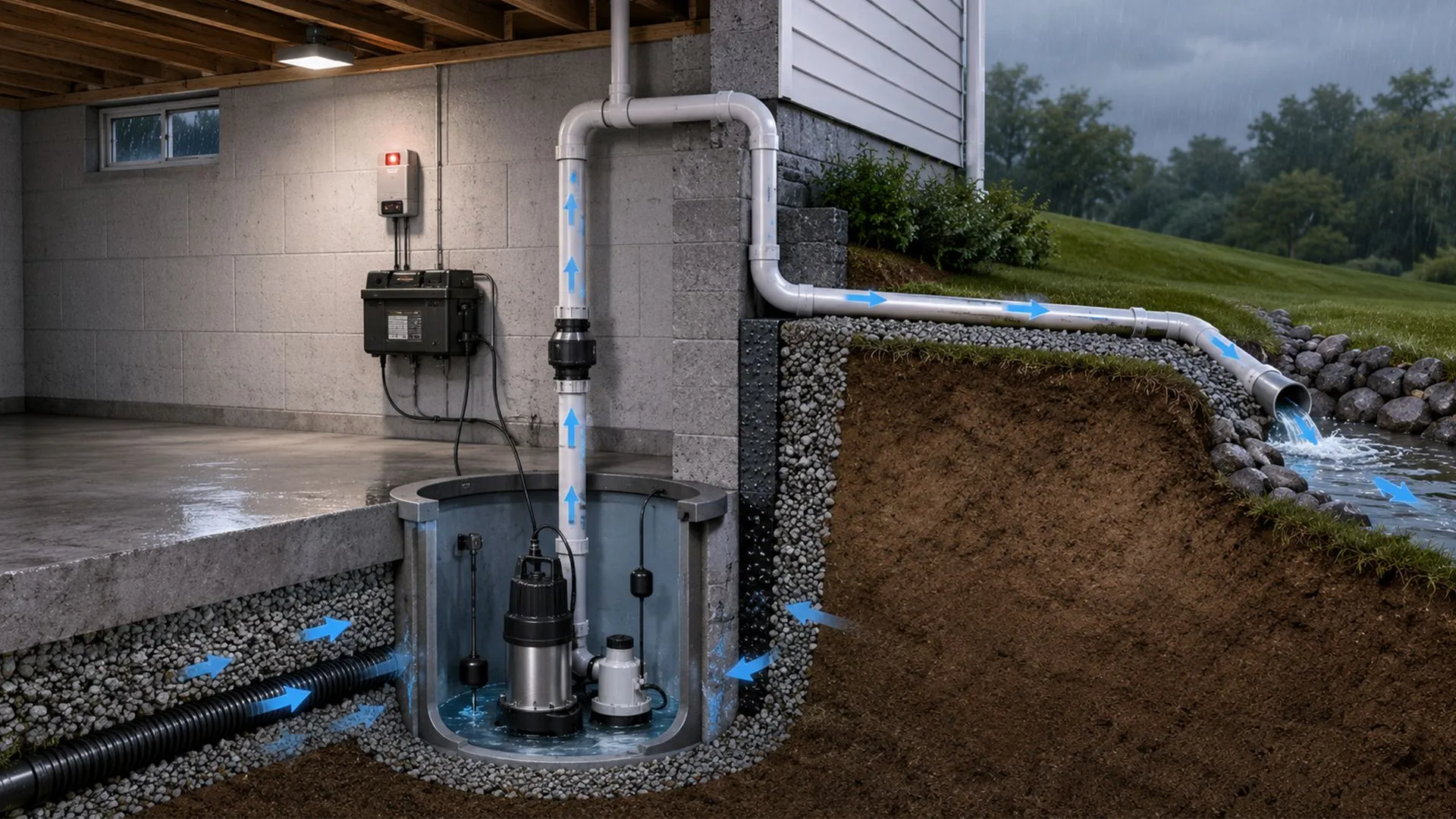
Best Pump by Basement Type
Basement type strongly affects pump selection because the consequence of flooding is different in a finished home, commercial basement, underground garage, elevator pit, or basement bathroom.
Best Pump for Residential Basements
Residential basement flood control usually starts with a submersible sump pump for clean groundwater or rainwater seepage. If the basement is finished, used for storage, or located in an area with frequent storms, a battery backup pump and high-water alarm are strongly recommended.
A good residential basement system usually includes a submersible sump pump, covered sump pit, float switch or electronic level control, check valve, discharge line away from foundation, battery backup pump, high-water alarm, and routine pre-storm testing.
The most common residential failure is not always pump capacity. It is often a stuck float switch, failed check valve, dead battery, or discharge pipe that sends water back toward the foundation.
Best Pump for Commercial Building Basements
Commercial basements need more reliability than typical residential basements because the cost of failure is higher. Mechanical rooms, electrical rooms, storage areas, and tenant spaces can all be affected by water.
A commercial basement often requires a duplex submersible drainage pump system, automatic alternation control, high-water alarm, control panel, larger sump pit, maintenance access, and emergency power review.
Duplex pumps allow alternating duty, which helps balance wear. They also provide emergency support if one pump fails or inflow temporarily exceeds one pump’s capacity.
Best Pump for Underground Parking Garages
Underground parking garage flood control should be designed for peak stormwater inflow, not only normal seepage. Water can enter rapidly through ramps, trench drains, and vehicle access points.
Recommended starting options include high-flow submersible dewatering pumps, duplex or triplex pump systems, solids-handling design, large collection basin, sediment trap, alarm and control panel, and emergency power connection.
The biggest risks are undersized pumps, clogged intakes, insufficient sump volume, and no backup power. In high-traffic buildings, garage flooding can stop business operations and create safety issues.
Best Pump for Basement Bathrooms
Basement bathroom drainage requires a sewage pump, not a clean-water sump pump. Toilet wastewater contains solids, and laundry or bathroom water may contain fibers, hair, soap, and debris.
A basement bathroom system should use a sewage pump, sealed basin, proper venting, check valve, correct discharge pipe, access cover, and alarm if failure consequence is high.
The buyer should confirm solids passage and local plumbing code requirements before selecting the pump.
Best Pump for Elevator Pits
Elevator pit drainage usually requires a compact submersible pump with reliable level control. In some locations, oil detection or special discharge requirements may apply because elevator pits can contain lubricants or contaminants.
Recommended features include compact submersible drainage pump, reliable float or level sensor, high-water alarm, maintenance access, oil detection if required, and code-compliant discharge route.
Elevator pit flooding can stop elevator operation, so alarm and maintenance access are especially important.
Reliability Level by Basement Risk
Basement flood control reliability should match the consequence of failure. A low-risk unfinished residential basement does not need the same pump system as an underground parking garage or commercial mechanical room.
The table below helps buyers decide whether a single pump, backup pump, duplex system, or emergency power strategy is justified.
| Basement Type | Failure Consequence | Recommended Reliability Level |
|---|---|---|
| Unfinished residential basement | Low to medium | Single sump pump + check valve + alarm |
| Finished residential basement | Medium to high | Sump pump + battery backup + high-water alarm |
| Basement with frequent outages | High | Main pump + backup pump + battery or generator review |
| Basement bathroom | Medium to high | Sewage pump + sealed basin + alarm |
| Commercial mechanical room | High | Duplex drainage pump + control panel + alarm |
| Underground parking garage | High | Duplex/triplex dewatering system + sediment management |
| Hotel or shopping center basement | High | Duplex system + remote alarm + maintenance plan |
| Data center or critical facility basement | Very high | Redundant pumps + backup power + remote monitoring |
| Factory basement or utility trench | Medium to high | Solids-handling pump + duty/standby review |
For commercial building owners comparing drainage, domestic water, HVAC, and fire protection pumps, this shopping center pump system guide shows how different building pump duties should be separated instead of specified as one generic pump type.
Pump Type Comparison for Basement Flood Control
Pump type comparison helps buyers avoid one of the most common mistakes: using one pump name for every basement water problem. A sump pump, sewage pump, grinder pump, dewatering pump, backup pump, and duplex system solve different problems.
| Pump Type | Main Function | Best Scenario | Key Limitation |
|---|---|---|---|
| Sump pump | Clean water drainage | Residential basement seepage | Not for sewage solids |
| Sewage pump | Wastewater with solids | Basement bathroom | Needs sealed basin and venting |
| Grinder pump | Cuts sewage solids | Difficult sewage discharge | Higher maintenance cost |
| Dewatering pump | Rapid water removal | Storm flood, garage ramp, construction water | Not ideal for permanent sewage duty |
| Solids-handling drainage pump | Muddy water and small debris | Ramp drainage, stormwater pits | Must still manage sediment |
| Battery backup pump | Emergency pumping during outage | Finished residential basement | Runtime and flow are limited |
| Duplex pump system | Redundancy and higher reliability | Commercial basement, underground garage | Higher upfront cost |
| Vertical sump pump | Above-pit motor arrangement | Shallow mechanical room pits | More noise and space impact |
For procurement, the important question is not “which pump is stronger?” It is “which pump matches the water, head, inflow rate, pit design, and failure consequence?”
How to Size a Basement Flood Control Pump
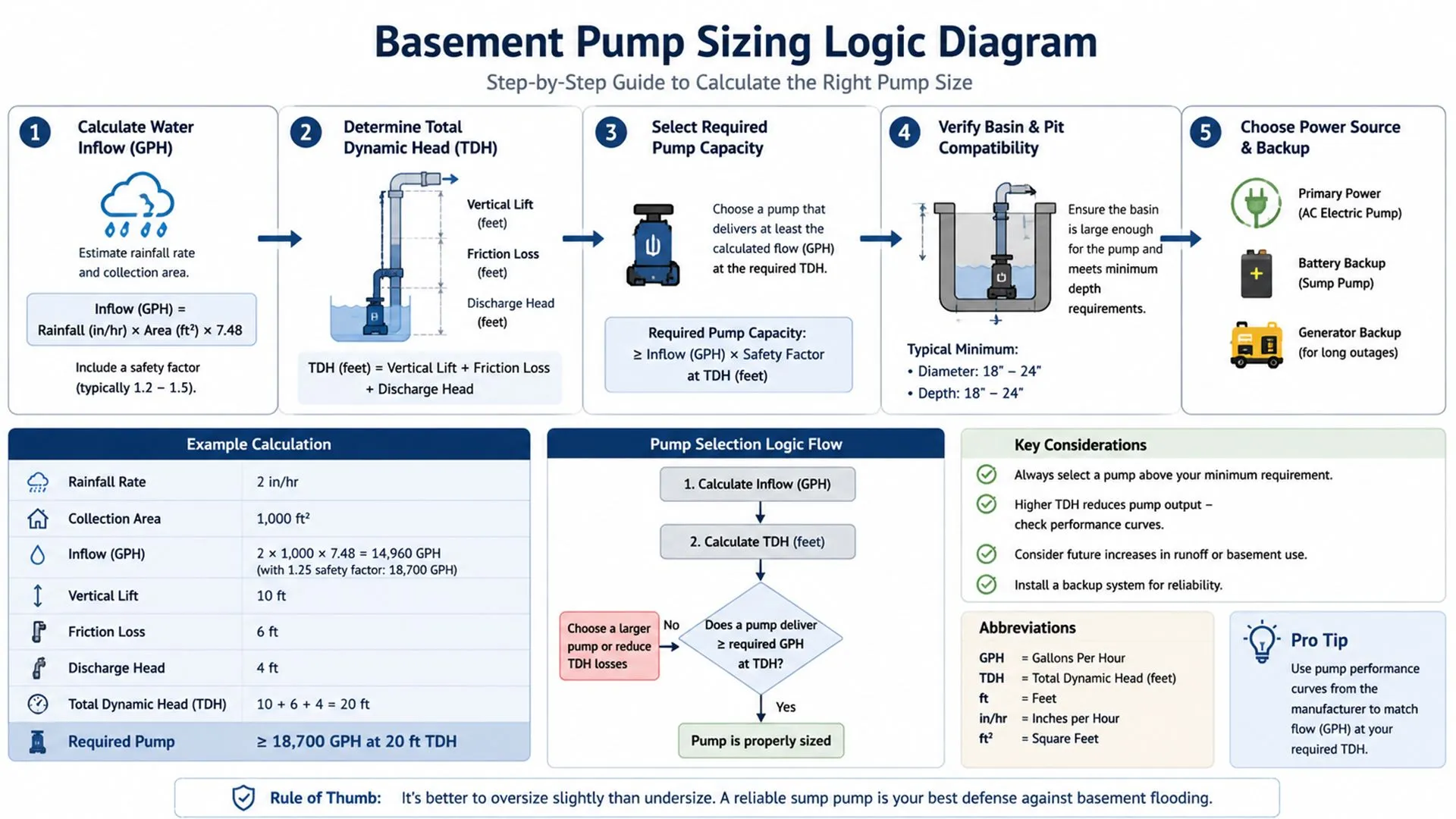
Basement flood pump sizing should combine inflow rate, pump head, pipe loss, water quality, pit size, and backup requirement. A pump that looks large on paper can still fail if the actual discharge head is high or the discharge pipe is restrictive.
Step 1: Estimate Peak Water Inflow
Peak water inflow is the first sizing reference. Buyers should estimate how quickly water enters during heavy rain, not how much water appears on normal days.
Practical ways to estimate inflow include measuring sump pit water rise per minute during a storm, reviewing past flood depth and time, checking driveway ramp catchment area, checking number of perimeter drain inlets, reviewing roof and yard drainage, and asking contractors for design inflow if available.
For commercial basements and underground garages, inflow estimation should be reviewed by drainage professionals because large paved areas can deliver stormwater into pits very quickly.
Step 2: Confirm Required Pump Head
Pump head means the total energy the pump must provide to move water from the sump pit to the discharge point. It is not only the basement depth.
Total head includes vertical lift from pump to discharge outlet, pipe friction loss, elbow and fitting loss, check valve loss, long pipe run loss, discharge elevation difference, and possible backpressure at outlet.
A common buying mistake is selecting by maximum flow without checking the pump curve at actual head. A pump may advertise high flow at zero head but deliver much less at the actual building condition.
Step 3: Check Solids Size and Water Quality
Water quality decides impeller type and solids passage. Clean groundwater can use a sump pump. Muddy stormwater needs better clog resistance. Basement sewage needs a sewage pump or grinder pump.
Check whether water contains sand, silt, leaves, small stones, paper, fibers, hair, sewage solids, oil, grease, or chemical contamination.
If liquid contains corrosive or chemically aggressive water, pump material selection becomes more important. In those cases, this pump corrosion troubleshooting guide can help buyers understand how water chemistry affects pump material life.
Step 4: Match Pump Flow at Real Head
The pump must remove water faster than the inflow at the actual operating head. Buyers should ask suppliers for a pump curve and confirm the flow at the estimated total head.
Ask the supplier what the flow is at the actual head, what happens if pipe length increases, what pipe diameter is recommended, what solids size the pump can pass, what duty cycle the pump supports, whether frequent starts are acceptable, and whether the pump is designed for automatic sump operation.
The best pump for basement flood control is not necessarily the largest pump. It is the pump that performs reliably at the real operating point.
Step 5: Check Sump Pit Size
Sump pit size affects pump cycling and flood buffer. A small pit may cause frequent starts and stops, which can shorten motor and switch life. A larger pit gives the pump more working volume and more time before overflow.
Check pit diameter, pit depth, pump footprint, float switch movement, backup pump space, sediment accumulation, lid access, inlet pipe height, and high-water alarm location.
If the pump is too large for the pit, it may short-cycle. If the pit is too small for the inflow, water may overflow before the pump can respond.
Step 6: Confirm Power and Backup
Power reliability is one of the most important basement flood control issues because storms often cause both flooding and power outages. A pump that depends entirely on grid power may stop when water is entering fastest.
Backup options include battery backup sump pumps, generator-ready pump circuits, duplex pump systems with emergency power, alarms with remote notification, and manual emergency pump plans.
Residential users often choose battery backup. Commercial and industrial basements may require generator connection or a more robust duplex/triplex system.
Step 7: Review Discharge Pipe and Check Valve
Discharge piping can limit real pump performance. A pipe that is too small, too long, frozen, blocked, or poorly routed can reduce flow and cause repeated flooding.
Buyers should check pipe diameter, pipe length, number of elbows, check valve quality, outdoor discharge location, freeze protection, backflow risk, and whether water returns toward the foundation.
A check valve prevents water in the discharge pipe from flowing back into the sump pit after the pump stops. Without it, the pump may cycle repeatedly and lose effective capacity.
Simple Basement Pump Sizing Example
A simple sizing example helps buyers understand why pump curve, head, and pipe loss matter more than horsepower alone. This is not a replacement for engineering design, but it shows the correct decision logic.
Assume a finished residential basement has the following conditions:
| Item | Example Value |
|---|---|
| Peak stormwater inflow | 80 L/min |
| Vertical lift from pit to outlet | 3 m |
| Discharge pipe length | 15 m |
| Pipe diameter | 1.5 inch |
| Check valve and elbows | Moderate loss |
| Estimated total head | About 4–5 m |
| Water type | Mostly clean groundwater / rainwater |
| Basement risk | Finished basement with stored goods |
| Power outage risk | Occasional storm outage |
In this case, the buyer should not select a pump only because the catalog says “maximum flow 250 L/min.” That maximum flow is often measured at very low or zero head. The important question is: how much water can the pump discharge at 4–5 m total head?
A safer starting target may be a pump that can deliver at least 120–150 L/min at the expected operating head, giving margin above the estimated 80 L/min inflow. Because the basement is finished and storms may cause outages, the system should also include a battery backup sump pump, high-water alarm, check valve, and discharge outlet located away from the foundation.
For a commercial basement or underground parking garage, this simplified example is not enough. Larger inflow, sediment, ramp catchment, longer pipe runs, and pump redundancy must be reviewed by a drainage professional.
Submersible Sump Pump vs Sewage Pump vs Dewatering Pump
Submersible sump pumps, sewage pumps, and dewatering pumps are often confused because all can move water. The correct choice depends on whether the water is clean, dirty, sewage-containing, or entering very quickly.
When to Choose a Submersible Sump Pump
Choose a submersible sump pump when the basement water is mostly clean groundwater or rainwater. It is usually installed inside a sump basin and starts automatically when water reaches a certain level.
A sump pump is suitable for residential basement seepage, clean stormwater collection, foundation drain water, small commercial sump pits, and finished basement protection.
Main advantages include quiet operation, compact installation, automatic start, and lower space impact. Do not choose a standard sump pump for sewage, heavy mud, sand-loaded water, or industrial wastewater.
When to Choose a Sewage Pump
Choose a sewage pump when the water contains toilet wastewater, soft solids, paper, or similar waste. Basement bathrooms, laundry discharge systems, and below-grade wastewater collection usually need sewage handling rather than clean-water drainage.
A sewage pump is suitable for basement toilet discharge, basement bathroom wastewater, laundry and utility wastewater where solids or fibers exist, and sewage ejector basin systems.
Buyer checks include solids passage, sealed basin, venting, check valve, discharge size, and local code compliance.
When to Choose a Dewatering Pump
Choose a dewatering pump when water must be removed quickly from temporary or high-inflow situations. Dewatering pumps are often used for stormwater, construction pits, emergency flooding, and underground garage ramps.
A dewatering pump is suitable for rapid stormwater removal, underground garage ramp drainage, temporary basement flood removal, construction water removal, and large inflow emergencies.
However, dewatering pumps may not be suitable for permanent sewage duty or unattended basement protection unless properly designed for automatic operation.
When NOT to Use Each Pump
The wrong pump type can create more risk than no pump at all because it gives the owner a false sense of protection.
| Situation | Do Not Use | Why |
|---|---|---|
| Basement toilet wastewater | Clean-water sump pump | Cannot reliably handle sewage solids |
| Clean seepage only | Grinder pump | Higher cost and maintenance than needed |
| Long-term automatic basement protection | Portable utility pump | Not designed for permanent sump duty |
| Commercial basement | Single small residential pump | No redundancy and limited capacity |
| Frequent outage area | Electric-only pump | Stops during storm power failure |
| Muddy ramp water | Small clean-water sump pump | Clogs and loses capacity |
| Small shallow sump pit | Oversized pump | Short cycling and switch wear |
The safest selection starts with water type, then flow, head, pit size, and failure consequence.
Electric Pump, Battery Backup, or Generator Backup?
Backup power is one of the most important basement flood control decisions. Many basement floods happen during storms, and storms often cause power interruptions.
Electric-Only Pump
An electric-only sump pump can be acceptable for low-risk basements where power is reliable, water inflow is moderate, and the basement does not contain high-value finishes or critical equipment.
Electric-only systems may be acceptable when flooding risk is low, power outages are rare, the basement is unfinished, water inflow is slow, the owner can respond quickly, and an alarm is installed.
However, electric-only protection is risky where storm outages are common.
Battery Backup Pump
A battery backup sump pump is a strong option for residential basements where flooding occurs during storms. It provides temporary pumping when the main electric pump loses power.
Buyers should check battery runtime, flow at actual head, charger quality, alarm function, battery replacement interval, and whether the backup pump has a separate discharge or shared discharge.
Battery backup pumps are not a full replacement for a main pump. They are emergency support for limited duration.
Generator-Ready Pump System
A generator-ready system is often more suitable for commercial basements, factories, underground garages, and properties where long outages are possible. The pump circuit, control panel, and facility electrical system should be reviewed before relying on generator backup.
Generator backup can support higher pump capacity than many battery systems, but it requires planning, fuel, transfer arrangements, and testing.
Duplex Pump System with Backup Power
A duplex pump system with backup power provides stronger protection for high-risk basements. Two pumps can alternate during normal operation and support higher inflow or pump failure events.
This option is often suitable for underground parking garages, commercial basements, mechanical rooms, hotels, shopping centers, factories, high-value finished basements, and critical utility rooms.
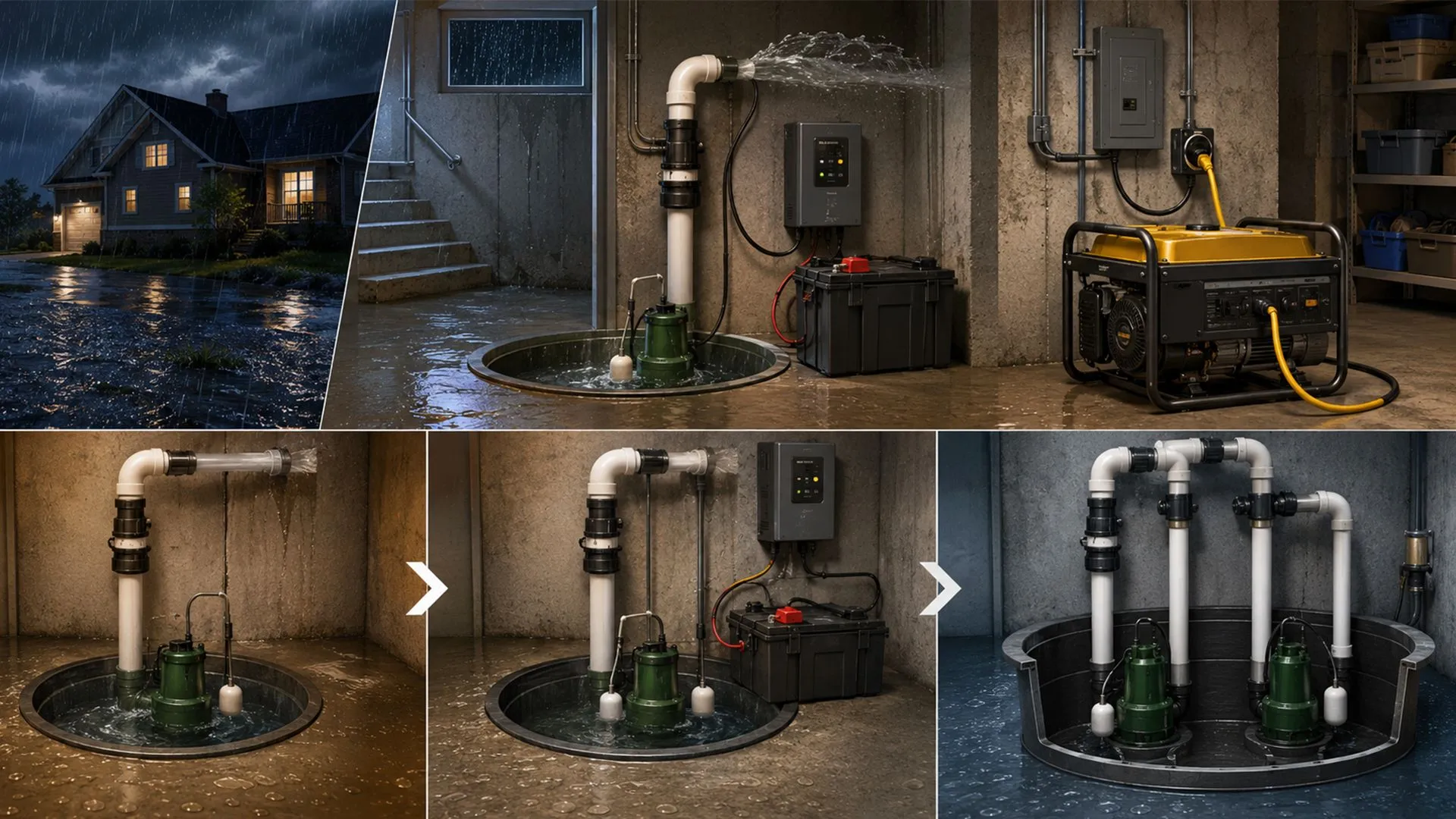
Key Components of a Reliable Basement Flood Control System
A reliable basement flood control system is built from several components that must work together. Even a good pump can fail if the basin, switch, valve, discharge pipe, alarm, or backup power is poorly selected.
Sump Pit
The sump pit collects water before the pump discharges it. Its size affects pump cycling, response time, and sediment accumulation.
A good sump pit should provide enough diameter for the pump and backup pump, enough depth for useful water volume, space for float switch movement, a stable base, cover or lid, access for cleaning, sediment control, and proper inlet location.
If the pit is too small, the pump may start too frequently and wear out faster.
Float Switch or Level Sensor
The float switch or level sensor tells the pump when to start and stop. It is a common failure point because it can be blocked by the pit wall, pump cable, debris, or a backup pump.
Buyers should check whether the switch has enough free movement. Commercial systems may use more robust level sensors or control panels to reduce failure risk.
Check Valve
The check valve prevents discharged water from flowing back into the sump pit after the pump stops. Without a check valve, water in the pipe can return to the pit and force the pump to start repeatedly.
A failed check valve can cause short cycling, reduced effective capacity, repeated pump starts, water hammer noise, and faster switch or motor wear.
Discharge Pipe
The discharge pipe carries water away from the basement. It must be sized correctly and routed to a safe discharge point.
Important checks include pipe diameter, pipe length, number of elbows, check valve location, freeze risk, outdoor discharge slope, outlet distance from foundation, and backflow risk.
A strong pump connected to a restrictive pipe may behave like a weak pump.
High-Water Alarm
A high-water alarm warns the owner before water reaches the basement floor. It is especially important for finished basements, commercial basements, mechanical rooms, and underground garages.
Alarm options include local audible alarm, visual alarm, control panel alarm, remote notification, and building management system connection.
The alarm should be positioned above normal pump start level but below overflow level.
Control Panel
A control panel is important for duplex and commercial systems. It can manage pump alternation, high-level alarm, overload indication, manual operation, and fault signals.
A control panel should be considered when two pumps are installed, the basement is commercial, remote alarm is needed, maintenance records are required, or pump failure consequence is high.
Backup Power
Backup power keeps the drainage system working when grid power fails. For residential basements, this may be a battery backup. For commercial basements, it may require generator support or emergency power planning.
Backup power should be tested before storm season. A backup system that is never tested may not work when needed.
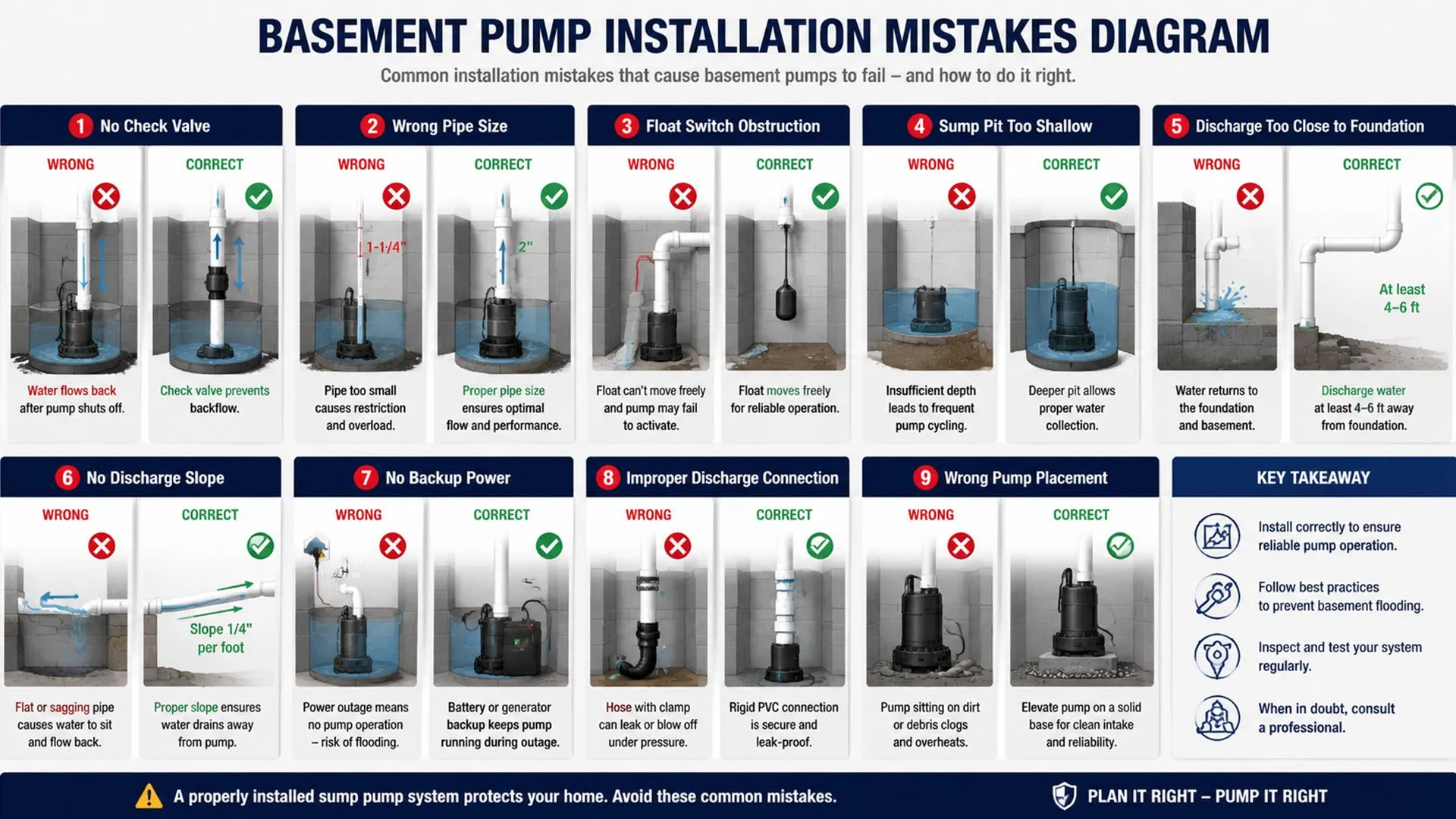
Installation Mistakes That Cause Basement Pumps to Fail
Basement pump installation mistakes often create repeat flooding even when the pump itself is good. Buyers should review installation quality before blaming the pump brand.
Wrong Pump for Water Type
A clean-water sump pump used for sewage, muddy water, or sand-loaded stormwater may clog quickly. The pump may run but fail to move water, trip thermal protection, or suffer impeller damage.
The solution is to match pump type to water type before purchase.
No Check Valve
Without a check valve, water in the discharge pipe falls back into the sump pit after the pump stops. This makes the pump run more often and reduces the effective emptying volume.
A missing or failed check valve is one of the simplest causes of repeated cycling.
Discharge Pipe Too Small
A small discharge pipe increases friction loss and reduces real pump flow. It can make a pump that looks large on paper perform poorly in the building.
The supplier should recommend pipe size based on expected flow and pipe length.
Float Switch Blocked
A blocked float switch can prevent the pump from starting. This may happen when the float touches the pit wall, gets tangled with a cable, or is obstructed by debris.
The float should move freely through its full range.
Sump Pit Too Small
A small sump pit causes short cycling and gives little buffer during high inflow. It may also leave insufficient room for a backup pump and alarm.
A properly sized pit improves reliability and service life.
No Backup Power
No backup power means no pumping during power outage. In storm-prone areas, this is one of the highest-risk design gaps.
Backup planning should match the value of the basement and the expected outage duration.
Poor Maintenance Access
A pump that cannot be inspected, cleaned, or removed easily will likely be neglected. Poor access increases downtime and emergency repair cost.
Installation should allow pump removal, float inspection, pit cleaning, and check valve replacement.
Installation Acceptance Checklist Before Handover
A basement flood control pump should be tested before the contractor leaves the site. Many systems fail because they were installed but never checked under realistic conditions.
| Acceptance Check | What to Verify | Why It Matters |
|---|---|---|
| Pump starts automatically | Raise water level or test level sensor | Confirms automatic operation |
| Float switch movement | Float moves freely without hitting pit wall or cable | Prevents no-start failure |
| Check valve direction | Valve installed in correct flow direction | Prevents backflow |
| Discharge pipe | Correct diameter, secure joints, no blockage | Protects real pump flow |
| Outdoor discharge point | Water drains away from foundation | Prevents water returning |
| Alarm test | High-water alarm activates before overflow | Gives early warning |
| Backup power | Battery or generator backup starts correctly | Protects during outage |
| Pump curve match | Flow at actual head meets requirement | Confirms real performance |
| Pit cleanliness | No sediment or construction debris | Prevents clogging |
| Duplex control | Pump alternation and second-pump start verified | Confirms redundancy |
| Access clearance | Pump can be removed and serviced | Supports maintenance |
| Documentation | Curve, manual, wiring, maintenance guide received | Supports ownership |
A pump that has not been tested after installation should not be considered ready for storm season.
Best Basement Flood Control Pump by Scenario
The best basement pump option changes by water source, flooding frequency, water quality, basement value, and backup requirement. This scenario table can help buyers prepare an internal decision before requesting quotations.
| Scenario | Best Starting Option | Why |
|---|---|---|
| Occasional minor seepage | Submersible sump pump | Handles clean water automatically |
| Finished residential basement | Sump pump + battery backup + alarm | Reduces damage risk during outage |
| Frequent storm flooding | High-flow sump or dewatering pump | Handles faster inflow |
| Basement bathroom | Sewage pump | Handles wastewater solids |
| Laundry wastewater | Sewage or effluent pump | Handles fibers and light solids |
| Underground garage | Duplex dewatering pump system | Higher flow and redundancy |
| Commercial basement | Duplex submersible drainage system | Reduces single-pump failure risk |
| Muddy floodwater | Solids-handling drainage pump | Better clog resistance |
| Elevator pit | Compact submersible drainage pump with alarm | Protects elevator operation |
| Critical facility | Duplex/triplex pump + backup power | Higher reliability requirement |
A pump quotation should be considered incomplete if it does not clearly state pump type, flow at head, solids passage, voltage, switch type, discharge size, and recommended installation conditions.
When NOT to Choose a Basement Pump
Knowing when not to choose a pump protects buyers from expensive mistakes. Many basement flood control failures come from using the wrong pump in the wrong application.
Do Not Choose by Horsepower Alone
Horsepower does not tell you how much water the pump will move at your actual building condition. A lower-horsepower pump with a better curve at your required head may outperform a larger pump that is poorly matched.
Buyers should ask for flow at actual head, not only motor power.
Do Not Choose a Clean-Water Pump for Sewage
A clean-water sump pump should not be used for basement toilet wastewater or sewage. It is not designed for solids passage and may clog or fail.
Use a sewage pump or grinder pump when wastewater contains solids.
Do Not Use a Portable Pump as Permanent Protection
Portable utility pumps are useful for emergency cleanup, but they are not ideal as permanent basement flood protection. They may lack automatic level control, proper sump installation, continuous readiness, and reliable discharge arrangement.
Permanent protection needs an automatic sump or drainage system.
Do Not Ignore Backup Power
Ignoring backup power is risky if flooding occurs during storms. Power outage can stop the pump exactly when water inflow is highest.
Finished basements, commercial basements, and underground garages should review backup power seriously.
Do Not Oversize Without Checking Pit Size
An oversized pump in a small pit may short-cycle. Short cycling increases wear on the motor, switch, check valve, and electrical components.
Pump size must match pit volume and control settings.
Basement Flood Control Pump Troubleshooting Guide
Basement pump troubleshooting should follow cause-and-effect logic. The goal is not only to restart the pump but to understand why the system failed.
Pump Does Not Start
A pump that does not start may have a power, switch, control, wiring, motor, or backup system issue. Start with simple checks before removing the pump.
Possible causes include power failure, tripped breaker, stuck float switch, control panel fault, motor overload, depleted battery backup, loose wiring, failed pump motor, or debris blocking the impeller.
Check power first. Then lift or test the float switch if safe. Check the alarm, control panel, battery backup, and breaker. If the pump hums but does not move water, disconnect power and inspect for clogging or mechanical blockage.
Pump Runs But Water Does Not Discharge
A pump that runs without discharging water may be clogged, air locked, blocked, incorrectly piped, or operating beyond its head capacity.
Possible causes include clogged intake, blocked discharge pipe, failed check valve, air lock, broken impeller, wrong pump head, frozen outdoor discharge, closed valve, or disconnected pipe.
Check whether water exits the discharge outlet. Inspect the check valve direction, discharge pipe blockage, and pump intake. Compare actual vertical lift with pump capability.
Pump Starts Too Often
A pump that starts too often may have a pit, valve, inflow, switch, or backflow issue. Frequent cycling shortens pump life.
Possible causes include small sump pit, leaking check valve, high groundwater inflow, narrow float differential, discharge water returning to the foundation, pipe backflow, or constantly high water table.
Check whether water returns after the pump stops. Inspect the check valve. Review sump pit size and float setting. Confirm that the outdoor discharge point does not send water back toward the building.
Pump Runs Continuously
A continuously running pump may be undersized, overwhelmed, stuck, or unable to discharge properly.
Possible causes include undersized pump, water inflow exceeding capacity, float switch stuck in the on position, blocked discharge, wrong outlet location, pump wear, excessive head, or incorrectly installed check valve.
Check water level while the pump runs. If water level does not fall, inspect discharge pipe, pump curve, and inflow rate. If the water level falls but pump does not stop, check the float switch.
Basement Still Floods Even When Pump Runs
A basement can still flood even when the pump runs if real inflow exceeds real discharge capacity.
Possible causes include pump flow too small at actual head, multiple water sources entering, undersized discharge pipe, storm sewer backflow, power interruption, pump overwhelmed by peak rainfall, small pit, blocked outdoor discharge, or float starting too late.
Measure how quickly water rises and how quickly it falls when the pump runs. Check discharge outlet and pump curve. Review whether a second pump, larger pit, improved drainage, or backup power is needed.
Supplier Verification Checklist for Basement Flood Control Pumps
A reliable supplier should provide data that allows the buyer to verify whether the pump fits the real basement condition. A simple price and horsepower number are not enough.
| Supplier Data | Why It Matters |
|---|---|
| Pump curve | Confirms flow at real head |
| Motor power and voltage | Confirms electrical compatibility |
| Flow at specified head | Shows real drainage performance |
| Solids passage | Confirms suitability for debris or sewage |
| Pump material | Affects corrosion and durability |
| Seal design | Affects leakage and lifespan |
| Impeller type | Affects clogging and solids handling |
| Float switch type | Affects automatic start reliability |
| Check valve recommendation | Prevents backflow |
| Control panel option | Needed for duplex systems |
| Alarm option | Improves early warning |
| Backup power option | Reduces outage risk |
| Installation drawing | Reduces installation mistakes |
| Maintenance manual | Supports long-term reliability |
| Warranty and spare parts | Reduces downtime risk |
A professional supplier should ask about basement type, water type, inflow, head, pipe length, solids, power supply, pit size, and backup requirement before recommending a model.
Red Flags When a Supplier Recommends a Basement Flood Control Pump
Supplier red flags help buyers avoid low-quality quotations that look cheap but fail in real use. A basement pump supplier should ask technical questions before recommending a model.
Reject or revise the quotation if the supplier does not ask what type of water is being pumped, does not ask actual vertical lift or discharge distance, does not provide a pump curve, quotes only by horsepower, does not ask whether water contains solids, sand, mud, or sewage, does not discuss sump pit size, does not mention float switch or level control, does not recommend a check valve, does not discuss backup power for storm outage risk, does not ask whether the basement is residential, commercial, or critical, does not provide installation guidance, treats a clean-water sump pump as suitable for basement sewage, treats a portable utility pump as permanent flood protection, or does not provide maintenance instructions.
A professional quotation should make the buyer more confident, not more confused.
RFQ Template for Basement Flood Control Pump Buyers
A complete RFQ helps suppliers quote the correct basement flood control pump. A vague request such as “quote one basement pump” usually produces incomplete or mismatched proposals.
| RFQ Item | Information to Provide |
|---|---|
| Basement type | Residential, commercial, garage, bathroom, elevator pit |
| Water type | Clean water, muddy water, sewage, stormwater |
| Estimated inflow | Slow seepage or rapid stormwater |
| Required vertical lift | Distance from pit to outlet |
| Pipe length | Total discharge pipe length |
| Pipe diameter | Existing or planned pipe size |
| Sump pit size | Diameter and depth |
| Power supply | Voltage and phase |
| Backup requirement | Battery, generator, duplex |
| Solids content | Sand, debris, sewage solids |
| Duty requirement | Occasional, frequent, continuous |
| Alarm requirement | Local alarm or remote monitoring |
| Installation space | Pit and service access |
| Discharge location | Storm drain, outdoor outlet, permitted sewer point |
| Required documents | Curve, drawing, manual, warranty |
If the buyer does not know inflow or head, the quotation should be treated as preliminary. Final pump selection should wait until site conditions are confirmed.
Local Code, Safety, and Discharge Boundary Notes
Basement flood control pump selection must respect local plumbing, electrical, building, environmental, and stormwater discharge rules. A pump that works mechanically may still be unacceptable if it discharges to the wrong location or violates local requirements.
Buyers should confirm whether stormwater can discharge to the proposed outlet, whether sewage requires a sealed basin and venting, whether backflow prevention is required, whether electrical connections require GFCI or specific protection, whether elevator pit discharge has oil detection requirements, whether basement bathroom wastewater must connect to sanitary sewer, whether pump alarm signals must connect to a building management system, and whether commercial garages require sediment or oil separation before discharge.
For residential projects, the contractor should verify local plumbing and drainage rules. For commercial projects, the engineer or facility consultant should confirm code compliance before procurement.
Maintenance Checklist for Basement Flood Control Pumps
Basement flood control pumps must be maintained before storm season, not after flooding occurs. Many failures are preventable with simple routine checks.
| Maintenance Item | Recommended Check |
|---|---|
| Sump pit | Remove sediment and debris |
| Float switch | Confirm free movement |
| Pump intake | Check clogging |
| Check valve | Confirm no backflow |
| Discharge pipe | Check blockage and freezing risk |
| Alarm | Test high-water alarm |
| Battery backup | Check battery condition and charger |
| Control panel | Check fault signals |
| Pump operation | Test before rainy season |
| Outdoor outlet | Confirm water drains away from foundation |
| Spare pump | Prepare for high-risk sites |
| Maintenance record | Keep inspection dates and issues |
A basement pump should not be treated as “installed and forgotten.” If the pump has not been tested before the rainy season, the owner does not know whether the system is ready.
FAQ About Basement Flood Control Pumps
Basement flood control buyers usually ask practical questions about sump pump type, sewage pump use, pump sizing, backup power, frequent cycling, and why flooding continues even when a pump is installed. These answers are written for buyer-side decision-making before final contractor or engineering review.
What is the best pump for basement flood control?
The best pump for basement flood control is usually a submersible sump pump for clean groundwater or rainwater, a sewage pump for basement wastewater with solids, and a duplex submersible drainage system for commercial basements or underground parking garages. The correct choice depends on water type, inflow rate, actual head, sump pit size, discharge pipe, power reliability, and backup requirement.
Is a sump pump enough for basement flooding?
A sump pump may be enough for minor clean groundwater seepage or moderate rainwater collection. It may not be enough for rapid stormwater inflow, driveway ramp runoff, sewage, muddy water, commercial basements, or areas with frequent power outages. In higher-risk basements, a backup pump, alarm, larger pit, or duplex system should be reviewed.
What size pump do I need for basement flood control?
The pump size should be based on peak inflow, actual vertical lift, pipe friction loss, water quality, solids content, sump pit size, and backup requirement. Do not choose only by horsepower. Ask for pump flow at the real total head because that number shows how much water the pump can actually remove in your basement.
Can I use a sewage pump instead of a sump pump?
A sewage pump can handle wastewater with solids, but it is not always necessary for clean groundwater or rainwater seepage. For clean basement water, a sump pump may be simpler and more cost-effective. For basement toilets, bathrooms, laundry wastewater, or sewage-containing water, a sewage pump is usually the correct starting point.
Do I need a battery backup sump pump?
You need a battery backup sump pump if basement flooding is likely during storms and power outage is possible. Battery backup is especially important for finished basements, stored goods, residential living space, and areas with frequent outages. For commercial basements or underground garages, generator backup or duplex systems may be more suitable than a small battery backup alone.
Why does my basement pump run all the time?
A basement pump may run continuously because water inflow is too high, the pump is undersized, the float switch is stuck, the discharge pipe is blocked, the check valve is installed incorrectly, or the discharge outlet sends water back toward the foundation. Continuous running should be investigated because it can lead to motor overheating and pump failure.
Why does my basement still flood even with a pump?
A basement may still flood because the pump flow is too small at the actual head, the sump pit is too small, the float switch starts too late, the discharge pipe is restricted, power failed, the water source is larger than expected, or stormwater enters from multiple paths. The solution may require a larger system, second pump, better drainage, check valve correction, or backup power.
What is better for a commercial basement: one large pump or two pumps?
A duplex pump system is usually better for a commercial basement because it provides redundancy and can alternate operation between pumps. One large pump may still leave the building unprotected if it fails. Two pumps with a control panel, alarm, and backup power review provide stronger flood control reliability.
Can a basement flood pump handle mud and sand?
A standard clean-water sump pump is not ideal for muddy water with sand. Muddy water should use a solids-handling drainage pump or dewatering pump designed for debris tolerance. The pit should also include sediment management and a cleaning plan because even solids-handling pumps can suffer wear if sediment is excessive.
Where should the discharge pipe send the water?
The discharge pipe should send water to a legal and safe drainage point away from the foundation. It should not discharge water where it can flow back into the basement, freeze near the outlet, create erosion, or violate local drainage rules. The outlet location is part of the flood control system, not an afterthought.
Should I choose a battery backup pump or a generator backup pump system?
Choose a battery backup pump for short-term residential outage protection where inflow is moderate. Choose a generator-ready system or duplex pump system with emergency power review for commercial basements, underground garages, high-inflow stormwater pits, or long outage risk. Battery backup is useful, but it is not designed to replace a full commercial drainage reliability plan.
What information should I send to a supplier before asking for a basement pump quotation?
Send water type, basement type, estimated inflow, vertical lift, pipe length, pipe diameter, sump pit size, voltage, solids content, backup requirement, alarm requirement, discharge location, and whether the site is residential or commercial. A supplier cannot make a reliable recommendation without these details.
Conclusion: The Best Pump for Basement Flood Control Must Match Water Type, Flood Risk, and Backup Needs
The best pump for basement flood control is the pump system that matches the real water source, peak inflow, discharge head, water quality, sump pit design, power reliability, and failure consequence. A residential basement with clean seepage may only need a reliable submersible sump pump with a check valve and alarm. A finished basement in a storm-prone area should add battery backup. A basement bathroom needs a sewage pump. An underground garage or commercial basement usually needs a duplex drainage system with alarm and backup power review.
Before buying a basement flood control pump, buyers should confirm what type of water is entering the basement, how fast the water enters during peak rainfall, what the actual vertical lift and pipe length are, whether the water contains sand, mud, debris, or sewage solids, whether the sump pit is large enough, whether the float switch can move freely, whether a check valve is installed, where the discharge pipe sends water, what happens during a power outage, whether one pump is enough, and whether a high-water alarm is included.
Basement flood control should never be based on pump price, horsepower, or maximum flow alone. It should be based on real operating conditions and failure risk. A correctly selected basement flood pump system protects the building from stormwater, groundwater, sewage backup, equipment damage, mold risk, business interruption, and emergency repair costs when the next heavy rain arrives.
Get A Quote

Get A Quote
0 Comments