
Domestic Pump vs Industrial Pump: Which One Should You Choose for Your Application?
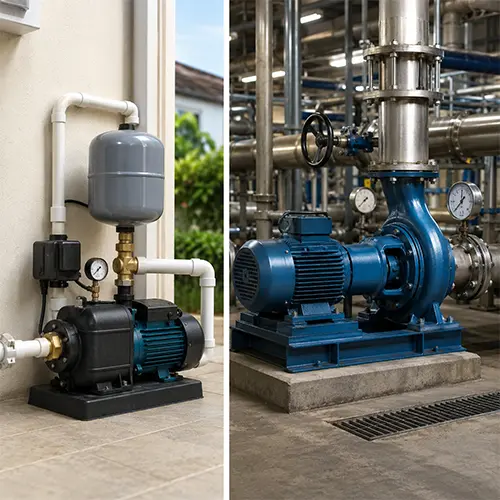
Domestic pump vs industrial pump selection should be based on duty cycle, liquid condition, flow rate, total head, operating hours, reliability requirement, maintenance access, spare parts support, documentation needs, and failure consequence—not on price or motor power alone. A domestic pump is designed for household water supply, garden irrigation, small building pressure boosting, light clean-water transfer, and intermittent use. An industrial pump is designed for longer operating hours, higher reliability, wider flow and head ranges, harsher environments, more demanding liquids, and stricter documentation or maintenance requirements.
For buyers, engineers, contractors, distributors, and procurement teams, the real question is not: “Is a domestic pump cheaper than an industrial pump?” The better question is: “Will this pump survive the real operating duty, liquid condition, and failure consequence of my application?”
A domestic pump is not automatically a low-quality pump. It can be a good choice when the water is clean, the system is simple, operating hours are short, and failure does not create serious business or safety risk. An industrial pump is not automatically the best choice for every application either. If the duty is light, the required flow and head are small, and replacement is easy, an industrial pump may be unnecessary over-specification.
However, many costly pump problems happen when a domestic pump is used beyond its design boundary. A pump that works well for a home booster system may fail quickly in a factory cooling loop, wastewater transfer system, irrigation station, or continuous-duty utility line. The early purchase saving can turn into motor overheating, seal leakage, bearing noise, flow loss, pressure instability, repeated replacement, warranty disputes, and unplanned downtime.
Choose a domestic pump when the application is clean, simple, intermittent, and low-risk. Choose an industrial pump when the system runs longer, handles tougher liquid, requires engineering documentation, or when pump failure creates downtime, safety, or business risk.
Quick Decision Summary for Buyers
Domestic pumps are usually suitable for clean-water, light-duty, intermittent applications. Industrial pumps are safer when the pump runs for many hours, supports a commercial or production system, handles difficult liquids, or when failure creates downtime cost. This first decision table helps buyers avoid both under-buying and over-buying.
| Buyer Condition | Better Direction | Why It Matters |
|---|---|---|
| Household water supply, garden irrigation, small tank transfer | Domestic pump | Lower duty, simple clean-water use |
| Small shop or light commercial water supply | Domestic or light commercial pump | Depends on operating hours and pressure stability |
| Factory utility water, production support, cooling circulation | Industrial pump | Longer duty cycle and reliability are required |
| Continuous 8–24 hours/day operation | Industrial pump | Domestic pumps may overheat or fail early |
| Corrosive, abrasive, hot, or dirty liquid | Industrial pump | Material, seal, and motor protection matter |
| Critical process where downtime stops production | Industrial pump | Failure cost may exceed pump price difference |
| Low budget, simple clean water, easy replacement | Domestic pump may be acceptable | Risk is low if duty is light |
| Remote site or difficult maintenance access | Industrial pump | Spare parts and service reliability matter |
| Project requires datasheet, curve, GA drawing, test report | Industrial pump | Documentation supports engineering approval |
The fastest practical judgment is this: If the pump only supports simple household or light-duty clean-water use, a domestic pump may be enough. If the pump supports business operation, production stability, long operating hours, dirty liquid, or engineering approval, an industrial pump is usually the safer choice.
Scope of This Guide: Applicable Pump Types and Operating Conditions
This domestic pump vs industrial pump guide applies mainly to clean water supply, pressure boosting, water transfer, drainage, irrigation, cooling circulation, and general utility water applications. It is designed to help buyers decide whether the application is light enough for a domestic pump or demanding enough to require an industrial pump.
This guide applies well to:
- Domestic booster pumps
- Household water pumps
- Garden pumps
- Small transfer pumps
- End suction pumps
- Inline pumps
- Multistage pumps
- Split case pumps
- Booster pump sets
- Submersible sewage pumps
- Drainage pumps
- Industrial centrifugal pumps
- Cooling water pumps
- Utility water pumps
This guide is useful for:
- Household water supply
- Garden irrigation
- Villa or residential booster systems
- Small building pressure boosting
- Light commercial water supply
- Factory utility water
- Industrial cooling circulation
- Tank filling
- Drainage and dewatering
- Agricultural irrigation
- Municipal auxiliary water systems
- General clean water transfer
This guide needs adjustment or separate engineering verification for:
- API process pumps
- Fire pumps governed by NFPA or local codes
- Chemical transfer pumps
- Slurry pumps
- Seawater pumps
- Food-grade sanitary pumps
- Explosion-proof pumps
- High-temperature thermal oil systems
- Mining pumps with heavy solids
- Hazardous or regulated processes
For special or regulated applications, buyers should not decide only by “domestic” or “industrial” labels. Material compatibility, local code compliance, certification, test requirements, sealing plan, motor protection, and safety approval may control the final selection.
If the buyer is still comparing pump structures before deciding whether a domestic or industrial pump is suitable, this end suction vs inline vs multistage pump guide can help clarify which pump type fits the required flow, head, and installation layout.
Practical Buyer Rule for Domestic Pump vs Industrial Pump
A domestic pump is suitable when the pump handles clean water, runs intermittently, has low failure consequence, and can be replaced easily. An industrial pump is required when the pump runs for long hours, handles dirty, hot, corrosive, or abrasive liquid, supports production or building service, or requires pump curves, test reports, and spare parts support.
This rule is important because many wrong pump purchases happen before the supplier quotes. A buyer may say “I need a small pump” or “I need a cheaper pump,” but the supplier still needs to know whether the pump will run ten minutes per day, four hours per day, or continuously.
A professional pump decision should answer four questions:
- How often and how long will the pump run?
- What liquid will the pump handle?
- What happens if the pump fails?
- What technical documents or spare parts are required after purchase?
If the answer points to light clean-water use, a domestic pump may be enough. If the answer points to long operation, dirty liquid, production loss, or project documentation, an industrial pump is usually the safer direction.
What Is a Domestic Pump?
A domestic pump is a small or medium pump designed for household water supply, garden irrigation, small pressure boosting, rainwater reuse, light drainage, and simple clean-water transfer. Its main advantages are lower purchase cost, compact size, easy installation, simple control, and convenient replacement.
Domestic pumps are not “bad pumps.” They are designed for a different duty range. A well-selected domestic pump can perform reliably in household and light-duty systems. The problem starts when buyers use a domestic pump for industrial duty without checking operating hours, liquid condition, system resistance, and failure consequence.
Definition of Domestic Pump
A domestic pump is a pump designed for residential or light-duty water applications where the liquid is usually clean, the operating time is limited, and failure consequence is relatively low. It is commonly used for household pressure boosting, garden watering, small tank filling, villa water supply, and temporary clean-water transfer.
Important terms buyers should understand:
- Domestic pump: A pump intended for residential or light-duty applications.
- Intermittent duty: The pump runs only when needed, not continuously for many hours.
- Clean water: Water without significant solids, chemicals, corrosive content, or abrasive particles.
- Light-duty application: A low-risk application with shorter operating hours, simple water conditions, and easy maintenance or replacement.
- Pressure boosting: Increasing water pressure for taps, showers, small buildings, or local water supply.
A domestic pump is usually a good choice when the system is simple and the user can tolerate short downtime. For example, a garden pump failing after long use is inconvenient, but it usually does not stop a production line or create a major commercial loss.
Typical Applications of Domestic Pumps
Domestic pumps are suitable when the water is clean, operating hours are short, the system is not critical, and replacement is easy. In these cases, the buyer may not need the heavier construction, documentation, or repairability of an industrial pump.
- Household water pressure boosting
- Garden irrigation
- Small tank filling
- Rainwater reuse
- Villa water supply
- Small building water transfer
- Light basement drainage
- Small farm auxiliary water supply
- Temporary clean-water transfer
- Small workshop non-critical water use
A domestic pump can be economically correct when the buyer needs a simple pump for a simple task. Paying for an industrial pump in these cases may not improve the result enough to justify the cost.
Common Features of Domestic Pumps
Domestic pumps usually prioritize affordability, compact design, easy installation, simple operation, and convenient replacement. They are often designed around consumer or light commercial use rather than continuous industrial reliability.
| Feature | Domestic Pump Typical Design | Buyer Meaning |
|---|---|---|
| Operating duty | Intermittent or light daily use | Not designed for long continuous operation |
| Liquid condition | Usually clean water | Not suitable for abrasive or corrosive liquid |
| Motor protection | Basic to moderate | May not tolerate harsh environments |
| Material | Standard cast iron, plastic, stainless steel, or brass | Depends on price and model |
| Control | Pressure switch, float switch, simple controller | Easy to use but limited for complex systems |
| Documentation | Basic manual and label | Limited engineering documents |
| Testing | Basic factory inspection | Usually less detailed than industrial pump testing |
| Spare parts | Limited or model-specific | Replacement may be easier than repair |
The buyer should treat a domestic pump as a practical light-duty solution, not as a universal water pump for every site.
What Is an Industrial Pump?
An industrial pump is a pump designed for commercial, manufacturing, municipal, agricultural, construction, process, or utility systems where operating hours, reliability, material selection, repairability, testing, and documentation requirements are more demanding than household use. Its value is not simply that it is “more expensive.” Its value is that it reduces risk in more demanding applications.
Industrial pumps are usually selected when the system must run longer, deliver stable performance, handle more difficult liquid, support production, or meet project documentation requirements.
Definition of Industrial Pump
An industrial pump is a pump designed for higher duty cycles, wider flow and head ranges, tougher environments, more demanding liquid conditions, and planned maintenance. It is commonly used in factories, municipal systems, irrigation stations, commercial buildings, cooling loops, process water systems, drainage systems, and EPC projects.
Important terms buyers should understand:
- Industrial duty: A more demanding operating condition involving longer running time, higher load, stricter reliability, or more difficult liquid.
- Duty cycle: The percentage or pattern of time a pump runs versus rests.
- Lifecycle cost: The total long-term cost, including purchase price, electricity, maintenance, spare parts, downtime, and replacement.
- Test report: A document showing factory inspection or performance verification, such as running test, hydrostatic test, vibration test, or performance test.
- GA drawing (General Arrangement drawing): A dimensional drawing showing pump layout, nozzle position, baseplate, and installation dimensions.
An industrial pump should be selected when the cost of failure is high enough that reliability, documentation, and service support matter.
Typical Applications of Industrial Pumps
Industrial pumps are selected when pump failure affects production, building service, cooling, process stability, safety, drainage capacity, or project acceptance. These applications usually need more than a simple pump that “moves water.”
- Factory utility water
- Industrial cooling circulation
- Boiler feed support
- RO pretreatment or pressure support
- Municipal water transfer
- High-rise booster systems
- Agricultural irrigation stations
- Mining drainage
- Wastewater transfer
- Construction dewatering
- Process water supply
- Large tank filling
- HVAC circulation
- Production line support
- Industrial drainage
Industrial pumps are also more suitable when buyers need pump curves, datasheets, material confirmation, spare parts, drawings, test reports, or long-term supplier support.
Common Features of Industrial Pumps
Industrial pumps usually provide stronger construction, wider material options, more complete hydraulic data, better repairability, and more documentation support. These features matter when downtime is expensive or the pump must be accepted by engineers, contractors, or project owners.
| Feature | Industrial Pump Typical Design | Buyer Meaning |
|---|---|---|
| Operating duty | Long daily operation or continuous duty | Better for 8–24 h/day use |
| Liquid condition | Clean, dirty, hot, corrosive, or abrasive depending on model | Material and seal can be selected |
| Motor protection | Higher insulation/IP options | Better for harsh environments |
| Material | Cast iron, stainless steel, duplex, bronze, coated materials | Matched to liquid condition |
| Documentation | Pump curve, datasheet, GA drawing, manual | Supports engineering approval |
| Testing | Performance, hydrostatic, vibration, or run test options | Reduces project risk |
| Spare parts | Seal, bearing, impeller, shaft, wear parts | Repairable and maintainable |
| Control options | VFD, control panel, pressure control, level control | Better for variable demand systems |
VFD (Variable Frequency Drive) means a motor control device that adjusts pump speed according to demand. It is often used in industrial or commercial systems where flow or pressure changes during operation.
Domestic Pump vs Industrial Pump: Core Difference for Buyers
The core difference between a domestic pump and an industrial pump is not simply price. The real difference is design boundary. A domestic pump solves light-duty household or small water transfer problems. An industrial pump solves longer-duty, higher-risk, more demanding system operation.
| Comparison Point | Domestic Pump | Industrial Pump | Buyer Meaning |
|---|---|---|---|
| Main purpose | Household and light water use | Commercial, factory, municipal, process use | Application controls selection |
| Operating hours | Short or intermittent | Long daily or continuous | Duty cycle is critical |
| Liquid condition | Usually clean water | Clean, dirty, hot, corrosive, abrasive depending on type | Material selection matters |
| Flow/head range | Smaller to moderate | Wider and higher | Industrial systems need engineered sizing |
| Motor design | Basic or moderate | Higher protection and efficiency options | Harsh environment needs better motor |
| Pump curve | Sometimes limited | Usually available | Needed for engineering selection |
| Repairability | Often replaced rather than repaired | More repairable | Important for downtime control |
| Testing | Basic | More complete options | Needed for critical systems |
| Documentation | Limited | More complete | Required for projects and tenders |
| Best use | Low-risk, light duty | High-risk, long-duty, demanding systems | Choose by risk and duty |
A domestic pump is not automatically poor quality, and an industrial pump is not automatically the best choice. The right pump is the one that matches the required duty cycle, liquid condition, performance demand, and failure consequence.
Domestic Pump, Light Commercial Pump, or Industrial Pump: How to Classify Your Duty
Many real projects are not purely domestic or heavy industrial. Small shops, small hotels, small farms, villas, workshops, and light commercial buildings often sit between domestic duty and industrial duty, so buyers should classify the duty before choosing the pump tier.
This classification prevents two mistakes. The first mistake is using a domestic pump in a duty that is too demanding. The second mistake is buying a large industrial pump for a simple light-duty application.
| Duty Class | Typical Application | Recommended Pump Direction | Buyer Logic |
|---|---|---|---|
| Domestic duty | Home booster, garden watering, small tank filling | Domestic pump | Clean water, short operation, low failure consequence |
| Light commercial duty | Small shop, small hotel, villa group, small farm water supply | Domestic or light commercial pump | Depends on daily hours, pressure stability, and start-stop frequency |
| Light industrial duty | Workshop utility water, small irrigation station, non-critical factory water | Light industrial or industrial pump | Longer operation and better reliability may be needed |
| Industrial duty | Factory cooling, process water, construction dewatering, municipal transfer | Industrial pump | Long duty, higher reliability, spare parts, and documentation matter |
| Specialist duty | Corrosive liquid, slurry, seawater, explosion-proof area, regulated process | Specialist industrial pump | Material, certification, safety, and engineering approval dominate |
A buyer should not jump from “domestic” directly to “large industrial” without checking the middle option. In many light commercial projects, a light commercial or light industrial pump provides the best balance between cost and reliability.
Why Buyers Confuse Domestic Pumps and Industrial Pumps
Buyers often confuse domestic pumps and industrial pumps because both may move water, both may have similar-looking motor power, and both may show flow and head values in catalogs. However, similar basic parameters do not mean the pumps are designed for the same operating conditions.
This confusion often causes false savings. A domestic pump may look cheaper in the quotation, but if it fails repeatedly in an industrial system, the buyer may pay more through downtime, maintenance, emergency replacement, and lost production.
Mistake 1: Thinking Similar Flow and Head Means Same Application
Similar flow and head values do not prove that two pumps are suitable for the same duty. A domestic pump may show a flow and head close to an industrial pump, but it may not be designed for the same daily operating hours, temperature, start-stop frequency, or working environment.
- Domestic pump overheating in long operation
- Shorter bearing life
- Seal leakage
- Motor failure
- Unstable pressure
- Frequent replacement
- Warranty rejection due to misuse
Buyers should compare operating duty, material, motor protection, seal design, pump curve, and documentation—not only catalog flow and head.
Mistake 2: Choosing by Price Instead of Failure Consequence
A lower purchase price is only useful when the cost of failure is low. If pump failure stops production, interrupts building water supply, damages equipment, or creates customer complaints, the cheaper pump may become the more expensive option.
- Emergency repair cost
- Production downtime
- Customer complaints
- Warranty disputes
- Repeated replacement
- Lost working hours
- Higher lifetime cost
- Damage to downstream equipment
The buyer should ask: If this pump fails, what happens next? If the answer is only minor inconvenience, a domestic pump may be acceptable. If the answer is production loss, safety risk, or project delay, an industrial pump is usually safer.
Mistake 3: Ignoring Liquid Condition
Domestic pumps are usually designed for clean water, while industrial applications may involve dirty, hot, corrosive, abrasive, oily, or wastewater conditions. Liquid condition directly affects casing material, impeller material, mechanical seal, motor load, clogging risk, and service life.
- Impeller wear
- Casing corrosion
- Mechanical seal failure
- Clogging
- Motor overload
- Reduced flow
- Early pump failure
- Leakage and safety concerns
If the liquid contains chloride, chemicals, or aggressive water, this pump corrosion troubleshooting guide can help buyers check whether the selected pump material matches the real liquid condition.
Duty Cycle: The Most Important Difference Between Domestic and Industrial Pumps
Duty cycle is one of the most important differences between a domestic pump and an industrial pump. A domestic pump is usually designed for intermittent or light daily operation, while an industrial pump may need to run for several hours, one shift, two shifts, or continuously.
A pump that works well for 30 minutes per day may not survive 12 hours per day. That is why buyers must define real operating hours before comparing prices.
What Is Duty Cycle?
Duty cycle refers to how often and how long the pump runs within a given period. It affects motor heating, bearing load, seal wear, impeller wear, energy cost, and maintenance interval.
| Duty Type | Typical Use | Pump Direction |
|---|---|---|
| Occasional use | Garden watering, small tank filling | Domestic pump |
| Intermittent daily use | Household booster, small building supply | Domestic or light commercial pump |
| Several hours per day | Small workshop, irrigation, utility water | Light industrial or industrial pump |
| 8–16 hours/day | Factory utility, cooling, process support | Industrial pump |
| 24/7 continuous use | Critical circulation, municipal, production systems | Industrial pump |
A buyer should not estimate duty cycle from ideal conditions. Real duty includes peak demand, hot season operation, repeated start-stop cycles, and operator behavior.
Why Domestic Pumps Fail in Industrial Duty
Domestic pumps may fail early in industrial duty because their motor, bearing, seal, and cooling design may not be intended for long continuous operation. Even if the pump starts normally, it may not survive repeated heavy operation.
- Motor overheating
- Seal leakage
- Bearing noise
- Reduced flow
- Pressure instability
- Frequent start-stop failure
- Shorter service life
- Control failure
- Warranty rejection due to application misuse
For example, a domestic booster pump may work well in a villa, where demand is intermittent. The same pump may overheat in a small factory where water is required for long periods every day.
How Buyers Should Estimate Duty Before Selection
Buyers should estimate real daily operating hours, start-stop frequency, liquid condition, ambient temperature, and failure consequence before selecting the pump. This information helps determine whether a domestic pump, light commercial pump, or industrial pump is appropriate.
- How many hours per day will the pump run?
- How many starts per hour?
- Is the pump controlled by pressure switch, float switch, or VFD?
- Is the environment hot, humid, dusty, or outdoor?
- Is the pump critical to operation?
- Is a standby pump available?
- Can the pump be repaired quickly?
- Are spare parts locally available?
If the buyer cannot answer these questions, the pump selection is not ready for final approval.
Flow, Head, and System Demand: Why Pump Size Alone Is Not Enough
Domestic pump vs industrial pump selection must still begin with flow rate and total head. A domestic pump may be unsuitable if the required flow or head exceeds its efficient operating range. An industrial pump may also be wrong if it is oversized or selected far from the system duty point.
Motor power, outlet size, and price cannot replace hydraulic selection. The buyer must know what the system needs.
Required Flow Rate
Flow rate is the volume of liquid the pump must move per unit time. Domestic applications usually have smaller and less demanding flow needs, while industrial applications may require stable flow over long periods.
| Unit | Common Use |
|---|---|
| m³/h | Industrial and commercial projects |
| L/min | Domestic and small pump use |
| L/s | Engineering calculation |
| GPM | North American markets |
For example, a household pressure pump may only need to supply several outlets intermittently. A factory cooling circulation pump may need stable flow for hours to protect equipment temperature. These two applications are very different even if the pump sizes look similar.
Required Total Head
Total head is the full resistance the pump must overcome, including vertical lift, pipe friction, valves, fittings, filters, and outlet pressure. It is usually expressed in meters or feet.
Total head = static head + friction loss + outlet pressure requirement + minor losses
- Static head: Vertical height difference between source and discharge point.
- Friction loss: Pressure loss caused by pipe length, pipe diameter, and flow velocity.
- Outlet pressure requirement: Pressure needed at taps, nozzles, machines, filters, or process equipment.
- Minor losses: Resistance caused by elbows, valves, strainers, meters, filters, and check valves.
A domestic pump may be acceptable for low head and simple pipe routes. If the pipeline is long, restrictive, or pressure-dependent, industrial pump selection may be needed.
Why Domestic Pump Catalog Values Can Mislead Buyers
Some domestic pump catalogs highlight maximum flow or maximum head, but maximum values do not represent real operating performance. Maximum flow usually occurs at very low head. Maximum head usually occurs at very low or zero flow.
| Catalog Value | Common Misunderstanding | Correct Buyer Interpretation |
|---|---|---|
| Max flow | Pump can deliver this flow in any system | Usually only at very low head |
| Max head | Pump can deliver full flow at this head | Flow may be very low near max head |
| Motor power | Pump is strong enough | Hydraulic performance still matters |
| Outlet size | Large enough for industrial use | Actual curve and duty cycle matter |
| “Heavy-duty” label | Suitable for industrial operation | Verify duty, curve, material, and motor |
Industrial buyers should ask for the pump curve, duty point, operating range, motor data, and material information before approving a pump for commercial or industrial use.
Material, Seal, and Motor Differences
The difference between domestic and industrial pumps is often inside the pump, not only on the outside. Materials, seals, bearings, shafts, motor protection, insulation, cooling, and testing determine whether the pump can survive the real application.
A pump that looks similar externally may have a very different service life under difficult conditions.
Material Difference
Domestic pumps often use standard materials for clean water, while industrial pumps may offer material options for different liquids and environments. Material mismatch is one of the fastest ways to cause corrosion, wear, leakage, or reduced service life.
| Component | Domestic Pump | Industrial Pump |
|---|---|---|
| Casing | Plastic, cast iron, stainless steel, or brass | Cast iron, stainless steel, duplex, bronze, coated materials |
| Impeller | Plastic, brass, stainless steel, or cast iron | Cast iron, stainless steel, bronze, special alloy |
| Shaft | Standard steel or stainless steel | Stainless steel or higher-grade shaft |
| Coating | Basic | Industrial coating options |
| Fasteners | Standard | Application-specific options |
For clean domestic water, standard materials may be enough. For hot water, chloride water, slightly abrasive water, wastewater, or chemical-containing water, industrial material selection becomes important.
Seal Difference
Mechanical seal quality directly affects leakage risk and maintenance frequency. Domestic pumps usually use standard seals, while industrial pumps can use upgraded seals depending on liquid temperature, chemicals, solids, and operating duty.
- Mechanical seal: A sealing component that prevents leakage where the shaft passes through the pump casing.
- Elastomer: The rubber-like material in a seal, which must match liquid temperature and chemical properties.
- Seal face: The friction surface in the seal, which affects leakage resistance and life.
- Single mechanical seal: A common seal design for many clean-water applications.
- Double mechanical seal: A more protective design used in some difficult or hazardous applications.
A domestic pump seal may work well in household clean water. It may fail quickly in hot, dirty, chemically aggressive, or continuous-duty systems.
Motor Difference
Industrial pump motors usually offer better protection, insulation, efficiency, cooling, and continuous-duty options. Motor design matters when the pump runs for long hours, starts frequently, operates outdoors, or works in hot, humid, dusty, or unstable power conditions.
| Motor Factor | Domestic Pump | Industrial Pump |
|---|---|---|
| Duty | Intermittent/light | Continuous/heavy-duty options |
| Protection | Basic to moderate | Higher IP rating options |
| Insulation | Basic | Higher insulation class options |
| Efficiency | Basic or standard | IE3/IE4 options |
| Cooling | Simple | Better cooling design |
| Control | Pressure switch/simple control | VFD/control panel options |
| Serviceability | Often limited | More repairable |
IP rating (Ingress Protection rating) describes motor protection against dust and water. IE3/IE4 refers to motor efficiency classes. Higher-efficiency motors can reduce energy cost in long-running industrial systems.
When to Choose a Domestic Pump
A domestic pump is a practical choice when the application is clean, simple, intermittent, low-risk, and easy to repair or replace. If the operating condition is light, an industrial pump may be unnecessary and may increase cost without improving the real business result.
The buyer should still verify flow, head, voltage, liquid condition, and operating hours. Domestic does not mean “no selection needed.”
Choose Domestic Pump for Household Water Supply
Domestic pumps are usually suitable for household water pressure boosting, small buildings, villas, and daily water transfer. These systems usually operate intermittently and handle clean water.
- The liquid is clean water.
- Operating time is short.
- Failure consequence is low.
- Replacement is easy.
- Budget is limited.
- No strict documentation is required.
- The system is not part of production or critical building service.
For home water use, a domestic pump may provide the best balance between cost and practical performance.
Choose Domestic Pump for Garden and Small Irrigation
Domestic or light-duty pumps can work for small garden irrigation when the water is clean and operating time is not excessive. The key is to avoid using a small domestic pump for large agricultural duty.
- Irrigation area is small.
- Pressure requirement is low.
- Water source is clean.
- Daily operation is short.
- Maintenance access is easy.
- Replacement pump is available.
If irrigation runs for many hours, uses long pipelines, or handles sandy water, the buyer should consider light industrial or industrial pump options.
Choose Domestic Pump for Temporary Clean-Water Transfer
Domestic pumps can be economical for temporary clean-water transfer when long-term reliability and documentation are not critical. Short use duration reduces lifecycle risk.
- The project is temporary.
- The liquid is clean water.
- Head and flow are moderate.
- A spare pump is available.
- Failure does not stop production.
- The operator can replace it quickly.
In these conditions, a domestic pump can be a rational low-cost option.
When to Choose an Industrial Pump
An industrial pump should be selected when the application has longer operating hours, higher reliability requirements, difficult liquid, stricter documentation needs, or high failure consequence. The industrial pump’s value is risk reduction over the full service life.
Industrial pumps are usually better when a pump is not just a convenience item but part of a working system.
Choose Industrial Pump for Long Operating Hours
An industrial pump is usually safer when the pump runs for many hours per day. Long operation increases motor heating, bearing load, seal wear, hydraulic stress, and energy cost.
- Factory water supply
- Cooling circulation
- Process water
- Irrigation station
- Municipal transfer
- Construction dewatering
- Continuous drainage
- Commercial building booster system
- HVAC circulation
If the pump runs 8–24 hours per day, a domestic pump may become a false economy. Industrial duty, motor efficiency, pump curve, spare parts, and maintenance planning become more important.
Choose Industrial Pump for Difficult Liquid
An industrial pump is usually required when the liquid is not clean water. Difficult liquid affects material selection, seal design, impeller structure, clogging risk, and motor load.
- Hot water
- Sewage
- Sandy water
- Slightly abrasive water
- Corrosive liquid
- Chemical water
- Oily water
- Industrial wastewater
- Water with suspended solids
A domestic pump used for dirty or corrosive liquid may fail quickly even if the motor power seems sufficient.
Choose Industrial Pump for Critical Systems
An industrial pump should be used when pump failure can stop production, interrupt building service, damage equipment, or create safety risk. In these systems, purchase price is only a small part of the real cost.
- Production line support
- Industrial cooling loop
- Municipal water supply
- High-rise booster station
- Hospital or commercial building supply
- Remote site water system
- EPC project
- Process water supply
- Data-center auxiliary cooling
For critical systems, buyers should ask for pump curves, datasheets, GA drawings, test options, spare parts lists, and supplier project experience.
When NOT to Choose a Domestic Pump
A domestic pump should not be used when the real application exceeds household or light-duty boundaries. The issue is not that domestic pumps are poor quality. The issue is that their design target may not match industrial duty.
Choosing a domestic pump outside its design range transfers risk from purchase price to maintenance and downtime.
Do Not Choose Domestic Pump for Continuous Industrial Operation
A domestic pump is risky for continuous industrial operation, especially in hot, dusty, humid, outdoor, or high-load environments. The motor, seal, and bearing may not tolerate long operation.
- Motor overheating
- Bearing failure
- Seal leakage
- Warranty rejection
- Short service life
- Emergency replacement
- Unstable pressure
- Repeated downtime
If the system supports factory operation, cooling, process water, or commercial building service, industrial pump selection is usually safer.
Do Not Choose Domestic Pump for Dirty, Corrosive, or Abrasive Liquid
A domestic pump should not be selected for dirty, corrosive, abrasive, hot, or chemically aggressive liquid unless the supplier confirms compatibility. Standard domestic pump materials and seals are usually designed for clean water.
- Clogging
- Impeller wear
- Seal damage
- Casing corrosion
- Reduced flow
- Sudden failure
- Leakage
- Motor overload
If the liquid is not clean water, the buyer should define the liquid condition before requesting a quotation.
Do Not Choose Domestic Pump for Project Documentation Requirements
A domestic pump is usually not the best choice when the project requires engineering documentation. Many domestic pump suppliers provide basic manuals but may not provide full pump curves, datasheets, GA drawings, material lists, performance test reports, or project acceptance documents.
- Pump curve
- Datasheet
- GA drawing
- Material list
- Motor data
- Seal specification
- Test report
- Manual
- Spare parts list
- Warranty terms
If these documents are required for approval, an industrial pump supplier is usually more suitable.
When NOT to Overbuy an Industrial Pump
An industrial pump should not be purchased only because it looks more professional or expensive. If the application is simple, clean, low-risk, and intermittent, an industrial pump may increase purchase cost, installation complexity, and spare parts cost without meaningful benefit.
The buyer should avoid both under-specification and over-specification.
Do Not Choose Industrial Pump Only Because It Looks More Professional
A larger industrial pump may not improve performance if the system only needs small flow and low head. The pump must match the duty point.
- Higher purchase cost
- More complex installation
- Higher spare parts cost
- Lower efficiency at small demand
- Overpressure risk
- More difficult maintenance
- Unnecessary control complexity
For light domestic applications, the best pump is often a properly selected domestic pump, not the largest or most expensive pump.
Do Not Choose Industrial Pump Without Checking Duty Point
Even an industrial pump can fail, waste energy, or operate poorly if selected far from its duty point. Industrial-grade construction does not correct wrong hydraulic selection.
- Flow
- Total head
- Pump curve
- System curve
- Operating hours
- Control method
- Pipe size
- Outlet pressure
- Liquid condition
- Motor load
If the selected industrial pump is too large, the system may require throttling, causing energy waste, vibration, noise, and premature wear.
Domestic Pump vs Industrial Pump: Lifecycle Cost Comparison
Domestic pump vs industrial pump decisions should be based on lifecycle cost, not purchase price alone. A domestic pump usually has a lower upfront price, but if used in the wrong application, it may create higher maintenance cost, downtime cost, and replacement cost.
Lifecycle cost is especially important when pumps run for many hours or support business-critical systems.
Lifecycle Cost Formula
Lifecycle cost helps buyers estimate the real long-term cost of a pump. It includes both visible and hidden costs.
Lifecycle cost = purchase price + energy cost + maintenance cost + spare parts cost + downtime cost + replacement cost
This formula helps explain why a cheaper pump may not be cheaper over time. If a domestic pump fails twice in an industrial application, the replacement cost and downtime may exceed the original price difference.
Cost Comparison Table
The cost comparison changes depending on duty risk. Domestic pumps often win in low-risk short-duty applications. Industrial pumps often win in long-running or critical systems.
| Cost Factor | Domestic Pump | Industrial Pump | Buyer Meaning |
|---|---|---|---|
| Purchase price | Lower | Higher | Domestic pump saves upfront cost |
| Energy cost | Depends on model | More efficiency options | Industrial pump may save cost in long-running systems |
| Maintenance | Replace-oriented | Repairable | Industrial pump supports planned maintenance |
| Spare parts | Limited | More available | Important for downtime control |
| Downtime cost | Acceptable if low-risk | Lower risk for critical systems | Failure consequence controls decision |
| Service life | Shorter under heavy duty | More predictable under correct duty | Industrial pump may be cheaper long-term |
| Documentation | Limited | Stronger | Industrial pump supports project approval |
If the existing pump shows lower output or higher energy use, this pump efficiency loss guide can help buyers identify whether the issue comes from pump wear, wrong sizing, or system conditions.
Real Buyer Cases: When Domestic Pumps Work and When They Fail
Real buyer cases show why the correct pump choice depends on duty, not only pump label. A domestic pump can be the right choice in one application and the wrong choice in another, even if both applications involve clean water.
| Case | Initial Choice | Result | Better Decision |
|---|---|---|---|
| Villa booster system running intermittently | Domestic booster pump | Works well because demand is light and intermittent | Domestic pump is correct |
| Garden irrigation 1 hour/day with clean water | Domestic pump | Acceptable because failure consequence is low | Domestic pump or light-duty pump |
| Small shop water supply several hours/day | Domestic pump | May work, but pressure stability and duty need review | Domestic or light commercial pump |
| Factory cooling loop running 12 hours/day | Domestic pump | Motor overheating and seal leakage risk increases | Industrial pump |
| Wastewater transfer with solids | Domestic pump | Clogging, seal damage, and early failure likely | Industrial sewage pump |
| Corrosive water transfer | Domestic pump | Casing corrosion and seal failure likely | Industrial or specialist pump |
| Temporary clean-water transfer for short project | Domestic pump | Acceptable if spare pump is available and downtime risk is low | Domestic or light industrial pump |
| Municipal water transfer project | Domestic pump | Documentation and reliability are insufficient | Industrial pump |
These cases help buyers explain the decision internally. The purchasing team may prefer the lower upfront price, but the engineering team should evaluate operating hours, liquid condition, and failure consequence before final approval.
Engineering Red Flags: When a Domestic Pump Is Being Used Beyond Its Design Limit
Engineering red flags help buyers identify when a domestic pump is being pushed outside its intended duty. If several warning signs appear at the same time, the buyer should move toward a light industrial, industrial, or specialist pump.
| Red Flag | Why It Matters | Safer Direction |
|---|---|---|
| Pump runs more than 4–6 hours/day | Domestic motor and seal life may shorten under longer operation | Light industrial or industrial pump |
| Pump starts frequently every hour | Frequent start-stop can heat the motor and stress controls | Better control system or industrial pump |
| Water contains sand, solids, or debris | Domestic impeller and seal may wear or clog | Drainage, sewage, or industrial pump |
| Liquid is hot, corrosive, oily, or chemical-containing | Standard materials may fail quickly | Industrial or specialist material selection |
| Pump is installed outdoors without protection | Motor protection may be insufficient | Higher IP-rated motor or protected installation |
| Failure affects business operation | Downtime cost exceeds purchase saving | Industrial pump |
| Supplier cannot provide pump curve | Performance cannot be verified | Industrial supplier or more complete quotation |
| Project requires drawings or test documents | Domestic pump documentation may be insufficient | Industrial pump |
These red flags do not mean every domestic pump will fail. They mean the buyer should stop treating the application as a simple household duty and verify the selection more carefully.
Troubleshooting Matrix: Did You Choose the Wrong Pump Type?
Troubleshooting helps buyers identify whether poor performance comes from wrong pump type, wrong duty cycle, liquid mismatch, control failure, or system resistance. This is especially useful when a domestic pump has been installed in a commercial or industrial site and starts failing earlier than expected.
| Site Symptom | Possible Cause | What to Check |
|---|---|---|
| Domestic pump overheats | Duty cycle too high | Operating hours, start-stop frequency, ambient temperature |
| Flow drops after short use | Pump not designed for system resistance | Pump curve, total head, pipe friction |
| Seal leaks frequently | Liquid or duty exceeds seal design | Seal material, water quality, temperature |
| Motor trips often | Overload or wrong duty point | Current, voltage, pump curve |
| Pump corrodes quickly | Wrong material | Liquid chemistry, chloride, pH |
| Industrial pump wastes energy | Oversized for simple duty | Duty point, control method, pipe size |
| Pressure unstable | Wrong control or undersized pump | Pressure switch, VFD, tank, demand pattern |
| Frequent replacement | Pump tier does not match application | Duty cycle, liquid, failure consequence |
| Bearing noise appears early | Excessive load or poor operating point | Alignment, vibration, duty point, suction condition |
| Pump clogs often | Wrong pump for solids | Solids size, impeller passage, sewage pump requirement |
This matrix helps buyers avoid replacing the same pump repeatedly without solving the root cause. The correct next step is to check the actual operating condition against the pump’s intended duty.
Supplier Verification: What Buyers Should Ask Before Purchase
Supplier verification is necessary whether the buyer chooses a domestic pump or an industrial pump. The level of verification should match the risk level. A household garden pump does not need the same documentation as a municipal booster station, but industrial projects should not proceed with only a model name and price.
| Verification Item | Domestic Pump | Industrial Pump |
|---|---|---|
| Pump curve | Nice to have | Required |
| Datasheet | Basic | Required |
| Material list | Basic | Required for industrial duty |
| Motor data | Required | Required |
| Seal information | Recommended | Required |
| GA drawing | Usually not needed | Often required |
| Test report | Usually not needed | Needed for critical projects |
| Spare parts list | Recommended | Required |
| Warranty terms | Required | Required |
| Similar project experience | Helpful | Important |
A professional supplier should explain why the selected pump fits the application. If the supplier cannot discuss duty cycle, liquid condition, flow, head, motor data, seal, and spare parts, the buyer should treat the quotation as incomplete.
Quotation Review: How to Compare Domestic and Industrial Pump Offers
A pump quotation should be reviewed by technical completeness, not only by price. A domestic pump offer may be acceptable for light use, but an industrial pump offer should provide enough data for engineering verification, installation, maintenance, and project approval.
| Quote Item | Domestic Pump Quote | Industrial Pump Quote | Buyer Check |
|---|---|---|---|
| Flow and head | May show maximum values | Should show rated duty point | Ask whether values are max or rated |
| Pump curve | Often missing or simplified | Should be available | Verify actual performance |
| Motor data | Basic voltage and power | Voltage, frequency, IP, insulation, efficiency, duty | Check operating hours and environment |
| Material | Often simplified | More detailed casing, impeller, shaft, seal materials | Match liquid condition |
| Seal | Often generic | Seal material or type should be specified | Check temperature and liquid compatibility |
| Testing | Basic inspection | Run test, hydrostatic test, vibration or performance test options | Needed for critical systems |
| Spare parts | Limited | Seal, bearing, impeller, shaft, gasket options | Check downtime risk |
| Warranty | Basic terms | More detailed warranty and exclusions | Check misuse exclusions |
| Documentation | Manual and label | Datasheet, GA drawing, curve, manual, test option | Needed for engineering approval |
| Supplier experience | Not always stated | Similar project references should be possible | Check application confidence |
A buyer should be cautious when two offers are compared only by price. A lower-priced domestic pump quotation may not include the documentation, materials, testing, or spare parts that an industrial site requires.
Step-by-Step Buyer Checklist Before Final Selection
A structured checklist helps buyers avoid choosing by price, appearance, or motor power alone. This checklist can be used before internal approval or supplier inquiry.
| Step | Buyer Question | Why It Matters |
|---|---|---|
| 1 | Is this household, commercial, or industrial use? | Defines pump category |
| 2 | How many hours per day will the pump run? | Determines duty cycle |
| 3 | What liquid is being pumped? | Determines material and seal |
| 4 | What flow rate is required? | Determines capacity |
| 5 | What total head is required? | Determines pressure requirement |
| 6 | Is the system critical? | Determines reliability level |
| 7 | Is dirty, hot, corrosive, or abrasive liquid involved? | Determines industrial pump need |
| 8 | Is documentation required? | Determines supplier level |
| 9 | Are spare parts available? | Reduces downtime |
| 10 | What is the real lifecycle cost? | Prevents false savings |
The buyer should not finalize the purchase until these questions are answered. A cheap quotation without operating data is not a reliable selection.
RFQ Checklist for Domestic Pump vs Industrial Pump Procurement
A clear RFQ (Request for Quotation) helps suppliers recommend the right pump tier instead of guessing. It also allows buyers to compare quotations fairly.
| RFQ Item | Information to Provide |
|---|---|
| Application | Household, building, factory, irrigation, drainage |
| Liquid | Clean water, hot water, sewage, corrosive water, sandy water |
| Flow rate | m³/h, L/min, L/s, or GPM |
| Total head | m or ft |
| Operating hours | Intermittent, daily, continuous |
| Start-stop frequency | Times per hour/day |
| Installation environment | Indoor, outdoor, dusty, humid, hot |
| Power supply | Voltage, frequency, phase |
| Control method | Pressure switch, float switch, VFD, control panel |
| Documentation needs | Curve, datasheet, GA drawing, test report |
| Spare parts | Seal, bearing, impeller, capacitor, motor parts |
| Budget priority | Low upfront cost or long-term reliability |
A good RFQ should clearly state whether the buyer wants the lowest acceptable cost, the safest long-term selection, or both domestic and industrial options for comparison.
Best Option by Scenario: Domestic Pump or Industrial Pump?
Different scenarios require different pump tiers. This decision matrix helps procurement teams, engineers, and business owners identify the first selection direction before requesting a detailed quotation.
| Scenario | Better Pump Direction | Reason |
|---|---|---|
| Home water pressure boosting | Domestic pump | Intermittent clean-water use |
| Garden watering | Domestic pump | Low-risk and simple duty |
| Small shop water supply | Domestic or light commercial pump | Depends on operating hours |
| Factory cooling circulation | Industrial pump | Long-duty stable operation |
| Construction dewatering | Industrial drainage pump | Harsh site and higher flow |
| Industrial wastewater | Industrial pump | Liquid condition is complex |
| High-rise building booster | Industrial booster set | Pressure stability and reliability matter |
| Temporary clean water transfer | Domestic or light industrial pump | Depends on duration and risk |
| Municipal water transfer | Industrial pump | Documentation and reliability required |
| Corrosive water application | Industrial or specialist pump | Material compatibility matters |
| Small farm auxiliary water use | Domestic or light industrial pump | Depends on hours and water quality |
| Remote site water supply | Industrial pump | Maintenance access and spare parts matter |
The best option is not always the most expensive pump. The best option is the pump that matches the real duty with acceptable risk and the lowest practical lifecycle cost.
Final Decision Matrix: Domestic Pump, Light Commercial Pump, Industrial Pump, or Specialist Pump?
The final decision should classify the real duty first, then choose the pump tier. This matrix gives buyers a practical final filter before sending an RFQ or approving a quotation.
| Real Condition | Recommended Choice | Buyer Reasoning |
|---|---|---|
| Clean water + short operation + easy replacement | Domestic pump | Low duty and low failure consequence |
| Household booster or garden irrigation | Domestic pump | Intermittent use and simple maintenance |
| Clean water + small shop + several hours/day | Light commercial pump | Higher duty than home use but not full industrial |
| Small farm or workshop water supply | Light commercial or light industrial pump | Depends on operating hours and water quality |
| 8–16 hours/day operation | Industrial pump | Motor, bearing, seal, and cooling design matter |
| 24/7 operation | Industrial pump with proper duty rating | Continuous duty requires reliability and maintenance planning |
| Dirty, hot, corrosive, or abrasive liquid | Industrial or specialist pump | Material and seal compatibility dominate |
| Failure stops production or building service | Industrial pump | Downtime cost dominates purchase price |
| Project needs curve, drawing, test report | Industrial pump | Documentation is required for approval |
| Hazardous, regulated, chemical, slurry, seawater, or fire system | Specialist pump | Certification, safety, and application engineering dominate |
| Simple temporary clean-water transfer | Domestic or light-duty pump | Depends on duration, risk, and spare availability |
| Existing pump fails repeatedly | Recheck duty and upgrade tier if needed | Repeated replacement indicates mismatch |
This final matrix helps buyers avoid emotional or price-only decisions. If the system is simple and low-risk, a domestic pump can be the correct choice. If the system is business-critical, difficult, or documentation-heavy, an industrial or specialist pump is safer.
FAQ About Domestic Pump vs Industrial Pump
These FAQ answers address common buyer questions about cost, quality, durability, factory use, documentation, and application boundaries. The goal is to help buyers avoid both false savings and unnecessary over-specification.
Is a Domestic Pump Lower Quality Than an Industrial Pump?
A domestic pump is not necessarily lower quality than an industrial pump. It is designed for lighter duty, clean water, intermittent use, and lower failure consequence. It becomes unsuitable only when used beyond its design range.
A high-quality domestic pump can work well in household applications. But even a good domestic pump may fail quickly in continuous industrial duty if its motor, bearing, seal, and materials are not designed for that load.
Can I Use a Domestic Pump in a Factory?
A domestic pump can be used in a factory only for simple, low-risk, intermittent clean-water tasks. If the pump runs many hours, supports production, handles dirty or hot water, or failure causes downtime, an industrial pump is safer.
For example, a domestic pump may be acceptable for occasional cleaning water or temporary tank filling. It is not usually suitable for production cooling, process water, industrial wastewater, or critical supply lines.
Can a Domestic Pump Be Used for Industrial Use?
A domestic pump should only be used for industrial use when the task is light, clean, intermittent, non-critical, and easy to replace. It should not be used for continuous operation, dirty liquid, corrosive liquid, high-temperature water, production support, or any application where failure causes business loss.
The buyer should confirm operating hours, start-stop frequency, flow, head, liquid condition, and failure consequence before using a domestic pump in any industrial site.
Why Is an Industrial Pump More Expensive?
An industrial pump is usually more expensive because it may include stronger materials, better seals, continuous-duty motors, better bearings, pump curves, test reports, repairable design, and spare parts support. These features reduce operating risk in demanding systems.
The higher price is justified only when the application needs those features. For simple household use, many industrial features may not create enough value.
Which Pump Lasts Longer?
The pump that matches the application lasts longer. A domestic pump can last well in household use, but it may fail quickly in industrial duty. An industrial pump can last longer in demanding systems if correctly selected and maintained.
Service life depends on liquid condition, operating hours, duty point, motor load, seal compatibility, installation quality, and maintenance.
Is Motor Power Enough to Compare Domestic and Industrial Pumps?
Motor power is not enough to compare domestic and industrial pumps. Motor power does not prove duty cycle, material suitability, pump curve, efficiency, seal quality, bearing life, or reliability.
Buyers should compare flow, head, duty cycle, liquid condition, pump curve, motor data, material, seal, spare parts, and failure consequence.
When Should I Avoid a Domestic Pump?
Buyers should avoid domestic pumps for continuous operation, dirty water, corrosive liquid, high-temperature liquid, critical systems, remote sites, and projects requiring engineering documentation. These conditions usually exceed the intended duty of domestic pumps.
If failure creates production downtime, safety risk, or project delay, an industrial pump is usually the safer choice.
When Is an Industrial Pump Unnecessary?
An industrial pump may be unnecessary for simple household water use, small garden irrigation, temporary clean-water transfer, or low-risk applications where replacement is easy and operating hours are short. In these cases, a properly selected domestic pump may provide better cost efficiency.
Industrial over-specification can increase purchase cost, installation cost, and spare parts cost without improving the real result.
What Should I Ask the Supplier Before Choosing?
Buyers should ask suppliers about flow, head, duty cycle, material, seal, motor data, pump curve, installation environment, spare parts, warranty terms, and similar application experience. For industrial applications, buyers should also ask for datasheets, GA drawings, and test report options.
A supplier who quotes only by motor power or price may not have enough information to make a safe selection.
What Is the Safest Buying Rule?
The safest buying rule is to choose by duty risk, not by product label. Domestic pumps are suitable for simple, clean, intermittent, low-risk use. Industrial pumps are suitable for longer operation, tougher liquids, project documentation, and higher failure consequence.
If the buyer is unsure, request both a light-duty option and an industrial option from the supplier, then compare duty cycle, pump curve, material, warranty, spare parts, and lifecycle cost.
Conclusion: How Buyers Should Choose Between Domestic Pump and Industrial Pump
The final decision between a domestic pump and an industrial pump should be based on application risk, not product label. A domestic pump is suitable for clean-water, light-duty, intermittent, low-risk applications. An industrial pump is suitable for longer operating hours, more difficult liquids, higher reliability needs, engineering documentation, and systems where failure creates downtime, safety, or business risk.
Buyers should not choose a domestic pump only because it is cheaper. They should also not choose an industrial pump only because it looks more professional. Both choices can be wrong if the pump does not match flow, head, duty cycle, liquid condition, and failure consequence.
Choose a domestic pump when the application is clean, simple, intermittent, and low-risk. Choose an industrial pump when the system runs longer, handles tougher liquid, requires documentation, or when pump failure creates downtime, safety, or business risk.
Before final purchase, buyers should verify operating hours, liquid condition, required flow rate, total head, duty cycle, motor protection, material, seal, pump curve, spare parts, warranty terms, and supplier support. That is the difference between buying a pump by price and selecting a reliable pumping solution.
Get A Quote

Get A Quote
0 Comments