
Close Coupled vs Frame Mounted Pump: Which Design Should Industrial Buyers Choose?
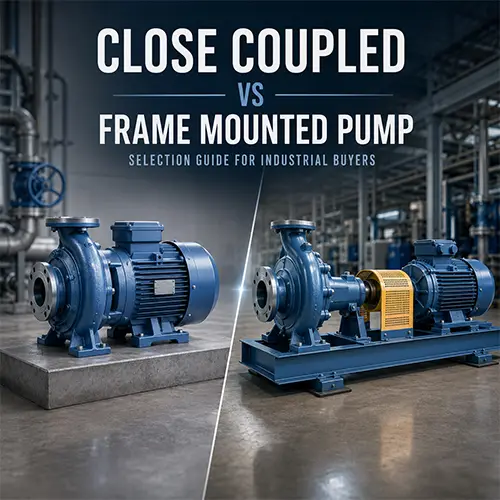
Close coupled vs frame mounted pump selection should be based on duty severity, installation space, maintenance strategy, alignment capability, and downtime cost—not only on the pump price. A close coupled pump is usually the better choice for compact, standard-duty clean water systems where low initial cost and easy installation matter most. A frame mounted pump is usually the better choice for continuous-duty, higher-power, maintenance-sensitive, or industrial systems where reliability and service access are more important than footprint.
For buyers, engineers, contractors, and maintenance teams, the real decision is not whether one design is “better” in every situation. The practical question is: which pump structure creates the lowest risk for this specific operating condition over the full service life of the system?
A wrong choice can increase vibration, shorten bearing life, make mechanical seal replacement difficult, create unexpected downtime, or force expensive piping and baseplate modifications later. A correct choice gives the buyer a pump that fits the hydraulic duty, matches the site layout, supports maintenance access, and reduces lifecycle cost.
Direct answer for buyers: Choose a close coupled pump when compactness, lower initial cost, and simple installation matter most. Choose a frame mounted pump when continuous operation, maintenance access, stronger mechanical support, and downtime control matter more.
30-Second Buyer Decision Table
A fast decision table helps procurement and engineering teams screen the correct pump structure before requesting quotations. It does not replace pump curve verification, but it prevents the most common mistake: choosing a compact pump for a heavy-duty system or overpaying for a frame mounted pump in a simple application.
| If Your Project Priority Is... | Better Choice | Why It Usually Fits |
|---|---|---|
| Lowest initial purchase cost | Close coupled pump | Fewer components and compact construction usually reduce unit cost. |
| Limited pump room space | Close coupled pump | Shorter overall length and smaller footprint. |
| Fast installation | Close coupled pump | Less alignment work and simpler mounting. |
| Standard clean water transfer | Close coupled pump | Good fit for moderate, stable operating conditions. |
| Compact packaged booster system | Close coupled pump | Easier to integrate into skid or packaged units. |
| Continuous industrial duty | Frame mounted pump | Better mechanical support and serviceability. |
| Higher motor power | Frame mounted pump | Separate bearing frame better supports larger loads. |
| Easier motor replacement | Frame mounted pump | Motor and pump are more independent. |
| Lower downtime risk | Frame mounted pump | Easier access for inspection, alignment, and repair. |
| Planned maintenance program | Frame mounted pump | Better for scheduled service and overhaul. |
The simplest rule is this: choose close coupled when compactness and initial cost dominate; choose frame mounted when serviceability, mechanical margin, and uptime dominate.
Key Takeaways for Buyers
These summary points are written as short, extractable decision statements. They help buyers, engineers, and procurement teams quickly understand the core difference before moving into technical details.
- A close coupled pump is a compact pump-motor design where the pump is directly connected to the motor.
- A frame mounted pump uses a separate pump bearing frame and a flexible coupling between the motor and pump.
- Close coupled pumps usually reduce footprint, installation time, and initial cost.
- Frame mounted pumps usually improve maintenance access, bearing support, and long-term serviceability.
- Close coupled pumps are usually suitable for standard-duty clean water service with small to medium motor power.
- Frame mounted pumps are usually preferred for continuous-duty, higher-power, industrial, or maintenance-sensitive systems.
- Poor coupling alignment on a frame mounted pump can cause vibration, bearing failure, and mechanical seal leakage.
- Using a close coupled pump outside its duty range can increase motor-side stress, repair difficulty, and downtime risk.
- The final selection should be based on flow, head, duty cycle, motor power, site space, maintenance capability, and downtime cost.
Scope of This Guide: Applicable Pump Types and Use Conditions
This guide mainly applies to centrifugal pumps used for clean water, cooling water, HVAC circulation, booster systems, irrigation, light industrial transfer, and general process water. It is especially useful when buyers are comparing close coupled and frame mounted versions of horizontal end suction centrifugal pumps.
The comparison is most relevant when the pump handles relatively clean, non-abrasive, low-viscosity liquid under standard or moderately demanding conditions.
| Pump / System Type | Applicability | Notes for Buyers |
|---|---|---|
| End suction centrifugal pumps | Highly applicable | Most common comparison area. |
| Clean water transfer pumps | Highly applicable | Close coupled and frame mounted versions are common. |
| HVAC circulation pumps | Applicable | Space and installation cost often matter. |
| Booster pump systems | Applicable | Close coupled designs are common in compact packages. |
| Cooling water systems | Applicable | Frame mounted may be safer for continuous industrial duty. |
| General industrial water transfer | Applicable | Duty cycle and maintenance access should be checked. |
| Light process water systems | Applicable with review | Liquid temperature and seal type must be verified. |
This guide is not sufficient by itself for slurry pumps, high-viscosity fluids, aggressive chemical liquids, explosive environments, high-temperature process systems, or API 610 process pump applications. In those cases, buyers must also evaluate material compatibility, shaft deflection, seal plan, bearing life, casing pressure rating, safety standards, and project-specific specifications.
If the buyer is still comparing pump categories before deciding the mechanical layout, this water pump types explained guide can help clarify how different pump types match different industrial applications before narrowing the decision to close coupled or frame mounted designs.
What Is a Close Coupled Pump?
A close coupled pump is a compact pump design where the pump end is directly mounted to the motor, and the impeller is often installed on or very close to the motor shaft. This layout removes the need for a separate long coupling arrangement and reduces the total footprint of the pump set.
For buyers, the value of a close coupled pump is simplicity. It usually needs less installation space, fewer mechanical parts, and less alignment work. This makes it attractive for building services, small booster systems, HVAC circulation, irrigation, and standard clean water transfer.
How a Close Coupled Pump Is Built
A close coupled pump integrates the motor and pump into a short assembly. In many designs, the motor shaft or a compact shaft extension supports the impeller, and there is no separate bearing frame between the motor and pump.
| Component / Feature | Close Coupled Pump Design |
|---|---|
| Motor-pump connection | Direct connection. |
| Coupling | Usually no separate flexible coupling. |
| Bearing frame | Often absent or highly compact. |
| Shaft support | More dependent on motor-side structure. |
| Footprint | Short and compact. |
| Installation | Relatively simple. |
| Alignment requirement | Usually minimal compared with frame mounted pumps. |
| Service access | More limited in many designs. |
This compact structure is not a weakness when the pump is used correctly. A close coupled pump can be reliable and cost-effective when the duty is moderate, the liquid is clean, the hydraulic condition is stable, and downtime risk is not severe.
Where Close Coupled Pumps Are Commonly Used
Close coupled pumps are commonly used where the system requires compact installation and standard-duty performance rather than heavy industrial serviceability.
| Application | Why Close Coupled Can Be Suitable |
|---|---|
| HVAC water circulation | Compact layout and moderate operating duty. |
| Booster systems | Easy integration into packaged units. |
| Irrigation | Lower initial cost and simple installation. |
| Building water supply | Space-saving design. |
| Light industrial transfer | Suitable when liquid and duty are stable. |
| Utility water systems | Practical for clean water movement. |
A close coupled pump is often the right choice when the buyer needs a reliable, compact pump for a standard clean water system and does not expect frequent disassembly or heavy-duty continuous operation.
What Is a Frame Mounted Pump?
A frame mounted pump is a pump design where the pump has its own bearing frame and is connected to the motor through a flexible coupling. The pump and motor are usually installed on a baseplate, and the motor shaft and pump shaft must be aligned during installation.
For industrial buyers, the value of a frame mounted pump is serviceability and mechanical support. It takes more space and requires more careful installation, but it is often better suited for larger motor power, continuous operation, higher downtime cost, and planned maintenance programs.
How a Frame Mounted Pump Is Built
A frame mounted pump separates the pump’s rotating assembly from the motor. The pump shaft is supported by its own bearings, while the motor transmits torque through a flexible coupling.
| Component / Feature | Frame Mounted Pump Design |
|---|---|
| Motor-pump connection | Flexible coupling. |
| Bearing frame | Separate pump bearing frame. |
| Shaft support | Independent pump-side support. |
| Baseplate | Usually required. |
| Alignment | Required during installation. |
| Footprint | Larger than close coupled design. |
| Maintenance access | Usually better. |
| Motor replacement | Usually easier. |
This design gives the pump more mechanical independence. In practical terms, maintenance teams can often inspect, align, service, or replace the motor and pump components with less disruption than with a compact integrated design.
Where Frame Mounted Pumps Are Commonly Used
Frame mounted pumps are common in industrial pump rooms, cooling water systems, municipal water transfer, process water circulation, and larger end suction pump installations.
| Application | Why Frame Mounted Is Often Preferred |
|---|---|
| Industrial process water | Better for planned maintenance and continuous operation. |
| Cooling water systems | More suitable when downtime is costly. |
| Larger end suction pumps | Stronger shaft and bearing support. |
| Municipal water transfer | Easier long-term maintenance planning. |
| Pump rooms with skilled technicians | Alignment and inspection can be properly managed. |
| Higher-power clean water systems | Better mechanical margin. |
For buyers comparing multiple centrifugal pump layouts, this end suction vs inline vs multistage pump guide can help explain how pump configuration affects installation space, pressure range, and maintenance strategy.
Close Coupled vs Frame Mounted Pump: Core Structural Differences
The core difference between a close coupled pump and a frame mounted pump is how the motor, shaft, bearings, coupling, and pump casing are arranged. This structure affects installation work, mechanical load distribution, vibration risk, repair access, and lifecycle cost.
Buyers should not compare only flow and head. Two pumps can meet the same hydraulic duty point but create very different maintenance outcomes because their mechanical structures are different.
Motor and Pump Connection
The motor-pump connection determines how torque is transferred from the motor to the impeller. In a close coupled pump, the connection is direct and compact. In a frame mounted pump, torque is transferred through a flexible coupling.
| Comparison Point | Close Coupled Pump | Frame Mounted Pump |
|---|---|---|
| Connection method | Direct motor-pump connection. | Motor and pump connected by coupling. |
| Coupling component | Usually absent or highly compact. | Flexible coupling required. |
| Alignment work | Simpler. | Required. |
| Installation time | Shorter. | Longer. |
| Mechanical flexibility | Lower. | Higher. |
| Service separation | Limited. | Better. |
This is why close coupled pumps are easier to install, while frame mounted pumps are usually easier to service in industrial environments.
Bearing Support and Shaft Load
Bearing support is a major engineering difference. A bearing supports the rotating shaft and helps control radial and axial loads during pump operation.
In a close coupled pump, the compact structure may place more load responsibility on the motor-side support. This can be acceptable for moderate duty, but it becomes more sensitive when the pump operates under high load, frequent starts, vibration, or poor hydraulic conditions.
In a frame mounted pump, the pump has its own bearing frame. This gives the rotating assembly stronger independent support and makes the design more suitable for larger loads and continuous service.
| Mechanical Factor | Close Coupled Pump | Frame Mounted Pump |
|---|---|---|
| Bearing support | More compact, often motor-side dependent. | Independent pump bearing frame. |
| Shaft load tolerance | Lower to moderate. | Usually higher. |
| Suitability for large motor power | More limited. | Better. |
| Long running hours | Depends on design and duty. | Usually stronger fit. |
| Repair access | More restricted. | Better. |
| Risk if misapplied | Motor stress, bearing load, difficult service. | Alignment-related failure if installed poorly. |
The buyer’s decision should be based on load path and service plan. If the pump is small and the duty is stable, close coupled is usually enough. If the system is critical, larger, or service-intensive, frame mounted construction usually provides a safer margin.
Baseplate, Footprint, and Service Clearance
Footprint is one of the most visible differences. Close coupled pumps are shorter and easier to fit into compact spaces. Frame mounted pumps require more length because they include the pump, bearing frame, coupling, coupling guard, motor, and baseplate.
However, larger footprint can be an advantage when maintenance access matters.
| Layout Factor | Close Coupled Pump | Frame Mounted Pump |
|---|---|---|
| Overall length | Shorter. | Longer. |
| Baseplate requirement | Smaller or simpler. | Larger and more important. |
| Coupling guard | Usually not needed in the same way. | Required. |
| Motor removal space | More limited. | Easier to plan. |
| Seal service space | Often tighter. | Usually better. |
| Alignment access | Minimal. | Required. |
A pump room should not be evaluated only by whether the pump can fit. Buyers should also ask whether the motor can be removed, the seal can be replaced, the coupling can be inspected, and technicians can work safely.
Installation Differences Buyers Should Check Before Ordering
Installation differences can turn a cheap pump into an expensive project. A close coupled pump usually reduces installation complexity, while a frame mounted pump requires more foundation, baseplate, and alignment attention.
Before confirming the order, buyers should check site layout, piping support, foundation quality, service clearance, and installer capability.
Space and Piping Layout
Space and piping layout affect pump reliability. Poor suction piping, pipe stress, unsupported valves, or inadequate maintenance clearance can shorten pump life even when the pump model is correct.
| Site Check | Why It Matters |
|---|---|
| Suction pipe layout | Poor suction condition can cause cavitation and vibration. |
| Discharge pipe support | Unsupported pipe load can distort pump casing. |
| Motor removal clearance | Important for future repair. |
| Seal access space | Required for leakage service. |
| Valve position | Affects operation and maintenance safety. |
| Lifting access | Important for motor or pump removal. |
| Baseplate levelness | Critical for frame mounted alignment. |
| Coupling guard clearance | Required for safe inspection. |
A close coupled pump is easier to place in small rooms, but it still needs correct piping support. A frame mounted pump needs more installation planning, but it offers better maintenance access when installed correctly.
Coupling Alignment Requirements
Coupling alignment is one of the most important installation requirements for a frame mounted pump. Alignment means adjusting the motor and pump shafts so that they rotate along the correct centerline within acceptable tolerance.
Poor alignment can cause: vibration, bearing overheating, mechanical seal leakage, coupling wear, higher power consumption, shaft stress, shorter service life, and unexpected shutdown.
A frame mounted pump is only as reliable as its installation quality. If the site lacks alignment tools, trained installers, or a stable baseplate, the pump may fail earlier than expected.
If the system has repeated vibration, bearing heating, or abnormal noise after installation, this pump bearing failure diagnosis guide can help maintenance teams check whether misalignment, lubrication, hydraulic load, or installation error is the real cause.
Maintenance and Repair: Which Pump Is Easier to Service?
Frame mounted pumps are usually easier to service in industrial environments because the motor, coupling, bearing frame, and pump end are more accessible. Close coupled pumps are simpler and compact, but the integrated structure can make certain repairs less flexible.
For buyers, the key issue is not only how often the pump may fail, but how quickly and safely the site team can repair it.
Motor Replacement and Access
Motor replacement is usually more convenient with a frame mounted pump because the motor and pump are separated by a coupling. In many installations, the motor can be removed without disturbing the pump casing or piping.
With a close coupled pump, the compact connection can make installation easy, but it may also require more disassembly when motor-side service is needed.
| Maintenance Factor | Close Coupled Pump | Frame Mounted Pump |
|---|---|---|
| Motor access | More compact and sometimes restricted. | Usually better. |
| Motor replacement | May require more integrated disassembly. | Often easier. |
| Pump-end access | Depends on design. | Usually better. |
| Service modularity | Lower. | Higher. |
| Best maintenance fit | Simple systems. | Industrial systems with planned service. |
If the pump is small and replacement is easy, close coupled maintenance may be acceptable. If the pump is critical and downtime is expensive, frame mounted service access usually creates lower operational risk.
Mechanical Seal Replacement
The mechanical seal prevents liquid from leaking along the rotating shaft. Seal failure is one of the most common service issues in centrifugal pumps.
A close coupled pump may have tighter access around the seal area. A frame mounted pump usually provides more room around the shaft, bearing frame, and seal chamber, which helps inspection and replacement.
Seal leakage is often not caused by the seal alone. It can be triggered by misalignment, dry running, cavitation, pipe stress, excessive vibration, wrong seal material, operation far from the best efficiency point, or poor suction condition.
For users evaluating long-term leakage risk, this pump seal leak troubleshooting guide explains how seal leakage often connects with alignment, dry running, vibration, and operating conditions.
Bearing Maintenance and Lubrication
Bearing maintenance is more visible in frame mounted pumps because the pump has its own bearing frame. Depending on the design, the bearing housing may require periodic inspection, lubrication, temperature checks, and vibration monitoring.
A close coupled pump may have fewer separate pump-side bearing maintenance points, but that does not mean the design is always easier to maintain. If motor-side bearing stress increases due to poor application fit, service can become more complicated.
Buyer questions to ask: What bearings are used? What is the lubrication method? Is the bearing frame grease-lubricated or oil-lubricated? What is the recommended inspection interval? Are bearing spare parts standard and available? What vibration or temperature limits should be monitored?
Reliability and Service Life: Which Design Lasts Longer?
Neither close coupled nor frame mounted construction automatically guarantees longer service life. Reliability depends on whether the pump design matches the duty point, operating hours, hydraulic condition, installation quality, and maintenance plan.
A close coupled pump can run reliably for years in the right system. A frame mounted pump can fail quickly if the coupling is misaligned, the baseplate is weak, or the pump operates far from its proper duty range.
When Close Coupled Pumps Are Reliable Enough
Close coupled pumps are reliable when the system is stable, moderate, and within the manufacturer’s recommended operating range.
- The liquid is clean water or similar non-abrasive fluid.
- The pump operates near its intended duty point.
- Motor power is small to medium according to the supplier’s range.
- Operating hours are moderate or predictable.
- The pump is not part of a highly critical system.
- Maintenance access is acceptable.
- Replacement is easier than complex repair.
- Space saving and initial cost are important.
In these conditions, a close coupled pump is not a compromise. It is a practical design that avoids unnecessary baseplate, coupling, and alignment complexity.
When Frame Mounted Pumps Provide Better Reliability Margin
Frame mounted pumps usually provide a better reliability margin when the system is larger, more critical, or more demanding.
- The pump runs continuously or close to 24/7.
- Motor power is higher.
- Downtime affects production or service delivery.
- Maintenance teams need easier access.
- Bearing support and shaft stability matter.
- The pump is installed in an industrial pump room.
- Scheduled maintenance is part of the operation plan.
- The site can perform proper coupling alignment.
The independent bearing frame helps manage mechanical load, while the flexible coupling allows better service separation between pump and motor.
Why Both Designs Can Fail If Misapplied
Both pump designs can fail if the buyer focuses only on flow and head while ignoring real operating conditions.
| Failure Cause | How It Affects the Pump |
|---|---|
| Operation far from duty point | Increases vibration, heat, and hydraulic instability. |
| Poor suction piping | Causes cavitation and seal damage. |
| Pipe stress | Distorts casing and affects alignment. |
| Poor foundation | Increases vibration. |
| Incorrect alignment | Damages coupling, bearings, and seal. |
| Wrong seal material | Causes leakage or chemical attack. |
| No maintenance clearance | Extends downtime and repair cost. |
| Wrong pump structure | Creates mechanical stress or unnecessary complexity. |
Reliability is not only a product feature. It is the result of correct selection, correct installation, correct operation, and correct maintenance.
Cost Comparison: Initial Price vs Total Ownership Cost
Close coupled pumps usually have lower initial cost, while frame mounted pumps may provide better lifecycle value in demanding systems. Buyers should compare the full cost of ownership instead of only the unit price.
Total ownership cost includes purchase price, installation labor, foundation work, alignment, downtime, maintenance labor, spare parts, repair speed, and replacement risk.
Initial Purchase Cost
Close coupled pumps are usually cheaper at the purchase stage because the design is simpler and more compact.
- Lower pump unit price.
- Fewer mechanical components.
- Smaller footprint.
- Lower installation labor.
- Less alignment work.
- Easier packaged system integration.
- Faster commissioning.
For standard clean water service, this lower initial cost can be the right business decision.
Installation and Commissioning Cost
Frame mounted pumps usually require more installation work. The baseplate must be properly supported, the motor and pump must be aligned, and the coupling guard must be installed safely.
- Baseplate preparation.
- Foundation leveling.
- Grouting.
- Coupling alignment.
- Piping support verification.
- Guard installation.
- Final alignment check after piping connection.
- Vibration inspection during commissioning.
These costs are not disadvantages if the application requires a frame mounted design. They are part of building a more serviceable and mechanically robust pump installation.
Maintenance and Downtime Cost
Frame mounted pumps may reduce long-term cost when downtime is expensive. Easier access to the motor, coupling, bearing frame, and pump end can shorten repair time and support planned maintenance.
| Cost Factor | Close Coupled Pump | Frame Mounted Pump |
|---|---|---|
| Purchase price | Usually lower. | Usually higher. |
| Installation labor | Lower. | Higher. |
| Alignment cost | Lower or minimal. | Required. |
| Foundation requirement | Simpler. | More important. |
| Maintenance access | Limited to moderate. | Better. |
| Motor service flexibility | Lower. | Higher. |
| Downtime control | Good for simple systems. | Better for critical systems. |
| Best cost logic | Lower initial investment. | Lower lifecycle risk in demanding service. |
The right financial decision depends on the application. If the pump is non-critical and simple, close coupled may be more economical. If downtime affects production, cooling, water supply, or customer delivery, frame mounted may create lower total cost over the life of the pump.
Real-World Selection Scenarios
Real project conditions often make the decision clearer than technical definitions. The following scenarios show how buyers can apply the selection logic in practical situations.
Scenario 1: Building HVAC Pump Room With Limited Space
A building services contractor needs a pump for HVAC water circulation in a compact mechanical room. The liquid is clean water, operating conditions are stable, motor power is moderate, and the project budget is controlled.
In this case, a close coupled pump is often the practical choice. It saves floor space, simplifies installation, and avoids unnecessary coupling alignment work. A frame mounted pump may be technically acceptable, but it may add footprint and installation complexity without meaningful benefit.
The buyer should still verify suction piping, isolation valves, service clearance, and motor access. Compact does not mean maintenance space can be ignored.
Scenario 2: 24/7 Industrial Cooling Water System
An industrial plant needs a pump for a cooling water loop that runs continuously. Downtime can stop production equipment, and the maintenance team follows a scheduled inspection program.
In this case, a frame mounted pump is usually the safer choice. The separate bearing frame, flexible coupling, and better service access support long operating hours and planned maintenance. The higher initial cost is easier to justify because downtime is expensive.
The buyer should check coupling alignment requirements, baseplate quality, bearing lubrication, mechanical seal type, and spare parts availability.
Scenario 3: Pump Replacement in an Existing Plant
A maintenance team wants to replace an old frame mounted pump with a close coupled pump because the close coupled quotation is cheaper. The flow and head seem similar on paper.
This decision requires caution. Even if the hydraulic performance appears similar, the original frame mounted pump may have been selected because of motor power, operating hours, service access, or mechanical load. Replacing it with a close coupled pump may reduce purchase cost but increase bearing stress, seal service difficulty, or downtime risk.
Before changing the structure, the buyer should review the existing duty point, motor power, operating hours, maintenance history, failure records, and available service clearance.
Scenario 4: Distributor Quoting for a Cost-Sensitive Project
A pump distributor receives a price-sensitive inquiry where the buyer asks for the cheapest pump that meets flow and head. The project is a small clean water transfer system with limited operating hours.
In this case, quoting a close coupled pump may be reasonable. However, the distributor should still ask about operating hours, liquid condition, site space, voltage, installation layout, and downtime impact. This protects both the buyer and the supplier from selecting a pump that meets the catalog point but does not match the real project risk.
Wrong Selection Consequences Buyers Should Avoid
Wrong pump structure selection can create problems that appear months after installation. These failures are often blamed on the pump brand, but the real cause may be a mismatch between design and duty.
Understanding the consequences helps buyers make a safer decision before purchase.
| Wrong Choice | Possible Result | Why It Happens |
|---|---|---|
| Close coupled pump used in heavy-duty continuous service | Bearing stress, seal leakage, shorter life. | Compact support may not match duty severity. |
| Frame mounted pump installed without proper alignment | Vibration, coupling wear, bearing failure. | Shaft centerlines are not correctly aligned. |
| Pump selected only by flow and head | Maintenance problems later. | Mechanical structure was ignored. |
| No service clearance planned | Longer downtime. | Technicians cannot access motor, seal, or coupling. |
| Wrong pump chosen for high downtime system | Expensive production interruption. | Initial cost was prioritized over lifecycle risk. |
| Frame mounted pump used in very tight space | Difficult installation and unsafe maintenance. | Layout does not support the design. |
| Close coupled pump used where motor separation is needed | More difficult repair. | Pump and motor are more integrated. |
Buyer warning: The cheapest correct pump is good value. The cheapest incorrect pump is usually expensive later.
Engineering Verification Checklist Before Final Selection
A strong pump decision requires document verification. Buyers should not confirm a close coupled or frame mounted pump based only on a quotation line, photo, or general catalog description.
The following checklist helps engineering, procurement, and maintenance teams verify the selection before purchase.
Hydraulic Verification
Hydraulic verification confirms whether the pump can meet the required flow and head without operating in an unstable or inefficient range.
| Check Item | What Buyer Should Verify |
|---|---|
| Rated flow | Matches system demand. |
| Rated head | Matches pressure requirement. |
| Pump curve | Duty point is within acceptable range. |
| Efficiency | Reasonable near the operating point. |
| NPSH requirement | Compatible with suction condition. |
| Operating range | Not too far left or right on the curve. |
| Liquid condition | Clean water or compatible fluid. |
A pump that meets one duty point on paper may still be a poor choice if it operates too far from its best efficiency region.
Mechanical Verification
Mechanical verification confirms whether the structure can support the expected duty and maintenance plan.
| Check Item | Close Coupled Focus | Frame Mounted Focus |
|---|---|---|
| Motor power | Within supplier’s recommended range. | Suitable for bearing frame and coupling. |
| Bearing support | Check motor-side load suitability. | Check bearing frame design. |
| Shaft arrangement | Confirm impeller mounting method. | Confirm pump shaft and coupling design. |
| Seal type | Check access and material. | Check seal chamber and service access. |
| Vibration risk | Check suction and pipe support. | Check alignment and baseplate. |
| Maintenance plan | Confirm replacement approach. | Confirm inspection and overhaul access. |
This is where many low-price comparisons fail. Two pumps may look similar in flow and head but differ greatly in mechanical serviceability.
Installation Verification
Installation verification confirms whether the site can support the selected pump structure.
| Check Item | What Buyer Should Verify |
|---|---|
| General arrangement drawing | Footprint, height, nozzle position, service space. |
| Foundation | Stable, level, and suitable for pump size. |
| Baseplate | Required quality for frame mounted pump. |
| Pipe support | No excessive pipe stress on pump casing. |
| Coupling guard | Required for frame mounted safety. |
| Alignment access | Enough room for tools and inspection. |
| Motor removal path | Enough clearance for future maintenance. |
| Valve position | Safe and accessible operation. |
A frame mounted pump with poor installation can fail faster than a close coupled pump in a proper standard-duty system.
Maintenance Verification
Maintenance verification confirms whether the buyer can service the pump during its expected life.
| Check Item | Why It Matters |
|---|---|
| Spare parts list | Supports long-term maintenance planning. |
| Seal availability | Reduces leakage repair downtime. |
| Bearing availability | Important for frame mounted pumps. |
| Coupling element | Required for frame mounted maintenance. |
| Motor replacement method | Affects downtime. |
| Recommended inspection interval | Helps plan preventive maintenance. |
| Lubrication method | Affects bearing service life. |
| Warranty terms | Clarifies responsibility for installation-related issues. |
If buyers need to evaluate pump material at the same time, this cast iron vs stainless steel pump guide can help compare corrosion risk, lifecycle cost, and material suitability for different water conditions.
Supplier Questions Buyers Should Ask Before Confirming the Order
A reliable supplier should help buyers verify whether close coupled or frame mounted construction fits the real operating condition. Buyers should ask technical questions before confirming model, price, and delivery schedule.
Good questions reduce selection risk and make quotations more comparable.
Technical Questions for Close Coupled Pumps
For close coupled pumps, buyers should focus on duty limits, motor-side support, seal access, and service practicality.
- What is the recommended motor power range for this close coupled model?
- Is the impeller mounted directly on the motor shaft or on a shaft extension?
- What operating duty is this design intended for?
- Is the pump suitable for continuous operation?
- What liquid temperature range is allowed?
- What seal type is supplied?
- How is the mechanical seal accessed during replacement?
- Can the motor be replaced separately?
- What are the common spare parts?
- What installation clearance should be reserved?
Technical Questions for Frame Mounted Pumps
For frame mounted pumps, buyers should focus on bearing frame design, alignment, baseplate, coupling, and maintenance access.
- What bearing frame size is used?
- What coupling type is supplied?
- What alignment tolerance should be followed?
- Is the baseplate included?
- Is grouting required?
- What bearing lubrication method is used?
- What is the recommended bearing inspection interval?
- Can the motor be removed without disturbing the pump casing?
- Is a coupling guard supplied?
- What vibration limits should be checked after commissioning?
Document Checklist Before Purchase
Buyers should request documents that prove the pump can match the hydraulic duty, mechanical load, and installation condition.
| Document | Why It Matters |
|---|---|
| Pump curve | Confirms flow, head, efficiency, and operating range. |
| General arrangement drawing | Confirms footprint, nozzle position, and maintenance space. |
| Motor specification | Confirms power, voltage, speed, insulation, and efficiency. |
| Material list | Confirms corrosion and wear suitability. |
| Mechanical seal specification | Confirms leakage control and liquid compatibility. |
| Bearing/frame details | Confirms mechanical support. |
| Coupling specification | Important for frame mounted pumps. |
| Installation manual | Confirms foundation, alignment, and piping requirements. |
| Spare parts list | Supports long-term maintenance planning. |
| Test report | Confirms factory performance verification. |
| Warranty terms | Clarifies responsibility and exclusions. |
A supplier who cannot provide these documents may still sell a pump, but the buyer carries more technical risk.
Close Coupled Pump Advantages and Limitations
Close coupled pumps offer strong value when the project requires compactness, simple installation, and lower initial cost. Their limitations appear when the application requires higher service flexibility, stronger bearing support, or frequent maintenance.
Buyers should evaluate both sides before deciding.
Main Advantages of Close Coupled Pumps
Close coupled pumps are often selected because they simplify the overall pump package.
- Compact footprint.
- Lower initial cost in many cases.
- Faster installation.
- Fewer separate mechanical components.
- Reduced alignment complexity.
- Good fit for packaged systems.
- Practical for standard-duty clean water service.
These advantages are valuable when the system is not mechanically demanding and the buyer wants efficient project execution.
Main Limitations of Close Coupled Pumps
Close coupled pumps become less attractive when the system requires frequent service, larger motor power, or high downtime protection.
- Less flexible motor and pump separation.
- More restricted service access.
- Lower mechanical margin for demanding duty.
- Greater sensitivity if applied outside design range.
- Potentially more difficult seal or motor-side service.
- Not ideal for many heavy-duty continuous applications.
A close coupled pump should be selected because it matches the job—not just because it is cheaper.
Frame Mounted Pump Advantages and Limitations
Frame mounted pumps provide stronger serviceability and mechanical support, but they also require more space, more installation work, and proper alignment. Their value is highest when the application justifies the additional complexity.
Buyers should avoid both under-specifying and over-specifying.
Main Advantages of Frame Mounted Pumps
Frame mounted pumps are often selected for industrial systems because they support long-term maintenance and heavier mechanical duty.
- Separate pump bearing frame.
- Better service access.
- Easier motor replacement in many layouts.
- More suitable for higher motor power.
- Better fit for continuous operation.
- More practical for planned maintenance.
- Stronger mechanical margin in demanding systems.
These advantages matter most when downtime is expensive or the pump is part of a critical process.
Main Limitations of Frame Mounted Pumps
Frame mounted pumps are not always the best choice. They increase space requirement and installation complexity.
- Higher initial purchase cost.
- Larger footprint.
- Coupling alignment required.
- More installation labor.
- More foundation and baseplate attention.
- Higher risk if alignment is done poorly.
- Not necessary for many small standard-duty systems.
A frame mounted pump is a good investment only when the application needs the serviceability and mechanical margin it provides.
Best Option by Application Scenario
Application-based selection is often more useful than a generic advantage list. Buyers should match the pump structure to the real service condition.
| Application Scenario | Recommended Design | Reason |
|---|---|---|
| Small clean water transfer | Close coupled | Lower cost and compact structure. |
| Building HVAC circulation | Close coupled | Space-saving and easy installation. |
| Packaged booster unit | Close coupled | Better fit for compact skid design. |
| Irrigation pump station with moderate duty | Close coupled | Practical and economical. |
| Industrial cooling water loop | Frame mounted | Better for continuous operation. |
| Larger end suction pump installation | Frame mounted | Better shaft and bearing support. |
| Municipal transfer system | Frame mounted | Easier long-term maintenance. |
| High downtime cost application | Frame mounted | Better serviceability. |
| Site with no alignment capability | Close coupled | Lower alignment complexity. |
| Pump room with planned maintenance access | Frame mounted | Easier inspection and overhaul. |
The best choice is not the one with the most features. The best choice is the one that matches the actual duty, site condition, and maintenance capability.
When NOT to Choose a Close Coupled Pump
A close coupled pump should not be selected only because it is compact or low-cost. If the application is too demanding, the lower initial price may lead to higher lifetime cost.
- The system requires heavy-duty continuous operation.
- The motor power is outside the recommended range.
- Downtime cost is high.
- Frequent seal or bearing maintenance is expected.
- The pump is installed in a difficult-to-access location.
- The system has vibration sensitivity.
- The liquid condition is not clean or stable.
- The buyer needs easy motor-pump separation.
- The pump is replacing a frame mounted unit without engineering review.
The risk is not that close coupled pumps are poor. The risk is using a compact design where the system requires industrial serviceability.
When NOT to Choose a Frame Mounted Pump
A frame mounted pump should not be selected only because it looks more industrial. If the application is simple, compact, and standard-duty, the additional cost and alignment work may not provide enough value.
- The pump room is too tight.
- The system is small and non-critical.
- The site lacks alignment tools or trained installers.
- The buyer needs a compact packaged solution.
- Installation speed is more important than long-term service access.
- The duty does not justify higher mechanical complexity.
- The total project budget cannot support foundation and alignment work.
The risk is not that frame mounted pumps are too complicated. The risk is paying for serviceability that the system does not actually need.
Practical Procurement Checklist Before Final Decision
Procurement teams should use a checklist that connects technical risk with purchasing decisions. This prevents price-only comparison and helps suppliers quote the correct design.
| Procurement Question | Why It Matters | Better Choice If Answer Is “Yes” |
|---|---|---|
| Is the pump room very limited? | Footprint affects installation. | Close coupled. |
| Is the system standard clean water service? | Duty is moderate. | Close coupled. |
| Is the pump part of a compact package? | Space and simplicity matter. | Close coupled. |
| Is continuous operation expected? | Service reliability matters. | Frame mounted. |
| Is downtime expensive? | Repair speed matters. | Frame mounted. |
| Is motor power higher? | Bearing support matters. | Frame mounted. |
| Is planned maintenance required? | Service access matters. | Frame mounted. |
| Does the site lack alignment tools? | Frame mounted risk increases. | Close coupled. |
| Can the supplier provide GA drawing and pump curve? | Verifies real suitability. | Required for both. |
| Are spare parts available? | Reduces maintenance risk. | Required for both. |
A good procurement decision balances cost, risk, maintenance, and uptime. A low-price quotation is valuable only when the pump structure is technically suitable.
FAQ About Close Coupled vs Frame Mounted Pumps
These questions reflect real buyer concerns before confirming a pump order. The answers focus on selection, cost, maintenance, reliability, and replacement risk.
Is a frame mounted pump always better than a close coupled pump?
No, a frame mounted pump is not always better. It is usually better for larger, continuous, higher-power, or maintenance-sensitive systems, but it may be unnecessary for compact standard-duty applications.
A close coupled pump can be the better choice when the liquid is clean, the operating duty is moderate, space is limited, and low initial cost is important.
Is a close coupled pump always cheaper?
A close coupled pump is usually cheaper at the initial purchase and installation stage, but it is not always cheaper over the full service life.
If the pump is used in a demanding system where maintenance access is poor or downtime is expensive, the lifecycle cost may become higher than expected. Buyers should compare purchase price, installation cost, maintenance labor, spare parts, and downtime risk.
Does a frame mounted pump require coupling alignment?
Yes, a frame mounted pump usually requires coupling alignment between the motor and pump shaft. Alignment should be checked during installation and often rechecked after piping connection because pipe stress can shift the pump or motor position.
Poor alignment can cause vibration, bearing failure, mechanical seal leakage, coupling wear, and higher energy consumption.
Which pump type is better for continuous operation?
A frame mounted pump is usually preferred for continuous operation, especially when the system has higher motor power, high downtime cost, or planned maintenance requirements.
However, the final decision should still be confirmed by the pump curve, bearing design, seal type, motor specification, installation layout, and supplier recommendation.
Which pump type is better for limited space?
A close coupled pump is usually better for limited space because it has a shorter overall length and more compact layout.
However, buyers should still reserve enough space for motor access, seal replacement, valve operation, and safe maintenance. A pump that fits physically but cannot be serviced properly can still create long-term problems.
Can I replace a frame mounted pump with a close coupled pump?
Yes, but only after engineering review. The buyer must verify flow, head, motor power, operating hours, downtime cost, piping layout, service access, and the reason the original pump was frame mounted.
If the original frame mounted pump was selected for heavy-duty service, continuous operation, or maintenance access, replacing it with a close coupled pump may increase mechanical and service risk.
Can I replace a close coupled pump with a frame mounted pump?
Yes, but the site may need more space, a larger baseplate, coupling alignment access, piping adjustment, and motor clearance.
This upgrade can make sense when the existing close coupled pump is difficult to service, undersized for the duty, or failing repeatedly due to mechanical stress. However, the buyer should check the general arrangement drawing before purchase.
Which design is better for reducing downtime?
Frame mounted pumps usually provide better downtime control in industrial systems because the motor, coupling, bearing frame, and pump end are easier to access and service separately.
Close coupled pumps may still reduce downtime in small non-critical systems because the entire unit can sometimes be replaced quickly. The correct answer depends on whether the site prefers quick replacement or repairable serviceability.
Is close coupled pump maintenance difficult?
Close coupled pump maintenance is not necessarily difficult, but it can be less flexible than frame mounted pump maintenance. The compact design may limit access to the seal area, motor interface, or pump end depending on the model.
For simple applications, this is usually acceptable. For frequent maintenance or critical operation, buyers should check service access before selecting the pump.
Why do some engineers prefer frame mounted pumps?
Engineers often prefer frame mounted pumps in industrial systems because the design provides better bearing support, easier alignment inspection, better service access, and more flexible motor replacement.
This preference is not about appearance. It is based on long-term maintenance, reliability margin, and downtime control.
What information should I send to a supplier before asking for a quotation?
Buyers should send the required flow, head, liquid type, temperature, motor voltage, operating hours, installation layout, available space, suction condition, and whether the system is critical.
The supplier should also know whether the buyer prioritizes low initial cost, compact installation, continuous operation, or easier maintenance. Without this information, the supplier may quote a pump that meets the basic duty point but does not match the real project risk.
Which pump design is better for procurement teams under budget pressure?
If the system is small, clean, non-critical, and space-limited, a close coupled pump may be the better value. If downtime is expensive, motor power is higher, or the pump runs continuously, a frame mounted pump may be the safer investment even if the initial price is higher.
Procurement teams should not compare only unit price. They should compare the cost of installation, maintenance, spare parts, repair time, and downtime.
Conclusion: How Buyers Should Make the Final Choice
Close coupled vs frame mounted pump selection should be decided by duty severity, installation space, maintenance access, alignment capability, motor power, and downtime cost. A close coupled pump is usually the right choice when the buyer needs a compact, cost-effective, easy-to-install pump for standard-duty clean water service. A frame mounted pump is usually the right choice when the buyer needs stronger mechanical support, easier maintenance, and better long-term reliability for industrial or continuous-duty operation.
The safest buyer decision process is:
- Confirm the required flow and head.
- Check the duty point on the pump curve.
- Identify whether the system is standard-duty or heavy-duty.
- Confirm liquid condition, temperature, and material requirement.
- Evaluate available pump room space and maintenance clearance.
- Check whether the site can perform coupling alignment.
- Compare initial cost with downtime and maintenance cost.
- Request pump curve, GA drawing, seal specification, bearing details, and spare parts list.
- Ask the supplier whether the selected structure matches the real operating condition.
- Choose the design that creates the lowest lifecycle risk.
Final buyer takeaway: Close coupled pumps are best for compact standard-duty systems, while frame mounted pumps are best for industrial systems where serviceability and reliability matter more than footprint.
Get A Quote

Get A Quote
0 Comments