
Why Is My Pump Losing Prime? Causes, Troubleshooting & Fixes (Complete Guide for Buyers)
Introduction
If your pump keeps losing prime, requires repeated manual priming, or runs without delivering stable flow, the issue is not random—it is a clear sign that your system is unstable.
In industrial, agricultural, and diesel pump systems, “losing prime” is one of the most common and most misunderstood problems. Many users replace the pump, but the problem remains.
A pump loses prime when it cannot maintain a continuous liquid column in the suction line due to air entry, suction instability, or system design limitations.
In most cases, the root cause is not the pump itself, but:
- suction leakage
- incorrect suction design
- faulty valves
- pipe layout problems
This guide will help you:
- understand why pumps lose prime
- follow a step-by-step troubleshooting process
- identify whether the issue is pump or system related
- decide whether to repair, replace, or redesign
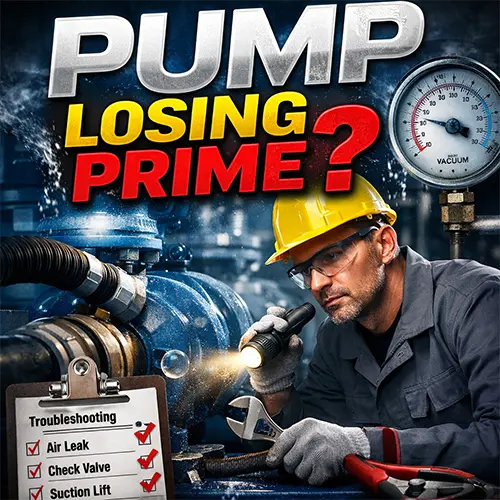
Pump Losing Prime Troubleshooting Flow (Start Here)
Before checking individual causes, follow this priority path to avoid wasting time.
Step-by-Step Flow
- Check suction line for air leakage
- Check foot valve / check valve condition
- Measure actual suction lift
- Inspect suction blockage
- Evaluate pipe design
Start from sealing and suction conditions first. Over 70% of priming problems are found in the first two steps.
Pump Losing Prime Due to Air Leakage in Suction Line (Causes & Troubleshooting)
Air leakage is the most common reason a pump loses prime, and often the hardest to detect.
Why It Happens
A centrifugal pump relies on a sealed suction system to maintain a continuous liquid column.
When air enters:
- vacuum stability is lost
- liquid column breaks
- flow becomes unstable or stops
Even very small leaks can cause failure, and they often do not show visible water leakage.
How to Troubleshoot (Step-by-Step)
Step 1: Inspect all suction joints
Check:
- flanges
- threaded connections
- flexible hoses
- seal interfaces
Step 2: Look for indirect signs
- bubbles in discharge
- unstable pressure
- intermittent flow
Step 3: Temporary sealing test
Apply temporary seal (tape/grease) to suspected joints
→ If performance improves → leakage confirmed
Step 4: Check vacuum stability
If vacuum cannot be maintained → air ingress exists
What the Result Means
| Observation | Diagnosis |
| Flow improves after sealing | Air leakage confirmed |
| Intermittent vacuum | Partial leakage |
| No change | Check next cause |
What to Do Next
- Reseal all joints
- Replace gaskets
- Use high-quality fittings
In most cases, losing prime is caused by suction leakage, not pump failure.
Pump Losing Prime Because of Excessive Suction Lift (Diagnosis Guide)
If suction height exceeds pump capability, the pump cannot maintain stable priming.
Why It Happens
Pumps do not actively pull liquid upward. They depend on:
- atmospheric pressure
- available NPSH
If suction lift is too high:
- pressure drops below safe level
- vapor or air forms
- liquid column breaks
How to Troubleshoot
Step 1: Measure suction height
Distance from liquid surface to pump centerline
Step 2: Compare with pump limit
Check pump specifications
Step 3: Observe performance vs liquid level
- Works when tank full
- Fails when level drops
Step 4: Check temperature effect
Higher temperature → lower suction performance
What the Result Means
| Observation | Diagnosis |
| Works only at high level | Suction lift too high |
| Worse at high temperature | NPSH issue |
| Always unstable | Design mismatch |
What to Do Next
- Lower pump position
- Reduce suction height
- Optimize suction piping
If suction lift exceeds limits, no pump can maintain prime reliably.
Pump Losing Prime Due to Faulty Foot Valve or Check Valve
A failed valve allows liquid to drain back, causing loss of prime after shutdown.
Why It Happens
Foot/check valves are designed to:
- keep suction line filled
- prevent backflow
Failure leads to:
- liquid draining back
- air entering
- dry startup
How to Troubleshoot
Step 1: Stop pump and observe
Does liquid drain back?
Step 2: Restart test
Does pump need priming every time?
Step 3: Inspect valve
Check for:
- wear
- debris
- sealing failure
What the Result Means
| Observation | Diagnosis |
| Needs priming every restart | Valve failure |
| Slow drain-back | Partial leak |
| Stable | Not the cause |
What to Do Next
- Replace valve
- Clean debris
- Upgrade valve quality
Repeated priming after shutdown almost always indicates valve failure.
Pump Losing Prime Due to Suction Blockage (How to Check)
Blockage increases resistance and disrupts suction stability.
Why It Happens
Blocked suction causes:
- pressure drop
- unstable flow
- air entrainment
How to Troubleshoot
Step 1: Inspect strainer
Step 2: Check intake debris
Step 3: Compare before/after cleaning
Step 4: Monitor pressure changes
What the Result Means
| Observation | Diagnosis |
| Flow improves after cleaning | Blockage confirmed |
| No change | Continue diagnosis |
What to Do Next
- Clean regularly
- Improve filtration
Pump Losing Prime Due to Improper Suction Pipe Design
Poor pipe design creates air traps and unstable flow.
Why It Happens
Common design mistakes:
- high points (air pockets)
- sharp bends
- undersized pipe
- improper slope
These cause:
- trapped air
- unstable suction
How to Troubleshoot
Step 1: Inspect pipe routing
Step 2: Identify high points
Step 3: Check pipe diameter
Step 4: Evaluate layout
What the Result Means
| Observation | Diagnosis |
| Air pockets found | Design issue |
| Repeated priming failure | Layout problem |
What to Do Next
- Redesign piping
- Remove high points
- Increase pipe diameter
Pipe design is one of the most underestimated causes of priming failure.
Common Installation Mistakes That Cause Pump Losing Prime
Many priming problems come from simple but critical installation mistakes.
Typical Mistakes
- suction pipe with upward loop
- too many elbows
- incorrect valve type
- poor sealing
- pipe too small
What to Do Next
If your system matches these issues, redesign is more effective than repeated repair.
Pump Losing Prime: Pump Problem vs System Problem
Most priming failures are system-related.
| Symptom | Pump Issue | System Issue |
| Losing prime | Rare | Common |
| Air in suction | No | Yes |
| Drain-back | No | Yes |
Replacing the pump without fixing the system will not solve the problem.
Real Case: Pump Losing Prime Every Day
A real example shows why correct diagnosis matters.
A diesel pump system required daily priming.
Root Cause
Small suction flange leak
Result
After sealing → problem solved
The issue was installation, not equipment.
FAQ – Pump Losing Prime
Most pump losing prime issues are not caused by the pump itself, but by suction system instability, air leakage, or improper installation. The questions below reflect real-world problems faced by operators and buyers.
Why does my pump lose prime every time after shutdown?
This usually indicates that liquid is draining back through a faulty foot valve or check valve, or air is entering the suction line through small leaks.
If the pump requires re-priming after every stop, the issue is almost always related to valve failure or suction sealing problems, not the pump itself.
Why does my pump start normally but lose flow after a few minutes?
This indicates unstable suction conditions.
At startup, the suction pipe is filled with liquid, but during operation:
- air may enter through leaks
- suction pressure may drop
- liquid column breaks
This is typically caused by air leakage, excessive suction lift, or poor pipe design.
Why does the problem only happen when the water level drops?
As the liquid level decreases, the suction lift increases.
Once the suction height exceeds the pump’s capability:
- vacuum becomes insufficient
- liquid cannot be sustained
- the pump loses prime
This is a design limitation issue, not a pump defect.
I replaced the pump but still have the same problem. Why?
Because the root cause is in the system, not the pump.
Most common causes:
- suction air leakage
- incorrect piping layout
- faulty valves
- excessive suction lift
Replacing the pump without fixing these issues will not solve the problem.
Can losing prime damage the pump?
Yes. Losing prime can lead to:
- dry running
- overheating
- mechanical seal failure
Repeated priming failure significantly reduces pump lifespan.
Do I need a self-priming pump to solve this problem?
Not necessarily.
If the system design is incorrect (air leaks, bad piping, excessive suction lift), even a self-priming pump will not work reliably.
Self-priming pumps help with startup, but cannot compensate for poor system design.
What is the fastest way to fix a pump losing prime?
Follow this priority:
- Check suction sealing (most common cause)
- Check valve condition
- Measure suction lift
- Inspect pipe design
Fixing sealing and suction conditions solves most problems without replacing equipment.
Conclusion: Pump Losing Prime Is a System Problem, Not a Pump Problem
If your pump is losing prime, the issue is rarely the pump itself. It is almost always caused by suction system instability, installation errors, or design limitations.
What This Means for You (Buyer Perspective)
If you are:
- repeatedly priming your pump
- experiencing unstable flow
- replacing pumps without solving the issue
Then the real problem is likely:
- suction leakage
- improper piping design
- excessive suction lift
- valve failure
What You Should Do Next
Instead of replacing the pump blindly, follow a structured approach:
- Fix suction sealing first
- Verify valve performance
- Check suction height limits
- Evaluate pipe layout
Critical Decision Insight
Replacing a pump without correcting system conditions will not solve priming problems.
In many real-world cases:
- The pump is replaced
- The problem remains
- Costs increase unnecessarily
Final Recommendation
If you want a stable, reliable pump system:
- Focus on system design, not just equipment
- Ensure airtight suction conditions
- Avoid installation mistakes
Closing Statement
A stable pump system is not defined by the pump you buy,
but by how well your system is designed, installed, and maintained.
Get A Quote

Get A Quote
0 Comments