
How to Select a Long-Term Pump Supplier
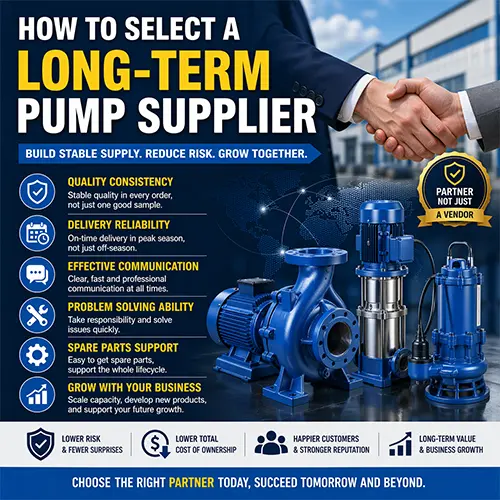
A Smart Buyer’s Guide to Build Stable Supply, Reduce Risk, and Grow Profitably for Years
Many companies spend significant time choosing the right pump model, but far less time choosing the right pump supplier. That imbalance often becomes expensive later.
A pump can be replaced. A weak supplier relationship can damage delivery schedules, create customer complaints, increase internal workload, and slow business growth for years.
Many buyers still focus mainly on:
- lowest quotation today
- fastest promised delivery
- attractive first sample
- aggressive sales promises
Those factors matter, but they do not answer the most important business question:
Can this supplier help my company succeed for the next three to five years?
That is the real decision.
For distributors, importers, EPC contractors (Engineering, Procurement, and Construction project companies), OEM brands (companies selling products under their own brand name), wholesalers, and procurement teams, a supplier should do more than ship products.
A valuable long-term supplier should help create:
- stable quality
- predictable delivery schedules
- faster problem solving
- lower operational risk
- stronger customer confidence
- easier business expansion
This guide explains how smart buyers evaluate pump suppliers for long-term partnership value—not only one-time transactions.
Why Long-Term Supplier Selection Matters More Than One Cheap Order
A low-cost first order may look successful, while future orders create larger problems. Long-term supplier quality determines repeat business, profit stability, and management efficiency.
Many buyers celebrate a good first order because:
- price looked competitive
- shipment arrived on time
- sample quality seemed acceptable
- communication felt smooth
Then second or third orders create issues such as:
- quality inconsistency
- longer lead times
- unavailable spare parts
- slower technical support
- unexpected price increases
- difficult warranty claims
This happens because short-term success and long-term reliability are not the same thing.
Re-Sourcing Is Expensive
Re-sourcing means replacing one supplier with another and restarting the qualification process.
That often creates hidden costs:
- testing new products again
- approving new specifications
- redesigning packaging
- updating manuals and labels
- training internal sales teams again
- customer hesitation
- lost selling time
Changing suppliers repeatedly often costs more than staying with a stable one.
Consistency Builds Customer Trust
If customers receive stable quality every shipment, confidence grows.
If every batch feels different, trust drops quickly—even if price remains low.
Long-Term Partners Improve Over Time
Strong supplier relationships often become more efficient because both sides learn each other’s systems:
- forecast timing
- packaging preferences
- document formats
- quality expectations
- reorder cycles
That lowers friction and increases profit.
What Makes a Supplier Long-Term Worthy
A long-term supplier is not just a factory. It is an operating partner that helps your business run smoothly year after year.
Many suppliers can ship one container. Far fewer can support five years of repeat business without creating major headaches.
The most valuable suppliers usually combine product capability with business reliability.
Core Traits of a Strong Long-Term Supplier
They usually offer:
- stable quality
- predictable lead time
- honest communication
- professional problem solving
- spare-parts continuity
- growth capability
Long-Term Buying Truth
The best supplier is not always the cheapest.
It is often the supplier who creates the fewest expensive surprises.
Step 1: Evaluate Quality Consistency, Not Just One Good Sample
One strong sample proves very little. Repeat production quality is what protects your business.
Many buyers receive a good sample and assume future production will always match it. That assumption is risky.
Samples are often prepared carefully. Mass production tests the real system.
Batch-to-Batch Stability
A batch means one production lot or one group of units made together.
Ask whether materials, motors, seals, bearings, and assembly standards remain consistent between different orders.
Material Consistency
Two pumps may look the same externally while metal thickness, coating quality, or internal parts change.
Performance Repeatability
Flow rate means how much water moves. Head means how strongly the pump pushes water upward or through resistance.
These values, along with vibration and noise, should remain stable over repeated orders.
Complaint Rate Trend
Ask whether complaint rates remain low and controlled over time.
Buyer Action
Do not ask only:
Is the sample good?
Ask:
How do you keep the next ten orders at the same quality level?
Step 2: Check Delivery Reliability Across Busy Seasons
Many suppliers deliver well during slow months but struggle during busy seasons.
Any supplier can promise fast delivery when the factory is quiet. Real capability appears when demand rises and schedules become crowded.
Normal Lead Time
Lead time means the time between confirmed order and shipment.
Ask for normal production timing during standard months.
Peak Season Lead Time
Ask what happens during the busiest months of the year.
Production Scheduling Ability
Scheduling means how the factory organizes machines, labor, and orders.
Strong factories usually have clearer planning systems.
Export Experience
Experienced exporters usually manage shipping documents, packaging, and bookings better.
Buyer Action
Ask directly:
What is your average lead time, and what is your worst-case lead time during peak season?
That often reveals maturity quickly.
Step 3: Evaluate Communication Quality
Long-term supplier relationships often fail because of communication problems before product problems.
Even good products become difficult if communication is weak.
Reliable Response Speed
Not necessarily instant replies, but consistent and dependable answers.
Technical Accuracy
Replies should be clear and based on product knowledge, not guesses.
Transparency During Problems
Strong suppliers warn buyers early about delays or risks instead of hiding them.
Clear Trade Language
Especially important for:
- payment terms
- warranty wording
- technical specifications
- shipping marks
- packaging instructions
Buyer Action
Observe communication quality during the first month. That period often predicts the future relationship.
Step 4: Judge How They Handle Problems
Every supplier will face issues eventually. The difference is how they respond.
No factory is perfect forever. Strong suppliers solve issues professionally. Weak suppliers delay, deny, or blame.
Investigate Facts Quickly
They ask for:
- serial number (tracking number for the product)
- photos
- videos
- operating conditions
- batch details
Explain Root Cause
Root cause means the original reason a problem happened.
They investigate whether the issue came from:
- material defect
- assembly error
- transport damage
- installation mistake
- wrong application use
Offer Corrective Action
Corrective action means practical steps to solve and prevent repeat issues.
Examples include:
- replacement parts
- credit note
- technical guidance
- process improvement
Accept Responsibility Fairly
They do not automatically blame the buyer.
Buyer Action
Ask:
Can you share an example of how you handled a warranty claim?
The answer often reveals company culture.
Step 5: Check Spare Parts and Lifecycle Support
Many buyers underestimate spare-parts support until pumps begin aging in the field.
A product line without spare-parts support becomes difficult to sell long-term.
Common Wear Parts Availability
Wear parts are components that naturally wear over time, such as:
- mechanical seals (rotating anti-leak seals)
- bearings (shaft support components)
- gaskets (flat sealing parts)
- capacitors (electrical start-support parts on some motors)
Old Model Support
Can the supplier still support pumps sold two or three years ago?
Manuals and Drawings
Useful for service teams and technical support.
Buyer Action
Ask for a spare-parts list before committing to a long-term product line.
Step 6: Assess Whether the Supplier Can Grow With You
A supplier that fits today may fail tomorrow if your company expands.
Many buyers begin with small orders, then later need:
- larger monthly volume
- OEM branding
- custom packaging
- new product categories
- faster replenishment
- support for multiple countries
Can Production Scale?
If your sales double, can they support the new volume?
Can They Handle OEM Projects?
OEM means manufacturing products under your brand.
This requires label control, packaging discipline, and document accuracy.
Can They Develop New Products?
Growth often requires additional pump categories later.
Can They Support Different Markets?
Different countries may need different voltage, manuals, labels, or certifications.
Certification means official compliance approval for certain markets.
Buyer Action
Choose suppliers based on future fit—not only current fit.
Step 7: Review Financial and Operational Stability
Unstable suppliers create invisible long-term risk.
Acceptable quality today does not guarantee continuity tomorrow.
Years in Business
Not a guarantee, but useful context.
Factory or Trader Structure
Both can work, but buyers should understand who controls production.
Staff Stability
Frequent staff turnover often damages continuity.
Export Market Diversity
Suppliers dependent on one market may be more vulnerable.
Process Discipline
This includes:
- order tracking
- document control
- QC systems (quality control systems used to maintain consistency)
- structured management
Buyer Action
You do not need private financial records. You need visible signs of operational seriousness.
Red Flags That Suggest Poor Long-Term Fit
Some suppliers may be acceptable for one urgent order but risky for long-term partnership.
Frequent Unexpected Price Changes
This may signal weak cost control or unstable strategy.
Inconsistent Technical Answers
Different answers from different staff often indicate weak systems.
No Spare-Parts Planning
This creates future service problems.
Reactive Behavior Only
If the supplier only reacts after problems happen, risk remains high.
Quality Changes After First Order
This is a major warning sign.
Salesperson Leaves and Service Collapses
If one person holds the whole relationship together, continuity risk is high.
Buyer Action
One red flag may be manageable. Several together deserve caution.
How Smart Buyers Compare Two Suppliers for 3-Year Value
Use a long-term scorecard, not only first-order pricing.
| Factor | Supplier A | Supplier B |
| Price Today | Lower | Higher |
| Quality Stability | Medium | Strong |
| Delivery Reliability | Medium | Strong |
| Support Speed | Weak | Strong |
| Spare Parts Support | Weak | Strong |
| OEM Growth Capability | Low | High |
| 3-Year Risk Level | Higher | Lower |
Buyer Logic
Supplier A may win the first purchase order.
Supplier B may win the next three years.
That is often the more important victory.
FAQ: What Buyers Really Need to Know Before Choosing a Long-Term Pump Supplier
Selecting a long-term pump supplier is not only about product price or first-order success. Most buyers are trying to reduce future risk, protect customer relationships, and build a stable supply chain that can support growth over several years.
The questions below reflect the real concerns importers, distributors, contractors, and procurement teams usually have before making a long-term supplier decision.
Should I choose a factory or a trader for long-term business?
Many buyers assume a factory is always the better long-term choice. In reality, both factories and traders can be excellent—or poor—partners depending on how they operate.
A strong factory may offer better production control, faster customization, and clearer technical communication. A strong trader may offer better coordination, access to multiple product categories, and faster commercial response.
For long-term cooperation, the safer decision is not based on company label. It is based on consistency, honesty, problem-solving ability, and supply control.
Choose the business model that performs better in practice.
How many trial orders should I place before full commitment?
One sample or one first order is rarely enough to judge long-term reliability.
Many professional buyers use one to three controlled purchase orders to evaluate real performance over time. This helps measure whether the supplier can maintain:
- stable quality
- repeatable lead times
- accurate documentation
- responsive communication
- consistent packaging standards
If the second and third orders remain stable, confidence increases significantly.
The goal of trial orders is not only to buy inventory. It is to buy evidence.
What if the first order is good but the second order becomes worse?
This is one of the most common buyer concerns, and it is valid.
Sometimes suppliers give extra attention to the first order to win the account, then lose discipline afterward. In other cases, rapid growth, raw material changes, or poor internal systems create inconsistency.
If the second order drops in quality, act quickly.
Review:
- material changes
- packaging changes
- production batch differences
- delivery delays
- complaint patterns
Then ask the supplier for a formal root cause explanation and corrective action plan.
A strong long-term partner treats this seriously. A weak supplier becomes defensive or vague.
Can one supplier handle multiple pump categories for my business?
Sometimes yes, sometimes no.
Some suppliers genuinely specialize across multiple categories such as end suction pumps, multistage pumps, sewage pumps, and booster systems. Others are strong in one category but weak in others.
Buyers should avoid assuming broad capability based only on catalog size.
The better approach is to verify category by category:
- technical knowledge
- production experience
- certifications
- spare parts support
- export history
One supplier may be excellent for centrifugal pumps but average for submersible pumps.
Long-term buyers grow faster when they use the right supplier for the right category.
How do I lock quality long-term after approving a supplier?
Long-term quality should be managed through systems, not memory.
Once a supplier is approved, buyers should establish clear control points such as:
- approved reference sample
- written specifications
- packaging standard files
- quality checkpoints before shipment
- inspection photo/video requirements
- change approval process
Change approval means the supplier should not switch materials, dimensions, motors, seals, or packaging without buyer confirmation.
Stable quality usually comes from documented control, not verbal promises.
When should I diversify suppliers instead of relying on one company?
Single-supplier dependence can become risky when business volume grows.
Diversification becomes smart when:
- one supplier controls too much volume
- lead times become unstable
- pricing power becomes one-sided
- category range expands
- geopolitical or freight risks increase
- quality consistency starts slipping
Diversification does not always mean replacing the main supplier.
Often the best model is:
- one primary strategic supplier
- one secondary backup supplier
- specialty suppliers for niche products
This creates resilience without losing efficiency.
How important is spare-parts support in a long-term supplier relationship?
It is far more important than many buyers realize.
A supplier may deliver good pumps today, but if seals, bearings, gaskets, or motors are unavailable later, customer satisfaction can decline quickly.
Long-term buyers should confirm:
- common spare-parts stock availability
- dispatch speed
- support for older models
- technical service documents
A supplier with strong spare-parts support is usually easier to grow with.
What is the clearest sign that a supplier is suitable for long-term cooperation?
The clearest sign is not the lowest price or fastest promise.
It is consistent performance across repeated transactions.
That usually means:
- similar quality every order
- realistic lead times
- clear communication
- fast issue resolution
- transparent behavior
- willingness to improve with you
Long-term partnerships are built through repeated reliability, not one impressive quotation.
Final FAQ Buyer Advice
If you are choosing between two suppliers, ask yourself one final question:
Which company will create fewer problems for my business over the next three years?
That question often leads to a better decision than comparing price alone.
Final Conclusion: Choose a Partner, Not Just a Vendor
The best long-term pump supplier is rarely the loudest salesperson or the cheapest quotation.
It is usually the supplier who consistently delivers:
- stable quality
- realistic lead times
- honest communication
- professional claim handling
- spare-parts continuity
- support for growth
Buying pumps is relatively easy.
Building a reliable supply chain is harder—and far more valuable.
Before selecting any supplier, ask one final question:
Will this company still make my business easier three years from now?
That question often leads to the right partner.
Final Buyer Checklist
| Item | Checked |
| Quality consistency reviewed | □ |
| Lead time history checked | □ |
| Communication quality tested | □ |
| Claim handling discussed | □ |
| Spare-parts support confirmed | □ |
| Growth capability assessed | □ |
| Operational stability reviewed | □ |
| Long-term risk compared | □ |
If most boxes are checked, you are not choosing a vendor.
Get A Quote

Get A Quote
0 Comments